Category: Europe
Some Irish hiking titbits
 22nd January 2020
 In the middle of the first decade of the century, blogging was an activity that felt new and novel. Thus, walking, hiking, backpacking and other outdoor activity blogs felt likewise, and I did mention other blogs on here in those early days. That has lapsed, but some reading about Irish outdoor activities stoked it up again.
It was perusing an Irish adventure guidebook that had lain unread for more than two years that caused the perhaps momentary restart. Hiking and walking are my main interests, but the book also included others like swimming, diving, snorkelling, surfing, caving and climbing. It also promoted responsible enjoyment of nature's delights, so it perhaps was not a surprise to have mentions given to Leave No Trace Ireland with its Seven Principles and Invasive Species Northern Ireland.
There are very good reasons for highlighting the need to respect the countryside when legal access is so limited that there is much dependence on the permissive kind and goodwill can be lost so easily by a spot of carelessness. It is a theme that recurs in reports on the Mountain Views website, where many a hill outing gets documented. It is not just the likes of James Forest who visit Irish hilltops.
Of course, not everyone is bound for a summit, so initiatives that have given us the National Waymarked Trails or Loop Walks more than retain their importance. Satisfyingly, there is about 4,000 km of walking covered by the former of these and someone set to walking all of them, and that story gets told on the Tough Soles blog. However, this was not what brought it to my attention, but rather the maps that are shared on there. Completing the lot is quite a feat, and others might be inspired to do the same and make Ireland even more of a walking destination. Anything that drives enhancement of facilities has to be a good thing.
Trip reports often get accompanied by photos, and that is very true of my own offerings. What is more unusual is when artwork like sketching or painting is used instead, as is the case on the Hikelines blog. Initially, this featured many longer hikes in Ireland, but a knee injury sadly changed that. Even so, the shorter strolls still suffice for adding those alluring handcrafted images and new posts retain the same amount of interest.
Even now, my own incursions remain more limited than anything mentioned above, so there remains more scope for advancement beyond what I did in the counties of Clare and Galway during August 2018. For this, the prospect of an extended weekend in Killarney appeals when there is so much near at hand there. For that, the Killarney Shuttle Bus may or may not have a use depending on its intent, though I have seen it mentioned in the book described near the start of this entry. If not, longer self-devised circular walking routes would support any desired exploring like they have done for me in other places.
Another thought arose while writing these words: using previously visited places as launchpads for exploring new locations. Dursey Island in West Cork or the Blasket Islands near Dingle are examples that come to mind, and small offshore islands do have much to offer a seeker of wider adventure. The Irish mainland does some of that too and I even get to think about counties where I never have set foot; Down, Donegal or Sligo are just three of these with hills that await attention.
What gets in the way of seeing all this is a wider wanderlust that is the cause of my reading guidebooks while surveying other prospective holiday destinations. That will continue, and it is premature to talk of these possibilities and the ones that might have come to my notice during the Adventure Travel Show that I went to see last weekend. Some plans are best described when they have happened and, in marked contrast to my Irish ruminations, that will remain my approach to these other putative designs.
Into the 2020’s
1st January 2020 2019 had its share of preoccupations, both political and professional, and I did get out and about more during the first half of the year than the second. Weather had its part in that as much as those aforementioned preoccupations but the dividing line appears to be my trip to British Columbia in July. That also needed recovery from jet lag together with financial restoration.
Before all that, there were numerous trips to Yorkshire and Scotland between February and May. The Yorkshire outings took me around Settle and Malham after a visit to the North York Moors near Great Ayton. Easter was spent around Edinburgh with excursions to Linlithgow, Peebles and Penicuik getting me out into more natural surroundings on a sunny weekend that rather spoiled me. Subsequent return visits in May even featured a return to Stirling as well as another stopover in Linlithgow.
The Canadian trip was the highlight though and my base in Vancouver allowed for plenty of exploration around the city itself as well as fitting in side trips to North Vancouver, Squamish and Vancouver Island. The introduction was so thorough that I struggle to think of an excuse to return and there should be plenty of those as long as I figure out how to spend time on any associated long flights.
To some, 2020 is not when the new decade begins but popular opinion is not awaiting 2021. For me too, a certain wistfulness has descended and I look back to 2000 when I began my career and 2010 when I changed jobs. The 2010's have been life changing too and unwanted political developments to come in 2020 will bring more change. For that reason, I am not planning very much and will see how the year goes.
It this was 1990 or 2000, my sentiments would be more optimistic since that was the world view at the time. However, all that has dissipated and popular dissatisfaction is causing all sorts of upheaval. Throughout all this, it is important to keep a sense of perspective so it is likely that sunny days will lure me out of doors like the last days of 2019. After all, my late mother left me with a constant desire never to waste bursts of sunshine.
We appear to live in a time when making one's own new happy experiences is never more needed and then there is the necessity to share them. Distractions in 2019 have lengthened the trip report backlog though I am writing one at the moment. As I now look to 2020, that motivation is one that feels sound even if I largely will let the opportunities come to me. Then, less of them get wasted and more stories are there to be told. If a few are uplifting too, that will be even better.
Revisiting Calderdale after a long absence
23rd December 2019 2007 became a year that was dominated by walking sections of long-distance trails like the Pennine Way. That in turn led me to Calderdale during the spring of that year. Two trips stand out for me with the first being near the start of February and the second near the start of March. Since those, I hardly have explored the area with other places gaining my attention.
This is a part of the world laden with so many public rights of way that it is difficult to pick out a few to facilitate some wandering. Maybe it is better to ramble from one to another in a more haphazard way and civilisation is ever at hand in the valley below the moors in any case. That sort of approach lay in the background as I plied my circuitous way from Hebden Bridge to Todmorden during the autumn of 2017.
It was a sunny if chilly Friday so it was little surprise to see others wandering about as well. Even so, I was about to find plenty of those quieter interludes that I relish so much. The advantage of having many paths to follow is that people can spread out everywhere. Some of these rights of way were not as clear or as well signed as others, but there was no conflict with landowners either.
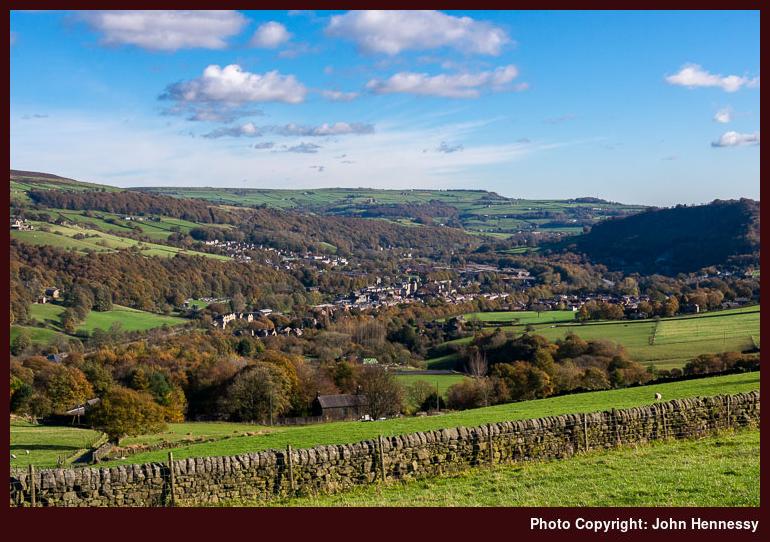
There may have been a problem with train services going east from Hebden Bridge but it did little to delay my arrival and was soon forgotten as I scaled the steep slopes to reach the moors in the autumn sunshine. Because of all the path options, that also meant correcting a wrong turning and I got to wondering if having a GPS receiver with me might have been better. These days, the OS app on my phone would have been enough to put me right but that lay in the future back then.
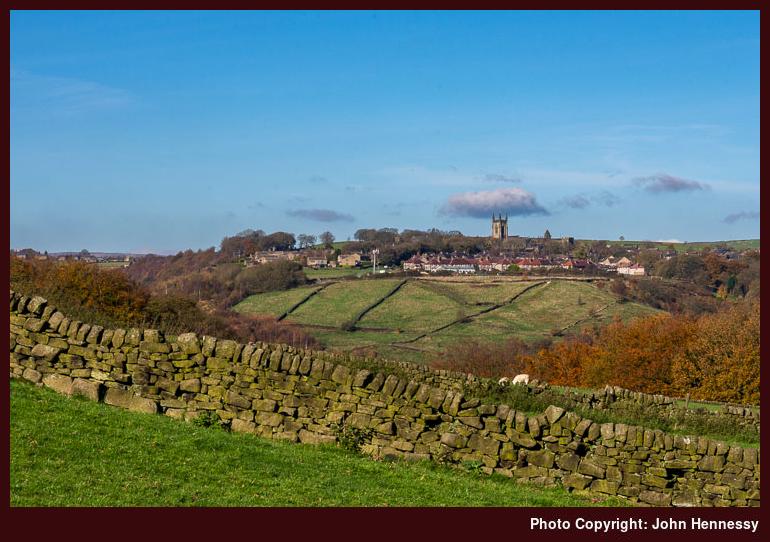
The constant sunshine and the multitude of quieter places meant that I could navigate from right of way to right of way in peace and with ample time for ensuring that I was going in the right direction. Some of these followed clear tracks while others took me straight across boggy ground. Along the way, I took in views towards Heptonstall and Mytholmroyd though any sights of Hebden Bridge were lost in the steep-sided cleft of Calderdale. On any hike, some views are left behind you as you proceed towards others.
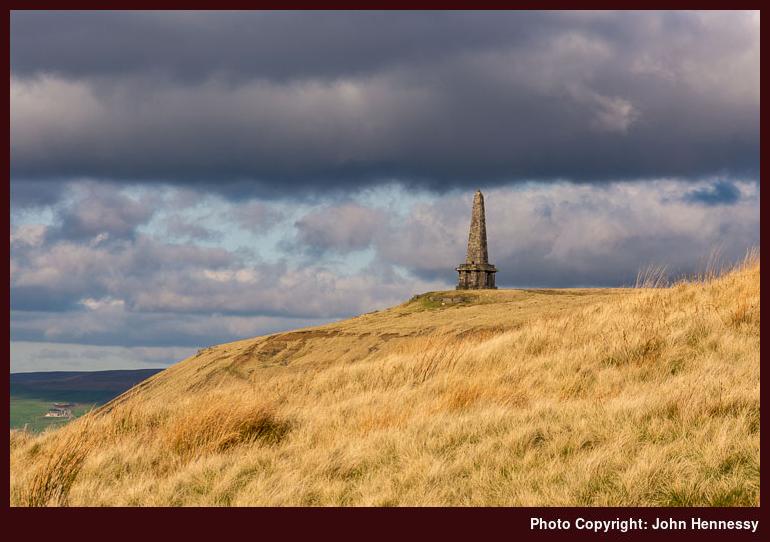
My eventual destination was Stoodley Pike and getting there meant passage along part of the Pennine Way, so the direction of travel was easy to follow at this point even if the air was chilly enough for me not to tarry for too long. Cloud may have started to fill the sky, but any disruption of sunshine was momentary so I started on my way towards Todmorden. That took me down a steep incline using part of the Calderdale Way to Mankinholes and Lumbutts from where a mixture of road walking and footpath rambling got me to my final destination in ample time for the train journey home again after what had been a satisfying stroll with an added element of problem-solving.
Travel Arrangements
Train journey from Macclesfield to Hebden Bridge followed by a train journey from Todmorden to Macclesfield.
Autumnal and springtime encounters with both Parkhouse Hill and Chrome Hill
16th July 2019 Sometimes, places get two visits before I get around to writing up any of them. A few of the trip reports that have made their way on here already have that characteristic, so you get two for the price of one, as risky as that might be when it comes to quickly writing the accounts. As you will find here, it is a chance that I am taking yet again.
This one involves a comparison of different seasons after my finishing the winter, autumn and spring instalments of a seasonal tetralogy written by renowned Scottish nature writer Jim Crumley. The fourth has yet to be published, but the others contain a sense of how seasons can betray their caricatures to produce green winters and white springs, something that he notes in the snapshots he features in these writings. Our climate may be changing, but I still get the sense that what we get is more like daily weather rather than a seasonal pattern.
It also needs to be said that seasons can be cultural as much meteorological or astronomical. That quite possibly is how I got taught about Celtic seasons at primary schools. These apparently have regular starts on the first day of each of February (St. Brigid's Day, spring), May (Beltaine, summer), August (Lunasa, autumn) and November (Samhain, winter). Given meteorological vagaries, I am going to stick with this convention for this piece, so a February stroll is a representative of spring, and it helps that the weather on that day was more like a day in April.
October 2017
First, though, I return to October and that is given a name in the Irish language (Deireadh Fómhair) that means "end of autumn" so you should again hear the effect of what I described above. In the natural world, autumn is a season of change as much as spring can be, and it brings stormy weather too after the supposed quietude of summer. However, the world of the human mind can be quite a different place.
The summer of 2017 became one of my most tumultuous, and it brought me to commencing a much-needed career break. It was in the midst of ongoing renewal and recovery that I went to Sterndale Moor. It was a sunny day after the preceding passage of Storm Ophelia, and there was a camera to try out on the day.
Earlier in the year, I acquired a second-hand Canon EOS 5D Mark II DSLR that I partnered with a lens I bought when I used photographic film. The lens began to show its age on that October day, before it totally failed a few months later. It was replaced earlier this year after it was deemed irreparable due to unavailability of spare parts. Together with life's other events, the expense of the purchase had caused me to delay the new acquisition.
A successful local outing near Macclesfield encouraged me to leave my usual camera after me to make more use of the Canon, so it was with that I left the A515 to go to Earl Sterndale. In some ways, there was not so much that was photogenic as I crossed fields on the way towards a landscape that has been altered by quarrying of limestone. The presence of quarries explains why Buxton is excluded from the Peak District National Park.
A walk from Buxton to Castleton quite a few years ago took me through a quarry on the northern side of the former and brought home to me the violence of the assault on an otherwise bucolic landscape that such industry can undertake. Thankfully, my stroll in 2017 shielded me from much of the horrors of such labours, and Earl Sterndale felt far removed from such things. As if the layout of the countryside can conspire to deceive, that pastoral setting was to accompany me for much of the way from there to Buxton.
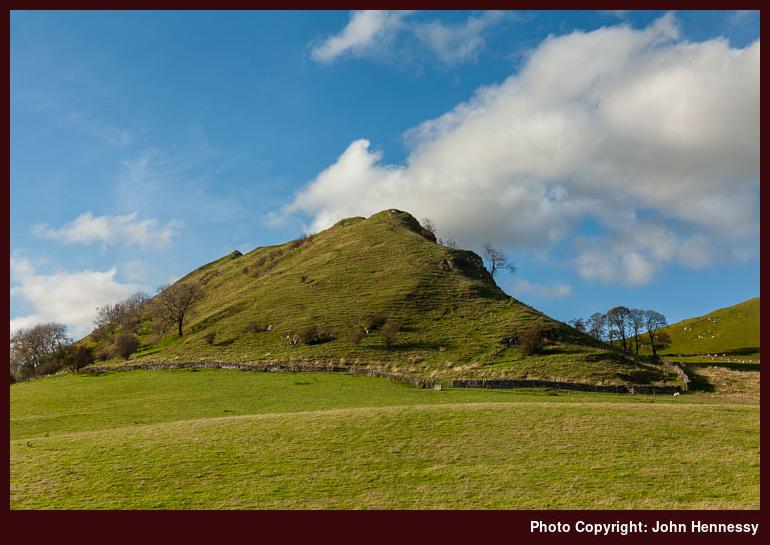
From Earl Sterndale, a public footpath led me through fields around Hitter Hill before dropping me onto the B5053 near Glutton Bridge after I had deliberated on the supposed line of the public footpath give that a farmhouse lying just beneath me. This was to be repeated later, but the next part of my route was easily clear. Deciding against any ascents, I passed Parkhouse Hill instead of ascending it. This was to be a time for getting to know the area better after passing by on several bus journeys and seeing photos in magazines. Any hill climbing could wait, and there were photos to be made.
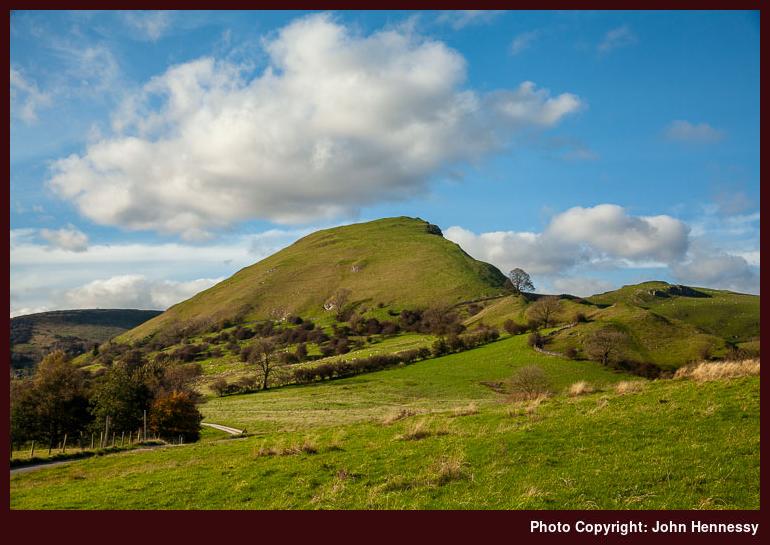
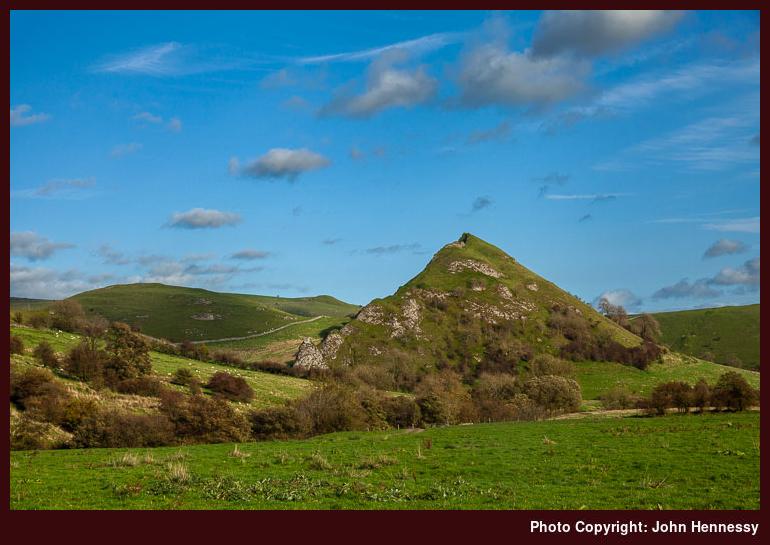
The path rounding Parkhouse Hill deposited me on a lane that I soon left to follow a byway that took me past Chrome Hill. The theme of passing hills rather than reaching their summits was continuing, with encouragement being provided by a lunchtime start and the loss of evening light. Accompanying quietude allowing for stilling of the spirit, admiration of surroundings and ambience together with a chance for my brain to drift while I made for Hollinsclough.
That again was a quiet hamlet and I left it to head for Booth Farm along clear paths and tracks. Deciding how to continue after that took some thinking and not a little courage to work out the correct way to Thirkelow. Once I had done that deed, there still was a chance of veering off trail, and it took my GPS receiver to stop me going towards Brand End. Earlier fears about such imperfections arousing the ire of landowners were unrealised, and another encounter with the effects of industrialisation lay ahead of me.
The last stretch of my amble took me around land owned by the Health & Safety Laboratory, with attendant signage to stop any wandering into danger zones where experiments get conducted. The floor of the defunct Stanley Moor Reservoir was another perilous place to avoid, and that was passed without much in the way of inspection as I continued towards Buxton Country Park, whose environs ensure a far more amenable feel to the end of my stroll. All was again familiar as I went from there to the nearest bus stop to await the last bus of the day from Buxton to Macclesfield, a feat that was achieved with minutes to spare, so a satisfying day could be reviewed on the way home.
February 2019
As described in another post, the spring of 2019 saw such a frenzy of wandering about England and Scotland that it was very different to autumn 2017 when I was replenishing my energy reserves. Near the start of this outbreak of outings, I returned to Earl Sterndale for a walk close to home in advance of a trip to Ireland.
Looking back through this trip's photos now, it surprised me how long I spent in Buxton before travelling to the starting point for the day's ramble. The morning was sunny and mild, so it might have been inevitable that I made the most of the layover time. In fact, the weather was to remain like that for the whole day.
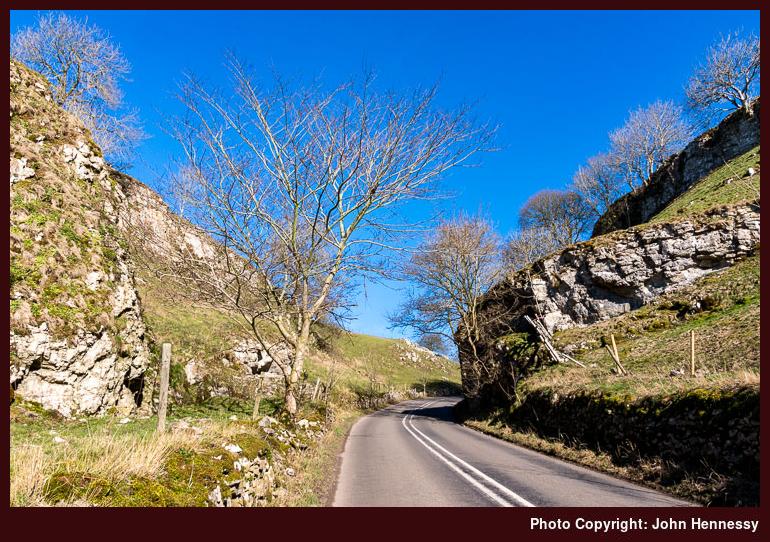
It also was to be one with many variations on the route that was followed in October 2017. The first of these decided the first stretch of my ramble once I arrived in Earl Sterndale. The re-use of the public footpath from the previous walk would have been expected, but I instead chose a way that added road walking involving the B5053 and that gained the sight of Glutton Dale, which looked similar to many a Derbyshire dale that I have encountered apart from its having a tarmacadam road going through it.
While the reason for this is lost to me now if there ever was one, I do recall the dismissal of the idea of using a right of way from Glutton Grange because the person who was using it was not a walker like myself but looked more like someone of farming stock. Maybe it was my shyness that intervened, but it was to be a day when such decisions recurred, even if more outdoors enthusiasts like myself were around.
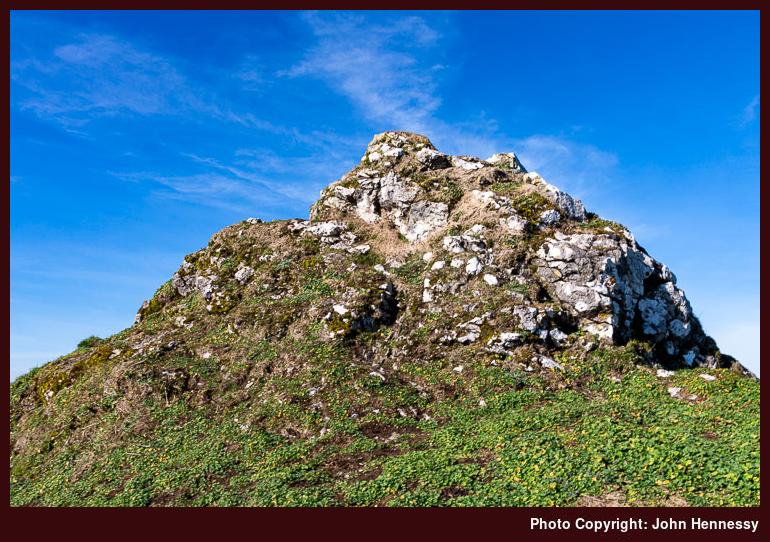
On the approach to Parkhouse Hill, there were figures seen to be ascending its southern slopes. When I left the B50553 for a path leading towards it, they were gone, and it could be presumed that they had completed a traverse of the steep-sided rocky little hillock. As it happened, I too was to follow in their wake and reached the top of the hill before deciding to change my route again.
The height gain may have not been that much, but the combination of steep ground and a sense of pronounced exposure was enough to cause me to retrace my steps from the summit instead of descending through the rocky pinnacles. Doing so needed an element of fortitude, but I soon enough found another way: along the hill's eastern slopes a gentler descent was on offer, and it led me north as I wished. As other walkers continued up the hill with their dog, I used this quieter, easier terrain to both continue on my way and regain my composure.
Once down on the lane again, I was to see where the northbound descent led and decided that I had chosen a more sensible route. Because Parkhouse Hill is on Access Land, doubts about footpath maintenance also surfaced. The last thing that anyone needs on steep, exposed ground is an eroded path that offers reduced traction, and I have met a few of those on my ambles. Another summit lay ahead of me, so it was better to have saved myself for that.
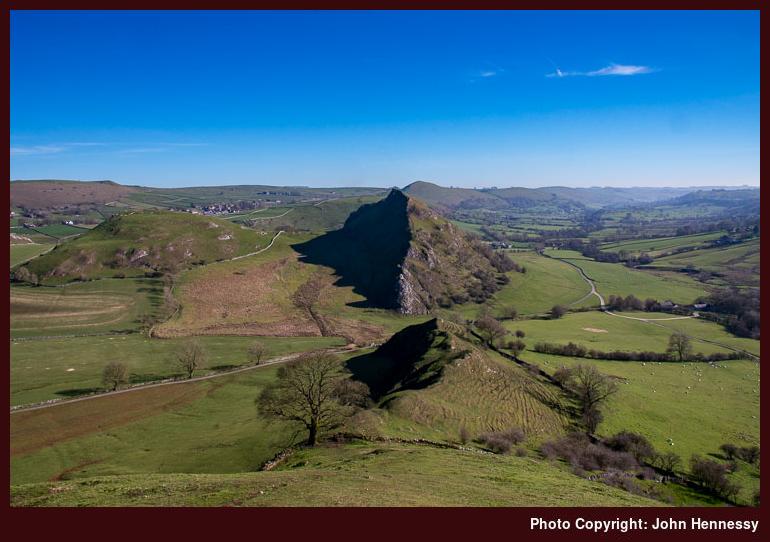
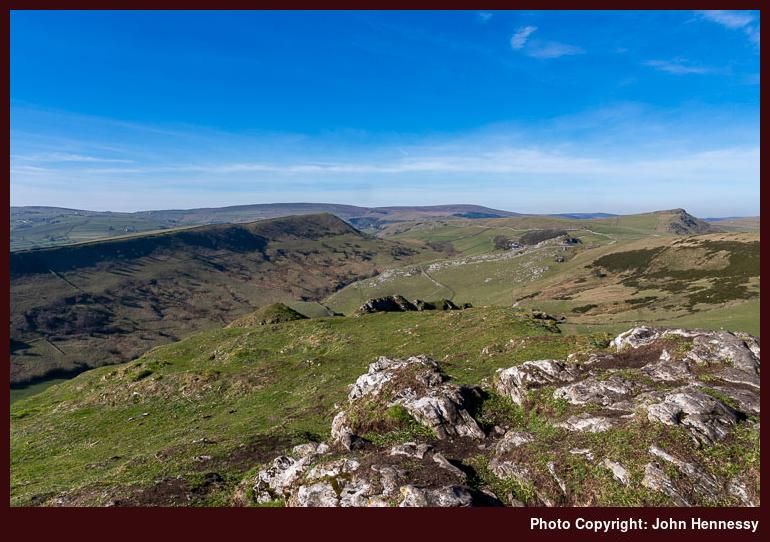
Once down on the lane separating Parkhouse Hill from Chrome Hill, there was time for a little refreshment before I sought out the concessionary path leading onto the Access Land encompassing the latter. Before that, a Land Rover driver stopped to ask me if I had a parked car. Having none, the conversation came to an end there and I recommenced my walk.
The way up the southern flank of Chrome Hill was a more friendly affair compared to that of its neighbour. The greater girth had something to do with that, and that was just as well given the higher summit. Though I might have been tempted to continue north from there, the lack of a right of access, let alone a right of way, put a stop to that. The later sighting of a fire demonstrated the wisdom of ascending and descending the hill by the same route.
On returning to the lane, I now reprised the one part of the pair of walks that was identical in each: the section from the feet of Parkhouse Hill and Chrome Hill to Booth Farm via Hollinsclough. Along the way, smoke from that fire on the northern slopes of Chrome was there for all to see. It even caused some fellow ramblers to ask me if I had been on Chrome Hill and if it was alright. In fact, I had seen no sign of a fire while up there while savouring unobstructed views of what lay all around me.
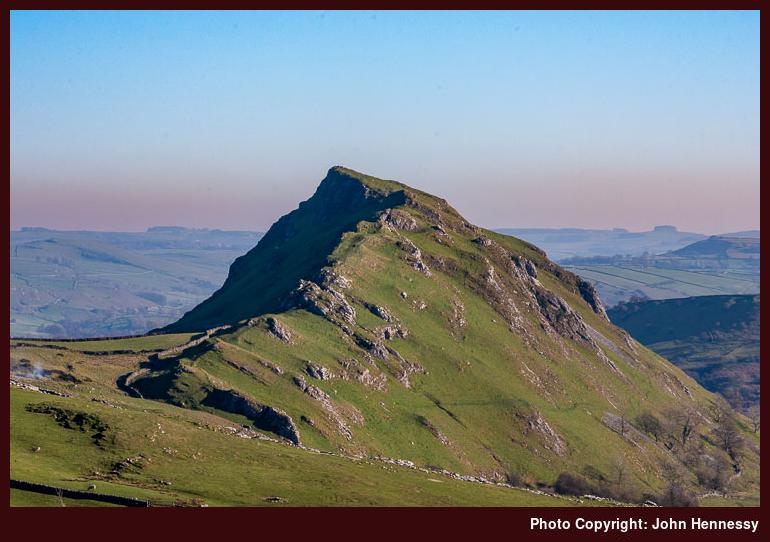
At Booth Farm, the passage of time between encounters ensure the lack of confidence away where a right of way led and the extra activity on the day led me to dismiss the previous route to Buxton in favour of following a lane before leaving it for a more distinct public footpath. Along the way, I could look back towards Chrome Hill, with any fire near there by now a smouldering remnant. My sense is that this might have been controlled burning, as dramatic as it looked, but I know no more.
While still following public rights of way, I continued from field to field and across Access Land encompassing High Edge. From there, I descended by Staker Hill and found my way onto the road leading to Harpur Hill on the outskirts of Buxton. That was preceded by my traipsing through what might have been someone's yard, but there was no associated rancour, and I ambled along the road for a while before choosing to await a bus at a nearby bus stop. The walk had ended in time to allow preparation for travelling the next morning, and the day had brought much satisfaction. It had been a worthwhile second visit to an alluring area.
Travel Arrangements
Both walks saw me making use of service 58 between Macclesfield and Buxton. The 2017 outing saw me use service 441 between Buxton and Sterndale Moor, while the 2019 one saw me travel from Buxton to Earl Sterndale on service 442. The latter also involved my using the TransPeak service to get from near Brierlow Bar into Buxton when a variation of the original route presented the possibility of more road walking than was desirable.
Logjam
3rd July 2019 One I feature a trip report for an overseas trip on here, chances are that urban strolling gets mixed in with rural hiking. Separating the two has a habit of feeling very wrong even when the the countryside explorations are subsets of what else occupied me. The comment applies as equally to Swedish explorations as much as they do to Aberdonian ones. It might be tempting to move the urban activities into my Travel Jottings and leave the shorter incursions into more more natural surroundings for here but it just feels like I am doing the whole task a disservice so they all end up here instead.
That has its consequences and the Swedish trip report was the cause of getting in the way of adding other content on here. After all, the trip was a six day affair and writing up each day would have proved challenging on its own but I left the whole lot go together. With overseas outings always likely to combine urban and rural, that conundrum is likely to remain but there may be chances for a split just as well. An Easter sojourn in Edinburgh could lend itself to such division and they are some ideas in my mind for purely urban explorations just as well. It all depends on how I feel about things at the time.
Another outcome of the uncomfortable juxtaposition of walking around built-up and wilder areas is that I decided on a name change to cover what is here that little bit better. After all, all my walking and cycling takes me out-of-doors so Outdoor Excursions is now the name you find at the top until I find something else or get in the mood for a change.
As it happens, there have been a few names for this place over the years and Collected Musings of a Hill Wanderer still feels the best even it now longer fits the style of the rest of the website. Maybe, it can return as a strapline even if I mix up the destinations for my wanderings these days. What will not alter is the intended focus on celebrating quality time in more natural surroundings while a better name might come to mind.


