Category: Europe
A mid-winter Mediterranean escape: Part 3
 11th December 2018
 One subject that I purposely left out of the previous part of this trilogy of posts regarding my 2016 trip to Mallorca was what started to take hold of me on the bus journey back from Sollér to Palma. The day had me wondering if had been underdressed on my walk up and down Barranc de Biniaraix. The summer-like weather was out of keeping with my usual wintertime experiences, so my being clad in little more than a shirt and trousers for much of the time felt odd.
Feeling Less Strong than Usual
What I probably had neglected to do was acclimatise to the new conditions. Instead, I went from place to place as I set about getting to know the island and, on that bus journey from Sollér to Palma, I began to feel signs of a sore throat with my brain starting to race into fears of falling ill. Quite whether this was something that I had picked up on the journey to Mallorca or whether I had thought myself into it is an open question. There might have been a mix of the two, but the symptoms became real enough.
The result was that Thursday night was not as restful as I would have wanted, and the ideal thing to do might have been to have a rest day around Palma on Friday. However, such was my state of mind that such a design was not to satisfy me. The chance to go pottering around Port d'Andratx won out, despite my less than optimal physical state. Slower strolling up and down gentler gradients was my decided compromise for a day with much sunshine and more cloud cover.
Pottering around Port d'Andratx
My day around Port d'Andratx was to involve another encounter with the GR 221, this time at its south-western extremity. The buses, that went there and back, stopped in many places, with some being tourist hotspots for more leisurely activities than what I was pursuing. That may for a busier trip on the outbound journey, but that was no intrusion because my destination turned out to be a quiet spot and exactly what I needed for my own form of gentler activity.
Even so, I had it in mind to walk from Port d'Andratx to Sant Elm, with views of the island of Sa Dragonera along the way. There may have been concerns about infrequent buses from the latter to Palma, but I decided to give it a go anyway. Thus, I set off around the quays on what felt like a summer day. Numerous pleasure craft lay docked while all around was mostly quiet, and I kept walking.
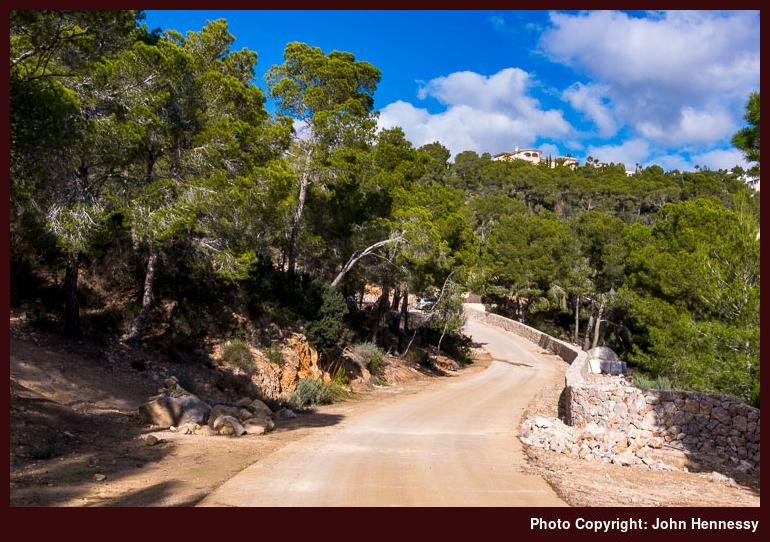
In time, the gradients were to steepen, but I was following a road with many switchback bends, so progress was steady. At times, I found paths through tree cover that got me out of the strong sunshine for brief episodes; any relief that they gave was relished. Building works were to be heard yet my quest was to take me away from built-up surroundings, at least for a while.
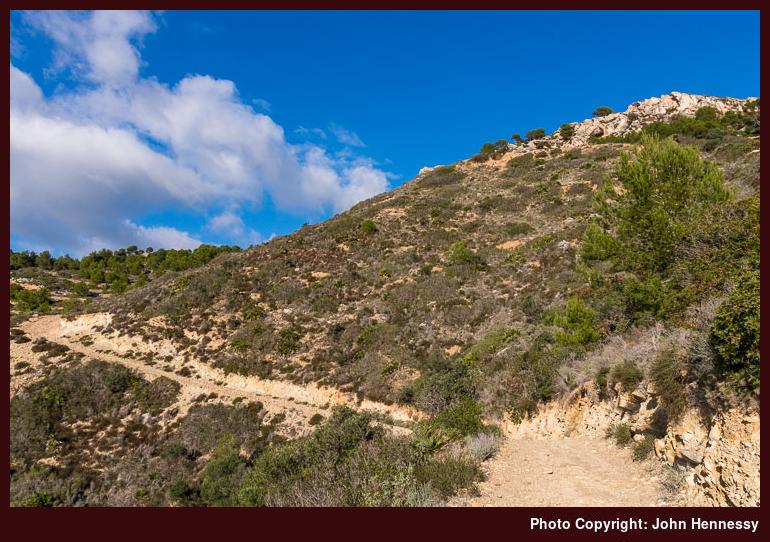
Finding the GR 221 trail and staying on its route needed some care. Apart from the constraints of available maps, there were tracks and trails leading in various directions, so the inattentive and undisciplined easily could have gone astray, for signage was absent. That was not my destiny though, so I got to reach those sought after wilder surroundings, as dessicated though they appeared to me. It felt as if any supposed proximity to houses was an illusion.
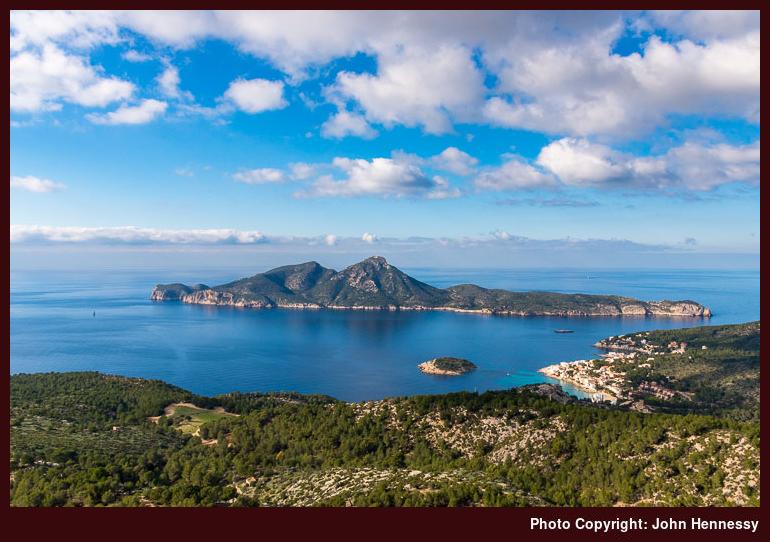
After a while, I took to locating myself according to nearby hill tops, even if more striking ones in the more distant east proved less easy to identify. Closer ones like Puig d'en Ric and Pintal Vermell were much easier to recognise. As it happened, my journey took me to the top of the latter, with its views of the sea and the island of Sa Dragonera. Sant Elm was on show too and seemed tantalisingly close.
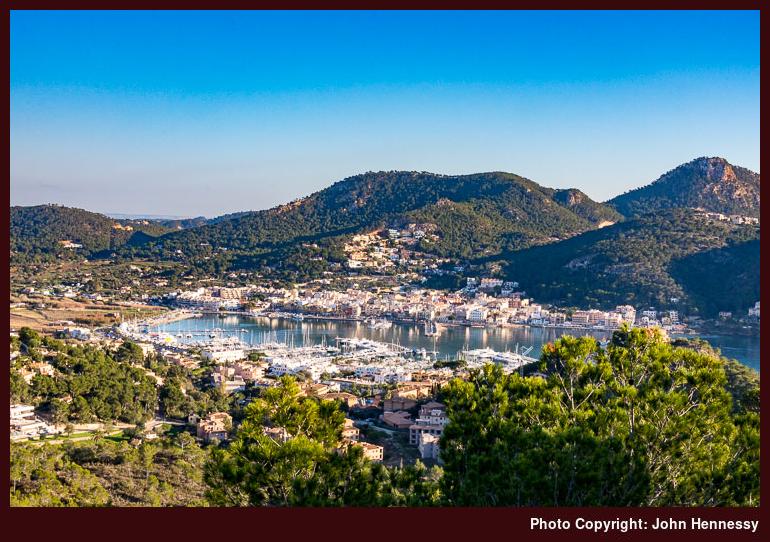
However, the path that I needed to drop onto a track leading there was not obvious on the ground, and I had exhausted my quota of risk taking for the day. Consequently, I decided to return to Port d'Andratx after contenting myself with the sights that I had savoured. On the way back, I purposely veered onto a lower track to get a different perspective, but I seem to remember a height gain cost for that before that final descent of the day commenced.
All in all, a good walk had been gained despite various challenges, and an afternoon departure ensured a timely return to Palma. The outing had continued the theme of exploration of Mallorcan coastal and mountain scenery that had brought so many rewards. While thoughts of my imminent departure from the island were not to be scotched, there was some time for rest and a further slowing of pace before I did so.
Departure
Friday night was taken slowly, as was Saturday morning. Given that I had an evening flight back to Manchester, I stayed in the hotel as long as I could on Saturday. When I left there, the mild, sunny day meant I could lounge near the cathedral and its precincts until I needed to go to the airport.
As I did so, my possession of a larger camera ensured that I was asked to make photos of others with their devices. People photography may not be my thing, but the list still included a German group and an English lady seeking a photo of her wearing a certain t-shirt for someone in her home country. Though these snappers may not have such demanding needs, I always wonder if my efforts suffice. In fact, they generally do just that.
There were opportunities for photos of my own too, and the time came to catch a bus to the airport to start my journey home. Given that this was New Year's Eve, I opted for a stay in a hotel near Manchester Airport in preference to a possibly expensive taxi ride home. Given how tired I was on my arrival, that probably was just as well, and it allowed me a leisurely journey home on the first day of 2017.
Afterwards
January 2017 was to see me battle that cold for a few days more until it left me just before I went to Ireland to sort out some business there. This was the end of the time-boxed inheritance works, though some overshot the January deadline, but they could be completed in their own time. Other matters came before them in priority and such things as a springtime sabbatical, eventual career break and subsequent career alteration lay in the future. It was now time to sort out my working life, so I could manage my Irish interests while keeping my emotional health in order.
Overseas journeying continued with trips to Norway and Sweden, though nothing like that has happened in 2018 aside from a longer recreational trip to Ireland last month. A more settled working life may help me to start those overseas trips again, and the prospect of a mid-winter sunshine break has come to mind once more. Possible choices include a hiking break on one of the Canary Islands or various city stays like Rome or even Singapore. The actual decision will be revealed at the right time, and that is not now.
Lessons have been learned from the Mallorcan trip, so any new mid-winter escapade will be less packed with objectives. Time for acclimatisation is a must, given any differences between winter climates, and that applies even more so for any antipodean outing where the seasons are opposite to our own in the Northern Hemisphere. Life's adventure continues, and the Mallorcan trip has taught me a lot, as will any future ones like it.
Travel Arrangements
Return flights between Manchester and Palma de Mallorca. Return bus journeys to and from Port Pollença, Sóller and Port d'Andratx.
A mid-winter Mediterranean escape: Part 2
10th December 2018 Sometimes, writing comes easy and there are other times when it is harder. Writing up my Mallorcan escapade from nearly two years ago has become one of the latter for a number of reasons. Some of these are emotional given the time on which I am reflecting, and I also have distracted myself with technical matters such as moving this and other websites to faster servers. The added speed may prove noticeable, but any rough edges should be ironed out by now.
With that out of the way, it is not before time that I commenced the telling of the second part of what became a trilogy when I realised the scale of the task. This was not planned quite like Tim Robinson's duology regarding the Aran Islands or his trilogy about Connemara. Even with his planning, the difficulty in writing the Aran Island books is evident, and it offers some reassurance regarding any challenge overcome in writing this piece.
Addressing an Omission
The first part of the trip report dealt with a certain amount of familiarisation that preceded the deeper explorations described here, but I had failed to use the slacker pace of that day to address a packing oversight that needed sorting. What I had managed to do is arrive somewhere with near continuously strong daytime sunshine without having a hat to use while walking. The fact that the lapse did not dawn on me until the end of my second day on the island might have something to say about my state of mind at the time and how life had been going in 2016.
The outcome was that I had one extra thing to do before setting off for Sóller. Thankfully, these internet-enabled days allowed me to find an outdoors shop where the requisite purchase was made. However, instead of a broad rimmed hat like what I usually wear in such circumstances, I ended up with a peaked cap with a dropdown sun veil at the back. Its appearance reminded me of the sort of garb worn in desert warfare films, but it was to do what I asked of it.
Not so Late a Start
The added retail activity had me thinking that it had delayed my departure for Sóller more than was ideal. However, there are reasons why I now discount such a possibility. The realisation that the clock on my main DSLR had advanced to more than ninety minutes ahead of Greenwich Mean Time is among these. Having it set to British Summer Time is one thing, but the added advance beyond this was another, so I now decided that timing. Inspection of bus timetables and the time recorded on my GPS receiver track support my new thinking.
Being closer to the equator than my usual British and Irish haunts made for longer hours of daylight and stronger sunshine. The latter of these made my new hat a necessity, while the former allowed me more time for hiking. Having the sun rise around 08:00 is not so different from my home turf, but the timing of sunset at around 17:30 is the bigger help with an added ninety minutes of daylight walking time.
Now, I reckon that I left Palma for Sóller around 11:00, and I chose the more scenic bus route on the outbound leg of my return journey. This went around by the coast and is more scenic than the alternative that goes through a tunnel. The roads are narrow though and the heady drops down to the sea are in view, so this also is best considered as a way for more adventurous drivers or locals to go. For a first visit, the bus trip was a good introduction to this part of the island, and I must have arrived in Sóller around 12:15.
Finding a More Direct Way to Go
Once in Sóller, my mind was set on exiting the place, searching for more natural surroundings. Along the way, I passed a church near a central square before ambling through narrow lanes boxed in by multi-storey buildings bedecked with shuttered windows. Even on a winter's day, I could see the purpose behind such a design with its added shade from the bright sunshine of a hot summer's day. That thought was to recur later on in the walk.
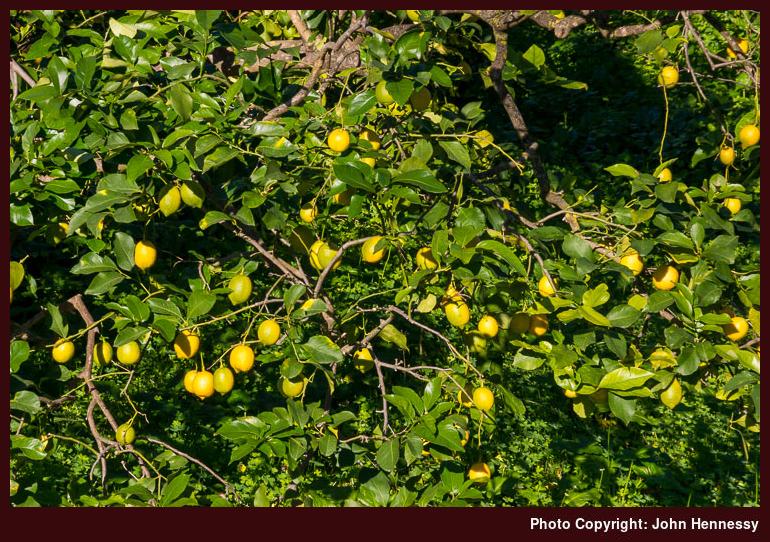
For whatever reason, I considered that my route to Biniaraix was a haphazard one. While there was one inadvertent dogleg added, it now looks the more direct way to have taken, and I found just how circuitous the GR221 could be later in the day. My supposed deviation also introduced me to the sight of ripening orange and lemon groves, as well as the effect of heat-haze on views of more distant craggy limestone eminences.
A Climb Begins in Earnest
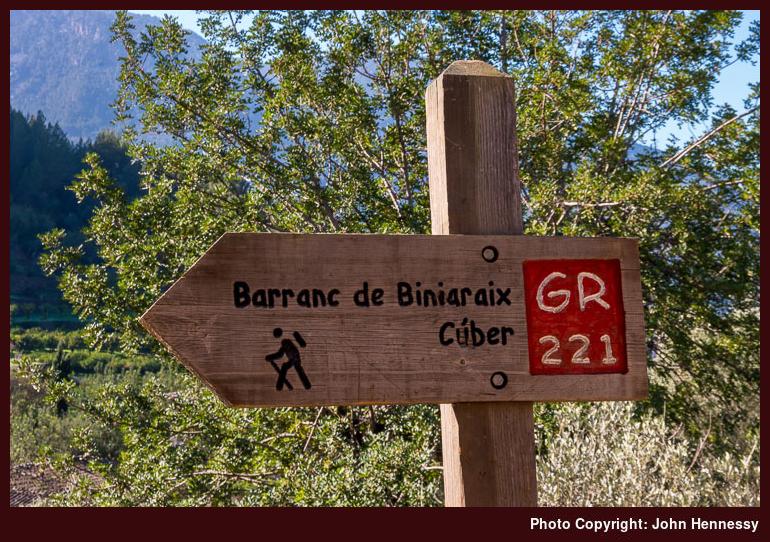
At Biniaraix, I finally joined the route of the GR221 and headed into those wilder surroundings that I so desired. The track was quiet, too, so I had plenty of those much craved episodes of solitude. What I did not realise back then was that the word "barranc" means gorge, yet I certainly realised that a steep ascent awaited me. The track was well engineered all the way as it wound up the slopes, so footing never proved problematic.
For whatever reason, my mind began to turn to thinking about traders of old who might have used tracks like these regardless of the gradients. A good surface would have helped with that, and that was another consideration given such toil. Would the added shade have been a factor in building such a route, given how hot summer days can be in this part of the world? Such mental meanderings took away from any shortfall in photographic activity until sufficient height had been gained.
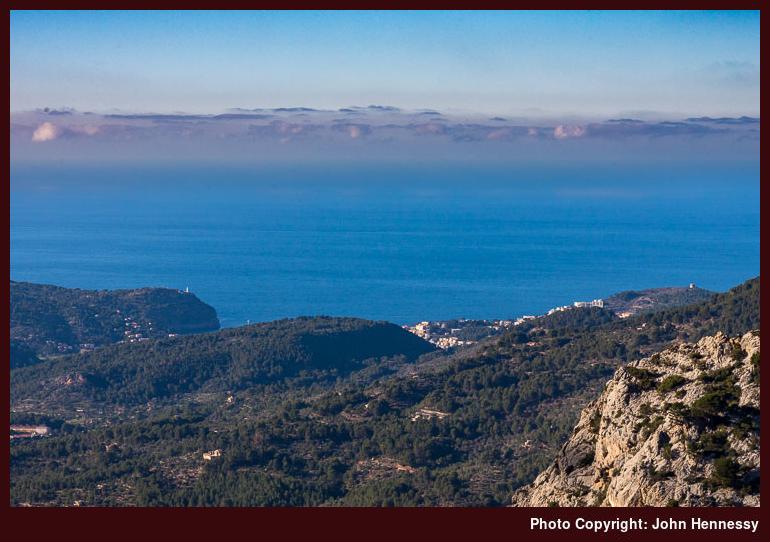
After those shaded zigzags, I again emerged into sunshine and benefited from the wider views that opened up at the same time. Though afflicted by heat haze, they extended as far as the coastline and some signs of the otherwise obscured Port de Sóller were there to be spotted, while Sóller showed itself far more confidingly at one point. Sunlit limestone crags lay above and around me, so they also became targets for my camera, as challenging as the mix of bright white rock and often dessicated vegetation proved. This was a refrain that would recur at other times during my stay in Mallorca.
Any such thinking was set aside as I took in the surrounding sites when the ground levelled off, and I closed in on my turning point of L'Ofre. A gate lay across the track advising walkers to stay on the trail in Spanish, an ever familiar trail in any language. In fact, a farm lay in front of me but keeping left brought me to a quieter spot where I could linger awhile.
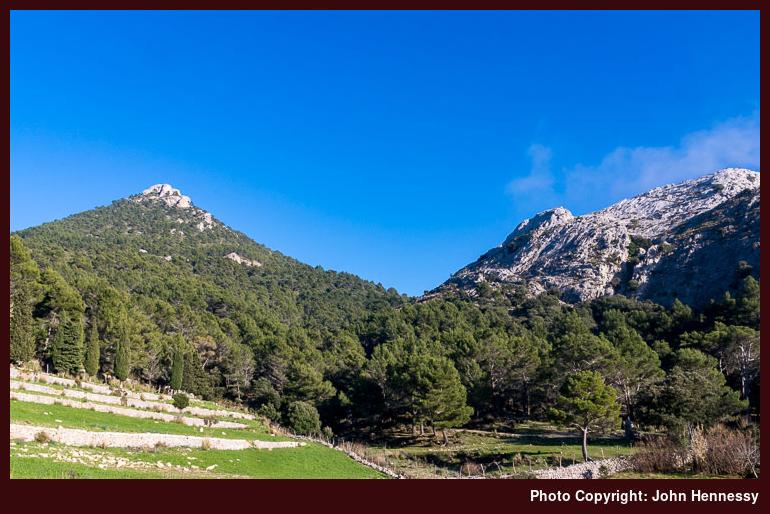
Some lunch was taken near such eminences as Puig de l'Ofre and Puig de na Maria. The first of these reached above 1000 metres above sea level while the second failed to reach 900 metres of altitude. This was a high and rugged place with a cross placed by the local Confraternity of the Holy Shroud in 2008, if Google Translate made an accurate translation of the inscription on the plaque on its rugged concrete base.
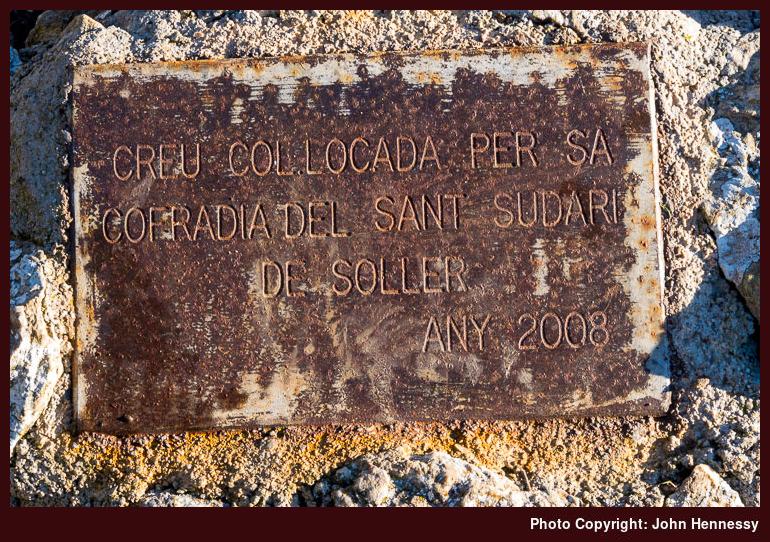
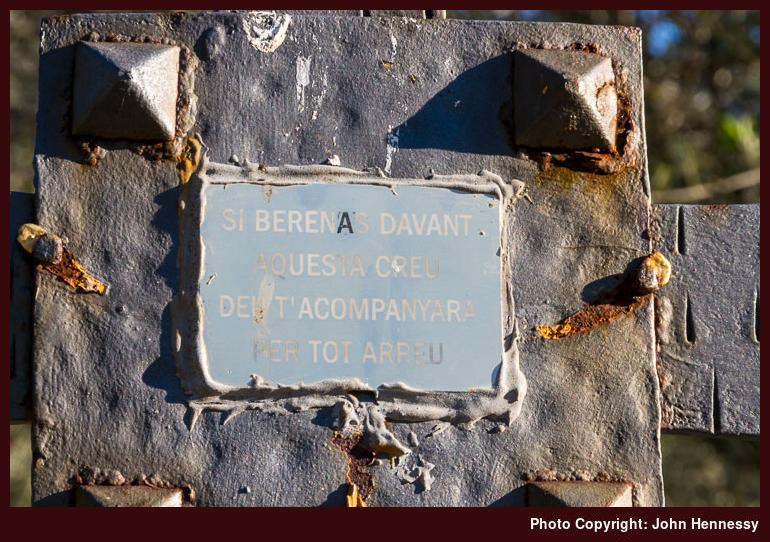
That Catalan was suggested by the online translation tool was no surprise, but the attempt on translating an inscription on the cross itself did not meet with as much success. The best way to express it was that any food taken in front of the cross would last a walker the rest of their journey, and that more or less is what my lunch did for me that day.
Because of the time of year, my own itinerary was not to take in Embassament de Cubér, a reservoir in otherwise natural-looking surroundings, as many a guidebook advises. There was no seasonal bus service running that would allow me to avoid adding a descent and subsequent re-ascent to the height that I had gained already. My time also was limited by the available hours of daylight, so I was happy to begin my return to Sóller and there was no question of feeling short-changed.
An Alternative Return Route
In the event, the return route was a variation of the outbound, so that helped for a change of scenery on the way. The first of two deviations was chosen near Can Catí and an initially appealing path turned rougher as I continued along its length. That did not matter as it kept me higher for longer and only featured adventurous descents near its rejoined of the track following by the GR 221. All the while, light was fading and my memory features a recollection of overcast skies, though I cannot confirm if that was the case.
Even so, I stuck with GR 221 after passing through Biniaraix to sample what I had missed earlier in the day. This was a roundabout way to go in ever more declining light, but it was still possible to see why it went this way. Expansive views abounded in contrast to what was offered by the gorge section. Sollér's central church could be as clearly seen as the craggy mountains that lie all around the place. If it had been brighter, I might have made photos, but those faded memories are enough for me.
Signs for Fornalutx may have been tempting at another time, but that added too much of a diversion, so I was content to shorten the distance to Sollér. That was just as well, since it was practically dark when I met with its outskirts, and it was reassuring to make my way to the bus stop through well lit streets. After a wait, the bus for Palma arrived to ensure that I was back at my hotel at a reasonable hour. The day had been a good one.
Travel Arrangements
Return bus journey between Palma and Sóller.
A mid-winter Mediterranean escape: Part 1
16th November 2018 This time two years ago, I was in the business of surveying numerous locations for a momentary mid-winter escape to a warmer climate before settling on Mallorca after a chat with my brother, that allowed me to build up the necessary courage. Another motivation was that I wanted to do something different between Christmas and New Year. A planned trip to Ireland in the same period in 2015 was aborted when grief hit me with a vengeance. After that experience, I was all the more determined to ensure that Christmas 2016 felt very different.
After a Christmas period laden with plenty of local walking that got as far as Tegg’s Nose on St. Stephen’s Day (or Boxing Day as some know it), I headed off to Mallorca in an effort to make a hard break in the run of things. Having sunny weather all the time was a novelty for me as I took the sights around Palma as well as heading out for walks around Port de Pollença, Sóller and Port d'Andratx. That ensured that I enjoyed a mixture of coastal and hill walking together with a feeling of leaving normal life after me. It might have worked too well, for a cold slowed my beginning to 2017 while it felt for a long time like it was refusing to leave me. Other than that, the getaway was undoubtedly what I needed to snap me out of a mental rut into which I had fallen.
Arrival
Unlike previous overseas excursions and even Irish ones these days, I arrived in Palma de Mallorca at night. The pre-booked shuttle to my hotel was not to be found, so a taxi was hailed for the purpose. Noting the fare incrementing on the metre, I wondered how much this was going to cost, and it was with some relief that the floodlit Cathedral of Santa Maria came into view and my hotel was not far from there. Even with the darkness, I was lured outside in an act of exploration, and that included pottering about the said cathedral with its opulent flying buttresses and other medieval architectural flourishes. As I returned to the hotel for the night, the stage was set for a daytime sighting next morning. Temperatures had been very mild, too, so this was about to be the start of an unusual experience for me.
Around Palma and Port Pollença
Part of that oddness was the fact that there was one sunny day after another. Having lived on maritime islands where sunny spells are as finite as they are occasional, this was striking. Being precious about episodes of sunshine means that there is a tendency to rush around to make the best of them. What I probably more needed at the time was to slow down and let things flow at a gentler pace.
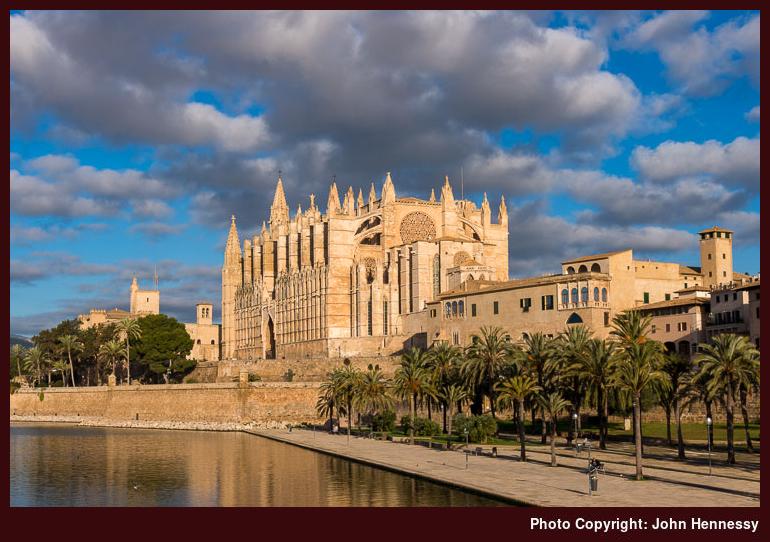
Instead, I set about exploring Palma, as I have done with so many other places. It might have taken a while for the route between the hotel, and the bus station to gel in my memory after embarking on several circuitous itineraries, but the way to Palma's cathedral saw no such errors. It seemed that a straight route to the dominating edifice was hard for anyone not to find. The bright sunshine felt at odds with the time of year and the pale stonework only amplified its effects.
Pottering about the edifice and its environs kept me going for the whole morning, and many a photo was made of near and far. Eventually, it could not hold me, for I wanted to see more of the island. To accomplish that, I needed to seek out the city bus station.
That was done in a customary meandering manner and I discovered that it was an underground operation, with the island's mainline trains leaving from the same place as its bright red and yellow interurban buses. The curious cycling of train departures through different languages; English was among them, though the idea of German being included along with something more local like Spanish or Catalan appeals to me, even if my memory cannot confirm it as being a fact.
Once I got my bearings around the interchange's subterranean construction, I got something to eat there and then headed back to my hotel, possibly to organise myself before travelling further afield. On returning to the transport hub, I caught a bus to Port de Pollença for an afternoon visit. Before I even arrived in Mallorca, train travel had been rejected due to its restricted reach; it hardly went near the mountain areas that I wished to explore.
The sunlit Serra de Tramuntana accompanied my northward journey, but this was not to be a day for their exploration. Instead, the northern coast was my intended destination, and I admired what I passed on the way there. Once in Port de Pollença, I made for the coast and pottered along the shoreline as workmen attended to one of the houses along there. It may have felt like summer to me, but the place was far from being thronged, and I had ample time to survey what lay around Badia de Pollença.
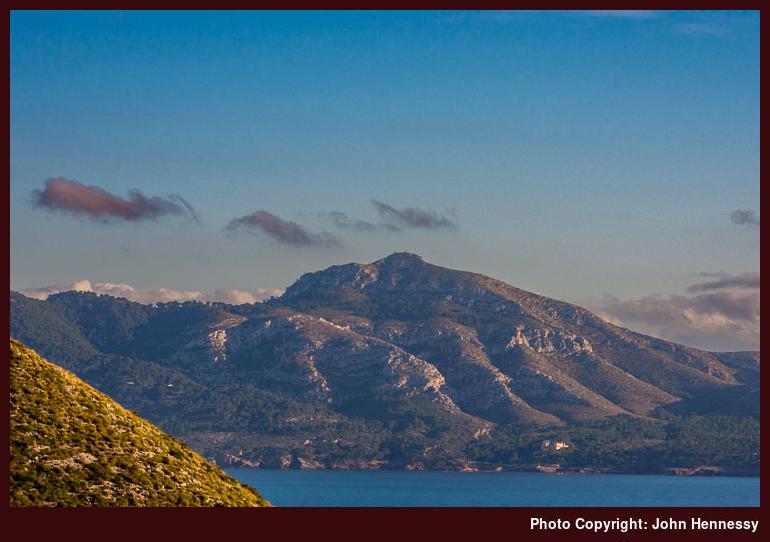
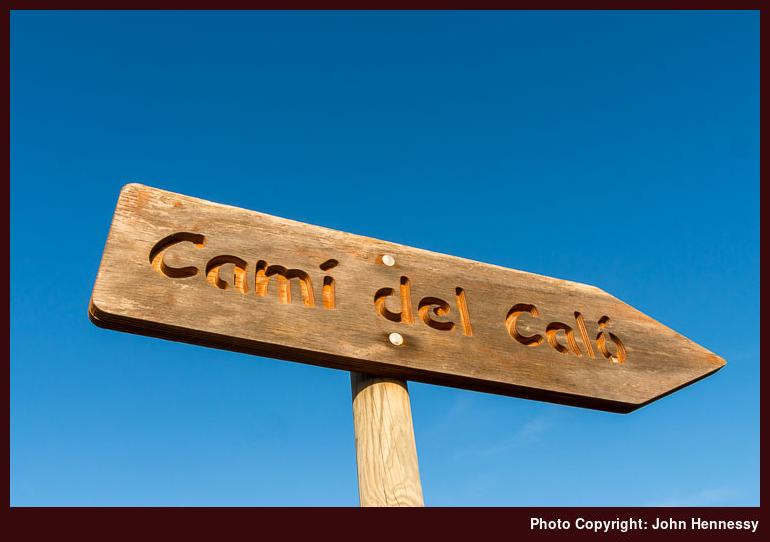
Most of that involved road and footway tramping, since this was not a day for more adventurous wandering. In hindsight, there might have been a tempting short off-road stroll to be had, but I fancied seeing if I could get a closer look at the Peninsula de Formentor. Along the way, there was time for photos and for realising the limitations of the map loaded on my GPS receiver. It did not help that I was near a military facility, so I followed the MA-2210 around its switchback bends to gain some height before leaving it on a path signed for El Caló for a wilder feel. The escape did not last long, for I did not fancy losing height to reach the shore only to have to gain it again. Instead, I stopped a while before starting to retrace my steps back to civilisation again.
Port de Pollença proved confusing to negotiate, and I very nearly missed a bus back to Palma but for an observant and facilitating driver. There could have been a two-hour wait for the next departure, so I was appreciative, and the bus took a slightly different route too since it called at Cala Sant Vicenç. Light was fading on the way back to Palma and I made a roundabout way back to the hotel too; it took time for the way there from the transport interchange to become engrained in my mind. The explorations of the ensuing days were to ensure that, and they are the subjects of subsequent parts of this trilogy.
Travel Arrangements
Outbound flight from Manchester to Palma de Mallorca. Return bus journey to Port Pollença.
Journeys of others
15th November 2018 Before my career break, I found it difficult time to read a book and often lapsed into watch television documentaries on the BBC iPlayer. The situation got reversed after a book called Flow by Mihaly Csikszentmihalyi encouraged the practice. Whenever I feel an emotion that I do not want to remain, a TV watching binge never helped but reading a book causes movement and the feeling can be left in the past. It is as if someone else's journey brings you along too.
Currently, that is taking on the shores of the Aran Islands in the company of Yorkshireman Tim Robinson. Reading his two part work on the islands has lain on my reading list for far too long and I started Stones of Aran: Pilgrimmage back in the noughties only never to get very far with it. My paper copy may be gone but I made a new start on its digital counterpart and it is reading well so far.
Handily, I visited Inishmore (Árainn, as Gaeilge) so the localities are not all that lost to me. If another visit were to happen, then Iaráirne could see an encounter as could the opposite end of the island if I feel sufficiently adventurous. Sightings of Inishmann (inis Meáin, as Gaeilge) or the Brannock Islands could be additional rewards for such endeavours. Before such things, more of Robinson's works like Stones of Aran: Labyrinth and his Connemara Trilogy await and who knows what they might inspire?
The world described by Tim Robinson is not dissimilar in ambience to that described in Chris Townsend's The Munros and Tops, another of this year's reads. After that came John McPhee's Coming into the Country and it proved to be a book in three very different sections. The first section features the Brooks Range with a narrative split in two with the second part preceding the first. It still hangs together well with the second and third sections featuring more of the folk that are attracted to the idea of a wild place away from the strictures of everyday living.
That unleashes tensions when trying to find a new state capital or dealing with the encroaching bureaucracy keen on keep a wild landscape as it is when you fancy exploiting its resources on a small scale. The act of taking a Caterpillar D9 bulldozer into wilderness oddly aroused my concern for the machine and not the landscape as might be expected. Maybe it reminded me of of abandonment in a big hostile world and there could be a wider theme there. In the end, McPhee finds himself siding with industrious Alaskans earning a living rather than others solely following their perhaps unrealisable dreams. They might fancy abandonment much like Christopher McCandless only to find that they still need humanity or that it continues to intrude on their world.
Stepping away from humanity awhile is a recurring theme in my own wanderings and it is why such places as the Scottish highlands and islands are as amenable to my ends as the wilder parts of other places. That also explains a certain interest in North America that was accompanied by perusal of writings about Lewis and Clark crossing the continent though that was a very dry read that I was happy to finish.
There is another recurring theme in all of this: you often find Robert Macfarlane appearing in these with either a recommendation or a foreword. That applies to the McPhee and Robinson works as much as that by Nan Shepherd on the Cairngorms. It might be that he is using his fame to restore older books to our notice but I reckon that I might be reading them anyway given how I have been collecting them onto a reading list in recent months.
Speaking of those older books, it is unlikely but if I ever were to wnat more but I might be tempted by the Gutenberg project if I wanted eReader files of works from a very different era by Heny David Thoreau or Raplh Waldo Emerson. They are out of copyright but a visit to either AbeBooks, The Literature Network or Scribd could serve a use if I fancied a wider selection of those still covered by such restrictions. With more new tomes that appeal to me, that is unlikely to happen just yet. Usefully, the time taken to complete any single volume should put a brake on any overspending. After all, it is better to acquire for reading than to decorate a bookshelf and horde more than you need.
Overcoming an obstruction
12th November 2018 Currently, an ongoing train conductor's strike at Arriva Rail North, otherwise known as Northern Rail, has meant that local train services in the north of England are much reduced on Saturdays and that is set to continue until the end of the year. In fact, I would be surprised if it did not continue through 2019 given the ongoing stand-off.
Saturday usually was when I went out on walking trips so the reduction in train services has given me pause for thought since I do not have a car. Some feel trapped by what is happening but I have begun to think about alternative options offer by bus travel. The bus network may be beleaguered after years of spending cuts but I reckon that it still offers some travel possibilities.
One of these is the Witch Way service between Manchester and Skipton. Perhaps surprisingly, journey times are not so much longer than going by train because of layover times between different services. The fact that you are rather doubling back on yourself when travelling from Manchester to Skipton is another factor.
Last Saturday saw me try out that bus route to gain a few hours around Skipton after an absence of too many years. The town was busy because it was market day and there was a display at the visitor centre pertaining to World War I, a relevant subject given Armistice Day was near. The crowds were left too as I wandered into Skipton Castle Wood, pottered along the Leeds to Liverpool Canal and passed through Aireville Park. Occasional sunshine was overtaken by spells of rain but it did not matter for this was a break from a Saturday spent at home. That was enough for me.
There is another bus route that I like to sample and it is part of the Mainline bus network. The service goes between Burnley and Keighley and passes through countryside that I perhaps have not visited since a bunch of Pennine Way wanderings in 2007 and I fancy pottering along a missed section of the trail between Ickornshaw and Cowling, an oversight that has lain unaddressed for longer than is desirable.
Maybe there might be a chance to fill in that gap as part of a repeat visit to countryside where I found waymarking was not what it should have been. Recent years of reduced public spending cannot have helped so a GPS receiver or the OS mobile phone map could have its uses in keeping me from going astray and annoying the locals in the process. There was some of that on a walk along the Pennine Way between Gargrave and Cowling when the tapping of a finger on a window deterred me from erroneously going further into someone's back yard. Embarrassment kept me from checking the mood of whoever was at that window and it might have been a better course to take.
There was a time a time when I was a regular visitor to Yorkshire with many a day trip featuring parts of Wharfedale with some overnight stays too. Basing myself in either Keighley or Skipton could allow some repeat visits after many years and both Malham Cove and Malham Tarn could be among them. Though very different in aspect, Brontë country is another possibility since there is many a right of way to found around there and bus services are decent too.
As I think of them, numerous possibilities come to mind to follow what I have done already. Thoughts take me around by Settle and Nidderdale in a continuing mix of millstone grit and limestone scars. Capturing some of the sights using digital photography is a bonus since I mainly used film on those earlier incursions. Also, it feels as if I need to take some notes and act upon them. After all, the reduced mobility by train could make North and West Yorkshire all the more useful and a bit of quiet strolling never did any harm.


