Category: Outdoor Activities
Sticking with what was near at hand
 21st December 2009
 In those rare times when snow pays a visit, thoughts can turn to going elsewhere. So, it was on Monday after with Sunday's snow covering. In the end, I wisely stuck with enjoying what lay on my doorstep and spent an afternoon among Macclesfield's nearby hills. Traffic may have been free-flowing and public transport running well enough for an excursion to the likes of North Wales to have worked but it would have been shameful to ignore the wonder that lay near me.
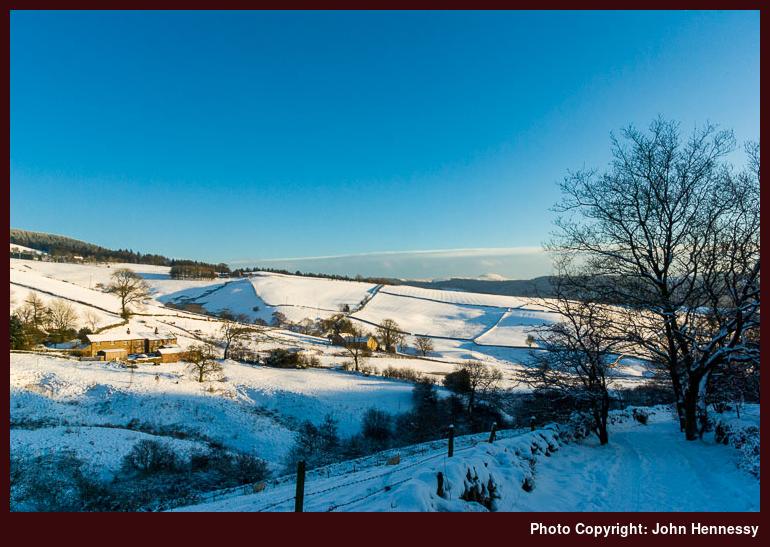
The route that I took was a familiar mix of roads and other rights of way. To start, I found my way onto the Macclesfield Canal via a very attractive Victoria Park and followed it until I reached the road near Sutton Hall, a pub near Gurnett, having taken in a section that was closed up to October. Having missed out on one or two public footpath options, I followed the road around by Lyme Green to Sutton where I made photographic use of the local parish church. After that, it was more roadside footway travel until Langley where I picked up a bridleway by Teggsnose Reservoir. As I shortened the distance to the visitor centre and car park at Tegg's Nose Country Park, the views opened up with Shutlingsloe being backed by a bank of cloud. From there, I joined the Gritstone Trail through snowy fields with the hillsides developing a certain alpenglow in the late afternoon sun. On reaching, the A537, the ridge that is Kerridge Hill lay tantalisingly before me but I tamed my ambitions to content myself with a road walk to Rainow, avoiding the steep up and down of the Gritstone Trail alternative. An untrodden public footpath beckoned, but a tight stile persuaded me to stay on tarmac. From Rainow, it was roadside footway travel all the way home in the declining light. There was a tempting bus option but I stuck with the plan of a circular walk from my own house with the street lights coming on as I went.
All of this was on familiar turf but that made it no less wonderful; never discount snow's transforming powers. There was a mixture of uninterrupted reverie interspersed with encounters with snowball throwing and sled riding that remained of the detached observation variety. Everyone was out enjoying the results of the previous day's hefty snowfall in their own way, no bad thing, though there's something to be said for leaving things where they have fallen for the enjoyment of others. After all, the chances of replenishment are not so high these days. In a way, that may make us all make more of what comes when it does and that applies to me as much as anyone. Then there's the chance to add to your experience of winter conditions too.
Approaching the end of a decade
20th December 2009 The first decade of the twenty-first century certainly has proved to contain plenty of talking points. It started with a euphoric opening and looks like ending with a more downbeat mood. Along the way, there has been contentious warfare and economic upheaval. Worries about the millennium computer bug and a debate about when the millennium actually began are but a distant concern now. The recession and global warming have replaced these. Big challenges lie ahead and the Copenhagen summit wasn't an end but one of a series, much to the disappointment of many. Computing has moved from the desktop into our pockets and digital photography has taken off in big way. We certainly are removed far from where we were ten years ago.
Back then, my association with hill country was of the occasional day trip variety. I even thought that hill walking was for more athletic types and contented myself with scratching the surface before a cycle from Macclesfield to Buxton on the A537 convinced me that it might be an idea to discover places on foot. Even so, it took a while for the hill wandering to really come together after that with knowledge and gear coming together in some sort of haphazard manner.
Though my explorations of Britain were equally unplanned, there were years when I saw a lot of a certain area. Not every year was like this but here are the ones that were:
2001: Peak District
2002: Yorkshire Dales
2003: Lake District
2005: North Wales
2008: Scottish Highlands
There are reasons for the gaps. After the superb year that was 2003, 2004 was a disappointment when it cam to exploring hill country. It's grey dampness made it a good one for moving house. 2006 was a year of expanding horizons with visits to Highland Perthshire, Pembrokeshire and Northumberland. Even so, it got me wondering if I was spreading myself too thin. After that, 2007 was a year for long distance trail walking and completion. I got to pondering the idea of multi-day backpacking but other things mean that hasn't gone too far forward.
What about 2009? The usual round up is to come but here are a few highlights. First, a proper Irish hill walking outing came to pass after having it on the to do list for so long. There needs to be more but the threshold has been crossed now. The Cairngorm mountains are no longer ones that I keep passing and there's even more to see. Another thing that the year has taught me is that, while there are convenient destinations, the ones that need more planning are worthwhile even if they are once in a while escapades. Then, there's the enduring lesson that there are destinations where I haven't been for a while that I could do with revisiting because you always can see a different side to a familiar location. It is that which has put the idea of photography-inspired returns that spruced up my Cheshire photo gallery on here. Who knows where this mix will take me next?
A good covering
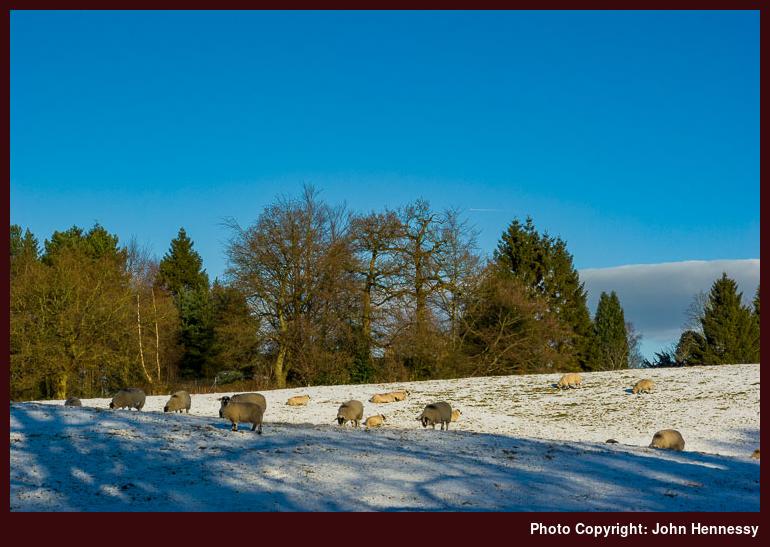
19th December 2009 I was out earlier this evening on an A to B trip on my bike when a shower of sleet came upon me, not a problem with my being appropriately attired. Even if I got snow, the lugs on my mountain bike's tyres would have coped; yes, they are staying inflated so far. Speaking of the fluffy while stuff, there is a plentiful supply of that emanating from the sky right now and it is coating everywhere in white. Getting about on foot now looks like a job for my North Face Hedgehogs and any wondering about a pre-Christmas outdoors outing could have snow-covered countryside on the agenda. Methinks that I need to decide where to go, a task that may or may not be made easier by my adding an at a glance collection of Met Office mountain weather forecast summaries on here. After all, there is a need for preparation for the prevailing conditions, as last Friday in Cheshire proved by its feeling like being in a chest freezer with fans turned on. Without any wind, daytime temperatures were around freezing in the lowlands anyway and below that (-2.5° C) in Buxton and Leek. With temperatures like those, it's best not to be rushing out to become a mountain rescue statistic.
A promise made good
18th December 2009 In recent days, Mapyx has brought out OSNI 1:50000 Discoverer mapping data for Quo, with 1:25000 due to follow. Having found some spare time, I got a quick chance to metaphorically kick some tyres. As with OSi maps, you cannot have OS maps and OSNI maps open at once, but there is no bar to shuttling over and back across the Irish border in the digital world. Tiles for either provider are £1.99 each, with the entire OSNI set going for a not unreasonable £39.99.
However, there are no grid lines on the NI maps that I have in my sample. That surprised me and makes rough and ready estimations of distance a non-starter; you need to use Quo's route planning tools to get a handle on distances and to determine grid references. However, you'll be glad to know that the OSNI's paper maps do not have the same feature as my copy of Sheet 29 (covering the Mourne Mountains and published in 2008) is well crossed with those ever useful lines and feeling very like an equivalent OSi specimen, albeit with townlands superimposed on the back of the sheet. The digital counterpart to the same looks bleached in comparison, but it may have been decided that all those greens and browns obscured the contour lines anyway. In contrast, the OSi have gone for faithful reproduction instead, yet there's merit in both approaches.
Because Quo's overview map for Britain and Ireland is only available with the OS coordinates system, you could find OSi and OSNI tiles lying on a white background. Adding the OSi's 1:600000 overview map of the island of Ireland to your collection for £4.99 does help to bring together an incomplete tile collection and get around it. What is also available for £4.99 is a copy of the OSNI gazetteer that allows to search for places on NI, like you'd do for mainland Britain with the OS Landranger gazetteer database.
All this perusal of Northern Ireland maps sits uneasily with the lack of attention that I have given the province. The Mourne Mountains certainly look promising and there are the Glens of Antrim too along with the Sperrin Mountains; lack of choice clearly isn't a problem then. Now, when might there be a visit?
Dry weather promised; rain found
17th December 2009 My last visit to Scotland was with tempered expectations but only visited voluntary dampness upon me. Sunday's trot in Derbyshire was predicted to be dry but turned wet from the east when I might have been hoping for a bit more in the way of sun. Was it an example of the weather playing up at weekends or hill country confounding predictions yet again? Whatever might be the answer to that teaser, I was in no mood to let a bit of dampness spoil a good day's walking and it didn't.
The yomp started at Edale's train station and it looks now that I must have been displaying signs of a sense of purpose. Was that why two young ladies thought that I knew where I was going and asked where short strolls might be found? Whether I should have done so or not, I pointed them towards the grassy stuff beyond the Nag's Head inn where there is gentler walking than on the nearby moors. That might have been my trusting their possession of good sense but I thought that I saw them again on the train back to Manchester so I couldn't have done them much in the way of harm.
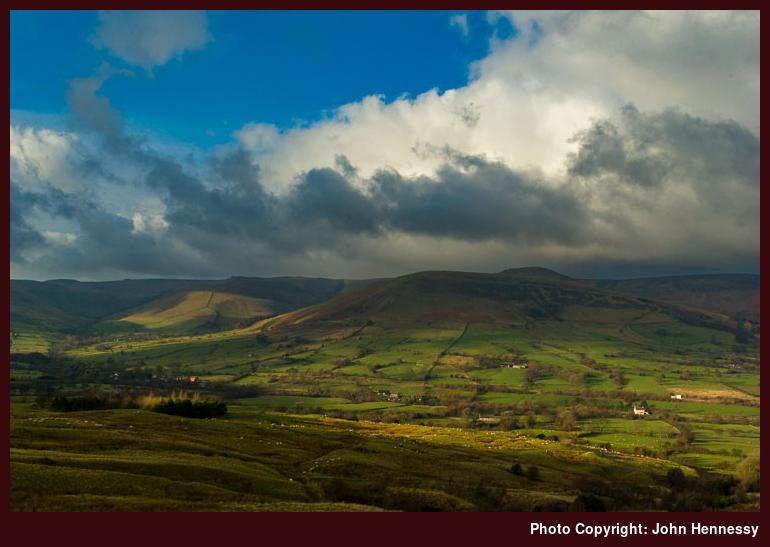
Looking over maps can trigger moments of indecision that need to be cinched and my pondering this Derbyshire outing was no different. Though my first destination was Mam Tor, the option of going directly heading for Hollins Cross was in the back of my mind too, once I put a stop to any indecision. As it happened, I stayed on a bridleway for the "shivering mountain" that I should have used on a previous hike from Castleton to Edale but didn't, for some reason, lost in the gathering mists of time. My course followed Harden Clough before I detoured around by Greenlands to make my way past the not inappropriately named Cold Side; it is north facing, after all. There were occasional parties of walkers and cyclists going the way, but these were nothing intrusive and spotty sunshine did its bit for the hillsides.
Going up on Mam Tor meant encountering a mix of occasional walkers, regular ramblers and spots of rain. There had been signs of murk upon the Ladybower and Derwent moors even as I started out but I paid them no heed. The plan was to make the best of the conditions, come what may. That murky dampness did make me don waterproofs but it was no real encumbrance to the prepared. In any case, an escape from Hollins Cross was always a possibility if things ever got too annoying. They never did and I took a chance on getting to Hope train station.
Back Tor looked more impressive than my memories of its crags would have suggested. The occasional hang glider was out and about but a fine sunny summer day would have drawn more of its kind. Later, the air dried up, and the sun made vain efforts to light up the land about me. Even so, any designs that I may have had on engaging in aerial photography of Castleton and Hope would have to await another day.
When I reached the top of Lose Hill, I began to wonder whether making the 15:39 from Hope station to Manchester was asking too much. In the end, I amazed myself by getting from the hill top to the train station in 35 minutes and that gave me a few minutes to wait before the train appeared as well; it was as if I had been travelling by fairy wind. It does leave me wondering about my perception of my own walking speed, but that may be tempered by the amount of travel over rough ground that I do. Regardless of my wonderment, it was a good way to end a good afternoon out in the fresh air. That I had mixed fortunes with the weather doesn't even come into it.
Travel details:
Return train trip from Macclesfield to Edale with a change in Manchester.


