Category: Countryside & Environment
British Summer Time
 2nd April 2009
 Since Sunday, there have been a raft of announcements and happenstances that make it look as someone somewhere has held them over until the arrival of BST. First, there's spell of dry weather. The sun might be in short supply but I'm far from complaining as I have turned to the bike for the daily commute. I also have every plan not to have a computing failure stop me from embarking on an outdoors escapade like last weekend. While on the subject of weather, we have had the Met Office adding more detail to their mountain weather information and the Peak District has been added as a new area too, not at all inappropriate given the number of visitors that it receives.
The mention of a National Park brings to mind the announcement of one for the South Downs. Hopefully, the rancour that has accompanied the New Forest one can be avoided but I am reminded of something else: the fact that the southern English countryside is no lure for me. That is never to say that we should value everything in our custodianship so that we can hand it on to future generations in as good a condition as we can. I am sure that these places are an invaluable escape for those living near them but I may have been so spoilt by experiences in open hill country that it is difficult for me muster the wherewithal to visit them. Speaking of being spoilt, living in Cheshire does mean that I am within reach of an embarrassment of riches and the list would become long very quickly. It's the sort of thing that makes me reluctant to move south from here, particularly when I get to realising how little of I have actually savoured.
The mention of Cheshire reminds me of the local authority reorganisation that has happened. Hopefully, the new Cheshire East and Cheshire West & Chester unitary authorities will continue the good work that has been done with regard to public rights of way and not allow serious degradation in public transport provision either. Northumberland is getting a new county council so the same aspirations apply there.
Along with the release of the new Quo by Mapyx, this has been a busy week and that's even without looking in on the events in London but I won't comment on them here. It would be nice to cap it all with an outing. There are no definite plans yet but I am not going to rip up a computer over the weekend if it can be avoided. To get into the great outdoors needs some space and time to be set aside, for planning as much as execution; working through the variety of destinations that creep into my thinking so as to pick one can eat time like it's going out of fashion. An outdoors excursion can clear the head but I have found that other clutter might need clearing first or you'll never even get out the door. That has happened me rather too often...
Walking among trees: pleasure or penance?
24th March 2009 My ongoing updates to the photo gallery (my attention is drifting towards the Argyll & Mull section at the time of writing) has caused my eye to fall upon coniferous forestry more often than not. It seems that my journeys in search of wilder countryside have taken through me by more plantations than I care to remember. Scotland is particular prone to them, it seems, but my native Éire has them too, a consequence of government policy in the 1960's and after. I seem to remember from secondary school geography lessons that statements like adding to the visual appeal of the landscape and making good use of marginal land were stated as its advantages. The first of these is a matter of personal taste but the second is being challenged by the realisation that marginal land only yields wood of a quality perhaps only useful for paper manufacture has since dawned upon our collective consciousness. It seems that some such plantations could be left without felling because their economic value cannot justify the expenditure involved. All in all, the advance of coniferous woodland wasn't all that it was cracked up to be.
Whatever the reservations may be, even I have to admit these commercial plantations have allowed the opportunity to create recreational spaces from which to escape our cluttered lives. In Ireland, trips to the likes of the Ballyhoura Mountains or Gougane Barra cannot be managed without the sight of conifers and they accompanied my early introductions to the pleasure of exploring hill country. In latter times, many a trek in Scotland has had me encountering similar sights.
It almost goes without saying that some plantations are more walker friendly than others. Ireland's forestry agency, Coillte, is one of the better owners and I ask myself how many Looped Walks or off road sections of the Waymarked Ways there would be without them. Also coming up for an honourable mention is the Forestry Commission with their work on paths and tracks around Loch Long and Glen Croe. They also made a contribution to the development of the Rob Roy Way in the shape of the way marking that I found useful while following the trail from Drymen to Callander.
Even with these helping hands, passage through plantations should never be taken for granted and I have caused myself torment of this kind more often than I should have. All it takes for an OS map to be unhelpful is for a new track to appear or an old one to become overgrown or obstructed. The ensuing navigational confusion can lead you to do things like my reaching the A85 in cross country fashion while walking from Inverarnan to Dalmally. It's not the only lesson teaching me never to rush woodland walking unless I know really well where I am going.
Aside from navigation, the other downside of passing through forestry is that you often cannot see the wider vistas that surround you. That point can be driven home rather too firmly by an outbreak of sod's law where the sun is released from its cloudy lair when the trees block your view only for it to be hidden again when you finally reach open country. In days when the prospects of capturing those panoramic views was a stronger draw for me, misgivings about woodland walking arose from this very kind of thing. There are times when the trees are felled to release the vistas but the challenge of making pleasing photos while avoiding having the remaining wreckage in the foreground rears its head on you.
While on the subject of photography, it has to be said that broadleaved woodland probably does you more favours than the conifers with their homogeneous and near unchanging hues; they do need the surrounding countryside to help them for wider views. For one thing, there's more diversity on the floor of one of the former and I have memories of the extensive bluebell glades etched in my mind from a yomp along the bonny banks of Loch Lomond to bag the WHW between Inverarnan and Drymen. The colours of new growth in May is another pleasure and any unease at the year reaching its autumnal phase is at least partly dispelled by the sights of the russets, oranges and yellows in the trees. It's the sort of thing that has brightened up many a lunchtime walk for me and there's birdsong too to make it a truly audiovisual experience. It's these sorts of experiences that soothed any misgivings about woodland walking that I may have had but coniferous forests have their pleasures too and you can always get above the tree line.
Stark warnings
9th February 2009 While out on a trot from Langdale to Ambleside on Saturday, I spotted a stark notice on a gate. It was on a path leading towards the Langdale Pikes and issuing a strong message that ice axe and crampons were needed above 300 metres in height; I was staying low with plenty of hillside bereft of snow while the white stuff made itself plain to see at higher altitudes. Of course, there have been fatalities on the "Pikes" so the strong wording was not without good cause. It was also a reminder of similar unfortunate outcomes in Wales and Scotland. I can't say that I have heard of anything like this from Ireland, but something tells that full winter conditions must be blanketing those hills too.
The trouble with official warnings is that we have seen so many that could be termed an overreaction that heretical thoughts begin to percolate into your consciousness not long after you have seen the warnings. There are those who issue shrill warnings without they being truly needed, acting in a manner akin to the shepherd boy who cried "Wolf!" in the Aesop's fable. This time around, I am inclined to think that the "wolf" is real and have got to moderating my usual questioning. This is for a number of reasons. First, the warnings were coming from mountain rescue folk, and they didn't overreact to events around the time of the OMM in Cumbria when a deluge came from the heavens and caused raging roads to turn into rivers. The other chastening observation supporting that suspension is that there have been those serious accidents and fatalities.
Another factor in all of this is that we have been spoilt with the milder winters of late. Apart from the shorter days, the occasional spell of snow and ice or a storm, winter walking became perhaps no less accessible than at any other time of year. In contrast, this winter is a sharp reminder that what we have enjoyed of late isn't always the case and preparedness for winter walking can be another matter entirely. The whiteness is attractive, but there's a certain "here be dragons" element lurking too, particularly with inexperienced folk being drawn out to enjoy the prettiness. That could be the reason behind the advice given by the head of the Lake District National Park last weekend, particularly with the school half-term holidays and their bringing more folk with many perhaps without the requisite equipment, knowledge, skills and experience (the LDNP is between a rock and a hard place: in these trying times, they need the visitors, yet safety remains vital too).
Speaking of experience, assessment of conditions is a big part of it, and any disparity between those on high and those in the lowlands makes it tricky unless you have some experience of being up high in the first place. For instance, snow coverings among the hill country lining the Cheshire-Derbyshire boundary are measured in feet while those on the Cheshire plain are inches in thickness if they lie at all. Increasing the height differential can only exacerbate that sort of difference and entrap the unwary. Saying that, it doesn't take much to realise that any whitened hills look very different to the green valley bottoms with their icy patches due to paths having turned into stream beds; that was very typical of the Langdale that I encountered on Saturday. Mountains and hills do make their own weather, and it seems that winter conditions bring that into sharp relief.
The warnings and the fatalities can make one feel that they are on the outside of a different world, looking into it. They certainly challenge any perception of readiness for winter conditions and set you to thinking, particularly about those who have been left behind by those deaths. That certainly is the case for me, but barriers should be overcome carefully rather than allowed to stop you in your tracks. Even so, the mountains won't melt away overnight, even if the snow does.
Update 2009-02-10: It now appears that winter conditions have gripped some of Ireland's hills too. In fact, the Irish public service broadcaster RTÉ has a report on two men lost on Lugnaquila, Wicklow's highest mountain with a height of above 3000 feet, after dropping their map in foggy conditions. They have been out all night and mountain rescue teams are searching for them, but there is a glimmer of good news: mobile phone contact has been maintained throughout. Let's hope it all ends well.
An imperfect rights of way network?
16th December 2008 Access to the countryside has always been a contentious area and a recent piece of blundering of mine along a public footpath returned that very much to mind (I ended up straying away from where I should have been to earn some yelling from a passing gent atop a quad bike on a nearby road). Within the last decade, Scotland has got its very enlightened access legislation and a less extensive variant has made its appearance south of the border in England and Wales, with legal wrangles forcing up the cost of implementation of the latter.
Until these innovations, public rights of way did next to all the access backwork in England and Wales and the question as whether the network that has come into place over time is all that useful for the purposes of exploring the countryside. In a similar vein, Graham Wilson, in his book Macc and the Art of Long Distance Walking, comes up with some thoughts on the subject:
Many of these exist for reasons long since forgotten and to insist that the world and his wife can march through someone else's back garden because a postman from Time Immemorial has had to take this route to deliver a letter to a neighbouring farm is as equally unreasonable as it is for us to be denied the right to walk in a straight line across rough country direct from the summit of Shutlingsloe to the hospitality of The Hanging Gate.
I must admit that I find it hard to improve on that well put sentiment from the time prior to the Countryside Rights of Way Act that has given us tracts of Open Access Land with all their limitations in size. It just seems to capture so much and very much fits in with my wonderment as whether we are using a network designed in another era and for another purpose for very different ends. To my mind, it seems that we are using paths and tracks that came into use to link up houses and their ilk to explore the countryside. Add to that the very modern need of privacy and security and path diversions come to life, adding to the complexity that was there in the first place and things become more tricky as you approach civilisation. All that's needed is a momentary slip of concentration and the ungainly activity of map inspection and not always in the most opportune of places either.
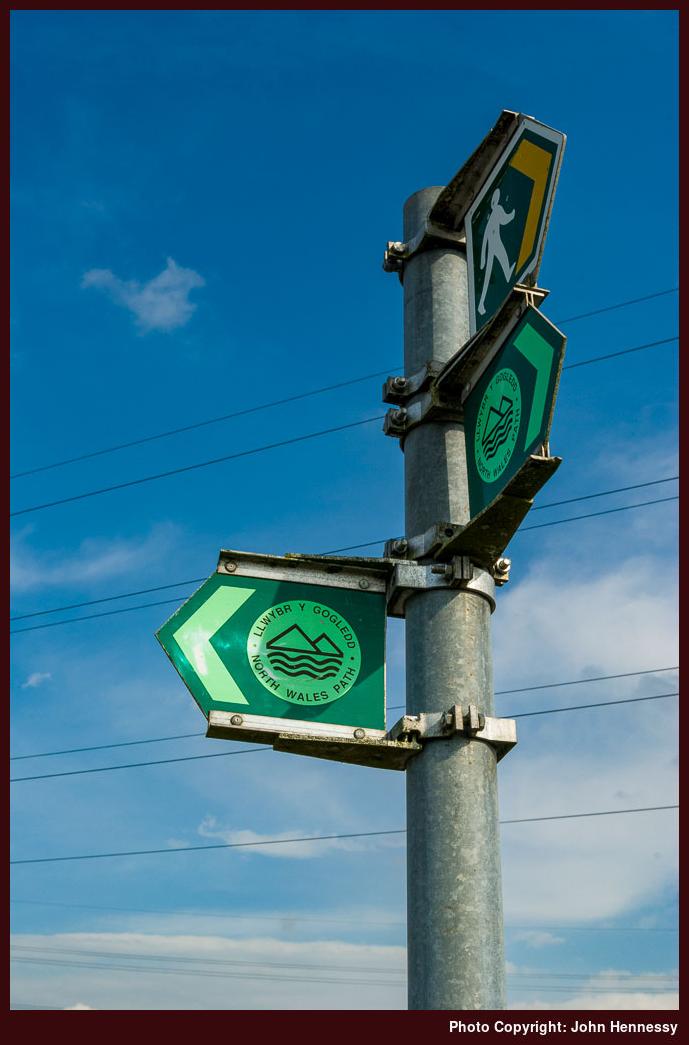
That intricacy and complexity makes waymarking even more important and it's not always up to scratch; even the best OS mapping cannot be expected to show every twist and turn of a path within a field with complete accuracy. With circular waymarks, the rotation of the arrow can confound if one is without the understanding that an arrow in the 2 o'clock position means that you are meant to take a sharp right! Apart from poor waymarking, other ways to make walkers a little unsure of themselves include the condition of stiles and the state of a path. Some areas do well on this and Cheshire would seem to be among them. Surprisingly, North Yorkshire is poor for waymarking away from its national parks while overgrown paths in North Wales are things that I have encountered a few times now. All of this doesn't aid one's sense of self-confidence if an unwelcoming soul were to be encountered (yes, the countryside is like anywhere and they surely exist there too). It seems that those spontaneous on the fly decisions to see where a right of way takes might be best replaced by a modicum of planning unless it's an area that I already know.
The impression that starts to build from this is that we might need a simpler network of rights of way in place of the rag bag that we use now. What I wouldn't want to see is a reduction in ease of access to any area, but diversions away from houses and farmyards would suit me better; I like my explorations to be uncontentious rather than appearing to be prying. However, I cannot see that scale of improvement happening because there are always other things that command the attentions of governments and local authorities and that is never more true than in these times of economic upheaval. Inertia probably rules anyway with a major push being needed to get anything like a path and bridleway reorganisation through; it took a huge effort to get the "Right to Roam" legislation implemented and I cannot see a government again confronting vested interests in the countryside quite like that for a while.
My conclusion from these ramblings? It sounds like making the best of what's there is the sensible approach, sharpening those navigational skills along the way. My days of spontaneously following a tempting signpost might be best put behind me in place of some more advance planning and noting of field exits or wanderings in open country where few are likely to feel threatened or annoyed. As with everything, you always can learn more and I am open to the idea, with thoughts of perusing the Open Spaces Society's book on rights of way coming to mind.
When a certain ring of familiarity attracts your attention
29th November 2008 The name "Allt Coire Chaorach" probably doesn't mean that much to most people. When I saw mention of it in a BBC news item concerning the recent approval of a hydroelectric scheme, I just had to investigate. That search for further information led me to the Scottish Government's website where the fuller details are for all to see.
It was the inclusion of the word "Chaorach" that got up my curiosity because there was a faint possibility that I may have passed it on my travels through Scottish hills. In fact, it was my passing through Gleann nan Caorann whilst on a trek from Inverarnan to Dalmally at the end of May that proved to be the trigger. However, in Gaelic, caorann is the word for a rowan tree while caora is the word for sheep. So my wandering took me by glens and burns named after the rowan rather than sheep or ewes like how it appears for Allt Coire Chaorach. It's amazing how appearances can deceive when it comes to languages of which you don't have a detailed knowledge.
However, Allt Coire Chaorach isn't that far from Inverarnan since it starts out on the eastern slopes of Ben More and Stob Binnein before plunging to the floor of Glen Dochart to join the river that gives that glen its name; that river itself goes on to feed Loch Tay, from which emanates the river of the same name that reaches the sea near Dundee. Apparently, this is also a site of special scientific interest and the Scottish Government seems to be continuing on its course of not entirely respecting SSSI's if the approval of the hydroelectric scheme is any useful indicator. It's also located within the bounds of the Loch Lomond and the Trossachs National Park so the trend seems a little too consistent. Let's hope that the construction works are as sympathetic as they can be.
Incursion of modernity into our beloved hill country often attracts furious disapproval; just look what surrounds the subjects of wind farms and electricity supply lines. Anything that is already done doesn't trouble me so much since removing it might cause even more disruption than leaving things as they are. However, any proposed changes do rouse my misgivings and I hope that the powers that be do leave us with sufficient wild country to explore and so escape the pressures and demands of modern life. Getting corralled into busy honeypots would be no fun; while National Parks have their own multitude of quieter corners, making one's way through the hordes to get to them isn't as nice as the unimpeded access to them in lesser frequented parts.
Saying all of the above, the new hydroelectric scheme may not be that intrusive in the visual sense. From the side of the A85, it should be hidden behind forestry but it will take some time to blend in with its surroundings so that it doesn't look so obvious from the heady heights of the likes of Ben More and Stob Binnein. For those who might like a wilder feel, now might be a good time to explore these and other summits before any changes take place. The rest of us might be comforted by the thoughts as to how quickly nature can reclaim the land from our worst attentions. Just visit the North Pennines, once a bastion of lead mining, and other parts where such activities were once prevalent and now long gone. Visiting the quarry-scarred hillsides of Gwynedd might not be the best idea when seeking solace from our disregard for the landscape with which we have been gifted is what's in order.


