Category: Cheshire
Taken by surprise again?
 28th May 2009
 About this time last year, I was feeling a tad sore after a weekend in Scotland where I was surprised by some of the best weather that I had seen there in a while. It was as if I was taken by surprise and reluctantly left because I was of the opinion, rightly or wrongly, that a certain lack of planning meant that I may not have made the most of it. Looking back on it now, it may not have been as wasted an opportunity as I thought it to be at the time. After all, that Sunday sojourn on Kerrera sharpened my appreciation of island scenery and perhaps inspired the Hebridean island hopping session that occupied me for a week later on in the year.
This year, with various things that have been going on in my life together with a stretch of lacklustre weather, I would have been forgiven for being surprised by the weather yet again, just like last year in fact. Now that I think of it, the weather has behaved similarly on both times. The run up to the same weekend last year would have been no preparation for what eventually arrived either. However, there is an important distinction between the two years: the locations blessed by good weather. Last year, Scotland got it better and had a generally good May with the TGO Challenge seeing more dry sunny days than usual. England did better this time around but it all depended on where you were and when you were there; it turned wet in Cheshire on Monday.
Overall, Cheshire did well with a steadily improving Saturday that coaxed me out on the bike in the evening time after an afternoon shopping expediton. Sunday was even better and I spent my afternoon and evening on a stroll from Leek back home by way of Tittesworth Reservoir and Danebridge. On Monday, I popped up to Cumbria to hike the Cumbria Way from Coniston to Skelwith Bridge before skirting Loughrigg Fell on the way to Ambleside. That was the cause of taking me through a honeypot or two (Tarn Hows comes to mind as a particular fleshpot) but the quieter parts more than made up for this.
One plan did fall by the wayside and that was the idea of following the Derwent Valley Heritage Way north from Baslow until either Grindleford, Hathersage or Bamford; the end point was to depend on progress and the time of the next train home from either of these stations. The plot certainly was fluid but a late bus caused its abandonment on Sunday so it goes onto the ideas shelf for another time. Another route option is to go around by Baslow Edge, Curbar Edge and Froggat Edge, proper hill wandering if you will and a variation of the original theme, but that also still awaits its opportunity and goes beside the DVHW on that proverbial shelf.
All in all, I cannot declare 2009's Spring Bank Holiday weekend wasted and, anyway, that's not the way that I feel about it at all. Any period of time that allowed chances for walks and cycles can only have been used well and, as if that were not enough, it has sown the seeds for future excursions too so it has been more than fruitful. Having more good weather than was expected can be a test too because you need to pick where you want to go when the temptation is to go out and gorge yourself; having only so much time has its uses. Trip reports for the walks themselves should follow but there's the prospect of good weather next weekend so that may cause the postponement of their appearance. Of course, that depends on how things come together and only time will tell on that score.
An involved way to cross a county boundary
8th April 2009 Whenever I get to plot an outdoors outing, I almost invariably turn to maps for ideas. That's not to say that guidebooks don't get perused as well, but there's something very immediate about casting one's eye over a map. Scotland's enlightened access legislation means that any track can be fair game, but more care is needed south of the border. In fact, I have had enough experience of the English and Welsh rights of way network that a growing distrust needs to be confronted, but I use any path. I need to be careful not to overdo things, but anything that looks unpromising could be left for another route. The sorts of things that leave a poor impression are rickety styles, poor waymarking and overgrown paths. A somewhat unpleasant experience last year has got me very wary about complex route finding too near habitations on other people's land.
Anything that's part of a long-distance trail should be fine, but there is a part of the Pennine Way proceeding through fields in North Yorkshire that looks like yet another unloved part of the rights of way network. Saying that, seeing the attention lavished on the Gritstone Trail reassures me more than just a little. The mention of the GT brings me to Staffordshire's moorlands. Yes, there are some neglected parts and I came across them while I was out hiking on Sunday, but a good deal of care is apparent too. I passed along part of the Staffordshire Way, but the moniker "Staffordshire Moorland Walks" is one that is seen a lot on maps for where I was wandering.
These are Staffordshire's answer to Ireland's Looped Walks and have been conceived, very nobly, as a network of self-guided walks by Staffordshire Moorlands District Council. You will not find them highlighted on OS Landranger maps, but they are given the same level of prominence on Explorer maps as point-to-point long-distance trails. That might have the potential to confuse just a little and some may decry the idea of cluttering up mapping, but these remain very useful. Good waymarking makes them more user-friendly, too. As it happened, Sunday saw me traversing portions near Biddulph, Rudyard and Leek but a previous escapade saw me rounding Tittesworth Reservoir with a side visit to Hen Cloud too.
What took me onto those looped walks on Sunday was a yomp from Congleton to Leek. It was meant to be the other way around but for my own muddling and a missing bus delayed my start as well. It also meant a change from my initial plan of going from Leek to Rushton Spencer by way of Rudyard Reservoir and then following the Gritstone Trail for most of the way to Congleton, possibly with an ascent of The Cloud included for good measure. However, the onset of summer time has granted us longer evenings, so sufficient daylight time was available for me to complete the walk. The walk out of Congleton to reach another part of the Gritstone Trail, a section shared with the Biddulph Valley Way, certainly took long enough to bring home to me the size of the town and how far its train station is from the town centre.
My patience on the exit from Congleton was rewarded by a peaceful amble among woodland along a now disused railway line that once ran between Congleton and Biddulph. That embankment was left to pick up part of the Staffordshire Moorlands Walks loop that goes around Biddulph. That stretch took me across the A527 and over the fields to The Talbot in Poolfold. Another road crossing followed and another exit into green fields was found in the said pub's car park. That proved temporary, and I found Country Landowners Association signs bearing waymarks and welcoming caring walkers around The Moor House, perhaps a reassuring touch.
The hotchpotch of public footpath and road walking was set to continue after I left the Staffordshire Moorlands Walks waymarks after me to cross High Bent. My journey took me around by Boons' Meadow Farm on tarmac before I again crossed fields to reach a byway called The Hollands. After another road crossing, I was following field boundaries again. There were copious views at this point, with the familiar sights of Croker Hill and Shutlingsloe visible in the northern panorama. Looking east, I could just about make out The Roaches beyond Gun. There were enough clouds in the sky to ensure that unbroken sunshine was a pipe dream, and my photographic exploits were attenuated as a direct result.
With all the twists and turns taken by my route, I would have been forgiven for tiring by the time that I reached Halfway House. As it happened, I must have missed the footpath for Birch Trees Farm. However, I had mixed feelings about following a right of way through a farmyard, so I wasn't sorry to have passed it and I knew where I was in any case. It may have meant that I needed to contend with motor vehicle traffic for longer than I might have liked, but no major perturbation was felt on my part.
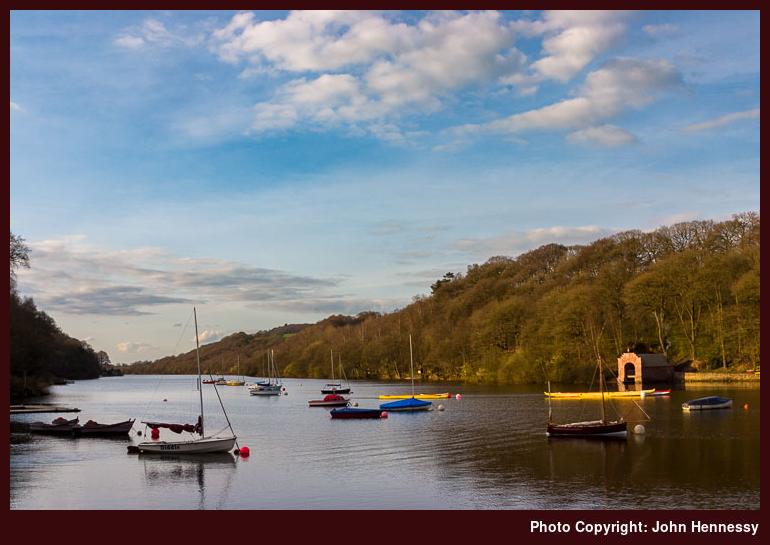
Reacliffe Road was found soon enough at a switchback bend and, a short downhill stroll later, I reached the second loop of the Staffordshire Moorlands Walks for the day. I was bound for Leek, but this is where you would be going for a circuit of Rudyard Reservoir. The quiet wooded lanes and paths were an agreeable way to reach the dam of the said reservoir before I descended to follow its outlet stream for much of the remainder of the walk. There was another uneventful road crossing too, but I was on the lookout for the junction that would see me go along a path that take me under the old Macclesfield-Derby railway line and on to the A523 on the outskirts of Leek. Perversely, the centre of Leek sits atop a hill and, by this time, my legs were telling me that they had done enough for one day as I made for the bus station.
Though the day had its moments of sunshine, they were limited throughout the walk, but that also meant that I wasn't to be scorched by the strengthening sun, never a bad thing. Because of circumstances, the route followed was a tricky one, but it was dispatched with only one unscheduled diversion and that was far from being a hardship. All in all, I enjoyed a good few hours and revisited somewhere where I hadn't been for a while. Many stretches were quiet, too, which helped for a spot of relaxation along the way. Hopefully, the short outing can act as a springboard for other excursions.
Travel details:
Service 38 from Macclesfield to Congleton. Service 18 from Leek to Hanley, followed by service 25 from there to Stoke train station for a Virgin train to Macclesfield. There is a service 108 connecting Leek and Macclesfield, but that is irregular, and the last one had long gone by the time that I reached Leek.
A good walk home on a blustery day
11th February 2009 Recent entries on this blog have wandered into areas not often frequented by my thoughts so it is high time that I got the first trip report of 2009 on here. One of the causes of those thoughts darting here, there and everywhere is the current cold spell with its numerous dumps of snow. In everyday life, snow has become avoidable but, on my first trek of the year, I didn't encounter any of the white stuff at all.
That was because I was out the day before the snow came. When it came to weather, a strong frigid south-easterly was the main encumbrance though it was possible to escape its influence in sheltered spots. That didn't stop me taking a bus journey up to the Cat and Fiddle Inn between Macclesfield and Buxton to commence a walk back to my house again. The idea had been in my head for a while and the fact that it would only take part of a day allowed time for other things afterwards has its appeal for me.
It was sufficiently breezy about the pub in question that I invested more attention in crossing the A537, a road with a foul reputation thanks to its ability to attract bikers with its many bends. The reason for that crossing was to pick up a bridleway that was more or less due south, though it does change to a more easterly direction later on in its length. In November 2004, this was the start of a very muddy hike (some may have forgotten it now but the whole year was well wet and grey and that's how I remember it) that took me to Rushton Spencer with much of the route following the Dane Valley Way and passing Three Shire Heads, Gradbach and Danebridge along the way. In fact, I met up with the Gritstone Trail as I approached the A523 for a walk into Rushton to catch a bus home.
Returning to 2009, I was going nowhere near Three Shire Heads, let alone Gradbach, Danebridge or Rushton Spencer. In fact, I wanted to pick up a path that tempted me in 2004, but thoughts of muddy feet kept me away and there is irony in the way that things turned out that way as it happened. So, I continued along the bridleway through former coal mining land until I lost sight of Shutlingsloe and Croker Hill to reach the signpost erected by the Peak and Northern Footpaths Society. Progress was set to be downhill from here as Cumberland Brook was first found and then followed. At one point, I may not have followed the path as intended but, given that it was all Open Access land anyway, I was never going to have anyone shouting at me for it. The path met a track that was to take me towards Clough House near Wildboarclough and by a delightful wood too with views of Shutlingsloe ahead of me.
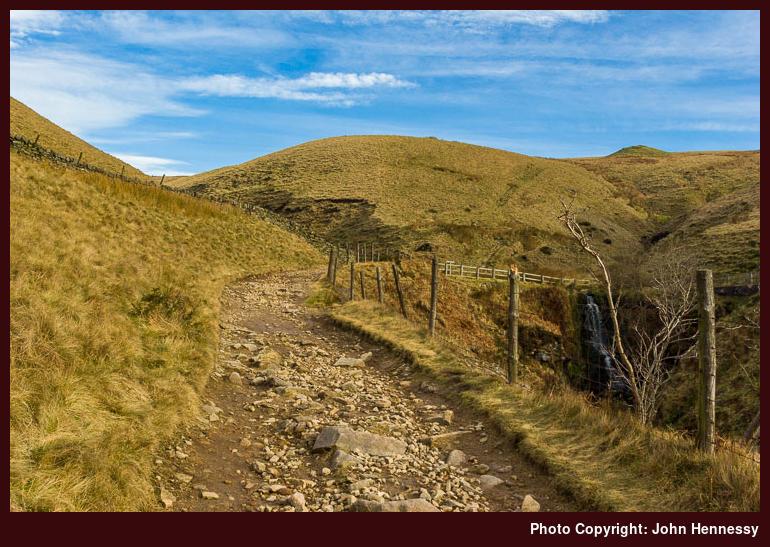
There might have been a path by Clough House but I stuck with the road rather than cutting though its yard. Another path was reached without delay and I was on my way towards Shutlingsloe itself. At this stage, I was between two minds as to go around the hill or up and over. Having walked to its summit twice before, I was minded to skirt its slopes but decided to ascend it in the end. The path rounded Banktop to reach my second island of access land after leaving the first en route to Clough House. That allowed me to pick my own more gentle way to the top of the hill and it proved to be just as well with the public footpath taking a steeper line through crags. In one sense, the gentler line might have been more manageable with the strength of the wind but it could also have been that the traditional route was less exposed to it. Returning to the strength of that wind, I and those around me were to feel it more keenly the higher that we went. I have to say that this was the strongest breeze that I have ever felt and there was one that came close when it hit near the end of a hike from Horton-in-Ribblesdale to Hawes along the Pennine Way. Even standing was difficult and movement became much more of a feat than usual. Nevertheless, I was so near the top that I continued inching my way forward; in another situation, I would reconsider what I was doing. Intriguingly, the wind was less strong on the top and standing around the trig point was no problem; it can be surprising where shelter is found.
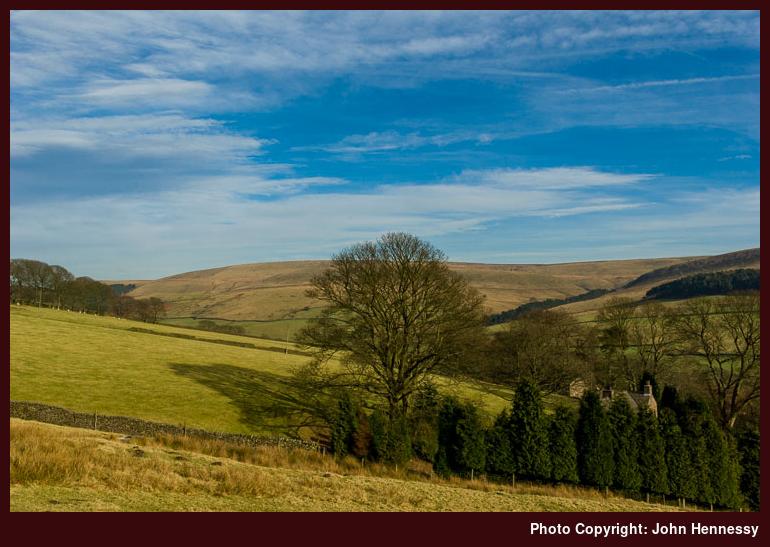
I felt the wind again on the way down along the slabbed path to Macclesfield Forest but it was no way near as intense as before. On the way into the forest, I met a gentleman who was wondering where the path along which I had come was going. I showed him where he was on his forestry visitor map and he decided on another course that kept within the forest itself; he and his young one might have been better off. Rather than dropping straight down to Trentabeck Reservoir, I chose a concessionary bridleway that took me round by Nessit Hill before dropping me on a minor road next to Ridgegate reservoir. That track was very muddy in places thanks in no small part to tree felling operations but it took nothing from my enjoyment of the walk.
From the road, I took another concessionary bridleway before making my way onto the Gritstone Trail to come out on Clarke Lane near Bottoms Reservoir. After a walk along the road through Langley, I left tarmac after me again to tramp though fields around by Macclesfield Golf Course while en route to Macclesfield Canal. Tiredness raised its profile about this time, but home was near at hand and a mixture of street negotiation and canal bank strolling returned me to my doorstep. I suppose that staying upright in that strong wind had taken its toll, as did the distance travelled together with the amount of ascent and descent that was involved. It had been a good few hours walking on a dry if cold day with the sun occasionally breaking through the cloudy sky. 2009 had started well.
Travel Arrangements:
Bus service 58 between Macclesfield and the Cat and Fiddle Inn.
Good weather for trying out warm jackets
2nd February 2009 The snow has found its way across to Cheshire within the last 24 hours. Buses weren't stopped up like in London, though things did feel a little too slippery on the way home. That was enough for me to press an old pair of Salomon boots into service for negotiating the snow-covered streets of Macclesfield, a job that they did well. This kind of weather needs that kind of footwear; some may use wellington boots, but they are not as versatile or as warm.
Another item has that came in for a lot of use in the last few days has been a Mountain Equipment Lightline down jacket that I managed to find in the January sales for a third off the original price. I haven't had it long, but it came in time for the current burst of cold weather. My initial impressions were that it wasn't as warm as my TNF Nuptse, but there have been times when I overheated in that jacket and the Lightline did keep out that cutting south-easterly that visited us over the weekend. That easily suffices for most of my purposes.
In fact, I now think that the generosity of the fit might have swayed my assessment. The pernickety might criticise a certain lack of finesse in the finish department, but it's good enough for me. The zip isn't the smoothest of operators and has potential to be the greater irritant, but I can overlook that given how well it works otherwise.
Otherwise, there's a lot to like: generous pockets and an outer shell that keeps the down dry in most conditions are those that I find most useful. Given the amount of rain we get in Cheshire, that is a major plus point. A detachable hood comes too, as does a stuff-sack. I can't say that I have used either, with my detaching the hood reflecting my preference for hats over hoods in all but driving rain. All in all, it does the job for which I bought it, while the Nupste can be saved for much colder days.
A look back at 2008 Part 3: Beyond Midsummer
17th January 2009 Midsummer in 2008 might have been a time when I felt that the year had peaked, and the encroachment of unsettled weather may have had something to do with that view. Certainly, the year will not be remembered for having a sunny summer and many were disappointed, even if it did have its better interludes.
Personally, I reckon that it's best to try and enjoy what is visited upon us at any time of year, and seem to have come to the conclusion that the traditional summer holiday season is overrated. There may be more hours of daylight but, if the days get too hot, it may be worth sticking to the cooler parts of the day and that reduces the amount of time available for wandering through the countryside anyway, perhaps restricting the time available until it is not that much different from spring or autumn anyway.
Even with the feeling that the second half of a year feels like an anticlimax after the first, I continued to get out into attractive countryside. I found hot sunny weather in July, was extremely lucky with my visits to Scotland in August, had an easier September and October before taking advantage of numerous wonderful opportunities in November and December. There was much to behold, so here are a few recollections of it all.
July
In walking terms, July was another fallow month, with a sun scorched saunter along the Offa's Dyke Path near Welshpool at the end of the month being the main trip of note. Otherwise, time limited by other activities ensure that most of my major outdoor activity was to be cycling rather than walking. The month's mixture of weather contributed too, but I was feeling that the best of the year had passed by this time anyway, and began to wonder if the timing of the school holidays was more than a little nonsensical. I also got to mull over island wandering as a possibility for my now habitual longer Scottish walking break. My few hours on Kerrera in May may have had something to do with this inspiration coming upon me, and I felt the need for a longer break anyhow.
August
The main even in August was that island hopping trip to Skye and the Western Isles. Though, anyone surveying the weather and the weather forecast on the eve of the trip might have questioned my sanity for even considering what I was about to undertake. In the event, I struck the jackpot: while other parts of the U.K. and Ireland were getting a soaking, I managed to find wonderful sunshine and avoid those downpours. That was thanks to the belt of rain getting stuck across the north of England and the south of Scotland. Harris was to prove the highlight of the week, without Skye failing to satisfy or the peace of the Uists being forgettable. However, it does need to be said that South Uist felt a little like an anti-climax after Harris, so it might be best to journey in the northbound direction on any future visit. A social visit to Edinburgh followed, but I still got in a few hours among the Pentland Hills, an area that I surprisingly ignored when I lived up there in that city.
September & October
September and October turned out to be pivotal months for many reasons, the economic situation in the wider world being one of them. For me, it was a period lacking in longer walking excursions, but shortening days meant that walks at lunchtimes started to take over from evening cycles.
Another trip to Ireland in September allowed me to spend a few sunny hours around Gougane Barra. Even though I felt unable to add a fuller narrative for that trip, the photos found their way into the photo gallery very quickly.
Alongside this, the realities of writing a longer trip away were made plain to me as producing reports for my Hebridean trip began to take eat up their share of time. It wasn't just the writing that slowed progress, since choosing and processing the photos to be included as part of the descriptions nearly were more rate limiting than the actual writing itself. That experience had been happening throughout the year, but it really came to a head with the larger block of writing.
Staying with the subject of lessons learned, I started to cast more of a critical eye on the focus of the blog and came to the conclusion that much of the musings on public transport really belonged elsewhere. In time, another blog was spawned for that, but travel matters relevant to the exploring of wonderful countryside will continue to make their appearance here. In time, any old posting falling outside of this might get moved elsewhere as part of continued content reshaping, yet I'll leave things as they are for now.
November
November saw me re-emerge into areas well populated by hills again. The first of two trips to Cumbria saw me embark on an out and back trek from Windermere's train station to Yoke. I had gone north with a few ideas in mind, and this proved to be just as well when public transport and the available daylight constrained my ambitions a little. Neither did anything to spoil my enjoyment of the day.
A miscalculation on the following weekend had me walking from Ardlui to Butterbridge a day too early for good weather to do its magic on the landscape. In some respects, the hike echoed my February outing to the area in that showers got going to make things feel unpleasant as I descended towards the end of my walk. I may not have seen the countryside in its best light, but plans for potential excursions came to mind, and they may compensate for this at some suitable juncture in the future.
Dullness of a drier variety was set to dominate my walk from Ambleside to the top of Red Screes and back the next weekend. Some sunshine managed to escape from its cloudy prison towards the end of the walk, yet the intense cold remains in mind, particularly since the turning on of Ambleside's Christmas lights delayed my journey home.
December
December may be considered by meteorologists to be the start of winter, but my walking was not about to go into hibernation, especially with the possibility of sampling some snow. So, the first Saturday of the month saw me return to the Howgill Fells after the briefest of visits a few years earlier. The snow that I met got me wondering about winter skills and such like, but the experience was one not to be missed. The day after had me out exploring Macclesfield's hills with an out and back hike from my own doorstep. I might have been trampling familiar ground, but there were some new sides to be seen too.
A trip to Ireland for Christmas and New didn't stop my walking either, even if road walking took up the most of what I was doing. Nevertheless, I got to get off-road to explore around Springfield Castle near Broadford in County Limerick and even got to sample a little piece of the Dingle peninsula around Camp and Castlegregory in Kerry.
Sunshine enlivened both walks, but that part of Kerry was frequented by a biting wind while we were there; nevertheless, it didn't stop me wandering a little way along a track (used by a tractor to get winter feeding to livestock by appearance of things) through the dunes at Maherabeg (Machaire Beag in Irish) in the late evening sunshine, at least shadowing the Dingle Way if not actually following it. That brought a year packed full of walking trips and opportunities to a delightful close. 2009 awaits.


