Category: Europe
Getting a bus to Glendalough
 7th November 2006
 The rolling landscapes of Ireland's Wicklow Mountains have long appealed to me, and they also were a favourite haunt of my parents. And now, I've discovered a twice-daily bus service that transports you straight to this alluring corner of the Emerald Isle: the St. Kevin's Bus.
The 30-mile (48 km) route commences in Dublin, where I once spotted an evening service departing, adorned with its web address. This coach ride will take you to one of the most picturesque locales in Ireland. Along the way, the bus makes a stop at the coastal town of Bray, a place where my parents once honeymooned. The place is home to an enchanting promenade that offers panoramic views of the Irish Sea. Beyond that, Roundwood is the next landmark along the route, the highest village in Ireland.
The final destination is Glendalough, which resides within the expansive Wicklow Mountains National Park, a haven for nature lovers and adventure seekers alike. Two picturesque lakes, the Upper Lake and Lower Lake, beckon visitors to embark on serene picnics or invigorating hikes. The area offers a variety of outdoor activities such as rock climbing, making it an ideal destination for those wishing to immerse themselves in the natural splendour.
The Wicklow Mountains, with their rugged beauty and abundance of walking trails, make for an ideal destination for those seeking nature. And while I have yet to visit this captivating region, the knowledge of the bus times has sparked a sense of possibility within me, the promise of new journeys waiting for embarkation.
So, if you find yourself in Dublin and yearning for an escape into the countryside, you can hop aboard the St. Kevin's Bus. Then, you can allow the Wicklow Mountains unfold before your eyes, as you traverse an enchanting land and uncover its quieter corners. Their rugged beauty and abundance of walking trails, make for an ideal destination for those seeking an escape from urban confines.
Even though, I have yet to visit this captivating region, the knowledge of the bus times has sparked a sense of possibility within me, the promise of new journeys waiting for embarkation. Perhaps one day, I too will step off that bus in Wicklow, hoping for invigoration as I take my first steps into this attractive area not far from Dublin. Until then, those hills and valleys will be kept on a shelf where appealing ideas are retained.
Walking the central Brecon Beacons
6th November 2006 The naming of the Brecon Beacons National Park is a plausible source of confusion because it is named after one of the several mountain ranges occurring within its boundaries. From west to east, the mountain ranges are: Black Mountain, Fforest Fawr, Brecon Beacons and Black Mountains. The first and last on the list are another source of confusion, especially when guidebook writes get them mixed up. In addition to these, there are other attractions such as the town of Brecon (which hosts a jazz festival every year) and the Usk Valley around Crickhowell and Abergavenny.
The last of these is where I have been on my previous visits to the national park. The first of these saw me walk from Abergavenny to the summit of Sugar Loaf and back. On the other visit, I walked the Monmouthshire and Brecon Canal between Abergavenny to Crickhowell, from where a bus returned me to the start of my walk.
Abergavenny has always been my entry point because of its being a stop for train services travelling between Manchester and Cardiff. However, remaining in its vicinity has always felt as if I was away from the heart of the action and tricky public connections stopped me going east until last Saturday when I visited the central Beacons, the Bannau Brycheiniog proper.
The useful X43 got me from Abergavenny train station to Storey Arms between Brecon and Merthyr Tydfil. Storey Arms is a popular starting point for walkers, as I discovered, and that was even with Cardiff playing Australia at the Millennium Stadium: the Welsh follow their rugby closely. Next time, I might start from somewhere quieter because I found it difficult to relax with people both ahead of and behind me. In fact, I have seen Storey Arms described since as a honeypot.
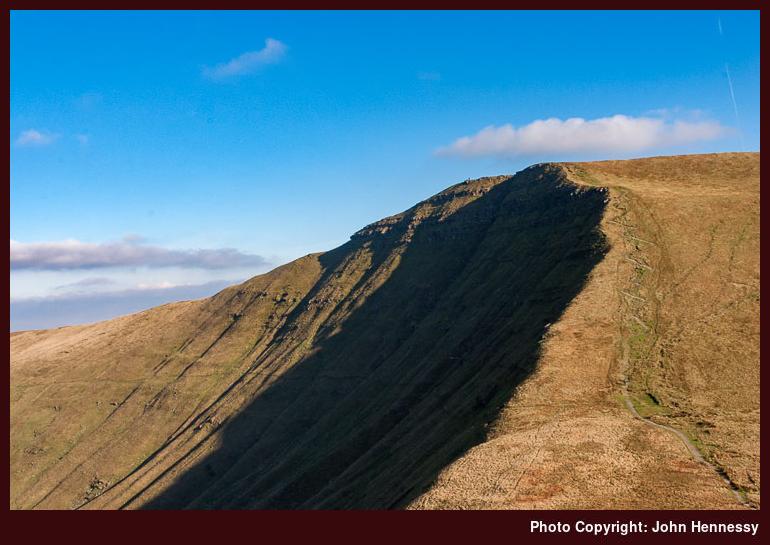
My walk took me over Y Gyrn on my way to Corn Ddu and then Pen y Fan, the highest hill in the national park. Cribyn was a tempting proposition, but for the amount of up and down that would be incurred to reach its summit: I decided to leave it for another day and picked up a path on its southern slopes that took me to Bwlch ar y Fan. The steep sided Fan y Big presented itself there, and I was tempted by a partial ascent of Cribyn from its less steep side before returning to the aforementioned pass (bwlch is the Welsh for pass, just as bealach performs the same function in Scots Gaelic) and made my way to Brecon before dark. I now realise that ascending Cribyn and descending its northern spur was a distinct possibility, but I decided to play it cautious on my first visit to these hills.
After some good walking on a clear, sunny day, I left Brecon on the X43 to Abergavenny with a view to returning: there is a good deal to experience here. From Abergavenny, rail got me home by 21:00 with a train to Stockport for a connection to Macclesfield, an early finish; the start was early though with a 06:10 bus departure to get me to Crewe for the 07:18 train to Abergavenny.
More on Transport Arrangements
There was a time when getting to Brecon from the north by public transport was not such an easy task. Apparently, connections were possible from Cardiff and Merthyr Tydfil but would have added to the journey length. The ideal situation would have been the provision of sensibly timed buses from Abergavenny train station to Brecon; these have, in fact, materialised in the form of the X43 Abergavenny-Brecon-Merthyr Tydfil-Cardiff service run by Sixty Sixty Coaches. Sadly, it does not run on Sundays, but this is an improvement on what was previously available. Nevertheless, it has allowed me to travel from home, walk from Storey Arms over Pen y Fan to Brecon and return on the same day (not as long a day as you might think…).
Exploring the Pennine Way
3rd November 2006 Last Sunday was not the first occasion that I walked along part of the Pennine Way; I already been along different sections at different times and in no particular order. Given that its southern terminus is at Edale in Derbyshire, not that far from where I live in Cheshire, my acquaintance with the long distance trail should come as little surprise. Last Sunday took me from Torside reservoir towards the Snake Pass but a sunny Saturday in September 2005 saw me journey along the Way as part of a walk from Edale to Glossop. Before that, I journeyed from Marsden in Yorkshire to Hadfield in Derbyshire, taking in another part of the way on a day that started out glum and ended up glorious.
While all that means that I trotted along most of the way between Marsden and Edale, there are other short sections on which I have been as well. For instance, in July 2002, I walked from Hebden (near Grassington in the Yorkshire Dales) to Malham via the Dales Way, Mastiles Lane, other paths and, of course, the Pennine Way. That meant that section between Malham Tarn and Malham has been visited by my boots. Another short Yorkshire section that has received attention from my boots is that around Pen-y-Ghent in Ribblesdale: the Way goes right over this member of Yorkshire's three peaks (not ideal for tired legs at the end of the day, then).
Reviewing this uncoordinated series of visits has got me thinking: what about a concerted effort? I am not talking about doing it all (or the parts that I have yet to encounter) in one hit but planning to complete it in sections rather than the hotchpotch approach that I have taken to date. For instance, I have been looking a hill day staring in Marsden and heading to Littleborough, Todmorden or Hebden Bridge, depending on how fit I feel and the length of the day. Another thought is to have a look at the northernmost sections around Bellingham and Kirk Yetholm, its northern terminus. Both are reasonably accessible with regular bus services. Then there is everything in between; Terry Marsh's Pennine Way (published by Dalesman) and a good deal of travel planning will help to make inroads on that front. This venture would take me into areas where I have to encounter and some that where my encounters have been so fleeting that they may as well not have happened at all. Alfred Wainwright (of Pictorial Guides to the Lakeland Fells fame) may not have liked this long distance trail but the idea of completing it all or just seeing more of it seems an appealing prospect to me.
A Pennine Way Stroll
1st November 2006 Last Sunday, I did get out to enjoy the unseasonably mild sunny day that was on offer. My journey by bus and train (bizarrely, the first train service to Manchester from Macclesfield on Sundays is 11:26: a fact that must have filled up the 09:05 Arriva 130 service that I used) took me to Hadfield in Derbyshire, where my walk started.
From Hadfield train station, I proceeded along the somewhat disfigured Longdendale valley to pick up the Pennine Way. Flooding what must have been a pleasant dale to create a series of reservoirs might be forgivable these days, but setting a line of pylons marching along it seems a contemptible notion. In the days when electric coal trains plied the now defunct train line, they might have thought that few would have noticed, especially given the presence of the busy A628. Now that the line terminates rather untidily at Hadfield, the former railway now forms the Longdendale Trail, part of the Transpennine Trail. Even with the apparent diminution of the place, the old rail-bed is used by many walkers, cyclists and horse riders who must be able to see past the blights littering the landscape. While photography is a tricky proposition with the wires and the pylons, I have to say that I can see the attractions too.
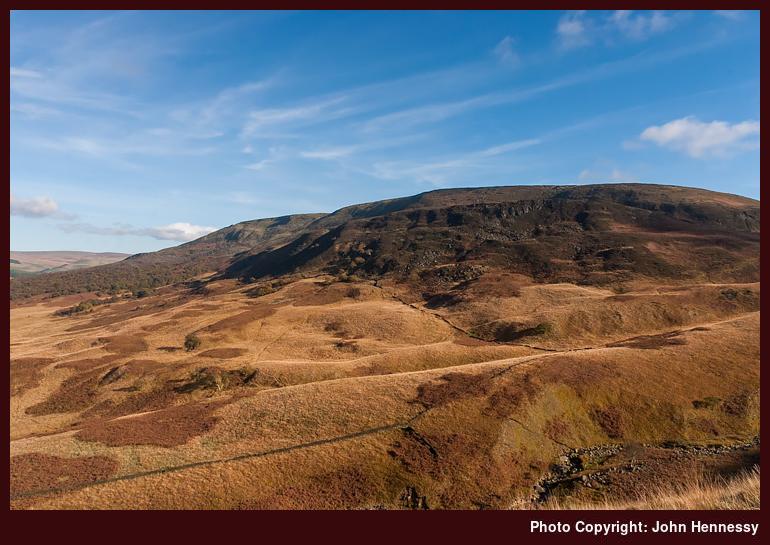
Once I picked up the Pennine Way, I headed more or less south from then on. The path climbs up beside Torside Clough before swinging west to Bleaklow before turning south again to follow Hern Clough and Devil's Dyke. However, along the way, I made an unintentional diversion, but it was nothing that a sight of the Wain Stones couldn't fix. This really is featureless moorland country and a GPS would make a useful safeguard, especially when clag comes down. When I got back on track, the stone waymark posts of the Pennine Way served a very useful purpose, particularly around Bleaklow Head and when hopping over and back across Hern Clough (the proofing of my boots was well tested).
I continued along the Pennine Way until it met the Doctor's Gate footpath that took me to Glossop before the light had faded too much. This right of way is classed as a bridleway, but I cannot see anyone cycling along it for a lot of its length, and I suspect that the same may apply to horse riding. In some places, attention is needed due to landslips, particularly on the section right next to Shelf Brook, though there is a section high up the valley that makes one think. Nevertheless, none of this stopped me reaching the pleasant town of Glossop and its train station, where a waiting train conveyed a tired but satisfied Irishman to Manchester Piccadilly for his train back to Macclesfield and home.
Postscript: Winter has arrived...
After a period of very mild weather, a spell of winter chill has arrived on cue for the first day of November (Irish primary schools used to teach that this was the first day of winter; I am not sure what happens these days). This is the type of weather that makes me look for my Karrimor Polartec gloves and think about making use of my excellent North Face Nuptse down jacket; the latter was purchased from Blacks earlier this year ahead of a business trip to Lund in Sweden. October had its share of wet weather but cheered up at its close with weather that wouldn't disgrace a summer day. Now, we have a seasonal cold dry spell to return us to reality, but the walking continues: I was wondering what to do at the weekend. The days may be shorter, but walks can still be done even with the change from summer time to winter time last weekend, a sharp shock if ever there was one.
Northumberland revisited
2nd October 2006 On Saturday, I got to revisit Northumberland and expand my knowledge of the county. The start was early but I did get to Newcastle-upon-Tyne by 10:40 and travelled north to Berwick-upon-Tweed aboard a rail replacement coach that very nearly got me there in time to catch the 12:00 bus to Wooler. Along the way, I caught glimpses of Bamburgh castle and Holy Island in the distance. I had plans to catch a bus back to Belford and walk to Bamburgh, and maybe beyond, before catching a bus back to Newcastle.
However, the call of the Cheviots proved too strong and I ended up in Wooler by 13:50 (a bit late, I know) after spending a little time taking in a little of what Berwick has to offer. In the glorious sunshine, everywhere looked fantastic but I had to choose between coast and hill and it was a difficult choice. After spending a few hours of exploring a section of St. Cuthbert's Way, I continued to Alnwick where I only spent minutes before continuing back to Newcastle on a bus that took me round by Alnmouth (where I had been in January), Warkworth (home to an enticing castle) and Amble before it made its way to Morpeth and its final destination. From there, it was the railway that returned me home after a worthwhile day that had its share of tight transport connections, especially on the way home.
Following my ramble, my ideas and plans for exploring Northumberland have firmed up a little more. For the Northumberland National Park, there are a number of gateways with reasonable public transport options: Haltwhistle, Hexham, Bellingham, Rothbury, Wooler, Kelso and Kirk Yetholm. Now that I have been to Wooler, I can continue my explorations at leisure (all going well). St. Cuthbert's Way, mentioned earlier, passes through the Cheviots on its way from Melrose in the Scottish Borders, before heading across Northumberland to its destination on Holy Island. The route reflects that taken by St. Cuthbert himself through his life. Alnwick, while home to historic Alnwick castle (home of the Duke of Northumberland), is also sited in hill country of its own and worthy a little more attention. Northumberland's coast remains an attraction with places like Amble, Warkworth and others worth revisiting. In addition, I have recently learned that a long-distance footpath following this coast and there is a good supply of cycle trails as well. With the land near the coast is reasonably flat as well, which makes cycling a viable option.


