Category: Europe
Emerald Inspirations
 21st April 2012
 A trip to Ireland in March may have taken the form of an elongated weekend that involved no hill wandering (there was some urban trotting around Limerick that took in its People's Park and Arthur's Quay though) but the warm sunny day on which I needed to leave the place to return to the U.K. left a more lasting impression. There has been perusal of issues of Walking World Ireland too so it might be no surprise to hear that my mind (if not my heart) began to ponder a hill wandering excursion to follow my ascent of the Great Sugarloaf in Wicklow a few years ago and a trot around Howth Head last year.
Though sunshine was hazy and skies milky, thoughts of staying on my bus from Limerick to Shannon Airport all the way to final destination of Galway were very tempting. The ambience was very much of the feeling of summer days when we get the sort of weather of which so many of us dream. On looking down while flying across Ireland en route to Manchester, the extent of the haze was unmissable yet various hilltops protruded from low cloud. In fact, I reckoned that I could see the tops of the Galtee Mountains along the Limerick-Tipperary county boundary and I wouldn't be surprised if we passed over Slieve Bloom too. On the eastern side of Ireland, the sprawl of the Dublin and Wicklow mountains was there to be survey and I fancy that I picked out Poulaphuca reservoir near Blessington in Co. Wicklow too.
After the summery feel of March, April has plunged us into atypically chilly temperatures and typically showery weather; maybe that's why I am weathering a cold as I write these words. That made for a less than glorious Easter weekend that I spent doing some spring cleaning and tidying. If we had got the sort of weather that we enjoyed around Easter 2011 and the following Mayday Bank Holiday weekend, then I might have been tempted to follow up those thoughts of Irish explorations. After all, curiosity had me survey photos of Wicklow's hill country and antiquities on a few royalty-free stock photography websites and much of what I saw left me thinking that I might do better myself; it would make a good excuse to go across the Irish sea to survey the delights of picturesque Glendalough for the first time. For now though, that's on a waiting list.
Weather and workload has meant that I otherwise haven't been doing much wandering around hill country than a short trot up Nab End near Bollington. The hoped for extensive views over Pott Shrigley failed to materialise. That's not to say that I didn't content myself with what I found because I also managed to have the place to myself, something that would be said for the Kerridge ridge on the same day. A cycle that took in both Bollington and Pott Shrigley was what allowed me to sample Nab End's delights so there definitely were no complaints from me even if cloud rolled in to blot out the sun during the afternoon. Rediscovering a little more in the way of motivation not only would get me to that Irish waiting list but would send me out among Macclesfield's hill country more often too.
Following a North Sea coastline
12th March 2012 After having thought of it for a few Saturdays, I finally sorted myself for a walk by Northumberland's coastline from Alnmouth to Embleton. It had been January 2006 when I last walked from Alnmouth to Craster. Then, the hoped for combination of blue skies and sunshine didn't materialise so photographic opportunities were limited. While amazed at how long it took for me to follow up on the earlier visit, there was set to be no problem with the weather for February's visit. In fact, I was playing with the idea of an overnight stay with a less taxing Sunday to follow a coastal on Saturday, but returned home that night and went for a short cycle around Macclesfield and Bollington the next day. Limbs may have been tired, but both places saw the sunny that didn't come their way the previous day.
Having not been there for more than six years made for imperfect recollection of the route as I found out more than once. It also made for changes such as extra cycle paths added by SUSTRANS for their Coast and Castles cycling route (NCN 1). This was what I discovered at the other side of a hedge while going from Alnmouth train station to Alnmouth. Also, there was little sign of the Northumberland Coast Path when I came this way last and it's made an appearance on maps since then as has St. Oswald's Way, with which it shares some of the same route. Nevertheless, there was little sign of waymarks for the latter and those for the former had become faded so I really needed a newer map to be sure of the line of my route.
After a road walk took me from Alnmouth railway station, I reached the village of the same name. Prior to entry, I stopped on the bridge over the River Aln to see if I could make some photos before continuing on my way. In my haste to set off walking along the coastline the last time around, I avoided Alnmouth's pretty main street on my first visit, but this omission was remedied this time around. Everything may have been a little too close together for photos but it was good to savour it all the same. At its end, I picked up a coastal path and trotted along it before dropping in on a handy public convenience.
Rather than sticking with rights of way that cut through a golf course, I opted for a well trodden path up by its coastal side before cutting a little inland to pick up the Northumberland Coastal Path again near Marden Rocks. Then, it was onto Foxton Hall, the hub of yet another golf course and one of which I oddly have no recollection from my first passage by there. That may explain my need for establishing my route onward from there before I dropped onto the beach as the right of way dictated. For those occasions when high tide obstructs the route, there is an alternative that goes by public footpath and road.
To get to Seaton Point, I needed neither though walking over loose stones was less pleasant than threading on grassland and reaching wet sand didn't come a moment too soon. Then, it was a case of rising up off the beach to reach Seaton House and its assorted collection of summer houses, by which the right of way passed. Beyond those, it was straightforward and quite undisturbed walking to Boulmer. The OS map may make it look as if you are going along a beach for much of this but I was walking on grass turf for the most of it.
At Boulmer, the signed restrictions on the taking of fishing bait from a proscribed area were a curiosity, as was that of the local sea rescue service. The first was the business of Alnwick District Council while it surprised that the second wasn't that of the RNLI. They say that there is an independent spirit in Northumberland so that may be part of the explanation for that state of affairs.
Leaving those curiosities behind, I continued with heading north by using a byway open to all traffic that is an off-road section of NCN 1. At this point, I began to veer away from that around Longhoughton Steel and got in generous views up the coast towards Bamburgh Castle. The perceived distance did spur me along, but there was another deviation from the line of the trail before I decided on keeping to its line more rigorously. Twitches in muscles may have helped to convince me of the sense of this, but there had been no loss of route completeness since I have been the way before anyway.
Around Iron Scars, I left the byway after me to pick up a footpath. Since I was beyond where the end of a road leading out from Longhoughton, there were more folk about now than was the case earlier and families were among them. Views were shared and I shortened the distance to Rumbling Kern. Beyond there I passed Howick and noted improvements to the path since I last had been this way, particularly the part that shadowed a single - track road.
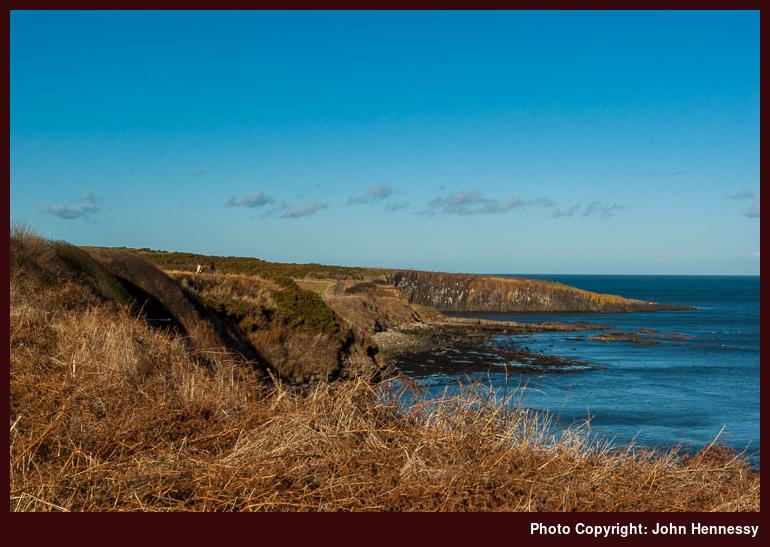
Cullernose Point was growing ever closer now and the proximity of Craster was yet another explanation for how many were going the way along with me. The glorious day must have drawn them too, as did the school midterm break. The weather certainly was a departure from the struggles that the sun had in effecting any light on cliffs when I passed this way before. The result this time around was a feast for the eyes and there remained quiet spaces at which I could stop awhile and take it in before the path took me up onto Long Heugh and over by those same cliffs.
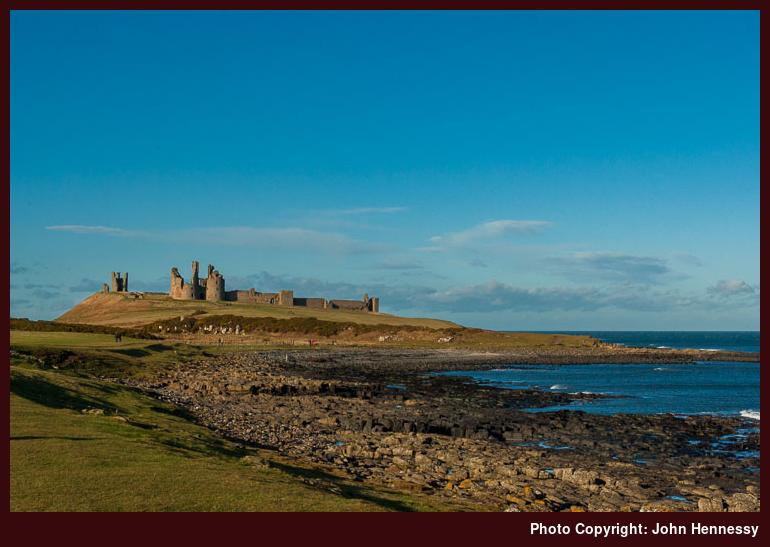
The progress into Craster was good and the sight of Bamburgh Castle was luring me along though Craster is a not unpretty spot either. Last time around, it was at this point that I decided to turn around before without passing the nearby castle at all. With time in my favour, I decided to set that piece of unfinished business to rights.
What an English Heritage monument like this wasn't going to offer was having it to myself so getting photos like what you see above needed some patience. Nevertheless, good things come to those who wait and a few uncluttered photos of the ruin were mine to keep. It was below the castle that I decided to continue to Embleton after making good time from Craster. Unfortunately, there was no time to dawdle around the castle itself, but that can be an excuse for another visit, never a bad thing.
Beyond the castle, I noticed a defensive element not apparent from the south: a cliff face. That would have made it difficult to approach from the north so they had cut down on one option for attack. It's being atop a hummock too must have helped until the age of the cannon finally did for the fortification. The ample views up and down the coast must explain the position of the castle too. Maybe that's also why so many spend time around there.
The rest of my walk was to carry me across yet another golf course; they seem to be plentiful in these parts, perhaps because of the sandy soil. While the public footpath weaves its way across the course, the coastal path takes a less intrusive line by following its boundary. Nevertheless, there were waymarking posts directing those who fancied using the former, though the later would be my personal preference.
Light was declining at this stage and I reckon that time went faster than I'd have liked it to go too. Maybe I dallied as I walked along, but a reality check around Dunstan Steads saw an end to any sense of dawdling. From then, it was with a sense of purpose that I reached the end of the road from Embleton and then dealt with the height gain to reach the village itself. Travel contingencies were emerging in my mind but I was in time for a double-decker bus to pick me up from the front of the Dunstanburgh Castle Hotel, even if I was unsure of its being an official stop; others with signs were to be seen later so that's useful information for future excursions.
In the fading light, it was a curious experience to feel the undulations of Northumberland roads on the top deck of the bus. It weaved in and out of Craster (telling me where the main bus stop is to be found) before making for Longhoughton and passed Boulmer RAF Helicopter Station before going through Lesbury on its way to Alnwick. It was along roads like these that I trotted to return to Alnmouth train station on my first visit to the area, with a head torch being needed south of Longhoughton. This time around, I was able to relax, rest my limbs and let the bus do the work while I pondered a return to explore Alnwick itself and other places besides. Northumberland remains a place of unfinished business for me, but the same can be said for anywhere that I have visited, if I am to be honest about it.
Travel Arrangements:
Train travel from Macclesfield to Alnmouth with changes at Manchester and York. Bus service 501 from Embleton to Newcastle and train travel home again, changing at Manchester.
A trot through three counties
4th March 2012 In 2011, most of my walking trips took me outside of England, with both Scotland and Wales featuring strongly. The first outing of the year took me to Wales, and trips to other Celtic countries followed before any sort of hike took place on English soil and took until April before it took place. It was July when what might be called a more extensive trot through the English countryside, and that took me from Wooler into Scotland. A Friday outing in December was an exclusively English affair when I visited the part of Shropshire's hill country near Church Stretton.
Part of the reason for that delay was how busy my working life in the early months of last year, and it was to be a continuing theme for the rest of it too. With that in mind, I have been playing with ideas that involve explorations of the countryside that lies not far from where I live. As if that weren't enough encouragement, a quick journey over the hills to Buxton on the second day of this year reminded me of how glorious the hills between there and Macclesfield appear when the right light falls on them. It was as if it ensured that I got out among them when the next opportunity arose.
That came a week or two later and took me from the Cat and Fiddle Inn to Buxton, using the upper reaches of the Dane Valley Way for much of the walk. Thinking about the walk since reminded me of how many walks started from or ended at the Cat and Fiddle Inn over the years. With that in mind, I was planning a preamble for this piece that recalled them, but it grew too long and became a posting in its own right.
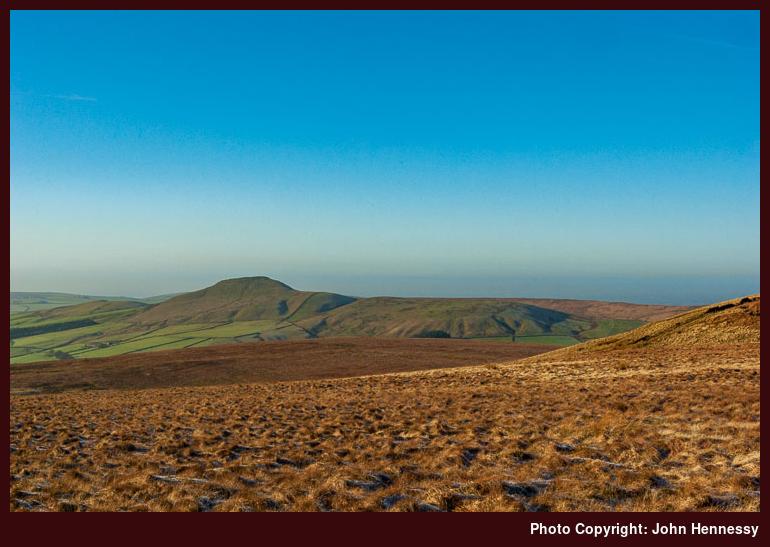
The track south from the Cat and Fiddle Inn is one that I have traversed a few times before, yet never with the type of weather that I had on my most recent stroll. The quality of the light falling on the surrounding countryside was enough to have me stopping and admiring the surrounding countryside. Naturally, a camera was set to work too, and the passage by Danebower hollow may have taken longer than it otherwise might. Well, I had grey skies the first time that I passed this way and plenty of clouds abounded the same time around. Neither were frustrating, but they seemed to ensure that I made the best of near perfect photographic conditions.
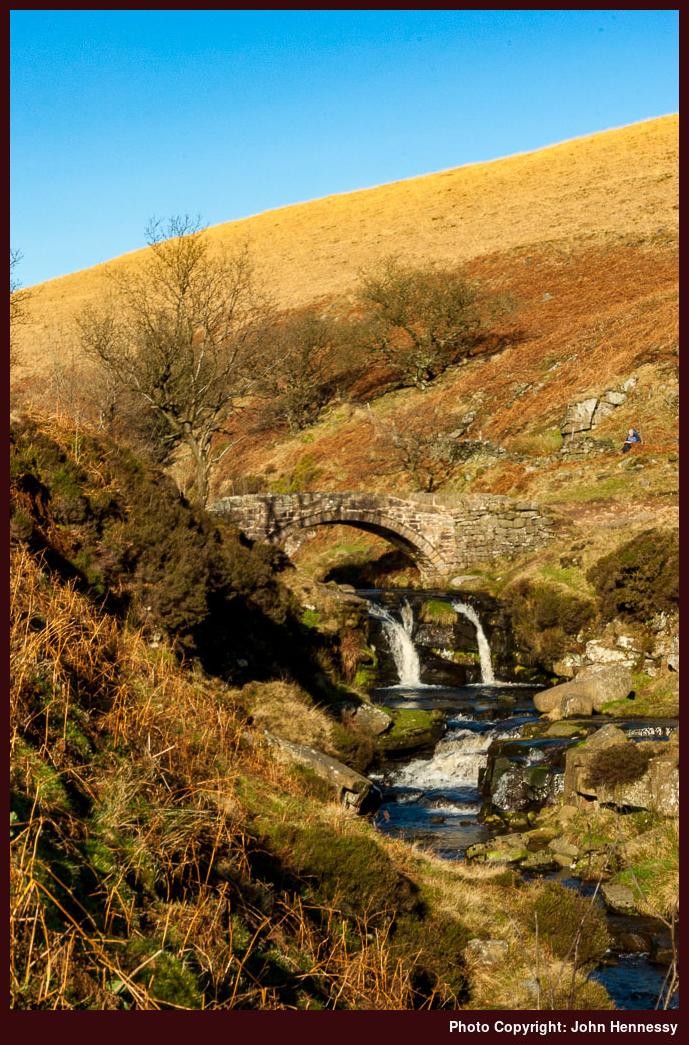
Though I wasn't certain that reaching the A54 should have taken as long as it did, that didn't mean that a course deflection wasn't about to happen. Noting the time that I had until sundown and the distance to be covered, I decided on deviating around by Three Shire Heads. This is home to a well-known packhorse bridge, and I fancied having a go at photographing it in what I considered to be good light. That meant forsaking the frozen ground of higher reaches for more waterlogged parts as I followed the River Dane towards the bridge. It was a reminder of how soft the going was the first time that I passed this way, but I was rewarded when I got to the bridge that was my objective.
Others were about enjoying lunch around there, and who could blame them? It's a good place for such an activity and there are plenty of nooks and crannies where you can stay awhile too. Though it isn't near any conurbation in particular, I was to be surprised by how many folk had gone and congregated in the vicinity. That's not to say that the area was overrun though and none really in the way of my photographic efforts.
The waterlogging of the Dane Valley Way south from the A54 encouraged me to a different course on continuing to head towards Buxton again. That involved following public footpaths by Panniers Pool and Blackclough until I reached the Dane Valley Way. Though I can understand that a long-distance trail following the course of a river should try and keep as close to the watercourse as possible, I must admit that my deviation seemed to me as being the more pleasurable as it took to higher and sounder ground though there was some sogginess in places.
For the sake of completeness, I decided on returning to my southward turning point again. If time was an issue, I wouldn't have bothered, but there's never any point in rushing things either. Doing this took me by the now unused Reeve-edge and Danebower quarries and revealed that the Dane Valley Way leaves the course of the said river for its later stages, hence the comment that I made earlier. The first of the quarries that I passed were north facing, so plenty of frost remained on the stones that littered the ground. That's not to stay that the path was icy, though, but a spot of due care and attention was in order too.
That last observation especially applied to the crossing of the Dane on steeping stones. If there was less water, fording might have been an option, but that wasn't the case, so careful steps and studious use of walking poles got me over and back as required; the latter proved to be the easier crossing of the two so it must have something to do with the positioning of the stones because I doubt that it had anything to do with practice.
A quick and back trot made good a missing piece of a long-distance trail. The river crossing added ups and downs to this too, but there was a time for taking stock before proceeding towards Buxton in earnest after a diversionary amble. That revealed that I should make my destination before the light failed completely, so I set off again.
On approaching the steeping stones, I passed more walkers who had stopped for a spot of lunch nearby. A few words were passed about the crossing before I was on my way again, and I mentally noted how much quieter was their lunching spot in comparison with that of others. Putting Reeves-edge Quarries behind brought me past another walker that I had seen stopped at Three Shire Heads earlier; this one was altogether quieter than the other two, though.
Quietness was to pervade for much of the remainder of my walk too, with the Dane Valley Way twisting and turning its way above Blackclough and with Knotbury Common across the valley from me. Oddly, the trail goes down to the road near Orchard Farm when there is an alternative right of way that cuts out the attendant descent, re-ascent and road walking altogether. Nevertheless, I stuck with the trail though route finding was a little bereft of waymarking and correspondingly dependent on my map reading skills until the road was reached. To my relief, all was done without a hitch. It was then a matter of continuing past both Orchard Common and Cheeks Hill. This stretch was to be shared with other walkers who were out and about and with no perturbations, either.
The source of the River Dane is a soggy bog, but it was partially frozen, so its crossing wasn't as muddy an affair as it might have been. Still, the course of the path was unclear thanks to constant erasure by the wet ground, a phenomenon that I have perceived elsewhere. Thankfully, this is all Open Access Land so no one is going to pick an argument with you about following a line on the ground and the road was reached soon enough.
That brought views towards the Cat and Fiddle Inn and reminded me of the sort of course that I had taken. Then and after I had left the road to cross Axe Edge Moor, I reckoned that I was making out the back of both Shining Tor and Cats Tor, with both throwing the Goyt Valley into shadow. It was yet another reminder of how often I have trodden these parts over the last decade.
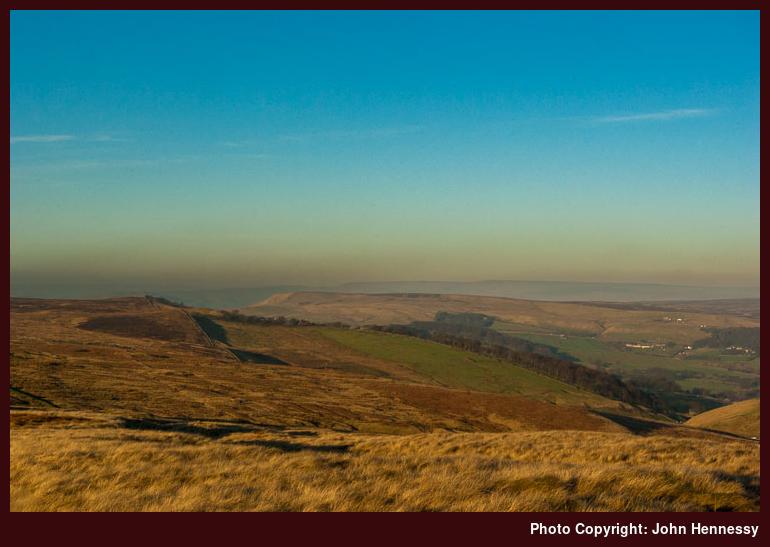
As I was crossing Axe Edge Moor, the declining height of the sun could not be missed; it was a reminder of the coming end of the day. Looking to me right, I thought that I was making out the trig point marking the top of the hill, and looking straight ahead drew my eyes towards the descent of the A54 as it approached Buxton. That told me that my walking destination for the day wasn't so far away, a reassuring thought at that point in the day.
Crossing the A54 took me to the next stretch of the trail, though I now wonder is I followed it so exactly; sometimes it's best to follow things in spirit and not to be overly concerned with complete precision. Another crossing of the same road, got me onto a byway and public footpath that needed a stop for map reading to be sure of my course. The A53 (Buxton-Leek road) was the next thoroughfare to be crossed before that in turn was left for Grin Low Road. While the HSE laboratories near Harpur Hill lay in the near distance, I was seeking to head to Grinlow Country Park instead.
The latter is owned by the local council and proved to be easy to find and had an open public convenience too. The next stage of my walk proved to be a little confusion when it came to route finding because of all the micro-detail on the ground. Though I had scotched in the idea in my mind, I ended up taking Solomon's Temple (also known as Grinlow Tower), a folly. There were good views from the top of this even in the declining light, so I quite fancy the prospect of returning to it sometime. As if to prove how frozen the ground was underfoot, I even embarked on an unplanned slide when my boots lost purchase on it. All stopped very quickly and no one took any notice of my little adventure, so there was no embarrassment either; the views must have been as appealing to them as they were to me.
With that little reminder of frozen ground, I picked my way back to the trail that I was following with more care. Light really was failing as I went down to Poole's Cavern and a snow-covered field looked like a car park, though that deception was short-lived. Once in the real car park, I decided that there was no more time for dawdling because of when the next bus to Macclesfield was leaving. Due to keeping a keen eye on time, I made it too, and that was thanks to a little shortcut that I discovered on the second day of 2012. Not only was it the cause of getting me out there in the first place, but it also helped to get me home a little sooner in the day too. Hopefully, it will continue to help with future outings, too.
Travel Arrangements
Bus service 58 from Macclesfield to Cat & Fiddle Inn. Same bus service from Buxton to Macclesfield.
A hub for numerous hill country wanderings
3rd March 2012 January's walk from the Cat and Fiddle Inn to Buxton caused me to recall other walks that started or ended at the Cat and Fiddle Inn. When I set to pondering the trip report for that hike, the idea of collecting them together as a preamble to the trip report was stymied by there being so many of them over the years and there could (and should) have been more than these.
Thus, that planned preamble has been moved here. Most of those walks that featured the Cat and Fiddle Inn at some point in their route started from there, and I only recall one that finished there. Another thing that strikes me is that many of their number took place before this blog existed, so I reckon that it's no harm recalling them here. As it happens, time has made the memories of some more vague, so it's best to recall them somewhere before recollections fade further. It appears that writing those trip reports helps to reinforce memories, and it helps to be able to return to them later, too.
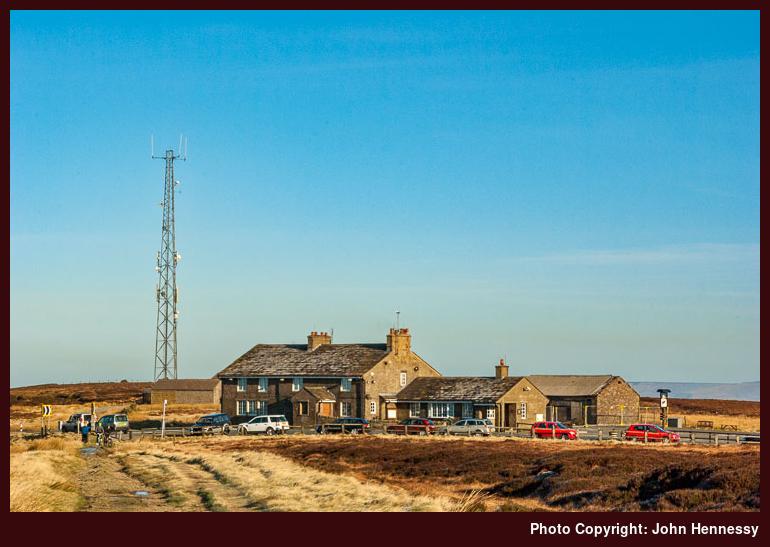
Buxton to the Cat and Fiddle Inn
The first on this list is what I believe to be the only walk from Buxton that landed me at the Cat and Fiddle Inn. It was a snowy affair and Buxton was snow-covered when I got there. Coming from the south-west of Ireland, as I do, meant that the sight remained a novelty even under slate grey skies as I lingered next to the cenotaph on The Slopes in the heart of the town. My next port of call was Poole Cavern Country Park where I passed through woodland with a white coating on its floor. That there was a snow shower as I went on my added to the magic of the experience.
From there, it was a matter of stitching a few public footpaths together to get me to where I wanted to be to await my bus home. As I continued west, the snow cover grew more tenuous. It was patchy as I passed the HSE Laboratory, but I seem to recall seeing a snowman by the side of the A54 as I passed that way. The A537 was encountered after that, and quiet lanes got me to my stopping point for the day. Looking at the map again, it appears that I may have passed Dane Head as I plied my way, though I seem to remain no images of its appearance that day, though sunshine was not plentiful. The year is one I cannot name either, but why does that matter when the experiences live on regardless?
Following the River Dane to Rushton Spencer
There are some years that don't get forgotten and 2004 was one of them for a few reasons. The summer was a washout though I did manage to pick off the best of the weather for a visit to the Western Highlands in Scotland during August before a wet autumn descended on us. Though I did manage a sunlit visit to Snowdonia in the previous month, my main memory still remains that 2004 wasn't a great year for walking.
The weather-induced autumnal hiatus caused me to leave walking aside until early November, and I was more than ready for a walk at that stage. Thanks to the weather, sodden terrain and soft going was my lot as I hiked from the Cat and Fiddle Inn to Rushton Spencer. Though it left me with very muddy boots, the conditions did nothing to dispel the sense of satisfaction gained from getting outside again. The dirty footwear wasn't an impediment to catching a bus home that day, either, though the current state of the public finances has meant that it no longer runs these days. Hopefully, we may see a bus connection between Macclesfield and Leek again, most likely in better times.
After a soundtrack taking me by Danebower Hollow, the Dane Valley Way was to convey me for the rest of the way. This was where I met all the mud under overcast skies with a foolish footstep leaving me with a leg sunk in mud up to the shin in a gateway, always problematic places due to animal traffic and congregation. Three Shire Heads was behind me at this stage with a return needed for photographic purposes; that had to wait until January 2012, so there'll be more about that in time. Maybe I'll repeat the walk in similarly sunny conditions to refresh my memory and make the most of what's there.
Via Shutlingsloe to Macclesfield
While out on that November 2004 stroll, I spotted another footpath that caught my attention, but a few years were to follow before a hillwalking year was begun with a hike that made use of that route option. Then, I walked from the Cat and Fiddle Inn to my home in Macclesfield and took in a windswept Shutlingsloe before going down from there through Macclesfield Forest to start a more level route for the rest of the way. Then, ground conditions largely were favourable, apart from a section in Macclesfield Forest, and the day stayed dry, though the sun wasn't as free of the cloud cover as might have been hoped. It did nothing to take from the fact that 2009 got its debut as a walking year at the end of that January.
To Buxton via the Goyt Valley
March often sees a whitening of the countryside at its start and one such episode of this caused me to abandon a planned trot around the Derbyshire Dales in 2006 (shortly before I started what you find here) to embark on one that skirted Shining Tor and crossed the Goyt Valley to reach Buxton by following the Midshires Way. It was the white coating that caused the change of plan since not many scenes like that which you see above were my lot until more recent years. The result was that I wasn't going to leave this chance to go on me, and plenty of snow was trodden though there remained patches of ground that lay uncovered too. Long-time followers of these musings should be aware that I have met with more snowy conditions since then.
To Whaley Bridge via Shining Tor and Kettleshulme
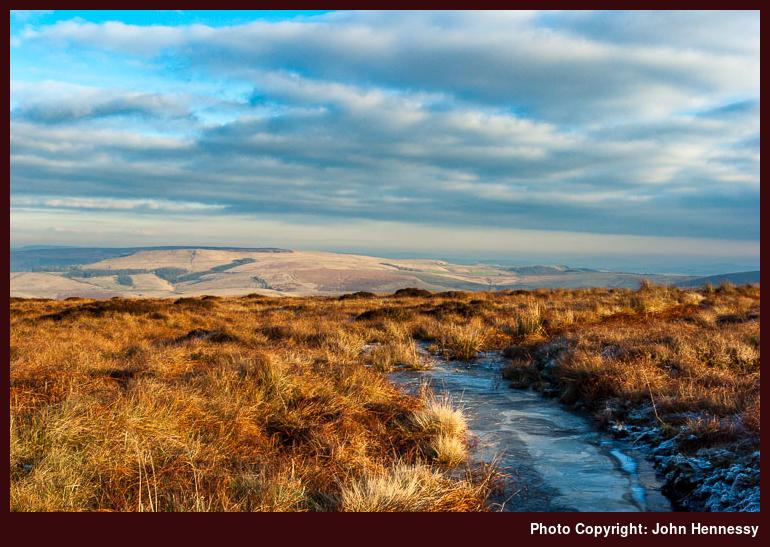
As if to pause the pre-Christmas rush in 2007, I took a day off from work and a local hike ensued. It took me from the Cat and Fiddle Inn over Shining Tor and onto Whaley Bridge via Pym Chair and Windgather Rocks. A route was found that avoided much of the B5470 to drop from Kettleshulme into my final destination for the day. The trot had taken me along frozen hillsides in glorious winter sunshine, so I didn't decry the declining light on the final stages of the walk.
To Macclesfield via Shining Tor, Lamaload Reservoir and Rainow
This was a variation of the above route that actually preceded; it might have been the overcast skies on the first time around that resulted in a partial repeat. On that Sunday, I walked from the second-highest inn in England as far as Pym Chair. Though I am making do with disjointed stored mental images, I believe that I made way from there to Thursbitch before turning in a switchback manner for the way to Redmoor and then Lamaload and Rainow. It looks like an indirect yet intriguing course of travel, and the switchback section in embedded in my mind, though I wouldn't have associated walking by Lamaload with this day out. With that surprise in mind, I reckon that re-walking this part would be no bad idea. After all, it feels that a memory bank needs refilling and there are plenty of other options in these parts. They may keep me busy for a while yet.
Reminders of past outings
20th February 2012 My first two major walking outings of this year have been in parts of England and they share one thing in common: they are reminders of past excursions. The second of these happened over the weekend and took me to Northumberland where I walked along the coast from Alnmouth to Embleton and took in Dunstanburgh Castle along the way. That recalled a trot of a cloudy day over six years ago that also started from Alnmouth but went as far as Craster before I turned towards Alnmouth train station again. Last Saturday had me hiking in far sunnier if more blustery conditions so I could make more of my surroundings in the photographic sense. Having been delighted by what I have revisited, thoughts of continuing north from Embleton as far as Bamburgh are coming to mind along with those proposing a visit to Alnwick Castle.
January's stroll from the Cat and Fiddle Inn to Buxton reminded me of an earlier outing in November 2004 (not a great year from the weather point of view so the ground was very unsound in places) that took me from the same starting point but finished at Rushton Spencer in the dark. Again, more cloud abounded on that day it was a release to have gotten out of doors even if a careless step landed me up to my shin in brown Staffordshire clay. It was with very muddy feet that I caught the bus home from Rushton Spencer that evening though there was no comment from driver or passengers.
Those two returns of a kind have me wondering if there might be more of that this year. However, I have unspent ideas from exploring other parts of Staffordshire and Derbyshire that may come in handy yet. After all, lurking on Twitter is revealing more of the delights that lie not so far away from me and that has me asking if this could be a year of Peak District walking trips. Only time will answer that question.


