Category: Europe
A Canal Bank Trot
 28th October 2010
 A few Sundays ago, I made my way onto the banks of Macclesfield Canal with the idea of making some photos of it to improve on those that I already had. In addition, I also was entertaining the thought of making a loop that took in Pott Shrigley and doing the same for there. However, I ended up sticking with the canal all the way to Marple, where it joins the Peak Forest Canal.
The day was certainly the sort that would entice you outside, and the bright sunshine was warming too. Nevertheless, cloud cover was forecast to take over the sky in the afternoon, and it duly did, yet not before I was delighted by the sights that I encountered. After getting rid of an irritating autumn cold, this was to be just the thing for getting me out in the fresh air again.
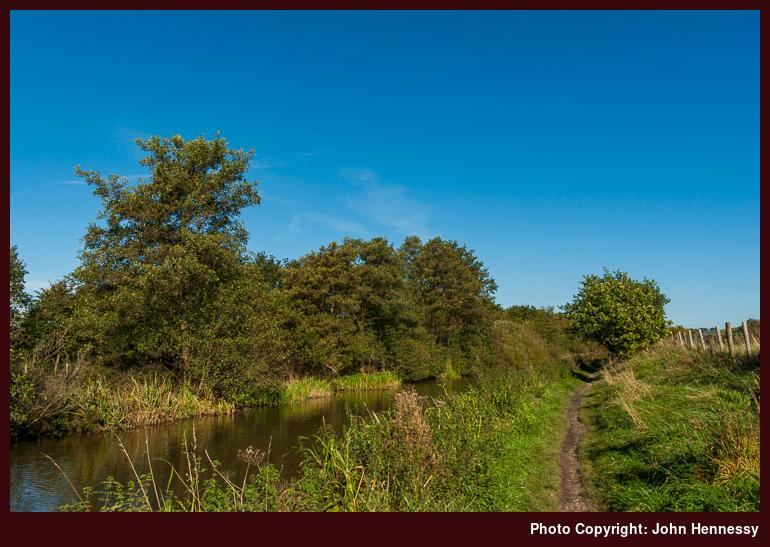
To get to the canal, I used a familiar route that took in part of the Middlewood until I rounded the perimeter of AstraZeneca's manufacturing site to reach the canal. Unsurprisingly, there were others who had the same idea as I had. Nevertheless, things weren't to get overly busy until I passed near to Bollington, where a canoeing competition meant that walkers weren't the only ones using the amenity.
It took a while after Bollington before things became quieter again, and I could relax into an unperturbed gait. At this stage, I was still not fully decided on whether I'd call to Pott Shrigley or keep going along the canal at least as far as High Lane before making my way home again. Blue skies and bright sunshine added to my indecision, but I eventually chose to stick with the canal, albeit with mixed feelings.
Those doubts were to be banished by passage through delightful wooded areas, such as those around Middlewood, later on. Near Higher Poynton, the banks again became busy with many folk strolling along them but they, as always is the case with strollers, weren't going far, and I was to have quieter surroundings from which to survey the hill country around Lyme Park with Cage Hill being identifiable thanks to its folly. It was one reminder as to how high the canal remained, even the surrounding countryside was much lower.
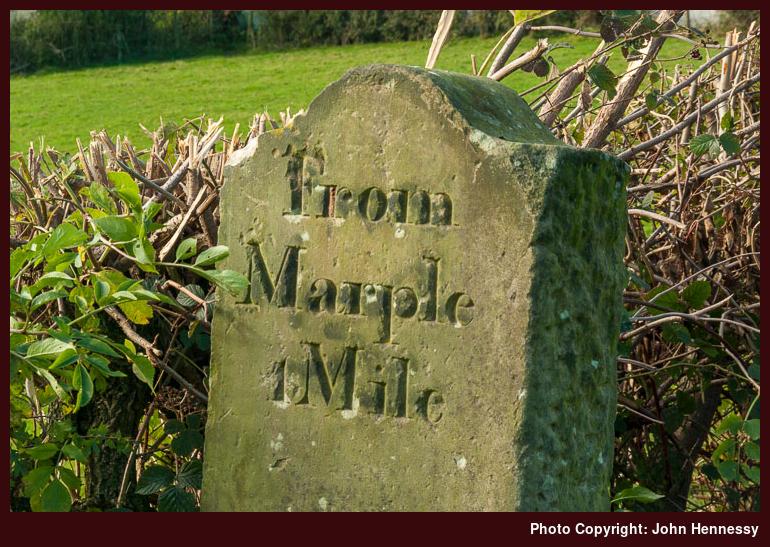
Cloud had usurped the sun by the time that I was plying the old towpath between High Lane and Marple. When travelling by bicycle to the aforementioned Lyme Park, had been along this stretch before and more than satisfied myself that it wasn't the greatest of places to be cycling. It felt somewhat to be near built up areas and have so few people walking along at the same time as I was there, but the space was welcome nonetheless. My legs were tiring by then anyway, and I was keeping a close idea on the distance left to Marple train station. One hint was the numbers on the bridges over the canal that were counting down; they must have been numbered in the southbound direction from the junction with the Peak Forest Canal.
The sight of a mill in grotty condition to my right was another pointer to my journey nearing its end, and the manicuring of the canal banks after this was in complete contrast. It was a reminder of how well-kept its counterparts around Bollington and Macclesfield are in comparison. The condition of the canal surroundings itself acted as a trigger for wondering as to how British Waterways can keep its waterways once it has transitioned from being a government to being a charity like the National Trust. A return at a time when Marple is sunlit seems in order after what I saw, and I hope that things don't go downhill for the waterways.
Tired limbs pulled me around two bridges before I was on the bank of the Peak Forest Canal and passing the locks that help to get boats up and down the incline. Along the way, I spotted a sign saying that it was 11 miles to Macclesfield. Had I really walked that far on a whim? That downward slope was nothing compared to that of the road leading from the canal to the train station. It was leading to the Goyt, yet another Cheshire river (and one that finds itself in the invention that is Greater Manchester these days) nestling in a deep sided valley. With the next train being an hour away, I chose the bus option to start on my way home, convinced that I must resume my outdoors excursions after something of a lay-off.
Travel Details:
The return journey was made using bus service 384 from Marple to Stockport and by train from there to Macclesfield.
Contemplating explorations of southern Derbyshire Dales
3rd October 2010 A reduction in outdoors outings seems to have coincided with a change of job a few months ago so I am wondering about changing that state of affairs. Whether it is the busy working weeks or something else such as unappealing weather that has broken my stride, it now feels as if usual haunts such as Cumbria or North Wales have got that little further away. The result is that I am wondering about destinations not so far away from home such as Shropshire, Staffordshire and Derbyshire.
The mention of Derbyshire brings me to a short run out last weekend. The possibility of some sun was enough to get me wondering about a photographic outing to Buxton. However, the afternoon became very grey and there was a biting cold wind too. The result was that I ended up in Ashbourne for a little while. While there, I did a little exploration and found the Tissington Trail on an improving afternoon. There was only enough time for a short stretch along the well used former railway but it was enough to etch thoughts about further explorations into my mind, especially with the rare experience of walking through an old railway tunnel included. After all, I had passed through the pretty estate village of Tissington while en route to Ashbourne and that deserves a proper visit and not just a glimpse through a bus window.
The result of my brief taste of this area was that I have been perusing Mark Richards' White Peak Walks: The Southern Dales, published by Cicerone, in the name of learning more. Though largely pastoral now, the landscape has had an industrial past that gives us the railway alignments that nowadays find recreational use as the Tissington and High Peak trails, among others. All in all, there seems to be plenty to explore and it all seems to be the sort of walking that would ease someone into the outdoors again after a layoff. That isn't to say that there isn't something for the cyclist too as I discovered a cycle hire service near the start of the Tissington Trail.
In a way, it's a surprise that I hadn't been around these parts before now. As to why that has been the case is unclear to me but perceived greater ease of access using public transport might have had something to do with it. Even so, there are a good number of bus services doing duty in these parts and there are YHA hostels (Hartington and Youlgreave) too if I fancy staying overnight somewhere and can find a space available. Now, what needs doing is to firmly pencil in some time for plying paths and trails so as to avert any fatigue-inspired foot-dragging.
Travel details:
Bus services 58 from Macclesfield to Buxton, 42 from Buxton to Ashbourne and 108 from Ashbourne to Macclesfield via Leek.
Sampling a Cicerone eBook
2nd October 2010 For whatever reason, I retain a soft spot for Cicerone guidebooks and have amassed a collection of them. Whether it is the handy presentation, the descriptions, the included maps or the authoritative coverage of many parts of Britain and beyond, I cannot say exactly but all must play a part in the buying decisions. Of all of the ones that I have, it only seems to be Walking in the Hebrides that left me unsatisfied. Otherwise, they all seem to offer what I need for route planning. Hopefully, a newer one that concentrates on Harris and Lewis is a better bet since the older title's eschewing of maps makes it hard to read and that's unusual for a Cicerone book.
A recent look at the publisher's website has put other tempting options like Ronald Turnbull's Not the West Highland Way along with Walking on the Brecon Beacons and Walking Loch Lomond and the Trossachs. Then, there's Chris Townsend's Scotland to follow at this time of writing too. It's all too easy to let the list of tempting walking titles tempt you but I managed to contain myself apart from a certain errand that sent me onto Cicerone's online outpost in the first place.
What mainly caused that errand was my apparent misplacement of my Cicerone walking guide to the Cairngorms, something that I only noticed before a trip to Royal Deeside in Scotland at the end of August. Another matter that I wished to investigate was how Cicerone's guides appeared in eBook format after their announcement of its availability a few months back; seemingly, not every title is available like this just yet. The result is that I now have an electronic equivalent of the paper volume that I have yet to find again; no doubt, it's somewhere that I haven't searched yet but experiments always are worth doing.
What Cicerone don't give you is a straight PDF with which you can do what you like and read using whatever software you choose; there's more than Adobe out there. Perhaps for reasons such as revenue and copyright protection, they make you use Adobe's Digital Editions software instead. Given that it is available free of charge for Windows and OS X, that isn't such a restriction though users of Linux/UNIX like me need to make their own arrangements but we generally are technical types that can manage that anyway. For transferring eBooks from one computer to another, you need an Adobe ID and ensure that both are authorised. It also seems that the same arrangements can make things operable for certain Sony eReaders too.
The good news is that the eBook itself is a faithful copy of the paper counterpart and very legible too, though I do have a 24" wide-screen display that helps a lot with this type of thing along with surveying any digital maps. In the software, there's a navigation pane at the left that contains a useful hyperlinked table of contents and the facility to add your own bookmarks too. Apart from those and the ability to display a double-page spread, there's not too much that I need so I come away from the experience satisfied though I do wonder at the wisdom about charging the same for eBooks as their paper equivalents and severely limiting printing too. Maybe they're trying to staunch any rush to the electronic world for now. After all, there remains a certain something about having a paper book in your hands even if their digital equivalents take up less space, a feature that I appreciate when it comes to storing music, and may not be so easy to mislay either.
On the power of price reductions and open doors
26th September 2010 Over the past two months, I have to admit that two spur of the moment purchases got made, and price reductions were partly to blame for them. Another cause was my playing with buying the sorts of items in question in the not so distant past anyway. On both occasions, I wasn't really on a shopping trip but it was the curiosity that drew me into the emporia in the first place anyway.
The first lapse took place in Chester when I popped into a Field and Trek store and spotted a Berghaus Twister Softshell jacket on sale with £30 off the normal retail price. Having realised the usefulness of a heavier softshell once upon a time when pondering outdoor gear, I came away with the thing and it has been exposed to some of the copious amounts of rain that have been visiting us over the last few months. That was enough to convince that it was capable of shedding more than a little light rain on an evening when there was plenty of the wet stuff about the place. Well, the material encourages beading much in the same way as any Gore-Tex or eVent hard shell jacket so that looks promising. There may be no hood but it's the way that I prefer them and a cap always addresses the omission. With a microfleece lining, it may be better able to deal with chilly days like yesterday than my Berghaus fleece too.
The next lapse of financial strength came upon me while browsing in the Cotswold Outdoor store in Aberdeen's Union Square shopping centre. My seeing a tastefully presented outdoors shop was enough to draw me inside it. Along the way, I spied Rab Pinnacle jackets on sale with a £50 reduction. What made me more vulnerable to the prospect was that I have thought about having a lightweight waterproof a while back and this is lighter than the Rab Latok that has given me plenty of good service since I got it nearly four years ago. It, too, uses eVent but remains untested as yet. Nevertheless, it's a good fit for me and opportunities for trying out its rain-proofing should come in due course.
After both of these lapses with my wallet, I think that I might to stay away from outdoor gear shops for a little while. Nevertheless, I was stood outside Jo Brown's in Buxton yesterday and, though I saw Paramo gear in the shop window display, my willpower held firm even though there were sale signs there too. Did having to walk through a closed door help? Maybe that's most of the chain stores leave theirs open.
Temptation can reign online too as I found when an email dropped into my inbox featuring a Terra Nova Laser Competition tent at a well-reduced price. Of course, having to get the thing delivered was sufficient to keep any cravings under control. As ever, there are more important things to be buying so building up outdoors gear wish lists is for me something that's best avoided even if it's so easy to do.
Well, it certainly isn’t all flat…
12th September 2010 A few weeks ago, I finally managed to turn into reality something that I had been considering for a while: cycling from Macclesfield to Chester. Being a journey of 35–40 miles in length, it shouldn't surprise you that I was well tired after it. However, I didn't have to use any of the opportunities that I had for letting a train take the strain until the journey that took me home again. In fact, the prospect of cycling to Knutsford and catching a train to Chester from there was a lure in the first place, though that clearly developed into something else...
Earlier in the year, I had gone part of the way in undertaking a cycle from Macclesfield to Northwich on a sunny day in March (I think!) with included an extra elbow to my route that allowed the use of NCN Route 573 from Congleton to Davenham though I did veer away from the itinerary from time to time, mainly around Goostrey. In truth, it was a tricky task to keep to a route while negotiating a rat's nest of country lanes, even if they also allowed for some relaxation so long as there wasn't a passing car. Many of these lanes were new to me too as I glided around by Swettenham, while a bit of extra time spent around Northwich ended up allowing me to sample its flashes and go around by Great Budworth among other places. All of this was to stand me in good stead for the full county crossing, though I didn't go around by Congleton and Astbury the second time around.
On paper, the journey from Macclesfield to Cheshire by bike should be around three or four hours. Whether it was because of the route that I took and my unfamiliarity with many of the roads that I travelled (route finding eats time too even if you're using the road network), it ended up taking two hours more than that, with the leg avoiding Northwich taking what felt like longer than intended. Now that I look back at the route that I took, I am inclined to think that I ended up adding some extra mileage, and that's especially when you get to compare it with the Cheshire Cycleway. Of course, taking a little time over things is not a bad thing, but you don't want to be cutting out opportunities for exploration when the travel time is too long in the first place.
Rather than boring you with every detail of the route in the narrative, I have added the full lists of roads travelled and places passed near the bottom of the piece, should you decide to trace it out on a map. Amazingly, every road in Cheshire seems to have a name, and that's more striking to someone like me who hails from a land where only urban roads are named. Returning to the subject of maps, I largely relied on OS Landranger ones for the ride, and they got me around after a fashion. As it happened, there were some moments of quandary that might have answered by my Philip's Cheshire Street Atlas had I brought it with me; that's particularly true of my search for Chester's train station or picking my way around the village of Norley. There's nothing quite like a rat's nest of country lanes and city streets for generating confusion, and it doesn't help when things aren't how you remembered them to be either.
The last thing that I had to do before setting off westwards was acquire a Landranger for the western part of Cheshire from the local branch of Waterstones. That need fulfilled, I set off under cloudy skies to get beyond Macclesfield. All was familiar at this stage, every up, down, twist and turn. So it remained until I left the A537 at Chelford to pursue what I thought to be a more direct line, though there were some deviations as I passed Peover Heath and Over Peover on the way to the A50. The sun came out from behind the clouds, too, and I really felt the strength of the sun. Nevertheless, the lanes were quiet, and I could take any undulations in my stride.
One over the A50, it was back to quieter roads again, and that especially was the case after Smithy Green and Lower Peover. It was from a quiet Plumley Moor Lane that I could gaze down on a bustling M6. Sun was in short supply at this stage and, given my feeling of its earlier strength, I wasn't too sorry. In fact, I was pleased to pass Plumley's train station after 90 minutes of cycling without having to go via Knutsford.
Northwich was ahead of me, but I was set to avoid that too. First, I needed to get across the ugly A556 to reach Linnards Lane and tranquillity again. Collections of houses like Higher Wincham and Higher Marston were passed as I commenced my circuit of Budworth Mere. It might have been nice to have had more sun at this stage, though Great Budworth was catching some. As far as I could remember, it was largely gone again by the time that I reached Comberbach, having met up with the route of the Cheshire Cycleway for the first time that way. Looking at its route again, I do wonder why I left it to stitch together my own course, but I suppose that seeing Anderton Boat Lift might have been a draw for me. It certainly has a nice public park about it, yet it did look incongruous to see folk queueing up for a boat ride with chemical workings beside them. Northwich remains industrial, thanks no doubt to the salt that is underground.
Gazing at industrial scenes is not my way of spending a day, so I continued my bumbling along country lanes. A misunderstanding landed me in Barnton, but that was resolved, and I got to sample the real peace of the lanes around Little Leigh before braving bigger roads to get to Weaverham and Acton Bridge. After those, it was onto more quiet lanes, and it was staring to feel that I was leaving hustle and bustle after me more and more as I continued west. Still, mileposts revealed that it wasn't so far away either, with places like Warrington and Runcorn all within cycling range. Frodsham wasn't far either, and the banks of the Mersey are near there too. It was if a slower mode of travel was shrinking a world that train travel had made to feel a little larger.
All along the way, the ups and downs were continuing. The heights may not have been too striking, but you cannot call the terrain flat. The reason for the Anderton Boat Lift has to be the height difference between the Weaver Navigation and the Trent and Mersey Canal. A steep sided dip near Little Leigh was sufficient to convince me of that. Well, it is difficult to forget gradients like those, and one in Weaverham left me wondering if my legs were starting to tire.
It was around Delamere Forest that the undulations really got going; the lane took on the aspect of an Irish bog road as it went through the woodland. There were ascents and descents before then too as I approached Norley, where the Cheshire Cycleway sorted a spot of navigational confusion for me. However, there is something about ups and downs in an unfamiliar area well frequented by folk and with a good number of cars about that seems to concentrate my mind all the more.
If the sun wasn't being obstructed by cloud cover, I might have appreciated the tree cover around Delamere. In fact, it would have been nice to have stopped for longer, but I was conscious of the time. One of the problems with just travelling through anywhere on a train, bus or car is that you lose all connection with what is there and what is around it. For example, I was surprised to see that Delamere was part of the Mersey Forest but Frodsham is of the order of five miles away, it is easier to see why. Amazingly, I hadn't pieced together several parts of Cheshire until I cycled through the midst of them.
One past Delamere, all was quieter again. Mouldsworth, the penultimate stop on the mid-Cheshire line for Chester-bound trains from Stockport and Manchester, didn't tempt me as a way of shortening the journey, having done enough cycling. It was as if I had travelled so far that I wanted to finish off the job. There was height to be lost too, and the gradients weren't languid either. However, things did level out, and I could relax since there scarcely was a car passing the way by then. It was early evening and I suppose that most had retired to their homes and the task of preparing for the working week.
Even the A56 wasn't so busy when I was passing Bridge Trafford and Mickle Trafford. The sun had made some progress with lighting up the countryside too, which added to the lazy atmosphere that was to pervade for me for the rest of the journey, though there was some anxiousness as I was finding my way around Chester. Strangely, it took until going under the M53 for there to be any admission that a city was nearby. It was as if places like Bridge Trafford, Mickle Trafford and Hoole Bank were all in denial about the proximity of Chester.
If I had arrived in Chester earlier, there may have been a chance for a little more photography after a previous visit there. That was not to be, and I had to deal with an unfamiliar approach and that I was cycling rather than walking. That meant a more circuitous route to the train station than I would have liked, and it would have helped if my recollections of the street layout weren't tricking me into believing that what I was seeing wasn't making that much sense. Having a tired mind as well as a tired body cannot have helped either. In the end, all of these were conquered, and I boarded a train for home. That it was a later than I had in mind was immaterial; after all, I had crossed Cheshire under my own power and ended up relaxing along the way too. While there may be refinements that I'd apply to the route, they're for another time.
Route Followed:
Macclesfield, Mill Street, Exchange Street, Churchill Way, Great King Street, Chester Road, Broken Cross, Henbury, Monk's Heath, Chelford, Peover Heath, Over Peover, Stocks Lane, A50 Holmes Chapel Road, B5081 Middlewich Road, Smithy Green, Lower Peover, Plumley Moor Road, Plumley, A556, Linnards Lane, Higher Wincham, Earles Lane, A559, Great Budworth, Budworth Lane, Comberbach, Warrington Road, Marbury Road, Marbury, New Road, Anderton, Hough Lane, Stoney Heyes Lane, A533, Little Leigh, Brakeley Lane, Church Road, Leigh Lane, Willow Green Lane, A49, B5142, Weaverham, B5153, Acton Bridge, Milton Rough, Onston Lane, Bag Lane, Norley, School Bank, Houghs Lane, High Street, Post Office Lane, School Lane, Ashton Road, Delamere Forest, Delamere Road, Station Road, Mouldsworth, Smithy Lane, Manley, Manley Lane, Morley Lane, A56, Bridge Trafford, Mickle Trafford, Dee Road, The Street, Hoole Bank, Mannings Lane South, Kingsway, Newton, Kingsway West, Brook Lane, Liverpool Road, Countess Road, Parkgate Road, Upper Northgate Street, Chester, Union Terrace, Leadworks Lane, City Road, Chester Train Station
Travel Arrangements:
Train journey back from Chester to Macclesfield, with changes in Crewe and Stockport.


