Category: Wales
Pembrokeshire photos added
 12th December 2006
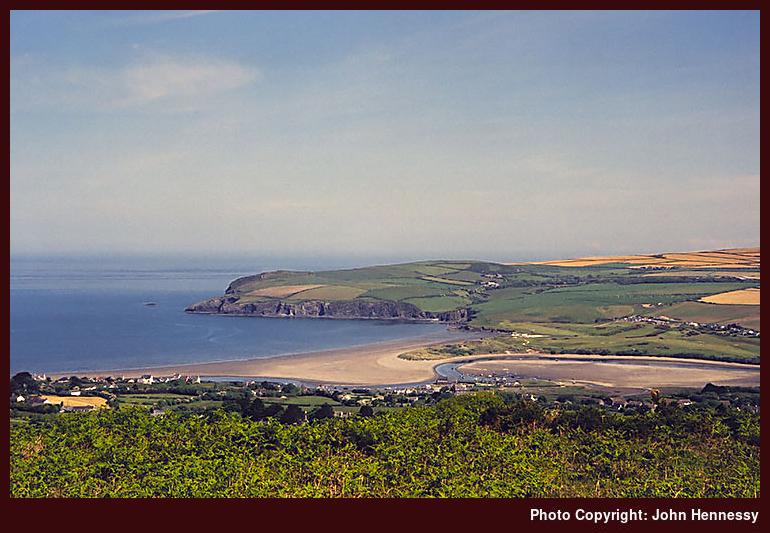
 It may have been six months since I spent some time there, but a selection of the photos that I made while out walking in Pembrokeshire have finally made it onto the web. There is now a new album to go with the trip report that was shared on here already. It was a glorious weekend visit so I hope the photos reflect the majesty of what I managed to sample while down there.
Walking the central Brecon Beacons
6th November 2006 The naming of the Brecon Beacons National Park is a plausible source of confusion because it is named after one of the several mountain ranges occurring within its boundaries. From west to east, the mountain ranges are: Black Mountain, Fforest Fawr, Brecon Beacons and Black Mountains. The first and last on the list are another source of confusion, especially when guidebook writes get them mixed up. In addition to these, there are other attractions such as the town of Brecon (which hosts a jazz festival every year) and the Usk Valley around Crickhowell and Abergavenny.
The last of these is where I have been on my previous visits to the national park. The first of these saw me walk from Abergavenny to the summit of Sugar Loaf and back. On the other visit, I walked the Monmouthshire and Brecon Canal between Abergavenny to Crickhowell, from where a bus returned me to the start of my walk.
Abergavenny has always been my entry point because of its being a stop for train services travelling between Manchester and Cardiff. However, remaining in its vicinity has always felt as if I was away from the heart of the action and tricky public connections stopped me going east until last Saturday when I visited the central Beacons, the Bannau Brycheiniog proper.
The useful X43 got me from Abergavenny train station to Storey Arms between Brecon and Merthyr Tydfil. Storey Arms is a popular starting point for walkers, as I discovered, and that was even with Cardiff playing Australia at the Millennium Stadium: the Welsh follow their rugby closely. Next time, I might start from somewhere quieter because I found it difficult to relax with people both ahead of and behind me. In fact, I have seen Storey Arms described since as a honeypot.
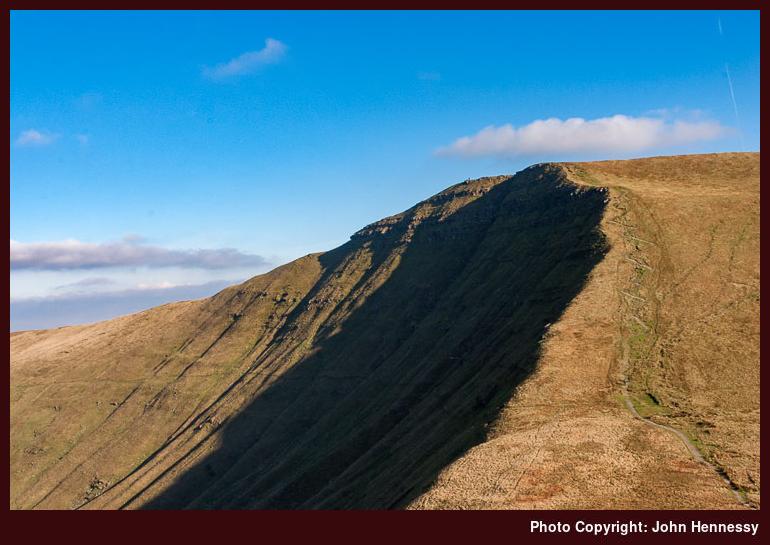
My walk took me over Y Gyrn on my way to Corn Ddu and then Pen y Fan, the highest hill in the national park. Cribyn was a tempting proposition, but for the amount of up and down that would be incurred to reach its summit: I decided to leave it for another day and picked up a path on its southern slopes that took me to Bwlch ar y Fan. The steep sided Fan y Big presented itself there, and I was tempted by a partial ascent of Cribyn from its less steep side before returning to the aforementioned pass (bwlch is the Welsh for pass, just as bealach performs the same function in Scots Gaelic) and made my way to Brecon before dark. I now realise that ascending Cribyn and descending its northern spur was a distinct possibility, but I decided to play it cautious on my first visit to these hills.
After some good walking on a clear, sunny day, I left Brecon on the X43 to Abergavenny with a view to returning: there is a good deal to experience here. From Abergavenny, rail got me home by 21:00 with a train to Stockport for a connection to Macclesfield, an early finish; the start was early though with a 06:10 bus departure to get me to Crewe for the 07:18 train to Abergavenny.
More on Transport Arrangements
There was a time when getting to Brecon from the north by public transport was not such an easy task. Apparently, connections were possible from Cardiff and Merthyr Tydfil but would have added to the journey length. The ideal situation would have been the provision of sensibly timed buses from Abergavenny train station to Brecon; these have, in fact, materialised in the form of the X43 Abergavenny-Brecon-Merthyr Tydfil-Cardiff service run by Sixty Sixty Coaches. Sadly, it does not run on Sundays, but this is an improvement on what was previously available. Nevertheless, it has allowed me to travel from home, walk from Storey Arms over Pen y Fan to Brecon and return on the same day (not as long a day as you might think…).
Catching up on my outdoor reading
28th September 2006 A brief sojourn in Ireland sparked a thought that refused to dissipate amidst the hustle of family and other obligations. As I caught up with my favourite outdoor magazines (TGO, Walking World Ireland, Outdoor Photography) a question lingered: why do we seldom discuss the public transport options for accessing our natural wonders?
Trail and Country Walking, fortunately, have grasped this concept already. Yet, even TGO, which strives valiantly to cover all aspects of the outdoors, could do more. The assumption, perhaps, is that public transport is wanting in many places. For photographers, the timings often run counter to the whims of landscape photography, best captured during the extremes of daylight. However, I suspect there's another reason behind this omission: car-using writers might simply neglect to mention alternative options when they do not use them themselves.
The Traveline phone number or website address, possibly a beacon for many a British traveller, has become synonymous with a certain lack of application in our outdoor community. Could we, as advocates and practitioners of the great outdoors, nudge them towards more providing comprehensive information? It could start with our showing where to find this; even a bus route number would be an improvement on what we see much of the time, and telling the whereabouts of the nearest bus or train stop would help, even if there is more distance to go on foot to reach a trailhead.
To embrace this new frontier, one must first acknowledge the sustainability that public transport offers, and there are times when it works better for linear hikes too. So let us seize this opportunity to redefine our outdoor pursuits, embracing the journey as much as the destination. Why don't we champion public transport, advocate for comprehensive information, and encourage fellow explorers to leave their cars at home?
Macclesfield-Dolgellau: A Public Transport Odyssey
14th August 2006 When I started this post about getting from Macclesfield to Dolgellau using public transport, it quickly grew in length. The issue is that there is no direct service between the two places and when you start combining rail and bus services, the number of possibilities is not a small one.
Once upon a time, Dolgellau was a stop on a now largely mothballed train line between Ruabon and Morfa Mawddach, where it joined the Cambrian Coast line. These days, only sections of this remain in preservation: Llangollen to Corwen, Bala Lake railway. I can understand why a single track railway line might be adjudged uneconomic in the 1950's, but I do regard its demise as a tragedy given that it would be a scenic railway journey. Nevertheless, the X94 TrawsCambria bus service performs much the same role these days.
Speaking of buses, Dolgellau is not without regular services connecting it with the outside world. The aforementioned X94 calls while plying its way from Barmouth to and from Wrexham. Another representative of the TrawsCambria network, the X32, calls on its journeys between Bangor, Machynlleth and Aberystwyth. Other services from Dolgellau connect it with the coast between it and Machynlleth and destinations to Blaenau Ffestiniog.
Getting the above to connect with the remaining rail network requires a certain amount of concentration: Barmouth, Aberystwyth, Machynlleth, Bangor, Wrexham and Blaenau Ffestiniog are some of the options: Machynlleth and Barmouth are the nearest. All of these can get you east in the end, but the itineraries, journey times and service frequencies differ: a perusal of train timetables is more than a useful exercise. Four railway lines are implicated in these: the Cambrian, connecting the Welsh coast with the English Midlands (Shrewsbury and Birmingham, for instance); North Wales, Holyhead to Chester and beyond; Vale of Conwy, connects Blaenau Ffestiniog and other places with the North Wales line; Chester-Birmingham, on which Wrexham is a stop.
Now that I have confused you with options for getting from Dolgellau to England, I will share the way that I have tended to go: X94 to Wrexham for regular bus and train connections to Chester. I know that I am going backwards here, but there is another reason for this apart from the cornucopia of Welsh journey options: there is no direct bus or train service between Macclesfield and Chester.
Yes, they are in the same county, but their 43-mile separation takes some bridging without recourse to a car. Quite possibly the quickest way to Chester from Macclesfield is by train with a change in Manchester (formerly part of Lancashire!). A slower option is change at Stockport instead of Manchester. None of these has stopped me catching a bus (Arriva, route 38) to Crewe for an onward train to Chester. There are other alternatives, but they are more complex than these. For sake of completeness, I will quickly list them here:
Macclesfield-Stoke(-on-Trent)-Crewe-Chester: involves three changes, and the Stoke-Crewe connection is the weak point in this rail option.
Macclesfield-Alderley Edge-Crewe-Chester/ Macclesfield-Wilmslow-Crewe-Chester: the first part of this is the Arriva 130 headed for Manchester and the rest is by train; the Crewe-Manchester line is plague by teething problems with a new signalling system.
Macclesfield-Stockport-Crewe-Chester: an all-rail option with the similar caveats to the above; a missed connection in Stockport last Saturday night left me enduring an annoying 70-minute wait for a connection to Macclesfield.
Macclesfield-Knutsford-Chester: looks good on paper, but the first part involves a daytime bus service with almost no Sunday service.
Before I end up writing a book on this, I better leave you in on what I consider to be the best way to go from Macclesfield to Dolgellau (yes, in the forward direction): Macclesfield-Manchester-Chester-Wrexham-Dolgellau. It is all rail to Wrexham and then the X94 the rest of the way. It will take you at least four hours, but it is the speediest of the lot.
Cadair Idris Summited
13th August 2006 Yesterday, I journeyed to Dolgellau to try to walk to the top of Cadair Idris, an objective that I finally achieved after quite a few attempts. My first trip to these parts was on a showery day in March of last year, but that was without the intention of climbing the mountain (I think). Nevertheless, I did get to within sight of the mountain and it still held on to its crop of winter snow. Just take a look below.
Further visits to the area followed; the next one was on the Spring Bank Holiday weekend. Unfortunately, no one had told me about the annual Cadair Idris hill race and I came into a Dolgellau with all of its accommodation taken up. That meant a relocation of base to Machynlleth and a complete change to whatever plans that I had. While I did do some walking around Dolgellau, my main walking was done in the hills immediately east of the seaside resort of Barmouth (Abermawe in Welsh) not far from the Rhinogs (see below) and with views of the Cadair.
When I returned to Dolgellau in July, I did find a place to stay, albeit run by an eccentric lady with a gold filling in one of her teeth, and the scene was set for an ascent of the Cadair. Being July, the day was hot and sunny; I sweated loads on the Fox's Path but I only got to Llyn y Gadair before a change in plan became necessary. I knew Fox's Path was steep on the final ascent and that it wasn't a descent route but I had no idea that it scaled a scree slope: that put paid to that scheme. I followed another path that took me along the lower slopes to join another one taking me down to the road again. On my return to Dolgellau, I encountered the start of the Pony Path and so another plan was hatched, one for the future. The next day, I remained on low level by following the Mawddach Trail, formerly part of the railway line from Ruabon to Morfa Mawddach where it joined the Cambrian Coast line, to Barmouth before returning home.
In January of this year, I carried out reconnaissance on the Pony Path in sunny conditions with the ground frozen underfoot (the slopes are north-facing) and a scattering of snow in places. Due to the length of the day and the presence of snow underfoot, the final ascent was postponed, but the stage was set for yesterday. Yesterday's successful effort involved an early start to arrive in Dolgellau at 11:00 (more on the transport logistics is in another post). By 14:40, I was on the summit of Cadair Idris being buffeted by a strong wind. By 17:10, I was back in Dolgellau awaiting the 17:20 service to Wrexham. The day was mostly cloudy with the odd spout of sunshine, but that didn't matter, and the cooler temperatures were more amenable to walking anyway.


