Category: Scotland
Stark warnings
 9th February 2009
 While out on a trot from Langdale to Ambleside on Saturday, I spotted a stark notice on a gate. It was on a path leading towards the Langdale Pikes and issuing a strong message that ice axe and crampons were needed above 300 metres in height; I was staying low with plenty of hillside bereft of snow while the white stuff made itself plain to see at higher altitudes. Of course, there have been fatalities on the "Pikes" so the strong wording was not without good cause. It was also a reminder of similar unfortunate outcomes in Wales and Scotland. I can't say that I have heard of anything like this from Ireland, but something tells that full winter conditions must be blanketing those hills too.
The trouble with official warnings is that we have seen so many that could be termed an overreaction that heretical thoughts begin to percolate into your consciousness not long after you have seen the warnings. There are those who issue shrill warnings without they being truly needed, acting in a manner akin to the shepherd boy who cried "Wolf!" in the Aesop's fable. This time around, I am inclined to think that the "wolf" is real and have got to moderating my usual questioning. This is for a number of reasons. First, the warnings were coming from mountain rescue folk, and they didn't overreact to events around the time of the OMM in Cumbria when a deluge came from the heavens and caused raging roads to turn into rivers. The other chastening observation supporting that suspension is that there have been those serious accidents and fatalities.
Another factor in all of this is that we have been spoilt with the milder winters of late. Apart from the shorter days, the occasional spell of snow and ice or a storm, winter walking became perhaps no less accessible than at any other time of year. In contrast, this winter is a sharp reminder that what we have enjoyed of late isn't always the case and preparedness for winter walking can be another matter entirely. The whiteness is attractive, but there's a certain "here be dragons" element lurking too, particularly with inexperienced folk being drawn out to enjoy the prettiness. That could be the reason behind the advice given by the head of the Lake District National Park last weekend, particularly with the school half-term holidays and their bringing more folk with many perhaps without the requisite equipment, knowledge, skills and experience (the LDNP is between a rock and a hard place: in these trying times, they need the visitors, yet safety remains vital too).
Speaking of experience, assessment of conditions is a big part of it, and any disparity between those on high and those in the lowlands makes it tricky unless you have some experience of being up high in the first place. For instance, snow coverings among the hill country lining the Cheshire-Derbyshire boundary are measured in feet while those on the Cheshire plain are inches in thickness if they lie at all. Increasing the height differential can only exacerbate that sort of difference and entrap the unwary. Saying that, it doesn't take much to realise that any whitened hills look very different to the green valley bottoms with their icy patches due to paths having turned into stream beds; that was very typical of the Langdale that I encountered on Saturday. Mountains and hills do make their own weather, and it seems that winter conditions bring that into sharp relief.
The warnings and the fatalities can make one feel that they are on the outside of a different world, looking into it. They certainly challenge any perception of readiness for winter conditions and set you to thinking, particularly about those who have been left behind by those deaths. That certainly is the case for me, but barriers should be overcome carefully rather than allowed to stop you in your tracks. Even so, the mountains won't melt away overnight, even if the snow does.
Update 2009-02-10: It now appears that winter conditions have gripped some of Ireland's hills too. In fact, the Irish public service broadcaster RTÉ has a report on two men lost on Lugnaquila, Wicklow's highest mountain with a height of above 3000 feet, after dropping their map in foggy conditions. They have been out all night and mountain rescue teams are searching for them, but there is a glimmer of good news: mobile phone contact has been maintained throughout. Let's hope it all ends well.
A look back at 2008 Part 3: Beyond Midsummer
17th January 2009 Midsummer in 2008 might have been a time when I felt that the year had peaked, and the encroachment of unsettled weather may have had something to do with that view. Certainly, the year will not be remembered for having a sunny summer and many were disappointed, even if it did have its better interludes.
Personally, I reckon that it's best to try and enjoy what is visited upon us at any time of year, and seem to have come to the conclusion that the traditional summer holiday season is overrated. There may be more hours of daylight but, if the days get too hot, it may be worth sticking to the cooler parts of the day and that reduces the amount of time available for wandering through the countryside anyway, perhaps restricting the time available until it is not that much different from spring or autumn anyway.
Even with the feeling that the second half of a year feels like an anticlimax after the first, I continued to get out into attractive countryside. I found hot sunny weather in July, was extremely lucky with my visits to Scotland in August, had an easier September and October before taking advantage of numerous wonderful opportunities in November and December. There was much to behold, so here are a few recollections of it all.
July
In walking terms, July was another fallow month, with a sun scorched saunter along the Offa's Dyke Path near Welshpool at the end of the month being the main trip of note. Otherwise, time limited by other activities ensure that most of my major outdoor activity was to be cycling rather than walking. The month's mixture of weather contributed too, but I was feeling that the best of the year had passed by this time anyway, and began to wonder if the timing of the school holidays was more than a little nonsensical. I also got to mull over island wandering as a possibility for my now habitual longer Scottish walking break. My few hours on Kerrera in May may have had something to do with this inspiration coming upon me, and I felt the need for a longer break anyhow.
August
The main even in August was that island hopping trip to Skye and the Western Isles. Though, anyone surveying the weather and the weather forecast on the eve of the trip might have questioned my sanity for even considering what I was about to undertake. In the event, I struck the jackpot: while other parts of the U.K. and Ireland were getting a soaking, I managed to find wonderful sunshine and avoid those downpours. That was thanks to the belt of rain getting stuck across the north of England and the south of Scotland. Harris was to prove the highlight of the week, without Skye failing to satisfy or the peace of the Uists being forgettable. However, it does need to be said that South Uist felt a little like an anti-climax after Harris, so it might be best to journey in the northbound direction on any future visit. A social visit to Edinburgh followed, but I still got in a few hours among the Pentland Hills, an area that I surprisingly ignored when I lived up there in that city.
September & October
September and October turned out to be pivotal months for many reasons, the economic situation in the wider world being one of them. For me, it was a period lacking in longer walking excursions, but shortening days meant that walks at lunchtimes started to take over from evening cycles.
Another trip to Ireland in September allowed me to spend a few sunny hours around Gougane Barra. Even though I felt unable to add a fuller narrative for that trip, the photos found their way into the photo gallery very quickly.
Alongside this, the realities of writing a longer trip away were made plain to me as producing reports for my Hebridean trip began to take eat up their share of time. It wasn't just the writing that slowed progress, since choosing and processing the photos to be included as part of the descriptions nearly were more rate limiting than the actual writing itself. That experience had been happening throughout the year, but it really came to a head with the larger block of writing.
Staying with the subject of lessons learned, I started to cast more of a critical eye on the focus of the blog and came to the conclusion that much of the musings on public transport really belonged elsewhere. In time, another blog was spawned for that, but travel matters relevant to the exploring of wonderful countryside will continue to make their appearance here. In time, any old posting falling outside of this might get moved elsewhere as part of continued content reshaping, yet I'll leave things as they are for now.
November
November saw me re-emerge into areas well populated by hills again. The first of two trips to Cumbria saw me embark on an out and back trek from Windermere's train station to Yoke. I had gone north with a few ideas in mind, and this proved to be just as well when public transport and the available daylight constrained my ambitions a little. Neither did anything to spoil my enjoyment of the day.
A miscalculation on the following weekend had me walking from Ardlui to Butterbridge a day too early for good weather to do its magic on the landscape. In some respects, the hike echoed my February outing to the area in that showers got going to make things feel unpleasant as I descended towards the end of my walk. I may not have seen the countryside in its best light, but plans for potential excursions came to mind, and they may compensate for this at some suitable juncture in the future.
Dullness of a drier variety was set to dominate my walk from Ambleside to the top of Red Screes and back the next weekend. Some sunshine managed to escape from its cloudy prison towards the end of the walk, yet the intense cold remains in mind, particularly since the turning on of Ambleside's Christmas lights delayed my journey home.
December
December may be considered by meteorologists to be the start of winter, but my walking was not about to go into hibernation, especially with the possibility of sampling some snow. So, the first Saturday of the month saw me return to the Howgill Fells after the briefest of visits a few years earlier. The snow that I met got me wondering about winter skills and such like, but the experience was one not to be missed. The day after had me out exploring Macclesfield's hills with an out and back hike from my own doorstep. I might have been trampling familiar ground, but there were some new sides to be seen too.
A trip to Ireland for Christmas and New didn't stop my walking either, even if road walking took up the most of what I was doing. Nevertheless, I got to get off-road to explore around Springfield Castle near Broadford in County Limerick and even got to sample a little piece of the Dingle peninsula around Camp and Castlegregory in Kerry.
Sunshine enlivened both walks, but that part of Kerry was frequented by a biting wind while we were there; nevertheless, it didn't stop me wandering a little way along a track (used by a tractor to get winter feeding to livestock by appearance of things) through the dunes at Maherabeg (Machaire Beag in Irish) in the late evening sunshine, at least shadowing the Dingle Way if not actually following it. That brought a year packed full of walking trips and opportunities to a delightful close. 2009 awaits.
A look back at 2008 Part 2: Until Midsummer
16th January 2009 While 2009 has yet to see its first proper hill outing of the year for me, I have to say that anyone who doesn't make the most of the first half of any year is missing out on something special. It is nice to think that everything is on the up and your next outing could be more wonderful than the last. You are less likely to be overrun by hoards too, and there's much to admire, from the skeletal forms of the trees to the way that fine landscape is enlivened by the gentler light. I can see some being put out by such things as the shortness of the days or the lingering feel of winter, but I see wonder in these too, and it allows one to be ready for the annual crescendo that is April, May and even June. After that, I feel that the year passes its peak and regard the traditional summer holiday months of July and August as being ill-timed, but that means that we are more likely to have things to ourselves, never a bad thing. Here's how the first half of 2008 fared.
January
Casting my mind back to January, I remember expressing an inclination to stay home when the weather wasn't so inviting. Something that had been a tactical device for ensuring that necessary life chores got done had developed a less than desirable side effect: being too choosy about when to go walking among those wonderful hills. A sunny Sunday at the start of the month drew me out on a cycle between Macclesfield and Leek, with a diversion round by the Roaches on the way back. It was a good start to the year and I followed it up by strengthening my resolve to head to Leek for a circular walk through Staffordshire's muddy moorlands (encountering clay was rather apt given the county's fame for pottery production) that took me over Hen Cloud. The need for inner strength was prompted by the greyness of skies earlier in the day, but that soon evaporated to uncloak blue skies and unleash the sun to do its magic, a sort of reward for my endeavours.
February
That "get out there regardless of everything but personal safety and other much more important things" mentality was to serve me well in February. When a dusting of snow presented itself, I was off to Northumberland to explore more of the hills near Wooler. There was an ample coating of powder dry snow about, and that both enlivened the views and brought out a little of the inner child in mind as I bobbed downhill on my return to Wooler. The middle of the month saw that replaced by a settle spell of glorious if nippy weather that allowed me to narrow the gap between Haworth and Gargrave in my Pennine Way hiking project. In line with the "bag-of-nails" approach that I have been adapting, a southbound walk from Gargrave to Lothersdale came first, followed by a northbound hike from Haworth to Ickornshaw. The narrow gap between Ickornshaw and Lothersdale remains a possible irritation, but it's also another excuse to revisit those parts, even if public footpath signposting isn't what it might be. The end of the month saw me undertake my visit outing of the year in Scotland, with a ramble through the countryside by Tarbet and Arrochar. I needed my new-found resolve as the showers started to gang up on me with the ageing of the day; it was certainly good weather for any frogs that I saw.
March
In contrast to February, March was a much quieter month when it came to exploring the outdoors. A heavy flu was partly to blame for that, yet I felt a need to clear out some physical and mental clutter too, an activity that kept me busy over the early and white Easter. The latter fact should have drawn me out because a good walk is often good for garbage clearance, but I ended up looking out at the Maxonian (that's to Macclesfield what Mancunian is to Manchester) hills instead.
April
April's two excursions mean that I was among hills instead of looking at them from afar. The first of these saw me traipse along part of the Offa's Dyke Path near Knighton on a day that had me frequenting both Powys in Wales and Shropshire in England. I even dropped in on Church Stretton on the way home for a short sortie that preceded a heavy shower. Another weekend trip to Scotland followed with my exploring around the villages of Glencoe and Kinlochleven. The weather couldn't have been better and snow still lay on the mountain tops though I remained at lower levels. On the way home, I began to feel that I had seen enough of the pervading browns of the hills for one sitting.
May
May made another good month for wandering through open hill country, and its being topped and tailed by bank holidays surely helped. The first of these saw me exploring Teesdale on a grey if dry day, with the sun struggling to make any headway through the cloud cover. Even so, I got taken along another part of the Pennine Way, and it made for a good day out. The next day was a damp affair, so my next trip took advantage of the fact that normal weekday train services run on a bank holiday to get to Bethesda in North Wales for what turned out to be a linear hike to Bangor by way of the foothills of the Carneddau and the North Wales Path. Cloud broke to release the sun, even if sea fog somewhat curtailed the sunshine later on in my walk. Another Welsh outing followed, with my planned walk near Dolwyddelan being displaced by an out and back hike from Dolgarrog to Llyn Eigiau due to transport misinformation. It didn't matter because a good day of walking followed anyway. Scotland surprised me with perfect weather for the second bank holiday weekend of the month, so much so that I was barely ready to take full advantage of what was on offer, and I left for home with a certain amount of regret. That's not to say that a good tramp from Inverarnan to Dalmally or a few hours spent on Kerrera wasted the time that I had, but I would have preferred more extensive planning than was done. If I had known what was ahead of me, I might have booked some time off from work and made a longer weekend of it. Having Monday would have avoided the bank holiday traffic and allowed for some very enjoyable walking too. Maybe the weather forecasters were so taken up by what was coming to England that they forgot Scotland...
June
June started well with a walk along the Cumbria Way through Langstrath on my way from Borrowdale into Great Langdale. Though I had glimpsed the Langdale Pikes from afar, this was to be my first visit to Great Langdale and, though clouds got to obscure the sun as the day wore on, a return to these wondrous parts remains in order. A primarily social visit to Ireland followed, with my only snatching short strolls on a visit to Killarney on a damp day. Nevertheless, the sight of Torc waterfall retained its appeal, and I was sorely tempted by the idea of going further along the Kerry Way.
Cowal: yet another area that escaped my attention?
5th December 2008 A little while ago, the prospect of a sunny forecast for Argyll got me wondering about another journey up north and pouring over maps revealed north Cowal as a possible destination. The trip never got off the ground, so that idea is one that still remains on the shelf awaiting further examination. Even so, I thought that I'd share with you some of the possibilities that came into my mind.
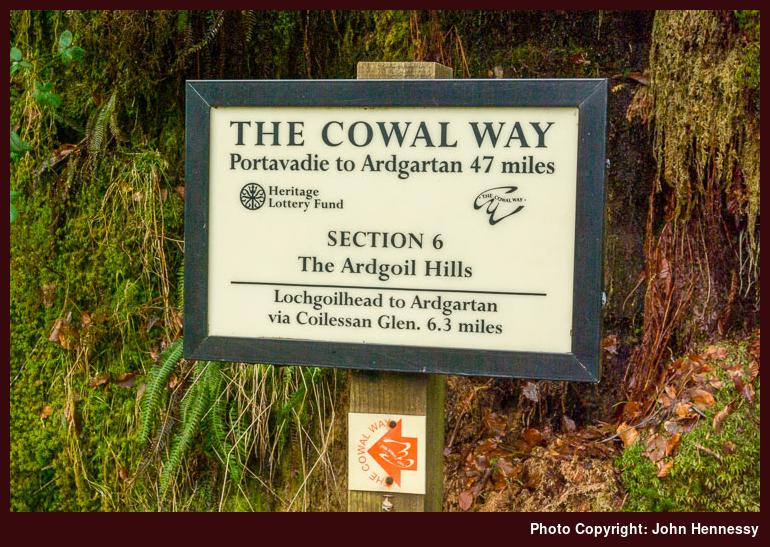
Casual inspection of OS Explorer mapping for the area will reveal the existence of the Cowal Way and it wouldn't be the first long distance to reveal itself to me in such a manner. Starting at Ardgartan near Arrochar, it then continues to Lochgoilhead and Strachur before dropping south on its way to Portavadie. Taking on the whole trail would be a longer excursion than a weekend away, but looking along its length does reveal possibilities for future exploration. The only fly in the ointment for some might be the number of forest plantations passed along its length but it is promising otherwise.
For that abortive weekend outing, I confined my attentions to north Cowal and the area around Arrochar. One idea that appealed was an early morning arrival by coach at Tarbet followed by going around the head of Loch Long and then starting up Glen Croe. Much of this can be done on forest tracks, so road walking, never the best sort, could be kept to a minimum. From Glen Croe, crossing between The Brack and Ben Donich would take you towards Lochgoilhead from which bus connections return to more built-up parts again. What I find attractive about that plan is the variety of scenery encountered so it goes on file awaiting a suitable opportunity for setting it into action.
Other ideas then began to queue up in my thinking too. Some are centred on Strachur, which can be reached by bus from either Dunoon or Inveraray, with a linear hike to Lochgoilhead and various circular options becoming apparent. Linear treks taking two days joined the line and soon I was sat with a good number of ideas to explore. This is not the sort of thing that is needed in the days leading up to a departure because that's a time for making up one's mind about things but, away from any imminent escapades, it's never a bad thing to be doing. After all, when an opportunity does make its appearance for a long weekend away, you might need to have more than one idea in mind. My trip to Cumbria at the start of November showed one advantage of this: some plans do fall by the wayside. As if to show another side to the proverbial coin, my Spring Bank Holiday weekend excursion to north Argyll left me feeling a little short on ideas after the longer walk from Inverarnan to Dalmally and I felt that to be a travesty with the perfect weather that I met while up there.
Cowal may not be that far away from Glasgow but, for whatever reason, it never dawned on me to go exploring the area; the lure of other destinations may have been to blame. I seem to have got a sense from guidebooks and so on that not many go past Dunoon to probe deeper into the area, so the omens are good for a spot of quiet walking; Arrochar and Ardlui are not so far from Glasgow either and quiet walking can be found in those places too, so my hopes are up. When it comes to a weekend visit, the fact that many bus services do not run on Sundays is a concern and, on other days, it is useful, but you do need to watch your times. Still, having a spot of hill country hiking and avoiding having to brave the possible A82 gridlock on a sunny bank holiday weekend seems good to me so I'll keep the area in mind for when the occasion arises.
When a certain ring of familiarity attracts your attention
29th November 2008 The name "Allt Coire Chaorach" probably doesn't mean that much to most people. When I saw mention of it in a BBC news item concerning the recent approval of a hydroelectric scheme, I just had to investigate. That search for further information led me to the Scottish Government's website where the fuller details are for all to see.
It was the inclusion of the word "Chaorach" that got up my curiosity because there was a faint possibility that I may have passed it on my travels through Scottish hills. In fact, it was my passing through Gleann nan Caorann whilst on a trek from Inverarnan to Dalmally at the end of May that proved to be the trigger. However, in Gaelic, caorann is the word for a rowan tree while caora is the word for sheep. So my wandering took me by glens and burns named after the rowan rather than sheep or ewes like how it appears for Allt Coire Chaorach. It's amazing how appearances can deceive when it comes to languages of which you don't have a detailed knowledge.
However, Allt Coire Chaorach isn't that far from Inverarnan since it starts out on the eastern slopes of Ben More and Stob Binnein before plunging to the floor of Glen Dochart to join the river that gives that glen its name; that river itself goes on to feed Loch Tay, from which emanates the river of the same name that reaches the sea near Dundee. Apparently, this is also a site of special scientific interest and the Scottish Government seems to be continuing on its course of not entirely respecting SSSI's if the approval of the hydroelectric scheme is any useful indicator. It's also located within the bounds of the Loch Lomond and the Trossachs National Park so the trend seems a little too consistent. Let's hope that the construction works are as sympathetic as they can be.
Incursion of modernity into our beloved hill country often attracts furious disapproval; just look what surrounds the subjects of wind farms and electricity supply lines. Anything that is already done doesn't trouble me so much since removing it might cause even more disruption than leaving things as they are. However, any proposed changes do rouse my misgivings and I hope that the powers that be do leave us with sufficient wild country to explore and so escape the pressures and demands of modern life. Getting corralled into busy honeypots would be no fun; while National Parks have their own multitude of quieter corners, making one's way through the hordes to get to them isn't as nice as the unimpeded access to them in lesser frequented parts.
Saying all of the above, the new hydroelectric scheme may not be that intrusive in the visual sense. From the side of the A85, it should be hidden behind forestry but it will take some time to blend in with its surroundings so that it doesn't look so obvious from the heady heights of the likes of Ben More and Stob Binnein. For those who might like a wilder feel, now might be a good time to explore these and other summits before any changes take place. The rest of us might be comforted by the thoughts as to how quickly nature can reclaim the land from our worst attentions. Just visit the North Pennines, once a bastion of lead mining, and other parts where such activities were once prevalent and now long gone. Visiting the quarry-scarred hillsides of Gwynedd might not be the best idea when seeking solace from our disregard for the landscape with which we have been gifted is what's in order.


