Category: Scotland
Along the banks of Loch Lomond
 30th May 2007
 Despite the weather outlook, I decided to brave the elements and catch up with the part of the West Highland Way that follows the shores of Loch Lomond. This was going to be a two-day walk from Inverarnan to Drymen with an overnight stay at the hostel at Rowardennan, so I took my chance on the bank holiday weekend and with an extra day off work. As it happened, the weather wasn't too unkind, with only the odd light shower offering any dampness while I was out on the trail. There was a downpour at one point, but that had the good manners to wait for me to arrive at Rowardennan and savour the scenic delights on display in some fine evening sunshine before it did its thing. Thankfully, I was under cover, but that was no consolation to those campers with flooded tents - I encountered one such refugee who had made his way to the hostel for a night's stay and to dry out his gear: a very sensible decision. Other than that, it was largely dry if cloudy for a lot of the time; any sun was enjoyed with gratitude.
Loch Lomond may have a certain genteel reputation, especially with there being a song extant called "The Bonnie Banks O' Loch Lomond", but the track followed by the WHW has a reputation not in keeping with this impression. It is that part between Inverarnan and Rowardennan where the main difficulties are found; that was why my two-day walk headed south rather than north. Nevertheless, the track is not all bad, with only the section between Doune and Inversnaid being an unavoidable test of sure-footedness, balance and agility. The only other real difficulty on the WHW occurs just north of Rowardennan and a 4x4 track (a WHW route option) helpfully by-passes this obstacle course littered with fallen trees from one of this past spring's storms while also being a victim of erosion to boot.
An early morning start from Inverarnan got me on my way under predominantly cloudy skies, and they were to be with me for most of the day. In contrast, if I was heading north towards Crianlarich, blue skies and sunshine would have been my reward, but that was not the plan that I had concocted for this time around. The likes of Ben a' Chleibh, Ben Lui, Ben Oss and Ben Dubhcraig gave me much cause to gaze northwards and slow me down in the process, even if a pesky power line threatened to place a dampener on the glory of the vistas set out before me. At the very least, I know that there is some appeal to following the WHW north to bridge the gap between Inverarnan and Bridge of Orchy.
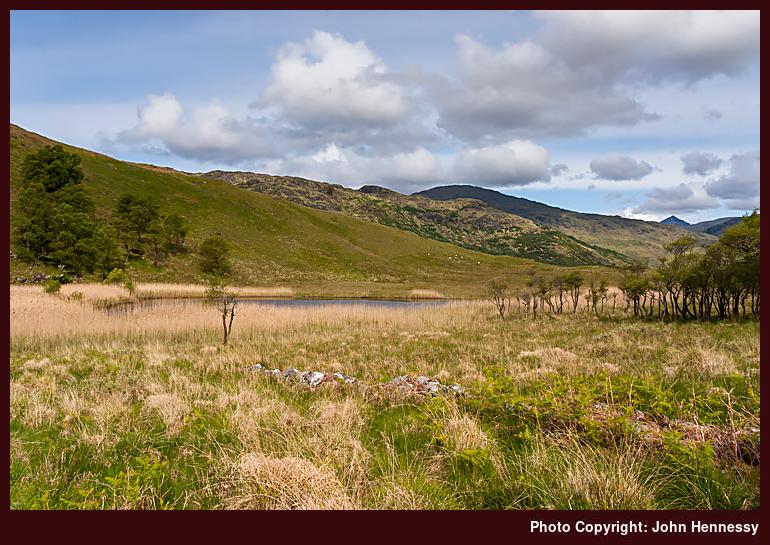
Having managed to drag myself away from the sights of such glories, it was not long until I found myself in conversation near Ardleish with a gentleman from Bangor (Wales, not N.I.) who was walking the WHW northbound with his son. We exchanged experiences before continuing our respective journeys. Having negotiated any path difficulties and enjoyed seeing bluebell carpeted woodland, I paused for a food stop at Inversnaid; I didn't venture into the hotel since I had some food with me. As I passed the hotel, I spotted a lady with a severe expression looking out through one of the front windows (no, she wouldn't have seen me taking lunch outside). It was almost as if she were on watch for aberrant walkers who might try to enter through the front door; there's a very separate entrance for us at the back and a place for us to put our rucksacks too. Severe expressions were soon replaced by far more delightful prospects: more bluebell woodland; it might have been the end of May, but they were still in their prime up here. Rowardennan remained far way, but I was at the hostel by 18:00 and, with my booking was confirmed, I found my bed for the night. This was after my adventurous side taking me away from the sensible 4x4 track at Rowchoish to follow the loch-side obstacle course; I must have been out of my senses, but it did avoid some extra ascent. Once, I sorted myself out at the hostel, I went out into the fine evening for some photographic exploits before I headed to the hotel for dinner. After that, I retired for the night.
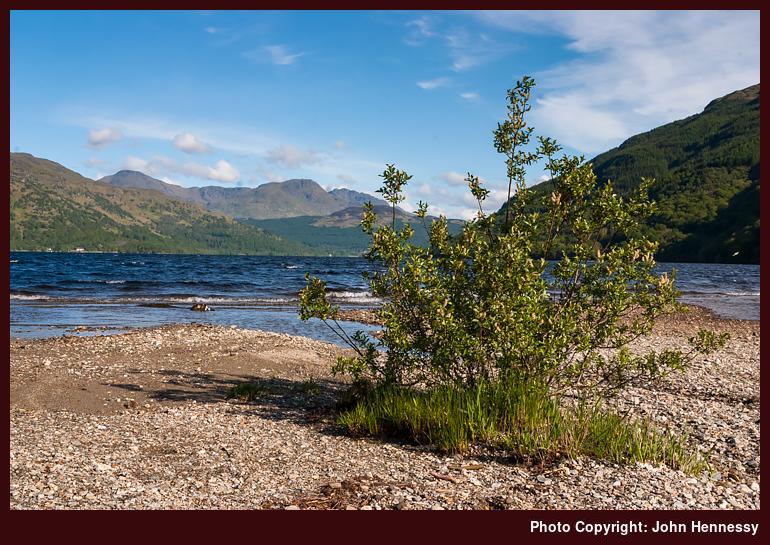
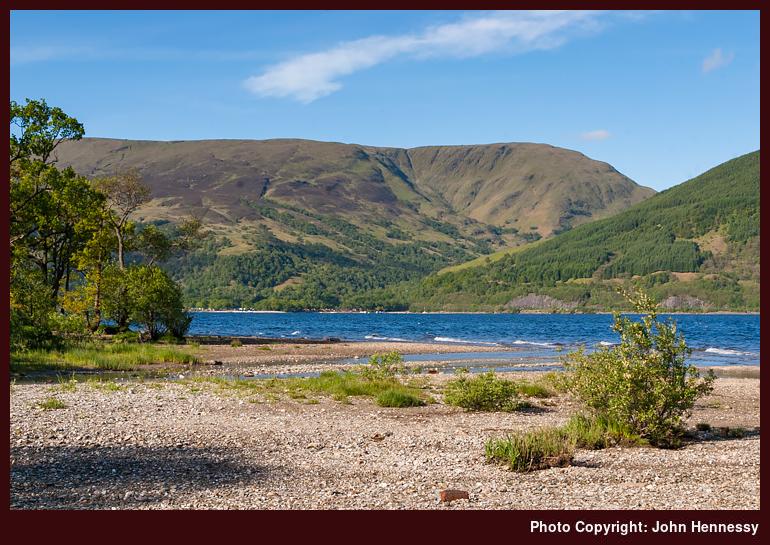
The next morning began with more photographic activity before breakfast. Knowing how fickle Scottish weather can be, I take any chance of sunshine that I get and there was plenty on offer at this time, but cloud was to dominate skies later on. A light breakfast, which included porridge, was to set me on my way and progress out of Rowardennan was slow, not because of tired muscles but because of the views that were behind me. Beyond Rowardennan, tracks are easier to negotiate, even if the way to Balmaha is still littered with sharp little ascents and descents. Proximity to the road may not be ideal, but delights are still there to be enjoyed. South of Balmaha, there is another route choice: high level via Conic Hill or low level beside the Drymen road. I stuck with the latter, even though the restrictions around Conic Hill were lifted for another year; use of the low-level route is mandatory during the lambing season. After carrying a heavy pack for a second day, I decided to leave Conic Hill for another time (combining it with a section of the Rob Roy Way for a longer hill day, perhaps?) and made my way into Garadhban Forest from Milton of Buchanan in which I negotiated a diversion due to tree harvesting operations. Much to my own surprise, I really got into my stride here, and that continued all the way to Drymen on what became a glorious evening. From there it was onto Balloch by bus for an overnight stay before I headed home again by train.
New Lonely Planet book on Scottish Hillwalking
18th April 2007 When passing through Leeds on my Easter Yorkshire Dales excursions, I popped into Waterstones and spotted that Lonely Planet has finally updated its guide to walking in Scotland. The previous edition dated from 2001, so it might have been time for an update. Six years can be a long time, sometimes.
Being easily persuaded, I acquired a copy to see what's in the new one. There are changes to the routes featured, but I'll hang on to my copy of the first edition as there seem to be a number of changes to the featured walking routes and I might find some use for it yet.
On the surface, not much has changed with the included walking information, apart from updates to the text and changes to the presentation. These include putting the walking information chapters at the back and adding glossy sections at the front containing a good supply of colour photos. Nevertheless, dig deeper and more of the changes appear.
The recently enacted Scottish access legislation must surely have had an impact, as walks in the Campsie Fells and Ochil Hills are now headline inclusions. New routes such as the John Buchan Way between Peebles and Broughton now get a mention. Some previously featured routes now find themselves in the Other Walks sections at the end of the chapters, along with new additions such as the Rob Roy Way that goes from Drymen to Pitlochry.
Another fate for previous headline routes is that they find themselves in boxes sitting outside the main text. Classic routes such as the Aonach Eagach ridge or the ascent of Ben Nevis via the Carn Mor Dearg arête find themselves in this position. Given the level of challenge associated with these, that may be wise, for these are not beginner's routes.
Motivation, motivation, motivation
3rd March 2007 This year, I am using the completion of national trails to motivate me to get out into wild and not so wild country. Yesterday, I spent more time exploring the Pennine Way, this time proceeding beyond Heptonstall into the moors near Burnley. There will be more on that later. The West Highland Way is another target of my attention, while the Rob Roy Way is another possibility. And there are many, many more long distance paths to consider than that lot. In fact, the moorland I enjoyed yesterday is criss-crossed with the things.
Until I decided to complete some long distance trails, it was the prospect of exploring places new to me that drove me on. Last year was a particular example of this when I ventured beyond my usual haunts to the likes of Pembrokeshire and Northumberland. Scotland's Southern Uplands also fit into this category.
Before that, I could list years when I spent of time walking in a particular area. To give you a few examples, I associate 2002 with the Yorkshire Dales, 2003 with the Lake District and 2005 with North and Mid-Wales. The habit likely will never leave me as long as I am hiking, though.
Another tantalising prospect is the ascent of a particular hill, and it has got me out and about a good number of times. Yorkshire's Three Peaks are a great example of this. However, I am not so sure that I would go further and do all the Corbetts or Munros, for example.
Usually, I prefer to keep things informal for now, but there are plenty of lists on Hill Bagging, a site that I noticed while lurking on the alt.rec.walking newsgroup, should the mood take me. Interestingly, the site also allows you can register so that you can plot your progress, an anathema surely to those who detest the idea of list ticking. There even is a version of the database that you can download for yourself, and there also is the Relative Hills Society if you are so inclined.
Rob Roy Way: a tempting proposition?
23rd February 2007 On one occasion when I was out walking during my stay in Highland Perthshire last summer, some people that I encountered asked me if I was doing the Rob Roy Way. I think that they were disappointed when I said that I wasn't. At the time, I had been walking from Kenmore and was nearing Aberfeldy, my final destination for the day and where I was catching a bus back to Pitlochry, the base for my visit. That meant that I was in a rush at the time, but I did manage to make time to stop and share a few words with them. Nevertheless, I still had five minutes to spare when I reached the bus stop, not bad going.
Recently, in preparation for my most recent stroll on the West Highland Way, I bought a new OS Explorer 348; I know that the WHW is well waymarked, but it's better to know your exact position at all times. And a map is good for telling you what's around you as well. However, on the top left-hand corner of the map, there was another green-dotted line: that of the Rob Roy Way. A spot of further investigation has revealed it to be a trail starting at Drymen and heading across the Trossachs on its way to Pitlochry. Along its length, it passes places such as Aberfoyle, Callander, Strathyre, Lochearnhead, Killin, Kenmore, Amulree and Aberfeldy. Between Killin and Aberfeldy, there is a choice of routes: one going around by Amulree and a shorter, more direct course. The latter is described in the Rucksack Readers guide to the long distance path, while the former is only described on its official website, a truly useful calling point for planning a trek on the RRW.
The trail has only been in existence since 2002, making it a mere youngster in comparison with the 27-year-old West Highland Way. In fact, unlike like other trails, it has yet to be waymarked. That, and the fact that that mapping, presented in my OS Explorer 379, dates from 2001, explains how I had been straying along the way between Tombuie cottage and Aberfeldy without realising it. And it hasn't been the only section that I have encountered, either. In 2002, I followed part of the RRW when I went for a walk up the slopes of Ben Ledi by way of the section between Callander and Strathyre, though it may be that this ramble pre-dated the RRW. Moving away from this somewhat accidental approach seems an appealing proposition. The key attractions of the RRW for me are its passage through the Trossachs and skirting of Loch Tay. So far, my walking in these areas has been limited and the RRW would take that forward a great deal and there is definitely much to commend the area.
Postscript: Rucksack Readers
While I mentioned Rucksack Readers above, I thought that I'd say a bit more about them. They offer a range of guidebooks covering trails in Scotland, Ireland and beyond. The idea is that you carry them in your rucksack while out on the trail. Consequently, they are waterproof and lightweight. Added bonuses are the inclusion of mapping and the ability to fold the guidebooks flat. Their Irish range includes: Dingle Way, Kerry Way and Wicklow Way. Apart from maybe the Dingle Way, I had heard of these and the guides are a welcome addition to the market. But it was the Scottish range that alerted me to some trails about which I had known nothing: Cateran Trail and Kintyre Way. Otherwise, stalwarts such as the West Highland Way and Great Glen Way are covered, as are the Rob Roy Way and the Speyside Way. Going further afield, treks in Europe, Asia and South America get are featured.
West Highland Way revisited
22nd February 2007 Last weekend, I pottered up to Scotland to take in the scenery lining the southernmost section of the West Highland Way. Having followed the esteemed long-distance path all the way from Bridge of Orchy to Fort William, albeit in a piecemeal manner, I have decided to see if I can have a go at completing it. And yes, the piecemeal approach continues.
Before I describe my latest trek, I'll let you in on my previous exploits. My first real outing on the WHW, apart from being in its vicinity when I was starting to explore Glen Nevis near Fort William, was when I walked the section from Kinlochleven to Glen Coe on a largely cloudy day that tried to brighten up at one point. The second encounter was on another cloudy day but one without any sun; that was when I headed from Kinlochleven to Fort William. The scenery was so outstanding that I returned on a sunny weekend to repeat the walk, and I was not to be disappointed. Following that, I explored the section between Glen Coe and Bridge of Orchy. That day had a lot of cloud about, but the sun made its way through for a good part of the journey.
And now to my most recent excursion. An overnight National Express coach service got me to Glasgow from where I headed to Milngavie (pronounced mullguy), the southern terminus of the WHW, after getting myself some breakfast at Buchanan Bus Station. Once in Milngavie, I picked up the WHW and followed it through the path-strewn Mugdock Wood on a very crisp morning with frost abounding everywhere, a very memorable experience.
Eventually, my journey took me past both Craigallian Loch and Carbeth Loch and on towards the gloriously appealing Campsie Fells. The outlying knob of Dumgoyne, one of their number, very much played the role of a distinctive landmark for much of my walk and looked much grander than its 428 metres height would suggest. A farmer putting out hay for his cattle and their procession along the WHW track distracted attention for a while, but it was the surrounding scenery that was the real attraction.
Surprisingly for a trail that courts a lot of fine scenery, the WHW keeps out of the Campsie Fells and follows a disused railway, the old Strath Blane Line, from Dumgoyach Farm until it ventures onto a minor road as it nears Drymen before heading off-road again for Balmaha and beyond. I suppose that the one issue is that there is no old right of way through the Campsie Fells that passes near Strath Blane. Naturally, there is also the issue of distance and the effect on a walker of continual ascent and descent in hilly country, but these are considerations for the walker. Given that Conic Hill near Balmaha is a no-go area during the lambing season, another concern would be the potential effect on sheep during the lambing season. While Scotland's current access legislation could allow things to happen in principle, I see a re-routing of the West Highland Way as being highly unlikely. Nevertheless, the thoughts of proceeding through the Campsie Fells are far more appealing than the reality of shadowing busy roads while walking on a disused railway line, even if this route possibility would require some road walking through Killearn to the old railway line for the rest of the walk.
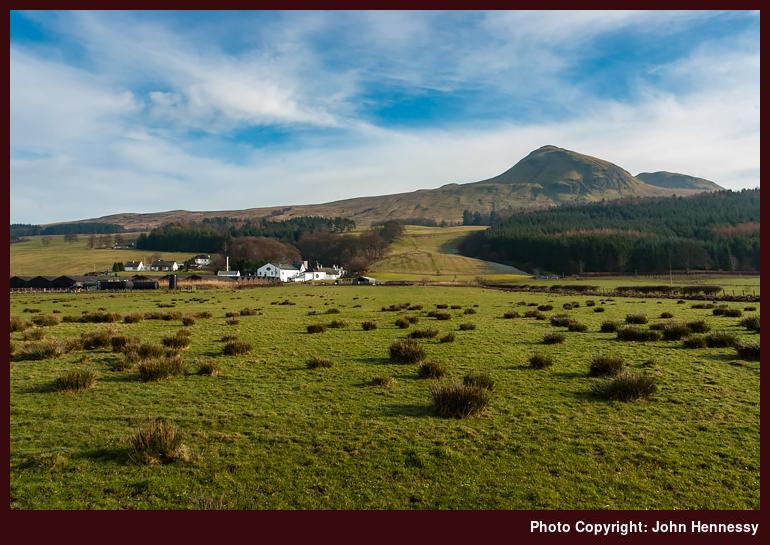
I was a tired walker when I reached Drymen in pleasant sunshine, but the cloud had rolled in by the time that I got to Balloch by bus; it was from there that I eventually headed home. In fact, there was a good deal of cloud about that day, and at times it blocked the sun and put a dampener on photographic exploits. Another fly in the ointment was the more than ample number of pylons that dotted (and in my view blighted) the landscape in a number of places. Also creating compositional challenges was the quarry that got in the way when I was trying to enjoy the enchanting views of the hills across Loch Lomond while on the final approach to Drymen. Actually, taking a spot of care meant that things didn't look too bad in the foreground of the photographs taken. Then there was the matter of ensuring that Loch Lomond's surface was not at an angle; it's very easy for those horizons to develop a slant...
All in all, the day was enjoyable, and I am planning to plug the gap between Drymen and Bridge of Orchy. A weekend visit could allow me to cover the WHW between Drymen and Inverarnan, with a break in Rowardennan. And a long day could get me from Inverarnan to Bridge of Orchy, although a break in Crianlarich might make things more comfortable. Plans are one thing, let's see how the reality turns out.


