Category: Times and Seasons
Pairs
 17th December 2018
 Thinking back to a year ago when I was in the middle of a career break, I am struck by how much reading I was doing. There were two from Bruce Chatwin, In Patagonia and Songlines, and both gave me my fill of travelogue writings by the time that I got as far as January. Both contained a certain air of desolation that also came in its own way from Kev Reynold's Abode of the Gods. It might have been a certain end of year feeling with the dull days of a passing December as much as what I was reading. After all, I found myself again detached from the mainstream flow of living much like I did when transitioning from university into the world of work.
The sense of desolation might have befallen my impressions of Tim Robinson's Stones of Aran duology but for other distractions. Work has been among these as much as seasonal activities like sending cards and buying presents. Becoming engrossed in computer tinkering has been another factor and it certainly helped with speeding up this website. All of this delayed my completion of the aforementioned pair of books with their incompleteness of ending. The second was supposed to resolve a conundrum posed by the first but I get the impression that it may have proved to be a voyage of acceptance rather than resolution.
For all that, I now have moved onto the same author's Connemara trilogy and there is extra life in its early pages. A quieter place like Aran has less documented history while most of the action is elsewhere so it is easy to find loose ends that never can be brought to a satisfying conclusion. For one thing, oral history can bring its own challenges with an intermingling of myth and actual events together with loss of memory as one generation hands over to another. Eve today, this remains an elemental place as I found when I was there last August.
Throughout all this recent activity, two visits have been made to the moorland around Hathersage, Grindleford and Sheffield. In fact, there is such an extensive path network that more may follow because of the possibilities that are offered. That thought popped into my mind during last Sunday's hike from Grindleford into Sheffield during an interlude between spells of heavy rain. In truth, I should have been attending to seasonal matters but my enthusiasm for hill country got the better of me.
Anything that grants views of such sights as Padley Gorge and Higger Torr cannot be a bad thing and the area could be a fallback should all other forms of inspiration fail me. December was not much of a walking month for me in 2017 so I embarked on bus journeys that took me around mid-Wales and by the area that I walked last Sunday in their stead. It helps that collecting ideas is as good as making use of them and those from then led to one walk from Hathersage to Sheffield in November and another from Grindleford to Sheffield last Sunday. In turn, each of the duo could be the cause of return visits to the area and longer hours of daylight could allow more scope for any future explorations.
Thought collection
28th September 2018 To me, writing is a little like sculpting in that it takes a while to craft a report, article, blog entry or other piece. There is creation in action and there often is a first draft that gets taken asunder and reassembled. After all, that has happened what you are reading now and much of what you find on this website.
There have times during the last few years when I felt sufficiently bereft of energy that even writing trip reports was something for which I had no enthusiasm. After all, photos need selection and editing and details need to be extracted from faded memories. Some of this can be blamed by the amount of time that I have allowed to elapse before writing up an outing.
It is easy to blame the passage of one or two years with all that they bring but I think that trip reports need to be more than what can be a route description that might be found on a platform such as Viewranger or Mountain Views. Sights and circumstances help bring a narrative to life but it still takes a little writing time for the words and ideas to come together.
Some ensure this by keeping a journal throughout the time that inspires later writing. Though I am not one of those, I have got myself a notebook where I can jot phrases whenever a valuable thought passes through my mind. Too often, it is the ones that I wish to retain are the very ones that leave me with hardly a trace and the unwanted ones scarcely want to depart at all. Such is the paradoxical way in which my brain works and mine may not be so unique if the growing collection of mindfulness books are any indication.
The notebook may be an A5 sized Moleskine item but it is not destined for the kind of use that prolific author John McPhee apparently made of his. Such will be the terseness of the phrases in mine that there will be little need to add my name and address should I lose the thing and need it returned. That also means that the reward section of that page is surplus to requirements and I am not sure that the notebook will travel with me in any case.
It is true that blogs collect thoughts but these are processed, edited and curated before any reader gets to view them. Raw material is needed and various photos with accompanying photos help but something read in a book or magazine could be equally worthy of retention. Then, there are those thoughts that arise when a mind to left to wander. Now that there is somewhere to keep these from being lost, who knows what might come of them? Only time will answer that question.
Sharing or sparing?
18th September 2018 Having what is called a bucket list, a list of places that you would like to visit while you can, is common these days but I wonder if such a thing is all that desirable. By the its nature, the problems start when compiling a list of such ideas because chances are that you will select places that already are popular. That applies as much when perusing travel magazines or holiday brochures as it does when using social media.
One consequence of this is that certain locations become too popular for the sake of sustainability and that leads to restrictions that affect the independent traveller. South American destinations like Machu Pichu and Torres del Paine National Park come to mind here but the problem is spread around the world. Scotland's Isle of Skye has experienced problems that never made the news before and you only have to see how many visit well promoted attractions like the Cliffs of Moher to see how many people visit a small number of locations in Ireland at a time during the high season.
This then poses something of a dilemma: do you cater for the visitor numbers or do you restrict them? With wilderness and conservation areas, there is a tendency to do the latter though it does have the consequence of pushing up visitor costs and that may have its benefits for local tourism businesses as you may find on a trip to places in either the Canadian Rockies or Alaska. When you add in short summer tourism seasons, the effect by necessity is more pronounced.
In other destinations, they add in facilities for the extra visitors with some decrying the effect that this has had on Spain's Mediterranean coastline because of hotel and holiday apartment construction. Parts of the Alps are afflicted like this but in a different way: it is the infrastructure of skiing resorts that hardly help appearances in mountain country during the summer season. Both examples make you wonder at the appropriateness of such developments and they must tug at the heartstrings of anyone who adores mountain and coastal scenery.
Another aspect of any overdevelopment is that you can install something that encourages the otherwise unprepared into wild places without realise the possible dangers that are there. For instance, I seem to have inherited my father's unease at cliff edges and my knowledge of how slippery limestone can be almost made me shout at people to keep back from the edge on a damp day hike around the Cliffs of Moher and Doolin. It is little wonder that staff are equipped with whistles to direct the unaware away from peril.
There is overcaution too and one example is the boardwalk on Cuilcagh Mountain and how incongruous it looks in the landscape through which it conveys people to the top of the hill shared between Cavan and Fermanagh, between Éire and Northern Ireland. It also does not help that it stops short of the top too but the boggy morass deters most. Another location where path development attracted adverse comment was at Sliabh Liag in County Donegal but it might be that some sense prevailed there in the end.
Hillwalking is a growing pastime in Ireland so there remains a lot to learn in a country where there is neither experience nor tradition of path and track building in such places. Thankfully, organisations like Mountain Meitheal and Mountaineering Ireland together with initiatives like Helping the Hills are starting to address this so lessons are learned from places like Scotland and applied to get sensible solutions to the growing problem of erosion on popular hills. It is something that needs attention as much as securing access for hill wandering in the first place.
The mention of countryside access brings me to another factor that causes some places to feel overloaded: a lack of alternatives. It is not everywhere that has the liberal access rights that are enjoyed in Scotland and across Scandinavia so there can be a very really reduction in the number of places where you can explore. The options may not stop you going to those better known places like Norway's Preikestolen before finding other quieter hikes nearby as knowledge grows and maps feel more confiding.
It is this last point that inspires the title and the theme runs through Fiona Reynolds' The Fight for Beauty, a book that I read last autumn. It is not for nothing park rangers in Denali National Park tell you not to walk one after another in a group so a path never develops and that everyone's backcountry journey is their own. When there is plenty of land for all, we can spread out and find our own space to recharge weary spirits. That is easier when we are not retracing the steps of others all the while and it can have a lighter impact on the countryside too with less erosion caused by many feet and much path widening. While it can be true that we get confined by or own lack of knowledge, physical restrictions caused by not having enough other places to go hardly help either. Overcoming both might be the ultimate answer to the visitor management conundrum.
A few hours wandering about the north wall of Great Langdale
4th September 2018 2016 was a very full year. There was a lot of Irish business to be completed along with two political upheavals and a new job that I now realise was not a match for me. Towards salving the last of these, there were no less than three overseas trips with on each to Austria, Norway and Mallorca. Even with these and maybe because of them, I still did not feel that I was getting the emotional space that I craved so much. It set the scene for changes in 2017 that led to the start of a career break.
This post tells the tale of another trip that preceded the personal tumult of 2017 while coming after the global turbulence of 2016 and in the midst of finishing the personal work for the year. It, too, was a reminder that not all was well with my lifestyle and there was another in the form of an inability to stop spending on some things as if the future never existed. Looking back on this now, I realise that it was caused by a lack of personal emotional space caused by having too much happening in my life. That theme was to result in some adjustment in subsequent years.
To avert any loss in motivation, I booked a single room in YHA Ambleside so I travelled up there by train and bus on Saturday. A later departure meant that I arrived in the dark, but that did not stop me strolling about the place. After all, the shore was near at hand and I even got into the heart of Ambleside, which was a kilometre or two away; in spite of the name, the hostel is found at Waterhead on the shore of Lake Windermere. A fish supper was enjoyed too, a rare thing for me these days. For the way back, I should have had my head torch for going along a darkened lane though I came to no harm because of my risk taking.
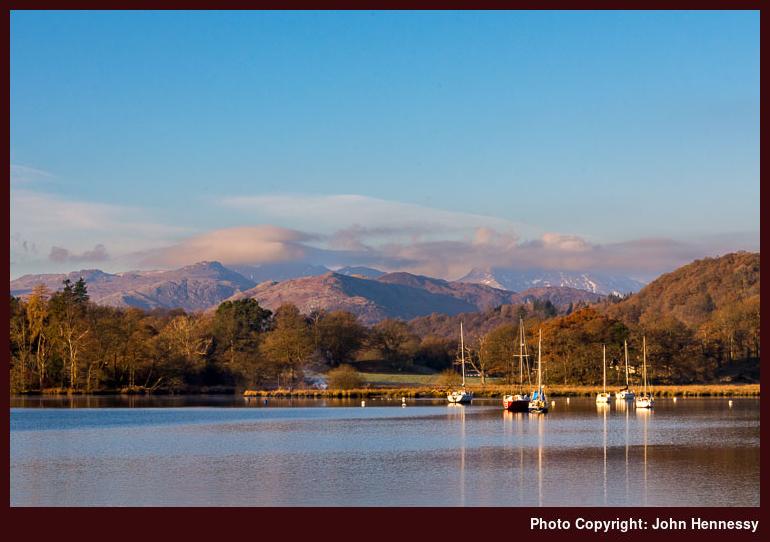
After all that, I settled down for the night and arose next morning to a pleasing scene. Between 08:00 and 09:00, the sun leisurely arose. Before this all started, I made a solitary photo that recorded a peaceful scene on Windermere with the sky having a rosy hue about the frosted grassland. This also preceded breakfast and I was lured out again after that to savour a scene whose tinting was changing from red to blue. Cloud cover steadily broke as I did so and, after collecting my belongings and checking out, it was time to await a bus to Great Langdale.
It may have been down to thinking of exploring the place at the wrong time but I never had much luck with seeing Great Langdale in bright sunshine. Admittedly, the visits have been few with the first being on a walk from Borrowdale that took in the Scottish sounding Langstrath and that was followed by a winter wander from Great Langdale to Ambleside. Both were greeted by grey skies. More often than not, I viewed the distinctive Langdale Pikes while on other hikes so it was not before time that I saw them up close in favourable conditions.
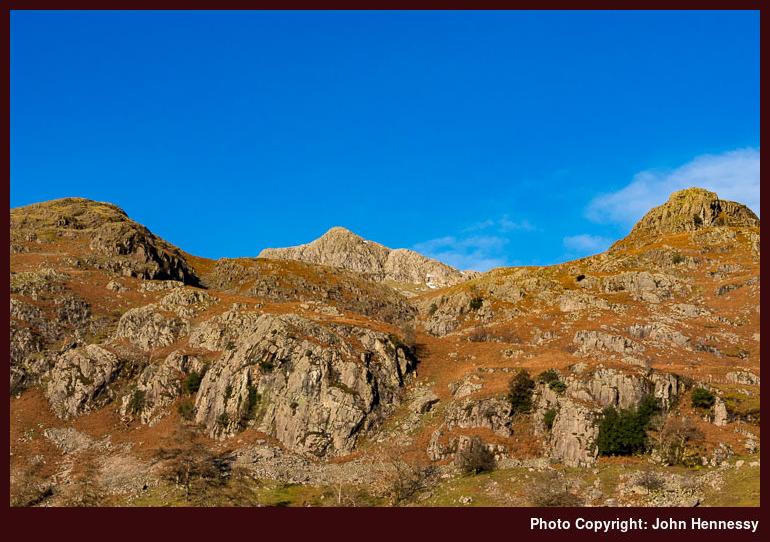
The bus dropped me at its terminus near the Old Dungeon Ghyll Hotel. Frosted grass told a story of a preceding cold night on the valley bottom and the following morning was little warmer. This was more than a little noticed as I pottered along the flat ground by Great Langdale Beck between Old Dungeon Ghyll Hotel and New Dungeon Ghyll Hotel. In fact, I was reproaching my forgetfulness when it came to having gloves. Local shepherds were moving their flock, something had me wondering if such an act could not have been done on another day. After letting them on their way, I shortened the distance to Stickle Ghyll while warming my hands as well as I could.
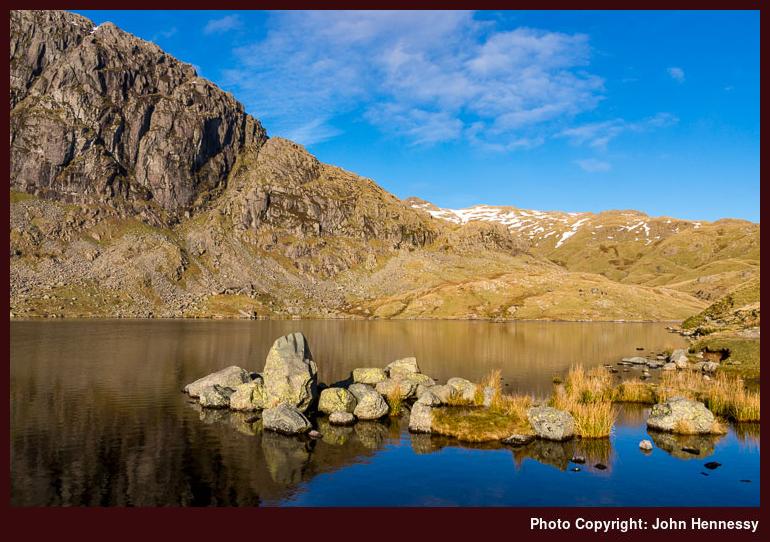
Following what had been a largely quiet interlude, I joined the busy path up to Stickle Tarn. The gradient was testing and it helped little that the perceived throng stopped me from stopping as much as I would have liked. Passing and re-passing the same people needed energy so I was not willing to allow that to happen so readily. The others were bound from the tarn with some continuing to the top of Pavey Ark. After the fleshpot, quieter surroundings were sought and found. The distraction had its uses for my hands warmed on the ascent while the presence of snow patches attempted to belie any sense of the day having become that little bit warmer too.
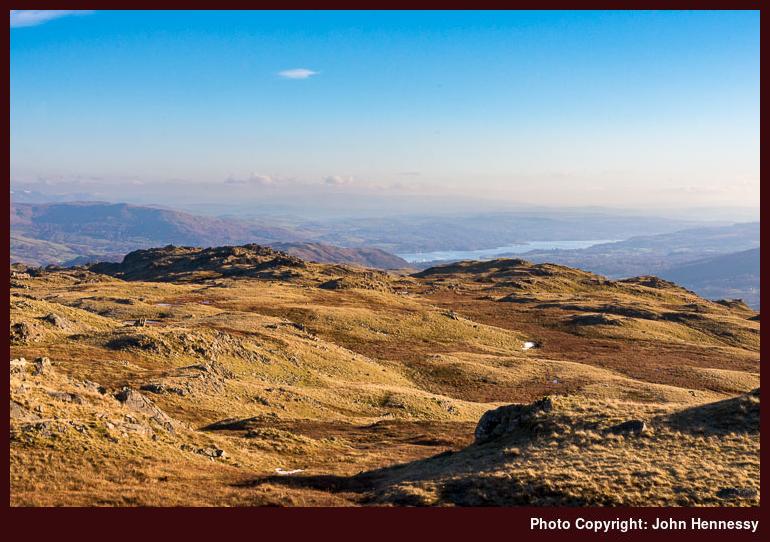
Looking back on what happened next, it might have been that the expected right of way was not a path on the ground, but even having a GPS receiver could not stop me veering off it. A determined effort could have addressed this, as I was to find afterwards in similar circumstances on the moors between Bamford and Hathersage in Derbyshire. Then, I stuck with the line almost regardless of what lay underfoot. Returning to its Cumbrian predecessor, I took the hint and adopted a freestyle approach. In any case, there were multiple paths so it was a case of picking one that went in the desired direction and the benign weather allowed for such an approach.
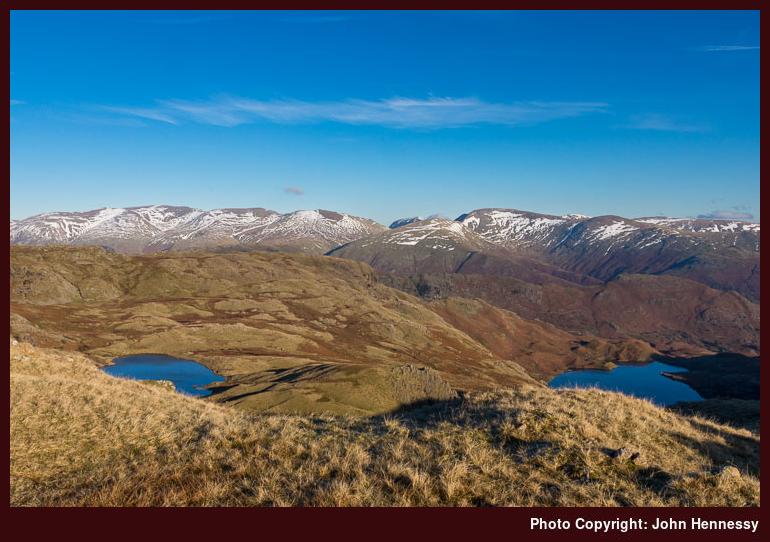
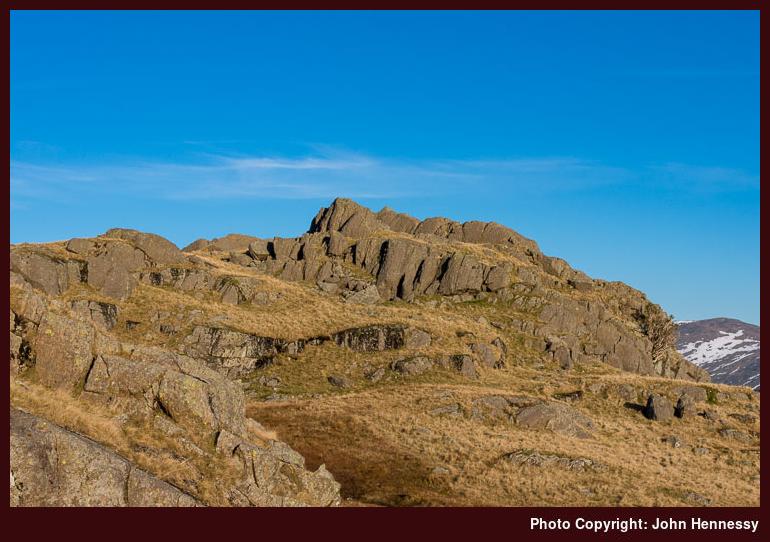
My wandering course took me around by Blea Rigg and Great Castle How. Though it was afternoon at this point, it was around these that I gained the most satisfaction. Few were about so I could amble as I liked and the momentary sense of relaxation was just what I needed with wonderful views round about me. Windermere could be seen to the south while both Codale Tarn and Easedale Tarn lay below me in the growing afternoon shadows. It did not matter that I ought to have been beside them and not above them as I was.
What began to occupy my mind was finding a way down to the eastern end of Easedale Tarn. Once the initial steepness of the chosen descent was past, it was replaced by more gentle slopes as I negotiated the way to the track by Sourmilk Gill. The sun may have been lowering all the while but I had daylight with me and there were a few others passing the way but in nothing like the numbers encountered on the way up to Stickle Tarn.
All navigational travails were behind me, for the clarity of a defined track aided passage as much as the onset of a quiet lane. The surrounding land was falling increasingly into shadow, but my timing was good when I got to Grasmere. There even was some time for self-tidying before the next bus to Windermere. The air may have been cooling again but I was on my way soon enough.
That afternoon had provided a much-needed interlude that was the forbear of longer ones like a subsequent springtime sabbatical and a longer career break. The identification of a need for more personal emotional space became a search that remains ongoing. It even seeps into how I approach work these days and a spot of quiet time among Cumbrian fells became the start of an ongoing journey.
What has not happened so far is the incorporation of repeat visits to that itinerary. Vantage points like Lingmoor Fell, Pavey Ark and Harrison Stickle all take my fancy and should add the familiarity whose absence was felt while figuring out what subjects were in the photos selected for this trip report. Doing so in similarly sunny and serene condition would add to such experiences and I would return in hope of such things. Life still needs quieter moments.
Travel Arrangements
Train journey between Macclesfield and Windermere. Bus service 555 from Windermere to Ambleside and from Grasmere to Windermere. Bus service 516 from Ambleside to Great Langdale.
Autumn reflections
30th August 2018 There have been a few nights this week that possessed the chill of autumn and some trees already are losing their spring and summer colouring. In fact, I picked two early conkers on a walk this evening. Meteorologists may prefer us to wait until the start of September but I always wonder if autumn really starts in the middle of August. Some I overheard talking about turning on their heating may not disagree with me so strongly.
It is strange how we assign the summer months because when it comes to hours of daylight, August in some ways is a mirror image of April. The main difference generally is the residual heat remaining after June and July, something that can hold until the start of November. This past summer has been exceptional so it is not that the school year starts after a break without its share of sunshine even if August came damp.
For whatever reason, I can get ideas about fresh restarts around this time. It might be that there is a lull during September or the start of those school, college and university years but my mind can fill with possibilities while bemoaning that such things often are stymied by a decline in energy coinciding with growing hours of darkness. It often feels like a brief burst of energy before other things take hold.
The latter has me wondering about a midwinter getaway since I did not have an overseas trip this summer because of other concerns. This line of thought also emerged two years ago and there was a trip to Mallorca with some walking that in on my radar for a forthcoming trip report. Other possibilities will be assessed and enough time allowed so as not to have 2019 began like 2017 when a heavy cold weighed me down.
2018 has been a busy year for me with a move into self-employment taking up the summer months and a series of property maintenance tasks in Ireland that were planned during the career break that I began in August 2017. The last part of 2016 came busy with Irish matters so that might not have helped the start of the next year either. As I look to the rest of this year, I hope that work will remain steady enough for me to focus on other things like getting out and about in any good weather that comes. Life has become an adventure again and that blows away any staleness that once may have beset me.


