Category: Long Distance Trails
A day spent passing bridges
 10th October 2009
 The Indian summer that we had been enjoying for a few weeks has decided to take a break from us but it looks like a session of stable weather awaits us once this weekend is over. It may be the sort of weather that brings frosts after dark that make you reach for winter warmers, especially when your toes are frozen after a bike ride. In the last week, there has been the occasional deluge locally but nothing like what other places got. Last weekend, I was grounded by a spot of furniture rearrangement, but this weekend offers a chance for a bit of brain clearing if I can stop tweaking the online photo gallery for a while (more on that in another post). In the midst of this, I have got to turning my mind to recounting that stroll along the banks of the Wharfe at the end of September. It might have sounded a little late in the year to seek a sun-drenched paradise anywhere in Britain, let alone Wharfedale in Yorkshire, but that's undoubtedly what I found.
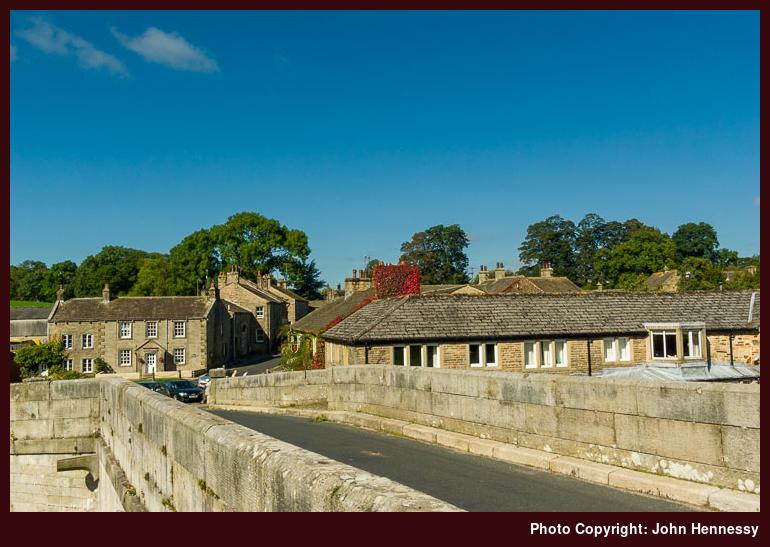
The wondrous weather meant that many strollers were drawn out and about and I spent the section of the Dales Way between Burnsall and Howgill (yes, there is one here too) feeling a little hemmed in by those perambulating at a gentler pace. It cannot be pleasurable for anyone to have someone continually leap frogging them so that realisation meant that some of the photographic opportunities were more rushed than I would have liked. That was not the way at the start, with Burnsall looking splendid in the sunshine with the only disturbance of the peace being an overly enthusiastic spaniel putting the wind up the local ducks, triggering a spot of human mirth in the process; the aberrant mutt's owner wasn't so pleased.
Once on my way, I sought out the Dales Way and saw that I was going to be sharing it with a goodly number undertaking shorter saunters, perhaps a circuit taking in Appletreewick. This always raises the prospect of speed mismatches and the last thing that you want to do to anyone is constantly leap frogging them so any episodes of DSLR action were curtailed in their length. I was still undecided whether the walk would take me all the way back to Ilkley or whether my sole means of propulsion would start to tell me that shortening it and letting a bus carry me the rest of the way would be the most sensible choice. The plan was to see how things went and decide as I go.
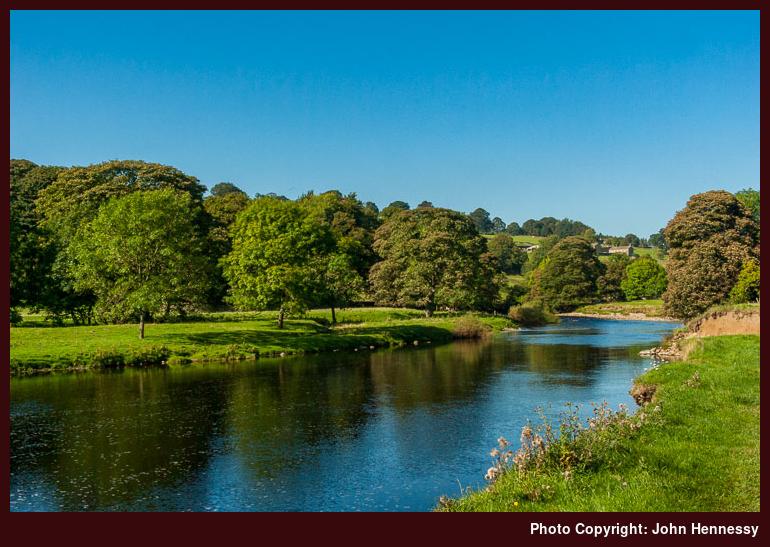
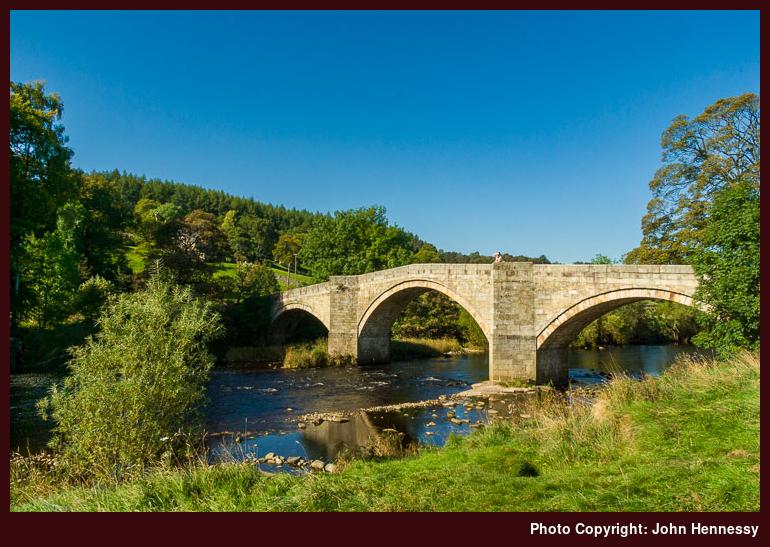
Things quietened markedly after passing Howgill and I got the sense that I had more space to myself and got to relax a little more as I shortened the trail to Barden Bridge; I could see folk a field or so behind me, but that was no perturbation. The scenery was pastoral too, pleasant but nothing to draw the occasional ambler. That may have been a contributor to my increasing personal peace too and it wasn't long before Barden Bridge was reached and I entered the Bolton Abbey estate. A convenient bench allowed a chance to rest a little while before continuing forth. Barden Tower, the now ruined stronghold of the "Shepherd Lord" Thomas Clifford, remained hidden from view among the trees until an ornate aqueduct took me across the Wharfe. There were more folk about at this stage but I was past the point of caring. In fact, it was no throng and I just ambled along through Strid Wood with the sense of personal peace continuing unruffled. The shade from the afternoon sun was welcome if it did mean that it limited chances for camera usage.
My next stopping point, apart from a short rest in the woods themselves, was the Cavendish Pavilion where day trippers really had gathered. It came in useful for attending to human needs and acquiring a map that was missing from my collection and would become useful for the final stretches around by Addingham and Ilkley itself. Having a Quo print-out meant that I wasn't dependent on finding a shop selling maps along the way, but my expectation was that urban Bradford or Ilkley would have been where the gap in map collection was filled rather than rural Wharfedale. The A4 sheet would have sufficed but having the full OS article felt so much more reassuring because of being able to get a wider sense of where I was.
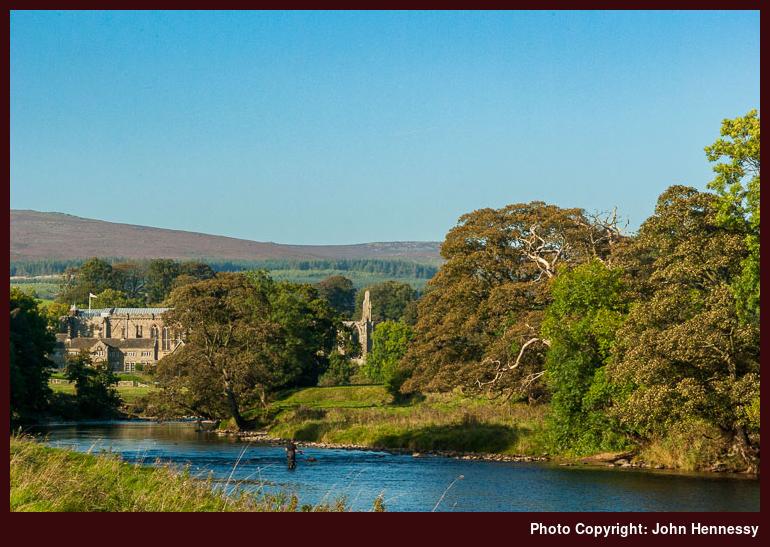
From the pavilion, I continued my way southwards to reach Bolton Priory, part Church of England parish church and part ruined abbey. In fact, it was this that drew my attentions to the lower reaches of Wharfedale in the first place. When those first monks selected the site all those centuries ago, they certainly knew idyll when they saw it. The human incursion really does seem to add to the mixture of rolling hills and a meandering angler-friendly river. Though there are stepping stones, I stuck with the bridge; the last thing that you want to see on such a long crossing is a lapse of common sense and someone coming the other way. As it happened, I witnessed some folk having a go, even a cane wielding pensioner (I would have thought them too far apart for someone less mobile, but there's always one...), but no mishaps of the type that I imagined. The mixture of directional sunshine, a stunning focal point and pleasurable surroundings had me engaged in photographic capture. There was plenty from which to choose and that was with a goodly number about but not so many as to be intrusive.
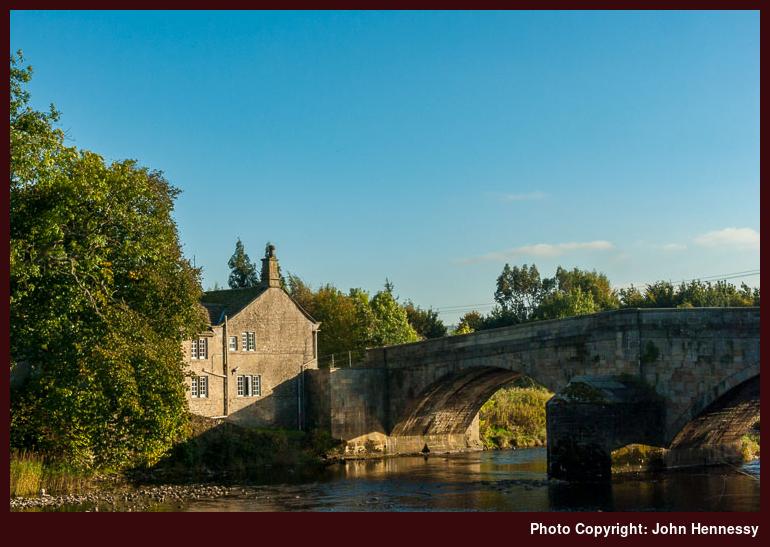
Pulling myself away from Bolton Priory took some effort, but constant withdrawal was the answer and humanity was left to its honeypot as I continued to ply the banks. Bolton Bridge came soon enough and a handy underpass escorted me beyond the busy A59. A section of the narrow B6160 awaited me but I escaped from the passing traffic onto a path just inside a wall after Lob Wood. A little route finding and a road crossing about Lobwood House was all that was needed to stay on the straight and narrow. The only fly in the ointment was a certain feeling that I was at risk of falling out on the ground from the top step of a stone style, not a good thought at all.
The outskirts of Addingham came up soon enough and I left them after me as I rounded by its parish church and old mill. Though I was approaching the A65 all the while, the Dales Way escaped back onto the turf again to shadow the river bank as it had been doing all day. Constantly changing surroundings provided reassuring confirmation of progress with views of Ilkley's outskirts with Ilkley Moor behind them changing into the very urban surroundings within which the old bridge that marks the end of the Dales Way is located.
A look at an OS map might lead one to believe that it goes beyond this point, but my understanding is that they are mistaking the link trail from Leeds as part of the Dales Way proper. While the U.K. walking community is to be envied when it comes to mapping, it goes to show that the OS isn't infallible either, but who is? It's not a subject on which anyone needs to dwell for too long and neither was I as I made for Ilkley's train station with the 18:51 to Bradford coming easily to hand after a good day spent following the course of a river.
Travel arrangements:
Train travel between Macclesfield and Ilkley with changes in Manchester and Bradford. One way bus travel from Ilkley to Burnsall.
A route reprised in reverse to resolve a quandary
26th June 2009 In light of the weather forecast, a trip to Scotland last weekend might have seemed an odd choice to make. After all, one other occasion where I set off north in search of consistent improvement over the course of a day had me arriving a day too early. However, I wasn't so fussy and I set off regardless with the options of exploring around Loch Ericht near Dalwhinnie or reprise a part of the West Highland Way that I haven't hiked for a number of years now.
In the event, I plumped for the latter and arrived at a rainy roadside at the head of Glen Coe. Buachaille Etive Mor was shrouded in low cloud and it might have been sensible to consider adjourning to the King's House Hotel and awaiting the next bus north for a day of travelling in place of the planned walk. Duly equipped, I faced the dampness and all it took for things to dry out was the length of time that it takes to get from the A82 to the hotel along the West Highland Way. This change of affairs certainly put paid to any fears of having a long wet walk ahead of me.
Soon enough, the track of the WHW started to attract journeying types like myself and others doing the entire thing. With a well frequented track such as this, it is too easy to get your normal walking rhythm disturbed by the incompatible pace at which others are going. Though there were showers, the clearance continued as I shortened both the distance to Kinlochleven and the amount of time that I was to spend shadowing the A82. Thankfully, the road wasn't too busy and road noise was none too intrusive. Even with the prospect of being passed by slowcoaches, I still took my chances to look across the glen to savour whatever brightness happened to spotlight the slopes. Making decent headway across the slopes of Beinn a' Chrùlaiste ensured that Altnafeadh was reached soon enough.
After a short break, I took to the track up the Devil's Staircase. Having passed the way once before, I knew that this was going to be hard leg work. That time, I was going the other way on a day that was cloudy but dry if reluctant to leave the sun out, a marked contrast to a sunny afternoon and evening spent in Glen Nevis the previous day. The descent down the Devil's Staircase lingered in my memory but I had forgotten the ardour of the ascent from Kinlochleven and how long it took; that was something that I was set to discover later. Going at things in the opposite way to everyone else and during the afternoon too, almost guaranteed that my hike was my own and without intrusion from others. It was so different last Saturday with a human train trailing down the steep slope and with me at or near its head. Stops were in order on the ascent and I did get passed near the top by someone carrying no pack. My having one with all my weekend bits and bobs contained therein meant that I was unable to offer much of a contest anyway so I was far from bothered.
A well-earned break was taken where the gradient levelled off on the bealach between Beinn Bheag and Stob Mhic Mhartuin. Letting the hoards continue on their way, I noted the more friendly slopes round about me and got to picking up a clear track, boggy in parts, as I surmounted the lesser visited 616 metres high summit of Beinn Bheag. The reward was good panoramic views subject to low cloud and any rain showers staying away. Finding some shelter from the wind, I set to making sense of what lay about me and slaying any demons that beset me when looking at old photos. Being able to pinpoint my location became key to the task; it's hard to work out what's in a photo when you are unclear where it was taken. Setting the map with my compass helped again, although finding that two maps are needed for the exercise has its drawbacks.
After descending Beinn Bheag to the WHW again, I opted for Stob Mhic Mhartuin in the knowledge that I had time available with Kinlochleven being just a few hours away. My Harvey map showed a track marked leading up to the 707 metres high summit, a little surprising since it showed nothing on Beinn Bheag, though I suspect that this may be due to Stob Mhic Mhartuin being a possible stepping stone on a traverse of the Aonach Eagach. The slopes beyond Stob Mhic Mhartuin looking amenable but, inviting as they were, Sron a' Choire Odhar-bhig and its neighbours were left for another time; one with more sun would be ideal for photographic pursuits in an area where they should be splendidly fruitful.
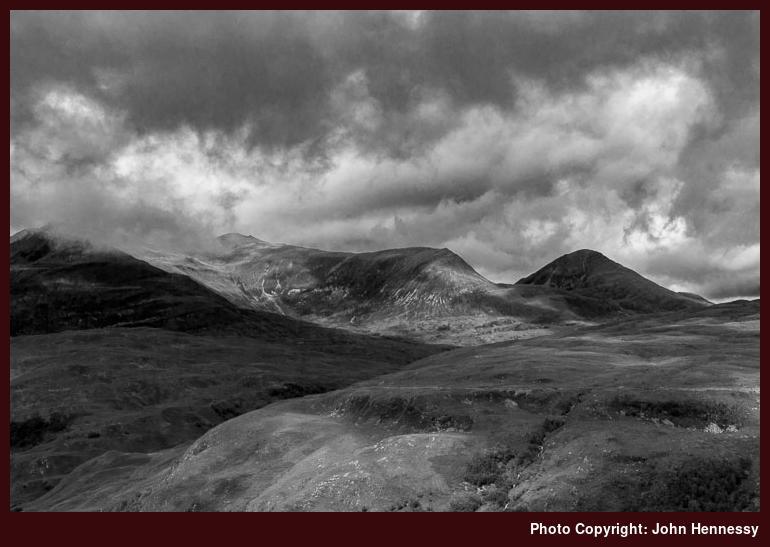
After a saunter about its top, I descended Stob Mhic Mhartuin to recommence my journey to Kinlochleven. The morning rush along the WHW has passed, so walking a busy old military road had become a far more relaxing prospect. That is not to say that there were no other folk going the way but the well scattered mix of fellow walkers and runners was a nicer one than feeling surrounded by bunched up groups. The threat of rain had nigh on completely receded, but cloudiness reigned unopposed with the occasional insurgency of sunlight. Any glance east revealed sunlit hummocks in the distance, an observation that cannot but cause one to wonder if they were in the right place but I was where I was and enjoying it anyway. In any event, the sun was greater headway as views over Blackwater Reservoir and Meall Bad a' Bheithe opened out for fuller inspection.
Progress towards Kinlochleven was good but not sufficient to make the idea of catching the 15:40 bus to Fort William a reality. Saying that, I was well in time for the 16:40, so travel plans remained on course. The final descent into Kinlochleven was steep, steep enough that gambolling along wasn't an option and especially so with all the twists and turns that were taken. Camera work was slowing things a little too because the sun was winning out over the clouds. In fact, warm sun was the order of things on the final approaches to Kinlochleven. My arrival into the village saw me leave the WHW for a more direct approach around by the Blackwater Hostel. After some time for ablutions and a little shopping, I set about awaiting the bus after what had been a good day out. It remains an area worthy of revisiting so I'll continue to keep it in mind as a definite possibility; you always want to leave somewhere as scenic as this with a plausible reason for a return if the opportunity should ever offer itself.
Midsummer madness can be rewarded
24th June 2009 The past weekend saw me set off on an incursion into Scotland. My arrival at the road end for the White Corries ski centre was in utterly unpromising conditions: continuous rain and low cloud obscuring the tops. Oddly undeterred, I stuck with my original plan to ply the West Highland Way all the way to Kinlochleven only to receive continual encouragement from a steady improvement in the weather; it dried up after King's House Hotel with light showers continuing until the middle of the day and sun coming out from the clouds for a grand evening. From the top of the Devil's Staircase, I popped up onto Beinn Bheag and Stob Mhic Martuin before carrying on towards Kinlochleven. Those ascents afforded opportunities to disentangle and put names to the various humps and bumps that surrounded me, a matter that has perplexed me every time that I get to look at photos taken when I was last this way a few years back. Ideas for future hikes have been planted in my mind, too, so the proverbial ideas shelf continues to be replenished.
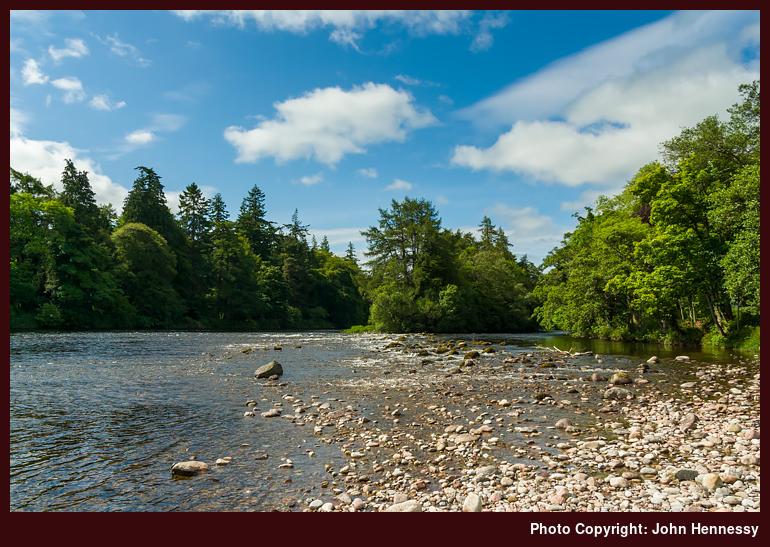
Having been forewarned about a sailing event in Fort William, I opted for a night in Inverness instead. Saying that, Fort William didn't look so overrun while I was there, but my plans were set, and I sat back to see the sights through the coach windows. A Sunday morning stroll changed my view of Inverness from a less than positive one to a more favourable standpoint. The cause of this change of heart was my discovery of the delights of walking by the River Ness and its islands in bright sunshine. My first visit to Inverness was on a cloudy dreich day prone to dampness, never good conditions to see anywhere, and I popped out to Urquhart Castle on the shores of Loch Ness without ever venturing around by the Ness islands in the city itself. In some respects, I am amazed by that omission, but it seems that the Great Glen Way isn't routed that way for nothing. If anything, my time in Inverness on this occasion may have been overly short; after all, I did have a long train journey ahead of me. Even so, the delights of the city displayed themselves so well that they could be translated into the traditional Scottish phrase "Haste Ye Back".
That may well set things in play for a mental distillation session ahead of my now habitual longer summer break. This year, there isn't a single silver bullet like the Western Isles became last year and foul weather alternatives are in order too, even with the Met Office's optimism. There's nothing for it but to lay out all the possibilities somewhere and assemble something reasonable from them. In the meantime, though, that Lochaber hike commands a longer description, so my intention is that one will appear on here in due course.
Sunlit journeying from Coniston to Ambleside
19th June 2009 One of the nice things about a British bank holiday is that, so long as engineering works are avoided, you still can get a normal weekday train service on the day itself. That afforded me an early morning getaway to Cumbria for a day's walking in Central Lakeland. Following the previous day's lengthy walk, I wasn't planning on doing anything too exhausting and so stayed away from testing gradients for a walk that took part of the Cumbria Way from Coniston to Skelwith Bridge followed by a mixture of road and footpath hiking, thankfully with more of the latter than the former, from there to Ambleside.
From the point of those who are sold on the idea of a Bank Holiday scorcher, the Spring Bank Holiday weekend was perfect in many respects. However, hot days are less good for those wanting to go wandering through the countryside. Without any semblance of a cooling breeze, there is the unavoidable strength of the sun with the heat inducing dehydration if you're not careful. The first consideration makes a good hat and sun screen essential and ongoing watering addresses the second though regular shaded pauses are things that I am coming believe necessary too. It was also the sort of weather for shady havens next to water and I could expect to pass fleshpots as I continued on my merry way, especially given that I was staying lower down anyway.
2007 became a year when many of the trip reports that you would have found on appearing here described progress along long distance trails. Somehow, it has slipped my notice that there is one that has been edging towards completion without my consciously planning it. That trail is the Cumbria Way and I have walked most of its length between Skiddaw House and Coniston. In fact, it turns out that I have been in its vicinity all of the way, even if I didn't follow the route to the letter; there is a missing part between Rosthwaite and Derwentwater but I ask myself if it's worth the effort unless I added it to a longer hike because I had frequented that are a good deal anyway. Other than that there are the fells around the Back o' Skiddaw on the way to Caldbeck and a stretch extending along the shores of Coniston Water before you get to mentioning sections beyond the Lake District proper that get you as far as Ulverston or Carlisle. The latter pieces may get left for occasions when I want something lower level and without encountering hoards along the way.
Returning to the section between Coniston and Skelwith Bridge, that was landed on the ideas shelf for a truncated day rather than the longer period of time that I had. However, the extension to Ambleside aroused caution in my mind so the bank holiday was when I made use of the option. The first trick to execute when you get anywhere is to get your bearings and so it was for me in Coniston. It may not be the biggest of places but it was my first visit so I took my time as I sought out the northbound leg of the Cumbria Way. The next entrance on the right after the leisure club is where the trail goes off road again and I set to making steady progress on National Trust land beneath the Yewdale Fells. The terrain was a mixture of woodland and pasture with gentler gradients. Others were out and about but it was far from crowded. The shadier spots like Tarn Hows Wood were welcome shelter from the heat of the day.
After a short spell over tarmac, the tarns at Tarn Hows were reached and that was were things became busy. The mixture of gentle trails, shady woodlands and water attracted the masses in droves but they remained steadfastly along the water's edge and the required spot of negotiation didn't take too long at all, a stone's throw along the trail and I virtually had it all to myself. Mountain bikers made their way against me (legally, I'll have you know) as I shortened the distance to the A593. The Way crosses the road to pick a path following the field side of a wall. This can be easy to miss so be eagle eyed with your map reading because I missed it at first and was left with the misimpression that I needed to walk along the road, not the most pleasant of things.
The trail eventually veers away from the road to follow the boundary of Tongue Intake Plantation before doing an about turn at High Park and travelling through the said woodland, a godsend on a hot sunny day. A road crossing takes you beyond the trees and onto more pastoral countryside. This was where I started to encounter more folk again, especially on the last approached to Skelwith Bridge. Another route warning is in order for around that passing point: don't expect the Way to emerge onto the road like it does on the map because I seem to recall that an off road alternative is now signed instead. That threw me while going from Great Langdale to Ambleside in February but my awareness of the deviation allowed me to proceed as I had planned.
After a short rest in a stone bus shelter, I carry on up the steep hill towards Loughrigg Tarn. The tarn wasn't my destination so I veered right at the junction and picked up a right of way leading off to the left and uphill through more National Trust property. Passing a scout encampment, the gradient eased as I carried on traversing the slopes of Loughrigg Fell. Following one last blast of ascent and views over Windermere, it was downhill again. At this point, I was very reminded of a circular walk from Ambleside that took me up and over Loughrigg Fell while passing Grasmere and Rydal Water. My plan was to go to Wales that day but a cancelled train was the cause of sending me north instead. It is too easy to feel fed up when this happened but views towards the Pass of Dunmail Raise and more allowed those feelings to be displaced and satisfaction to be derived from the day's outing.
There were no such negative thoughts as I dropped down to cross the road into a very pleasant tree-shaded Rothay Park. A pause for a short while was in order before I continued to catch my bus to Windermere's train station. If you were lazing in Rothay Park, you may have been oblivious to this but I spied a bank of cloud approaching from the south as I yomped over Loughrigg Fell; skies had been becoming more milky as the day wore on in any case. By the time that I was in Windermere, the cloud bank was making its presence felt and helped me to feel that I wasn't leaving for home prematurely. As it happened, I made way home from Macclesfield's train station in dampness, a definite contrast to the weather that I had encountered on my wanderings that made me feel that going north was the right thing to be doing. Saying that, the damp ending placed no dampener on my recollection of the day.
Travel Details:
Return train journey from Macclesfield to Windermere. Bus service 505 from Windermere to Coniston and service 599 from Ambleside to Windermere.
Taken by surprise again?
28th May 2009 About this time last year, I was feeling a tad sore after a weekend in Scotland where I was surprised by some of the best weather that I had seen there in a while. It was as if I was taken by surprise and reluctantly left because I was of the opinion, rightly or wrongly, that a certain lack of planning meant that I may not have made the most of it. Looking back on it now, it may not have been as wasted an opportunity as I thought it to be at the time. After all, that Sunday sojourn on Kerrera sharpened my appreciation of island scenery and perhaps inspired the Hebridean island hopping session that occupied me for a week later on in the year.
This year, with various things that have been going on in my life together with a stretch of lacklustre weather, I would have been forgiven for being surprised by the weather yet again, just like last year in fact. Now that I think of it, the weather has behaved similarly on both times. The run up to the same weekend last year would have been no preparation for what eventually arrived either. However, there is an important distinction between the two years: the locations blessed by good weather. Last year, Scotland got it better and had a generally good May with the TGO Challenge seeing more dry sunny days than usual. England did better this time around but it all depended on where you were and when you were there; it turned wet in Cheshire on Monday.
Overall, Cheshire did well with a steadily improving Saturday that coaxed me out on the bike in the evening time after an afternoon shopping expediton. Sunday was even better and I spent my afternoon and evening on a stroll from Leek back home by way of Tittesworth Reservoir and Danebridge. On Monday, I popped up to Cumbria to hike the Cumbria Way from Coniston to Skelwith Bridge before skirting Loughrigg Fell on the way to Ambleside. That was the cause of taking me through a honeypot or two (Tarn Hows comes to mind as a particular fleshpot) but the quieter parts more than made up for this.
One plan did fall by the wayside and that was the idea of following the Derwent Valley Heritage Way north from Baslow until either Grindleford, Hathersage or Bamford; the end point was to depend on progress and the time of the next train home from either of these stations. The plot certainly was fluid but a late bus caused its abandonment on Sunday so it goes onto the ideas shelf for another time. Another route option is to go around by Baslow Edge, Curbar Edge and Froggat Edge, proper hill wandering if you will and a variation of the original theme, but that also still awaits its opportunity and goes beside the DVHW on that proverbial shelf.
All in all, I cannot declare 2009's Spring Bank Holiday weekend wasted and, anyway, that's not the way that I feel about it at all. Any period of time that allowed chances for walks and cycles can only have been used well and, as if that were not enough, it has sown the seeds for future excursions too so it has been more than fruitful. Having more good weather than was expected can be a test too because you need to pick where you want to go when the temptation is to go out and gorge yourself; having only so much time has its uses. Trip reports for the walks themselves should follow but there's the prospect of good weather next weekend so that may cause the postponement of their appearance. Of course, that depends on how things come together and only time will tell on that score.


