Category: Travel
An alternative option that didn’t disappoint
 15th June 2009
 I suppose that it might be easier if I lived in Greater Manchester but early Sunday morning getaways from Macclesfield are an impossibility if you are dependent on public transport. Buses don't move until around 09:00 and train companies must regard Maxonians as right layabouts given that nothing runs north until at least 10:30 (saying that, earlier starts are possible, again at ca. 09:00, if you are heading south). The situation may not be the best but I often contend with it in place of settling into a rant.
That reality means that I need to keep ambitions in check to get something from a Sunday's wanderings; staying near to home is best. Saying that, the longer hours of daylight mean that you can gain quite a lot even with a later start and my start on the Spring Bank Holiday weekend's Sunday was tardy. Still, my mind did turn to the idea of popping over to Baslow for a spot of northward hiking to one of the stations on the Hope Valley railway line. In the event, a late bus ensured that connections were to be missed so I popped down to Leek instead. The idea of a long stroll to Buxton became a plaything for my mind before I saw sense and decided to walk home instead, an equally long hike but any concerns about missing trains or buses home can be set to one side when your own exertions are taking you back to your own doorstep again.
The route was to be a variation on a theme taken for a yomp from Leek home on a December day a few years ago, my first proper outing in Staffordshire as it happens. That time, I got benighted on the last stretches, but presence of mind allowed a head torch to light the way and I also helped my cause by sticking to road walking rather than "fooling" around in fields in the dark. This time around, there was much less of the tarmac bashing and I was well home before light failed.
As ever with starting from a town centre, some street navigation was in order before softer surfaces were reached on Leek's outer reaches. In places, this can require concentration by my vague recollections were enough to see me as far as Haregate where I found a public footpath. Crossing pasture and meadow, the strength of the sun was by now unmistakable. Benches with health messages were placed at irregular intervals along the way. It's an interesting idea but I was left wondering if they were preaching about the benefits of regular walking to the converted rather than the sedentary types who could do with seeing them. Saying that, I suppose that a spot of encouragement never goes amiss.
The growing season already had been busily obscuring man-made objects like road signs, but public footpaths are far from immune too and it only takes a meadow to obscure the line of a public right of way. Also, my upbringing on a dairy farm makes me feel uncomfortable trampling grassland without there being a need for it and I stuck with the obvious line of trespass. That led me among more of humanity than is usually my habit as I followed a track that hugged the shoreline of Tittesworth Reservoir closer than others that I have followed in the area. Still, that didn't take too long and the easier terrain was no harm either, though the indentations probably added to the distance being covered.
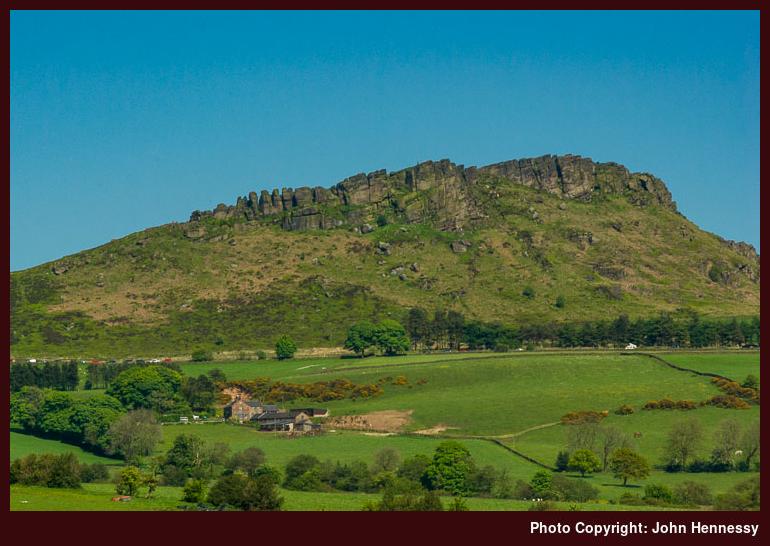
The next passing point for me was Meerbrook and tarmac was the surface over which I went from the shores of the reservoir to a public footpath making up part of the Staffordshire Moorlands Walks. The crowds were behind me at this point as I carefully picked my way to Greenlane beneath and beside the Roaches. From there, it was on past Roach Side Farm, again with some attention to route finding so as not to disturb their Sunday afternoon before I found a metalled road again near Roche Grange where I found a mock fortune-teller placed out on the side of the road and in the sun. Though there were other (real) folk enjoying the weather like I was, the road was untravelled by traffic until I found a right of way leading to Clough Farm. More of these were stitched together to take me to Danebridge and the late afternoon grew more pleasant. Before I crossed over the River Dane, I found what can only be described as an installation with more scarecrow-esque characters at a fake bus stop and awaiting an infrequent "buz" with humorous signs added to suit. It was all in jest, even if it was a striking reminder of my plans having been changed for me, and has set me to wondering if there was some sort of scarecrow thing going on in this part of Staffordshire of which I wasn't aware.
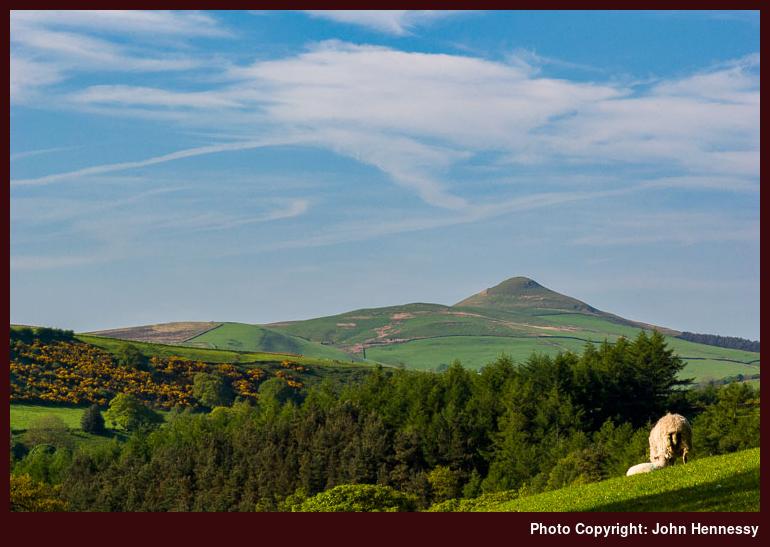
After Danebridge, I was back in Cheshire and it was now into evening time. A more direct off-road option was in mind than the one that I followed but it's never the slips that make for good navigation but the ability to correct them and that definitely the order of things. Even so, I passed through a short piece of shady woodland and reached Hammerton Farm as planned. From there, it was onto the A54 and the Wild Boar pub, which incidentally had opened up the area at its rear for camping. I left the Congleton-Buxton road for more soft surface travel near Longgutter before tarmac bashing took over again. Again, I was following a quiet lane and with good evening views of Shutlingsloe, Sutton Common and Croker Hill. That lane eventually gave me a footway at Higher Sutton (they turn up in the most unexpected places in Cheshire) and my lane took me ever onward towards Sutton, Macclesfield and home. It may have cooled down noticeably by this time, but there were still groups of hostelry patrons out and about, a grand evening (or night as one farming chap said to me and I thought that you only said that when it was dark; it was equally ironic given that I arrived home in daylight this time around) for it.
Travel Details:
Service 108 from Macclesfield to Leek.
Lakeland Roadworks
8th February 2009 Yesterday, I was up in Cumbria enjoying a walk from Old Dungeon Ghyll to Ambleside and two sets of roadworks made an attempt on derailing my plans rather than the expectation of snow and ice that had given me pause for thought. The first was at Troutbeck Bridge on the main Windermere to Ambleside road. The result was that lengthy tailbacks ensued, delaying local buses and other traffic. They may not have caused me to reconsider what I had in mind, but they are the sort of thing that could shorten a day among the hills and perhaps take away from the relaxation that such an outing usually involves. After all, we do not have extensive hours of daylight at this time of year.
The second was at Clappersgate (think of the road from Ambleside to Coniston, Hawkshead or Langdale) where deep excavations on the carriageway reduced traffic to single line with traffic signal and convoy control. Whenever I have heard before of this being done, it involved using a tipping truck, but this set up had a workman driving a quad bike ahead of traffic and up and down the affected area while work was being undertaken, a slightly peculiar slight to my eyes. It might have been that the truck was the appropriate tool to use in the circumstances; that may need wider roads.
While I am sure that both of these workings are needed, their being there does cause one to double-check the BBC's travel news page for Cumbria. Also, if they were carried out during the high season, chaos would be the result, and it certainly doesn't bode well for the forthcoming half-term school break, particularly with all that attractive white stuff in the hills. Travel news like this may not be the usual sort of thing that I'd put up on here, but these workings could have an impact on enjoyment of fine hill country, especially if everyone makes a beeline for the same area.
A spot of island hopping Part 7: leaving South Uist for home
16th October 2008 At the end of every good trip, there's the bittersweet experience of the journey home, especially if you like the wilder places as much as I do. Nevertheless, this was a journey that had its good points with the surroundings becoming ever more familiar as it continued. The first part of the journey involved a lengthy ferry crossing from Lochboisdale to Oban and I readily admit that I was looking forward to it because places that I had never visited before were to be passed along the way. After breaking my journey in Oban for the night, it was time to travel on land again, a journey that I had undertaken many times before.
Saturday, August 16th:
Of course, good weather can make any enticing sea journey even more memorable but I wasn't to be blessed with perfect weather. When I arose on the Saturday of my onward passage, the day was taking a more autumnal aspect with damp greyness being the recurring theme. There was a certain end of season feel too, not at all that inappropriate given that another of Scotland's school years was to begin on the following Monday.
Drier interludes allowed me out and about for one final stroll in the stillness before the afternoon sailing. However, the dampness was to win over the dryness and cars assembled for the ferry with rain falling. I had by now ensconced myself in the ferry terminal's waiting room and remained there until the Lord of the Isles made its appearance at the appointed time. Thankfully, it didn't take long for foot passengers like me to get on board and I went to the cafeteria for a midday meal. A sailing taking around five hours meant that it was never to get overly busy but getting some food was a good use of the time taken for all cars to be loaded onto the boat and the rain meant that being outside on the ship's deck at this stage in the day wouldn't have been the pleasure that it otherwise might have been.
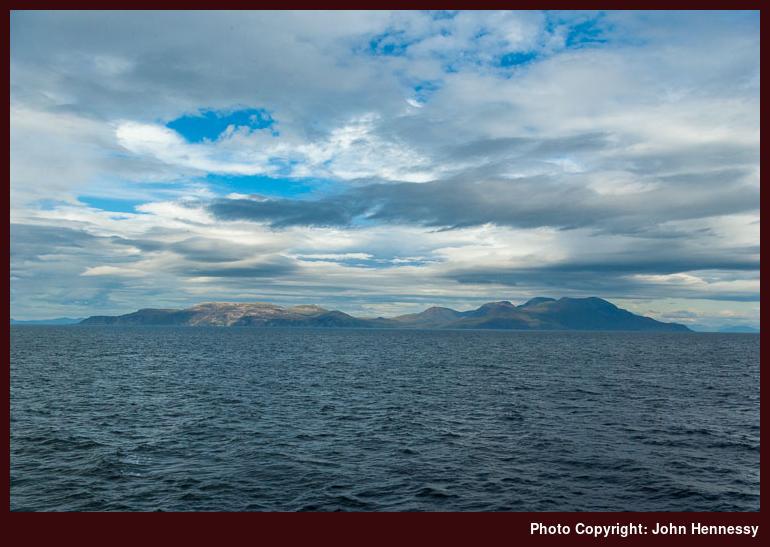
Thankfully, heading due east meant that the rain was going to be left after us at some point. However, we were in the vicinity of Rum before you could reside on the top deck without your sanity being questioned; it was good timing. In fact, there were flashes of blue sky and Rum was allowed to catch some sun and tease any onlookers. Eigg and Much were gathered about the tantaliser while Skye's Cuillin loomed in the distance beyond it. I did spy some indentations on the eastern horizon from South Uist and wondered if they belonged to Skye or to Rum; I am now inclined to think that it was the former that I had been seeing. Speaking of sightings on a horizon, Colonsay and Tiree may have lain to the south, but there was little sign of them.
It was nearly the halfway point of the crossing before the mainland made its appearance after my being away from it for the most of a week. Ardnamurchan's lighthouse was approached and passed as we changed to a more southerly direction to enter the Sound of Mull. The appearance of Mull allowed for some spotting of familiar locations like Tobermory and Craignure while we left Ardnamurchan behind on reaching Morvern. This continuous sight of land did make time go by a lot faster than the earlier expanse of open sea. The sun remained hidden away, so my camera was never going to be that useful and so I contented myself with savouring what was on offer. In any event, there's more to life than being concerned with photographic opportunities every single second when merely taking in the sights is often sufficient.
South of Craignure, I was well into territory frequented on my crossings from Oban to Mull. Landmarks like Torosay Castle, Duart Castle, the island of Lismore, Loch Linnhe, Ben Cruachan and so on all served to remind me that landfall was not far away. Nevertheless, I think that it might have when we passed Kerrera that I went downstairs to collect my belongings. I was well-organised by the time that we were to dock, even if remembering where I put the copy of my boarding card took some thinking (you start to wonder what will happen if you can't find it...). For sailings into (more) open water, Calmac needs you to fill out a boarding card in addition to purchasing your ticket. For the crossing from Skye to Harris, one copy sufficed, but two were needed for the South Uist-Argyll sailing; I suppose that it's an extra check that no one has fallen overboard, not at all a great thought.
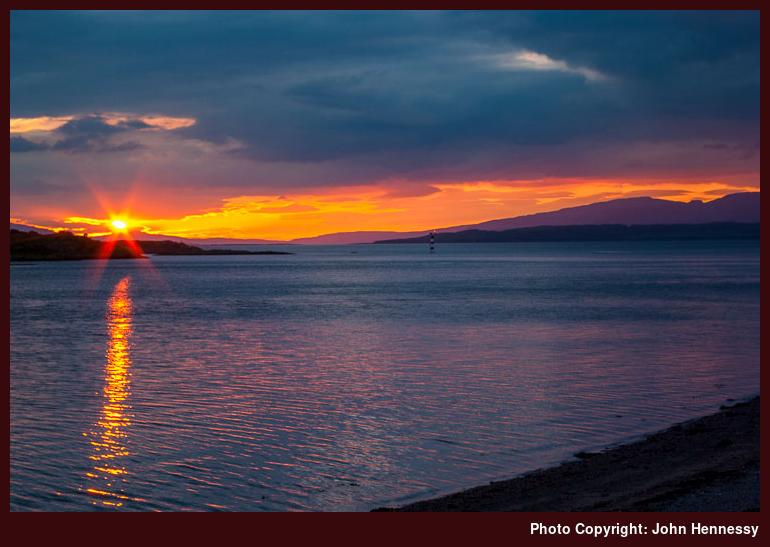
After my island hopping and all the new places that I had explored, you could say that reaching Oban was like a partial homecoming, to what is familiar to me at least. The town caught the sun and a memorable sunset was gifted to those who were out and about. Before all this, I needed to get to the SYHA hostel where I would spend the night. Duly booked in and organised, I then popped out to take in the last of the evening, a perfect end to a good day.
Sunday, August 17th:
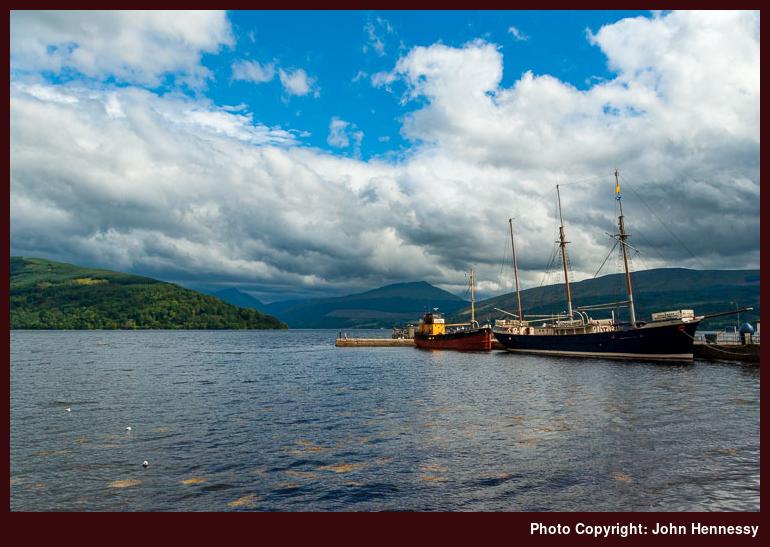
The next morning was glorious too and I had some time to enjoy it before catching the midday Citylink coach to Glasgow; familiarity was to reign supreme for the remainder of my travels. The sun did duck and dive behind the clouds, but the countryside retained its inviting feel as the bus passed Kilchurn Castle and Loch Awe. A short sunny stop in Inveraray allowed for a quick piece of camera action; I don't believe that I have seen the town and its surroundings catching the sun before. The sun stayed out as we passed Arrochar and Loch Lomond on the way to Glasgow. A flying visit to George Square preceded my onward journey by train, an uneventful journey that is more typical of my experiences of railway travel, that landed me at home at not too unreasonable hour. It was a good end to a wonderful trip to places where I had not gone before, and the best bit is that I am left with reasons to return, should the opportunity ever arise.
A spot of island hopping Part 5: travelling from Harris to South Uist
2nd October 2008 Thursday, August 14th:
Thursday morning began with sunny spells like the preceding days and I would have been forgiven for embarking on further explorations of Harris. After all, I had concentrated my efforts on that piece between Tarbert, Àird a' Mhulaidh (English: Ardvourlie) and Miabhaig (English: Meavaig) and that's only part of what's there. However, the planned itinerary for my week of island hopping dictated that I was to leave for South Uist. Reaching my destination of Lochboisdale was to involve a ferry crossing and three coach rides and the wonderful weather remained with me all day.
It was also good weather for those following the circular CalMac tour from Uig. If I recall correctly, they would have been treating themselves to a ferry crossing to Tarbert, a bus connection to Leverburgh, another ferry crossing over the Sound of Harris, another bus connection to Lochmaddy followed by a return ferry crossing to Uig. Those bus connections weren't coaches that were specially laid on but normal service buses which would have been running anyway. Even so, the coach conveying the folk on the tour from Tarbert to Leverburgh allowed stops near Harris' famous beaches.
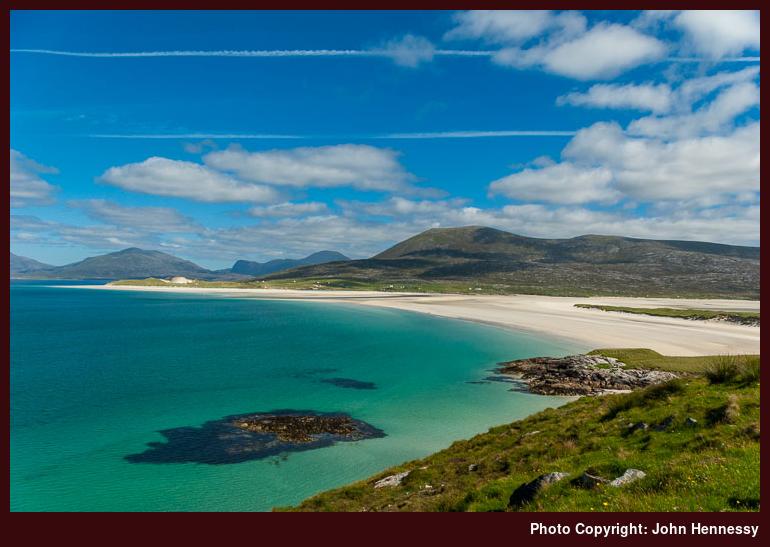
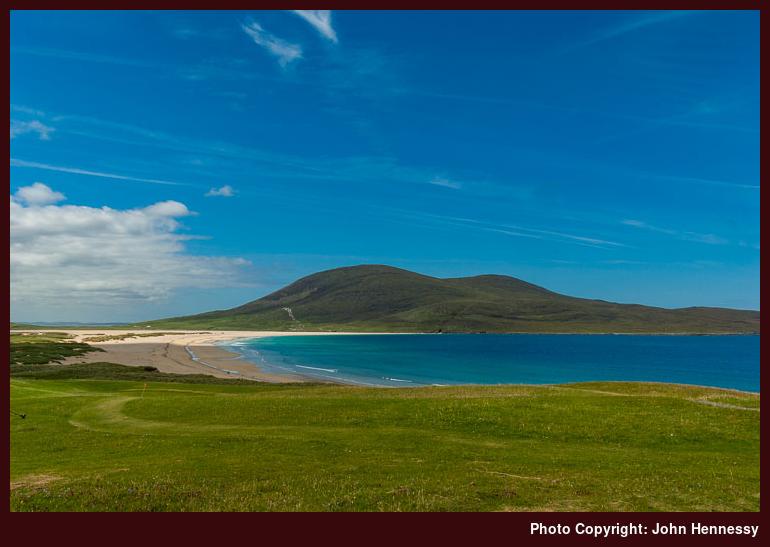
As it happened, the route of that tour overlapped with mine from Tarbert to Lochmaddy. I was especially appreciative of the stops made in South Harris because I got to capture views across beaches like Tràigh Losgaintir, Tràigh Seilebost and Tràigh Scarasta with my camera that I otherwise wouldn't. The former looked especially enticing with the hills of Frith Losgaintir and beyond as a powerful backdrop to the obvious elements of sunlit sand, sky and sea. As if all of that wasn't sufficient, there was the island of Taransay too. The countryside was flatter around Scarasta but Ceapabhal did break up the flat relief of Toe Head, adding a useful focal point.
If I stayed with the coach all the way to Leverburgh's pier, I would have been round by Rodel and glimpsed its notable church. However, I felt the need to for a longer break before catching the ferry and disembarked in Leverburgh to walk the rest of the way in place of the indirect bus journey. In Gaelic, Leverburgh is An tOb or the bay. The Anglicised name comes from the time when Lord Leverhulme owned this part of Harris and tried to set up a fishing port. Like so many big schemes in Scotland's highlands and islands, the plans came to nought (a lesson for Alladale, perhaps?). Deterioration in Leverhulme's financial affairs cannot have helped, but tidal conditions at Leverburgh didn't make things any easier either.
That tidal disruption continues today and, when planning my escapade, I noticed that the Sound of Harris ferry suffered cancellations as a result. With that potential for disruption in mind, I decided to check on things before I left Tarbert and get my ferry ticket there too; otherwise, I would have needed to buy it on the ferry because there are no ticket sales facilities at Leverburgh (I think that it's the same at Berneray). Luckily, tidal behaviour can be predicted these days, so my impression is any such disruption can be highlighted up to a week in advance, a very reassuring realisation. It wasn't to play havoc with my travel plans though and the small vessel that was to convey me soon came into view while I was waiting at the slipway.
The Sound of Harris is dotted with islands and that may be pleasant for the island wanderer but it makes life more difficult for ship navigation, even if there are a good number of markers in place. The result was that the ferry follows a course that weaves its way through the various channels and takes an hour when straight line travel would be quicker. The crossing was a smooth one though there was enough movement in the waters to set off a car alarm periodically; CalMac recommends that you disable your car alarm because of this.
After a short wait at Berneray, it was onto another coach. This portion of land travel to Lochmaddy on North Uist was devoid of stops for the tour, a potential source of disappointment given that it went a little way around Berneray. My journey was broken for an hour in Lochmaddy before I continued south with the those on the tour having gone their way on a delayed ferry to Uig. The thirty-minute delay had been caused by a car accident on the mainland, on the A87 near Shiel Bridge. The ferry waited as long as it could for travellers but had to leave before the coach from Fort William could make it, a major source of disruption to anyone on that coach wanting to travel on the ferry. I suppose that it's a lesson in the perils of travelling too far on the same day. Thankfully, my ferry crossing of the day had passed without any sort of incident and all that remained was trouble-free "land" travel from Lochmaddy to Lochboisdale.
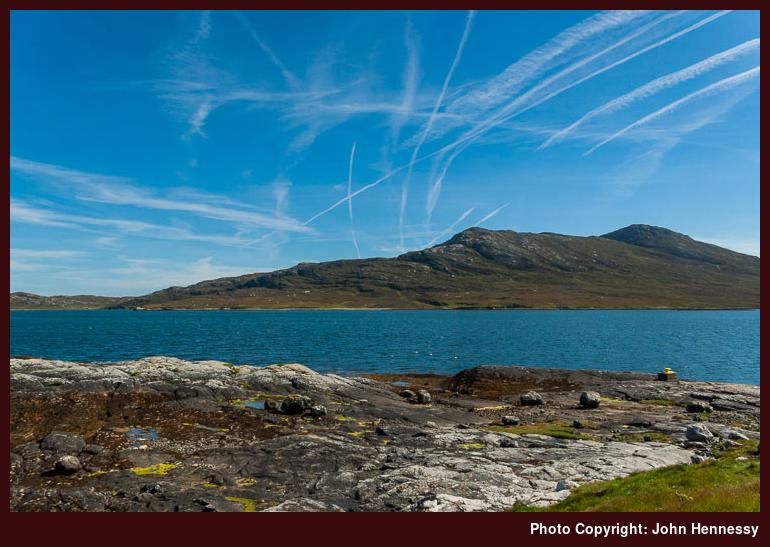
I was a world away from the disruption of the A87, and I began to sense the striking peace and quiet that seemed to typify the Uists for me. Even Harris seemed to possess more bustle and Skye having more again. Lochmaddy did nothing that changed that opinion of these islands' atmosphere while I was there. It wouldn't make a great place for a shopping trip but the vistas over the island-packed Loch nam Madadh and over towards humps like those of Lì a Tuath and Lì a Deas were well enlivened by the sunshine. Hills are lower and less common hereabouts, so there is a more open feel with big skies dominating the flatter landscape.
Soon enough, it was back to continuing my "land" travelling. There is a reason for my use of inverted commas here: this was interisland travel by coach, courtesy of the maintenance of a host of causeways. By the time that I reached Lochmaddy, I had already encountered one of them: that linking Berneray and North Uist. More were to follow as my journey took me to Grimsay, Benbecula and South Uist. Each was as undramatic as if they were built on the bed of a freshwater loch rather than that of the Atlantic.
A perhaps alternative reason for using those inverted commas might be that a glance at an OS map might lead one to conclude that water trumped over land in these parts. The near constant sight of land as my coach plied its way south from Lochmaddy contradicted such a perception. Though the landscape was flat in the main, hummocks like Eaval's 347 m summit lay proud.
After the remote feel of North Uist, Benbecula looked more populous but it is also completely flat, so much so that it is devoid of good harbours and that necessitated the causeway connection to South Uist. It plays host to the Uists' airport as well as an RAF base, something that helps on the population front. Baile a' Mhanaich (English: Balivanich) with its proximity to both of these and its hospital would seem to be a major hub in the Uists, particularly for shopping.
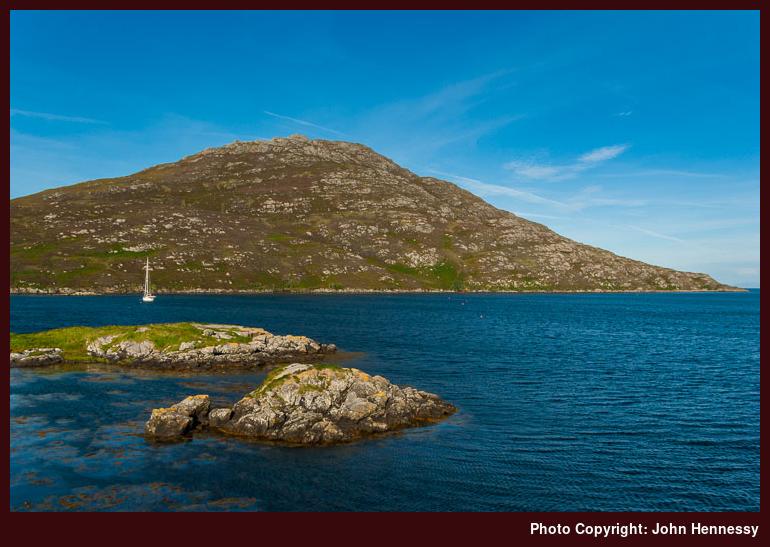
After Benbecula, it was on to South Uist. Like the other islands, it too features a landscape strewn with lochs and that was what typified my first sight of the island. However, hill country soon started to come into view and that is what draws the likes of me. After a change of coach in Tobha Mor (English: Howmore), I continued my journey to Lochboisdale. In contrast to the relative bustle of Harris, a more laid-back ambiance prevailed and bus drivers taking a few minutes to share the latest news did nothing to perturb it. When I reached it, Lochboisdale was as quiet as the coastal communities through which I had been journeying. After settling into my accommodation, I got something to eat and pottered out for a short evening stroll before retiring for the night. Further explorations of the island lay ahead of me, but the following day was to be the time for that; the amount of travelling that I had done from Harris was enough for one day.
When three-carriage trains are insufficient
3rd September 2008 My recent excursion to Edinburgh revealed a huge flaw in DfT thinking: three-carriage trains running on the Manchester-Edinburgh route and the Edinburgh Festival ongoing. The 15:34 departure from Manchester was packed and I was wise to have garnered myself a seat reservation beforehand. Engineering works in the Chorley area only made the situation worse. Nevertheless, the train was very busy all of the way up to Carlisle after which things thankfully eased down a bit.
That was nothing compared to what happened with the 15:52 from Edinburgh. A breakdown meant that only half of the planned six carriages appeared and ticket reservations couldn't be honoured; this was the last day of the Edinburgh Fringe so it wasn't at all brilliant. I counted myself lucky to have got a seat, even if my main luggage was in another carriage. From past experience, I know the problems that were experienced on bank holidays when Virgin Crosscountry could only proffer a four carriage train so I had braced myself for the worst; I even considered stumping up the fare for a journey around by York and trying to get a refund from Transpennine Express. As it happened, the train left Edinburgh with people standing and it wouldn't have been fun trying to get on it at subsequent stations. In fact, staying on the platform and awaiting another service would have been prudent.
Considering the overcrowding, I didn't get on too badly with both journeys and I did reach my destinations in one piece. Also, I am a regular train user so I know that there's better than what I encountered. However, an infrequent traveller could be forgiven for being put off the railways by this experience and choose to travel by other means or not at all. I have sent some feedback to Transpennine Express but a reply has yet to appear and may never do so. In any case, it sounds as if they need to sort out longer trains for their Anglo-Scottish workings and on a more permanent basis. It's a shame that the Manchester-Scotland piece was removed from the Crosscountry franchise and even its addition to the West Coast one would have been better than this.


