Category: Travel
Another way of delaying trains…
 27th October 2007
 The fact that Manchester's main railway station, Piccadilly, has only got two through platforms (13 and 14) and the fact that they seem to bolted onto the side of the station like an afternoon does surprise me. The disappointingly underused Manchester Victoria is far better in that respect and, given a more usable tram service, would be a great asset. I know that some may disagree with me regarding the Metrolink but I always feel that there is a certain detachment about the thing and now resort to walking instead; I have my own ideas about how it might be routed. As things are, I may press taxis into service for those occasions when time is not in plentiful supply.
As it is, funnelling people onto two train platforms at an otherwise busy station can only cause overcrowding, particularly if they are the only ones served by northbound and westbound services. And I saw plenty of evidence of that last Sunday morning while headed for the South Pennines.
In fact, a Virgin service to Glasgow that I had used when coming from Macclesfield was delayed by people not being able to board it. Admittedly, it was a Voyager but there were two four car sets forming the train. Nevertheless, passengers didn't realise this and all crowded onto the first four coaches. Amazingly, the train manager didn't put them right for five minutes and the train got delayed more than the thirteen minutes of lateness that it had when it reached the station. it didn't look good and I was glad that I didn't get an idea of heading to the Lake District on the day that I witnessed this.
The following service was delayed by the Virgin one ahead of it and it too was afflicted by slow boarding. In contrast to the service preceding it, a robust vocal intervention from the train conductor attempted to speed things up. And that was on a Transpennine Express to Blackpool North so Virgin could learn a thing or two.
The whole exhibition brings another thing to mind: going north from Manchester. This will soon be entirely in the hands of Transpennine Express if one is to travel without any changes of train during the journey. Quite how they will cope with passenger and luggage volumes will be interesting to see. Modern trains aren't particularly brilliant when it comes to luggage storage anyway. Thankfully, the Virgin option will remain north of Crewe since there might be a lot of lessons to be learnt by the powers that be before they realise how it should be done. Let's hope that such learning doesn't take as long as the Piccadilly through platform saga to result in improvements.
Public transport in Cumbria
6th May 2007 Public transport provision in Cumbria is a classic curate's egg, good in parts. As it happens, the western part of the county fares much better than the eastern side. For a walker in the Lake District, options are plentiful but they decline a lot when you start to consider following the likes of the Pennine Way. In any case, Cumbria County Council provides useful timetable information for any bus services that are likely to be running.
Being the honeypot that it is, it should not surprise you that bus services within the Lake District National Park are in good supply and they connect with train services, after a fashion. Anywhere with literary connections is bound to attract the crowds and will be well served by buses. Coniston, Rydal and Grasmere fall into that category and it is good news for walkers. However, any walking destinations away from these may not get the same level of service. Wasdale is the most extreme example here but Kentmere and Patterdale also fall into the same category, albeit to a lesser extent. Another thing to watch is that bus services can be seasonal too but this is all documented in the biannual guides that are produced.
There are a number of reasons why travel in eastern Cumbria takes my interest: the Dales Way, the Howgill Fells and the aforementioned Pennine Way. Am I becoming something of a connoisseur in my voyages off the beaten track? I am not sure that I am but getting to the likes of Sedbergh, Dufton and Alston would be very useful for exploring the above. The Settle-Carlisle railway line is a help for getting to Dufton, even if a walk from Appleby-in-Westmorland is involved but that isn't necessarily a bad thing. Nevertheless, it cannot do everything. Also, Sunday bus services are akin to the proverbial hens' teeth and weekday services aren't that plentiful either, particularly on Saturdays. It all needs some planning and maybe a few days of point-to-point walking to explore these parts. Nevertheless, Wright Brothers' summer only extension of their 888 service will be a boon when it comes to exploring around Alston and doing the sections of the Pennine Way nearest to the town. Weekday and Saturday connections from Carlisle and Haltwhistle help too. Eccentricities not withstanding, services between Kendal and Kirkby Stephen make access to the Howgill Fells a possibility.
A spot of recce in Gougane Barra
3rd May 2007 Last weekend saw pop over to Éire to see the folks for the first time since the Christmas break. It also saw me revisiting Gougane (pronounced guugawn) Barra, where the River Lee rises, on the Sunday. This place is one of my father's favourite places and even with cloudy skies and a cloud base approaching the 500 metre level, you could still see why. Seeing it on a sunny day and being able to explore it in a bit more depth would have been ideal but my 90 minutes off the leash (my parents are not really into walking but they have bequeath me a love of the countryside) allowed for a good few record shorts capturing ideas for any return. Still, the weather remained dry for our stay, a bonus since we had passed through mist, murk and light rain while we made our way there.
Gougane is place with two sides to it: Valley Desmond and an eponymous lake with an island hosting the ruins of an old monastery and a small church. The lake sits outside Valley Desmond and collects the waters of the juvenile Lee before it continues its onward journey towards Cork city where it meets the sea in Cork harbour. The monastic ruins once hosted a religious community found by Cork city's patron saint, Finbarr. Given how old it is, it is amazing how much remains in good condition and it is hard to fault its setting but it is well frequented.
Nowadays, Valley Desmond is owned by Coillte, the Irish forestry agency (it's the Irish word for forests or woods and is pronounced queellte), and ubiquitous conifers line the hills from whose craggy slopes the waters of the juvenile Lee gather. There was a time before the invasion of commercial forestry but there was no access for the public back then like there is today. Coillte, like any state-owned custodian of commercial forest, does do its bit to encourage visitors and they charge for entry too, though you could be lucky in the off season. For the money, you get parking and a reasonable network of paths; in fact, this network is being treated to a spot of maintenance right now with bridge replacements and surface improvements taking place. It was on these paths that I went for a stroll and some of them do get you above the tree line for views of the lake, among other things. The hills around here may not be that high - the Irish have a penchant for calling anything above 400 metres high a mountain but that's a discussion for another day - but the thoughts of delving deeper do appeal to me.
TransPennine Express customer service?
27th March 2007 The prospect of a fine, sunny day on Sunday had me heading off to Haworth so that I could take in another section of the Pennine Way. Part of my journey involved catching a train between Manchester and Leeds, normally a straightforward manoeuvre as there are frequent trains between the two cities provided by First Transpennine Express.
However, the 10:49 got delayed by a technical fault, but communication was next to non-existent as to what was happening; the sight of Transpennine Express staff huddled away from passengers did nothing to add to the company's reputation for customer service. Parking an out of service train in the station didn't help either, especially when it was at the same platform as an outbound service for which the train forming it was delayed.
Luckily, there was a train at 11:12, but passengers were left standing outside the doors of that for a while before they were opened to let them on, and the same applied to the 10:49 when it finally did arrive. The delay to door opening could be justified for the 10:49 because Siemens staff were having a look at it, and a staff changeover could have been the cause in the case of the 11:12.
Engineering works were preventing trains from reaching Manchester Airport that day, so all the staff changeovers could have been happening at Piccadilly instead. Granted these extenuating circumstances and the fact that it was a Sunday morning, the whole impression still reeked of laggardness; it was hardly a good advertisement for that rail industry and that's a pity because it continually needs it.
Thankfully, it was all a brief frustration as I got my train to Leeds and got to Haworth as planned, even if we did pass Wakefield along the way thanks to another set of rail engineering works. Nevertheless, the timeliness of the 10:49 would have helped me get to my destination earlier to start my walk, but all ended well anyway.
Encountering the attractions of Harlech
18th December 2006 Last Saturday, I took myself off to Harlech in Wales for a few hours of walking. Getting there and back was a rail-only affair with a change in Wolverhampton. The arrangements for the onward journey take a small bit of explaining: two car DMU from Wolverhampton (it starts out from Birmingham) to Shrewsbury, joined to another two car DMU at Shrewsbury, train splits at Machynlleth with one portion proceeding to Aberystwyth and the other continuing up the coast to places such as Barmouth, Harlech, Porthmadog and Pwllheli. It sounds complicated but it works well in practice; just make sure that you are in the right part of the train. The same sort of thing happened on the way back. In fact, the same sort of operation, again necessitated by a single track railway line, will be familiar to anyone has travelled on the West Highland railway in Scotland.
Apart from what I suspect was a miscommunication between the central control room and a helpful lady train conductor, which nearly led to my onward journey from Shrewsbury being delayed, everything went smoothly. Harlech is set on a steep hillside, around its famous castle built by King Edward I and dating from 1283. The site for the castle was an excellent choice: views up and down the coast and set on a steep hillside to slow the approach of any prospective attackers (if they got up the steep western approach, and it appears that water ran up to its foot in former times, they'd have to contend with the substantial fortifications).
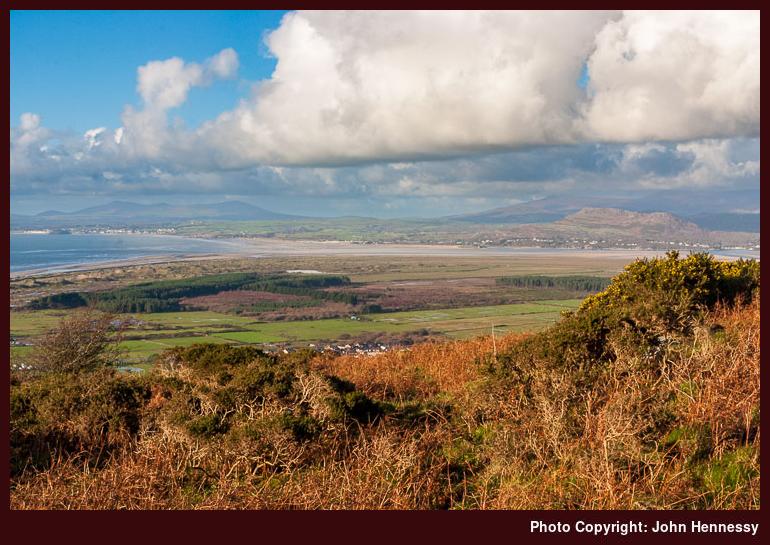
There is more to Harlech than the castle, though. For instance, beyond the flats of Morfa Harlech lie beaches of some note and golfing facilities for those with that inclination. Views across Tremadog Bay toward the Lleyn peninsula and its hills, Yr Eifl included, are complemented by those across the Glaslyn estuary towards the Eifionydd and Moelwynion mountains; all making up a superb vista. Adding to all of these delights are the Rhinogs only a few miles east of Harlech itself. My walk, with its diversions intentional and otherwise, allowed me to sample the scenery of the area. Clag was inclined to accumulate on the higher tops, but there was plenty of sunshine to enliven the aspects. On my outward journey, the sight of banks of cloud abounding over the hills of mid-Wales had me thinking that I had come too far west and was going to be under cloud all day with sunshine in plentiful supply further east, a fear happily unrealised.
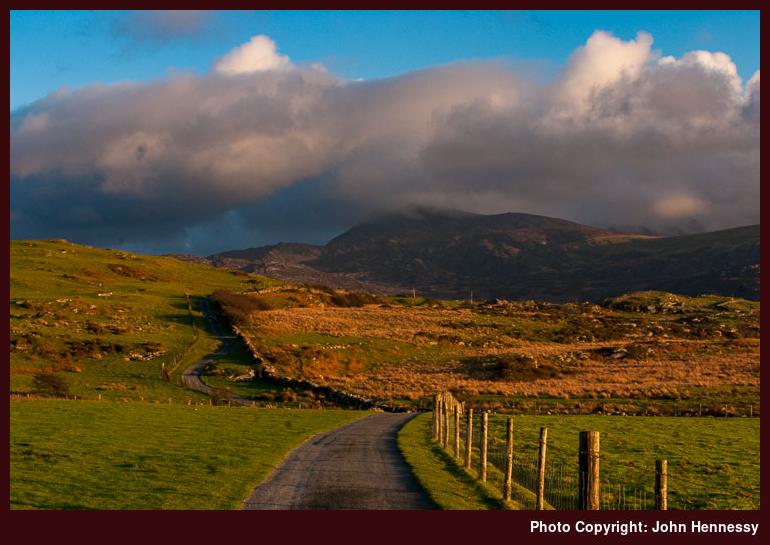
I have to admit that my walk allowed me only a brief reconnaissance of the area but it is more than worthy of further visits in the future. A weekend stay is definitely a proposition and I do hope to make a return.


