Category: Trip Ideas
A trot around and over Caer Caradoc
 25th November 2010
 Since I first glimpsed the hills around Church Stretton while en route to Abergavenny for a day of walking around there, Shropshire's hill country hasn't seen that much of me. Whether it's because I have failed to find ways of extending my explorations from those visits that I have made or there is another explanation, it's a part of the world that I reckon needs more of my attention.
After that, there is a copy of Cicerone's guide to the area sitting on my bookshelf, and it was from this that the idea of a walk around and over Caer Caradoc was put my way for something to made of it the Sunday before last. That it's a short hop within a proverbial stone's throw of Church Stretton at a time of year when days are short added to the appeal of the idea. It also meant that a later start than might be ideal did nothing to spoil the afternoon that it occupied for me.
Though the forecast was more hopeful, the day was to stay cloudy until the sun found a western gap in the cover late in the day. As it happened, it seemed that the North Wales were doing rather better with catching the sun than where I was spending my time. Nevertheless, I am putting any such galling thoughts out of my mind to enjoy what I had.
Travel arrangements meant a stopover in Shrewsbury and I took to take another little poke around the town. From a previous quick taster, I wasn't ignorant of its attraction, with quite a few pretty old buildings around the heart of the place. This time around, I stayed near to the train station to gawp at Charles Darwin's old school, now a public library, and to sample a little of the town's castle. A bit more sun and blues skies would have made the place that little bit harder to leave, while convincing me that popping down there for a few hours would be no waste of time.
Though the skies were brightening, I stuck to my plan, and I was soon to find how usefully near to Church Stretton Caer Caradoc was to be. After crossing the A49, I picked my way through streets to make for what once was the road to Cardington, and there even are Cardington Way markers on the route too. Part of what seems to have been the course of that old thoroughfare is now a sunken passageway hosting a stream. The right of way doesn't use this but leaves the tarmac roadway leading to New House Farm to follow the hedge that is by its side. Not unsurprisingly given the often wet autumn, the going was soft and muddy underfoot, something that wasn't unexpected anyway.
It didn't take long for me to pick up the old track where it enters the field and follow it into the dip between the wooded Helmeth Hill and the bare Caer Caradoc. Staying with the track, I went around underneath the slopes of Three Fingers Rock, having some easy height gains as I did so. Here, immersed in rolling hill country, it was difficult to believe that civilisation, a railway and a busy modern road weren't at all far away.
Seeing a path climbing up the hillside before me, I left the track to pick my way to the top of Caer Caradoc. What the hills of South Shropshire lack in height, they compensate by having steep sides, and Caer Caradoc is no different. It was a matter of letting the summit come when it did and stopping whenever more level ground allowed. The sun was struggling to get through the cloudy layer without much in the way of success; if it had done so, copious amounts of photographic activity would have ensued with hummocks like Hope Bowdler Hill, Robin's Tump and The Wilderness (not as wild as the name suggests, incidentally) featuring in resulting photos.
The 459-metre-high top of Caer Caradoc was once a fort, and you might see why it would be secure if you ever walked up there. To my eyes, the old ramparts weren't so obvious, though I was later to see the signs of an old ditch. The name comes from a Celtic chief who fought the Romans only to lose and fall into their hands to get carried to Rome; apparently, he possessed enough guile to ensure that he and his family didn't meet a sticky end at the hand of his captors with his living out his days in that foreign land to die a natural death. Today, the hill is seemingly well frequented though, as I found, not so much as to deprive anyone of peaceful relaxing moments to survey the surrounding panoramic views. It was from here that I spied sunlit Welsh hills beyond the Cheshire Plain, while making such neighbouring hillocks as The Lawley.
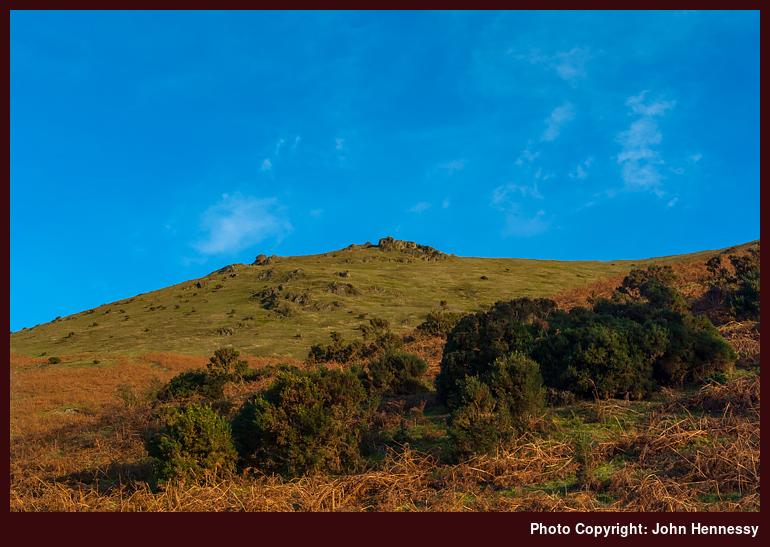
On the way down, I went around the smaller Little Caradoc though that involved a little diversion from what might have been my intended route back to civilisation. That deviation was well worth it, with only passing dog walkers to disturb my reverie while I took a breather after the steep descent from Caer Caradoc. Then, I needed to regain some height before picking up the path that was to take me along the lower slopes of Caer Caradoc while losing height all the while. It was while I was trotting along here that I spied the prospect of some late evening sun before it did come my way. When it did come, many hillsides were pleasingly lit, though its time of arrival meant that it was short-lived. That wasn't to be a cause for complaint, since it was the icing on the cake for me.
More steep descent lay ahead of me before I was to descend to the dip between Caer Caradoc and Helmeth Hill. Some of these were to be well eroded too, so I took a slight deviation from the direct route to be on more trustworthy ground. Before that was to pass, I was tramping along a path that reminded me of a similar approach that I took to walking Place Fell near Ullswater earlier in the year.
Once down in the dip between the two hills, it was a matter of retracing my steps to return to Church Stretton's train station in fading light. When I set foot onto the tarmac again, the street lights had come on, but there still was some light in the sky. A tempting public footpath diversion was discounted in favour of being sure of my route, and I was at the train station with enough time to spare for a spot of grocery shopping before staring my journey home.
One thing that I suspect after this trip is that I shouldn't be devoid of ideas for further walks in the area. After all, repeating the walk when there is more sun is one option and more hills are there to be walked too. For instance, I quite fancy reaching the top of The Lawley and seeing how things look from there. After that, there's another route that has come to my attention since the walk: The Ancient Portway, a hike from Church Stretton to Pulverbatch and Pontesbury. This would be a day-long affair for the full route, but it could be cut short at Pulverbatch if needed. It's a refrain that I may repeat too often, yet it's best to leave anywhere with more things to be doing on any return, and it's true of my wandering around Caer Caradoc. All in all, it was a satisfactory afternoon outside and in an area that wasn't overrun with folk, either. With that, there can be no complaints and there is always that Cicerone guide should these possibilities be exhausted.
Travel Arrangements:
Bus service 130 from Macclesfield to Wilmslow; train from there to Church Stretton with a change in Shrewsbury; train from Church Stretton to Crewe with a change in Shrewsbury, bus service 38 from Crewe to Macclesfield.
Contemplating explorations of southern Derbyshire Dales
3rd October 2010 A reduction in outdoors outings seems to have coincided with a change of job a few months ago so I am wondering about changing that state of affairs. Whether it is the busy working weeks or something else such as unappealing weather that has broken my stride, it now feels as if usual haunts such as Cumbria or North Wales have got that little further away. The result is that I am wondering about destinations not so far away from home such as Shropshire, Staffordshire and Derbyshire.
The mention of Derbyshire brings me to a short run out last weekend. The possibility of some sun was enough to get me wondering about a photographic outing to Buxton. However, the afternoon became very grey and there was a biting cold wind too. The result was that I ended up in Ashbourne for a little while. While there, I did a little exploration and found the Tissington Trail on an improving afternoon. There was only enough time for a short stretch along the well used former railway but it was enough to etch thoughts about further explorations into my mind, especially with the rare experience of walking through an old railway tunnel included. After all, I had passed through the pretty estate village of Tissington while en route to Ashbourne and that deserves a proper visit and not just a glimpse through a bus window.
The result of my brief taste of this area was that I have been perusing Mark Richards' White Peak Walks: The Southern Dales, published by Cicerone, in the name of learning more. Though largely pastoral now, the landscape has had an industrial past that gives us the railway alignments that nowadays find recreational use as the Tissington and High Peak trails, among others. All in all, there seems to be plenty to explore and it all seems to be the sort of walking that would ease someone into the outdoors again after a layoff. That isn't to say that there isn't something for the cyclist too as I discovered a cycle hire service near the start of the Tissington Trail.
In a way, it's a surprise that I hadn't been around these parts before now. As to why that has been the case is unclear to me but perceived greater ease of access using public transport might have had something to do with it. Even so, there are a good number of bus services doing duty in these parts and there are YHA hostels (Hartington and Youlgreave) too if I fancy staying overnight somewhere and can find a space available. Now, what needs doing is to firmly pencil in some time for plying paths and trails so as to avert any fatigue-inspired foot-dragging.
Travel details:
Bus services 58 from Macclesfield to Buxton, 42 from Buxton to Ashbourne and 108 from Ashbourne to Macclesfield via Leek.
An alternative choice
1st August 2010 Today, I was in a shop when I overheard someone moaning about the less than exciting weather that has been with us for much of July. Many have very optimistic hopes for the summertime so that sense of frustration was understandable. It's why it's best to spread those aspirations around the year instead. Nevertheless, some spouts of sun this evening added some cheer and there may be a window of better weather latter in the week to break up things.
Maybe I should have made better use of the dry though grey day but I ended up doing some clearance at home instead. It was that activity that caused me to come across a map that I bought in Dublin in May. Surveying outdoors blogs can leave you with an impression that some have a soft spot for certain types of outdoors equipment. For on, it's stoves and another does footwear. For me, it seems to be maps, probably because they are so good at opening up any location awaiting exploration.
The map in question was produced by an alternative producer of Irish Maps, EastWest Mapping. For a while now, they have produced maps for Walking World Ireland to accompany pieces on walking routes in the island of Ireland. There was a time when they sold all sorts of outdoor maps and guides, including OSi and Harvey maps, but that seems to be over now. Nowadays, they use their website to sell only their own wares instead of those from others.
So far, those include three maps for the Dublin and Wicklow Mountains along with map guides for the Wicklow Way and the Táin Way, a circular trail starting and ending Carlingford on the Cooley Peninsula in County Louth (incidentally and perhaps ironically given it features in a Celtic myth regarding cattle rustling, it was the only part of Éire affected in the 2001 Foot and Mouth Disease outbreak; the disease was not allowed to spread any further). All can be ordered over the web and payment is by using PayPal. Regarding the maps for the Dublin and Wicklow Mountains, they are divided to cover the following areas: Dublin & North Wicklow Mountains, Lugnaquila & Glendalough, West Wicklow Mountains. There is another in the offing to complete the quartet and that will be for the eastern Wicklow Mountains. Currently, it is possible to by three of the intended four as a set from the website though that should become a quartet when the final map is released early next year. The scale is 1:30000 and overlap between each of the maps is generous so things look promising.
Returning to that map bought last May, it covers the Dublin and North Wicklow Mountains and I seem to remember that it needed discipline to leave the others after me at Eason's in O' Connell Street. Looking at it now, I have to say that there is a good deal of detail though I'd have to try it out on a real walk and not an armchair one to reach a definitive verdict. As well as claiming to be waterproof or water resistant on the cover, the paper used in the maps seems to be like what Harvey's use in their SuperWalker series so it should stand up to the occasional wetting, even if I wouldn't go opening the map up in a downpour like I got on the way home last Friday evening. Though my work circumstances have changed since the purchase, any excuse for more walking in my native Ireland has to be good. After all, any excuse to return to a area with pleasing hill country has to be good.
Edge
20th June 2010 There may have been wonderful sunny summer weather visiting us over the last few weeks, but goings-on in my professional life have meant that I haven't made the kind of use of it that is habitual for me. That's not to say that there haven't been restive escapes during the hurly-burly. In fact, lengthening my cycling commute on the homeward leg has afforded the spending of some quality time among still fresh greenery.
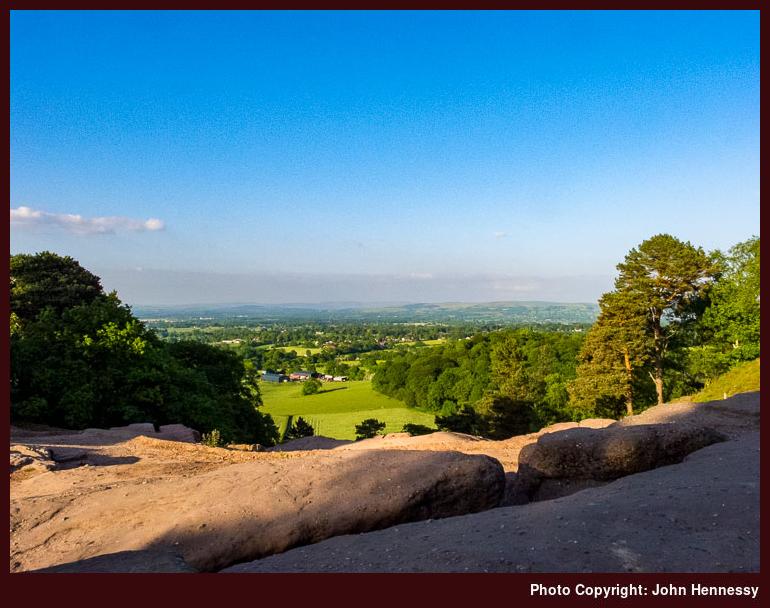
Not inappropriately given the prospect of a major change to my work circumstances (a change of job is looming on the horizon), some of those peaceful interludes have had me poking around the National Trust property surrounding the escarpment that is Alderley Edge. The result was that some aimless exploration took me in directions that I mightn't have followed while if I had a map with me! Even so, no harm came from them and you need to break out from the constraints of modern life from time to time anyway. The area is a confined one that I know well enough so not too much can go awry. Still, there are plenty of paths for a stroll and it's under tree cover much of the time too, a perfect antidote to the hot bright strong sunshine that occasionally makes its appearance around this time of year. Trees may be things with which I have a love/hate relationship but they have their plus points too and the National Trust's broadleaved collection near the edge offers plenty of shade when it gets as warm as it has been on the way towards midsummer.
Looking further ahead, it doesn't look as if this summer will get the customary longer break that has tended to happen every year in recent times. Nevertheless, there are some days' leave coming to me that I plan to use as well as I can. It's a matter of using what is available rather than having all that I'd like to possess. Ambitions may require control (the sort of Hebridean adventure that I enjoyed a few years ago is out of the question for now but you never know what the future might bring) but one or two possibilities are coming to mind regardless. Despite the constraints that I face, I should get more out of the summer than I did during the one when my career was first set on its faltering course a decade ago. Its next phase is ahead of me and I hope to keep up my wanderings through hill country. They have afforded respite from life's toils up to now and it is unlikely that the need will disappear.
Back savouring the variety of Scottish Borders countryside
15th May 2010 It's been a while since my last trip up there, but last weekend saw me back in the Scottish Borders and sampling more of its attractive countryside. 2006 was when I last frequented these parts and so decided that it was high time for a return. Then, it was the turn of St. Mary's Loch and Ettrick Head while on a trot west along the Southern Upland Way. That followed a reconnaissance visit based in Lockerbie that involved a poke around Moffat on a largely cloudy weekend. That's not to say that the sun hasn't been out either with previous hikes around Peebles, Traquair and Innerleithen being blessed by blue skies.
Last August's visit to Edinburgh had the unfulfilled ulterior motive of an outing to Melrose to savour the delights of the Eildon Hills. However, a forecast of rain raised the prospect of not seeing them at their best and that was one reason why they have lain on the ideas shelf since. It was that and thoughts of seeing Melrose Abbey that drew my mind to the area again.
Everything may have looked sunny in Carlisle, but Selkirk was cloudy when I got there. It stayed like that as I left the town to cross over Ettrick Water as I headed for the Philiphaugh Estate. The possibility of using the Borders Abbeys Way to get to Melrose was set to one side in favour of using the old right of way between Selkirk and Three Brethren before following the Southern Upland Way first to Galashiels and then to Melrose.
To my surprise, the Philiphaugh Estate has set up trails for visitors to follow and a leaflet to go with them. While it may not have been my intention, I ended up sampling a track through forestry that gave me a sneak preview of my surroundings from an elevated vantage point. After retracing my steps, I followed the vehicle track named the Corbielinn (or Corbylinn as the OS has it) Road until it left woodland near a reservoir.
Beyond that, it was onto the slopes leading away from Long Philip Burn with a spot of track hopping until I found myself on one leading me straight towards the Three Brethren. The sun was making a better fist of peering out through the cloud cover and caused me to stop a lot on gradients that otherwise weren't the unkindest. The views were changing all the while too as I gained height, keeping my mind occupied and warding off any sense of impatience. This observation leaves me wondering if it as unchanging surroundings that were the cause of any rising impatience during my long walk on the Isle of Man, but there may have other factors at play too.
The three cairns that are the Three Brethren came into sight soon enough and grew steadily larger as the approach to them grew ever shorter. They caught the sun too as it ducked out from behind the broken cloud cover sporadically and I started to think it to be a pity that someone placed a fence through them. Once beside the cairns, the line of the old drovers road that now carries the Southern Upland Way stretched out to the east and to the west. A useful signpost confirmed that Galashiels was nearer than Traquair, verifying the sense of my route.
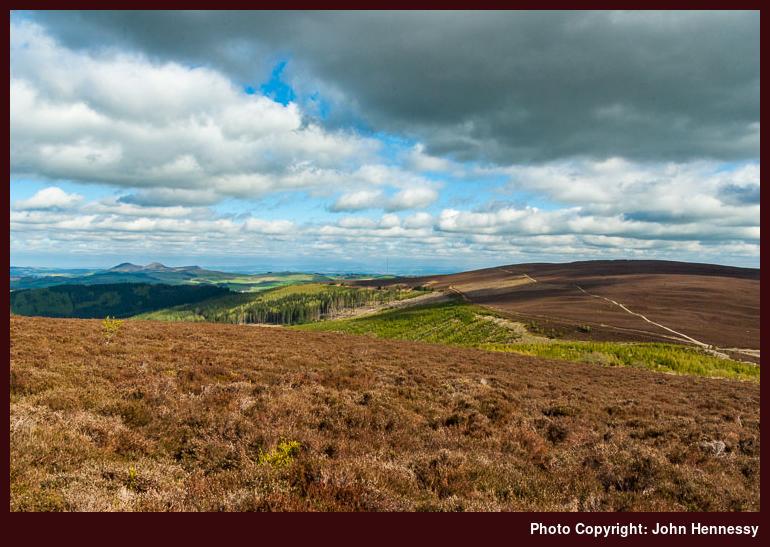
With the highest point of the day behind me, I began to lose height as the day grew ever better; it had all the hallmarks of being one of those delightful late spring and early summer evenings of the kind that I met once around Peebles and never have forgotten. There was no doubt about the way to be followed though I found yet another signpost and it included the option to return to Selkirk if I so desired, via a track that I left further down as it happened, but I was bound for passage through Yair Hill Forest.
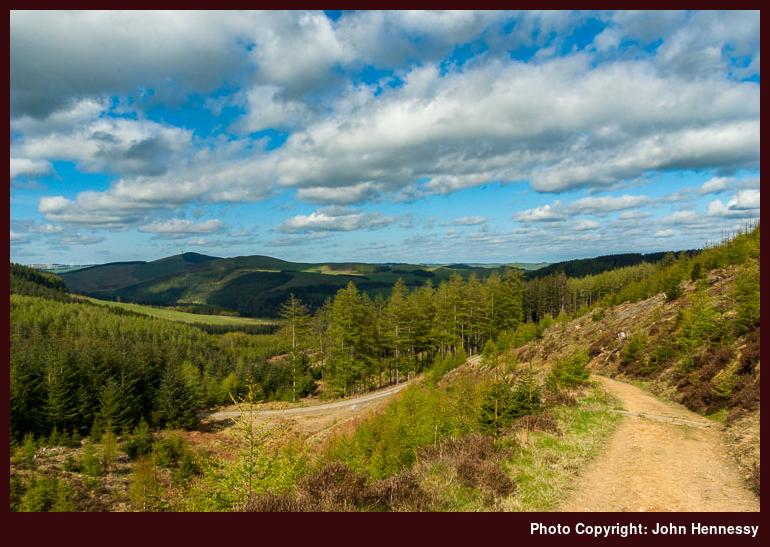
Mercifully, some forest clearing allowed greater views of what lay ahead of me. Yes, there was the sight of wind turbines that no doubt would annoy some but they weren't all over the place either and enough was left in an unblemished state for unperturbed enjoyment. Woodland wandering demanded good attention to a map but any waymarks that I met were a useful backup too, not that they made good map reading unnecessary. Without going around in any circles, veering off track or any other difficulties, I found myself at Yair Bridge for a crossing over the Tweed as planned.
From Fairnilee Farm, it was all pastoral wandering in pleasing sunshine. There was height gain but it was fairly gradual and views back towards Selkirk opened up behind me; it looked as if it was stuck in constant shadow. Sheep and lambs abounded as did stone wall field enclosures. You'd be forgiven for thinking that you were further south in Britain than Scotland as I crossed from field to field.
In time, the views over Galashiels came too, first from a large neatly constructed cairn much like one of the Three Brethren. From there, it was downhill again as waymarks draw the wanderer closer and closer to Gala Hill. The Southern Upland Way chooses to go around it and skirt Galashiels in doing so. Saying that, there are plenty of paths on Gala Hill shown in Explorer 338 and Galashiels has its share of waymarked paths too, some of which use part of the Southern Upland Way. Though it would mean gaining some height again, I can see the point of including the woods around Gala Hill and the trail gains height after Galashiels anyway. The Galashiels variant can be left for anyone who wants it but I think that having the SUW going over Gala Hill would bring its own rewards too and cut down on any urban walking.
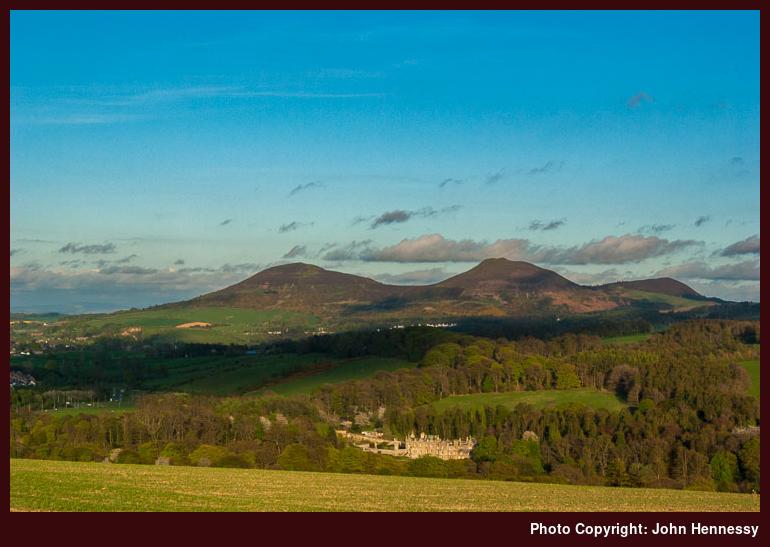
Having to face more ascent was not welcome to tired limbs but it did offer recompense in the form of more views of Eildon Hills, this time with the added interest of Abbotsford, Sir Walter Scott's former home. After the last loss of height for the day, I was to find myself on the opposite side of the Tweed from Abbotsford and among trees for a last fling before urban walking was to take hold. More river crossings followed with one of Gala Water coming before another of the Tweed.
The latter brought me along a former railway cutting and the tarmac underfoot was taking its toll on the soles of my feet; is it time to get better insoles for my Meindl Burmas? This part of the SUW is shared with part of the National Cycle Network and the distances on their signs did everything that they could to dispel and impression that Melrose and Galashiels are right beside each other. With sore feet, not seeing much in the way of progress can be dispiriting and it was with relief that I gained one final stretch by the Tweed with hard dry grassland underfoot. When that was behind me, there was the matter of pavement pounding until I found my lodgings for the night, but that didn't seem to take so long.
The next morning began with blue skies before a rain shower came my way and there were a few more before the day set to improving steadily. After the one before, it was to be one of gentler pursuits such as relaxed inspection of Melrose Abbey. Other than that, there was a taste of St. Cuthbert's Way before I stopped to soak the views that any gain in height revealed. Not having the time to use that trail to continue in among the Eildon Hills, I left the idea of exploring them for another time and subsequent map inspection revealed a possible alternative itinerary that would achieve that end. Following St. Cuthbert's Way from St. Boswell's to Melrose not only would take me through the aforementioned hills but also near Dryburgh Abbey too. It only needs one excuse to return to any place and I have found it for the Scottish Borders. Let's hope that it doesn't as long to get back as it did before.
Travel Arrangements:
Return train trip from Macclesfield to Carlisle. Outward bus journey onward to Selkirk and more buses to bring me back from Melrose by way of Galashiels.


