Category: Trip Ideas
Walking in Cheshire
 4th June 2007
 With the long evenings upon us, the possibility of having a short evening stroll after work becomes a reality and Cheshire does supply the goods. The range of opportunities includes the hill country next to Macclesfield, public footpaths through rolling pastoral land, canal bank tracks and local long-distance trails. Friday evening saw me head into the hill country, but there'll be more on that later. Other evenings have been wiled away by the Macclesfield Canal, either by heading north to nearby Bollington or south towards Bosley and Gawsworth. Pastoral strolls have taken me between Nether Alderley to Macclesfield or, on one winter's afternoon, from my own doorstep to Wilmslow, which proved to be a shorter journey than I expected.
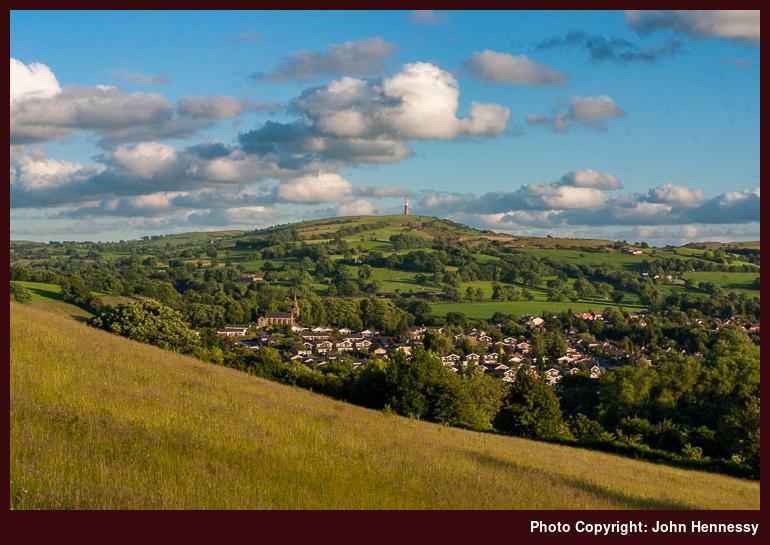
Speaking of my own doorstep, a good number of my local walks have started and/or ended right there and so it was last Friday. It was a spot of road walking that got me to Tegg's Nose Country Park, not a large place but the views make up for that. From the top of "Teggie", which was subject to quarrying in times past, I dropped down to Langley before I encountered what I consider a peach of a path; the views over the villages of Langley and Sutton towards the radio mast surmounting Croker Hill will draw me back. One afternoon, another stroll began from Teggie and that took me through Macclesfield Forest to the small settlement of Forest Chapel, over the summit of Shutlingsloe and then home via Langley. It was a six-hour venture and all I had to do was walk straight out the front door of my town centre abode.
Extending the "from my own doorstep" theme, January strolls have seen me head to Lyme Park near Disley by way of the Middlewood Way, which largely follows the alignment of the old Marple-Macclesfield railway line, and the Gritstone Trail, which extends from Kidsgrove in Staffordshire to Lyme Park. That takes me onto the longer distance paths around here. I have been known to travel over sections of the North Cheshire Way, the Bollin Valley Way (which extends from Macclesfield to Partington) and the Dane Valley Way. The latter goes from Buxton in Derbyshire to Middlewich in Cheshire and I followed part of its length while on a particularly muddy walk from the Cat and Fiddle Inn to Rushton Spencer in November 2004; the conditions underfoot were hardly a surprise given how wet 2004 was.
There's plenty of walking to be had around here all right; all that is needed is a spot of map perusal and some time to explore the possibilities. The Discover Cheshire website has a walking section where you can find out about these and other options.
Public transport in Cumbria
6th May 2007 Public transport provision in Cumbria is a classic curate's egg, good in parts. As it happens, the western part of the county fares much better than the eastern side. For a walker in the Lake District, options are plentiful but they decline a lot when you start to consider following the likes of the Pennine Way. In any case, Cumbria County Council provides useful timetable information for any bus services that are likely to be running.
Being the honeypot that it is, it should not surprise you that bus services within the Lake District National Park are in good supply and they connect with train services, after a fashion. Anywhere with literary connections is bound to attract the crowds and will be well served by buses. Coniston, Rydal and Grasmere fall into that category and it is good news for walkers. However, any walking destinations away from these may not get the same level of service. Wasdale is the most extreme example here but Kentmere and Patterdale also fall into the same category, albeit to a lesser extent. Another thing to watch is that bus services can be seasonal too but this is all documented in the biannual guides that are produced.
There are a number of reasons why travel in eastern Cumbria takes my interest: the Dales Way, the Howgill Fells and the aforementioned Pennine Way. Am I becoming something of a connoisseur in my voyages off the beaten track? I am not sure that I am but getting to the likes of Sedbergh, Dufton and Alston would be very useful for exploring the above. The Settle-Carlisle railway line is a help for getting to Dufton, even if a walk from Appleby-in-Westmorland is involved but that isn't necessarily a bad thing. Nevertheless, it cannot do everything. Also, Sunday bus services are akin to the proverbial hens' teeth and weekday services aren't that plentiful either, particularly on Saturdays. It all needs some planning and maybe a few days of point-to-point walking to explore these parts. Nevertheless, Wright Brothers' summer only extension of their 888 service will be a boon when it comes to exploring around Alston and doing the sections of the Pennine Way nearest to the town. Weekday and Saturday connections from Carlisle and Haltwhistle help too. Eccentricities not withstanding, services between Kendal and Kirkby Stephen make access to the Howgill Fells a possibility.
One or more cruxes of the Pennine Way
31st March 2007 Upon pondering my progress along the Pennine Way, I started to look at how things might pan out from a logistical point of view, the further north that I continued. Once the section between Littleborough and Marsden is out of the way (hopefully soon), things extend beyond the realm of the day trip and overnight stays, weekend trips even, become a necessity. The land also gets wilder as you continue north, a joy for the hill walker but a challenge for users of public transport like me. And unfamiliarity with an area adds to that. Because I have been that way more than a few times, the Yorkshire Dales sections shouldn't prove to be too much trouble until I get beyond Ribblesdale. Hawes, Thwaite and Keld will be new to me but that's an attraction in itself, seeing new places and enjoying scenery afresh. It will also mean exploring the transport options and they seem to extend from the east. The same applies to Teesdale though Dufton is accessible from the Settle-Carlisle railway, at least on foot. Between Alston and Bellingham, the Newcastle-Carlisle railway and assorted bus connections help access to Alston, Hadrian's Wall and around. Beyond Bellingham, things require even more care with Byrness having limited transport options though they do suffice with good planning.
However, all that still leaves a 27 mile section before Kirk Yetholm is reached. There are mountain refuges along the way so purchasing a lightweight sleeping bag such as PHD's Minimus or Piqolo has come to mind. I also got to wondering if there were any ways to split the marathon journey into more manageable chunks, especially as I am not trying to do the entire Pennine Way in one go. That this is not straightforward becomes obvious when one peruses a map; as one goes north along what becomes the Scotland-England border, the sparsely populated Scottish side is evident to the left and it is a good distance to habitation on the English one. For example, crossing the Cheviot from Wooler and continuing from there is next to a twenty mile day. Ingram and the hamlets of Upper Coquetdale (accommodation is provided in Alwinton and Harbottle but it does not come cheap) may help but long walk-ins are involved from these too. This is wild country all right and I believe it to be the crux of the Pennine Way so that overnight stay in a refuge seems to be the best way to overcome it. Anything has to be better than a one day (up to 14 hours walking at my speed) marathon.
Rob Roy Way: a tempting proposition?
23rd February 2007 On one occasion when I was out walking during my stay in Highland Perthshire last summer, some people that I encountered asked me if I was doing the Rob Roy Way. I think that they were disappointed when I said that I wasn't. At the time, I had been walking from Kenmore and was nearing Aberfeldy, my final destination for the day and where I was catching a bus back to Pitlochry, the base for my visit. That meant that I was in a rush at the time, but I did manage to make time to stop and share a few words with them. Nevertheless, I still had five minutes to spare when I reached the bus stop, not bad going.
Recently, in preparation for my most recent stroll on the West Highland Way, I bought a new OS Explorer 348; I know that the WHW is well waymarked, but it's better to know your exact position at all times. And a map is good for telling you what's around you as well. However, on the top left-hand corner of the map, there was another green-dotted line: that of the Rob Roy Way. A spot of further investigation has revealed it to be a trail starting at Drymen and heading across the Trossachs on its way to Pitlochry. Along its length, it passes places such as Aberfoyle, Callander, Strathyre, Lochearnhead, Killin, Kenmore, Amulree and Aberfeldy. Between Killin and Aberfeldy, there is a choice of routes: one going around by Amulree and a shorter, more direct course. The latter is described in the Rucksack Readers guide to the long distance path, while the former is only described on its official website, a truly useful calling point for planning a trek on the RRW.
The trail has only been in existence since 2002, making it a mere youngster in comparison with the 27-year-old West Highland Way. In fact, unlike like other trails, it has yet to be waymarked. That, and the fact that that mapping, presented in my OS Explorer 379, dates from 2001, explains how I had been straying along the way between Tombuie cottage and Aberfeldy without realising it. And it hasn't been the only section that I have encountered, either. In 2002, I followed part of the RRW when I went for a walk up the slopes of Ben Ledi by way of the section between Callander and Strathyre, though it may be that this ramble pre-dated the RRW. Moving away from this somewhat accidental approach seems an appealing proposition. The key attractions of the RRW for me are its passage through the Trossachs and skirting of Loch Tay. So far, my walking in these areas has been limited and the RRW would take that forward a great deal and there is definitely much to commend the area.
Postscript: Rucksack Readers
While I mentioned Rucksack Readers above, I thought that I'd say a bit more about them. They offer a range of guidebooks covering trails in Scotland, Ireland and beyond. The idea is that you carry them in your rucksack while out on the trail. Consequently, they are waterproof and lightweight. Added bonuses are the inclusion of mapping and the ability to fold the guidebooks flat. Their Irish range includes: Dingle Way, Kerry Way and Wicklow Way. Apart from maybe the Dingle Way, I had heard of these and the guides are a welcome addition to the market. But it was the Scottish range that alerted me to some trails about which I had known nothing: Cateran Trail and Kintyre Way. Otherwise, stalwarts such as the West Highland Way and Great Glen Way are covered, as are the Rob Roy Way and the Speyside Way. Going further afield, treks in Europe, Asia and South America get are featured.
Ideas for cycling trips
10th December 2006 Whenever a fine day offers, I'm off on my bike to work and often take a longer route home than I took to get there. Over the years, I have managed to get in the odd recreational cycle as well. When still in Ireland, I was wont to go for regular cycles around my native West Limerick during summer holidays, and in all weathers! These days, I am far more choosy about cycling conditions. In Scotland, my biking has taken me all around Loch Tay, up along Glen Lochay and across the Isle of Skye from Portree to Dunvegan and back, all on hired/borrowed bicycles. Since I moved south to England, I have taken a bike around Yorkshire, Cheshire and even Derbyshire. I must admit that I have never ventured into Wales with a bike, though.
When based in Skipton, my cycling forays took me up into Wharfedale. One took me on to Bolton Abbey, Burnsall and Grassington before I made my back to Skipton via Threshfield. Later on, I continued past Threshfield to Cray at the head of Wharfedale, taking in Kilnsey Crag, Kettlewell, Starbotton and Buckden. As if to prove how fast weather can change, a dull day turned into a fabulous evening in the space of an hour or so. As luck would have it, I forgot my camera; I have more than made up for that since then.
These days my cycling forays seem to be limited to Cheshire, though I did cycle back to Macclesfield from Stoke-on-Trent one Friday evening during this past summer. Tatton Park, Little Moreton, Astbury, Gawsworth Hall, Lower Peover: they've all been ports of call on cycling trips. One evening, I headed over the top to Buxton, a cycle ride involved steep hills that caused me to think that hillwalking might be a worthwhile activity when exploring wild places. I cycled there but a train took me back to Hazel Grove, from where I returned to Macclesfield. The thought of re-encountering steep slopes caused me to rethink my return.
Following the Buxton trip, I restricted my cycles to the flatter parts of Cheshire but the thought of extending my range beyond has come more to the fore this year. There are two sides to this: getting around the limitations of patchy public transport networks and reducing the amount of tedious walking (yes, it does exist).
As regards the first of these, one possibility that comes to mind is the area around Sedbergh and Kirkby Stephen in Cumbria. The paucity of public transport provision is patchy makes a bike look a very liberating device, especially when it comes to exploring the Howgills. Highland Perthshire is very like this part of Cumbria in this regard and having a bike would make exploring the mountains around Loch Tay a reality without the need for a car. Other parts of Highland Scotland are like this too. For instance, a bike would really make light work of the trek from Fort William to Gairlochy (a soul-destroying walk, if ever there was one) and open up the delights of Loch Arkaig. In the spirit of this, speeding along an estate road would shorten many a walk-in, a fact that has not lost on writers in TGO and Trail. One example that comes to mind is the prospect of exploring the landscape around Loch Ericht, a great example in my view.
When I was staying in Pitlochry, I had a passing cyclist joking that I, then in full hillwalking gear awaiting a bus to take me to the start of another walk, was doing things the slow way. Highland Perthshire, like many parts of the U.K., has its share of the National Cycle Network and that puts further ideas into my head. Coming south of the English border, Northumberland has a share and this raises the possibility of exploring Northumberland's coastline by bike, an enticing prospect.
As you can see from this, I got quite a few ideas in mind. Now, all I have got to do it get around to turning them into reality and get over my fear of getting a puncture and missing a train home...


