Category: Trip Reports
More coastal walking on the Isle of Man
 22nd December 2011
 The change of plans that affected the previous weekend gained something of a silver lining: some extra time away from work. The result of that was another weekend on the Isle of Man to follow the one over twelve months before. In fact, it was near enough to the second anniversary of my first-ever excursion to the island. The rain-soaked reception that I then received did nothing to deter me.
As Raad ny Foillan occupied me for much of the 2010 Mayday Bank Holiday Weekend, it was to do the same for this visit too. However, it was another section of the long-distance path was to take me south from Port Erin towards the island's answer to Land's End before continuing to Port St. Mary and then to Castletown. Though the walking was less strenuous this time around, the coast that I followed had its own drama too, and I escaped with just a light shower and what otherwise was an unsettled weekend, as I discovered on a stroll out to Marine Drive from Douglas the evening before.
In contrast, both to the previous evening and to the last time that I was there, I was to find Port Erin enjoying blue skies and sunshine the following morning. While not exactly rushing about, I set off, shortening the distance to Port St. Mary. Knowing that I could shorten the walk wherever I saw fit meant that I could amble about Port Erin's Lifeboat Station and develop more of a feeling for the route of the Isle of Man Coastal Path.
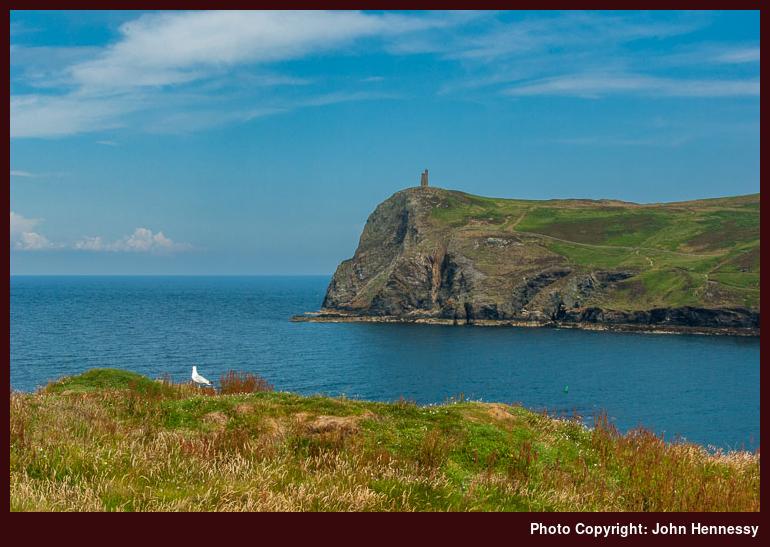
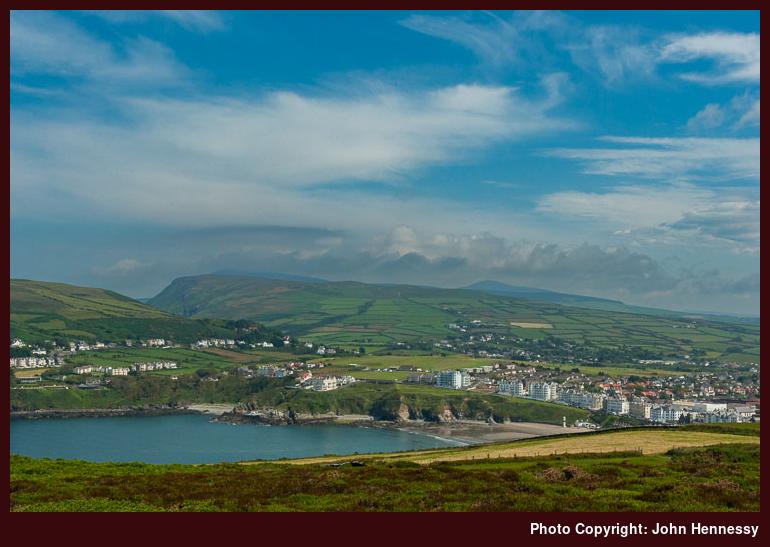
With those bearings established, I picked up the line of the coastal path to start gaining some height behind the Marine Biological Station. The energetic expenditure was rewarded by widening views of what surrounds Port Erin Bay, including both Brada Head and Port St. Erin itself. My new vantage points were granting me another perspective of the start of my walk from Port Erin to Peel more than a year before.
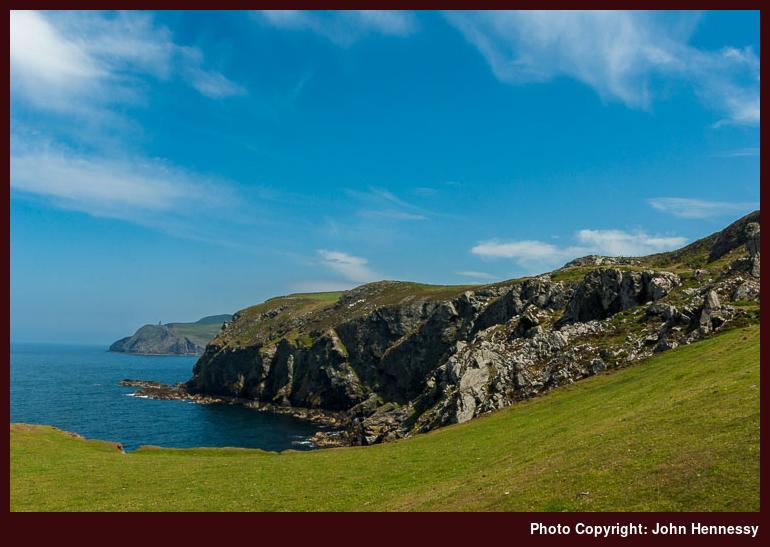
That northbound hike had me feeling very exposed near steep drops into the Irish Sea at various points along its length, but that wasn't the general feel of its southbound counterpart. That's not to say that the coastline didn't have its rugged parts when it did. In fact, when lured inland away from the route of the coastal path, I retraced my steps whenever I did so. That meant that no chance of seeing coastal drama got missed and one such occasion was just north of Aldrick and the time spent more well worth the time taken.
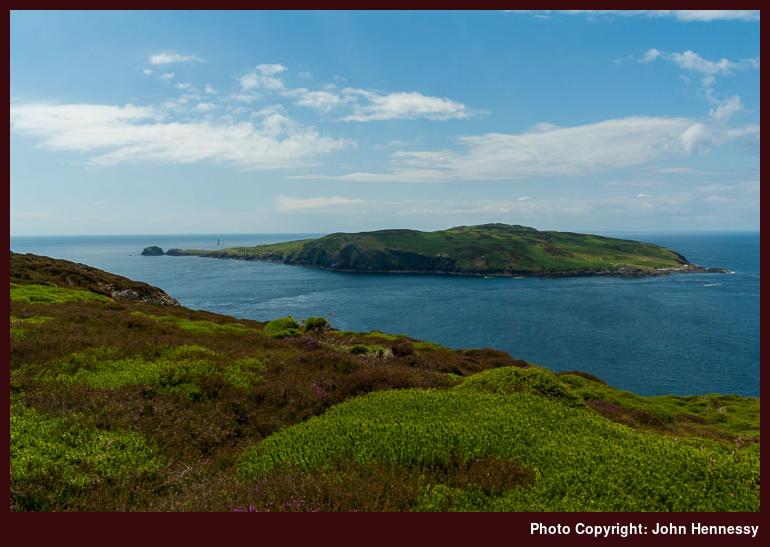
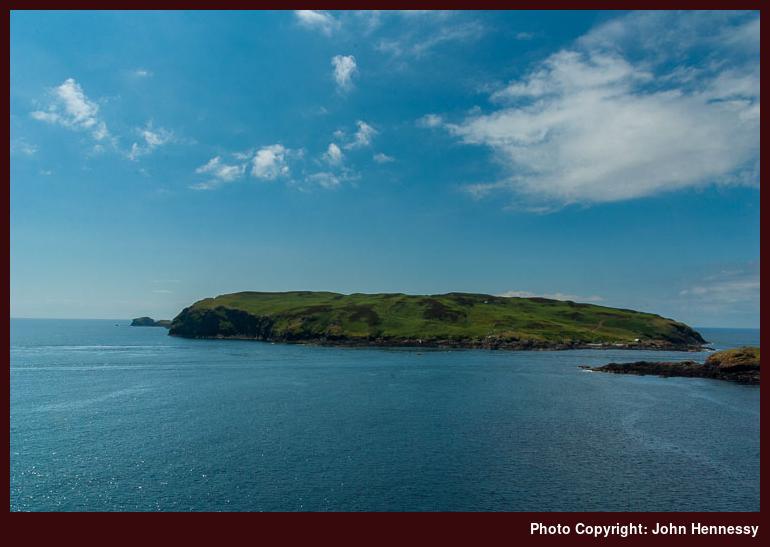
Approaching the Calf Sound meant that I was back sharing the sights with more folk again and for the first time since I left Douglas as well. Port Erin was quiet and I leaving it, as was the coastal trail south from there. There were other folk out enjoying the scenery like myself and following the coastal path too, but everyone had plenty of space. Having to walk a little further from an easy vantage point that well accessible by car. Being able to take in the sights from a café provided even more of a lure.
After getting an ice cream at the café myself, I found a quiet corner with a bench where I could enjoy it. All that was needed was a little along Raad ny Foillan in the direction of Port St. Mary. It never seems to amaze me how easy it can be to lose any vestige of crowding.
After the rest stop, I set off to go around Spanish Head (a name that reminds me of Spanish Point in County Clare in Ireland while having a very different character) and Bay Slacka. To ensure that nothing got overlooked, there was some toing and froing of the kind that I enjoyed more recently in the hills near Church Stretton in Shropshire. Rushing just didn't seem to be on the agenda.
After leaving the wilder countryside that is under the care of the Manx National Trust, it was time to make for Port St. Mary, where a decision was to be made. Before reaching any conclusions, there was a need to revisit to a public convenience to retrieve one of my walking poles. There was a shower of rain too, the only one that found me on the day, that had me playing with ending my walk in Port St. Mary instead of continuing to Castletown. The shower faded and I chose the latter course.
Gansey Point was passed on the way towards the main road between Port St. Mary and my eventual destination. Due to geography, I needed to use a footway beside that road for a little while. Making good progress meant that it wasn't long before I left it for a single track lane south to Pooilavaaish with views of hills behind me and to my right.
The road's end meant that a track took me through a farmyard, and passing a quarry meant that I was following a right of way through fields. Any sheep that I passed didn't seem to be too perturbed by my presence, and careful attention to my map meant that no foolishness manifested itself.
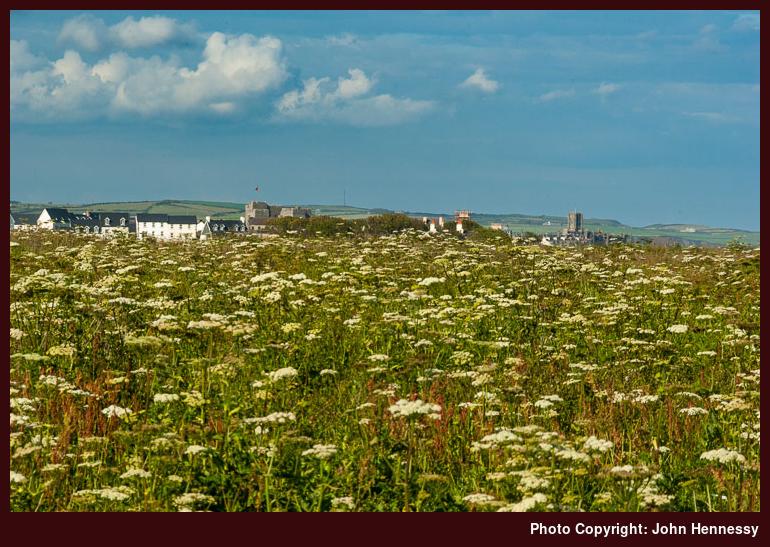
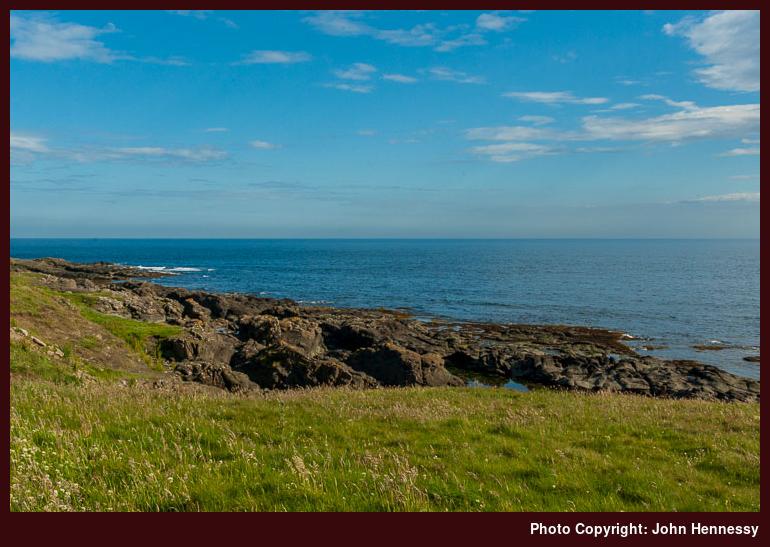
In time, I was to find myself no longer on the coastal side of a wall and in fields. There now were views of Castletown, my destination for the day, along with sights of the effects of coastal erosion. From then on, I also was beginning to encounter more people again, with a trail biking group among them; though I had misgivings seeing motorbikes going over rocky coastline, I decided on keeping my views to myself since it looked like a big organised party. Dispelling what remained of the peaceful ambiance of the evening didn't seem sensible when it might be an occasional event anyway.
Once past the trail bikers, I was back on tarmac again and steadily nearing Castletown. As I did so, I met with a father and son wondering if the way I had come was a quiet way to Port St. Mary. Since they were on bicycles and I had crossed stiles, I put them going along the main road for the sake of ease for themselves.
My entry into Castletown was accompanied by cloudy skies, putting paid to any ambitions of close up photos of Castle Rushen and its surroundings. That needs to be an excuse for a return, and they always come in handy. After all, Castletown is a pretty spot and I have more of the Isle of Man to see.
Travel Arrangements:
Return train journey between Macclesfield and Liverpool, with a change at Stockport on the outbound leg and at Manchester on the return. A return ferry crossing took me from Liverpool to Douglas on the Isle of Man. Bus service 1 from Douglas to Port Erin and bus service 11 from Castletown to Douglas.
A wintry day spent in Shropshire
18th December 2011 It is a little difficult to take photos in the middle of a wintry shower of sleet, so what you find accompanying this trip report are photos from the drier interludes. In fact, eastern Cheshire was beset by such things, with Macclesfield and Wilmslow bearing the brunt of the showers as they ran in from the Cheshire Gap as if on a conveyor belt on a Friday morning more than a week ago. As if to demonstrate that weather is remarkably local, Crewe was enjoying sunshine and blue skies.
On leaving home, I might have been forgiven for thinking that I was taking leave of my senses to head out with all that was tumbling from the sky. As if that weren't enough, the western and northern parts of Britain had been battered by a ferocious storm just the day before. Scotland still was picking up the pieces after that when I embarked on a walk among Shropshire's hills.
It wasn't all that inspiring when I arrived in Church Stretton because a rain shower was in progress. Nevertheless, I resisted the temptation to catch the next train back home and waited out the shower. Maybe the price of the return train ticket had something to do with it, but I also glimpsed sunnier weather as my train passed through Shropshire, so hopes remained far from extinguished.
With the air drying, I made my way to Carding Mill Valley. The sun was being left to light the hillsides too, always a bonus. For a Friday, I was surprised by the number of people out and about. Nowhere was overrun, but I might have expected less about in a part of the world that doesn't come that high on the list of places on anyone's wish list. Saying that, it is good that there are folk who can overlook such things.
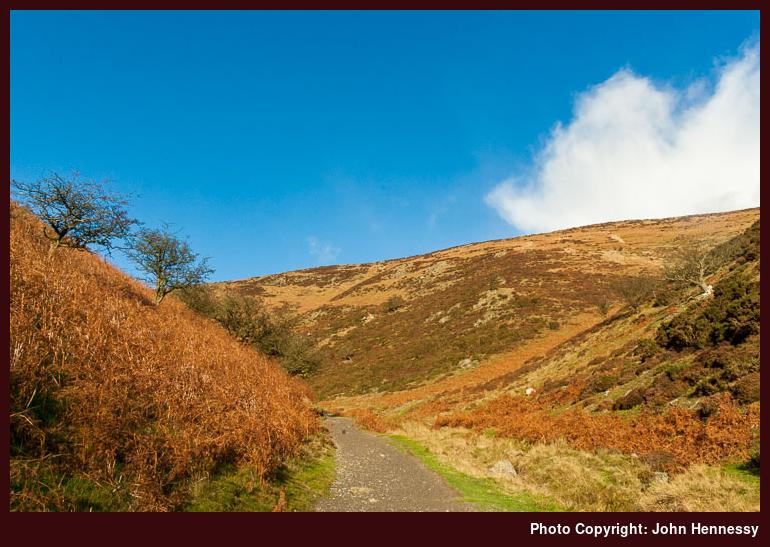
There is a wilder feel to what lies beyond the National Trust hut in Carding Mill Valley, and tarmac can be left behind for a well-surfaced gravel path. Shropshire's hills may not be high, but they have steep sides, and Mott's Road soon started to gain height at such a rate that taking it steady and enjoying the surroundings made much sense. A pair of mountain bikers passed the way too, and they stopped a fair few times on their ascent, so it wasn't just me.
As I reached the stop, the skies began to close in as another shower approached. Having got some satisfaction from the day already, this brought no disappointment; it just was a matter of wearing waterproofs to counter the dampness and enough layers to keep warm. Keeping moving helped with the latter point too as I headed south-west along part of the Shropshire Way.
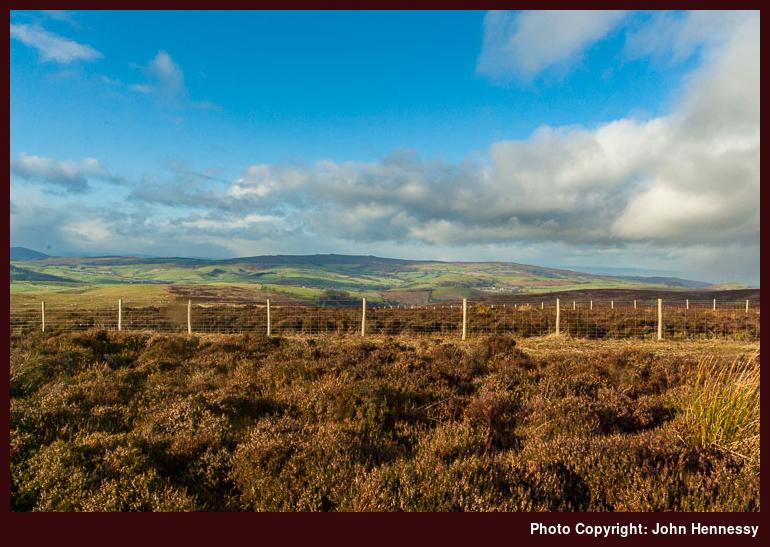
The skies cleared again as I approached Pole Bank following a road crossing. This was the second time that I had designs on Shropshire's highest point, with a lapse of concentration in the navigation department having caused me to abandon the venture when I last tried it. Now that I look back on that first-ever visit to Church Stretton's hill country on a Sunday in December a few years back, I am staggered to think that it happened at all; my error must have involved going straight at a junction when a turn to the right would have been the intended line.
My time on the top of Pole Bank was enjoying clear skies stayed with plenty of sunlight to go around. Though there were photographic stops, they were brief because it was a day for keeping moving. What turned out not to be brief instead was the drier interlude. It allowed me to amble about a fair bit while exploring where the lines of rights of way actually were after leaving the road reached on descending from Pole Bank. There was deliberate retracing of steps to see the set-up of paths across the hills, and there was no one to disturb in so doing. Even the horses and sheep that were out on the hillside hardly took any notice.
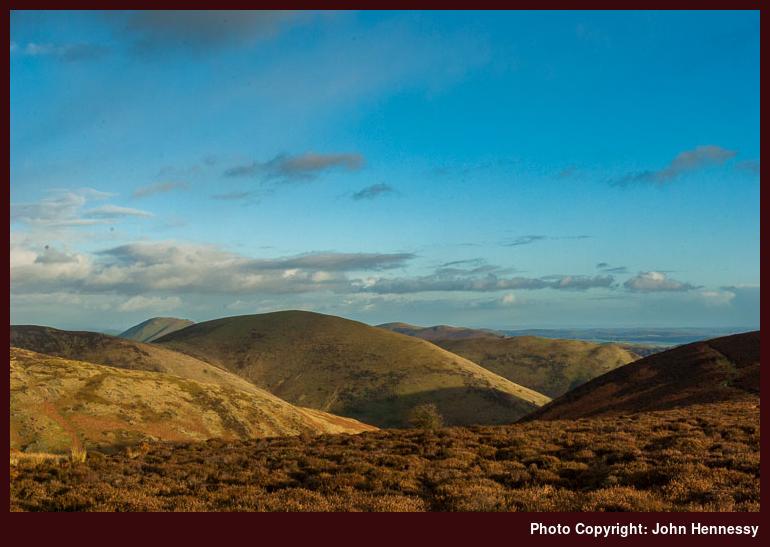
Eventually, I decided on a more direct course to Little Stretton, albeit with a little circuit around Round Hill. What surprised me was the way that the path took me by a number of different valleys; there were Ashes Hollow, Callow Hollow and Small Batch. It is as if this is hill country in miniature, and it is none the worse for that. Because another shower came my way, photography stopped after the first of those valleys, but there's enough there to justify a return visit sometime when days are again longer. The sun was getting ever lower in the sky anyway.
Height loss was hardly gradual on the way down to Little Stretton, and it must have knocked some of the stuffing out of my legs because they felt a little weary as I shortened the road back to Church Stretton. During the descent, the shower stopped, and the latter stages underfoot became muddy too, a not unexpected situation at this time of year. After stripping off my overtrousers, I took a little time to look around Little Stretton, with its timber-framed church especially catching my eye. Methinks it would be worth returning again to have more of a look around the place.
It was road walking that conveyed me from one Stretton to another, and there was no sign of the sun at all; low hills still can hide it even if clouds don't. The sky retained a blue tinge though as I coaxed myself along the roadside footway by not irregularly inspecting progress. Once in Church Stretton, I played with the idea of catching a bus to Shrewsbury until I noticed that the one for Ludlow was around twenty minutes late. Scotching the idea, I stocked up on some provisions and returned to the train station to await a train home after a good little day out in compact and decent hill country.
Travel Arrangements:
Return train journey with a change at Stockport on the outbound leg and at Shrewsbury and Wolverhampton on the return one.
From Abbey to Abbey: St. Boswells to Melrose
12th December 2011 Even without having walked from Wooler to Kirk Yetholm the day before, there would have been other reasons why following St. Cuthbert's Way on foot all the way to Melrose wasn't an option that I was considering when arising the next morning. Having only a day meant that covering the 36 miles was out of the question but my state of mind after the previous day's walking meant I even questioned the sense even of covering just the last 7.5 miles of the trail north from St. Boswells. Fortunately, doing just that turned out to be the best decision for the glorious day that lay ahead of me.
Buses (there was a change in Kelso) got me from Kirk Yetholm to St. Boswells. One thing that was remiss of me was not to have a road map with me to show where I had got off the bus for the start of my walk. That bit of forethought would have saved me some bumbling before I got my bearings. Getting off a bus at a point other than where I expected has been known to throw me and this was one of those occasions.
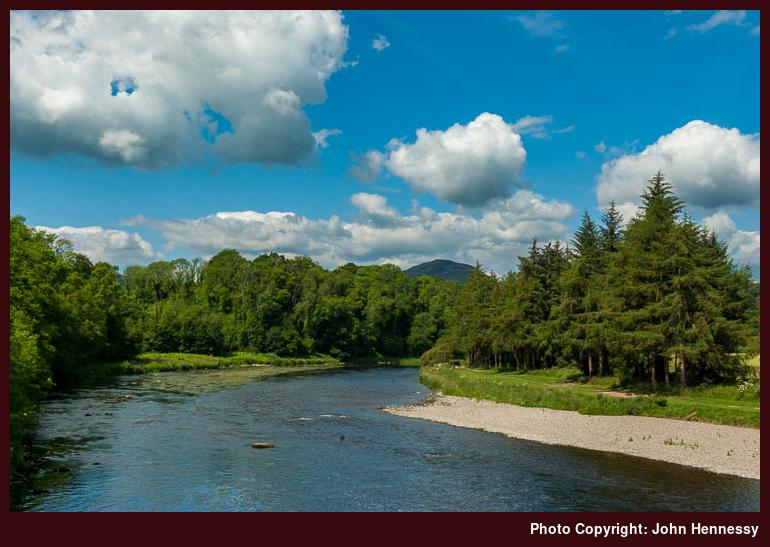
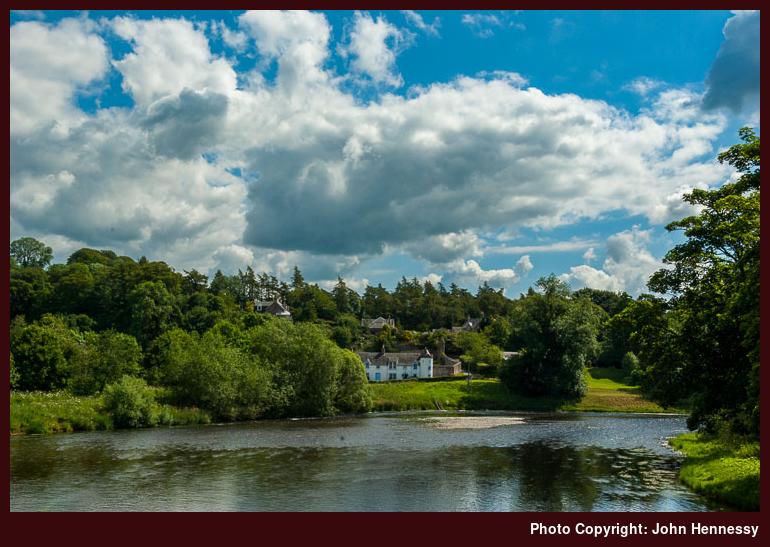
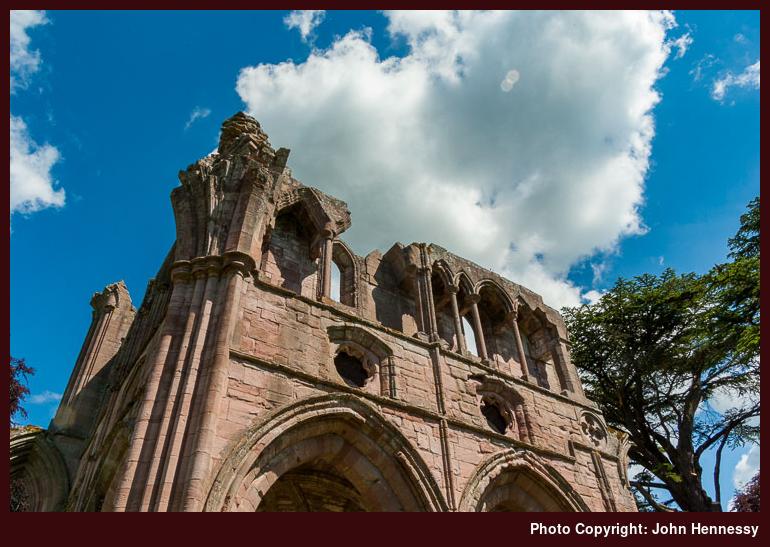
With the bumbling behind me, I was following the bank of the River Tweed after following a pleasant path from Lessudden House that really should be part of the trail instead of its taking you down a street instead. With navigational difficulties sorted, it was time to enjoy a morning stroll by a wide meandering river. Given the distance that lay ahead of me and the time that I had to cover it, there was no need to rush things and I was lured across a long footbridge to glimpse Dryburgh Abbey. In fact, this diversion was to cause me to pay to wander around the impressive ruins in the sunlight myself. Preparations for a wedding were ongoing but that did nothing to spoil things and I was away before the first attendees were going in anyway.
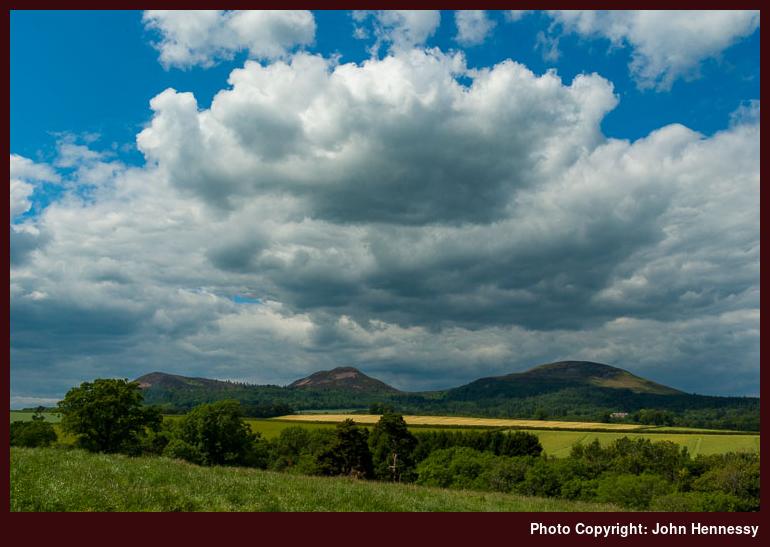
Another crossing of the Tweed returned me to my intended course as I pass through shading vegetation on the way to Newtown St. Boswells. Other than topping up on supplies, I wouldn't have dallied there, especially in the gathering heat of the day. Road walking from there conveyed me to a much more forgiving track that fortunately was sheltered from the heat of the sun. There was more tarmac bashing before I reached Bowden, but cloud was gathering in the skies to cool the day for a little while.
That development turned out to be opportune because the next stage of my journey was going to take me up into the Eildon Hills. Before that, I found a useful seat by the side of the trail that allowed for a resting and refuelling stop. Civic-mindedness was apparent with a play area set up nearby though it wasn't in use and a pathway had been made through the long grass too, so there could be no question about where to thread.
After passing a few fields and crossing Glenburnie Burn, it was into the tree cover of Greenside Plantation to the accompaniment of the sound of a forage harvester working in a nearby field. Rounding the lower slopes of Eildon Wester Hill took me into Broad Wood where the gradient really steepened. Nevertheless, it was nothing compared to those that I had scaled the day before and I left the trees after me to complete the ascent to Siller Stane and the saddle between Eildon Mid Hill and Eidon Hill North.
After another short stopover, I was lured up the steeper slopes of the Mid Hill to its top. The contours of the Wester Hill looked a lot flatter from up there and views of Melrose and its abbey were on offer too. As it happened, I didn't linger long up there and was drawn to the Mid Hill after coming down again. Naturally, there was an ascent to reach the flat top of that too and I loitered there for a while to allow the cloud cover to break for some photos of a landscape that was reminiscent of Rothiemurchus in its own way if you cropped out the green agrarian lowlands that surrounded it.
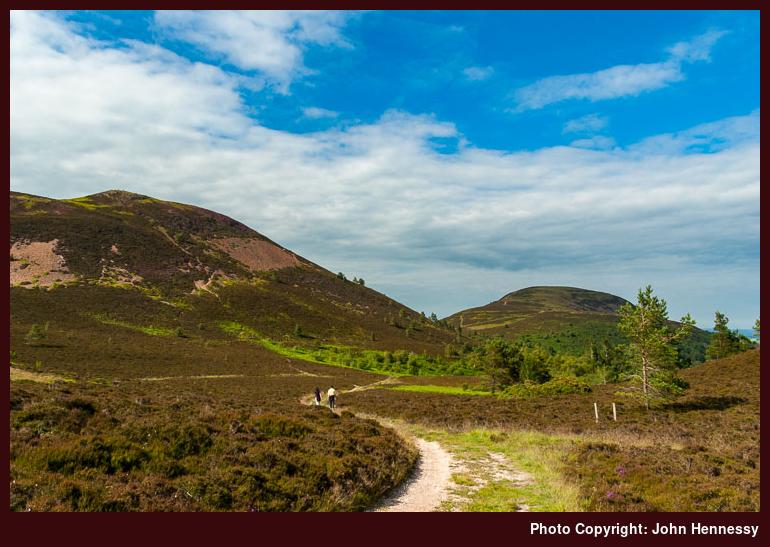
On retracing my steps from the Wester Hill, I decided to go up Eildon Hill North to finish off the job. There were far less folk about by this time and more dawdling followed. That seemed to be an ever present theme of this encounter with the Eildon Hills. In contrast to this stage of the evening before, being much nearer to my destination meant that there was no need to worry about the time of day at all. The fact that cloud still got in the way of the sun didn't matter either as I started my descent to Melrose to claim my bed for the night.
The descent from the North Hill to reach St. Cuthbert's Way was a carefree one and that theme continued even if it did come as a surprise to me how far around the North Hill the trail took me before dropping down through fields again. In May of last year, my designs on spending time among the Eildon Hills had to be set aside but not before popping up part of the way towards them. That point was reached again this time, having made much use of the postponed plans from that earlier time.
The official guide to St. Cuthbert's Way states that Melrose is a place worthy of a little of your time. Having spent Saturday evening and much of the day after around there, I can vouch for that. In fact, Sunday came very warm so it was no day for walking despite all the long-distance trails that converge around Melrose. Apart from the Southern Upland Way, there also is the Borders Abbeys Way. In fact, it was too warm for walking even as far as the site of the old Roman fort of Trimontium near Newsteads and that of Old Melrose, where St. Cuthbert spent much of his life, is a little further again. That last though has me wondering if an extension of St. Cuthbert's Way out to there wouldn't be a bad idea though it would have to be an out and back trot.
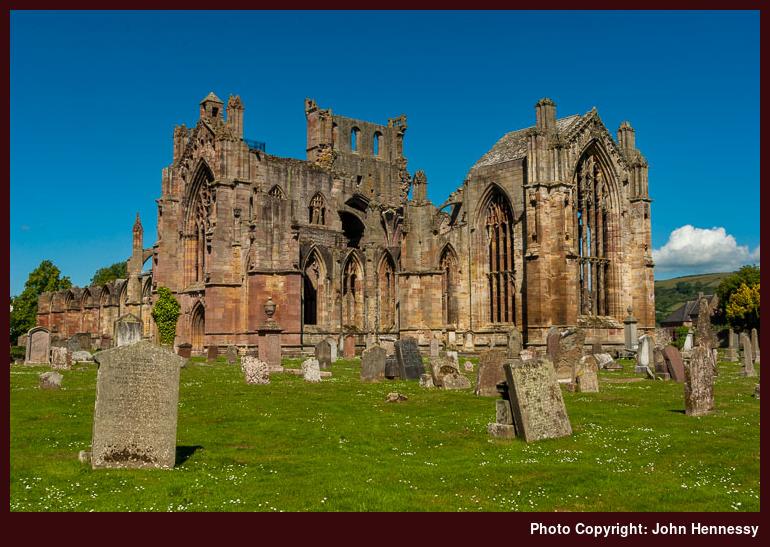
As it happened, I decided to explore the ruins of the Melrose Abbey that is best known and they are magnificent too. After seeing Dryburgh Abbey the day before, this was a variation on a theme and was equally unhurried. The coolness of the museum in the former Commendator's House was a welcome respite from a day that became a scorcher. There were plenty of artefacts in there to keep me busy too and the way the door sounded when you opened and closed it was another reminder that it dated from another time. After all, it was older than the ideas that drew me to Northumberland and the Scottish Borders for a weekend of walking. Even then, the yearning for stillness and quiet could have been similar to those of the monks who found a monastery in the area all those centuries ago. Maybe some things just don't change and returning to the hurly-burly of modern life to get home again was another of those.
Travel Arrangements
Bus service from 81 from Kirk Yetholm to Kelso and then bus service 67 from there to St. Boswell's. Bus service 67 from Melrose to Berwick-upon-Tweed and train from there to Macclesfield with changes at York and Manchester.
A Border Crossing: Wooler to Kirk Yetholm
11th December 2011 The prospect of having some time away from work at the start of July meant that I was playing with the prospect of using the time to head to Oban and reacquaint myself with some of the alluring countryside that surrounds the town. However, a change in circumstances was to rule out that escapade. With the reduction in time available to me, I decided on a weekend divided between Northumberland and the Scottish Borders instead. Though this might have been seen as a consolation prize, such was the quality of the countryside and the weather that such thoughts never entered my head. In fact, I seem to recall that I got better weather where I was, than I might have done in Argyll anyway.
Friday, the first one in July, saw me undertake a walk from Wooler to Kirk Yetholm with a night spent in the latter. That was followed by a shorter saunter on Saturday from St. Boswells to Melrose and chances to take in Dryburgh Abbey and the Eildon Hills weren't passed up at all. Sunday became too hot for walking, but Melrose turned out to be a good place to spend some time, much of it admiring its abbey. Given the warmth, I set aside other thoughts such as venturing out to see the nearby Roman fort of Trimontium or Old Melrose, where the original abbey was situated, for another time. All in all, it was a glorious weekend spent in countryside familiar to St. Cuthbert, who gave his name to the long-distance trail that I used for much of my walking.
Somehow, a map can make a walk seem shorter than it is, and that statement could be applied to the thirteen miles between Wooler and Kirk Yetholm. Interestingly, the official guidebook to St. Cuthbert's Way splits this in two with a break in Hethpool. Mind you, I still reckon that a full thirteen miles is a good use for a day out among hills even if my start was in the early afternoon and that was in spite of an early start from home.
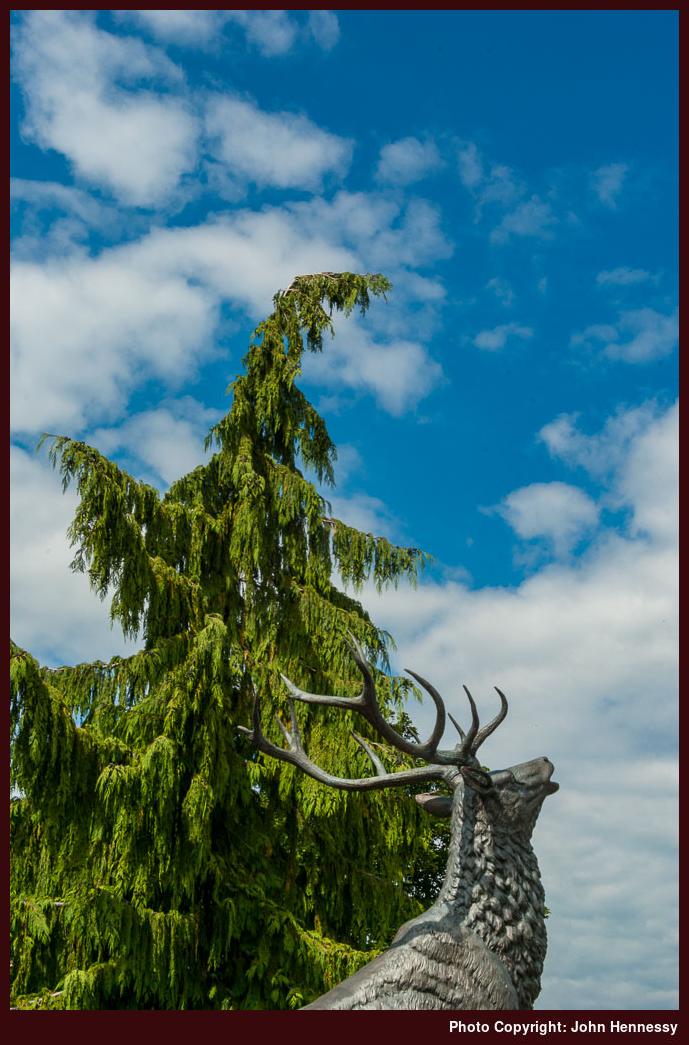
Knowing my way around the starting point meant that I needed not get too concerned when I unintentionally passed Wooler's Catholic church. For a quicker approach from there, I stuck with what largely was a road walk to Humbleton. Though the skies were cloudy, the heat was building as I found on the track leading uphill from Humbleton. Up to that point, the only respite from tarmac had been a short public footpath that took me across a field. There was another compensation, however, in the form of a statue of a stag at the gate of Highburn House Country Holiday Park. It somehow was very reminiscent of the country towards which I was headed: Scotland.
Of course, there was a not inconsiderable amount of England to be walked first and I was feeling the heat as I shadowed the flank of Humbleton Hill. Rest stops allowed to look about me at the way that these hills were rising up from lowlands and at the line of the trail that I was going to join: St. Cuthbert's Way. That came after an easing of the gradient and the passage from tended farmland into open moorland.
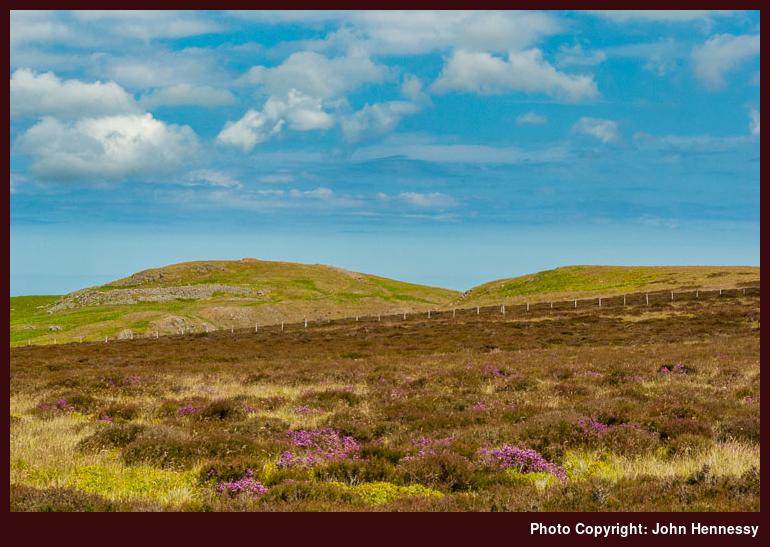
Vague memories can fool you and the direction that the trail didn't feel right though it was entirely correct; it's at times like these that a compass comes in very handy. Navigational doubts soon subsided with a clear path taking me across heather-clad moors with big skies opening out overhead. Not having to turn back at any point was a release for me and it was something in which I revelled as I passed Gains Law and Black Law. There was a lunch stop around here too.
Though hardly overrun, the countryside was being enjoyed by others too with greetings shared as we passed each other on our separate ways. The trail retained much of its height as it veered through higher country than the lower parts immediately surrounding Yeavering Bell. That height was set to be lost after passing Tom Talon's Crag and any daydreams about calling to the top of Yeavering Bell were set aside. The consideration of dealing with an ascent after a descent helped to consign the possibility to my bank of excuses for a return. Given the distance that still lay ahead of me, it proved to be just as well.
After all the descent, some of it a steep, I was on a track leading to Kirknewton but continuing in the opposite direction towards Torleehouse. As it kept going beneath Newton Tors, the track became a path and it now was late afternoon. The countryside was tranquil as I travelled along the valley floor travel with encounters with tree cover contrasting with those heather-carpeted moors that I crossed earlier.
After crossing fields and passage through a wood, I found myself on tarmac again at Hethpool and also keeping an eye on the time of day. Early anxieties about not making as much progress as I might have liked were replaced with satisfaction in having got as far as I did. Hethpool may be like many places in these pretty parts, a mere collection of houses, but it was a good place to assess how long I had left to walk. As I did so, I wasn't alone because folk were changing footwear at their cars, no doubt after a walk and who could blame them for that. In fact, I am tempted to return to savour more around there myself.
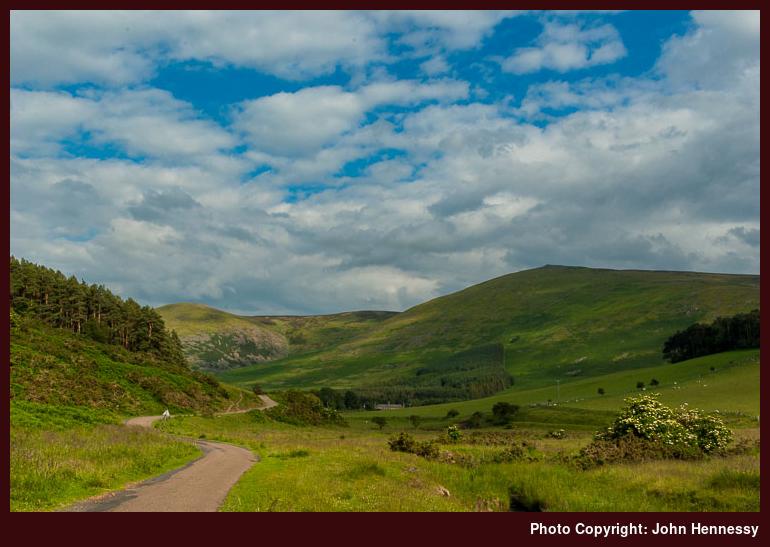
Tarmac was to take me all the way to Elsdonburn, first on a public road and then on a farm one. Seeing the way that I was covering ground along these was yet more encouragement and there was some scenery around me to enjoy too. The road to Trowupburn became another point to note how far lay ahead of me while also offering another excuse to return for future wanderings; this part of Northumberland is in no way short on possibilities. Planning would be needed due to the isolation, but isn't it always thus?
A surprise was in store for me at Elsdonburn in the form of a flock of sheep blocking my way. Though I didn't like disturbing the creatures, there was nothing for it but to stick to the right of way even if it caused a fair share of racket and I wasn't far from a farmhouse. Thankfully, no cross words were said to me or no lectures on the inconvenience of obstructed rights of way needed in reply. Bringing rancour and confrontation is not why I got wandering though countryside so I continued on my way glad to be past that obstruction.
After that, there was the matter of crossing the border ridge with legs that already had carried me quite a way; the pace was going to be steady from here on to Kirk Yetholm. Careful attention was mandated until I reached Tupple's Sike, the stream crossing preceding the last major ascent of the day. First, lush pasture was obscuring the line of the trail on Scaldhill Shank and I didn't want to do any more trampling than was necessary. Then, there was a narrow path weaving a less than obvious line through the ensuing wood with waymarks on trees keeping me from straying.
Once beyond the wood, it was time to scale the steep slopes of Eccles Cairn after crossing of Tupple's Sike. After the gradient eased, reaching the top of Eccles Cairn might have tempted me, but I decided against it in favour of passing the welcome sign marking the England-Scotland border; there may only have been ten metres of ascent needed but getting to Kirk Yetholm took greater priority. For all the effort expended in reaching it, the crossing into Scotland was a simple gateway in a wall.
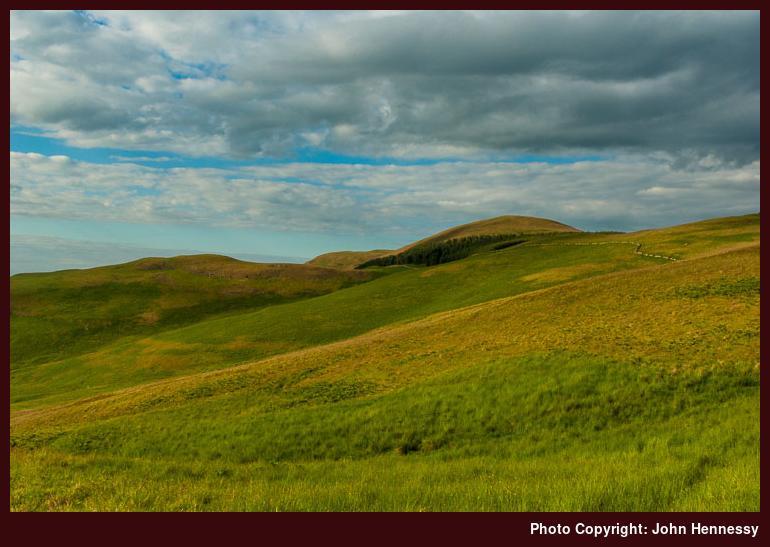
With a not so gradual descent down grass-carpeted slopes ahead of me, I took a little rest before setting off to join the Pennine Way; St. Cuthbert's Way follows its course for the last stretch to Kirk Yetholm. With much of the height lost, Green Humbleton (a name that hearkened back to the start of the hike) was rounded with Sheilknowe Burn below the narrow path that now conveyed me. Crossing the burn got me to the car park where I stopped a while before crossing one last height of the day. Having a downhill stroll would have been my desire after the miles that I had walked the slopes that I had crossed but that hummock did make the world seem very away by the banks of the Sheilknowe Burn. Not much was stirring in Kirk Yetholm when I reached it so I headed towards my lodgings for the night. All that was on my mind was to rest after the miles travelled since leaving Wooler and more miles of walking were to follow the next day.
Travel Arrangements
Train journey from Macclesfield to Berwick-upon-Tweed with changes at Manchester and York. Bus service 464 from Berwick-upon-Tweed to Wooler.
Wintry weather
10th December 2011 The last few days have seen dramatic weather conditions across parts of Britain, and strong winds again are forecast for western parts of the U.K. on Monday night. Scotland got the worst of the battering, and only now are some places up there returning to normal. It only was today that Blair Atholl got back its electricity supply and that the Inverness to Kyle of Lochalsh train service was restored to its normal timetable. Hopefully, no one got seriously hurt in all of this.
Despite what came on Thursday, I ventured out to the Shropshire hills around Church Stretton yesterday. There was sleet and rain about, but I braved both of these to escape the hurly-burly of the everyday. In doing so, I was surprised to see others out doing the same around there. Sunny spells came the way too and felt all the more special when they did so. All in all, it was an enjoyable outing and I hope to savour more like it. Well, there is more of Shropshire's hill country for me to sample. It's good always to leave somewhere with a reason for returning.
This morning, I arose to find the hills near Macclesfield having gained a snowy covering. Various webcams such as the one at the Cat & Fiddle Inn and another at Flash Bar Stores told the story of other parts of the hill country lining the Cheshire-Derbyshire boundary. After a milder than usual autumn, a wintry reality has descended on us.


