Category: Trip Reports
A developing pattern?
 19th April 2010
 Unusually for me, my walking escapades seem to involve my reaching more summits than usually has been the case. In fact, finding some sort of hummock to ascend has formed part of my planning in the last few months. The most recent example of this was an out and back hike to Y Llethr from Dyffryn Ardudwy over the past weekend. That followed a yomp over Moel Siabod the previous weekend and there was an ascent of Diffwys in early February. Thus, three outings to Wales have come to pass so far this year and Terry Marsh's Great Mountain Days in Snowdonia (Cicerone) might inspire more yet.
Mark Richard's Great Mountain Days in the Lake District should be encouraging a few too but I only have January's spur of the moment crossing of Place Fell to record for 2010. Still, that now looks as if it was start of a pattern where reaching hilltops has been playing a large role in my hill country outings. Even when I went to Scotland, I ended up on a unnamed though snow blanketed foothill of Bynack More when I had intended to stay low (boggy ground stalled my initial scheme). As if to continue high level hiking, an Easter crossing of Baslow Edge, Curbar Edge and Froggatt Edge needs to be mentioned too. With all of this falling into place, it may be a matter of time before that first Munro gets ascended and there are a few candidates in the Cairngorms that have caught my eye but there's no rush on that one.
All of this action may look like peak bagging but that is an incidental upshot rather than the avowed aim of the exercise. If creating some list of hills climbed was the aim, I wouldn't be bobbing around the place in such an unplanned manner. Going up hills is for me a device for propelling me out of doors when the weather makes an offer. It used to be that exploring somewhere or a new angle to an old favourite did the job on its own but adding a hill top has been giving form to plans in place of finding a tempting path or track on a map. Quite where all this is leading me is another matter but I'll enjoy the countryside along the way and share that (and any decent photos that I make) with you afterwards. Now, I need to find time to say more about that flying visit to Y Llethr...
A weekend around Capel Curig
16th April 2010 With fine weather around and a good forecast, I made sure that I sorted something for the past weekend without letting it to the vagaries of Friday night planning, an at times fragile activity that is vulnerable to tiredness after an intense working week. Much to my surprise, I managed to book a bed in the Capel Curig YHA after drawing a blank there and at other hostels in the vicinity on previous attempts. That placed a pivot on the map of Wales for my route planning. With that there, I pencilled in a planned walk from Dolwyddelan that was to take in the summit of Carnedd Moel Siabod. With a need to get away early on Sunday, I didn't fancy my chances of getting in another hike, but I managed to fit in a yomp from Capel Curig to Betws-y-coed through woodland and over boggy terrain.
Saturday
After an early morning start from Macclesfield, I arrived in Dolwyddelan on a busy two carriage train with lively dogs across from me; the tail of one of them kept striking my newspaper and I didn't envy their owners when it came to controlling them. All the way there, the skies had a very hazy look about them, and it was no different around Dolwyddelan. It was a hint that the day wasn't going to be one for splendid photographic results, but I set to sorting myself out in the car park anyway. That act left any other interlopers that came off the train with me time to go on their merry way.
The start of my hike reprised a route that I followed around the same time last year. It started with a short hop along the road that took me over the Afon Lledr before crossing a field. Once over a not so busy A470, I pulled out my walking poles and set off uphill; they were set to stay in use all the way to Capel Curig.
Just because I wasn't gaining so much height on the lane up from the A470 did nothing to reduce the gradient, but it still wasn't as steep as I remembered it to be, and I was carrying a more laden rucksack on my back this time around! After that effort, a short stop was in order and I made out Dolwyddelan Castle in the near distance. Last year, I seem to have missed it for no reason that I can recall, so it was a matter set to rights.
With that initial steepness out of the way, the terrain became more level as I ambled along a forestry track. Moel Siabod, the prospect that jumped out of the Snowdonia member of Cicerone's Great Mountain Days series, loomed above me as if to let me know what awaited me, yet I wasn't to be deflected, even with the white streaks that were apparent. When I last passed the way, there were more folk about, but this occasion was much quieter; I was to meet no one until a few mountain bikers passed me as I approached the sign for Moel Siabod. Last year, I kept going for Capel Curig with mixed feelings, but Llyn Idwal was my ultimate destination that day, and I wasn't to be disappointed with either progress or surroundings.
This time, I lugged my heavy pack to the top of Moel Siabod with no misgivings, marked Carnedd Moel Siabod on OS Explorer maps. The mention of maps brings me to the subject of my having two maps available in a trouser cargo pocket. One of the problems with Moel Siabod is that it sits astride OL17 and OL18, and not all the paths around the hill are depicted either. Given that Harvey's Superwalker map of the area put the hummock in the middle and not at the edge, it came too, and a few more tracks are depicted on it too. However, it doesn't show my route from Dolwyddelan to Llyn Foel very well, so an OS map was at hand too. When you get different stories, you need to hear them all to get a fuller picture.
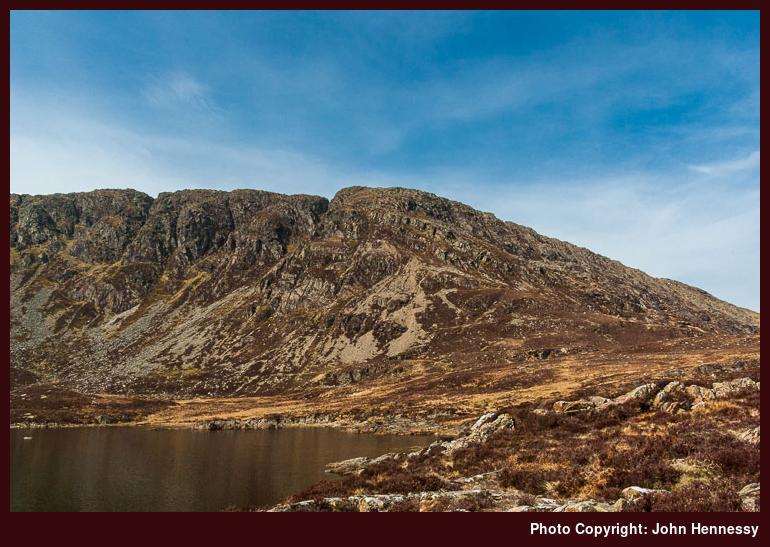
Before I could emerge into open country, I needed to pick my way though forestry, not my strongest point, but the track was clear up to its end and the path that took over was more than navigable too. The day was hot and sweat was coming out of me as I ascended the slopes until I exited the forest into boggy and craggy terrain. I knew that I had to cross the stream to my right but took a somewhat roundabout route before doing so; there's no need to do everything at once when some things can wait. It was from there that the gradient really sharpened, and I noticed two other walkers below me, the only ones that passed this way as I was making my ascent. They were far less laden, so I left them pass before continuing my sluggish course. Cataracts abounded, allowing opportunities for stopping and staring. Patience was needed, too, and it's so easy to become frustrated with not reaching your objective as soon as you'd like. Overestimating how high you are is another slippage to which I have succumbed, so I took it easy and left the shore of Llyn Foel come to me in its own good time.
Once there, I had a choice of going left or right. The former may have been the shorter journey, but I needed a break from hopping over stones and boulders, even if that took me over boggier ground. That it was to do so meant careful footwork of a different kind was in order until the drier ground leading to the flank of Daear Ddu allowed a chance of a rest. It became clear that I was onto more frequented turf by now, with folk passing by while I was stopped. You never could call it overrun, but remarks about a glorious day are always good to share.
Knowing that the ascent of Daear Ddu was ahead of me, I paced myself as I continued up as yet not unfriendly slopes. Though not marked on any map anyway, a path could be made out, and I followed that while using the widening views as a means for tracking progress. Dolwyddelan Castle and the Crimea Pass could be picked out below me as I scuttled up the steep hillside. Eventually, I even was led to believe that a sliver of Llyn Trawsfynydd was visible over hilltops. Progress was slow and not just for me. Another pair of walkers lost patience and went for a more direct approach to the summit, and guess who they met up there before them? A certain laden Irishman who wasn't that far above them when they went their own way. My more circuitous course demonstrated that direct routes aren't always that quick.
Though I needed to negotiate a boulder field and remnants of the past winter in the form of patches of snow, the fence that you see marked on an OS map came soon enough. While I was wondering if more clambering was ahead of me, another walker came and, after sharing a few words about the view, lobbed his Jack Russell terrier over that fence. Deciding to do the same, I followed while marvelling at all that I could pick out from the surrounding buckling of the landscape. Snowdon, Tryfan, Glyderau, Carneddau... The list grew on a day when haze meant that photographic capture was limited to record shots. Well, Snowdon is situated in a better place for morning photography from the Capel Curig side, so it's horses for courses. However, now I know what dome lay on the horizon when I looked east from the Miner's track to Snowdon's top a few years ago: Moel Siabod.
If it wasn't for the fact that I hadn't planned to stay the night, I might have been concerned by my arrival on Moel Siabod's summit at around 16:00, but I fitted in both the views and one of the boulder-strewn humps that are marked as Moel Siabod by the OS before heading down. Having had enough clambering done for any day, I left the other one or two after me, at least for now. One advantage of staying high for that little bit longer was that a downhill was plain to see. It also was the one that I planned to take to get onto an old pony track that was to take me down again. Even with my being at the gentler side of the hill, that didn't mean that I could go downhill willy-nilly. For one thing, the paths were stony and the gradients significant. Concentration remained of the essence.
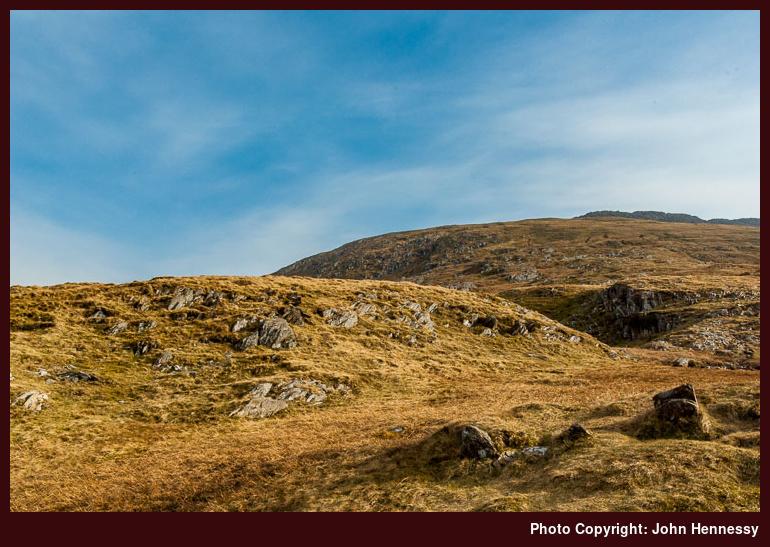
With accommodation sorted and a few hours of daylight remaining, tiring limbs were not being rushed, but I was down in less than three hours all the same. Llynnau Mymbyr lay beneath me as I made for Coed Bryn-engan, through which I needed to pass before I was out on the A5. Though there were better routes through the wood, I wasn't going around in circles either, even after a long day on the hoof. Still, it wasn't before time that I got to the hostel to be given a room with no one else in there before me, a situation that never greeted me before. That gave me time to organise myself before anyone else appeared on the scene, and it was a full house later on, and a noisy one too. With all the tossing and turning above, I wondered at the wisdom of taking a lower bunk, but the night wasn't all sleepless either. Before all this, though, I had spent a superb hour sat on a rock next to Afon Llugwy as the light declined.
Sunday
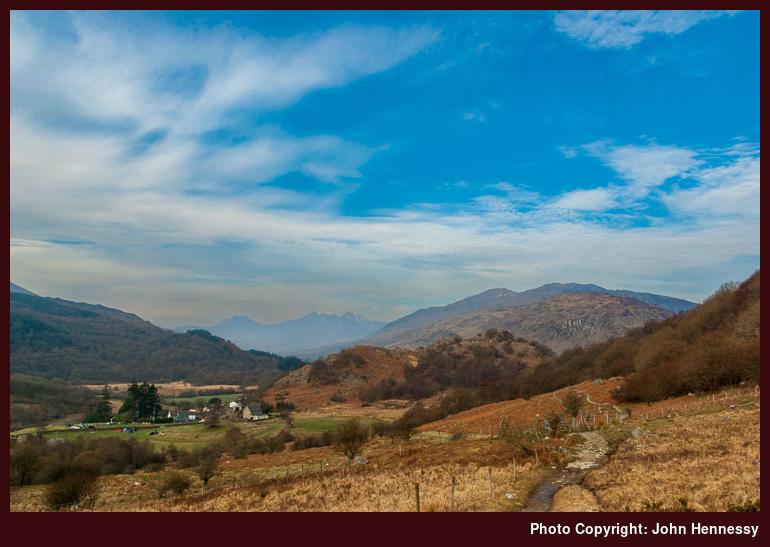
An early start after a decent breakfast had me heading towards Betws-y-Coed with an eye on the time. There was a footpath that circuited the hostel via a nearby campsite that gained me some height with occasional sun lighting up the likes of Moel Siabod and Snowdon among others. Eventually, the going got boggier and navigation needed attention if I wasn't to end up going all the way to Llyn Crafnant and Trefriw in error. Looking at a map since then, revealed that would have covered the same distance and used a different bus at the other end, not the end of the world in other words. On the ground, it took time for my selected course to reveal that it was my intended one and not another. Sodden soft ground is not the best for navigational clarity, and a later map showing a permissive path on a gate had me scratching my head for a moment. All that map perusal and careful stepping cost me time, and it took an hour to reach forestry again.
Once among trees, the pace quickened, and I dropped onto a path to cut down on the distance travelled, though a trip landed me out on my elbows at one stage. Apart from another muddying go with that from an earlier ill-placed footing, there was no damage done and I crossed Afron Abrach and took to another forestry track. This followed the edge of the plantation, with Glyn Farm to my right. It also allowed good progress, and I later stayed on forest tracks by choosing to cross a road to meet another. The roar of the Swallow Falls (a mistranslation of the Welsh for "Foaming Cataract", apparently) come up from below me and I saw the nearby hotel too, a good sign that time was with me.
When I found another narrow road, I stuck with it for a little while, until wonderment about the wisdom of staying on it all the way to Betws-y-Coed led me onto a rough path that shadowed Afon Llugwy. The promise of a softer surface must have swung it, though I don't know if the ups and downs were all that kind. Having had enough, I returned to the road only to find public footpath signs and left it again. The way east from Miner's Bridge grew ever flatter and drier. As I neared my destination, the numbers of people typical of a honeypot were milling about. Quite what they made of a muddied walker with two sticks and a well filled rucksack is another matter. They were no impediment as I sought out my bus stop with more than half an hour to spare. There may have been outdoors stores, but I resisted their allure and stuck with popping into a Spar for some sustenance and the National Park centre for leaflets and gifts. A weekend spent in wilder surroundings ended among more genteel ones. How dull would life be if it wasn't full of such contrasts?
Travel arrangements:
Getting to Dolwyddelan was all by train, with changes at Manchester and Llandudno Junction. The non-running of trains on the Conwy Valley line on Sundays meant travelling to Llandudno Junction from Betws-y-Coed on the X84 before continuing by train with changes at Chester and Manchester. The bus service accepts train tickets, so there was no extra cost beyond the price of a return train ticket to Dolwyddelan.
Over moor and along vale
12th April 2010 The weather that came our way this Easter was of lesser calibre than what we got last year. On Good Friday, I needed to go somewhere on my bike and I got a drenching on the way there and back, so I might be excused for not heading into the hills on that day. Though there was a threat of showers, they never materialised around Macclesfield and I should have been out only for other preoccupations. Knowing that Sunday was going to be the best day of the weekend almost guaranteed that I'd overcome any lethargy to go for a walk somewhere.
Because of a late start, I settled on an idea that I had in mind for a while: walking from Baslow to Bamford. The trigger was a walk south from Baslow to Matlock around this time of year last year, and seeing the northward path of the Derwent Valley Heritage Way was the cause of some inspiration. A spot of map perusal revealed an alternative route between Baslow and Grindleford, one that took to the moors above places like Froggatt and Curbar. So, I put the two together and took to the high ground from Baslow before dropping to the river banks at Grindleford for the rest of the way to Bamford. That shadowed the railway, so shortening the walk remained an option if I ran out of time. After all, there are stations at Grindleford, Hathersage and Bamford.
You'd think that heading up high would mean that less folk would be encountered, but I met fewer people by the Derwent than on Froggatt Edge or Curbar Edge. Of course, that might be a timing thing with everyone else enjoying their evening meal instead of being out in the open air. The availability of car parking and the good quality of the paths and tracks might have something to do with it too. Well, I did see families wheeling pushing pushchairs and the like. In this case, higher ground meant drier and sounder ground too, an observation that wasn't lost on me as I negotiated mud down by the Derwent!
The good weather and the fact that fewer shops are open on an Easter Sunday than a normal Sunday may have been the cause of so many folk out and about in Baslow when I arrived. The proximity of Chatsworth might have something to do with it too, and I overheard a bus driver saying how busy the place was. From the bus stop, I negotiated my way to Bar Road with a bit of side investigation on the way (it was deliberate but showed no promise and I retraced my steps).
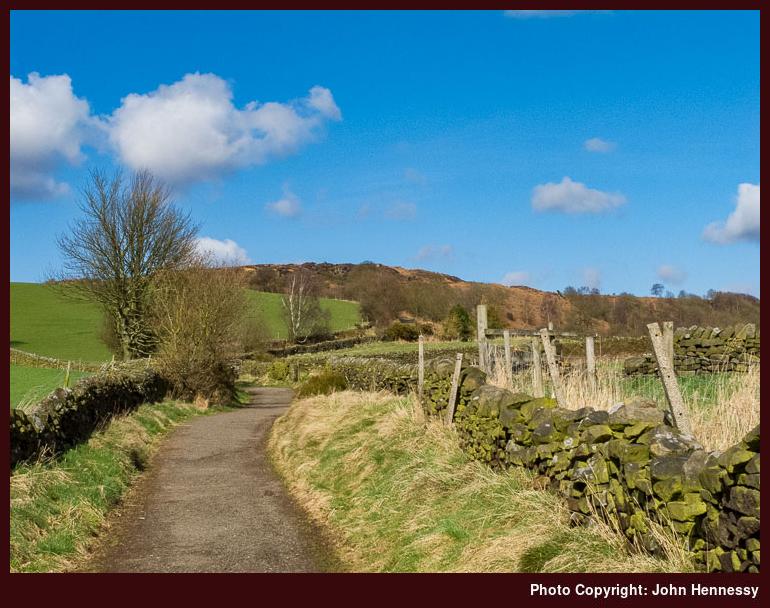
As I went up Bar Road, the views began to open out around me. Other parties were sharing the way with me and many clearly were out for a dander rather than anything more serious. There was plenty of room for all of us, so Baslow Edge came soon enough for me and the evidence of the sun's battle was there for all to see. One minute, there was brightly lit ground all around you only for clouds to rule the next. It was tricky to get a camera extracted in time to capture a scene before the sun was obscured again; clouds really were scudding around the sky at this time and there were loads of them too. Still, the vistas were there to be soaked in and the crumpling of the countryside couldn't be missed.
After Baslow Edge with its Eagle Stone, it was time to cross a minor road dropping down to Curbar to pick up Curbar Edge. With a clear track ahead of me, my brain wasn't being taxed at all heavily, and it started to fill with nonsense daydreams, entertaining though they were. White Edge lay to the right of me and Curbar Edge and Froggatt Edge were indistinguishable from the top; it might be a different story for those looking up from below. Looking north steered my eyes towards the Derwent Moors and Stanage Edge in the distance.
All that reverie was being challenged when I ended up in what looked like woodland and wondered if I had gone wrong somewhere. As it turned out, I hadn't, and it was the Ordnance Survey's depiction of woodland that was suspect, a very good reason for not depending too much on woodland boundaries for navigation. By this time, the sun had defeated the clouds, and it was through pleasantly lit woodland that I dropped onto the A625. Crossing that to go into Hay Wood meant a change of mental gear with more concentration on picking my way along public footpaths to get to where I had in mind and not somewhere else.
That spot of extra attention paid dividends as I landed on the Derwent Valley Heritage Way right by the village of Grindleford. After a brief look at the church that was beside me, I set off through a field that felt much wetter than what had been underfoot until then. Across the river, the B6001 scaled the slopes, and it was a usual situation where the road was taken above the flood plain, something that came to light on my early explorations in the Yorkshire Dales. Those same wooded slopes, leading to Eyam Moor, were the cause of my walking in a shadow that covered half of the field through which I was walking.
Things got much muddier when I went through the National Trust owned Coppice Wood. Apart from the wet state of the ground, a pair of evening joggers confirmed that it was the passage of human traffic that really was cutting up the path. Away from the wood, the ground was better, and the field walking was replaced with that along a private road, some respite from water and mud. Once on tarmac, it didn't take to reach a crossing of the B6001 as it crossed the Derwent not far from Hathersage, one of my potential exits if time was at a premium.
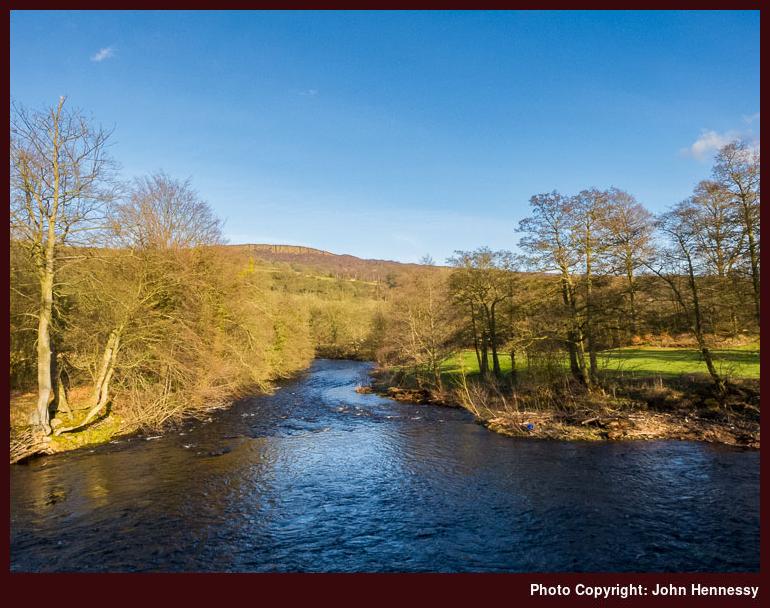
Satisfied with my progress up to then, I crossed over Leadmill Bridge to make for Bamford. Another muddy woodland floor came my way before I was out on a dry if disintegrating field edge path that had me keeping further away from the edge at times; while one wonders where they're going to find the money, this would need addressing because a crumbling river edge isn't inviting at all. Nevertheless, I was making good progress and spotted stepping stones in the Derwent that were so overrun by the river that they didn't look at all usable until river levels became lower. Sticking on my current side of the river, I kept going though, albeit with an increasing awareness of the time.
It was beyond Kentney Barn that I began to wonder about getting that train home. That drove me to plough on through any mud that was put my way until I reached tarmac again and stayed on it until I was in Bamford's train station with plenty of time to spare, a good way to have things and a small way to relax at the end of a walk too. Others around me weren't so driven: there was a family ambling the banks of the Derwent that I left to enjoy the rest of their evening and two children were out playing with their JCB. Maybe I should have organised some accommodation and stayed there longer myself. After all, it had been a very good outing and mud is all part and parcel of exploring the outdoors. Well, there are such contraptions as washing machines...
Travel Arrangements:
Bus services 58 from Macclesfield to Buxton and 218 from Buxton to Baslow. Train travel from Bamford home with a rail replacement bus journey between Manchester and Stockport and a long wait for a train at the latter. All travel was done for the price of a Greater Manchester Wayfarer ticket.
Remnants
11th April 2010 This weekend, I fitted in an overnight stay in Capel Curig and a strenuous walk over the top of Moel Siabod while en route from Dolwyddelan. Following that ardour, anything done today needed to be less energetic, though a hike over boggy ground and through woodland conveyed me to Betws-y-Coed from where I travelled home again.
Around the same time last year, I was in the same area and the one difference that stays in my mind is that there remained streaks of snow after the winter that we got. Moel Siabod had them and so had Snowdon, the Glyderau and the Carneddau too. It is small wonder that I had brought the Microspikes with me, though I largely avoided any difficulty in the event. Saying that, I did manage to inadvertently scoop up some snow in my right boot (I left off the gaiters, and the trousers are only fit for the washing machine now...) with a single ill-taken step. A spot of boot removal and flicking off any invaders from my sock was all that was needed for redress.
Last Sunday's outing was very different, but the sight of flecks, patches and streaks laying on much lower hills was held in common. Normally, you wouldn't see snowy remnants at this time of year while journeying along the A537 between Macclesfield and Buxton, yet I did this year. In fact, anytime that eyes gazed in the direction of the upper reaches of Edale, there were telltale white patches there too. If my imagination wasn't fooling me, I even think that I might have spotted a white speck on Lose Hill while on the train home. Not being accustomed to these sights, I tend to notice them, but a more seasoned observer mightn't pay that much heed.
This past weekend has distracted me from promised illustrated scribblings and, if the fine weather stays with us, I may be waylaid be the lure of well lit hill country next weekend too. Of course, we have what weather actually is coming our way first, but a look on Metcheck reveals signs to be promising. Meanwhile, I'd better be making time for some matters outstanding then. These hints of summer are a big change from what we were having...
A short sortie in snow-streaked hill country
24th March 2010 It's amazing how brainwaves emerge and the one that prompted my weekend visit to Glenmore and Abernethy is a case in point, and it might have been caused by the prevalence of cycling outings since my last walking excursion. What resulted was a hastily planned getaway facilitated by a Caledonian Sleeper journey between Crewe and Aviemore (booking a berth this time around) with an overnight stay in the SYHA Cairngorm Lodge hostel. For all that, it worked out very well in the end, and keeping things simple might have helped towards that end.
Overcast skies were pervasive when I got to Aviemore, but I didn't dally with disappointment at all. One thing that concerned me was that the later-than-usual arrival time because of the need for passengers bound for Fort William to continue their journey from Kingussie by coach due to engineering works. That concern subsided when I boarded my intended bus for Glenmore to make use of the full day ahead of me, one of the advantages of overnight travel.
That day was to be spent poking around a part of the world that I first explored on the last day of my stay in the area last August: Strath Nethy. With that in mind, I picked my way towards the Ryvoan Pass with patches of snow still littering the ground without my need to go that high at all. For safety's sake, I had my Kahtoola Microspikes with me so, while wary of over-exuberance, they gave me a little more confidence when dealing with what lay underfoot. Even so, much of the white stuff that I crossed was of the softer variety rather than its harder and icier counterpart.
To ensure views over well blanketed summits like Cairngorm and Braeriach, I reversed a higher level course to An Lochan Uaine that had me reproaching my wisdom in August until the vistas repaid my efforts. Though the sun was trying to get through any breaks in the cloud cover, conditions weren't so conducive to photography, and I contented myself with a few record shots in case nothing better came the way. That is not to say that there was no tinge of blue appearing, but it was taking its time doing so. It was after An Lochan Uaine that any real brightness began to grace the slopes of Meall a' Bhuachaille.
Leaving the track for Nethy Bridge to take the one going for Strath Nethy took me by the Abernethy Forest National Nature Reserve with the surrounding countryside being eerily reminiscent of what you find around the Rothiemurchus Estate with its mix of lone trees, a heather carpets and a smattering of lochs and lochans. Grouse were making their presence known, and I got to hear the classic "go-back, go-back" call for the first time ever; I have heard grouse before, but never making this sound as clearly as I heard it last Saturday morning. Having left a party of ice axe equipped mountaineers go ahead of me, I could take in the surrounding sights and sounds without worrying about holding up anyone.
Reaching Strath Nethy and the bridge over the river flowing along its floor was marked by a spot of early lunch. There were vague ambitions of reaching Glen Avon and Loch Avon in the back of my mind, but the tempting track shown on the map as following the Nethy on the floor of the glen was anything but appealing on the ground. In fact, it was a boggy mess, punctuated with occasional stretches of stepping stones. Any efforts to make it more passable looked far from concerted, and it's little wonder that the right of way for Glen Avon took a higher route.
In fact, I chose that right of way to get me onto an unnamed hill acting as a long shoulder to Bynack More. It was at this point that I became beset with rain showers, but there were dry respites too. That reminded me of a rain drenched trot over Meall a' Bhuachaille's neighbouring hills last August, albeit with the breaks that allowed so drying time. Snow took over as the main covering underfoot, but it remained largely soft, and I had the Microspikes on in case I needed, and they didn't let me down on one icy patch where I put them to the test.
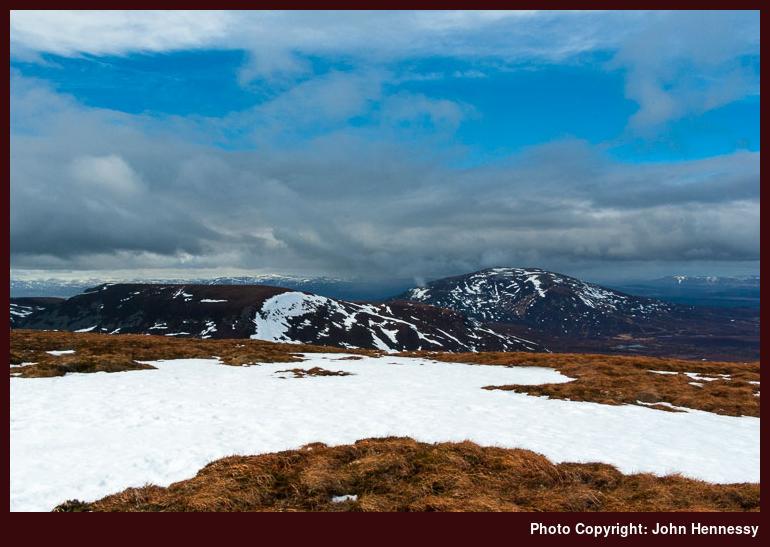
Gaining height does allow you to resolve geographical counundra and I saw the way to a well snow-enveloped Bynack More and confirmed that it was its neighbour Bynack Beg that I was seeing from the floor of Strath Nethy. The slab-sided Sròn a' Cha-no was another landmark across the same glen, and I think that I spotted a small cornice lining one of its minor side valleys too. While I was concentrating on what was near at hand, the views ranged far and wide too, with those opening up towards Cromdale's hills and those at the back of Aviemore while the showers stayed away.
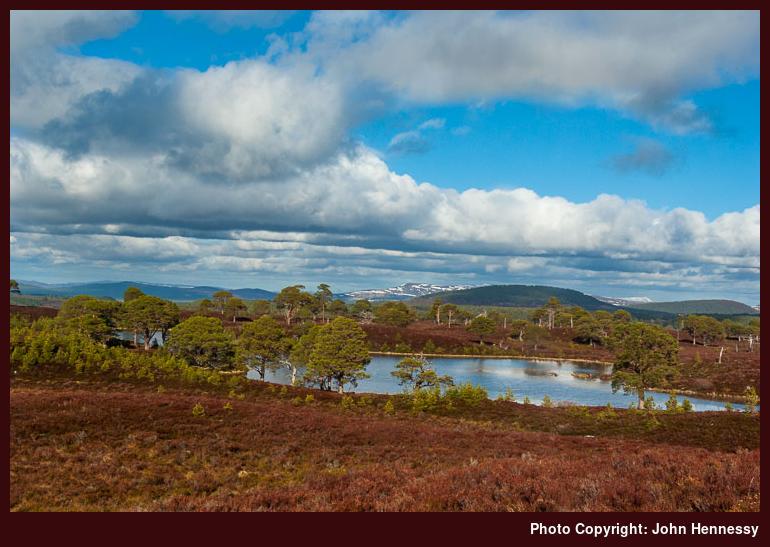
Satisfied with a pleasing bit of reconnaissance, I left a snow-covered Bynack More for another time and retraced my steps. Glen Avon and Loch Avon were left to wait too, but my patience with the passing showers, though wearing thin, was rewarded eventually with a clearance that was to remain for the rest of my time in the area. One of the advantages of an out and back walk is that views that didn't appear at the best on the outbound trip can look better on the way. So, it was on this occasion and I made the best photos of the surroundings while on my way back to Ryvoan and Glenmore.
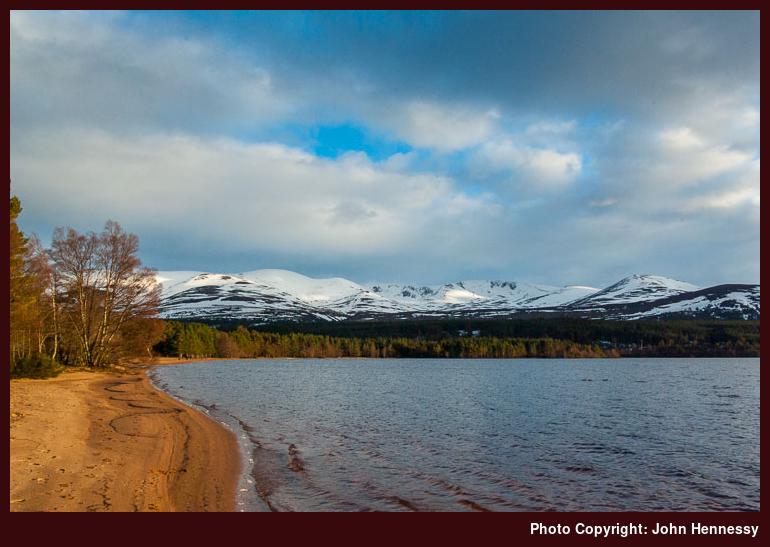
After An Lochan Uaine, I stayed with the track headed for Glenmore Lodge, but chose a variation later on. This took me over Abhainn Ruigh-eunachan and around by Allt Mòr before crossing the road that leads to the skiing centre and the funicular railway to head for the shores of Loch Morlich. Seeing sandy beaches by a freshwater loch is unusual, but having it all backed by woodland and snow-covered mountains was something else again. With the accessibility of the loch, there was no way that I was going to have it to myself, and I didn't begrudge anyone out enjoying the sights like me. That's not to say that there aren't quiet corners, and I sought one of them out to see what I could capture with a camera.
With the evening light fading, I made for the hostel to secure my bed for the night in a room named Ord Ban and across from another named Bynack More. It was a reminder of where I had been during the day and that a rest was needed after the way that the day had been spent. An early bedtime followed, a fortunate development given that someone rose at 06:30 the next morning and wasn't being so quiet about it either.
Sunday was never going to be much of an outdoors day, with a journey home to fit into it. Fatigue after the previous day was a factor too, as was the need to sort out a few things before I left Aviemore. Nevertheless, I did fit in an energetic trot from Glenmore to Aviemore by way of the track called the Old Logging Way. Having gone the way before in August, I had memories of the trail that gave a reassuring sense of progress as I was walking. The day was starting out like the one before, with grey skies letting some sunshine through and displaying vague signs of blue colouration. With few distractions, I got into a walking rhythm that made good use of any downhill sections (that there were plenty of these may go some way to explaining why snow was never that far away) to complete the five-mile distance in under two hours. There were patches of snow and ice along the route, but none of these were unmanageable, and it wasn't overly busy either, though I did encounter the occasional cyclist and jogger.
As if to give me a good send off after a fleeting visit, clouds had broken to reveal blue streaks in the sky by the time that I got to Aviemore. The hills underneath which I had slept looked resplendent in the distance as the sun got more opportunity to work its magic as the day grew older. The journey to Glasgow allowed more chances for admiring any hill country that caught the sun before I continued south again from there. All of this has me pondering an Easter escape. Of course, this is dependent on weather and other circumstances, but the mind is starting to wander, and who knows what brainwaves might be unleashed?
Travel arrangements:
Service 38 from Macclesfield to Crewe, ScotRail Caledonian Sleeper from Crewe to Aviemore and service 34 from Aviemore to Glenmore got me to the start of the walk. A railway journey conveyed me home from Aviemore with changes in Glasgow, Preston and Manchester.


