Category: Trip Reports
An uncertain forecast, but a dry day in Teesdale
 12th May 2008
 This past weekend might be seen as not being that friendly towards hill country hikers with its mix of high temperatures and an ever present threat of torrential downpours with added son et lumière. Apart from a session allotted to the breaking in of my Scarpa ZG10's, my own outdoors activity was non too extensive. As it happened, I just couldn't get myself in the mood for a longer hike. The thundery atmosphere and the heat might have something to do with this lethargy but it also could be due to my having decent walking outings over the previous bank holiday weekend. After a climax, an encore can be too much to ask.
The Mayday weekend might have shared weather uncertainties with that following it but, in many ways, it was a very different affair. For one thing, I managed to make my mind up that I was going for a walk and that was that. I was playing with a multi-day Pennine Way outing but doubts over the weather and personal fitness toned things down a lot. I still experienced a new section of the trail but in a much more manageable fashion: an out and back along the Tees from Middleton-in-Teesdale. Though there was a threat of rain and skies were packed full of light cloud, I was determined to explore a part of England that was hitherto new to me. At times, the sun broke through anyway and all fears of drenching were for naught; it was sunscreen that was needed rather than water proofs.
Getting to Middleton and away is easily described: by train from Macclesfield to Darlington and by bus from there. Returning home simply reversed things. An early morning departure ensured that I was in Teesdale not long after 11:00 and the only concern was a short connection time in Darlington but I made the bus in the nick of time. On the way back, a spot of muddling meant that I missed the 19:34 southbound train and I had to await the 20:14 instead. I still got home but at the same time but retain the lesson that you shouldn't trust your memory too closely: I took the correct turns but at the wrong locations. All got resolved in good time.
The Tees-side walk itself was devoid of such navigational blundering. From Middleton to Low Force, the track of the Pennine Way (which it shares with the Teesdale Way at this point) was quiet as it followed the fast flowing Tees through fields filled with sheep and their lambs. Apart from some ramblers, very few folk were met until around Low Force and High Force. The capacity for dramatic waterworks of the natural variety to attract wider humanity should never be underestimated. The fact that the day was balmy contributed to the attraction of the features in question, as it always does.
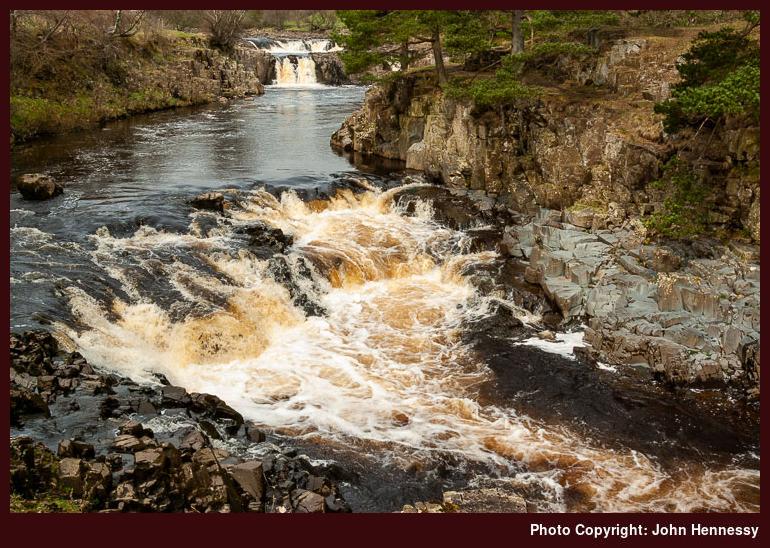
I didn't have to go far past High Force for things to quieten down again. However, the pleasing sights of torrents of water spouting over rocks were replaced momentarily by the fruits of some human industrial activity: quarrying. Having passed this, I became conscious of the time that I had, perhaps overly so, and decided to turn back on Bracken Rigg rather than dropping down to Cronkley and Forest-in-Teesdale. I am beginning to notice that I am overcautious with out-and-back treks while throwing some caution to the wind on point-to-point hikes. My visits to Teesdale and Kinlochleven typified the former while my bank holiday wander from Bethesda to Bangor (to be described in a future post) could be seen as being very much of the latter. This is something that I'll be watching, especially for linear walks.
Perambulation over a combination of footpaths and bridleways, some boggy, was to land me at Holwick with the scars looking very impressive, even on a cloudy day. After that, it was back to the Pennine Way and Middleton where I whiled away a relaxing hour before my bus turned up. It was a good relaxing end to an enjoyable day. Thoughts are now turning to future Pennine Way expeditions with a walk from Teesdale to Dufton in the mind. Connecting with Swaledale and Wensleydale to usher forth my progress is yet another proposition. We'll see how that might come to pass...
Wandering around lochs among white-capped hills
24th April 2008 This past weekend saw me head up to Lochaber in the Scottish Highlands after seeing a favourable weather forecast up there; the prospects for south of the border weren't as good. A spot of overnight travel saw me reach Glasgow, from where a Scottish Citylink coach service carried me through the usually glorious countryside with it looking resplendent in the sunshine. The slopes may have been brown, but many of the tops were still white, a reminder of the bumper crops of snow that fell over the past winter and spring. It seemed a pity to merely be passing through all of this wonderful stuff without stopping but it just isn't physically possible to explore it all at once.
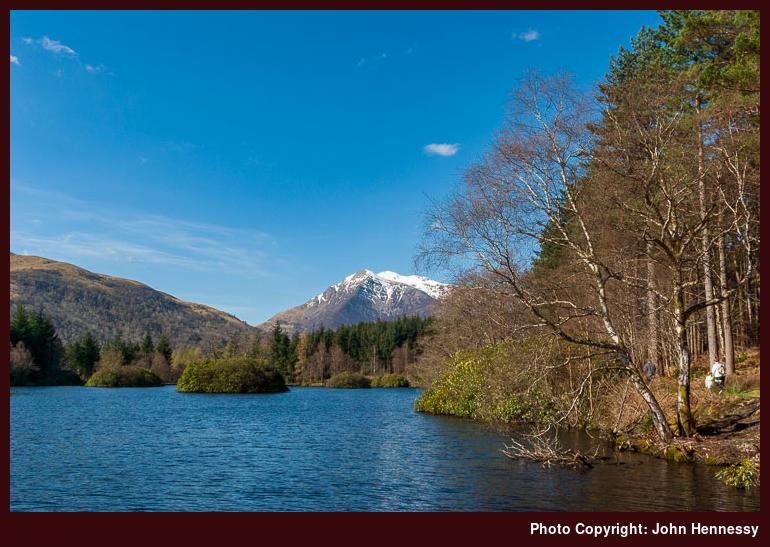
Appropriately enough for a day that was to be spent in its vicinity, my coach journey was completed on the shores of Loch Leven next to Glencoe village. My eventual destination was to be Kinlochleven, but the next bus there was nearly two hours away and a short stroll along the lower slopes of Sgurr na Cìche (also known as the Pap of Glencoe) was more than a way to spend the time. I found my way onto Forestry Commission land originally landscaped to mimic Canada for Lord Strathcona's wife. Unfortunately, the creation of an artificial lochan and planting of Canadian flora failed to stall a return to British Columbia and the big house that he built is now Glencoe Hospital. I walked around the lochan, taking in the views of mountains, some with snowy caps, above and through gaps in the trees. At one point, I took a path that gave my legs a good workout, a prelude to what was to come later.
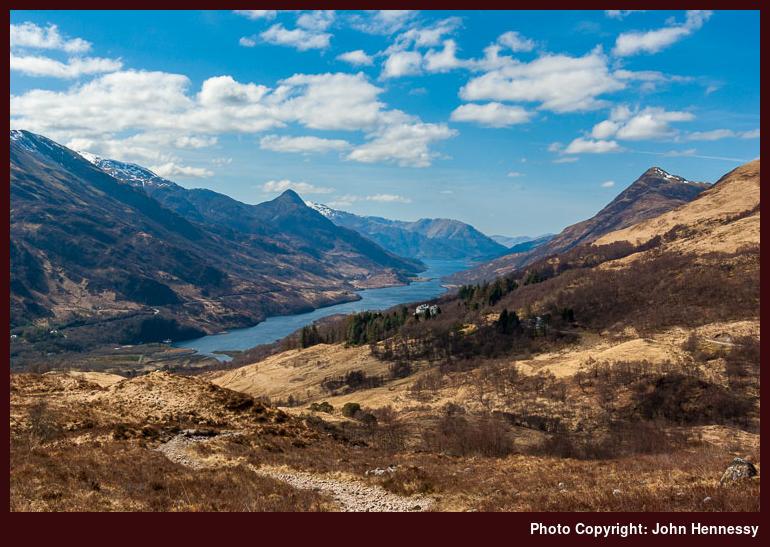
My time well spent, I caught my bus for the short hop to Kinlochleven where a trek to and from Loch Eilde Mor was in my mind. I was retracing my steps from a visit in damper, clammier weather last August. Kinlochleven seemed more alive with people when I got there this time around and there were no midges to plague those who were out and about. When I set to ascending the steep slopes by Allt a' Chumhann and Allt nan Slatan, it didn't take long for me to find myself away from humanity. Views down along Loch Leven caused me to dally; I saw the potential in August but I knew that better weather would improve the views and I wasn't wrong. The Mamores and their others were the mountainous wall on the right as I looked west while, on the left, the view towards Sgurr na Cìche took in what divides Glen Coe from Loch Leven.
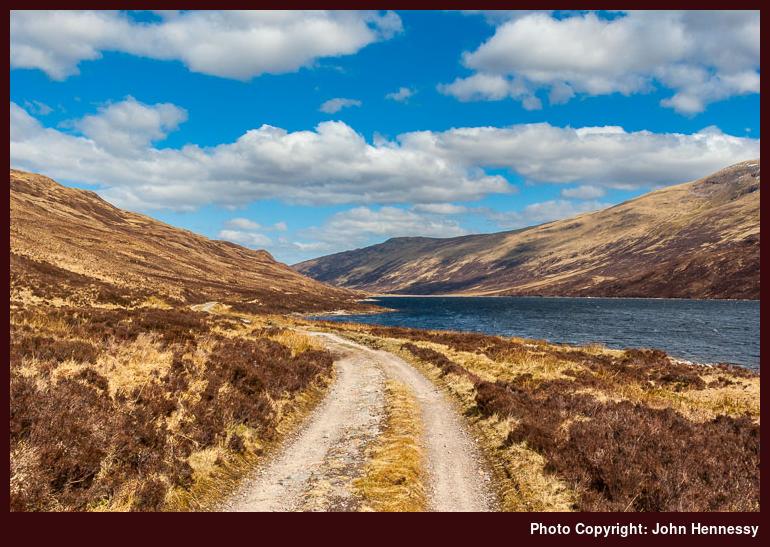
By the time that I reached more level ground, banks of cloud had bubbled up and were limiting the sun but not that much. It meant a spot of patience was in order when it came to photographic activity, a very minor problem. By now, I had made my way from a well-made path onto a good vehicle track and it didn't take that long for me to reach Loch Eilde Mor from that point. I would have walked its entire length were it not for doubts regarding my catching a bus to Fort William in time to reach my accommodation for the night. Thus, I turned back with Locheilt Lodge appearing tantalisingly close. In the event, I could have continued on a bit more since I was left with an hour to spare before the said bus arrived. However, it's best to be safer than sorry sometimes and I was getting tired anyway. On the way back, rather than following the path that I used on the way up, I stayed on the vehicle track and followed it until Mamore Lodge, after which I dropped down to the road on the West Highland Way.
Fort William was reached in good time and I spent a quiet night there before starting my journey home after enjoying the early morning sunshine. I was wondering if I left the area prematurely and whether a little more planning would have made a longer break of it. The views from the coach were as good on the way down as they were on the way up, even if a strange sense of fatigue with all things brown came over me. Even so, I might have been visiting Lochaber for next to ten years but I keep finding something new that always seems to convince me that I'll only ever scratch the surface of all that it has to offer. I have left hoping to return and a trek from Corrour to Kinlochleven might be a plausible proposition that returns me to the shores of Loch Eilde Mor and Loch Leven again.
Avoiding showers along the Welsh border
14th April 2008 For the weak willed, the threat of heavy showers over the past weekend might have been an excuse to stay at home from the outdoors, but dry sunny weather featured more than one would have thought in light of the various forecasts. As for me, I just couldn't rouse up any enthusiasm for going anywhere; I just was in no mood for it. The weekend before couldn't have been more different: after a month of March that was quiet on the hill wandering front for various reasons, a lengthy bout of "man flu" included, I firmly decided that I was going somewhere to get out among hills and an imperfect wasn't going to stop. I was prepared for it.
The destination was to be the hill country near Knighton on the Wales-England border. It was a plan that I attempted to execute last December, but a late train thwarted my designs and I explored the Long Mynd instead. This time, no mistake was made, as I left Macclesfield early in the morning and ended up leaving myself a forty-minute window in Shrewsbury after a train journey involving a change in Wolverhampton. I used that time to go for a walk around the town in damp weather, and I came away impressed with what I saw. In fact, I have made a mental note to make a photographic foray to both Shrewsbury and Oswestry some sunny day when I want something a little different from my usual hill country forays.
I completed my stroll in ample time to catch my train to Knighton and, when I arrived there at around 10:00, I found the place to have taken on the feeling of a ghost town. On the train, there were a goodly number of ramblers and I thought that this might be their destination, but I was to be very wrong: when I did disembark, there were more waiting to depart than what actually arrived. I took my time while ambling through this sleepy agrarian spot and dropped into the Offa's Dyke Centre, a spot nearly as quiet as everywhere else.
In fact, the aforementioned quietness was to pervade the most of my day's wandering. The sky indicated a day that was to be "iffy" on the weather front, but any predictions made based on its initial appearance were to be proved utterly wrong; the only rain encountered was the odd drop, if that at all. Once out of the Offa's Dyke Centre, I made my way north and, within minutes, I was in Shropshire and England was to play host to all of my footfall between then and my return to Knighton. Loosely defined plans are typical of my walking exploits, and this was no different: follow the Offa's Dyke Path north and turn around to return to the train station in time to get home again.
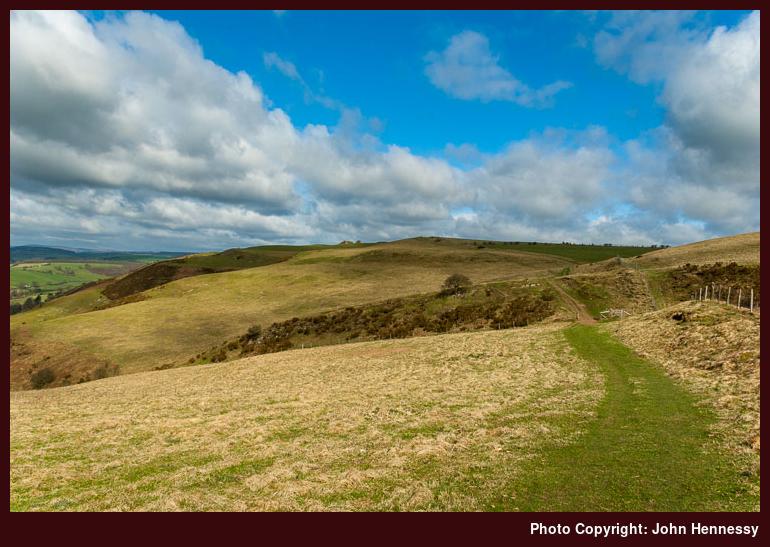
Along the way, I saw very few people and the weather kept getting better as I perambulated over the not so high English hills and looking west was all that was needed if wanted to see their Welsh counterparts across the Teme valley. The lack of stature in the hills didn't make any difference to the effort required to surmount them: a fact borne out by my progress up the not inappropriately named Panpunton Hill after crossing the Teme, a short stroll away from Knighton. From there on to Cwm-sanaham Hill, progress was gentler and serious up and down activity was deferred until the descent from the latter and the subsequent re-ascent.
It was not so far north-east of Llandair Waterdine that I decided that I had gone far enough north for the day and set to following Shropshire's public footpath network proper for a return to base. It was at this time that the cloud cover really started to break up to make up for some superb sunshine as I negotiated my way from field to field, never a strong point of mine. Crossing a minor road, I picked up a clear bridleway along which I continued on my way back to Panpunton Hill, Knighton and home. Everything was going well until confusion struck at a meeting of rights of way, for which nothing on the map seemed to represent where I was. There was only one thing for it: head west until I met the national trail along which I had been hiking earlier. A stone's throw was all it took to get me back to more familiar surroundings, and I am not certain how I ended up where I did, but I am inclined to suspect that a new public footpath may have been set up that the OS do not show on their maps. It's undoubtedly the sort of muddle that makes a GPS receiver very useful for confirming that you aren't going completely mad!
Once back on the Offa's Dyke Path, the journey was unremarkable apart from the descent of Panpunton Hill paining my tired knees. The sun remained out in force as I made my way through Knighton, the place now being more alive than it was earlier, to its train station for the 16:15 to Shrewsbury. With the weather as resplendent as it was, it seemed a pity to leave so early, but I had a good walk lasting more than five hours and the next train would have been at around 21:00 anyway. Nevertheless, I resolved that if the weather stayed as it was, I would stop off in Church Stretton for a quick nip into Carding Mill Valley with the idea of putting my camera to some use. That did happen, and I was leaving when the first of the forecasted "nasty" showers arrived.
From Church Stretton, I took a train to Stockport, although Shrewsbury's looking wonderful in the post shower sunshine had me sorely tempted. I stayed on the train, deciding that a quick run around with my camera (for most of the day, I had been working exclusively with film thanks to my DSLR running down its battery and my lack of foresight for not recharging the thing in time) wouldn't do the place justice anyway. Given that I travel this way regularly, the journey from Stockport to Macclesfield should have been routine, but I have encountered an incident verging on adventure before. This time, I was both lucky and unlucky to meet the first southbound Virgin departure from Manchester since 17:00; I was lucky that it ran on time but unlucky in that it was overcrowded. I inadvertently, and unusually for me, got on in the first class bit and, not realising that it was open to all anyway due to what happened earlier, I made my way to standard class on a very crowded train. If I wasn't on autopilot to an extent and knew more of what was going on, I would have stayed where I was, but hindsight is always twenty-twenty vision, isn't it? Anyway, a ten-minute journey like this is never going to spoil the memory of what was a good and varied outing, and I hope to head down that way again. The possibility of spending more time along the Offa's Dyke Path rears its head too.
Good weather for frogs
10th March 2008 Without doubt, I have shared similar sentiments on this blog before but I'll share them again: it never seems to amaze me how a honey pot walking location can blind you to other equally attractive places. On this occasion, it is again the delights of Lochaber and Skye that come to mind because, two weekends ago, I was enjoying a hike among the Arrochar hills in Scotland. Since then, I have pored over maps and the quality of the hill country really makes me wonder why I never explored the area before. A peek at any map will reveal a goodly number of useful paths and tracks through some accessible and fine countryside. Some offer ways to the summits of Munros and Corbetts and this presents me with the idea of ascending a top or two; I have yet to stand atop a Munro and this part of Argyll may well change that.
Returning to the subject of hill tracks, it was an inspection of ScotWays' very useful Scottish Hill Tracks that set me up with some ideas for a trip, as it has for many of my explorations of Scotland's wilder places. The old rights of way in these parts seem to offer opportunities for shorter days, a useful thing if you don't have the whole day to spare. One such idea was a circular walk from Arrochar through Glen Loin before following Allt Coiregrogain up to Bealach a' Mhaim and dropping down towards Arrochar between Ben Arthur (The Cobbler) and Beinn Narnain. The book describes it the other way around but I had my reasons for doing in reverse if my plans were to come to pass.
The forecast was for showers but I had my waterproofs with me and remained hopeful for some sunny spells so that I could avail of momentary glimpses of the surrounding scenery at its most resplendent. I suppose that I could have gone for hill country in the Scottish Borders instead because of a drier forecast, but the idea of an earlier start was to override the idea. At 08:00, a Scottish Citylink coach dropped me outside the hotel in Tarbet, and I couldn't resist pottering down to the shore of Loch Lomond before continuing on my way to Arrochar. I thought that I was in for two miles of road walking but the idea of checking on train times revealed the possibility of following a good Forestry Commission path around the slopes of Cruach Tarbeirt instead. The first shower of the day came on me while I was on this track but it soon departed to leave very reasonable views across Loch Long towards The Cobbler and its ilk.
Within an hour, I had made my way into Glen Loin, a somewhat industrialised spectacle. For one thing, conifer forestry is very much in evidence there, but what really attenuates the appeal is the presence of two processions of pylons through it. Conditions underfoot were sodden and the going would have been on the challenging side were it not for the presence of a good track, even if a spot of puddle dodging was in order. The reason was dodging those puddles was actually more nature consciousness than trying to avoid getting one's feet wet. I was being greeted with sights and sounds that were new to me and on a scale beyond my wildest imaginings...
The various pools and puddles were playing precarious host to a precious cargo: frog spawn. The sight is enough to make you shudder to think what devastation an errant boot or tyre might do to the frog population and the idea of pools drying out is no better. Being on the cusp of springtime, it was time for the creatures to do what comes naturally and they were everywhere, both on and off the track. Having one's reverie interrupted by the primordial cacophony of bullfrog croaking is certainly an experience that I will not forget and it just shows that you don't need to watch BBC television to encounter life of the cold-blooded variety.
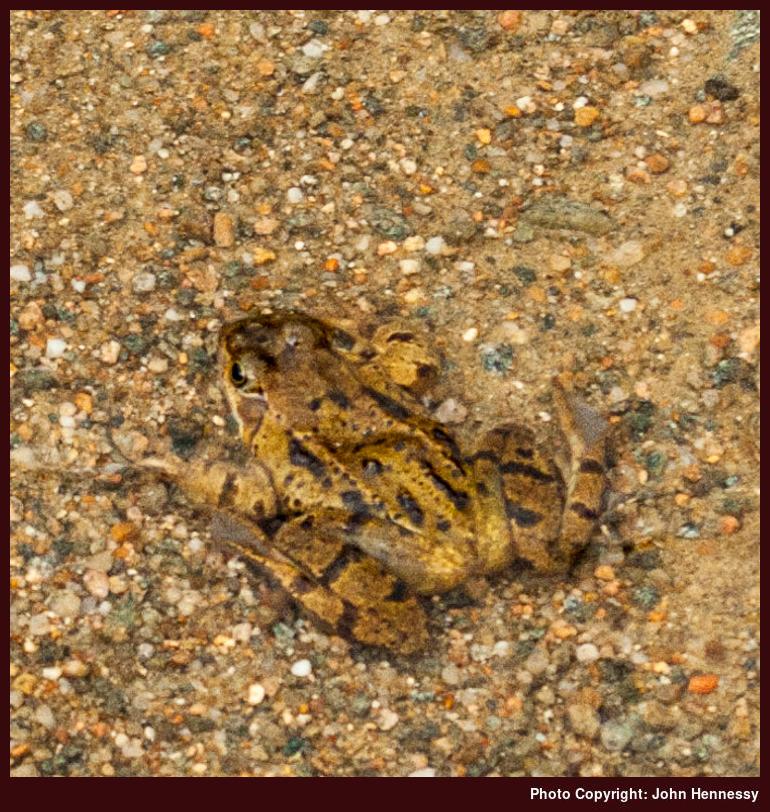
That spot of wildlife watching shortened the journey up Glen Loin and I crossed Inveruglas Water near Coriegrogan to pick the reservoir track between Loch Sloy and Inveruglas. It was about this time that the dry morning interlude, that I had been enjoying, came to an end and a shower dumped its wares upon all that were out in it. Some had headier heights, like Ben Vane, but my sighting of the reduction in visibility on high might have made me reconsider my plans in the absence of the time factor that already had made me go for a lower level circuit than that which was originally in mind.
The shower soon passed, and my gear was working well in the conditions that were experienced. The sun made an appearance to dry things a little and the hills were resplendent with a sprinkling of the white stuff having happened on or near the tops. I followed Allt Coiregrogan on its northern banks but, rather than staying on the track to ascend the slopes to the initially intended bealach, I crossed the burn and started to follow a track that was to take me back towards the shores of Loch Long again. Another shower came and went while I was immersed in tree cover so that the landscape was bathed in bright sunshine when the views returned.
As time moved on, my mind was becoming ever more concerned with my getting home and I needed to return to lower levels first. A track traversing well up a steep slope is all well and good for the views that you get but getting down with an out of date map is another matter. The OS Explorer that I was using dates from 2001 and it very nearly misled me because the tracks had changed in the meantime; it's getting rather tatty now so its replacement might be in order. A brief spot of fumbling got my feet wet, but patience paid off in the middle of yet another shower when I came upon a well-engineered path with plenty of switchbacks on the descent; some don't appreciate such niceties as was evidenced by the shortcuts visible on the ground. The going was easy from here: follow the road around the head of the loch until you see a bus stop sign.
The showery activity was continuing with a vengeance now, so much so that it was becoming an irritation. The coach from Campbeltown turned up late, but that wasn't such a problem because it was the one from Oban that I had in mind. (That both stop at Arrochar within 30 minutes of each other is something that I consider a missed opportunity when it comes to providing a less sporadic public transport service.) Unusually for a Citylink service, I was left on the bus with my rucksack but I suppose that the driver didn't want to go out in the middle of a heavy shower. As the coach continued to Glasgow, there was no let up in the rain so I reckon that my departure was well-timed even if I left shortly before 15:00.
After a stop in Glasgow that allowed me to acquire a new pair of socks to facilitate a change to drier footwear later on, my journey home continued. It should have been a railway one of all the way but engineering works meant travel to Carlisle was by coach and two were needed because the first one broke down. Otherwise, I travelled on without any incident after a very satisfying day. The showers may have annoyed at the end and I may have barely scratched the surface of what seems to be a fascinating part of the world, but gaining the lie of the land for future visits was well worth any effort. I hope to return.
Narrowing a gap
28th February 2008 The chance of a few fine February weekends has allowed me to continue my Pennine Way project after what has been a lengthy hiatus. The gap in my northbound progress to Hawes has been between Haworth and Gargrave and it is one that's been nagging at the back of my mind for a while now. It's a section that may be a light workout for the legs in comparison with others, but that means that you are crossing farmland. That introduces field navigation, a practice fraught with opportunities for error due to OS' difficulty in showing the lines of footpaths to the required level of precision and accuracy on their Explorer maps. The same issue affects any attempt to exit any sort of sizeable conurbation into hill country. Waymarking does help but only if it is done properly and I have got the impression that it's not one of North Yorkshire County Council's finer points. In fact, the sight of homemade signs and arrows paint and on stone walls is a little amazing when the role of such interventions is to direct you along what is a major national trail.
If I had taken heed of such amateur signposting, I would probably have avoided heading in the direction of someone's backyard at the start of my walk south from Gargrave a few weekends ago. I was set right when I heard tapping on a window and I was suitably chastened because it was my own curiosity that led me to continue in the wrong way. Getting to Gargrave in the first place was a minor travail with the railway taking the strain for me. I had planned to allow a bit of slack by catching an earlier train from Macclesfield but it got cancelled due to a staff shortage. Nevertheless, everything went as I had hoped, even if the train carrying me from Manchester to Leeds got crowded by ramblers at Dewsbury; they seemed to have headed off somewhere else because Gargrave was quiet and I starting out, which might have been just as well...
Once I had got onto the PW, it was very much a case of paying attention as I plied my way. Finding the initial sign in Gargrave itself required patience and the same quality was much required as I made my way from field to field until reaching the canal at East Marton. After following the canal for a short while, it was back to more careful field crossing until I reached Thornton-in-Craven. I may have veered slightly off route at times, but things on the navigational side were keeping up. After Thornton though, a spot of navigational bumbling struck around Brown House Farm before I got back on track again. After my thankfully unobserved fumbling, moorland began its encounter as I headed up and over Elslack Moor before more field walking until I reached Lothersdale, a pretty spot. I did have designs on continuing a bit further along the PW before returning to civilisation, but navigation looked uncertain at that hour of the day and I chose an alternative route that mixed footpaths and roads until I met up with a bus stop near Lumb Mill Bridge from where I took a bus to Keighley and it was all rail travel until I got home.
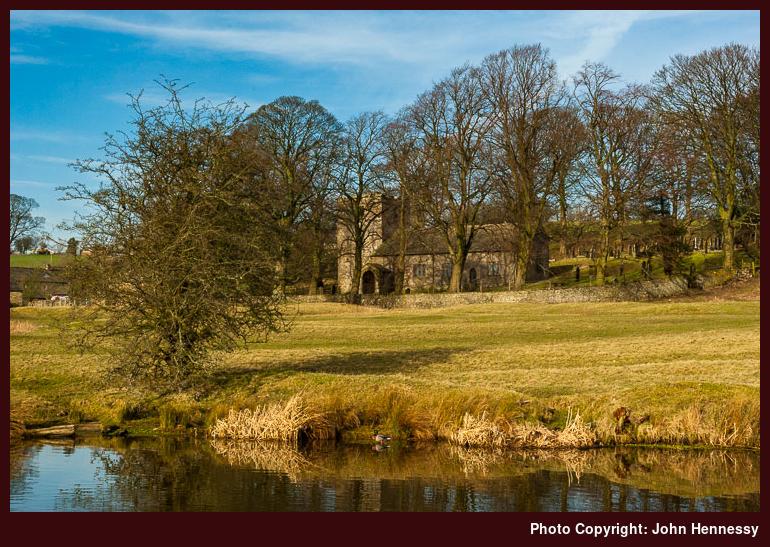
There was a gap between Lothersdale and Haworth to be closed and it wouldn't have received attention on the following weekend were it not for the fact that I couldn't muster up enough energy for a visit to Borrowdale in Cumbria on the Saturday. The fine weather was prodding my conscience, so a trip to Haworth was in order for the Sunday. The journey there involved: a bus to Manchester, a train to Hebden Bridge and a bus to Haworth. From Haworth, I got to Ponden Reservoir over public footpaths and roads in just over an hour, not very fast for some but I was satisfied. The day was glorious and icy conditions remained in places where the sun couldn't work its magic. The walking around the reservoir was easy and uneventful, but an energetic climb up and over Ickornshaw was soon to great me. Steady progress saw me up onto the moor where an observant eye kept me on track. The way down to Ickornshaw can cause confusion because of its many twists and turns with some homemade signposting in evidence; the waymarking people could do with visiting these parts. The good people of Ickornshaw have resorted to painting arrows on stone walls to keep weary walkers on track but I was to potter through to Cowling for a bus to Keighley and a railway journey back home.
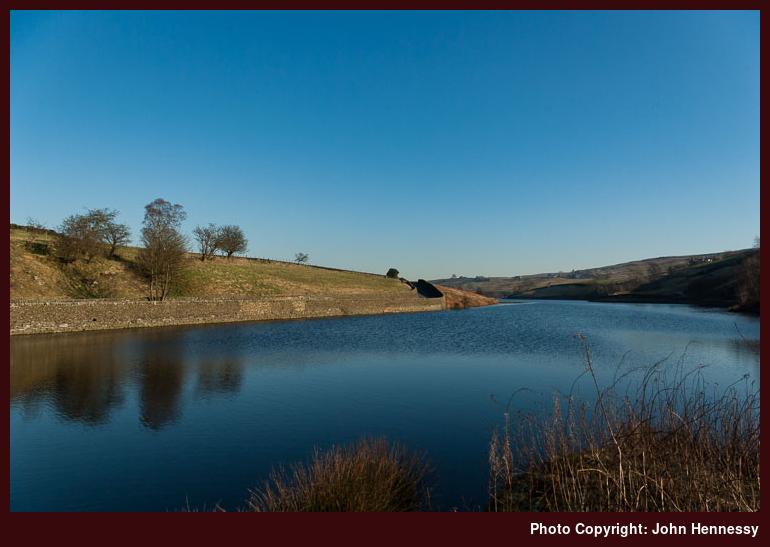
The remaining piece between Ickornshaw and Lothersdale still beckons, but that is another opportunity for exploring these parts rather than something maddening. The section itself is a reasonably short one, so further walking can be added to see these parts from another angle. It's good to see more possibilities...


