Category: Trip Reports
Along the banks of Loch Lomond
 30th May 2007
 Despite the weather outlook, I decided to brave the elements and catch up with the part of the West Highland Way that follows the shores of Loch Lomond. This was going to be a two-day walk from Inverarnan to Drymen with an overnight stay at the hostel at Rowardennan, so I took my chance on the bank holiday weekend and with an extra day off work. As it happened, the weather wasn't too unkind, with only the odd light shower offering any dampness while I was out on the trail. There was a downpour at one point, but that had the good manners to wait for me to arrive at Rowardennan and savour the scenic delights on display in some fine evening sunshine before it did its thing. Thankfully, I was under cover, but that was no consolation to those campers with flooded tents - I encountered one such refugee who had made his way to the hostel for a night's stay and to dry out his gear: a very sensible decision. Other than that, it was largely dry if cloudy for a lot of the time; any sun was enjoyed with gratitude.
Loch Lomond may have a certain genteel reputation, especially with there being a song extant called "The Bonnie Banks O' Loch Lomond", but the track followed by the WHW has a reputation not in keeping with this impression. It is that part between Inverarnan and Rowardennan where the main difficulties are found; that was why my two-day walk headed south rather than north. Nevertheless, the track is not all bad, with only the section between Doune and Inversnaid being an unavoidable test of sure-footedness, balance and agility. The only other real difficulty on the WHW occurs just north of Rowardennan and a 4x4 track (a WHW route option) helpfully by-passes this obstacle course littered with fallen trees from one of this past spring's storms while also being a victim of erosion to boot.
An early morning start from Inverarnan got me on my way under predominantly cloudy skies, and they were to be with me for most of the day. In contrast, if I was heading north towards Crianlarich, blue skies and sunshine would have been my reward, but that was not the plan that I had concocted for this time around. The likes of Ben a' Chleibh, Ben Lui, Ben Oss and Ben Dubhcraig gave me much cause to gaze northwards and slow me down in the process, even if a pesky power line threatened to place a dampener on the glory of the vistas set out before me. At the very least, I know that there is some appeal to following the WHW north to bridge the gap between Inverarnan and Bridge of Orchy.
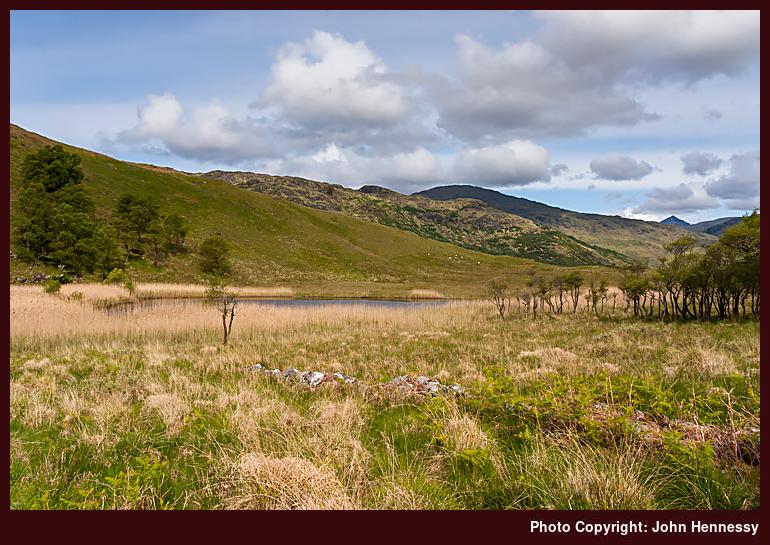
Having managed to drag myself away from the sights of such glories, it was not long until I found myself in conversation near Ardleish with a gentleman from Bangor (Wales, not N.I.) who was walking the WHW northbound with his son. We exchanged experiences before continuing our respective journeys. Having negotiated any path difficulties and enjoyed seeing bluebell carpeted woodland, I paused for a food stop at Inversnaid; I didn't venture into the hotel since I had some food with me. As I passed the hotel, I spotted a lady with a severe expression looking out through one of the front windows (no, she wouldn't have seen me taking lunch outside). It was almost as if she were on watch for aberrant walkers who might try to enter through the front door; there's a very separate entrance for us at the back and a place for us to put our rucksacks too. Severe expressions were soon replaced by far more delightful prospects: more bluebell woodland; it might have been the end of May, but they were still in their prime up here. Rowardennan remained far way, but I was at the hostel by 18:00 and, with my booking was confirmed, I found my bed for the night. This was after my adventurous side taking me away from the sensible 4x4 track at Rowchoish to follow the loch-side obstacle course; I must have been out of my senses, but it did avoid some extra ascent. Once, I sorted myself out at the hostel, I went out into the fine evening for some photographic exploits before I headed to the hotel for dinner. After that, I retired for the night.
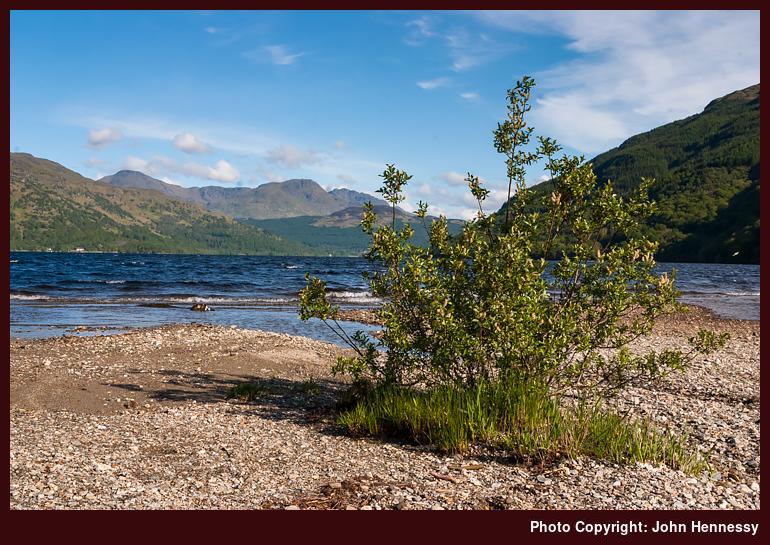
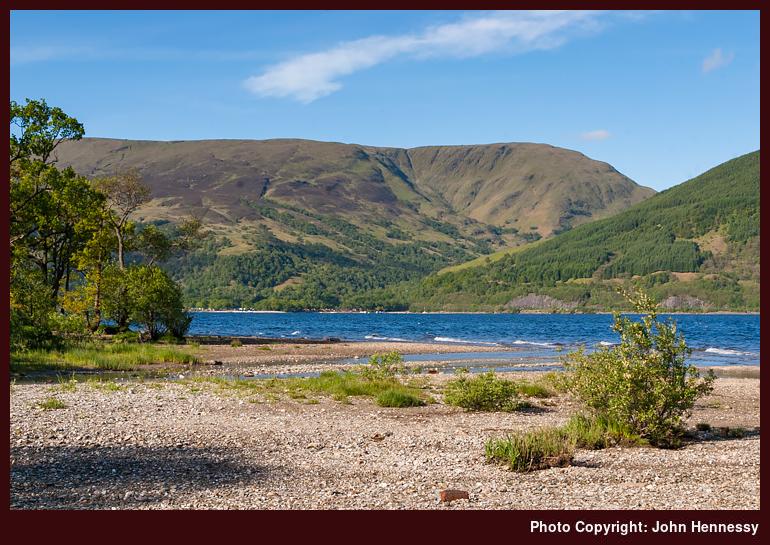
The next morning began with more photographic activity before breakfast. Knowing how fickle Scottish weather can be, I take any chance of sunshine that I get and there was plenty on offer at this time, but cloud was to dominate skies later on. A light breakfast, which included porridge, was to set me on my way and progress out of Rowardennan was slow, not because of tired muscles but because of the views that were behind me. Beyond Rowardennan, tracks are easier to negotiate, even if the way to Balmaha is still littered with sharp little ascents and descents. Proximity to the road may not be ideal, but delights are still there to be enjoyed. South of Balmaha, there is another route choice: high level via Conic Hill or low level beside the Drymen road. I stuck with the latter, even though the restrictions around Conic Hill were lifted for another year; use of the low-level route is mandatory during the lambing season. After carrying a heavy pack for a second day, I decided to leave Conic Hill for another time (combining it with a section of the Rob Roy Way for a longer hill day, perhaps?) and made my way into Garadhban Forest from Milton of Buchanan in which I negotiated a diversion due to tree harvesting operations. Much to my own surprise, I really got into my stride here, and that continued all the way to Drymen on what became a glorious evening. From there it was onto Balloch by bus for an overnight stay before I headed home again by train.
A bimble in border country
22nd May 2007 Even with showers forecast, I fancied taking myself off somewhere for a walk on Sunday. Because I wanted to continue my hiatus from the Pennine Way for the sake of variety, wandering along a bit of the Offa's Dyke National Trail appealed. I planned my hike using Anquet Maps to get an idea of what I was taking on and, while I departed from it at times, my planned route was essentially the one that I followed on the ground. The software also gave a projected time for the walk and, though it was largely correct, I might be tempted to add a bit extra to the predicted time for future excursions; I still kept an eye on the time and had alternate plans if it was taking too long.
With that in mind, I travelled to Chirk after braving the hoards of the Macclesfield Bikeathon and picked up the Llwybyr Ceiriog Trail and followed it along the Ceiriog valley until I met both the Offa's Dyke trail and part of the aforementioned earthwork itself, after crossing from Wales into England (Chirk is almost on the border between Wales and England). In fact, I was to have the famous military barrier for company for a good part of my journey to Craig Nant. It was while I was following this section that the sun came out for a brief spell on what was a mainly cloudy if dry day; the threatened showers thankfully failed to materialise. In fact, it caused me to dawdle for longer than maybe I should have done.
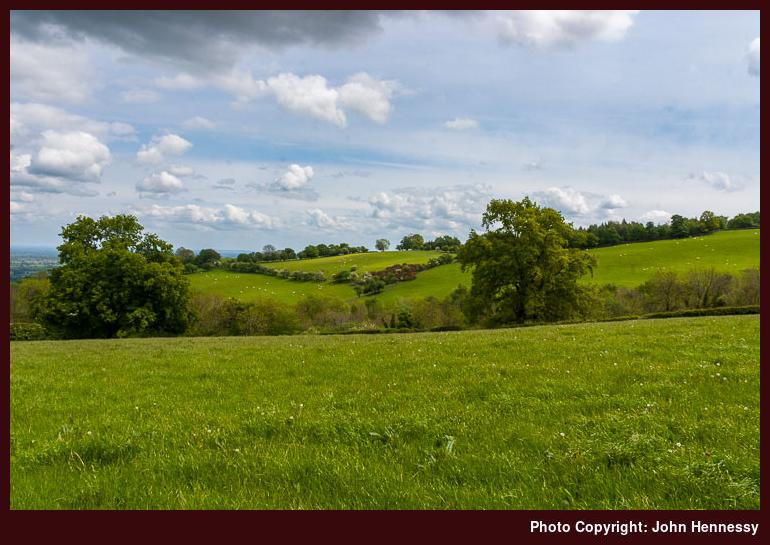
Progress from Craig Nant was steady as I rounded Selattyn Hill on my way to Racecourse Common, part of which unfortunately involved some tarmac bashing. Once past Racecourse Common, it was on into Racecourse Wood for views east over Shropshire with the humps of Long Mynd making an appearance; as luck would have it, the sun was very much in evidence further east, and I wonder what delights I would have savoured if skies were clearer for more of my journey.
These days, Racecourse Common and Wood are an amenity for those wanting a stroll but, as the name implies, there was indeed a racecourse here, and it was for horse racing. Its heyday was the early nineteenth century before the coming of the railways, and a less than salubrious crowd put paid to its continued existence.
It was about this point that I started to think about getting to Oswestry so that I could start on my journey home. The plan was to leave the national trail for a public footpath taking me most of the way to Oswestry, but the need to catch a bus from Oswestry meant that I instead pounded more tarmac than I would have liked. The sun had by then escaped from behind the clouds, and I was treated to pleasant scenes as I continued on my way; I still found some time to stop and admire my surroundings.
Oswestry is certainly a pleasant spot and one where I wouldn't have minded lingering but for time constraints; I needed to catch the 18:15 Arriva service to Shrewsbury. The wondrous St. Oswald's Church and the pleasant town centre may well inspire another excursion, and one with ample time for my training my camera on the sights. I will hold it in mind for the future. Until this walk, Shropshire hadn't really been subject to my attentions even though it does have its hill country; the Long Mynd and the country round about it certainly do look very attractive through train windows as I ply my way to Abergavenny for the hill country of the Brecon Beacons National Park; it's almost a shame to do so. Speaking of Wales, one thing that you don't need to do is go there for places whose names reveal Welsh origins; there are plenty in the west of Shropshire, as OS maps will show you. It's a part of the world to which I can return.
Drawn to Skiddaw
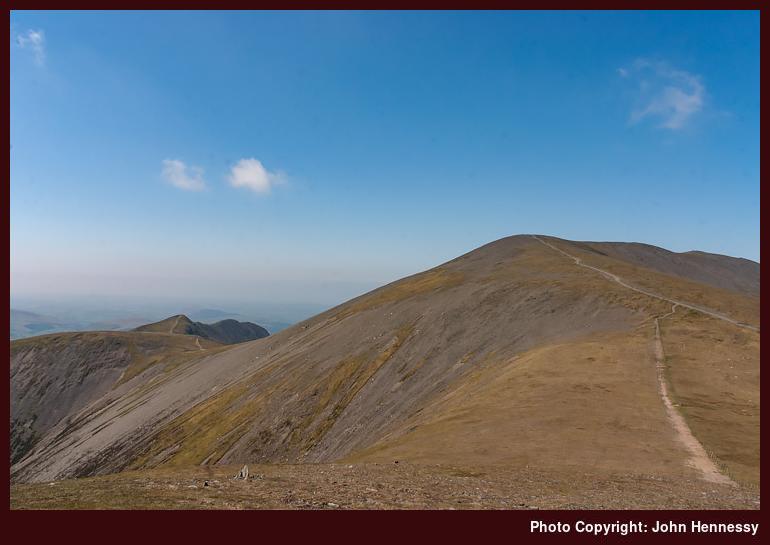
5th May 2007 While pondering this post following my ascent of Skiddaw yesterday, it occurred that if I tried listing my excursions to Cumbria's Lake District, I could have ended up with a very long list and I have not even come close to exploring all the area. 2003 was when I spent the most time up there and, in marked contrast, the nearest I came to it was while I was on the way up and down from Scotland!
On my visits, I have been fanning out from the likes of Ambleside, Rydal, Grasmere and Keswick. From Keswick, I have got to Buttermere, up and down the shores of Derwent Water, to Catbells, along Coledale, in the woods on Dodd (the one next to Carl Side; there are a few of them), around the Back o' Skiddaw... I think that probably covers it; Keswick has made a good starting point for many of my Lakeland excursions. Anyone with any knowledge of the Lake District should not be too surprised if I bundle Ambleside, Rydal and Grasmere together and they have been the starting (and, in some cases, the ending) points of walks over Loughrigg Fell, around the Fairfield horseshoe, to Patterdale via Grisedale and Fairfield... They're the main ones.
However, given all my treks, it took me until yesterday to mount the summit of Skiddaw; too many other distractions, perhaps? The mountain has featured in numerous photos posted on my Lakeland photo gallery so it was about time that I ascended it. Given the fine weather that we have been enjoying recently and the predicted break in the weather, as is customary for a bank holiday weekend, I decided to take a day off for some walking. For the sake of some variety, I took a break from my Pennine Way objective and returned to Keswick since perhaps 2003.
An early morning train/bus combination got me to Keswick around 10:30. Once there, I organised myself and picked up the Cumbria Way. A useful footbridge got me over the busy A66 and I then rounded Lattrigg before leaving the way after passing through a car park. After passing rounding a 333-metre-high hillock and passing a Celtic cross commemorating two noted breeders of Herdwick sheep, I dropped down a little before commencing the real ascent in earnest. Then, it was a case of taking things slow and steady between 300 and 700 metres before the gradient became more kind. A tempting track was heading for Little Man but I stayed my course for Skiddaw to conserve my energy levels; the actual right of way goes along the northern slopes of Little Man. The actual final ascent of Skiddaw itself wasn't too hard on the legs, though "steady as she goes" remained the approach. As I went up, views of Derwent Water, Bassenthwaite Lake, Blencathra, Ullock Pike, Little Man and the Back o' Skiddaw were abundant, though an ominous looking bank was there to see in the north and to the east; it looked like I picked the right place for my day out.
The views remained there to savour as I started on my way down at 14:00. Even after 800+ metres of ascent, I still possessed the energy to allow me to vary my route a little on the descent. The first of these diversions was to pick up a path over Little Man; this one does not appear on the OS Explorer map but Harvey's Superwalker equivalent does show most of it. I'm glad that I tackled it on the descent as there is a false summit on the eastern approach. The second diversion was to go up and over Lattrigg; I kept seeing the path from on high and got tempted by the proposition. The ascent wasn't too taxing either, and the views made it worthwhile. Even with these variations, I was back in Keswick at around 17:30 and spent a bit of time strolling through the town and doing a spot of shopping before catching the bus that took me towards my train home.
A spot of recce in Gougane Barra
3rd May 2007 Last weekend saw pop over to Éire to see the folks for the first time since the Christmas break. It also saw me revisiting Gougane (pronounced guugawn) Barra, where the River Lee rises, on the Sunday. This place is one of my father's favourite places and even with cloudy skies and a cloud base approaching the 500 metre level, you could still see why. Seeing it on a sunny day and being able to explore it in a bit more depth would have been ideal but my 90 minutes off the leash (my parents are not really into walking but they have bequeath me a love of the countryside) allowed for a good few record shorts capturing ideas for any return. Still, the weather remained dry for our stay, a bonus since we had passed through mist, murk and light rain while we made our way there.
Gougane is place with two sides to it: Valley Desmond and an eponymous lake with an island hosting the ruins of an old monastery and a small church. The lake sits outside Valley Desmond and collects the waters of the juvenile Lee before it continues its onward journey towards Cork city where it meets the sea in Cork harbour. The monastic ruins once hosted a religious community found by Cork city's patron saint, Finbarr. Given how old it is, it is amazing how much remains in good condition and it is hard to fault its setting but it is well frequented.
Nowadays, Valley Desmond is owned by Coillte, the Irish forestry agency (it's the Irish word for forests or woods and is pronounced queellte), and ubiquitous conifers line the hills from whose craggy slopes the waters of the juvenile Lee gather. There was a time before the invasion of commercial forestry but there was no access for the public back then like there is today. Coillte, like any state-owned custodian of commercial forest, does do its bit to encourage visitors and they charge for entry too, though you could be lucky in the off season. For the money, you get parking and a reasonable network of paths; in fact, this network is being treated to a spot of maintenance right now with bridge replacements and surface improvements taking place. It was on these paths that I went for a stroll and some of them do get you above the tree line for views of the lake, among other things. The hills around here may not be that high - the Irish have a penchant for calling anything above 400 metres high a mountain but that's a discussion for another day - but the thoughts of delving deeper do appeal to me.
Pennine Way adventures in the Yorkshire Dales: Part 3
16th April 2007 The weekend forecast got me returning to Yorkshire for the continuation of my Pennine Way quest, this time for a day trip on Saturday. The fact that I had no driving lesson to do allowed me to head off. It was an over and back trip with no overnight stays involved. My target was to head from Malham Tarn to Horton-in-Ribblesdale, crossing Fountains Fell and Pen-y-Ghent along the way. To get there, I caught the first train from Macclesfield to Manchester at 07:10 and onward connections via Leeds got me to Settle in time for the 11:30 minibus to Malham.
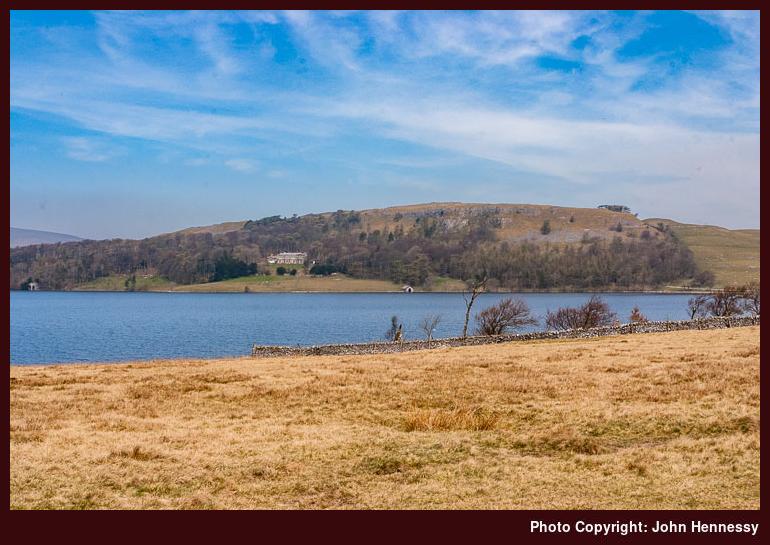
That got me to Malham Tarn around 10:45 and the prospect was much, much better than it was on Easter Monday. The spring sunshine, however hazy, lit up the scene more fully than I had ever seen it before; my 2002 visit was a cloud-bound affair. I retraced my steps around the tarn and made my way to Tennant Gill, from where the ascent of Fountains Fell began. That ascent is a long-drawn-out affair, but with the prevailing conditions, it was a delight, though the day was beginning to heat up. With my now well-worn OS OL2 map duly changed over to the correct side (the breeze and the bone dry conditions underfoot meant that it was placed on the ground to do this), I trooped over the fell, only to lose a lot of the height that I had gained.
The bulk of Pen-y-Ghent was temptingly close, though some miles were to be trodden before I was to reach it; the Pennine Way never goes at anything directly... After a spot of road walking to Dale Head, the ascent began again. Strangely, it didn't seem to take a lot out of me until I encountered that testing step near the top of Pen-y-ghent. Maybe, it was my taking it nice and easy, so that explains it. Nevertheless, I always find it strange that the Pennine Way goes up and over Pen-y-ghent when it could easily go around it. That would avoid the piece of clambering over limestone slabs that nearly caused me to bottle it. Nevertheless, I did conquer myself and go to the top of Pen-y-ghent for the second time. On the event, I did feel a little queasy after the clambering, and I don't know whether it was vertigo or something else that caused it.
My first trip up Pen-y-ghent followed the Pennine Way from Horton, but an inspection of the map convinced me, rightly in my view, not to come down the southern slopes of the hill; that was where I ascended on my second visit. Instead, I walked over Plover Hill and came off that way. The way down was still steep, yet I managed it, and I then followed a bridleway from Foxup Moor until I rejoined the Pennine Way to return to Horton. That was in April 2004 when the wall on the top of Pen-y-ghent was a standard affair with two stiles over it. Then, I got myself told off for descending from one of those in the wrong fashion as I was heading for the hill's trig point; I had been facing away from the wall rather towards it. Later that year, a spot of refurbishment was carried out, and this added wind shelters and more manageable stiles than the traditional wooden ones that did the job previously. Apparently, it was done to celebrate 50 years of the Yorkshire Dales National Park.
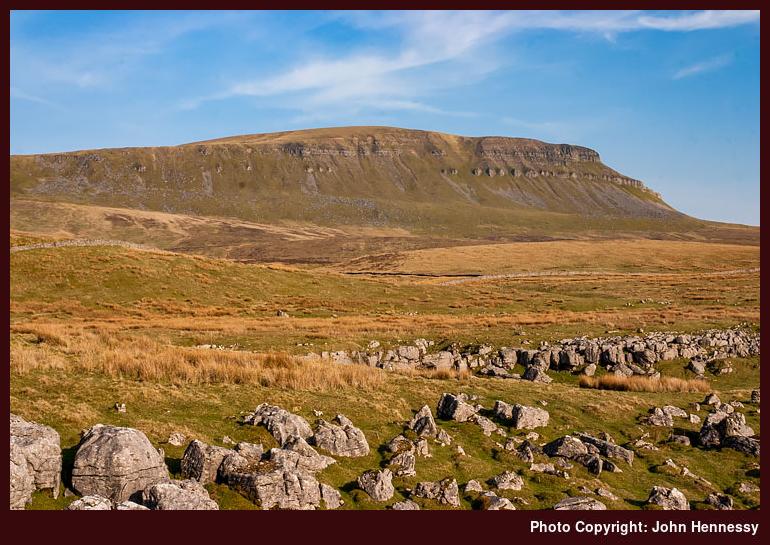
Returning to the second Pen-y-ghent encounter, the seats in the wind shelters allowed me to rest a while in an attempt to settle myself down before the descent to Horton. That descent is known territory to me from my previous outing, and I took it easy and enjoyed the way down as much as possible; without walking poles this is a knee-jarring stretch, so my full attention was required. It is also a stretch where you should not be rushing to catch a train, so I discarded any thoughts of using the 17:44 departure, which proved to be just as well; I would have been more than 15 minutes late. The evening was glorious, and I rediscovered views that I first encountered three years previously. Awaiting the 19:29 train allowed me to fully settle down after the day's exertions. Though that train was late, I still got home as I had planned, and the day out had been as good as I had hoped.


