Category: Wales
A bimble in border country
 22nd May 2007
 Even with showers forecast, I fancied taking myself off somewhere for a walk on Sunday. Because I wanted to continue my hiatus from the Pennine Way for the sake of variety, wandering along a bit of the Offa's Dyke National Trail appealed. I planned my hike using Anquet Maps to get an idea of what I was taking on and, while I departed from it at times, my planned route was essentially the one that I followed on the ground. The software also gave a projected time for the walk and, though it was largely correct, I might be tempted to add a bit extra to the predicted time for future excursions; I still kept an eye on the time and had alternate plans if it was taking too long.
With that in mind, I travelled to Chirk after braving the hoards of the Macclesfield Bikeathon and picked up the Llwybyr Ceiriog Trail and followed it along the Ceiriog valley until I met both the Offa's Dyke trail and part of the aforementioned earthwork itself, after crossing from Wales into England (Chirk is almost on the border between Wales and England). In fact, I was to have the famous military barrier for company for a good part of my journey to Craig Nant. It was while I was following this section that the sun came out for a brief spell on what was a mainly cloudy if dry day; the threatened showers thankfully failed to materialise. In fact, it caused me to dawdle for longer than maybe I should have done.
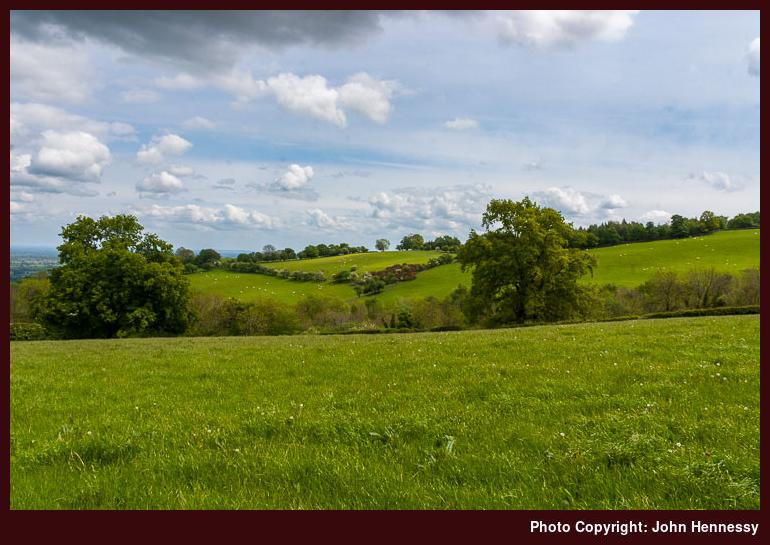
Progress from Craig Nant was steady as I rounded Selattyn Hill on my way to Racecourse Common, part of which unfortunately involved some tarmac bashing. Once past Racecourse Common, it was on into Racecourse Wood for views east over Shropshire with the humps of Long Mynd making an appearance; as luck would have it, the sun was very much in evidence further east, and I wonder what delights I would have savoured if skies were clearer for more of my journey.
These days, Racecourse Common and Wood are an amenity for those wanting a stroll but, as the name implies, there was indeed a racecourse here, and it was for horse racing. Its heyday was the early nineteenth century before the coming of the railways, and a less than salubrious crowd put paid to its continued existence.
It was about this point that I started to think about getting to Oswestry so that I could start on my journey home. The plan was to leave the national trail for a public footpath taking me most of the way to Oswestry, but the need to catch a bus from Oswestry meant that I instead pounded more tarmac than I would have liked. The sun had by then escaped from behind the clouds, and I was treated to pleasant scenes as I continued on my way; I still found some time to stop and admire my surroundings.
Oswestry is certainly a pleasant spot and one where I wouldn't have minded lingering but for time constraints; I needed to catch the 18:15 Arriva service to Shrewsbury. The wondrous St. Oswald's Church and the pleasant town centre may well inspire another excursion, and one with ample time for my training my camera on the sights. I will hold it in mind for the future. Until this walk, Shropshire hadn't really been subject to my attentions even though it does have its hill country; the Long Mynd and the country round about it certainly do look very attractive through train windows as I ply my way to Abergavenny for the hill country of the Brecon Beacons National Park; it's almost a shame to do so. Speaking of Wales, one thing that you don't need to do is go there for places whose names reveal Welsh origins; there are plenty in the west of Shropshire, as OS maps will show you. It's a part of the world to which I can return.
Motivation, motivation, motivation
3rd March 2007 This year, I am using the completion of national trails to motivate me to get out into wild and not so wild country. Yesterday, I spent more time exploring the Pennine Way, this time proceeding beyond Heptonstall into the moors near Burnley. There will be more on that later. The West Highland Way is another target of my attention, while the Rob Roy Way is another possibility. And there are many, many more long distance paths to consider than that lot. In fact, the moorland I enjoyed yesterday is criss-crossed with the things.
Until I decided to complete some long distance trails, it was the prospect of exploring places new to me that drove me on. Last year was a particular example of this when I ventured beyond my usual haunts to the likes of Pembrokeshire and Northumberland. Scotland's Southern Uplands also fit into this category.
Before that, I could list years when I spent of time walking in a particular area. To give you a few examples, I associate 2002 with the Yorkshire Dales, 2003 with the Lake District and 2005 with North and Mid-Wales. The habit likely will never leave me as long as I am hiking, though.
Another tantalising prospect is the ascent of a particular hill, and it has got me out and about a good number of times. Yorkshire's Three Peaks are a great example of this. However, I am not so sure that I would go further and do all the Corbetts or Munros, for example.
Usually, I prefer to keep things informal for now, but there are plenty of lists on Hill Bagging, a site that I noticed while lurking on the alt.rec.walking newsgroup, should the mood take me. Interestingly, the site also allows you can register so that you can plot your progress, an anathema surely to those who detest the idea of list ticking. There even is a version of the database that you can download for yourself, and there also is the Relative Hills Society if you are so inclined.
A trip to the North Wales Borderlands
16th January 2007 I was over in Llangollen last Sunday and picked up a copy of the 2007 visitor brochure for the North Wales Borderlands. Under this banner, the local authorities of Wrexham, Flintshire and Denbighshire are promoting the area's worth as a destination for visitors; particularly those who might stay for a few days, I would assume. The area may not be foremost to those considering North Wales for a holiday, but the area definitely does have its charms and does prove to be something of a visitor magnet in its own right.
My first encounter with the region was when I began to visit Llangollen. The town might list a heritage railway and canal among its attractions, but it is its location in the scenic Vale of Llangollen that draws me. To the south of the Dee Valley lie the wilder country among the Berwyns and the Offa's Dyke Path, a national trail, also passes near here. On my first foray, I walked over the hill playing host to the ruins of Castell Dinas Bran before heading to another ruin, that of the splendid Valle Crucis Abbey. From there, my return to Llangollen took me by the Llangollen Canal and within sight of the Llangollen Railway. Other visits have seen me taking in the Horseshoe Falls and sections of the Offa's Dyke Path. One trek along this national trail saw me walk from Llangollen to Llandegla before heading to Wrexham and returning home.
The Vale of Llangollen hasn't been the only part of Denbighshire that has been the subject of my attentions, though. In fact, I once headed to Denbigh in the Vale of Clwyd for a low-level walk along the line of the Clwydian Range to Ruthin (or Rhuthun in Welsh). That was sufficiently enjoyable that a return to those parts remains a possibility.
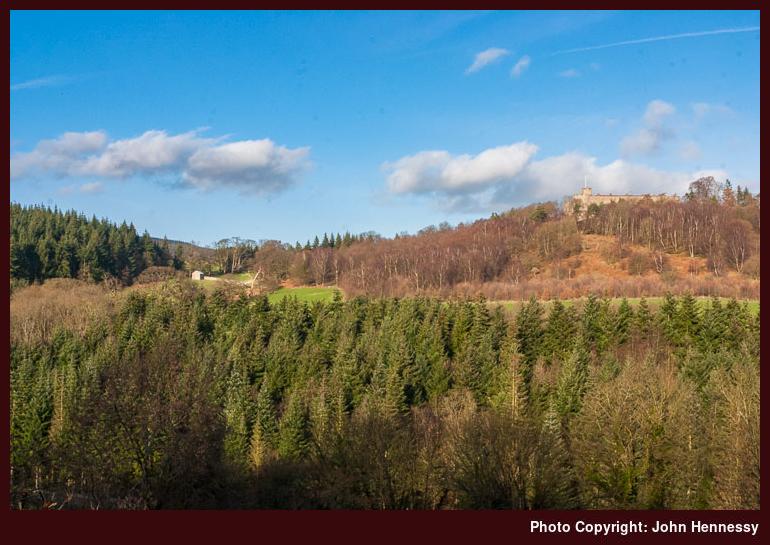
To return to last Sunday, the offer of a fine day in Wales was too tempting to ignore, and it felt more like April than January. Initially, my plans were to go to Llangollen for a walk in the vicinity of the Berwyns, but an alternative idea came to me and replaced the original one. The new scheme took me to Chirk, from where I picked up a short section of the Offa's Dyke Path after proceeding along the Ceiriog Valley, rounding the substantial hulk of Chirk Castle on my way. I then left the trail to head for Llangollen and was greeted by fine views of the Vale of Llangollen on my descent to my destination. The only fly in the ointment was the lack of height in the sun late on a January day, but the vistas were memorable nonetheless.
2006, a walking year
5th January 2007 Now that we have reached the beginning of 2007, it seems an appropriate place to take stock of 2006. So far, this year has begun as cloudily as 2006, but the latter did brighten up as January moved on and opportunities for walking trips soon presented themselves and continued to do so over the course of the rest of the year.
January began with a trot to Edinburgh for the post-Christmas sales. After that, the idea of catching a Caledonian Sleeper - a first for me and an expensive one at that - from Crewe to Fort William proved too tempting for me. After travelling overnight, I woke up to a memorable morning in the Scottish Highlands. Once I had sorted out somewhere to stay, an easy task in Fort William in January, I started walking in the sun on what turned out to be a very memorable day. It started with a trot along the Great Glen Way to Caol before I headed into Glen Nevis. Once there, I climbed to Dun Deardail via the West Highland Way, taking in memorable views along the way. A tired but happy walker made his way back to his base for the night, snoozed a little before getting something to eat and walking under the street lights along the coast road pondering the quiet of Fort William, hardly believing that it was the same tourist magnet frequented many a time during high season. Pathetic fallacy prevailed, with rain accompanying my departure by coach after the short but memorable visit. The next weekend saw me head to Northumberland for a hike along the coast between Alnmouth and Craster, a day trek that showed opportunities for the future. The following weekend saw me sampling the Pony Track up the slopes of Cadair Idris, near Dolgellau. A little snow was encountered high up, but the sun was well out, though the north-facing slope remained frozen underfoot: a pleasurable experience (then new to me) that could not be spoiled by a little slip on frozen grassland as I neared the end of my descent. I also snaffled a Sunday stroll around Lyme Park among this lot.
February was largely unfavourable, unless you enjoy walking in the rain. However, I took my chances at the end of the month and completed Yorkshire's Three Peaks; I summited Pen y Ghent a few years ago. Snow and ice were negotiated carefully on the higher east-facing slopes of Ingleborough and its summit; a descent of its western slopes avoided descending with such conditions underfoot. The walk started at Ribblehead railway station on the Settle-Carlisle railway line and finished in Ingleton, which used to have a railway station of its own time, a different line that hasn't survived the passage of time. Buses got me back to Skipton, from where my train journey home commenced. The following Saturday saw me ascend Whernside, completing Yorkshire's trio. The weather remained pleasant until the final approach to Whernside's summit, when clag, snow and rain came down from the north. I also had to watch my step due to the paved path up Whernside's eastern slopes having become iced up; I can cope with snow, but ice has me considering the purchase of crampons; I have yet to acquire such items. While the clag made me pay attention to my map reading, a useful stone wall and clear track guided me up and over. However, what was snow on the top became rain at lower altitudes, and the return to Ribblehead station became a bit of a slog. After a chilly wait, I was delighted to see my train home. The experience of a wet jacket in cold conditions sowed the seeds that bore fruit in my acquisition of a Rab Latok jacket later on.
Early March greeted us with snow, and an intended Sunday trip to the Derbyshire dales got interrupted by arresting views around the Cat and Fiddle Inn between Macclesfield and Buxton. My new plan took me from the aforementioned pub around the slopes of Shining Tor into the Goyt Valley, with wonderful grippy powder dry snow underfoot, before I picked up the Midshires Way that took me into Buxton for my return home.
April provided its chances too, staring with a Wednesday afternoon stroll from my house, around Tegg's Nose, through Macclesfield Forest to Forest Chapel and Shutlingsloe before returning home via Langley; a good day's walking from my doorstep. Easter weather was a mixed bag, yet it transpired that I stayed overnight on Ayrshire's Isle of Arran on Easter Sunday, taking in Goat Fell and taking a bus trip around the island during my short visit. While the weather had its moments, my sojourn could inspire a future return. At the end of April, I took an overnight journey to Fort William for the start of a Mayday bank holiday weekend trip to Scotland's Highlands. Even though bikers had descended on the town for the weekend, as is they are wont to do every year, I did manage to get somewhere to stay on Saturday night. Following hill tracks got me from Corrour Station to Spean Bridge, yet another memorable day spent among snow-capped mountains. The next day saw me travelling to Inverness before heading to Pitlochry for a flying visit before I made my way home again. That Scottish trek takes us into May, an otherwise quiet month on the hillwalking front but one in which my blogging began, and I got to know the pungent aroma created by a field of flowering oil seed rape on my journeys too and from work.
With the coming of June, my walking again stepped up a gear. Its first weekend saw me sampling coastal walking in Pembrokeshire. This was followed by a weekend trip to Galashiels and Peebles in the Scottish Borders. The main event was a trek from Peebles to Innerleithen starting on used to be a droving road followed by some cross-country travel, made legal thanks to the Scottish Rights of Way Act, before road travel got me to Traquair and Innerleithen. Berwick-upon-Tweed was my jumping off point after a Friday night stay and Galashiels was my Borders base until I returned home on Sunday. Lockerbie was my base for the following weekend from where I went for a recce around Moffat: the Southern Upland Way and views of the Devil's Beef Tub featured.
With the coming of July, I ventured into Yorkshire again, this time for an amble from Ribblehead to Sedbergh. From Ribblehead, I followed the slopes around Whernside to reach the Craven Way before I joined the Dales Way for the final part of my walk. The track to Whernside felt like the M6 with loads of folk abroad, a big contrast to my owning summiting of Whernside when only a few souls were out and about, but that made things more pleasurable, and I was glad to leave it for the Craven Way. The rest of the walk was a largely quiet affair. A taxi journey from there to Kirkby Stephen train station set me up for my journey home. Later on in July, I took my chance for what has become my now annual summer stay in Scotland. Pitlochry was the base this year, and I have to admit that I did get away from the heat of England. From Pitlochry, I radiated out to Kinloch Rannoch, Kingussie, Kenmore, Aberfeldy and Killiecrankie. I also took in Pitlochry's local summit of Ben Vrackie. It wasn't all sunshine, yet cloudy dry days are good for making time while walking, although sunshine is often better for camera-wielders like me.
Apparently, August was forecast as being a continuation of the July heatwave but, if it was, it was to be a no-show. August's wet weather turned my mind to waterproofs, but it also meant that sunny September weekends did not get wasted. I took myself off to Moffat, with a walk along the Southern Upland Way from St. Mary's Loch back to base forming the centrepiece of the weekend. Sunday was also offering in weather terms but, sadly, other things like recovering and returning home had to take priority. I was also tired after the excursions of the previous day. For me, the other walking high point of September was a trip to Northumberland on another glorious autumn (for me, anyway) day. Views of the coast were taken in on a longer than usual journey (thanks to railway engineering works) to Berwick-upon-Tweed. While there, I took a risk and headed to Wooler for a sample of St. Cuthbert's Way and while I did get home that night, I was concerned more than once along the way.
October and November were quieter affairs. In October, my sole outing was a trot from Hadfield to Glossop by way of the Longdendale Trail, the Pennine Way and the Doctor's Gate footpath. The sun was well out and the temperatures higher than you would expect for an October Sunday. This preceded a cold snap that returned us to reality. The walk was uneventful apart from a slight misnavigation that was easily corrected. In November, I got one fine interlude that allowed me to explore the central Brecon Beacons before a long spell of wet and unsettled weather set in. On that day though, Corn Du, Pen y Fan and the other summits that I encountered were resplendent in the sunshine and their memory tempts me back.
While December may be winter's pivot, the walking continued once it stopped raining. I got to Bellingham in the heart of Northumberland by way of Carlisle and Hexham. A tramp along the Pennine Way was as muddy as could be expected after all the rain that we were getting. In fact, the day of my ramble was what we in Ireland would call a "pet day" and it was all the better for it. Later, the weather settled down a little and I got to savour the delightful views around Harlech: castle, coastline and crags. There is more to see here, so I would not rule out a return.
In summary, 2006 could be said to be the year when I started to go beyond my usual haunts a lot. England's Peak District did see me sporadically, as did Yorkshire and North Wales. Cumbria's Lake District has attracted my attention a lot over the years, yet only saw me flying by on the railway line during last year. Scotland has seen a lot more of me than in previous years, so 2006 could be labelled the Year of Scotland for me, in walking terms at least. Southern Scotland and Northumberland have seen me more than before, Northumberland hosting my boots for the first time. Continuing the southern theme, new areas of the south of Wales experienced my attentions for the first time. It has been an interesting year.
What will 2007 bring? We have to await the answer to that one. Meanwhile, all the best for the coming year and happy walking.
Encountering the attractions of Harlech
18th December 2006 Last Saturday, I took myself off to Harlech in Wales for a few hours of walking. Getting there and back was a rail-only affair with a change in Wolverhampton. The arrangements for the onward journey take a small bit of explaining: two car DMU from Wolverhampton (it starts out from Birmingham) to Shrewsbury, joined to another two car DMU at Shrewsbury, train splits at Machynlleth with one portion proceeding to Aberystwyth and the other continuing up the coast to places such as Barmouth, Harlech, Porthmadog and Pwllheli. It sounds complicated but it works well in practice; just make sure that you are in the right part of the train. The same sort of thing happened on the way back. In fact, the same sort of operation, again necessitated by a single track railway line, will be familiar to anyone has travelled on the West Highland railway in Scotland.
Apart from what I suspect was a miscommunication between the central control room and a helpful lady train conductor, which nearly led to my onward journey from Shrewsbury being delayed, everything went smoothly. Harlech is set on a steep hillside, around its famous castle built by King Edward I and dating from 1283. The site for the castle was an excellent choice: views up and down the coast and set on a steep hillside to slow the approach of any prospective attackers (if they got up the steep western approach, and it appears that water ran up to its foot in former times, they'd have to contend with the substantial fortifications).
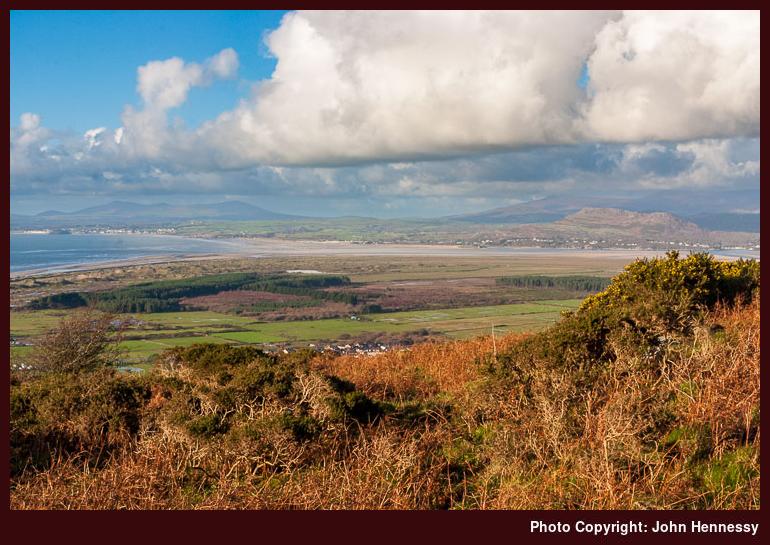
There is more to Harlech than the castle, though. For instance, beyond the flats of Morfa Harlech lie beaches of some note and golfing facilities for those with that inclination. Views across Tremadog Bay toward the Lleyn peninsula and its hills, Yr Eifl included, are complemented by those across the Glaslyn estuary towards the Eifionydd and Moelwynion mountains; all making up a superb vista. Adding to all of these delights are the Rhinogs only a few miles east of Harlech itself. My walk, with its diversions intentional and otherwise, allowed me to sample the scenery of the area. Clag was inclined to accumulate on the higher tops, but there was plenty of sunshine to enliven the aspects. On my outward journey, the sight of banks of cloud abounding over the hills of mid-Wales had me thinking that I had come too far west and was going to be under cloud all day with sunshine in plentiful supply further east, a fear happily unrealised.
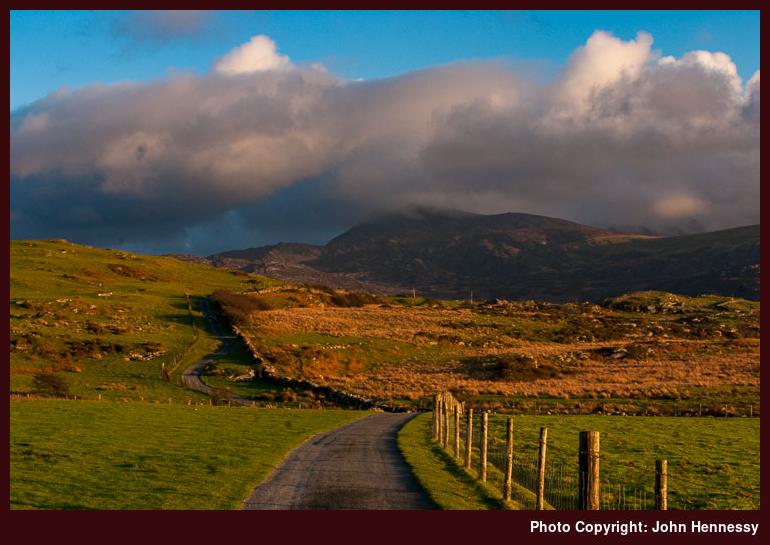
I have to admit that my walk allowed me only a brief reconnaissance of the area but it is more than worthy of further visits in the future. A weekend stay is definitely a proposition and I do hope to make a return.


