From Borrowdale into Great Langdale
 5th June 2008
 Last Saturday was a day when I was torn between possibilities. One dilemma that I didn't face was whether to go somewhere for a dander or not; that one was settled. It's where I was going that was the outstanding question, and the choice was between Wales and Cumbria. Even though Dolwyddelan tempted and remained a backup in the event of anything going awry on the travel front, it was Cumbria's Lake District that was to get my vote because a walk in Borrowdale was in my head for a while and I hadn't been to the area since last July anyway. If my time was more restricted, then my decision could have been very different.
My journey to Borrowdale was set to involve many changes: Stockport, Crewe, Penrith, Keswick. With this number ahead of me, it would have been better if passengers could control themselves and police didn't need to meet what was to be my train from Crewe. Luckily, I had a twenty-minute wait in Penrith in prospect, but losing ten minutes due to a delayed train soon chopped that down to size and delays can beget further delays. As it turned out, I had no cause for concern, and I easily made my bus to Keswick. However, I was reminded of my connection to Borrowdale when I saw slow traffic on the A66 and more people getting on at Threlkeld than I had ever seen before. It so happened that the Borrowdale bus was late, sufficiently so that one would start to wonder if it had departed without my seeing it. Keswick bus interchange was a busy spot that day.
Following all those opportunities for groundless anxiousness, I found myself in Rosthwaite, relaxed and enjoying wonderful sunshine. Eating an ice cream, I found my way onto the Cumbria Way that I was set to follow all the way into Langdale. Being a sunny day in the Lake District, solitude was not to be expected, but there were to be moments when I had a lot of space to myself. Still, it never seems to surprise me how easy it can be to lose them. Even so, Rosthwaite and Stonethwaite were hardly overrun anyway, but most of those perambulating about them seem to have got nary a thought of going further afield. With the sights that were on offer, I suppose that it is hard to blame them.
Having skirted past Stonethwaite, another choice presented itself: to stick with the original plan to walk to Dungeon Ghyll or tramp over Greenup Edge to Grasmere. If things got a bit too crowded on the former, the latter was to be my plan. They didn't, and I managed to drag myself onward to leave the Grasmere option for another day. A sign for Watendlath had tempted me earlier, but I managed to put that into my stash of ideas for the future too. Thus, I struck on for and through Langstrath, a wide, open and empty space in keeping with its Scottish-esque name. Also in keeping with any pseudo-Scottishness, it was here where I met next to nobody but a goodly number of Herdwick sheep.
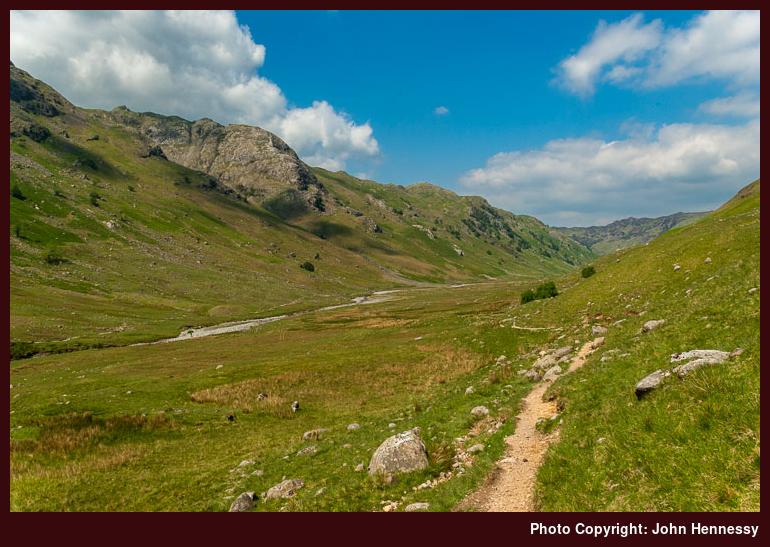
The seemingly obvious southbound exit from Langstrath is to follow the valley's beck to Angle Tarn and drop down from there by the side of Rosset Gill. This is not the way taken by the Cumbria Way, though; instead, a more direct route over Stake Pass is its choice. On paper, this is a seemingly unimpressive 200–300 metres of ascent. In reality, as with many slopes in these parts, that apparent "walk in the park" can be a lot more testing than those numbers might suggest. For one thing, you can guarantee steepness and erosion means that route finding involves a spot of blundering about on a maze of paths, many deviating from the "correct" one. Couple all of that with the hot and often breezeless day, and you have to take it nice and slow on the ascent. A descent still offers plenty of footholds, but you still need your wits about you so as not to take a more horizontal position than you would like.
On reaching the top, I soon found a spot to rest a while after my exertions. By this stage of the day, the sky was full of cloud and the sun had become well hidden. It remained pleasantly warm, though, and I enjoyed the flatter gradients before the descent that faced me. The state of the path down couldn't be more different than the one that I used on my way up. The National Trust have been keeping an eye on things and have been doing some further work over the past few months to improve things. I might have said that it didn't need the attention and that the path from Langstrath to Stake Pass needed it more. There is a counterpoint to this of course: the way up from the floor of Langdale is a busier trail because of the proximity of such delights as the Langdale Pikes, Pike'o'Stickle and many more. The result of the attentions was that I made steady progress down a well-built and pitched path that would be obstructed in places by big bags of big stones.
That descent and obstacle dodging completed, the track really levelled out and, apart maybe from the deepness of the loose stone surface in parts, it was easy and undemanding walking all the way to the Old Dungeon Ghyll Hotel. If I had arrived twenty minutes earlier, I might have caught the 16:30 bus to Ambleside, but a wait of over an hour, in blissful surroundings with the sun attempting to get through the cloud, for the next one was no hardship. I did consider walking further along Great Langdale, but reconsidered it on the grounds of time and wiled away the time on a shorter stroll instead.
When the bus did turn up, we found out that it terminated in Ambleside rather than Kendal as per the timetable. There were those who were far from happy with this state of affairs, more than likely those with ongoing connections. I suppose that anyone who was going south of Oxenholme would have had the limitations of late Saturday evening services on their minds. As with my travel that morning, any connection anxiety was needless since we easily made a connecting bus from Ambleside. That got me to Windermere in plenty of time for the start of the railway journey home, with changes in Oxenholme and Manchester. The sun was out as I was leaving; was it an effort to coax me into a return trip for those walking ideas that I had to set aside earlier that day?
Dolwyddelan bound but Dolgarrog destined
3rd June 2008 The strange title comes from the fact that a planned walking trip to Dolwyddelan got scuppered by a public transport lapse. I was travelling on a sunny Sunday a few weeks ago when the promised 07:40 rail replacement coach service to Wilmslow didn't materialise; what was listed on the National Rail website was a work of fiction. The result was that my train tickets for Dolwyddelan weren't to be fully used because of missed connections.
Instead, I resolved that a safer prospect to go part way up the Conwy valley to the quiet backwater of Dolgarrog. I was sorely tempted by the idea of a bus connection to my intended destination but I stuck to my guns for a walk with a slightly earlier start. Inspections of maps since then has made me realise that Dolwyddelan would still have been an option but that's not how I saw it at the time.
Once in Dolgarrog, I made my way up the steep wooded slopes that really worked out my legs and warmed me up. The confusing maze of paths and tracks also exercised by navigational skills and I am pleased to state that no failures occurred. After that start, things levelled out a bit and I rounded Coedty reservoir to set off into open country as part of a circular hike. Clouds were aplenty but the sun still broke though as steady progress was made along a good track along the lower slopes of Moel Eilio. I soon reached the broken dams of Llyn Eigiau, a relic of the disaster than struck in 1925 and a reminder of the 16 people who died in Dolgarrog and the need for the reservoir legislation that has been passed since then. Somewhat appropriately, members of the Carneddau offered a brooding backdrop to the scene as I then turned away to start my return trek to civilisation again. As I plied my way, I detoured over Waen Bryn-gwenith for some freestyle wandering before returning to the tarmac for a timely drop down into Tal-y-Bont, a short hop north of Dolgarrog, in ample time for a bus back to Llandudno Junction from where the railway conveyed me home again and without mythical connections confounding my progress.
All in all, it was a good day out. I might not have got to Dolwyddelan as planned but there are seeds sown for future outings. A walk from Dolwyddelan to Capel Curing is one such ploy but another is a trek from the Conwy Valley through to Bethesda or Bangor, passing by the Carneddau. It's a tempting possibility even if there would be a goodly amount of ascent and descent for those legs in the middle of the hike. Leaving somewhere with ideas for return visits is far from disappointing; in fact, I am inclined to consider it a successful attribute of a good day out. Having new places to explore does keep me going back to the outdoors and, if I ever felt that I had explored everywhere, a clear impossibility, then that desire for the outdoors could wither. I think that I may have experienced that sort of feeling at times over the last year so it feels good be building up a list of potential trips for one of them to be pulled off the shelf and dusted down when an opportunity presents itself. I hope that those ideas keep coming.
Changes to transport in Scotland’s West Highlands
1st June 2008 Stagecoach isn't exactly flavour of the month in the Scottish Highlands right now. Their association with Scottish Citylink has resulted in changes, some for the better. In the background, there's a potential takeover of the Rapsons group in the offing and West Coast Motors no longer run Scottish Citylink services. So, some suspicions of Stagecoach using Citylink as a stalking horse for moving wholesale into an area where they haven't been up to now are understandable. Quite what the likes of the Competition Commision and the Office of Fair Trading will make of all this remains to be seen. In the meantime, West Coast Motors have launched services competing with those run by Citylink.
I first heard the murmurings of discontent on a trip to Lochaber in April and there was good reason: time was when two coaches were known to depart on a Citylink working at the same time if the number of passengers required it and that's no more. In fact, I have have two experiences with 11:00 (formerly 11:20) departure to Glasgow from Fort William that rather makes me think that I should avoid using that service in the future. The first of these was last April and I was lucky enough to get on the coach. The second time around, I wanted to get on it at Tyndrum and found that it was full. There is a flip side to this, of course. For the summer at least, Citylink are operating a next to two hourly service between the capital of Lochaber and Scotland's biggest city and it is virtually hourly in the afternoons. So, if we could change people's behaviour so that the load is better spread, then the experience of getting ditched by a full coach would become a thing of the past.
In April, the extra services weren't running and that brings me to perennial problem with the Highlands: the reduction in services during winter time. That means next to no train service on Sundays and the corresponding strain on coach services in the off season. In reality, there is no off season in Scotland with wonderfulness available to all every time of year; it's just that the visitors often all turn up at the same time. Having been in Fort William of quiet January weekend, I know how quiet things can become but I still wonder if it would better to starting ensure that an improved public transport service started to operate from March on. There is a more extreme example of the shortness of the summer service period: direct coaches between Oban and Fort William are twice daily most of the year but for the Scottish summer school holidays when the service level is doubled. To my mind, that's daft but I think that it has been the way for a good few years now.
On the subject of connections between Oban and Fort William, this year seems to see an improvement so long as you are willing to change in Tyndrum and don't meet a full coach. That very same improvement applies to getting to Glasgow too, as does the caveat. Nevertheless, getting to the likes of Tyndrum or Dalmally for a walk has probably never been easier and I hope that's how it stays. In fact, I would like all of the extra services to stay because of the limited train timetable along single track railway lines but their limitations are another story in itself.
Finding some sun on a bank holiday
30th May 2008 In weather terms, May has been anything but a bad month, apart maybe from those deluges down south. However, it did have a shaky beginning and its first bank holiday weekend was far being settled. After a dry day in Teesdale, I wasn't expecting much for the Sunday but I seem to remember that it wasn't as bad as was predicted. In any event, the day in question offered an opportunity for a useful rest and allowed my mind to turn towards ideas for the day after. A ridge of high pressure was trying to make inroads from the west and so it seemed that Wales was a good bet, particularly given my lack of attention to the principality in recent years.
The skies were grey and the landscaped sheathed in a primordial murkiness as I made my way from Macclesfield, changing trains at Stoke-on-Trent and Crewe as I went. There was no hint of anything else and a duvet day could have resulted for me, only for my decisiveness; I am not always thus. In fact, I was nearly halfway along the North Wales coast before things really started to cheer up. This was to be my first sight of the weather that was to pervade the rest of the month.
My arrival in Bangor was blessed by hot sunny weather and I appreciated the shade as I awaited the bus to Bethesda, the starting point for my day's walk. That wait, lengthened by the observance of a Sunday timetable, allowed me a wee wander around the centre of the city in question. A pound was all that the final stretch of my outbound journey would cost me.
Once in Bethesda, I headed for the hills. OS maps aren't much use for navigating streets but I made my way onto open hillside without a fuss. Finding myself on Open Access land, I got tempted by the prospect of mounting the 409 metres summit of Moel Faban. After that diversion, a spot of map inspection was needed to return me to the bridleway that I had been following; I rejoined it at the base of Bwlch ym Mhwlle-le. That was the first indication of a certain "devil may care" attitude that was to pervade the rest of the walk. Initially clear, the bridleway became less distinct as it crossed the moorland and I opted for a less precise course that still set me up for another path that led up the side of Moel Wnion, a far more distinct affair.
Up to the point where I reached the saddle between Moel Wnion and nearby Gyrn, I had in my head the idea of an out and back trot from Bethesda, possibly taking in the heights of Garnedd Uchaf. However, a bank of low cloud coming in from the sea aroused some concern and I got to wonder about my own abilities. So, while I descended to the cwm ahead of Drosgyl, I decided to change tack and head towards the coast along the side of Moel Wnion rather than go up the former hill.
Being on rough moorland means that paths can be indistinct and so it was for the first part of my now northbound hike. Higher up Moel Wnion, it all got much clearer and the sharp drop was as good a handrail as any in any event. The views of nearby hills were good too as I made my way towards the North Wales Path. Rather than sticking with the right of way all the time, I was eventually to take a clear, if unofficial, path over Crâs to reach the trail that was to take me onward.
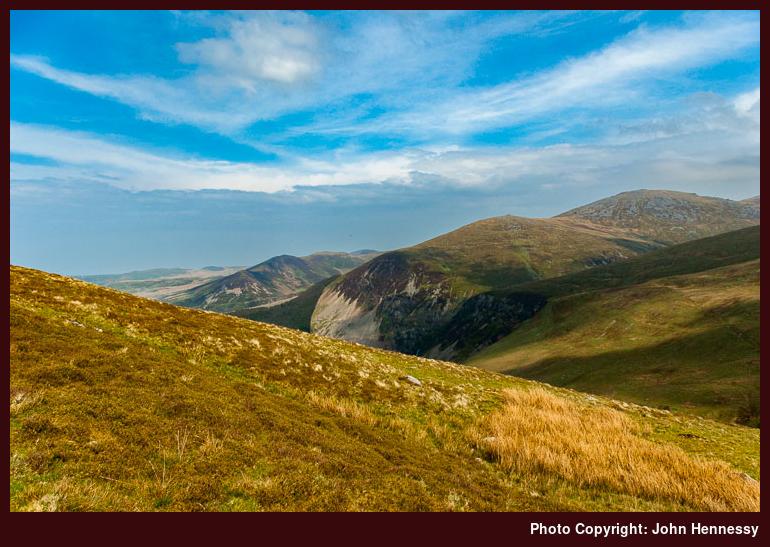
Dropping down to the North Wales Path came with a price: I entered that sea fog that I had seen earlier. Still, even if waymarking was far from perfect, the course to be followed remained clear. The presence of stiles is often a good guide to the course of a right of way and so it was here, and the grassy track was far from unclear. In fact, visibility never became so poor that a map wasn't helpful either. The mistiness had its pleasures too: a spot of cool on an otherwise warm day. It was a nicety that I was soon to lose and I also lost the clear track once I reached the road. After that, it was very much a question of careful navigation as the trail weaved its way along roads and through fields until I got near the A55.
From that point, it was largely a case of road walking until I reached Bangor train station. I might have caught an earlier train if I went from Tal-y-bont on a bus, but the spots of off-road progress and glimpses of Penrhyn castle were worthwhile too. Anyway, the extra time allowed me to compose myself before the journey home. It was a good day out.
A use for a damp evening
28th May 2008 Given our desire for clear blue skies and bright sunshine, it might seem strange to say it but seeing the countryside draped in a misty damp murkiness has a certain allure, a somewhat primordial feel in fact. That isn't what is at the heart of this post because I succumbed to the lure of soft shell clothing with the purchase of a North Face Apex Elixir jacket and these conditions presented an ideal opportunity to try it out in damper conditions than it has been seeing since I got it.
The idea of a soft shell is that there is at least some water repellence on offer, though heavy downpours will require something better suited to those conditions. If the Elixir keeps out drizzle and light rain like it has been doing (I am aware that Montane has something that is better in this regard), then the waterproof jacket can stay in the rucksack just a bit more.
Otherwise, the jacket has come in very handy on recent dry weather trips to Teesdale, North Wales and Argyll as well as going to and from work. It's a lightweight affair, a good thing for when it stays in the rucksack, but that does not stop it from warming you up on the move. Even so, I am not convinced that this is a cold weather item, at least not without additional layers, so the Polartec fleece remains the jacket of choice for those times.
They are a while away yet, so I won't be dwelling on the prospect. If things continue as they have been going, it looks as if my summertime fleeces could have their place usurped by the newcomer. The pockets are big enough to take a map, even if getting one in to and out of them is a bit of an art. The sleeves are roomy and can be rolled up for ventilation or cinched at the wrist if it gets a bit nippier. All in all, the jacket is a versatile thing that is seeing a lot of use, which is just as well seeing that it cost me £90.


