Thoughts on the West Highland Way Part 2: My Own Journey
 20th September 2007
 In the previous post in this series, I went over the route of the West Highland Way in detail while sharing my thoughts on different sections. There, I took each section in the order in which the WHW seems to want to be walked: going northbound. Well, it certainly looks that it has planned in that way and the approach does have a point if you are walking the thing all in one fell swoop.
While the northbound approach allows for acclimatisation before the wilder stuff beyond Bridge of Orchy is encountered, I feel that there is more to it. The fact that you start on terrain typical of Sunday afternoon strolls and end up immersed in high mountain country does suggest that this could be a journey that changes your walking forever. It is almost like this: it takes you by the hand and turns a sometime stroller (and camper) into a back country backpacker.
Of course, there are caveats to be added to the above metaphorical suggestion. We are talking about a 95 mile jaunt here and a certain amount of experience and fitness are needed if you are doing the trail all in one go. There certainly are some testing stretches for the legs before Bridge of Orchy is reached so it's no walk in the park, even if it is a more accessible long distance trail than others. And it is also an easy trail from which to exit if it all gets a little too much for you.
Moving onto my own association with the trail, there is an echo of the route plan of WHW in my progress along its length and that is even without my following it either as intended or as one multi-day hike. My first encounters with the trail preceded my interest in hillwalking; in those days, I somehow had it in my head that it wasn't an activity for mere mortals like me. So, walking the WHW was the last thing in my mind back then. I clearly have changed my mind since those days.
Returning to my first ever WHW encounter then, that was on a sunny Saturday in May 1998 when I took myself up to Fort William on a day trip from Edinburgh, where I lived at the time. Having been gobsmacked by the sight of Glen Coe on my way, there were further enticing sights awaiting me in Glen Nevis. I was very much a sometime stroller and cyclist with a soft spot for fine mountain scenery, something handed to me from my parents. In fact, I had planned to bring my bike but discovered that, unlike my native Eire, you can't take bicycles on Scottish coach services. My incursion into the glen was an unplanned affair but a spot of tentative wandering on good paths and tracks got something started: I wanted to see more of this. In fact, I brought my brother there a year later.
Of course, you could say that my initial encounter was at the wrong end, particularly given my then avoidance of anything too adventurous, but the Highlands are famous and how many have heard of Milngavie and the Campsie Fells? I certainly hadn't but I was aware of the WHW, though my knowledge of the route was sketchy to say the least. Moving from university to the world of work took me down to Macclesfield by way of Skipton (I started out my career working for a company based there). It was on a return to Edinburgh to see friends that had me witnessing the glories of the Southern Uplands through the train windows. That decided me: I was going to stage a return to the Highlands, having not been for the most of two years.
It was 2002 before I encountered the WHW again, first in Glen Nevis and then by a longer walk on the next day. The latter took me from Kinlochleven south to Glen Coe and views over empty wild moorland were the order of the day. By then, I could be called a hillwalker: I had the kit, was developing the knowledge and enjoying day walks in the countryside. That was followed up the following year by two northbound strolls between Kinlochleven and Fort William, the first was on a dry cloudy day in the middle of a week where the weather could only conjure up mischief and a weekend visit at the end of August saw me ply my way on a wonderfully memorable sunny day. This was the climax of the WHW and I saw it at its very best. 2004 saw me snatch a few drier days in July (the summer was far from being a classic) and one of these was spent walking south from Glen Coe to Bridge of Orchy. I had ended up completing the best part of the WHW first due to my affection for Lochaber and Glen Coe.
My hillwalking last year began to take me away from the beaten track and my appreciation of lesser celebrated spots like the Southern Uplands, Northumberland and Pembrokeshire grew. I also began to take an greater interest in completing long distance trails and my Pennine Way exertions are well documented on this blog. That meant that I was ready to resume my WHW excursions. Things started in earnest in February with the part between Milngavie and Drymen being ticked off and I have been musing over walks in the Campsies since then. Walking the WHW along the banks of Loch Lomond occurred to me as an idea the previous summer but it was an "iffy" weekend at the end of May that saw me do the rewarding deed with my overnighting in Rowardennan. For my completion of the WHW, I adopted the same tack with an overnight stay in Crianlarich sandwiched between walks south from Bridge of Orchy and north from Inverarnan; I have finished it, after a fashion.
I may not have followed faithfully a northbound itinerary along the WHW but I have been on my own journey when it comes to exploring the outdoors. I started as a sometime strolling day tripper and now seek the back country for hillwalking excursions. Who knows but my backpacking may develop yet; it would certainly aid progress along the Pennine Way. While on the subject of back country, my next post in the series (most likely the final one) will take a look at possible excursions extending from the WHW and potential enhancements.
Thoughts on the West Highland Way Part 1: A Route Appraisal
10th September 2007 Over the last few weeks, I have been writing up my thoughts on the West Highland Way now that I have all of its length. Initially, I was putting them all into a single post but it got so long that it derailed any other blogging that I would have been doing (there is a Rob Roy Way trip report from the end of August to appear here yet). So, I'm breaking the WHW review up to make it more digestible and easier to complete; proof reading a lengthy essay is asking for typos to slip out. This first instalment will go over the route as it should be walked rather than the way in which I did it. What I learnt from the way that I walked it will be the subject of the next instalment of these musings. Ideas for possible deviations that take you away from the madding crowd, busy noisy roads and electricity pylons are also planned.
Milngavie to Drymen
The choice of Milngavie as a starting point is certainly an interesting one. Access by public transport is a facile affair and progress from the main street is initially through woodland before you make your way out into more open country, crossing some fields on the way. Beyond Dumgoyach Farm, I felt that the walking was not as appealing as it could be. First, progress is by the disused Strath Blane railway with a stretch of road walking thereafter, never an exciting proposition. That said, you do cross a field on the way towards the A811; Drymen is a short jaunt west along the same road. As well as unexciting walking, pylons intrude on the views as does road traffic noise on the peace from time to time. Nevertheless, it is a stroll largely on the level with good views of the Campsie Fells with a first glimpse of Loch Lomond. The latter is over a gravel pit, not of great foreground interest in photographs.
Drymen to Rowardennan
After Drymen, the quality of the walking is on the ascendant with some progress along forest tracks and, if Conic Hill is open to walkers, a sharp shock to the legs: a taste of what is to come further north. From Balmaha, the WHW keeps rather too close to the Rowardennan road for my liking but it is not a busy affair. Even so, you lose it more and more, the further north you go and there are plenty of short sharp ascents to test those legs.
Rowardennan to Inverarnan
Rowardennan is a peach of a location and I certain enjoyed my overnight stay there. Views to the north are enticing and Ben Lomond is a possible excursion for the more adventurous; this is quality walking country. The way between Rowardennan and Inverarnan does seem to have garnered itself a reputation for being tough but I take the view that this is more like the WHW that I would have expected. Those of a more daring disposition can stay close to the shore while bound for Rowchoish; others may prefer the forestry track route. The latter certainly avoids a shoreline crux that nearly bested me; giving myself a chance to regain my composure got me beyond it. Beyond Rowchoish, good tracks and paths get you to Inversnaid. The section from Inversnaid to Ardleish can be adjudged tricky in places but I felt it to be a satisfyingly testing stretch without any serious difficulties. Good paths going over more predictable ground return on the approach to Inverarnan with some of the Crianlarich hills filling the view.
Inverarnan to Crianlarich
Beyond Inversnaid, humanity intrudes again, in the form of a very noisy A82. As if that were not enough, the pervasiveness of the pylons in Glen Falloch certainly detract from its visual appeal. Things do get better once the A82 is crossed and a quieter few miles along good tracks and paths do their bit to compensate for the earlier lack of pleasure until Strath Fillan is reached and another encounter with the A82 greets you. you could stop off in Crianlarich for a shorter day but getting to Tyndrum is no bad thing. Views of the Crianlarich hills are behind you, a pity in my opinion since they look grander than their Tyndrum counterparts; I was walking south and got the full benefit of the grandness. The views are good here and the A82 is not too intrusive either.
Crianlarich to Bridge of Orchy
The noisy A82 has it last hurrah as you make your way north from Tyndrum; hurrah is the last thing that I would have been saying until I made it off the slopes of Beinn an Dothaidh. A good military track takes you past tantalising glimpses along Glen Coralan and Gleann Ach'-inis Chailein do attempt to erase earlier memories. Along Beinn Dorainn, road noise is far away until Bridge of Orchy is reached and the A82 crossed yet again. Should the WHW be called the A82 Way or the W82?
Bridge of Orchy to Glen Coe
Leaving Bridge of Orchy takes you into wilder country. First up is progress along an old military road to Inveroran, where the legs will get a good workout from the ascent and descent. Views of Loch Tulla and the ever nearer Black Mount vie for your attention. From Inveroran, it is the forbear of the A82 that will be taking you forth. This is good walking with road noise by now a distant memory and the ever present Black Mount for company while you continue through wild country and gaze over Rannoch Moor when at last it presents itself. All of this is enjoyable stuff.
Glen Coe to Kinlochleven
The A82 is crossed for the last time near the Kingshouse Hotel at the head of Glen Coe. Unencumbered views along the glen pervade and the rocky buttress of Buachaille Etive Mor is unmissable. I don't seem to recall road noise blighting my memory of the way to the foot of the Devil's Staircase; maybe I had other things on my mind... The ascent of the Devil's Staircase is a shock to the system and could make you wonder why you are heading north. I descended it and it looked foreboding enough so an ascent is a definite test. The rewards are there, though. From here to Kinlochleven, you are undeniably immersed in wild country; it is hard to believe that workers on the construction passed through here on their way back from the Kingshouse Hotel at nighttime. That some perished while on the excursion should come as no surprise to you when you see what surrounds you. The Mamores come steadily into view as you head towards Kinlochleven, an undeservedly lesser frequented spot.
Kinlochleven to Fort William
Getting to Kinlochleven on the WHW involves a steep descent whichever way you are going and the same description applies to the ascent from from the village. The rewards are very much in evidence, though. For instance, heading north takes you through the magnificent Lairig Mor on the way to the pretty Glen Nevis. The final northbound section is undeniably a high point of the whole trip and may even be considered its zenith. I have walked it twice and it's not that often that I do that: my first visit was on a day that remain steadfastly cloud so I returned when the sun very much in evidence and I'll never forget that day and for all the right reasons too.
Public Rights of Way in North Lanarkshire
9th September 2007 While ScotWays do a reasonable job of publicising public rights of the way going through Scottish hill country, their lowland cousins seem to fall into some sort of black hole. It often feels as if you stumble upon them entirely through serendipity, which can make a day hike more interesting at the expense of predictability. There are places where you should not take risks like that.
The fact that OS maps don't depict Scottish rights of way like their English and Welsh counterparts is no help either. That makes route planning and navigation all the more challenging, especially when a map does not reveal what may be possible in a more accessible manner. Guidebooks and magazines then become invaluable for building up a library of ideas.
The only saving grace is the Scottish Right to Roam legislation that makes rights of way less crucial than they are in many parts of England and Wales, where someone is more likely to be put out by anyone rambling in the wrong place. Scots tend to be more tolerant anyway, which helps. Navigation in a right to roam situation then becomes more free-form, though there is need for added care given the scale of the Highlands and the Southern Uplands.
Thus, it was with some interest that I stumbled on the Public Access section of North Lanarkshire Council's website. There are loads here of interest, and the maps of the proposed core path network are especially useful, especially for the Kilsyth hills and the Kelvin Valley, and the Campsie Fells are not far away either.
The effort makes me wonder if other Scottish councils are planning to take a similar approach; it would be great if they did. Having a central place at national level, where you can survey what is there, would be even better again. If the information finally gets onto OS maps, that would be icing on the proverbial cake.
A long distance route on my doorstep: Gritstone Trail
30th August 2007 As if to prove that long-distance trails can be found anywhere, there is one in east Cheshire that passes not far from where I live. This is the 35 mile (56 km) Gritstone Trail and it starts at Disley before following the western fringes of the Peak District all the way to Kidsgrove in North Staffordshire.
While it is possible to complete it in two days, spreading it over three days seems a sounder proposition. Suggested sections are shown by the overview maps listed below. They live on the website of Cheshire County Council who maintain the route; smart new waymarking signs have been erected recently so they are looking after it. There is a cloud hanging over the future if HM Government has its way: CCC and all borough councils are to be replaced by two unitary authorities for East Cheshire and West Cheshire. We'll see how things go...
Central: Tegg's Nose to Timbersbrook
South: Timbersbrook to Kidsgrove
The trouble with things local to you is that you don't pay them the sort of attention that they would get if they were further away. As if to prove the point, my progress along the GT was far from concerted until very recently. That said, there have been longer walks along the route and ones that come to mind include: Bollington to Disley, Rainow to Sutton Common, Tegg's Nose to Kerridge, Sutton Common to The Cloud (not far from Bosley or Congleton) and The Cloud to Kidsgrove. As it happens, there have been many other shorter ones where I followed it, particularly on the stretch between Kerridge and Sutton Common. In fact, it was a short stroll between Bollington and Kerridge that completed the trail for me. Yes, there are times when I do allow things to become that bitty...
Here are some details of the longer ambles:
Bollington to Disley
This was one of those first of the year strolls on a January day with some snow on the ground. In fact, the thoughts of sunny skies with snow about could have been what tempted me out in the first place. In the event, the sun never did make it through the clag that abounded on that day. Field trekking was the order of the day between Bollington and Brink Farm and that seemed to take the longest, possibly because progress along a good track took me to Lyme Park felt a bit quicker. It was getting dark as I made my way from Lyme Park into Disley but I do seem to remember that the skies had cleared by then. What I more keenly remember is my lazy testing of boots on a patch of ice: the result momentarily involved having my legs positioned above my hips. I need say no more...
Tegg's Nose to Kerridge
From a start of year stroll to an end of year one, a sunny December afternoon tempted me to walk from my house to Tegg's Nose and I drank in the views from there: Shutlingsloe was clearly visible in the winter sunshine. A spot of down and up progress took me by Rainow from where it was uphill as I made my way towards the White Nancy, a folly usually painted white that is one of Cheshire's most famous landmarks. It used to be possible to enter it but vandalised put paid to that opportunity. Speaking of vandalism, someone must have thought it funny to paint the thing pink once; it got a mention in the Macclesfield Express but the good people of Kerridge and Bollington were anything but amused.
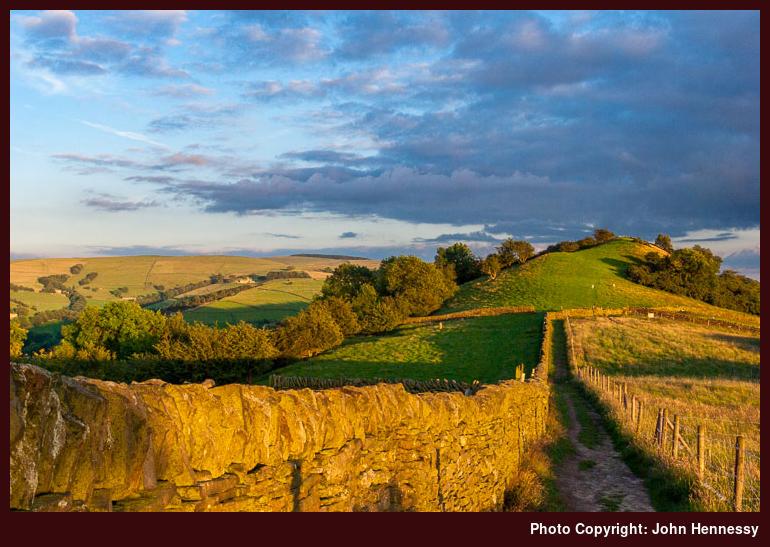
Rainow to Sutton Common
A hot sultry August day saw me have grand designs on a walk from Rainow to Rushton Spencer. Everything was going fine as I plied my way from Rainow, navigational challenges being overcome as I went, until I started making my way up Foxes Bank and Sutton Common. Feeling less than 100% on Sutton Common itself, I decided to return home at that point and a little lie down was enough to restore order: Walking on hot sunny days is never the best plan but the prospect of pleasant weather still seems to draw me out. Another valuable lesson learnt...
Sutton Common to The Cloud
The walk actually started out from my house with a variety of connecting footpaths being used to reach my starting point on the GT. The day was to be a hot and dry affair with the sun making its way from behind the clouds at times. This journey took me round by Langley until I reached Foxbank Farm. However, my rendezvous with the GT was to be delayed as a result of subsidence on the way up to Sutton Common. So, more footpath and road tramping followed before I was to reach the A54 and the trail in question, busily resolving any navigation uncertainties that raised their heads along the way. It was to some time before I left tarmac behind, though, as I enjoyed the views from the quiet Minn End Line before I headed back onto more foot friendly surfaces at Hawkslee. The off-road hiking was set to continue, apart from crossing the A523 near Rushton Spencer, until I found myself on the private road leading to Raven's Clough. Feeling the effects of my exertions on what was by now a hot and sunny August afternoon, I elected not to surmount The Cloud on my way to Congleton but to stick with the tarmac option. A short wait in Congleton preceded a non-too-long way home for a well deserved after walk rest.
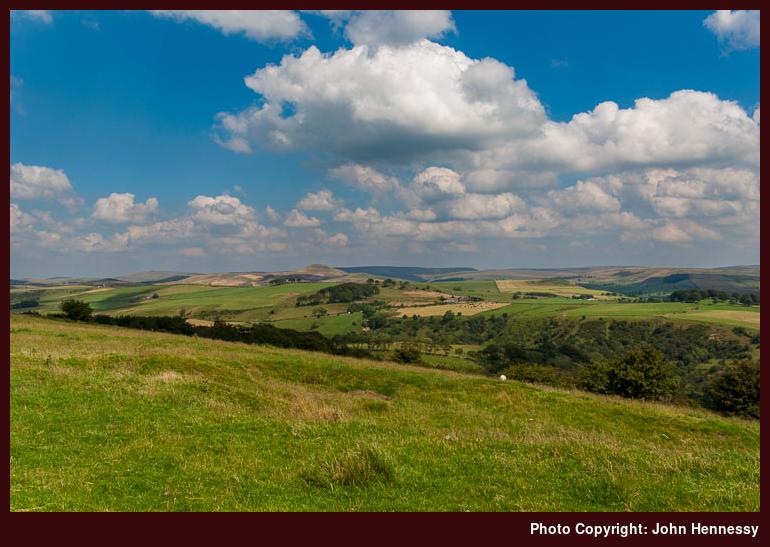
The Cloud to Kidsgrove
A short bus ride dropped me off sooner than I expected and I was about to continue along the road to get my bearings when a friendly gentleman put my mind to rest. My walk was starting in Eaton and I was using the Dane Valley Way to reach where I left the GT on my previous journey along its length. The DVW is yet another of Cheshire's longer distance paths and actually begins in Derbyshire, Buxton to be more precise, before it reaches the source of the said river and follows it to Middlewich in the centre of the county. Once I overcame my navigational doubts - there was another a little further on from my starting point that was soon answered without any inconvenience to anyone else, it was uneventful hiking all the way to the slopes of The Cloud. It is not a very high hill and it slopes were soon ascended, and the top was ablaze with flowering heather and panoramic views were in ample supply. I even took some lunch atop it with the sounds of silage making percolating up from below.
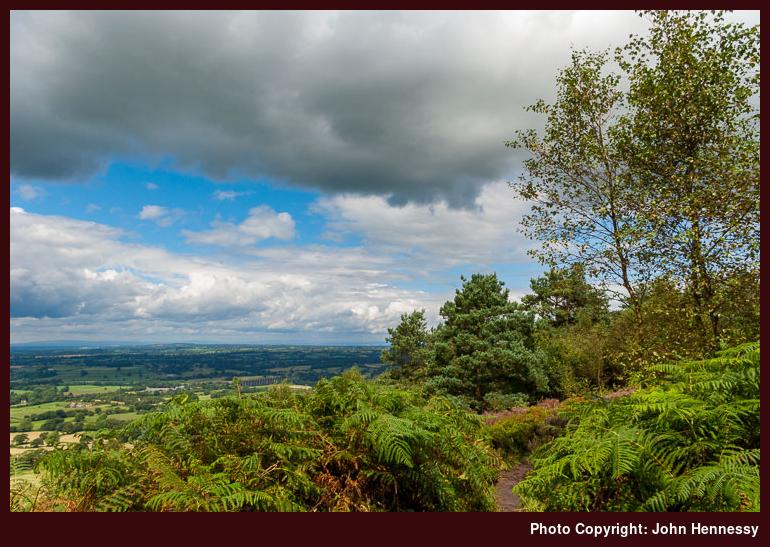
Having got away from the delights of The Cloud, I dropped down to Timbersbrook, where a former industrial site is now a delightful woodland park. A spot of field crossing took me on to the bed of the former Biddulph-Congleton railway. After a short stroll along its level length, I was to leave it for a climb up Congleton Edge on my way to Mow Cop. Again, views over the Cheshire Plain were offered in abundance. Having an older edition of OS Explorer 268 with me, I had to keep my concentration up since it showed the GT terminating in Mow Cop. Though I still broadly knew where I should have been going, I kept my eye out for any helpful waymarks; there was no problem as the authorities have been dutiful. I reached Scholar Green and picked the first of the canal paths that were to take me all the way to Kidsgrove train station; Kidsgrove is where the Macclesfield Canal meets the Trent & Mersey one.
It was a successful end to a day that began with somewhat doubtful looking skies that produced a dusting of rain as I neared The Cloud. Though clouds abounded, the day remained dry from then on and the sun was able to make its appearance at times. Even so, the temperatures never truly exceeded those suitable for walking.
A change of boots
21st August 2007 Your choice of walking footwear can be as individual as it is important. Choosing footwear that is unsuitable for you or the terrain that you are crossing can bring a hike to a premature end. For instance, I remember a tale of someone who attempted the West Highland Way in trail shoes with the shoes' footbeds replaced with insoles and had to bail out at Crianlarich following several days of misery; replacing the original footbeds removed much of the shoes' foot support and padding. On the other end of the scale, there is another story told of a WHW walker who had to cry out early because his boots were not well broken in.
Traditionally, hiking footwear has meant boots offering copious amounts of foot and ankle support with waterproofing to keep those feet dry in boggy terrain and there are those who consider any challenge to this orthodoxy to be heresy. That hasn't stopped others asking if you really need that Gore Tex lining when leaving it out allows for more breathability and feet that are less sweaty. There are even outdoors folk who rate drying ability above waterproofing. Sandal fans like Chris Townsend will no doubt appreciate this thinking. Moving on to foot support, questions have been asked about the amount of support that footwear really needs to supply; the faith of Innov-8's Wayne Edy in the biomechanics of the foot comes to mind on this one. On a more conventional, I remember Walking World Ireland's Andy Callan opining that foot support was more important than waterproofing or ankle support, which seems to sale up the middle somewhat.
One thing that can answer all of these types of questions is the type of walking that you do. Of course, that consideration starts with the terrain that you frequent. The requirements of dry dusty trails in the U.S. are very different from boggy hill tracks in the Scottish Highlands and the contrast between the tow path of the Macclesfield Canal and the side of Tryfan is equally as stark. Fitness (a very dangerous word following outbursts in the OutdoorsMagic forum...) and experience also come into the frame.
For my walking, I have tended to stay with the conventional thinking and use boots most of the time. My walking does range from good tracks to boggy terrain to craggy slopes so a general purpose boot is what I tend to choose. What has brought all of this to mind is my discovery of a hole in the Nubuck uppers of one of the Salomon boots that have been my mainstay over the last few years. It shouldn't surprise you to hear that water ingress has been experienced as a result. However, I have noticed wetting out as well and would be rejuvenating the Gore Tex lining with the likes of Nikwax were it not for the hole. In addition, the other boot was letting in water too so I was on the market for replacements.
That brings me on to another potential point of discussion: buying outdoor footwear over the internet. I must admit that I have done it but there is a lot to be said for going to a well stocked shop and that is what I did on this occasion. The shop that got my custom was the Manchester branch of Cotswold. I popped in on the muggy damp day that was last Sunday and spent a spot of time inspecting their selection. The Scarpa ZG10's caught my eye so I got help from the shop staff with their fitting. To my surprise, I was told that I needed UK size 9½; and there I was thinking that it was only Salomons where you needed to go at least a size larger than your normal shoe size (I take 8's). The width fitting seems good and my heels are held securely with plenty of ankle support. There is some space about the toes but that stops them getting bashed on my way down hills. The Vibram soles look designed for the job too and the rubber rand about the uppers look as if they could deal with the rough stuff too. The other advantage in going to a shop is that a spot of boot care advice is on offer too. The Scarpa's weren't cheap so I plan to look after them.
However good the fit is, any boots are going to take time to break in and, despite the leakiness of the boots that are being replaced, I am not going to rush things. For one thing, I have an older pair of Salomons that look tatty but I never remember them to leak (they were retired before that could have happened) and I am planning to press these into service for any forthcoming outings. In fact, I took them out for a recent ramble over the Gritstone Trail between The Cloud near Congleton and Kidsgrove with a walk in along the Dane Valley Way from Eaton was the warm up. The old clobbers did that job well.
I suppose that I could use trail shoes but I'd rather the security of boots. That said, I have been using trail shoes from Columbia and Salomon on walks on paths and tracks near home, where I go a little more lightweight anyway. I might even try them further afield where I can be sure that I am crossing less challenging terrain.


