Navigation and all that
 1st September 2006
 If you do any sort of walking, sufficiently detailed maps proved invaluable. For hillwalking, they are absolutely essential as is the ability to use them. If you want to advance your hill-craft so that you can cope with the vicissitudes of the weather, having a compass and knowing how to set your map with it is obligatory. Other navigational techniques build on these foundations and the more foul the weather, the more needed the advanced knowledge is. A GPS navigation system is useful but you will not get the best from it without a map and compass.
As for me, I do possess a Silva compass but Ordinance Survey maps suffice most of the time that I am out and about. Landranger 1:50000 maps work fine for cycling, but for walking, I find the Explorer 1:25000 series invaluable. They cover less area than the Landranger ones but the extra detail more than compensates for this perceived weakness. Some swear by Harvey's SuperWalker series and I have some, but the range is often restricted to popular hillwalking areas and I have been known to head off the beaten track. Nevertheless, given that they are based in Scotland, it should be no surprise for you to learn that their Scottish coverage is far from shabby.
Britain is blessed with good mapping, but Ireland is not so fortunate. In the Republic, the staple from the Ordinance Survey of Ireland is their Discovery 1:50000 series, the same scale as the OS Landranger series. Another thing that you need to watch is the age of the maps: some date from 2001. The Ordinance Survey of Northern Ireland Discoverer series, at the same scale as the OS Landranger series. Both services do larger scales (1:25000) for specific areas, but these are not many of these. Harvey has done 1:30000 SuperWalker maps of the Wicklow Mountains and Connemara for a while now but they have now brought out a new SuperWalker for the MacGillycuddy's Reeks at the same scale as the others.
So far, I have restricted my discussion to paper mapping, but mapping software is a growing area. OSI produce their own DVD's, but the main players in British mapping seem to be Anquet and Memory Map. Integration with GPS receivers and the ability to print off mapping for your walking are very much on offer. Just a few thoughts on the printing bit: laminate your print-out and remember not to cut yourself too tight; regarding the latter point, you may need to change your plans on location.
Why have a website?
31st August 2006 If you have been having a look around my blog, you'll notice that it is a loosely organised collection of thoughts around hillwalking, photography, public transport and website updates. That's because I want somewhere to share these otherwise my website would become more of a rambling mess than it is at the moment (seriously though, I hope that it's not that bad). There are other things that I could add here like thoughts on web design and development but I feel that would dilute the whole purpose too much.
Nevertheless, I have noticed two types of websites that are similar to my own: ones devoted to hillwalking and ones concerned with landscape and architectural photography. The latter can get quite serious with their owners travelling either far afield or being up and about their craft at both extremes of the day in summer and out all day at the other end of the year. Also, tripods are a necessity for these folk (must force myself to use mine at some point). Then there are the hillwalking websites. These also have photos but they are to illustrate the route being described rather than for their own sake. This need not be formal as you will see from Fraser Dickson's site. The purpose of his offering is to describe his experiences on the hill but he indulges in (digital) photography along the way. Another extreme is offered by Sandy Saunders' The Walk Zone where there is no route text at all, only photos taken out on the featured walks.
So where does my site fit in? Somewhere between these two extremes as it happens and there are three elements to the information that I present on the photo gallery website and here in my blog: photography, walking (urban as well as rural) and travel. The photography element of this is obvious: it is the whole point of my main website. I also have a directory of links to other photo galleries. Walking (and cycling) and travel provide the commentary to the photos and there is also a visitor directory on there. Indeed walking and travel are backbone of what I post here too. Therefore, a suggestion would be to separate the photo gallery from walking and travel. It's an intriguing idea and one that I might just consider.
Inverness photos added
29th August 2006 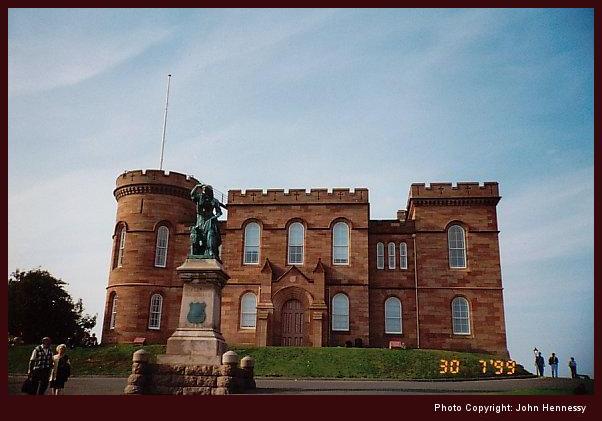
In spite of its status as the main administrative centre in the Highlands and Islands, Inverness always seems to be a place where I have never spent more than a few hours. Here's a list of my encounters with the city, starting before it attained city status:
July 1998: On a day trip from Edinburgh, I passed through the city on my way to Urquhart Castle and Loch Ness. Sadly, the day was cloudy and it even rained in the evening. Nevertheless, I did get a chance to walk around the city centre.
July 1999: A short stop on my way back to Edinburgh from my first visit to the Isle of Skye. The sun was out and I managed a few photos.
August 2002: Only stayed long enough to change buses on another Portree-Edinburgh journey. Rain was plaguing Portree when I left Skye, but Inverness was drier. My priority, though, was to meet up with friends in Edinburgh and a change of bus in Perth was ahead of me.
May Day weekend 2006: Stopped off for a few hours on Sunday while on my way from a cloudy Fort William to a sunny Pitlochry. Some accommodation booking took place (don't expect Inverness TIC to be open on Sundays out of season, though) and I got in some photography in the sunshine before a train took me to my destination.
The new photos are from my latest visit and feature the castle and the River Ness. There could have been more of them if I had stayed in Inverness rather than Fort William: a serious possibility due to a motorcycle event taking place in the latter. Every May Day weekend, bikers descend on Fort William and book up almost every room in the town. Even the hotels get booked out: bikers are particularly after single rooms and you could find that double and twin bedrooms getting let as singles to satisfy demand. I can understand their logic: it is still the off season up there so any trade gets welcomed and who'd blame them. I'll know it for the future, though. Genteel Pitlochry offered no such difficulties (once I remembered the name of the hotel into which I had booked...). The same level of accommodation provision allowed me to arrange a four-night stay there at short notice in July.
Lochaber and me
26th August 2006 When setting down the first draft of this post, I soon realised that some may have thought that I was using Lochaber as a euphemism for Fort William. It is the main town in the area and its proximity to Ben Nevis ensures a steady stream of visitors. That has ensured that a plentiful supply of accommodation is available, though the place can get booked out at times, particularly during the summer. The town is also a public transport hub with both train and bus services available. You can find out more from ScotRail and Scottish Citylink.
All of these have ensured that on all but one occasion, Fort William has been my base when exploring Lochaber. The exception was in July 2003 when I had to decamp to Banavie due to accommodation shortages in my preferred base. Even so. Banavie is only a few miles away from Fort William and connected with the latter by a frequent bus service. Other possibilities are available but they require a little more work if you do not possess motorised transport of your own. Kinlochleven is a viable option for exploring the Mamores; Glencoe for Glen Coe and the Aonach Eagach; Spean Bridge or Roy Bridge for the Grey Corries. These are just a few ideas and they can all be accessed without a car.
My first visit to Lochaber was a day trip to from Edinburgh to Fort William on Scottish Cup Final day in 1998. My original plan was to carry my bicycle on the bus like I had seen people do in Eire, but that's for most intents and purposes a no-no in the UK. The coach journey from Edinburgh went via Stirling, Callander, Crianlarich, Rannoch Moor and Glen Coe. Being a sunny day, Glen Coe looked glorious and left a lasting impression on me. After having my lunch, I found my way into Glen Nevis and, while I did not see much of Ben Nevis, the glorious sight of Sgurr a' Mhaim attracted my attention. The stage was set for the future.
My next visit to Glen Nevis was in August 1999 when my brother came over to see around Scotland. He picked me up in Edinburgh and we headed over to Fort William by way of Rannoch Moor and Glen Coe. We walked into the heart of Glen Nevis together, to the car park at the end of the road in fact. The day was dry and cloudy, but rain rolled in that evening. We then went to Oban, Mull and Iona before overnighting in Balloch before making our way to Stranraer and heading to Ireland. I spent a weekend at home in Ireland before returning to Edinburgh.
It was not until August 2001 that my next encounter with Lochaber occurred and I was only passing through on my way up to Skye and down to Oban. Furthering my knowledge of the area had to wait until August 2002 when Fort William was a two-night stop on a tour of my own making across Scotland, from Edinburgh to Skye. A return to Glen Nevis occupied my first day when I walked all the way into Achriabach and then up the sloping banks of Allt Coire a' Mhusgain to enjoy the views abounding on a sunny August evening. The next day took me on to Kinlochleven from where I followed the West Highland Way to Glen Coe before returning to Fort William. The extent of cloud around on that day somewhat limited opportunities for photography but it was a good start to my plying that long-distance path in earnest.
2003 saw me in the area twice: the first of these was the one where I stayed in Banavie as my base. It was also an occasion where I ran out of luck with the weather: a fine spell spread across Britain the following week. At least I found out what the area is like in rain, having got a soaking a few times. Being based a few miles outside Fort William is all right in dry weather but it exacerbates any soaking you get when it is wet and even a regular bus service is no answer to the problem. I still got a few walks out of the visit; the first of which was a venture into Glen Nevis in the rain from where I walked over Cow Hill to Fort William to catch a bus back to base. The next day saw me head to Kinlochleven from where I returned to Fort William by way of the West Highland Way. That day was dry and it attempted to brighten up but never quite succeeded, and the evening was wet. My last walk of the lot was in the throat of Glen Nevis. A bus service got me to Achriabhach and I then walked to the road end before following the path beyond that point. On my way, I passed Nevis Gorge before continuing on into the heart of the Aonachs and the Mamores. The path would have continued to Corrour train station but I had got my fill way before then. A few dreadful showers were encountered but I never planned to go all the way anyway. I managed to catch another bus on my return to base.
My bad luck with the weather prompted me to go to the Lake District at weekends to get over it but it was a return on the August Bank Holiday weekend that set the world to rights. This time, I was in the part of Britain where the weather was best and not the other way around. I reprised my ramble from Kinlochleven to base, and was rewarded with weather that really helped me to make the most of the surroundings and I used up more film than perhaps I should. My second outing took me from Spean Bridge to Loch Lochy before I returned to base by way of the Caledonian Canal. More sunny weather (the day turned out better than forecast) allowed me to make the most of this ramble, though it is a candidate for bicycle usage if I return there again. The weather was wonderful again on the Monday and I really had to pull myself away to get home.
2004 was a bit of a wash-out as regards weather, but my annual Scottish break hit on reasonable luck. The break started in Argyll where I encountered some showers before heading to my now customary base in Lochaber. My first day in Fort William was a wash-out but I needed to recover after the previous day's exertions and there was a promise of better weather on the day after. (It was then when I purchased the Sprayway Commanche jacket that I now use regularly for all-round purposes in wet weather, though I have no plans to use it for hillwalking.) I turned my first attentions to walking from Spean Bridge to Loch Arkaig. I returned to base via the Caledonian Canal and I was readily reminded of the need of a bicycle: the section skirting Banavie Hill is soul-destroying; you really feel that you are making no progress. The next day took me to Kingshouse in Glen Coe for a ramble along the West Highland Way to Bridge of Orchy. The day was cloudy in parts, but the walking was still superb. All in all, the weather I enjoyed was more than could be expected for the summer that was.
2005 saw me pass through Lochaber on my way to and from the Isle of Skye straight after the 22/7 bomb scare, not a good time to be travelling. In contrast, 2006 has seen me return twice: once in January and again on the May Day bank holiday weekend. Thoughts of snow-capped mountains and the photography of Colin Prior inspired me to take the Caledonian Sleeper from Crewe on a cold January night. I awoke to fascinating scenes beyond Tyndrum and enjoyed some good winter walking once I sorted out my accommodation. Travelling up a section of the Great Glen Way and proceeding into Glen Nevis to ascend Dun Deardail allowed to me to experience some fascinating panoramas in the winter sunshine. There wasn't that much snow around, though. The next day, it was raining as I was departing; a spot of pathetic fallacy perhaps? The second trip is covered in another post and, rather ironically, I witnessed more snow-capped hills on this one. The main event was a walk from Corrour railway station to Spean Bridge, skirting Loch Treig and passing through the Grey Corries along the way.
As regards future trips, I might move away from using Fort William as my base: Kinlochleven, Spean Bridge or Roy Bridge are tempting propositions. One thing is certain though, I have loads more to see and I doubt that it is possible for anyone to see all of it and that's no bad thing.
Hillwalking books: Scotland
25th August 2006 As an enthusiastic hillwalker, I've developed a fondness for expanding my bookshelf over the years, as these books are invaluable for planning my outings. Here are a few of my Scotland-related guides:
SMC Hillwalkers' Guide: The Munros
SMC Hillwalkers' Guide: The Corbetts and Other Scottish Hills
These guides are my go-to resources when I find myself wondering, "What hill is that in the photo?" They are comprehensive and beautifully illustrated with photos of the featured mountains. Recently, while reorganizing the Lochaber section of my photo gallery, I delved into these guides and came up with numerous ideas for a weekend in Kinlochleven. Though not inexpensive, they are well worth the investment. However, they are quite hefty, so I usually keep them at home for planning purposes.
At just £5.99 each, these guides offer incredible value, making it all too easy to accumulate an entire set. Illustrated with maps and photos, the concise route descriptions are perfectly suited for their purpose. My collection includes guides to The Central Highlands, The Cairngorms, The Islands, The Southern Highlands, and The Southern Uplands.
These are Cicerone Guides, coming from a publisher I greatly respect. They provide comprehensive route descriptions and maps as part of their package.
Due to a peculiarity in Scottish law, public rights of way are typically not indicated on Ordnance Survey maps. This makes the Scottish Rights of Way Society's guide indispensable. Many of these tracks are former livestock droving routes, so good navigation skills are essential, as the path may not always be evident on the ground.
For now, these guides fulfil my needs, though I can't rule out the possibility of acquiring more if I decide to explore other parts of Scotland. Nonetheless, I will continue to make the most of what I currently have.


