More ambling along the Goyt Valley
 12th September 2018
 Sometimes, walking routes get reprised very close to each other and this pairing is one of those that, I thought, had been written up earlier but surveying what was posted on here already proves me wrong. It might be that because I have done some pairing of different walks in other trip reports, blending of memories has struck, so let us move along.
A pair of strolls along variations of what otherwise might have been the same route allow an opportunity to find some contrasts, and so it is with these trots between Burbage and Whaley Bridge via the Goyt valley. Here is a list: wintery showers versus a taste of summer, midwinter versus the onset of spring, the end of a year versus the start of another and the end of one piece of business versus the onset of another. Each changed the character of my hikes as much as the deviations that I made the second time around, so they hopefully will add a little something to their respective narratives.
2016-12-22
It is difficult to talk about starting a Christmas break when part of your working life has stopped and another is continuing to what feels like the bitter end. That was the conundrum that surrounded this walk, yet an offer of a half decent day was enough to draw me outside again after a serene day spent among the Cumbrian fells. In truth, there was to be a lot of the same sensibility about this outing too, and that was just as well given how my life was going at the time.
My arrival in Burbage was followed by some fumbling while I oriented myself, but I was soon on the track by Burbage-edge Plantation. Height was gained steadily before a wintry shower of rain came my way to test my resolve. As if that were not enough. The wind was strong enough to obscure the words of a passing runner. Thankfully, this was to be the only such stormy weather episode of the day and dry, sunny if chilly weather became my lot for the rest of the walk.
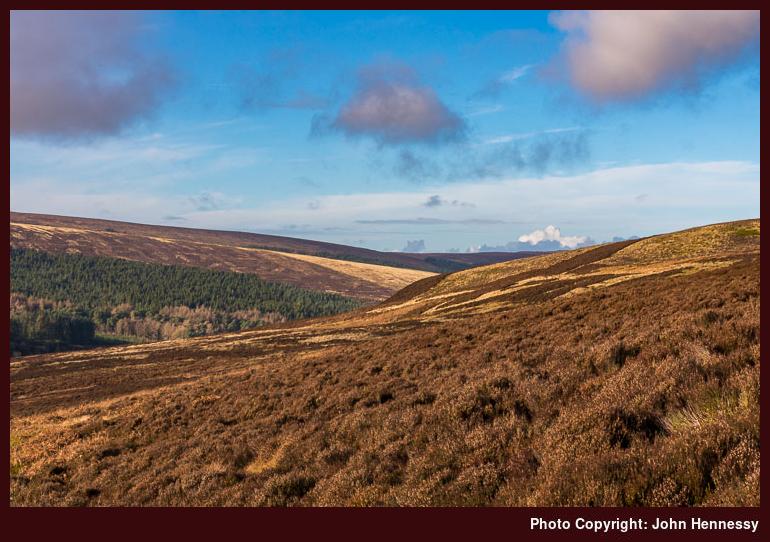
Skirting the aforementioned forestry plantation, I continued from Burbage Edge towards Berry Clough with opening views of my surroundings. Sunshine came and went, but my mind was allowed to wanderer but not so far that it interfered with navigation. The path remained clear and became even cleared as I followed the clough downhill. All the while, I also needed to keep an eye on my footing even on an agreeable gradient.
The end of the incline landed me near the waters of the River Goyt where there was a bridge on which I loitered a while before picking up a path in the belief that it might be the desired right of way. That did not prove to be the case, but it mattered not a jot. Its boggy way led me across the well-named Goyt's Moss towards Errwood Reservoir and around by the lower slopes of Wild Moor. The surroundings suggested otherwise, but Buxton was only a few miles away, but the emptiness was just what was needed to experience a much-needed soothing interlude of calm.
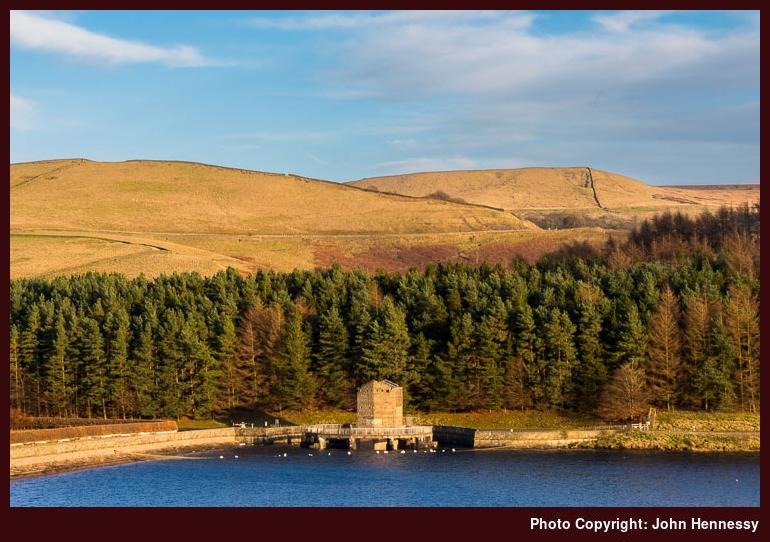
By then, the course was the same as one that had been followed before, so there was little need to consult a map and I wandered along tracks and paths until I reached the road that would drop me onto the dam at the end of Errwood Reservoir. Here, I was to linger awhile, especially on the other side before I continued on my way. The last spell of sunshine of the came and I left as clouds blocked it again.
Losing height gained me the shore of Fernilee Reservoir, by which I was to process for a kilometre or two. It was not all level going either, for I needed to gain some height on the way to the lane that crosses the reservoir dam. Any idea of continuing along the east back of the River Goyt was extinguished by the sight of signs warning of path closure due to work on an asbestos roof. The way by the west bank would suffice, and it was on a good track too. Eventually, a way down to a bridge across the river was found, so I could follow its east bank to reach Shallcross Wood where I would meet two equestrians coming the other way, though I questioned the wisdom of their following the track that they were using because of the tree cover.
Beyond the wood, the right of way lead me onto the A5004 that would carry me into the heart of Whaley Bridge, where I would await the next bus back to Macclesfield. Arriving at the bus stop in plenty of time to do some shopping in a small place that was not too tiny to have a Big Issue seller plying his wares. Light was declining, so I was glad to see the bus arrive. Its passage along the B5470 was to cause a missed phone call from my solicitor, whose business would need to wait until the following morning.
The same applied to an auctioneer who made contact with me while I was out among the hills, but both matters were sorted quickly enough to close affairs for the year. If it was as easy as that to unwind in the time that was available, 2017 might have been different and life progresses as it does. Between Christmas and New Year, there were to be a few days spent in Mallorca that would have their own story to tell.
Though dampened by rain and having enough wind not to hear what someone else was saying, I persevered and dropped into the Goyt Valley. From Berry Clough onward, much of my route was a reprise of a walk undertaken in October 2013. As if to underline what recent years of tumult have done to my memory, the section along by Fernilee Reservoir had been a blur and I followed the River Goyt from its dam on the western side instead of the eastern one as I did before. Otherwise, there was reward in the form of some sunshine lighting up Errwood Reservoir. Nevertheless, another return is in order and one on a sunny day would be best, since I never have had much luck with the Goyt Valley when it comes to photography. It may mean getting muddy again, but that is a trifle when it gives returns like the ones I often get.
2017-03-25
What probably was the first sunny weekend of the year could not do other than lure me out of what felt like a rut. 2017 had started with a flu-like illness before enough was completed in Ireland to satisfy a two-year deadline. Then, my mind turned to sorting out a certain lack of energy and there was a reluctance to pursue more in the way of Irish works. These and what preceded them were blamed for my lethargy, rather than signs that my day job was not what I hoped it would be. A spring sabbatical that began soon after this hike was not enough to deal with that, so I ended up stepping into "oblivion": leaving my job to start a career break that would allow for rest and a time for exploration that laid the foundations for how I work these days. Little did I know that quite a year lay ahead of me.
That sunny day in March, I had a decision to make: was it Burbage to Whaley Bridge again or a walk from Disley back to Macclesfield using part of the Gritstone Trail before using other rights of way beyond Bollington? Both options had me torn between, but I chose the former for Saturday and the pull of the latter got me out again on Sunday. This was to become a walking weekend.
This time, there was no fumbling on arrival in Burbage, for I knew where I was going next. In any case, it was a release from a bus full of folk tempted out for the day by the predicted weather. From start to end, this was to be a day with plenty of sunshine and rising temperatures. Thankfully, that is how it turned out, too.
After coming a little along the now familiar, I stopped a while to organise myself and took in such sights as Grinlow Tower and the busy A537 across the valley floor from me. If this sounds like the weather made it easier for me to look around, there might be some truth in that thought. The same benign conditions also made it easier to deviate from the December route, as much as an earlier start and longer hours of daylight. It would have been even better a day later with the extra hour of daylight in the evening time added by the onset of Summer Time. Still, there was ample time on the last Saturday of Winter Time for my needs.
The first variation came soon enough, with my not skirting the Burnage-edge Plantation as long as I did in December. Instead, I kept going straight along the track as if destined for Derbyshire Bridge. However, I still left it for the Goyt Valley and did that near its highest point too. The out of action Cat & Fiddle Inn lay before me, but my closest encounter was to be that aboard the bus that brought me from Macclesfield.
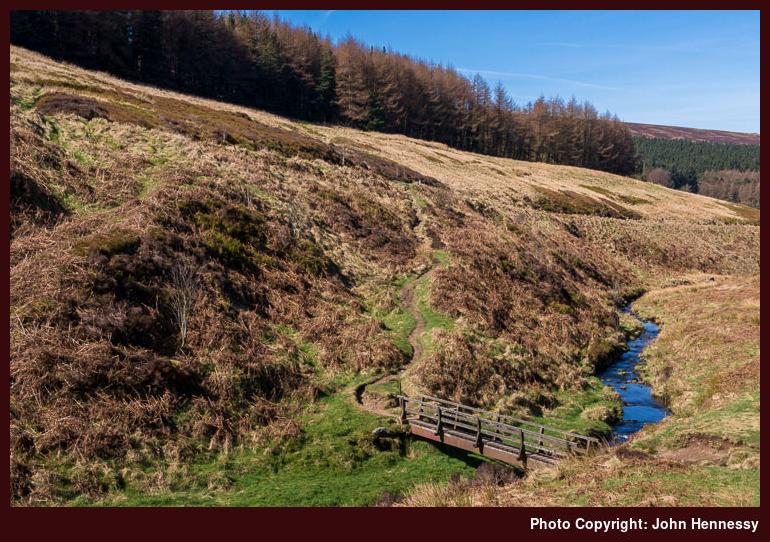
My thoughts though were on rejoining the path down to Berry Clough, and there was plenty to see in the sunshine as I went on my way. Goyt's Moss and Stake Side took up most of my field of view until I began to drop along the clough itself. In good time, the now familiar bridge over the River Goyt began to be seen and then reached. After a photography stop, I was on my way again.
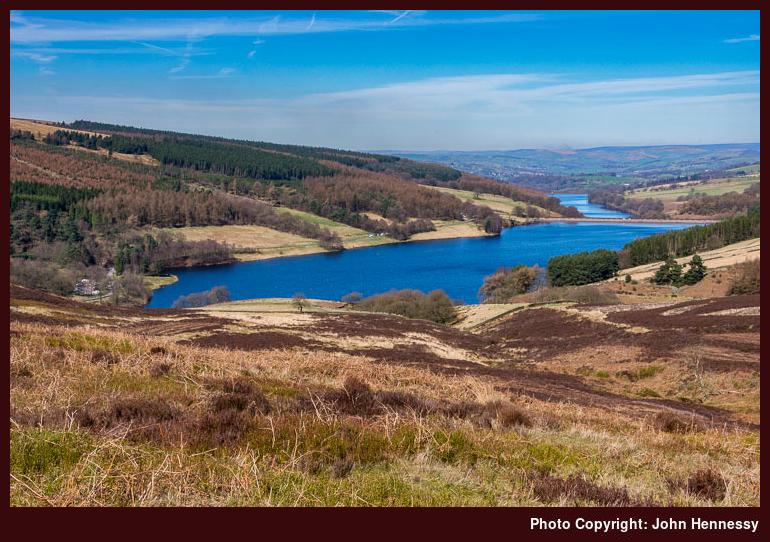
This time around, I ensured that I stayed as close to the line of my intended right of way as possible and got better views along the valley too. That there were hardly any marks on the ground from previous stragglers may have made it a more challenging task, but it increased the chances of solitary wandering, something that I relish. In something of a freestyle fashion, I found the wall where I would turn right and use as a handrail for further navigation. A clough crossing added a descent and subsequent re-ascent before a more descenting descent followed. While I should have stayed near the wall, I veered away in the hope of more friendly gradients and the chance of a zigzag course. Since I was on Open Access Land, there was no need to stick rigorously to the route of a public footpath anyway.
The cause of that testing descent was another nameless clough and I returned to the wall to continue to one with a name: Wildmoorstone Brook. Crossing that and going uphill again brought me to a reservoir near Goyt's Lane. While the road would take back towards Errwood Reservoir, I chose a byway in its place and that returned me to more familiar surroundings, but I was to add another twist: a footpath going around Bunsal Cob that cut out even more road walking. The knoll itself was not left without further exploratory perambulations to extend the time spent there before continuing to the dam of Errwood Reservoir.
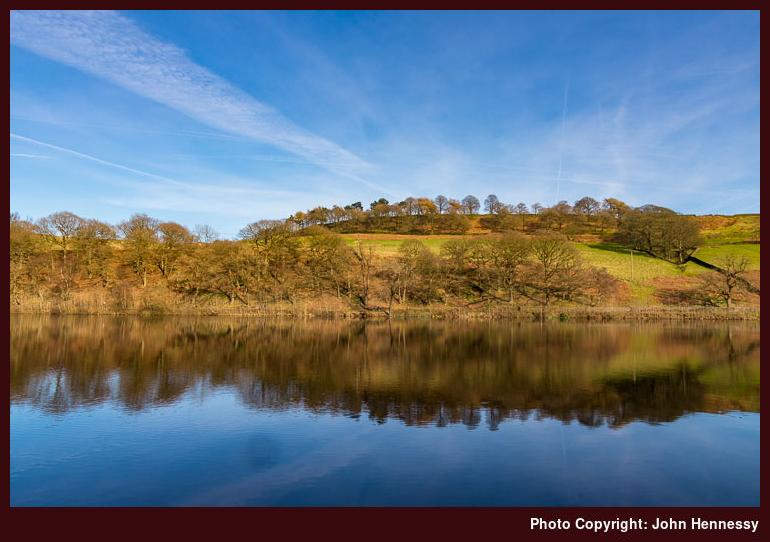
Leaving there, I spotted another path that followed the slope of the dam itself to give a more satisfying start to a stroll along by Fernilee Reservoir. This was the first time that I was doing that without sunshine fading on me or rain showers intruding. There was loitering about its reservoir as I checked if a previously encountered obstruction remained because of work on a building containing asbestos in its fabric. Since the obstacle allowed no further passage, I advised others as much, and I retraced steps and followed the same course into Whaley Bridge as I did in December. It was just as unpeopled as I found it on other visits.
It can amaze how a brain records events for the signs of others out enjoying the day as much as I did, hardly remain now. Another curiosity is that the exact details of how I got home have been lost too, but any journey would have involved a change in Stockport. Whether that was from bus to train or train to train is unclear now, but both are plausible, and it certainly was not a direct bus ride to Macclesfield like the previous encounter with the area. The important details persist, and it is the ambience of the hike that can be reproduced most readily. Since that is often what draws me, it is just as well, and any sense of recalled calm is a godsend when life proceeds along one of its rougher stretches.
Travel Arrangements
Bus Service 58 from Macclesfield to Burbage on both days. Bus service 60 from Whaley Bridge to Macclesfield after the December walk. Bus service 199 or train to Stockport followed by a train to Macclesfield after the March hike.
A few hours wandering about the north wall of Great Langdale
4th September 2018 2016 was a very full year. There was a lot of Irish business to be completed along with two political upheavals and a new job that I now realise was not a match for me. Towards salving the last of these, there were no less than three overseas trips with on each to Austria, Norway and Mallorca. Even with these and maybe because of them, I still did not feel that I was getting the emotional space that I craved so much. It set the scene for changes in 2017 that led to the start of a career break.
This post tells the tale of another trip that preceded the personal tumult of 2017 while coming after the global turbulence of 2016 and in the midst of finishing the personal work for the year. It, too, was a reminder that not all was well with my lifestyle and there was another in the form of an inability to stop spending on some things as if the future never existed. Looking back on this now, I realise that it was caused by a lack of personal emotional space caused by having too much happening in my life. That theme was to result in some adjustment in subsequent years.
To avert any loss in motivation, I booked a single room in YHA Ambleside so I travelled up there by train and bus on Saturday. A later departure meant that I arrived in the dark, but that did not stop me strolling about the place. After all, the shore was near at hand and I even got into the heart of Ambleside, which was a kilometre or two away; in spite of the name, the hostel is found at Waterhead on the shore of Lake Windermere. A fish supper was enjoyed too, a rare thing for me these days. For the way back, I should have had my head torch for going along a darkened lane though I came to no harm because of my risk taking.
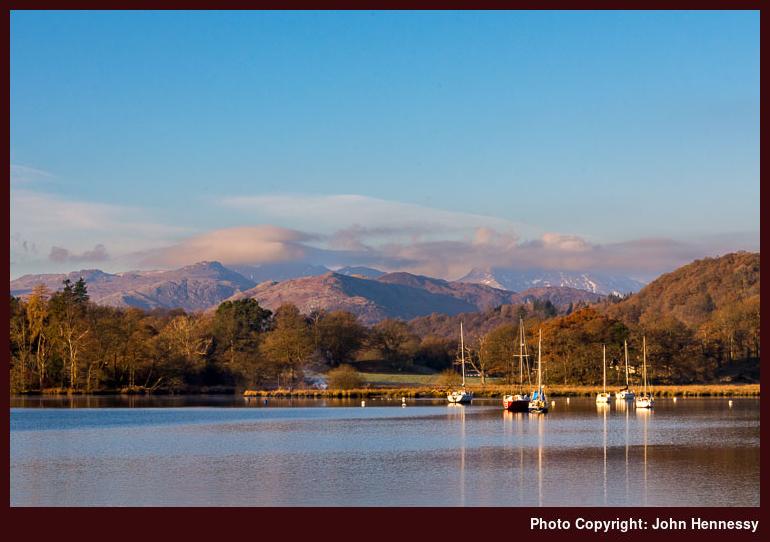
After all that, I settled down for the night and arose next morning to a pleasing scene. Between 08:00 and 09:00, the sun leisurely arose. Before this all started, I made a solitary photo that recorded a peaceful scene on Windermere with the sky having a rosy hue about the frosted grassland. This also preceded breakfast and I was lured out again after that to savour a scene whose tinting was changing from red to blue. Cloud cover steadily broke as I did so and, after collecting my belongings and checking out, it was time to await a bus to Great Langdale.
It may have been down to thinking of exploring the place at the wrong time but I never had much luck with seeing Great Langdale in bright sunshine. Admittedly, the visits have been few with the first being on a walk from Borrowdale that took in the Scottish sounding Langstrath and that was followed by a winter wander from Great Langdale to Ambleside. Both were greeted by grey skies. More often than not, I viewed the distinctive Langdale Pikes while on other hikes so it was not before time that I saw them up close in favourable conditions.
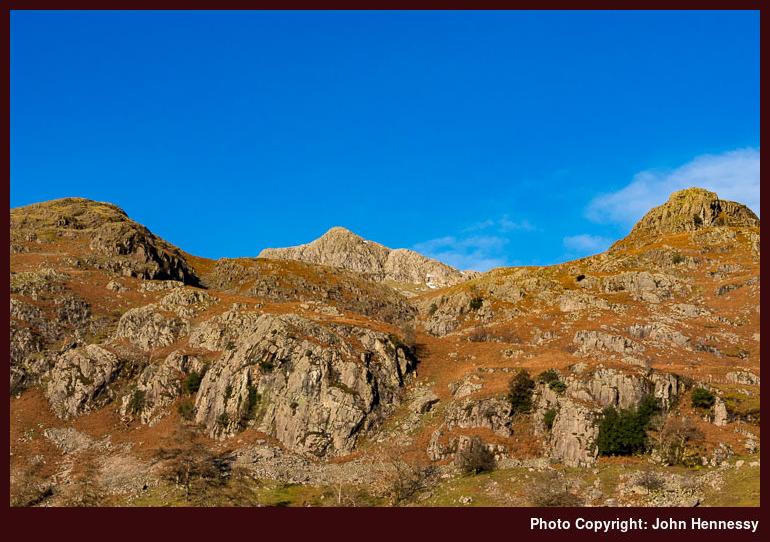
The bus dropped me at its terminus near the Old Dungeon Ghyll Hotel. Frosted grass told a story of a preceding cold night on the valley bottom and the following morning was little warmer. This was more than a little noticed as I pottered along the flat ground by Great Langdale Beck between Old Dungeon Ghyll Hotel and New Dungeon Ghyll Hotel. In fact, I was reproaching my forgetfulness when it came to having gloves. Local shepherds were moving their flock, something had me wondering if such an act could not have been done on another day. After letting them on their way, I shortened the distance to Stickle Ghyll while warming my hands as well as I could.
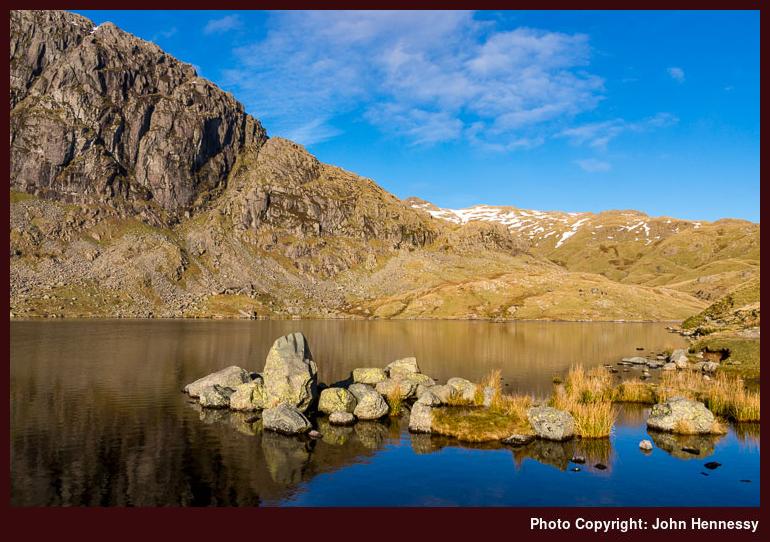
Following what had been a largely quiet interlude, I joined the busy path up to Stickle Tarn. The gradient was testing and it helped little that the perceived throng stopped me from stopping as much as I would have liked. Passing and re-passing the same people needed energy so I was not willing to allow that to happen so readily. The others were bound from the tarn with some continuing to the top of Pavey Ark. After the fleshpot, quieter surroundings were sought and found. The distraction had its uses for my hands warmed on the ascent while the presence of snow patches attempted to belie any sense of the day having become that little bit warmer too.
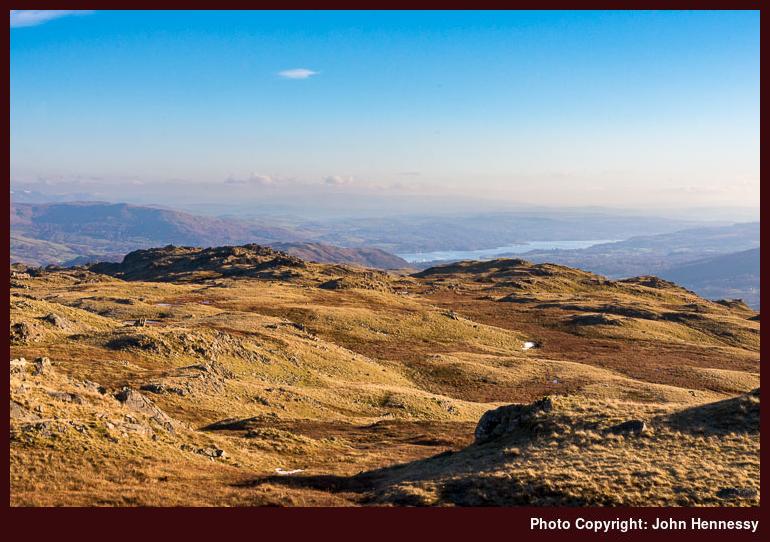
Looking back on what happened next, it might have been that the expected right of way was not a path on the ground, but even having a GPS receiver could not stop me veering off it. A determined effort could have addressed this, as I was to find afterwards in similar circumstances on the moors between Bamford and Hathersage in Derbyshire. Then, I stuck with the line almost regardless of what lay underfoot. Returning to its Cumbrian predecessor, I took the hint and adopted a freestyle approach. In any case, there were multiple paths so it was a case of picking one that went in the desired direction and the benign weather allowed for such an approach.
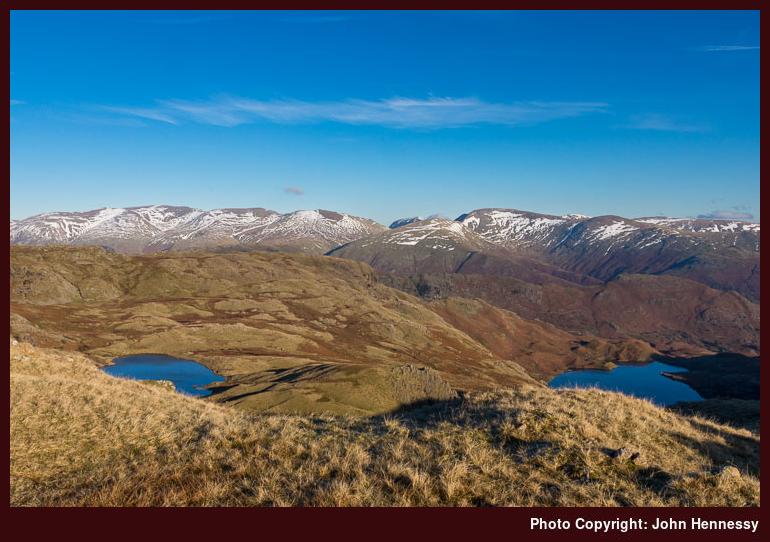
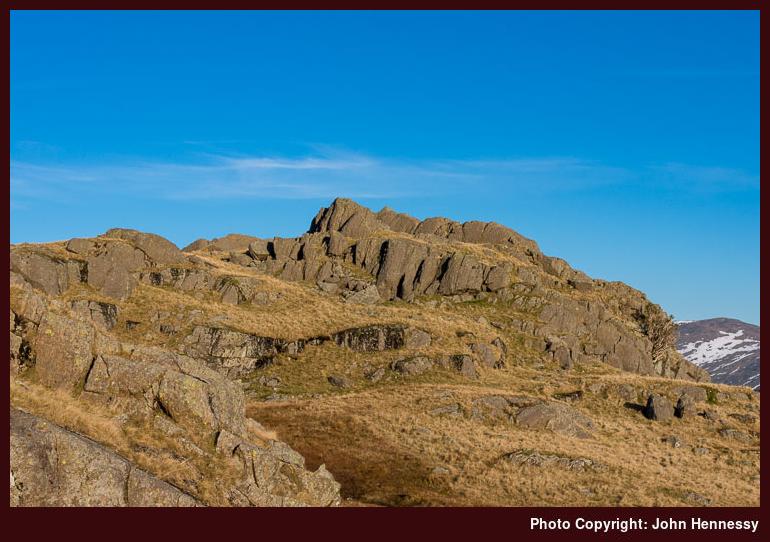
My wandering course took me around by Blea Rigg and Great Castle How. Though it was afternoon at this point, it was around these that I gained the most satisfaction. Few were about so I could amble as I liked and the momentary sense of relaxation was just what I needed with wonderful views round about me. Windermere could be seen to the south while both Codale Tarn and Easedale Tarn lay below me in the growing afternoon shadows. It did not matter that I ought to have been beside them and not above them as I was.
What began to occupy my mind was finding a way down to the eastern end of Easedale Tarn. Once the initial steepness of the chosen descent was past, it was replaced by more gentle slopes as I negotiated the way to the track by Sourmilk Gill. The sun may have been lowering all the while but I had daylight with me and there were a few others passing the way but in nothing like the numbers encountered on the way up to Stickle Tarn.
All navigational travails were behind me, for the clarity of a defined track aided passage as much as the onset of a quiet lane. The surrounding land was falling increasingly into shadow, but my timing was good when I got to Grasmere. There even was some time for self-tidying before the next bus to Windermere. The air may have been cooling again but I was on my way soon enough.
That afternoon had provided a much-needed interlude that was the forbear of longer ones like a subsequent springtime sabbatical and a longer career break. The identification of a need for more personal emotional space became a search that remains ongoing. It even seeps into how I approach work these days and a spot of quiet time among Cumbrian fells became the start of an ongoing journey.
What has not happened so far is the incorporation of repeat visits to that itinerary. Vantage points like Lingmoor Fell, Pavey Ark and Harrison Stickle all take my fancy and should add the familiarity whose absence was felt while figuring out what subjects were in the photos selected for this trip report. Doing so in similarly sunny and serene condition would add to such experiences and I would return in hope of such things. Life still needs quieter moments.
Travel Arrangements
Train journey between Macclesfield and Windermere. Bus service 555 from Windermere to Ambleside and from Grasmere to Windermere. Bus service 516 from Ambleside to Great Langdale.
Sport?
31st August 2018 Cooler temperatures have encouraged me to hop upon on a bicycle that is left permanently on a bike trainer. It got so hot at times this past summer that this was the last thing that I have contemplated. Some may think that such an act would be dull but I avoid anything like boredom by catching up with some reading at the same time.
This has been how I came to start through my back issues of the Irish Mountain Log, published by Mountaineering Ireland and one of the few remaining news stand titles that feature Irish hill walking. However, the organisation also covers other similar activities like mountaineering and climbing in both its indoor and outdoor forms.
That may be one reason why its editor insists in calling outdoor activities that take place in hill and mountain country a sport but funding for outdoor activities can come from government sports agencies for whatever reason and Ireland is among those. For instance, the Irish Trails website is funded by the Irish Sports Council.
However, I don't think of my hill wandering as being sport at all and I also find the expression alienating. To me, sport is a sterile thing with its focus on competition while my motivation for walking through the countryside is as much as about enjoying natural sights and sounds as getting some space to clear my mind. At heart, I am also an explorer so I like to see new sights too. It is about savouring surroundings and experiences rather than having a head filled with thoughts of conquest and victory.
The Irish Mountain Log does feature some of that so I would prefer outdoor-focussed activities to be called something more than a sport even if that attracts some funding. Mountaineering Ireland may support competitive events but they do include mountaineering and hill walking so my suggestion is that the label becomes "sport and outdoor activities" or "sport and outdoor pursuits". The titles may be longer but they sound more inclusive and might incorporate better the social side of these activities that is important for so many in Ireland.
Autumn reflections
30th August 2018 There have been a few nights this week that possessed the chill of autumn and some trees already are losing their spring and summer colouring. In fact, I picked two early conkers on a walk this evening. Meteorologists may prefer us to wait until the start of September but I always wonder if autumn really starts in the middle of August. Some I overheard talking about turning on their heating may not disagree with me so strongly.
It is strange how we assign the summer months because when it comes to hours of daylight, August in some ways is a mirror image of April. The main difference generally is the residual heat remaining after June and July, something that can hold until the start of November. This past summer has been exceptional so it is not that the school year starts after a break without its share of sunshine even if August came damp.
For whatever reason, I can get ideas about fresh restarts around this time. It might be that there is a lull during September or the start of those school, college and university years but my mind can fill with possibilities while bemoaning that such things often are stymied by a decline in energy coinciding with growing hours of darkness. It often feels like a brief burst of energy before other things take hold.
The latter has me wondering about a midwinter getaway since I did not have an overseas trip this summer because of other concerns. This line of thought also emerged two years ago and there was a trip to Mallorca with some walking that in on my radar for a forthcoming trip report. Other possibilities will be assessed and enough time allowed so as not to have 2019 began like 2017 when a heavy cold weighed me down.
2018 has been a busy year for me with a move into self-employment taking up the summer months and a series of property maintenance tasks in Ireland that were planned during the career break that I began in August 2017. The last part of 2016 came busy with Irish matters so that might not have helped the start of the next year either. As I look to the rest of this year, I hope that work will remain steady enough for me to focus on other things like getting out and about in any good weather that comes. Life has become an adventure again and that blows away any staleness that once may have beset me.
Getting to know Norway: Part 3
28th August 2018 There is something about spending around a week in a place that adds satisfaction to a trip. This is something that I have been discovering on trips to Ireland to get things done. The extra time allows for a chance to soak in the atmosphere of a place and feel more of a part of it. For that, though, you need to not overfill days with activity because that makes you so busy that nothing has any time to seep into your spirit.
That reminds me of a recent trip to Ireland where it was possible to stop awhile and go for strolls in addition to the other things that I needed to do. People were met and things organised, but there was enough time to feel more at one with where I was. Other stays have been as long in duration over the last twelve months, and they have left their mark in a manner that an extended weekend trip would never do.
A relaxed pace often helps. Thinking back to Scottish trips like the one that took me to Na h-Eileanan nan Iar ten years ago, they had defined itineraries, but hill wandering added the slack which allowed me to look around and take in the sights and the ambience of where I was. Just rushing along would never do that, and the much-needed recollections of peaceful islands would have been lost. Such is the state of the world right now, that any memories that restore peace and calm are all the more invaluable.
Oddly, no outing since that Hebridean escapade has exceeded its Sunday to Sunday eight day length and none came close until June 2017 when I enjoyed a six-day sojourn in Norway from Sunday to Friday. Following the August 2016 Friday to Monday four day encounter, this stay was to allow some added breathing room after I noticed how short its predecessor had been. There are other compensations too, for it starts to fill like a proper break after about the third day and any extra days embed a certain sense of discontinuity that really helps for a fresh restart once back into the everyday routine. After what has happened in my life over the past decade, that is relished all the more readily these days.
2017-06-05: More time around Oslo
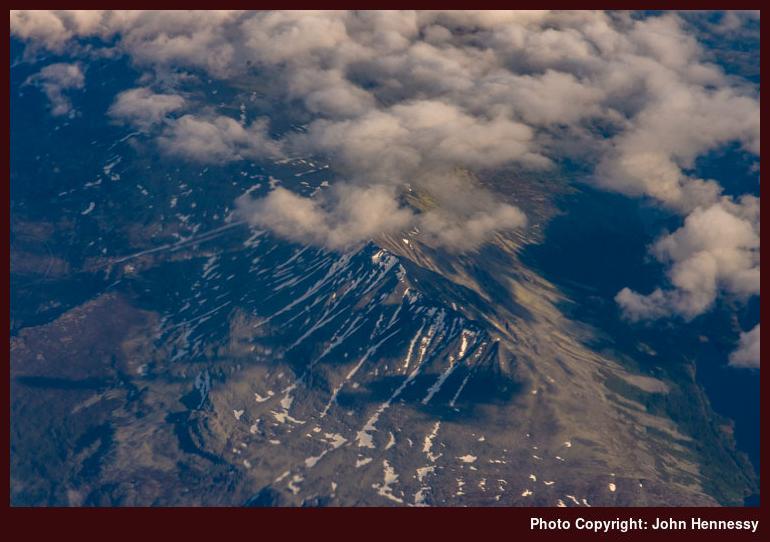
An afternoon flight from a stuffy and busy Manchester Airport got me to Oslo. If I had known better, I would have stayed on the train from Oslo's airport longer to get closer to where my hotel was. The day had been damp but remained dry as I undertook the longer than expected walk from Oslo sentralstasjon through the city's heart, and my tardiness was noted by the hotel receptionist before I was compensated with the largest hotel room that I ever occupied. It felt more like a two - room studio flat, so there was plenty of space to relax for a while.
The reason for the long trek that Sunday evening was the hotel's proximity to the Royal Palace (Det Kongelige Slott in Norwegian) and that helped to address some unfinished business from my previous visit to Oslo. The next morning brought bright sunshine, so it was time to start a whole day of exploration around Norway's capital city. Looking back through the photos now, it would be tempting to think that it was all sunshine, but there was a shower of rain in the middle of the day while I got something to eat.
My day started around the Royal Palace, though, and I realise that mornings were better for photographing its frontage because that is when sunlight falls on it. In 2016, I had hoped to do just that before catching my train to Bergen, but there was not enough time, so it had to wait. There were no time constraints the next time around, so I had the space that I needed, and it was a wrench to pull myself away for further exploring.
As I continued through the city centre, there was a feeling of closure, and it appeared that Norwegian public holiday observance was much like what they do on Sundays, since no large stores were open. The need to purchase a USB Type C cable for powering my Google Pixel C tablet had to wait until the next morning, but there was no time to be ruing my leaving the actual cable after me, for I wanted to see Akershus slott.
Getting there had me passing landmarks that I had seen before, like Domkirken, where I tarried a while. When I reached the Akershus fort, I spent some time there too, with the old buildings catching my eye as much as any views of Pipervika and the severe-looking towers of the Radhuset were unmissable. Their architectural style reminded me a little of Stockholm's Radhuset, and I was later to realise that Karl Johans gate lay not far behind Oslo's city hall. My previous wandering had taken indirect routes, but I was to uncover shorter ones.
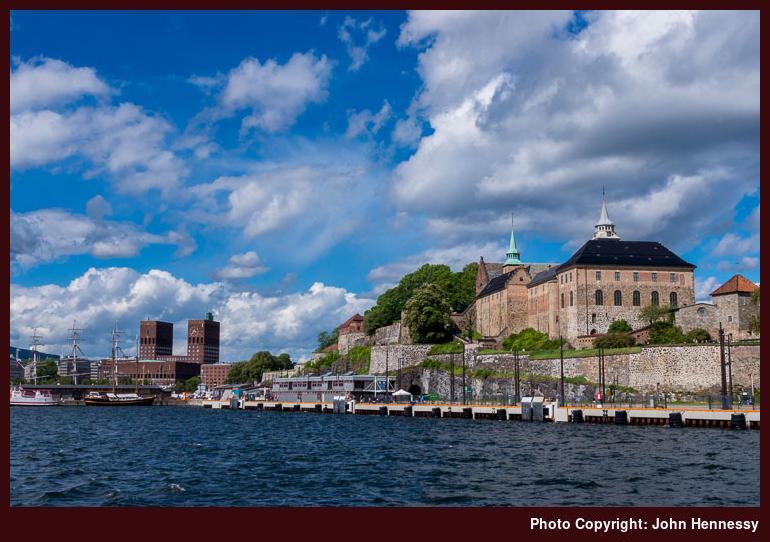
One of those was to facilitate a trip to my hotel that preceded a boat trip around Oslofjord that took my fancy. The outing was not a cheap one, but it made a change from wandering about on foot. The boat may have looked like a sailing-vessel, but it was powered by a diesel engine and did what was needed. Greener and bluer surroundings were to be savoured in the sunshine before a return to land, where I did more pottering about in by now familiar places before I retired for the evening in advance of travel to Stavanger the following morning.
2017-06-06: Last-minute resilience has its rewards
It is possible to travel to Stavanger by train, but it is a journey that takes six or seven hours, so setting aside a day or travelling overnight would be involved. In the interests of time, I chose to fly, so I caught a train to Oslo airport from near the hotel and checked in for the short flight. That was a speedy and well automated affair, so I had time to pick up a power cable for my tablet, and the helpful assistant also saved me some money on my purchase.
On arriving in Stavanger, I caught a coach to the city centre, where I placed my main holdall into a luggage locker for later retrieval. Check-in for the hotel was not until later in the day, and I wanted to try my luck at getting onto a Lysefjorden boat trip. When I went to the provider's shop, I got news that they were booked out for that afternoon's sailing, so the omens were not good.
As befitted the outcome of my enquiry, the skies were grey with little sunshine, so I strolled along the quay-sides surveying the cruise liners that were docked there. Then, it occurred to me that going to the boat and asking for a space might be worthwhile, given that not all booked passengers do show up. So, I resolved to try my luck and got on the next sailing after some patient perseverance. It was just as well, given that rain was to dominate the weather for the following few days.
It also happened that I had some designs on walking around that part of Norway, so I fancied getting an introduction to where I was intending to go. The boat manoeuvred around the docked ships with such agility that it was intriguing to watch, and I then realised why the boat had wing mirrors. One around those obstacles, we were on our way.
The boat entered more open water after going under the bridge carrying the main road to the islands of Sølyst, Engøy, Buøy and Hunvåg. Ferries were seen plying their ways, and we were accompanied by a smaller boat for much of our own journey. Passing more islands, we reached the opening of Høgsfjorden, where we entered to get to its tributary Lysefjorden. There was little sign of sun, or I would have been busy photographing sunlit islands to my heart's content, not that the surroundings were not beguiling without the added lighting.
Things got more interesting after Forsand, beyond which we passed under another road bridge. Bergsholmen was our next landmark, and the fjord grew wilder in appearance the further along its length that we went. There were various stops within the vicinity of Preikestolen to see waterfalls and such like, but it was the rocky outcrop itself that was the main event.
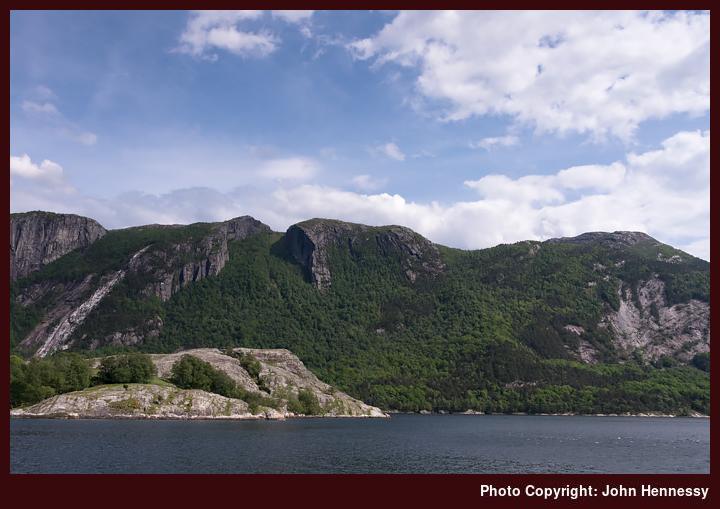
Once we started our return to Stavanger, it was easy to tell that the attentions of others were waning, for the sightseeing must have been done as far as they were concerned. For me, though, things only were getting going as sunshine had broken through the cloud cover to light up the surrounding hills. Though the episode did not last, there was plenty to photograph while it did. All the while, the Lauvikka to Forsand ferry plied its passage and there was a freight ferry full of articulated trucks carried in a more insecure way than I would have expected.
Soon enough, we were back on firm ground again, and I checked into my hotel. Electrical power in my room was limited until I discovered, until I made an enquiry of a hotel receptionist who told me what the "Hovedbrytter" switch. When I went back to offer my gratitude, I met someone different without realising it and caused some confusion before spotting the right person in the office behind her.
Putting that embarrassment behind me, I did more strolling around Stavanger while sunshine and blue skies had made their appearance. Later, I had some food while pondering the next few days would bring. Possibilities like hiking to Preikestolen or Kjerag would need to be selected according to the weather that came.
2017-06-07: Going Scandinavian in the rain
If I had any plans to go to Preikestolen on Wednesday, they were stymied by the predication of afternoon rain. The morning was dry, so it allowed some more strolling about Stavanger and a spot of shopping too. After a midday meal, I decided to brave the light rain to walk around some of Stavanger's lakes. In many ways, it was like what the Irish would call a "soft" day, and it was mild too.
There is a piece of Scandinavian wisdom about there being no such thing as bad weather, so long as you are clothed for the conditions. That was the approach that I took as I headed for Litla Stokkavatnet, but I hoped that there would some shelter from trees too, and so it proved when I started to go around the lake itself after getting there along urban streets. As I moved to the shore of the larger Stora Stokkavatnet, it was easy to get the impression that you were not in a city at all, but that this could have been a country location. That idea persisted as I made a brief visit to Hålandsvatnet because Friheim may as well have been a country hamlet.
Returning to Stora Stokkavatnet, I persisted with my anticlockwise circuit, even though coming off near Sanddal would have made it quicker to reach Mosavatnet. As I completed my way around, it was apparent that the evening rush hour was imminent because many were cycling in the opposite direction. The ambience had been pleasingly quiet, and this posse of cyclists did little to disturb that.
Eventually, I needed to leave my wooded lake-land surroundings after me to navigate towards Mosavatnet. Quieter lanes and cycle paths were my lot, and it took a little effort to orient myself properly at one junction over a busy road. Once that was achieved, I soon was at my intended destination.
Again, wooded lake shores were my lot, but there were more people out and about by this stage in the day. Quite a few of them were jogging, and no one seemed to notice the rain that much; that applied as much to groups of youngsters out training as it did to anyone else. The proximity of city streets and major building works meant that the feel of the place was not as rural as that around Stora Stokkavatnet, but that was overlooked as much as any temptation to take a shortcut back to my hotel again; this was to be another complete lake circuit.
Finding a quieter road, I left Mosavatnet to continue towards Breiavatnet and I soon started to recognise my surroundings as I got nearer to this lake that I had passed more than the others. After all, it is beside the bus and train stations, so I spent some time here the previous day. On this occasion, it was time to get back to the hotel and end my damp yet satisfying saunter.
2017-06-08: Two hikes in one day
My last full day in Norway allowed me to go hiking in wilder surroundings despite what felt like twenty-four hours of rain. Once I had dealt with some Irish matters by phone and email, I was on my way for a stretch of time away from any semblance of work. Lightening rain added to the hope of there being something special to savour.
After a ferry ride to Tau and a bus journey from there to Vatne, I was at my trailhead. Because I was destined for Preikestolen, this was no solitary trek given how famous the rocky outcrop happens to be. Nonetheless, I enjoyed a dry start in misty conditions, but rain was to return, so the walk was to become one where I was clad in waterproofs for much of the way. This made the ascent sweaty work and I needed to be aware of others around me too, not that there were no quieter stretches.
Looking through the photos that I captured, there is very little from the ascent, but I still recall moments like a phone call from my brother and the final approach to the viewpoint where you could see all around and wish for sunshine because it would have been so alluring. There was plenty of wet rock to traverse, and the conditions must have chivvied me into making near constant progress all the while.
What is etched in my mind is the poor visibility at Preikestolen itself, not that it deterred anyone from taking clichéd photos of each other. In my own mind, I like to think that the clag spared me from seeing anything like a sheer drop, so it was no disappointment to meet with it. People still must have remained there a while because what I remember of the descent is that it was quieter and there was one point where I was tempted to include a diversion to Moslifjellet but discounted it for reasons lost to me now.
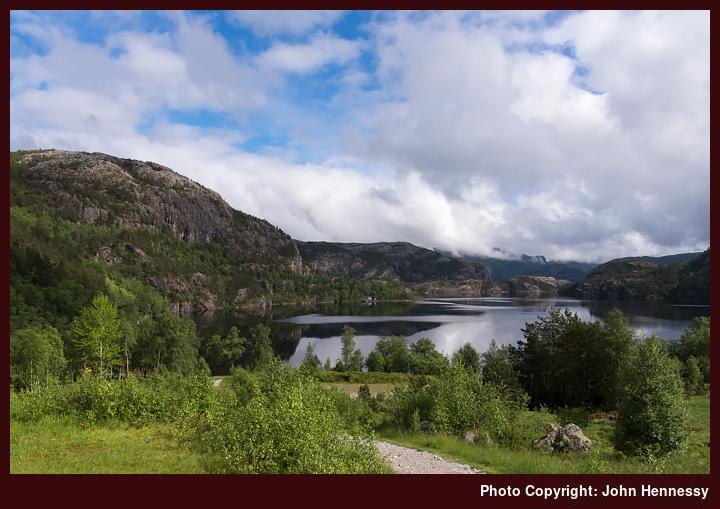
It might have been galling for some, but the sun began to come out when I was back at Preikestolhytta, but I must have seen it as an opportunity for a second hike to follow the four-hour return trip to Preikestolen; anyone that stayed up there may have been rewarded by breaking, so who is to know what rewards ample patience can bring? While others relished such a thing, I had Revsvatnet in front of me, and it surrounded by a pleasing mix of bright greenery and craggy hillsides. Assessing how long it might take from the map that I had and how long I had before the last bus to Tau, I decided to hike around a lake in a much wilder aspect than anything that I had encountered the day before. There are other walking routes in the area, but I reckon that they would need more time to explore and taking one's time is best.
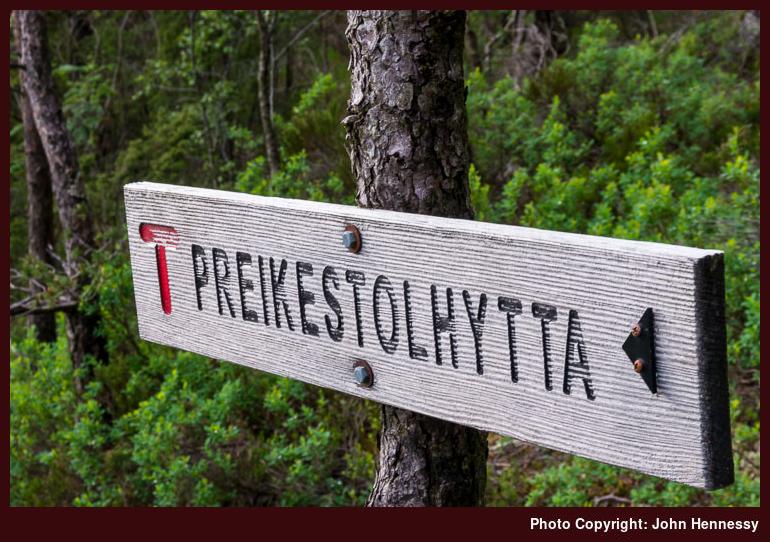
The lake circuit also granted me some solitary walking that was not my lot earlier in the day, and it was accompanied by morale-raising sunshine for most of the way, so my camera saw more use. The air might have dried, but the often boggy ground remained soaked, and any long vegetation was leg wetting. Even so, I continued along rough paths while keeping an eye out for any confirmatory splashes of red paint. That strategy worked well until a scramble threw me off track enough to cause disquiet in the woodland at the southern end of the lake before I regained the right path beside the Revsåna flowing towards Lysefjorden. Going along the river bank against the flow of water got me to a bridge near the lake shore and a sign for Preikestolhytta that soothed any loss of composure.
The path went up and down a lot as it passed several waterfalls, so that took its toll on tiring legs. Reaching the hut at Torsnes brought short-lived hopes of a broader and gentler track, but more path walking followed until I was back near Preikestolhytta again. Any hopes of catching the penultimate bus of the day to Tau suffered the same fate as those at Torsnes, so a longer wait in muggy midge-populated conditions was in order; it gave my system some much-needed rest. At least, I was awaiting the bus instead of being stranded by my own tardiness, and it was reassuring that I was not alone in my vigil. In fact, the others continued all the way back to Stavanger by the reverse of what had been my outbound route.
2017-06-09: Departure
While I might have liked to return home on a Saturday and gain an extra day, flight schedules scuppered that scheme, so I left on a wet Friday. Waiting in the hotel as long as possible did not stop my getting damp on my way from there to the bus station, from where I got to Stavanger's airport to start an air journey with a connection via Oslo. The experience was a reasonably painless one.
Overall, the trip satisfied me and imperfect weather was not a source of irritation; much had been savoured and Norway is better known to me. Unused schemes like a visit to Kjerag or travelling up the coast to Bergen may encourage another return yet should life settle down again and my overseas wanderings restart. Other parts of Norway are tempting too and visiting the Lofoten Islands or Jotunheimen National Park are just two examples, and I also would like to wander about the wooded and lake-studded hill country near Oslo itself. In a nutshell, there is more to draw me to Norway again.
Travel Arrangements
Trains between Macclesfield and Manchester Airport, as well as between Oslo and its main airport at Gardermoen. Outbound and return flights between Manchester and Oslo, and between Oslo and Stavanger. Coach travel between Stavanger and its airport. Return ferry trip between Stavanger and Tau, followed by a return bus journey between Tau and Vatne.


