A matter of building some confidence
 3rd March 2014
 Last Saturday came stunning but there was a list of things to be doing so I didn't get to making the most of the weather. Nevertheless, a useful hour was spent out on my new Dahon bike. The journey was short and took me from my house to Bollington and back. The Middlewood Way formed the outbound leg and offered useful off road acclimatisation to someone who has not done so much cycling over the last two years. Finding oneself negotiating a busy junction after being out of practice can fell more daunting that it should so that needed sorting.
Aside from the there being no road traffic, there are also was a chance to fine tune the set up of the bike. It was easy to stop and raise the saddle to the right height as well as tweaking the handlebars. Though there were others out and about, it didn't mean that the bike could be put through its paces to see how fast it went and how well the brakes really worked. Like my mountain bike, the Dahon is low geared and that may be just as well anyway. A touring bike might be a better proposition for any longer distances like going from Macclesfield to Chester like I did the most of four years ago now.
On the way back, I tried both it and myself out over roads and could do so with a little more confidence knowing that seat and handlebar settings were more optimal. A major roundabout was negotiated safely along with several road junctions. A diversion through a quieter housing area was a deliberate way of adding to the acclimatisation before going further afield.
Before that, I need to regain more of the fitness that I used to have because any hills tested me, even smaller ones. That could mean more short cycles like the one last Saturday and I am wondering about popping the mountain bike on rollers (otherwise known as cycle trainers) too so wet, windy or cold weather and shorter hours of daylight no longer can be an excuse for not being on a bike more often unless a certain prospect of boredom does for my good intentions. Going somewhere for real is a motivator that is hard to beat by other means.
New bike, new possibilities
25th February 2014 For a while now, I have been playing with the idea of getting a folding bicycle for use on cycling getaways. The main reason behind this is that one of the things that has held me back from cycling further afield has been the limited carriage of bicycles on buses, coaches and trains. It is true to say that I have entertained thoughts of bicycle rental though the only time that happened was on my first visit to the Isle of Skye in 1999. Maybe it's something that needs rediscovering.
In the days of goods vans on passenger train services, things were far better but my arrival in the U.K. came well after those days and some operators like Virgin Trains will not carry a non-folding bike for you without pre-booking. Others again restrict the carriage of bicycles on their services at peak times and others who do not only provide space for a small number of non-folding bicycles anyway. Two is typical on Northern Rail services and that cannot be called generous.
There may be buses with bicycle pens operating in parts but these are the exception and not the rule. Any space on a bus that could be used for bicycle carriage gets devoted instead to conveying those on wheelchairs and children's pushchairs. Those buses with bicycle carrying capability can be ephemeral too and any example would have been the bicycle racks on the backs of buses running Arriva's now defunct TrawsCymru services across Wales.
Bicycle carriage on coach services is very restricted as I discovered on my first ever trip to Fort William back in 1998. It was so unlike Ireland where I did see someone pop a bicycle into the luggage locker of a Bus Éireann without any comeback for the act. In contrast, National Express will carry a folding bike for you but only in a padded bag or hard case. Their conveyance of full bikes meant a certain amount of dismantling but even that is out of the question now.
With all these constraints, it is easy to see how folding bicycles have risen in prominence. The best known brand is a British one: Brompton. These are not cheap yet remain popular even if other manufacturers have entered the fray. These offer less expensive items and you even might be able to get a folding bike for around £100 in a Go Outdoors sale. Mind you, it probably is best to go for something more expensive to get better quality. Sometimes, you get what you pay for with these things.
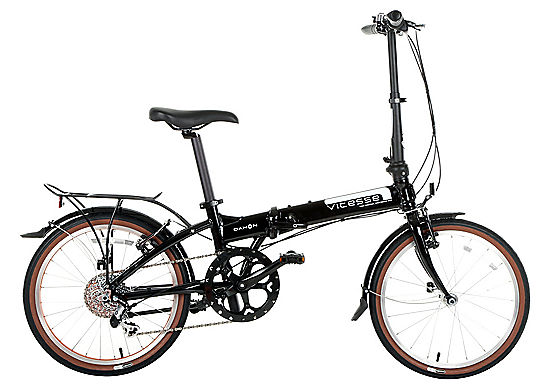
Recently, I finally took the plunge with a Dahon Vitesse D8 from my nearest branch of Halfords. They had the bike in stock and built it well for me. The folding mechanism was demonstrated too, if imperfectly. Once I got home, I spotted the actual folding order on a label attached to bike: saddle down first. handlebar folded next, then main bike frame. A short ride was a brief test of the 8-speed gearing and other important aspects of the bike like steering and brakes. The former of these worked well even it felt just a little giddy so that might why users are not advised to set the handlebars too high. As for the brakes, these had the bite that I would have wanted so there are no complaints there.
Thought the Dahon is sold as being for commuting, I quite fancy using it for more than this. Usefully, it has mudguards and a luggage rack so my mind to turning to various level cycling trails in Derbyshire. First, there is Longdendale Valley near Hadfield for seeing how things go to start. While a train journey possibility would allow transit of a full size bike, it sounds a good place to begin with a folding one. Others that come to mind include the Monsal Trail between Miller's Dale and Bakewell, the High Peak Trail from Dowlow (not so far from Buxton) to Cromford and the Tissington that also starts at Dowlow but instead goes as far as Ashbourne. Roving into Staffordshire, there is the Manifold Trail as well even if that has a scary tunnel at one point. More possibilities may appear to follow these but they all should make a good use of the new bike. The next step is to get it out there to savour those places and overcome such fears as punctures or other mechanical troubles. That off road cycling could help with regaining on-road confidence would be a bonus too since I have been on a lengthy break from cycling for one reason or another.
A circuit by the River Wye
9th February 2014 One thing that strikes me about Britain is how you find the same river names turning up in different places. Those that come to mind include the Ouse, the Derwent and the Wye. There is every possibility that some have come upon this post looking for the Wye that rises near Pumlumon in Wales between ducking and diving across the border between Wales and England before reaching the Severn estuary near Chepstow. As it happens, I quite fancy spending some time near Tintern and such places, but that has yet to happen. Pumlumon, where the Welsh Wye rises, has remained untouched by my footfall too, so that's another possibility.
Derbyshire's Wye and Preceding Occasions Spent Beside It
What this piece features instead is another River Wye, the Derbyshire one that rises near Axe Edge before dropping into Buxton and winding its way towards Bakewell before then going on to join with the River Trent. It is a river that I have been near more often than I had realised. The reason behind that discovery is that all my visits to Buxton have put be not far from its course without my realising it. There have been a fair few of those since my cycling there on a Saturday in August 2000. That was the first and only time that I did so and the steepness of the route followed by the A537 not only convinced me not to return the same way that even but also triggered the start of my hill wanderings and ensure that buses have been used since then.
Speaking of buses, further forays have been facilitated by them and one January day spent going further than Buxton to stop at Miller's Dale, Tideswell and Bakewell. It was a sort of poking around the Derbyshire Dales that a guidebook had inspired. Getting home from Bakewell even might have involved more bus journeys, with one taking me as far as Chesterfield before another got me to Sheffield, where trains took over travel duties. There must have been a change in Stockport, though I scarcely can recall it now. Well, it was more than a decade ago and many things have gone through my mind since then.
My first real walk on the Monsal Trail was on an overcast Easter Monday in 2001 when I embarked on an out and back journey from Monsal Head. When I initially tried to recall memories of the walk, it worked better for the outbound trot, and I was unsure whether I returned on foot or not. However, I now reckon that I must have retraced my steps on foot as well. With these things, you need to be careful that later memories are not getting mixed with earlier ones.
A Saturday during July 2001 again saw me following the Monsal Trail with a then new camera, a Canon EOS 300 film SLR, and with a lot of sunshine around too. The starting point was Miller's Dale and I remember the diversions that took me around by places like Cressbrook and how narrow the river valley got in places. Since then, former railway tunnels have been reopened, so the whole trail becomes a very reasonable cycling excursion for anyone. It was a delight to see the Monsal Viaduct with sunshine upon it, though it's best to remember that photographing the dale from Monsal Head is best done in the morning with the sun in the east. Otherwise, lens flare and undesirable exposures will stymie your efforts. From Monsal Head, I did not follow the trail all the way into Bakewell, but instead deviated to visit Ashford-in-the-Water before continuing to my destination. It was a good walk and that remains worth repeating.
Tideswell saw me visit again in December 2005 before I continued towards Litton and a descent into Cressbrook Dale to reach Monsal Dale. There again was a diversion towards Ashford-in-the-Water on the way to Bakewell. It remains a memorable day despite greasy ground conditions. A passing fellow walker tumbled to soil white woollen gloves, so my use of walking poles was far from daft. Apart from saving knees from wear and tear, they also steady you and stop most if not all accidents caused by slips.
Another Encounter
Last year, I was reminded of how long I had left Derbyshire without so much attention, and I redoubled my efforts. Thinking through those memories, some faded, again makes me keen to explore old haunts and reinforce those memories with new ones. That was partly why I got myself over to Bakewell on the penultimate Saturday in April of last year. Apart from the prospect of some sunshine, the need for some me time following a recent life event was another motivator.
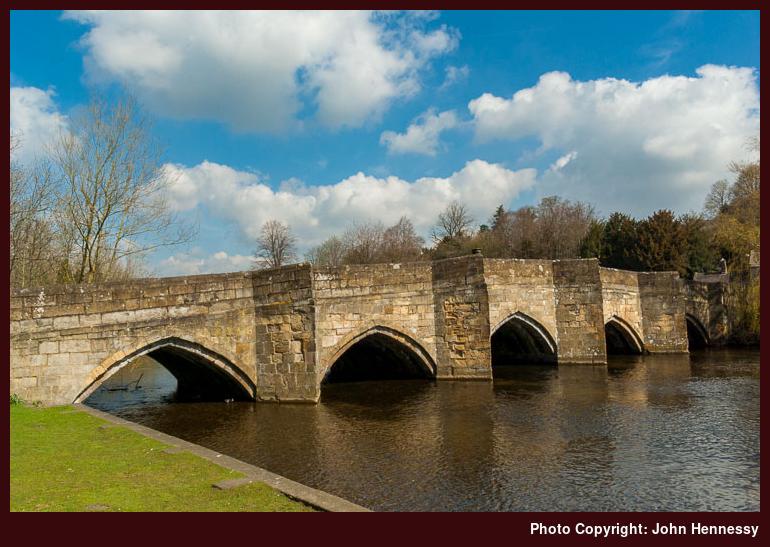
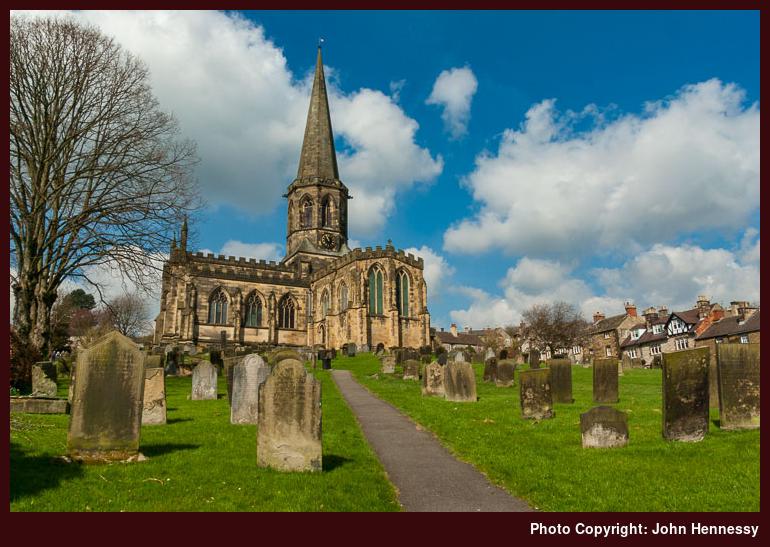
What resulted was a circuit from Bakewell that took in Ashford-in-the-Water and Monsal Dale. Before leaving Bakewell, though, the presence of sunshine allowed me some photo opportunities that I never had to the same extent before. For instance, I only ever got near Bakewell's main bridge over the Wye in declining light, so that needed addressing. Then, there was the churchyard that I only remember visiting under overcast skies. With a day ahead of me that allowed plenty of time for walking, I was not to overlook chances like these.
Not far from Bakewell's parish church, I found a useful public footpath for getting to Ashford. The sun ducked behind clouds while I was crossing fields, but it was not as if I were being deprived. One thing about the Derbyshire Dales is that once you are above the dales themselves, the countryside is largely level up there like a plateau and the photos end up needing panoramic compositions unless interesting skies are what you get over you. Along with many fields, roads such as Standedge Road and Crowhill Lane were crossed too, with navigation across a tilled field after one of these feeling uncertain until I reached the next one along. Bumbling around in someone else's field is not my idea of a walking, especially with sharp words ringing in my ears, as happened one December Saturday afternoon around Sedbergh. None of that rancour spoiled this day though, and I followed the lane until I saw a path down by a mast that dropped me onto the A6 near Ashford-in-the-Water. The descent was steep yet steady and plenty of views of the lie of the land below me occupied the mind while navigation was steadied by a useful wall. These types of things get called handrails and are invaluable.
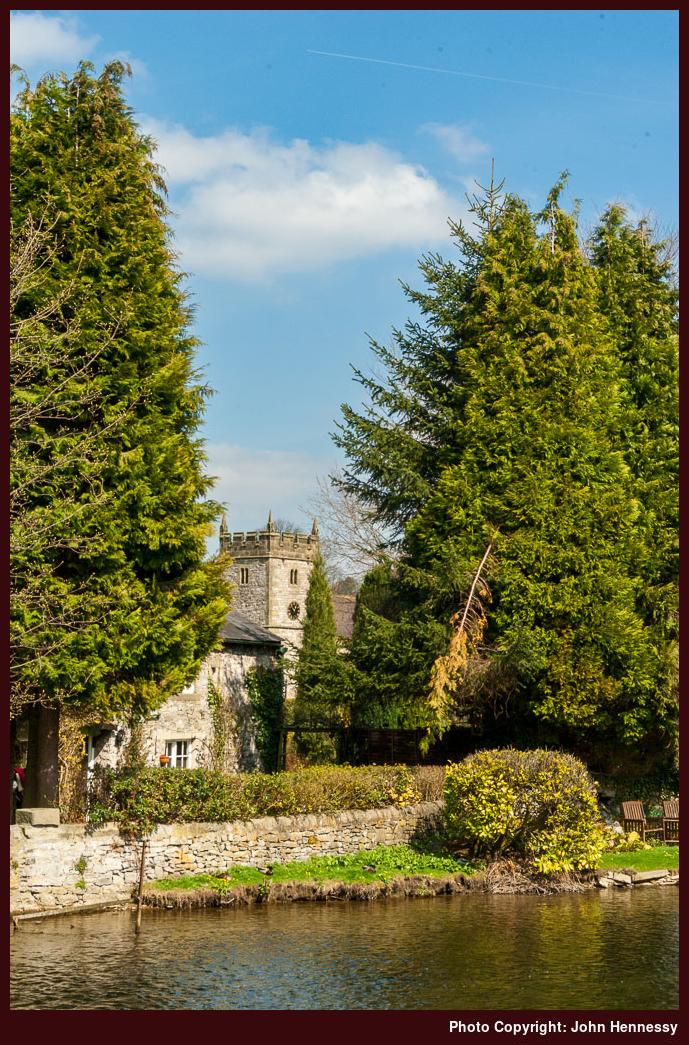
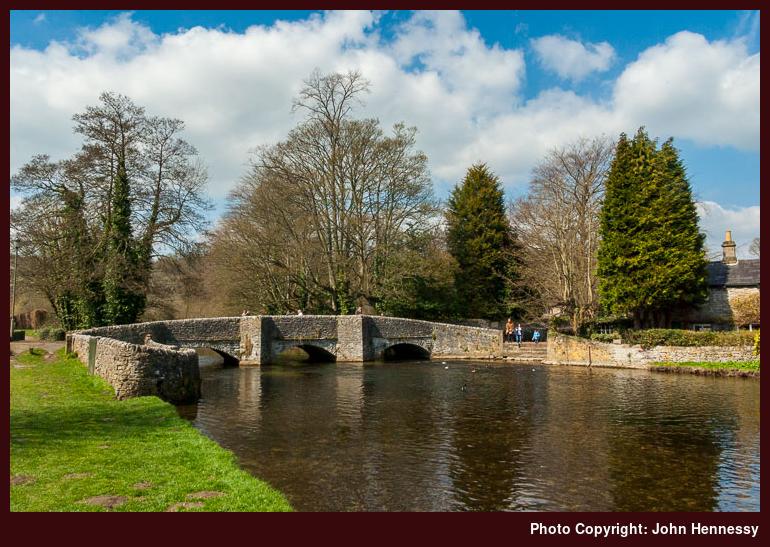
Getting across the A6 was less tricky than it might have been, and I got to spend some time around Ashford. As luck would have it, the sun was playing hide and seek on me with the clouds, so I needed to wait before I had the light needed for the sort of photos that I had in mind. Thus, I was delayed around Ashford's church and chose a lunching spot near the Sheepwash bridge, a packhorse structure where lambs were pinned in at one side (the left of the picture) and ewes driven across to wash their wool before shearing began. These days, the Wye is more likely to have trout than sheep in its waters. Its older use would generate an amount of commotion anyway, and I wonder how modern minds would have perceived such a practice, with all its guile and herdsmanship. Photography and strolling appears to be its main uses now as it is closed to motorised traffic. When I was making the most of the midday sun, folk were ambling about and that may not be to everyone's taste, so the early morning light that falls on the bridge from the east causes anyone making use of that to have little or no human intrusion in their compositions.
From Ashford, it was back across the A6 again to make my way towards Monsal Dale. There were two choices: a lower level path to Lees Bottom that strayed not far from the A6, and a less direct course around by Sheldon and Deep Dale. Because I did not fancy being beside road traffic any more than was needed, I went for the Sheldon route. A range of reasons could explain why this part of my walk was busier than that from Bakewell to Ashford. Even going uphill did nothing to dissuade some. Was it down to the time of day or the location? That is a question that I cannot answer, but there was no grumpiness with there being plenty of space to share on the way towards Sheldon.
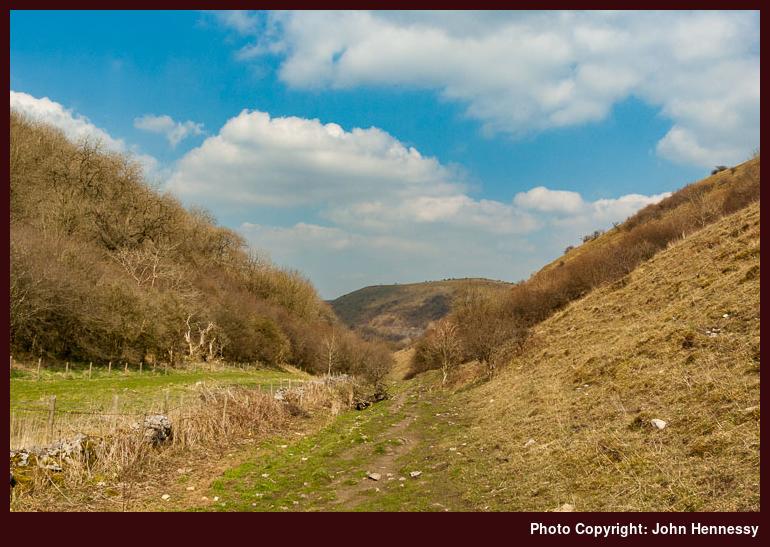
While passing through Sheldon, I was on the lookout for a public footpath that would lead me towards Deepdale. It looked as if I had found it, but something about its aspect left me getting cold feet. Lack of waymarks and a missing stile certainly did not help and visions of blundering in fields returned me to the road again. Others were more brave than me and I left them to go their way while I trod Johnson Lane with views of Magpie Mine to my left.
After turning right onto a busier road, I found my way to the unmetalled byway of Wheal Lane that led towards the path through Deep Dale. This is managed as a nature reserve for the preservation of its wild flower habitat by an organisation who I never encountered before: Plantlife. The clouds that had filled the sky as I journeyed around by Sheldon were breaking, and I began to hope again for seeing Monsal Dale in good light after giving up on the idea. In the event, I need not have worried, for cloud cover steadily dissolved over the remainder of the day.
That lower level path from Ashford-in-the-Water was crossed again, and some folk needed directions from me and I hope they sent them the way that they wanted. Before crossing the A6 at Lees Bottom, I stopped at a useful public convenience. This was without running water by design, a strange thing to many, and hand sanitiser was available instead of the soap and water that most of us would seek. That I wasn't the only one thrown by this became obvious when someone else needed the results of my perception.
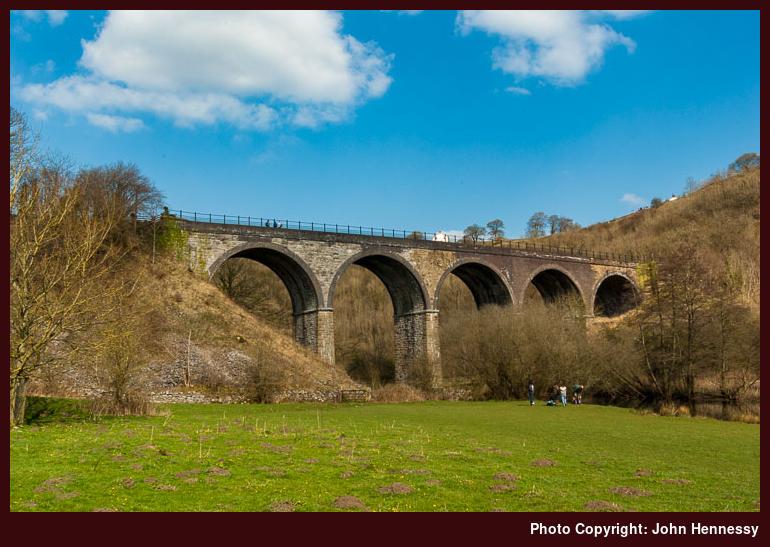
Once on the other side of the A6, the path into Monsal Dale beckoned, and I remained concerned about a rogue cloud blocking the sun for the final landmark that I had in mind for a photo: Monsal Viaduct. The bank of clouds had broken, but some shenanigans were going on over my head that kept me on my toes. Thankfully, nothing ruinous was to come of it, and I remained keen to get to my objective. What became clear was that it was not that far away from the A6, even if you feel that you are nowhere near it when at Monsal Head. Sometimes, it takes a walk for that sort of thing to become clear, and I also noted a useful bus stop for a future incursion around here.
First, though, I needed to get through woodland before being released into pasture not far beyond a weir that I also visited. This was a path that was well visited, and I had to share the views, which hardly was surprising given how well Monsal Dale is known and how near roads it is. Quite what John Ruskin would have made of all the visitors is a question that I cannot answer, but there was plenty of clearance was the making of photos. That meant that the valley remained peaceful and alluring of a sunny day near the end of April.
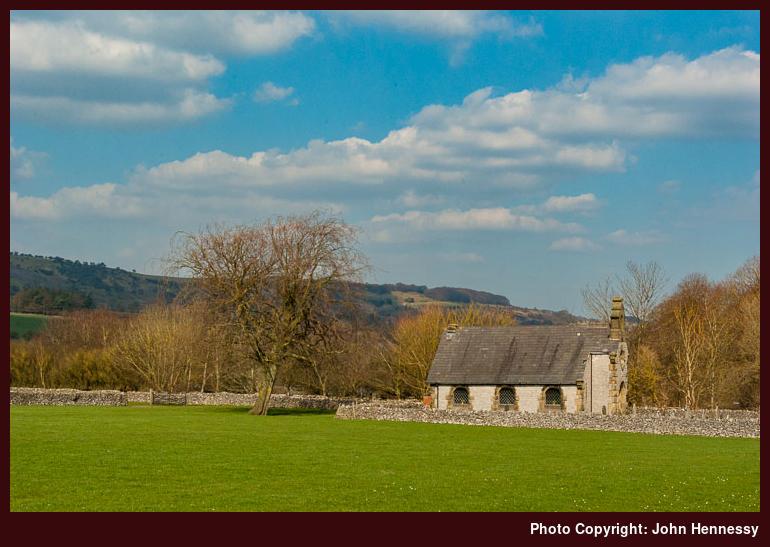
The recently reopened Headstone Tunnel was a tempting walking prospect, but my not wanting to waste sunshine was enough to keep me out of there. Instead, I retraced old steps to get up to the hotel above me. A delightful sight lay below me, and it was one that needed a morning outing to make the best of the scene with a camera. There by the roadside, I dallied a while and partook of an ice cream before continuing by road to Little Longstone before crossing a field to rejoin the former railway line again. This route may not be anywhere as necessary as it was on my first trots around here, but it usefully remains extant anyway.
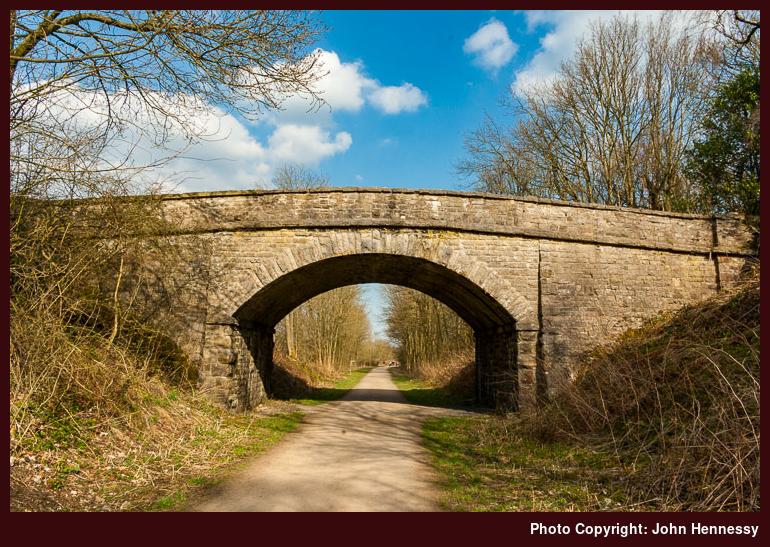
Once up on the trail, the number of cyclists using the amenity had greatly increased from what it was before, and I had every intention of following it all the way back to Bakewell. That resolve remained until I passed what formerly was Great Longstone station, but something beset me that never happened on the trail before: it began to feel like a slog. Looking back now, this almost feels like a lack of gratitude, given the steady sunshine that I was being bequeathed at the time. Maybe, I thought I should have been going faster given the good surface and there was concern that the same hardcore surface wasn't so friendly on my feet too. Also, familiarity might have bred contempt, so it might be an idea to follow it by bicycle in the future, and that sounds a delightful idea now as I write these words.
Eventually, I decided to leave the Monsal Trail for another bridleway near Toll Bar House. It was better than getting grumpy, and the green lane appeared to offer a more direct route into Bakewell too. Even with a hummock ahead of me, the new surroundings kept me interested and steady progress saw its results with Bakewell coming into view below me. Eventually, I was deposited not fat from the town centre and made for a waiting bus to start my journey home. That was a busy double-decker and, given the day, there could be no surprise at that. Clearly, others had good taste in weather and countryside, so I hope they enjoyed their day out like I did.
Travel Arrangements:
Bus service 58 from Macclesfield to Buxton and bus service 177 from the latter to Bakewell. Bus service 218 from Bakewell to Sheffield and travel by train from there back home with a change in Stockport.
Never the best to go rushing time
4th February 2014 When I was looking for my first step into the world of work after university, the quietness of some months were frustrating. January and September appear to fall into this category but I now see them differently. The sense of stasis has not gone but I now prize it because so much of a year can go in a frenzy. A working life will do that with its many deadlines and the events of family life can do the same as I found last year. Then, there can be the chasing of good weather from the start of year until summer. The whole mix can leave one so exhausted before autumn comes that hibernation looks attractive. It quite possibly explains my energy profile over the course of a year.
One matter that makes me wonder is when I start hearing about events towards the end of year being advertised right at the beginning. Concerts given by famous artists may be very desirable but why go wishing away the present? The same trick is used by marketing folk in the world of digital technology too and the risk is that you never appreciate what you have. Sections of the technology media do not help matters by speculating over what might be in the next iPhone or iPad but does it matter? Much of the time, the hubbub needs ignoring so we can enjoy any other delights that come our way in this life.
Another thing that amazes me is long term planning. Some plan their holidays a year in advance and I ask myself how on earth do you know how things will be then. Life's twists and turns bring the unexpected and that may be the comfortable situation that you expect either. Laying out your life before you just sounds like hubris to me and recent years have enforced that thinking with the progressive frailties of elderly parents. Parents of young children may feel the same. Your life may feel like it is being put hold but the present can bring joys too.
There is no doubt that January can feel too quiet for some and minds go racing ahead to designs on summertime holiday bliss. With days like Blue Monday and the current long run of stormy weather, such escapism is understandable. However, Blue Monday actually came up sunny this year so you could cheer yourself with a walk away from our more built up areas. That may not cure money worries or people trouble but the past year has reinforced for me how essential a good walk can be for easing a troubled mind and thinking over things. Even venting stress through footsteps often is what is needed and is all the better so no one else gets hurt by what is going on within you. Complaints from knees and feet are better than those from others with injured minds.
The real use of a quiet January is to take stock before the year's distractions get cracking. The month wasn't so quiet in 2013 but 2014 brought what was needed and my mind could wander elsewhere. On digital maps, I have ranged over the hills of mid Wales and along the courses of the Wye and Severn rivers that rise in Pumlumon. The Black Mountain in the Brecon Beacons National Park has been perused too while a general survey of transport possibilities have been ongoing. Any bus service that looks useful was noted with Sundays being better to avoid until the summertime Beacons Bus network recommences. While a little stay to sample what is in those places sounds promising, no dates are set as the course of life remains largely unknown and the uncertainties and vagaries of the weather lie among those.
It was the same sort of metal wandering that led to my visiting the Western Isles in August 2008. Quieter times allowed the formulation of an escapade that I am loathe to consider at the moment. Then, the playing with different configurations actually led to one that fitted in a week when other parts of the U.K. and Éire were getting a soaking. However, I pulled a cracker that I never will forget.
Another thing that I relished last month is a sense of steadiness that was so different from how much of 2013 felt. It so felt like bliss that it was tempting to procrastinate and leave some less pleasant and necessary tasks for later. Those now need listing and tackling because procrastination is not the way to go either. It's as bad as wishing away time ahead of summer holidays or the launch of an attractive gadget. Moments need seizing even if the freedom to relax a little is all the more appealing; no one can relax all the time.
January is not only for contemplating and designing escapades because it can have some of its own too. 2011 saw me head to Wales, Scotland and Ireland on successive weekends before I was swamped with work. Being in the off season does mean cheaper deals and lured me to Edinburgh and Llangollen one weekend after another. The first allowed me to recall times from my student days in a wonderful city and the second had me threading new ground with views of spots seen and sampled on previous outings.
February can be less frantic too though it was filled with angst in 2011 and weighed down on me in 2013. In 2012, it was so different with a weekend trip to savour a section of Northumberland's coastline that I had walked under cloudier skies. Last weekend, I got as far as Lincoln to visit its cathedral and its castle. The latter is under restoration ahead of the octocentenary of the signing of the Magna Carta next year. Currently, all the scaffolding is restricting what you can see so I didn't get the photo of Lincoln Cathedral that I had fancied. Another visit when it's all done sounds a possibility though the entry prices surely will have gone up from £2 for an adult by then. English Heritage look after the old Bishop's Palace and charge £4.60 for adult entry so that maybe what the entry charge for Lincoln Castle should be. Even with a reduced charge, the lady issuing my ticket took pains to tell me how little there was to see though a free tour was available if I fancied that. In the event, what was there satisfied me and I rather fancy the idea of seeing more should the occasion arise. What I saw around Lincoln's Cathedral Quarter looked very attractive on a sunny Sunday and I'd venture that the actual cathedral itself is more ornate than York Minster too. I left for home with a sense of satisfaction.
Whatever others may say or think, I have a certain affection for the months of January and February. They can be the calm before a frenzy and escapes from the everyday are a possibility. While having a breather appeals to me at the moment, there is no harm clearing niggling tasks out of the way too and the post-Christmas clearance often allows the space for doing exactly that. Then, it is a matter of taking the rest of the year as it comes. After all, long term planning often gets derailed by life itself.
The North
22nd January 2014 Having been tempted by a recommendation from Simon Armitage (Yorkshire poet and author of Walking Home) on the cover of the hardback edition in a bookshop, I got a digital copy of Paul Morley's The North and set to making my way through it. Anyone seeking something with a linear narrative will not find it here yet it lets one on a lot of the spirit of northern England in its own inimitable way. The mixture of memoir, digressions and side notes takes some acclimatisation and I found the sense of repetition in the book's early stages a little frustrating in that it felt as if not much progress was being made. Maybe that was because of the description of a young mind's developing consciousness and sense of place and belonging to there. Later on, things grew more linear when it came to telling of how Morley worked out his place in the world and what trade was to allow him to pay his way in it.
Interspersed between these, there is a reverse chronology of notable events in the north of England, especially when those relating to the development of the place and those who come from there. These include politics, industry and the better known folk associated with these. The interjections complemented any explorations of the conceptualisation of what it meant to be northern English and how the north of England came to be how it is in the main text.
Because I read the book in fits and starts before longer journeys allowed me to spend more time with it and grow accustomed to its eccentricities, a few months elapsed before I finished it during that trip to Edinburgh a few weeks ago. The non-linearity of the narrative meant that that it took some work before I got used to it and the fact that I was reading it on my Nexus 7 made me wish for hardback so that I could see more progress (one came into my possession later so I can dip in and out of it during free moments at home). However, it was the electronic gadget that ensured that the book was with me when I could make time to read it, a common failing of mine when it comes to paper editions of books. Apparently, the inspiration for the book's structure came from The Life and Opinions of Tristram Shandy, Gentleman and it was the familiarity of many of the places described within its pages that drew me along while filling me in on a lot of details that I otherwise would have missed. For one thing, I never realised how fluid the Cheshire-Lancashire county boundary has been over the centuries and there was but a single lesson found in those pages.
After the effort of working through The North, it's time for a more leisurely read and Ramble On by Sinclair McKay is just that. The story of how recreational walking became what it is for so many of us today may be somewhat familiar to me but there always are other insights and these are to be found here too. Still, I am tempted to sample Tristram Shandy to see just how contorted its narrative is and test how it inspired the flow of The North. For now though, that can wait because it is best to take things easy while life's events allow you to do so.


