Simple walks around a time of tumult
 14th December 2013
 At the end of November last year, I set aside some time for a what I would call a mid-winter break prior to the onslaught of the Christmas season. Such was my torpor that I did not get away anywhere and so more than contented myself with two walks near home. The account of the first of these already has appeared on here and took me from Bollington to Disley by way of the Gritstone Trail so it is the second that inspires this posting. The tale also carries us into 2013 after a spot of life upheaval along the way too.
November 25th, 2012
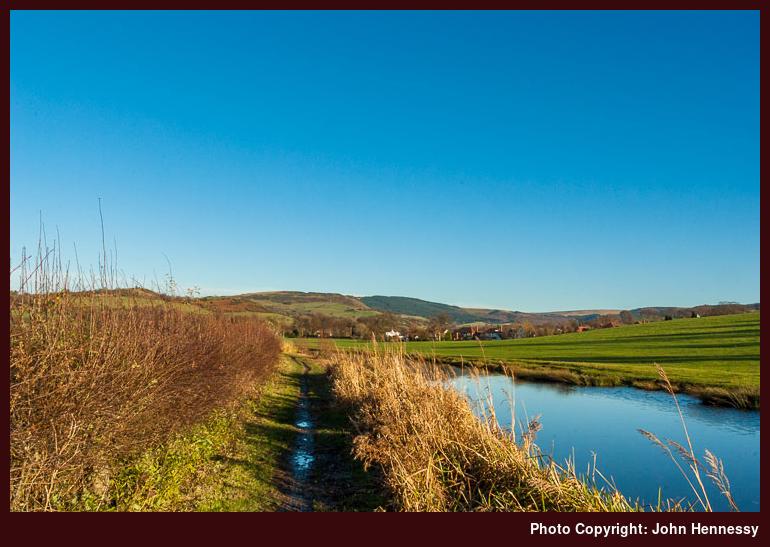
That second walk was a far simpler affair and went along the banks of the Macclesfield Canal between the town that gives it its name and Congleton. Foolishly, I began my journey later in the day than was appropriate for a distance of around ten miles; looking back at the photos, I now realise that I dawdled around Victoria Park in Macclesfield too and that cannot have helped timing. The trajectory was southward and I had sunshine on me nearly as far as the flight of 12 locks near Bosley. That part was more than familiar to me following various trots over the past decade and a Spring Bank Holiday Monday evening was spent getting that far before returning home again via Gawsworth.
Even with the prospect of clouding skies and declining light, I continued south as far as Congleton on my November stroll. Bosley's flight of locks are an impressive construction in their own way and remind me of another Thomas Telford design: Neptune's Staircase on the Caledonian Canal near Banavie. Cheshire's counterpart drops or raises boats around 36 metres and it led me towards the part of the Macclesfield Canal that I consider the most scenic. After proceeding in a near straight line south from Oakgrove, it then doglegs along the Dane valley towards Buglawton. As it does so, it passes The Cloud and that adds to the attraction of walking this way.
With cloudy skies and the time of day on a November afternoon, I made a mental note to return this way again with better light. Even with an eye on the time, this was a pleasurable stretch that I could enjoy without any semblance of it being crowded. Even so, there was no time for dallying and I noted the landmarks that told me how much progress I was making. Buglawton came before daylight failed and lured me into thinking that there was so much further that I needed to go before reaching Congleton's train station and street lights. Before then, I made good use of my head torch as I dealt with damp and soggy stretches left after one of the wettest years on record.
January 20th, 2013
December 2012 turned out a difficult month and it looked like January was to be no better. There was a heightened sense of my parents' mortality and neither were in good health during Christmas 2012. During this time, there needed to be some walking with a visit to Tatton Park at December's start and more trots in Ireland during Christmas week itself. Anyone's head just needs clearing in those circumstances. Serious actions were facing us and a resistance was overcome only by a near-death experience at the start of 2013.
There was a period of uneasy settlement then and it was then when I got to reprise November's walk along the Macclesfield Canal, albeit with a start in Congleton instead. My hopes were for a sunlit trot at least as far as the Bosley locks because I have seen the rest in sunny conditions before, not least that November walk. A morning start was to ensure that I reached Macclesfield in daylight and it was promisingly frosty too. There were blue skies, but the sunshine was being filtered by a certain haze, so photographic ambitions were not to be fully realised.
Still, I was to glimpse more of what lies around Congleton than on the previous sitting and others were wandering the way too, though never so many for a sense of crowding. The drop into the valley of Dane in Shaw Brook was visible in all its glory instead of being hidden in darkness's cloak of invisibility. Just before light completely failed on that November walk, the elevation above Timbers Brook was discerned and it was all the clearer in the morning light. Both valleys highlight the elevated course of the canal through largely rural surroundings as it goes from Congleton's train station to Buglawton on the town's outskirts. In the reverse direction, meeting with Buglawton can make you think that you are nearer to the centre of Congleton than you are, a point brought home to me in declining November evening light.
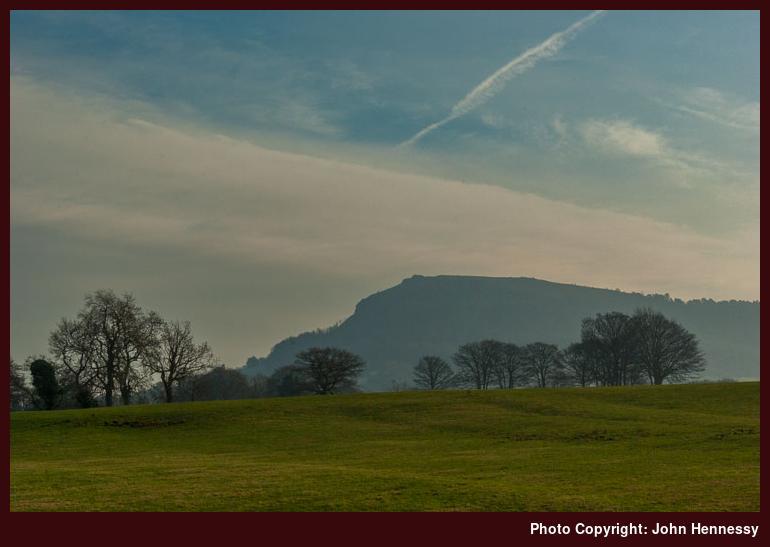
North of Buglawton, the canal swings east to shadow the course of the River Dane. Unlike Timbers Brook and Dane in Shaw Brook, the river valley must have seemed too wide for Telford to have engineered a direct crossing and the later viaduct carrying the West Coast Mainline just how wide an expanse this is. The dogleg is handy though in that it offers a passing wander the chance to take in multiple sightings of The Cloud. As if that weren't enough, there is the sense of immersion in manicured countryside, plausibly away from everything and maybe everyone. At least, it felt like that I was passing the way as clouds hijacked the sky and put a stop to the sunshine.
After turning north again at what felt like a valley head, it was on to Bosley's twelve locks under darker skies. There was plenty left in the day, but the weather was turning. Each lock number and feeder pond was being noted on the ascent as a way of checking progress. Then, there was passing under the A54 that runs from Congleton to Buxton. Near the last of the locks, I spied an open public convenience that came in handy. Noting its offering of showers and washing machines made me realise what the Canal and Rivers Trust offers to those plying these thoroughfares by boat. It was a passing CRT staff member who had opened the convenience and locked again before he left, possibly for the day. That was fortunate timing for a grateful traveller.
It was all familiar territory from here to Macclesfield, and the various landmarks were reassuring signs of steady weaving progress as I wind my way through the countryside. The road crossing near Oakgrove really granted me a sense that I was nearing home again. So did passing near the railway line and Dane's Moss wood. Crossing under the A523 between Macclesfield and Leek came next and I was well on the outskirts of my destination by now.
Lyme Green was left behind as I made for Gurnett with Sutton's church steeple to seen to my right. A cutting then conveyed me towards Buxton Road from where I was to thread streets on my way home. The cause of the darkening skies was ever more apparent now as snowflakes tentatively drifted through the air. None of them were staying though, and the ground stayed as it was, at least for as long as it took me to reach my house again. Later, the snow was to grow heavier and coat any surfaces on which it fell. By then, I was satisfied at home and resting after the hike that I had undertaken. There still were excuses for a repeat, though.
Any more to come?
At various sittings, I have covered most of the length of the Macclesfield Canal on foot. In fact, the only outstanding sections lie between Congleton and Kidsgrove and I hope to sample these sometime soon as well. The Macclesfield Canal is one of those that suits walking more than cycling or horse riding, both tempting possibilities given its length. It is the towpath's lack of girth that stymies those possibilities, though I have tried on a few occasions, such as between Marple and High Lane while going from the end of Middlewood Way to Lyme Park. Other stretches around Macclesfield are the same, so my assessment has been strengthened. The handy nearby walking and its being ever different should keep me plying the towpath of our local canal for a while yet. Then, there's the Peak Forest Canal along with the Trent and Mersey Canal if I ever want to continue the theme. The latter has a wider towpath should I wish to cycle that way. Hopefully, no life traumas are needed to provide encouragement to make use of these brainwaves.
Travel Arrangements:
Bus service 38 between Macclesfield and Congleton. It brought me home after November 2012's walk and took me to Congleton for the January 2013 reprise.
Why not a thousand?
16th October 2013 It seems that September is a time for releasing books and showing new documentaries on television. At it has felt that way with what I have seen in branches of Waterstones and on the BBC. The latter's iPlayer has made me aware of the television efforts of Paul Murton with his Grand Tours of the Scottish Islands still on BBC 1 in Scotland and three previous series of Grand Tours of Scotland. The viewing is undemanding and Scotland's scenery is the real star. Just like the country itself, the television series features a real variety ranging from inland islands on Loch Lomond to Lismore, Colonsay and Oronsay on Scotland's western seaboard. It's been a while since I explored and offshore Scottish island so revisiting their delights sounds like a plan to have in hand give the pleasures that I have met on them on previous trips.
Returning to the topic of books, it may be the looming end of the year and the lengthening of nights but there was an explosion in book launches last month. While my yearling Google Nexus 7 spends part of its life as an eBook reader and that has made sure that some more fleeting volumes actually do get read and not just collected, there remains a certain something about the traditional paper book than has been with us for hundreds of years. The packaging is part of the appeal and probably will ensure that at least some of us stick with them in preference to the lure of electronic gadgets. It seems that publishers have improved on presentation exactly when it was needed but there is one thing about the dead tree tome that I haven't found as easy to do with an eBook: dip in and out of the pages out of sequence as and when the mood takes you.
Both attributes certainly apply to Simon Jenkins' latest offering: England's 100 Best Views. This almost is the sort of book to have on a nearby shelf for spontaneous perusal of some random page in there. The same approach probably applies to predecessor tomes from the same author like England's Thousand Best Churches, England's Thousand Best Houses or Wales: Churches, Houses, Castles. Extending the analogy further, you even could apply this thinking to any walking guide that you care to have in your possession. Maybe, that added randomness could spice up route planning more than checking out the route pages of a walking magazine.
England's 100 Best Views does betray its associations with the National Trust, of which Jenkins is its chairman, as it seems that there seems to be some element of man's presence in any selected view so as a grand house or another equivalent focal point. In Britain and Ireland, it is hard to avoid human influence on a landscape but it seems even harder in England though featuring buildings pretty well makes this most obvious. Landscapes completely manufactured by man hardly are excluded either though the author is not a fan of such modern intrusions as wind farms, car parks and the wiring needed all over the place for modern living.
However, the National Trust was set up to conserve countryside and not the sort of old country houses of which it is custodian all over England and Wales. That only happened around the time of World War II and its role was sealed by the Office of Works (now English Heritage) being dissuaded from engaging in the same kind of thing by the government of the day in another time of austerity. It can be odd how things go with organisations at times.
There are landscape views without sizeable buildings in them too. The coastline of the south-west of England is an obvious example as is the Lake District. With his other books, it is surprising that Jenkins didn't try for a thousand views because they have to be out there. After Cheshire just has one entry - Peckforton Castle & Beeston Castle atop neighbouring sandstone outcrops in the west of the county - and gets into the West Midlands section for some reason. Quite why it is excluded from that devoted to the English Northwest is beyond me and there are plenty of other sights that could be added. A number from between Macclesfield and Buxton come to mind: looking towards Shutlingsloe from Tegg's Nose and looking north while descending from Shining Tor to Lamaload Reservoir are just two. Thinking about it now, views over reservoirs may not be amenable to Jenkins but it does highlight that there are so many alternatives from from which to choose. Of course, doing justice to each of them may have lead to cutting down the number so as to give descriptions of the chosen few more room to breathe. There are times when your cloth has to be cut according to your measure and so it seems with England's 100 Best Views. Any new viewpoints are to be celebrated and there always are more than a few to be found in a book like this; just like the aforementioned television series, it too does not disappoint.
Secrets of the Irish Landscape
15th October 2013 During May of this year, the Republic of Ireland's national broadcaster RTÉ ran a three part documentary series called Secrets of the Irish Landscape. The documentary series tells the story of the Irish landscape and is built around the work of Robert Lloyd Praeger that started a hundred years ago. His 1937 book, The Way That I Went, contributed to the inspiration for the series. With all of the references to this book, I am left wondering why a re-issue wasn't planned, especially since the last re-print was done by Collins Press around 15 years ago. The only way to acquire a copy now is to go out on the second hand market and I have seen prices reaching hundreds of pounds. Those may be for original editions but even a second hand paperback edition from Collins Press seems to attract prices of £20-30. At least, that's what my own copy cost me and it's in decent condition too, albeit with yellowed pages and bent corner to a few of them that I largely have straightened. What struck me though was the size of the book since he didn't write a slim tome while he was at the task. What really helps though is that it remains well readable from what I have read of it so far and spans a remarkable time in Ireland's history.
Praeger had much experience in writing since he co-edited the Irish Naturalist (when this ceased to exist in 1924, it was succeeded by the Irish Naturalist's Journal in 1925) and contributed also to the Proceedings of the Royal Irish Academy. One of those was published in 1901, Irish Topographical Botany: This was a weighty contribution with the descriptive treated almost as a preface with pages numbered using Roman numerals and what otherwise could be seen as an appendix gaining the Arabic ones to which we all are accustomed. Though largely a work of scientific reporting, mentions of fondness regarding the Irish outdoors were snook onto page lxxxix. Here is a first quote where a brief interlude of reminiscence was allowed:
The long summer days spent in the Limestone Plain,
where the gentle undulations of the ground
only occasionally hid the distant rim of brown and blue hills;
the marshy meadows, heavy with the scent of flowers;
the great brown bogs, where the curlews alone relieved the loneliness;
the bare limestone pavements and gaunt grey hills of Clare and Galway;
the savage cliffs of the Mayo coast;
the flower-filled sand-dunes which fringe the Irish Sea;
the fertile undulations of southern Ulster;
the swift brown current of the Barrow;
the fretted limestone shores of the great western lakes;
the towering cones of the Galtees:
all have left memories that can never be effaced.
That expression of affection was followed by another on the same page that suggests an innocence lost when it comes to access to the Irish countryside on foot. It sounds utopian to my ears now but it does seem that walking around Ireland in the late nineteenth century was more carefree than is the case today:
Ireland is a delightful country for the pursuit of work in the field.
Enclosed or preserved ground is but seldom met with,
and the country is free and open.
Few rivers but can be, forded;
few marshes or bogs but can be crossed;
few precipices but yield their treasures to the mountaineer;
few spots are so remote but they may be visited
in a good day's walking from the nearest stopping-place.
Praeger's scientific endeavours had him criss-crossing the Irish countryside on foot during weekend excursions and the Office of Public Works still has something on the web that offers a flavour of his itineraries. He depended on the rail network for these and never took to the car, perhaps seen as a newfangled development in his lifetime. His research was both done for the love of it and to sate a certain curiosity. It was the sort of enterprise that Brian Cox was describing in his documentary series Science Britannica on BBC television.
Just like its aforementioned BBC counterpart, the RTÉ series was a three part affair and these seem to be becoming a regular occurrence even on British television. Secrets of the Irish Landscape was a major effort for a national broadcaster whose finances have not been so healthy since the economic downturn of 2008 and its first episode was no shabby affair at all. But for what was going on in my life at the time, I might have caught up with all three programmes though only the first would have been seen in Ireland itself. RTÉ has a far more liberal approach to folk on the British side of the Irish Sea viewing or listening to its broadcasting over the web, more so than the BBC when it comes to seeing their output in Éire. The whole series could have been seen and there was a season of programmes under the Ireland Goes Wild banner to go along with Secrets of the Irish Landscape too.
Just as there has been no reissuing of Preager's The Way That I Went, Secrets of the Irish Landscape has not come out on DVD either; there is a teaser trailer still is to be found on YouTube where you can see how it took my fancy. What we have in its stead is a glossy coffee table format book featuring subjects covered in the series. It is a collection of scientific essays with accompanying photos from different experts with the whole being edited by Matthew Jebb of the National Botanic Gardens in Dublin and Colm Crowley of RTÉ. Given what's on offer, I am left wondering if a more portable format might have been a better choice; then, it not only would come on a journey with you or even live more easily on a nearby bookshelf to be picked up for a short perusal during a quiet few minutes. My own copy came from the Limerick city centre branch of Eason's a few months after the series had been on the Irish airwaves and has been perused in fits and starts since its organisation suits that more random approach. This also is something that can be done more easily with a book printed on paper than a digital equivalent.
There is one final thought that comes to mind when I think of what Praeger did. His explorations of Ireland remind me of my own outings though there remain great differences. The use of public transport over a hundred years ago and the long walks could be part of many an outdoors enthusiast's weekend away and they remind me of my own escapades. In place of seeking of peace and quiet for the soothing of the human spirit, Praeger had loftier ambitions and much more substantive achievements. In contrast to the seeking of an unperturbed ambience and fleeting light that brightened a pleasing vista for a photo that has motivated me, he wanted to know what plants were in Ireland and from where they had come after the last Ice Age. He sought knowledge and left a legacy while I have acquired memories that help to balm life's wounds. The comparison makes me wonder if something more would be in order but, for now, that's something for contemplation rather than rash action.
Reprising a part of the Gritstone Trail
23rd September 2013 There are times in the year when I feel the need to force a break in an attempt to rupture what feels like a headlong rush towards a certain event. Though it's only September and I writing these words, the last month leading towards Christmas is but one of these. Another is in a contrasting part of the year: that leading towards Easter. It's as if the seasons of Lent and Advent see life going in such full swing that you, that there is a strong risk of your rushing right through them inadvertently. As ever, there's little point in rushing either the start or the end of a year anyway.
Last November, I booked in one of those speed bumps, and it came up sunny enough for me to get out and about. My sights weren't raised beyond Cheshire, though, and I fancied seeing more of the nearby countryside than had been the case for a while until then. In fact, the Friday was to see me follow the Gritstone Trail from Bollington to Disley, and this section hadn't been walked by me in entirety since January or February 2003. Then, there were some vestiges of snow and ice on the ground, but it was the lack of visibility that I really remembered, along with a foolhardy episode of taking rubber soled walking boots on ice that I mentioned in a previous entry on here.
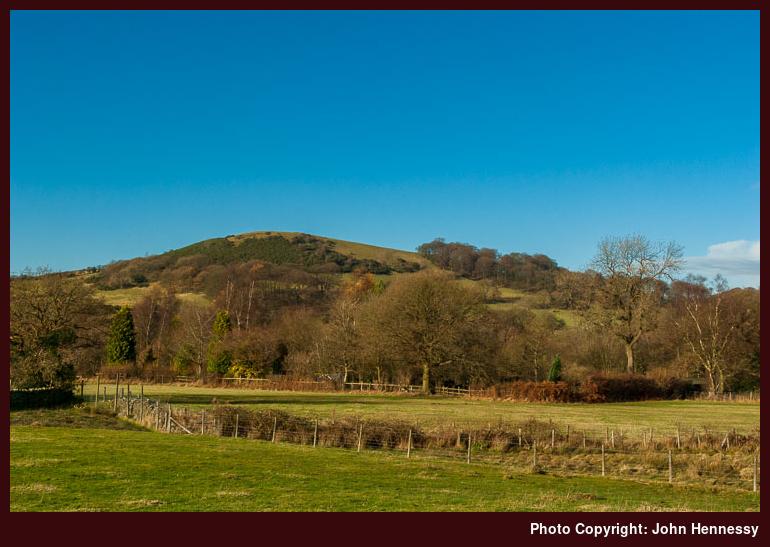
Skies may have clouded later in the day, but there was no folly with the choice of morning as I left Bollington. Indeed, it felt more like October than late in November, and looked like it too when I took in the sights of what surrounded me. After record-breaking stretches of wet weather, it momentarily seemed as if some kind of Indian summer had come our way. If it wasn't for my own lethargy, November 2012 could have seen me do better than trips to Tatton Park, a trot along the Macclesfield Canal from Macclesfield itself to Congleton and this hike. That's not to decry what I savoured, since there are times when excuses to stay local can be needed when shining sirens can call from afar.
After leaving a bus to continue on its way from Macclesfield to Stockport, I pottered up Ingersley Road, passed where it became Smithy Brow to meet the Gritstone Trail and followed it into Spuley Lane. To an Irishman unaccustomed to such conventions, such naming of rural roads has its own amazement; until relatively, recently many of those in the Irish Republic hardly merited even a number. It's not often that I stick exclusively with tarmac while walking in the countryside, so the sign showing the way through a field was a welcome thing.
Crossing that field was to get me to gain more height until I met and crossed yet another named lane: Hedge Row. In October 2007, I actually followed this as part of a weekday wander. For some reason, the lure of staying on the Gritstone Trail all the way to Disley was insufficiently strong that day. Was it the later start or a certain heartbreaking outcome to the very reason for which I had taken a day off from work in the first place? November 2012 was devoid of any such feelings as I continued towards Harrop Brook while taking any views towards Nab Head that were being granted to me.
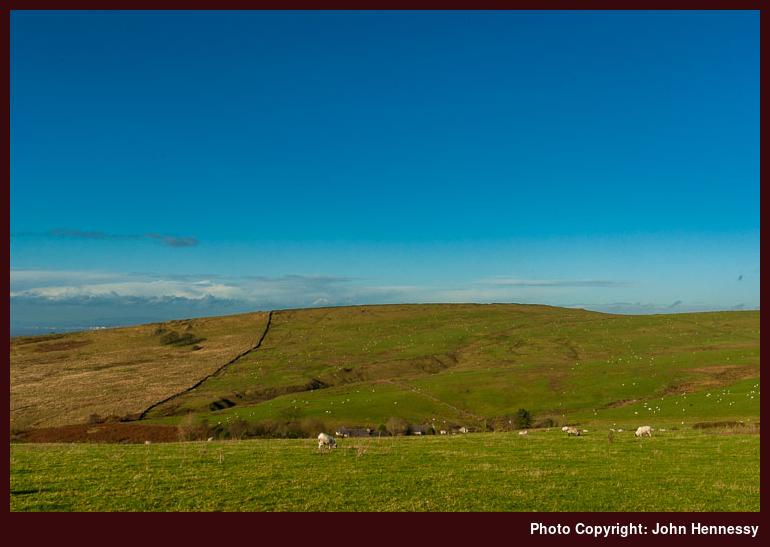
Once across the brook, it was time to continue uphill towards Berristall Hall, where I passed a pond with fowl such as geese around it. The farmyard itself was somewhere that I bypassed through nothing more than sticking with the route of the Gritstone Trail. My surroundings felt familiar, as if I had been there recently. That was something of a memory trick because it was January or February 2005 when I last passed the way on a crisp, chilly day when I was trying out my first ever DSLR. That was on a walk that took a section of the Macclesfield Canal before going cross-country to Pott Shrigley and then heading to Disley via the Gritstone Trail after coming up from the village via a path taking me by Berristall Hall that avoided going through the farmyard at the last moment.
My course last November took me uphill by a wood while I gazed upwards at the trees and across towards Billinge Hill. Its quarries were not on show, either through shadows cast by the low sun or because they away from my line of sight anyway. That non-sighting was not what on my mind, but the similarity to the Rainow of Kerridge Hill definitely was not lost on me either. Leaving trees behind me for a while, I began to cross fields, with Bakestonedale Moor to my left. Sheep were out grazing and stuck with that task instead of being distracted by a passing wanderer. The scene may have looked exclusively pastoral to my eyes but lay a road unhidden in a cleft of the landscape. It was one that I needed to cross, but that was further ahead.
Another wood lay by my path and there was an opportunity for navigational blundering, so care was needed. With no mishaps, I skirted a quarry to pick up a track that appeared to be making a beeline for a farmyard. Though I grew up on a farm and maybe because of it, I have no desire to walk through the farmyards of others, let alone wander aimlessly around one due to a map-reading error. Perhaps, it's the fact that I am outside someone else's back door that does it, so I prefer to pick my way through the countryside without having anyone else staring at me doing so. Though the track passed a dwelling house, the initial sighting was an illusion, and I was on Bakestonedale Road instead, another part of which had been hidden from me earlier. On a return from Lyme Park by bicycle one August day in 2009, I passed its entire length without fitting together the landscape through which I was passing; it can take a walk to do just that.
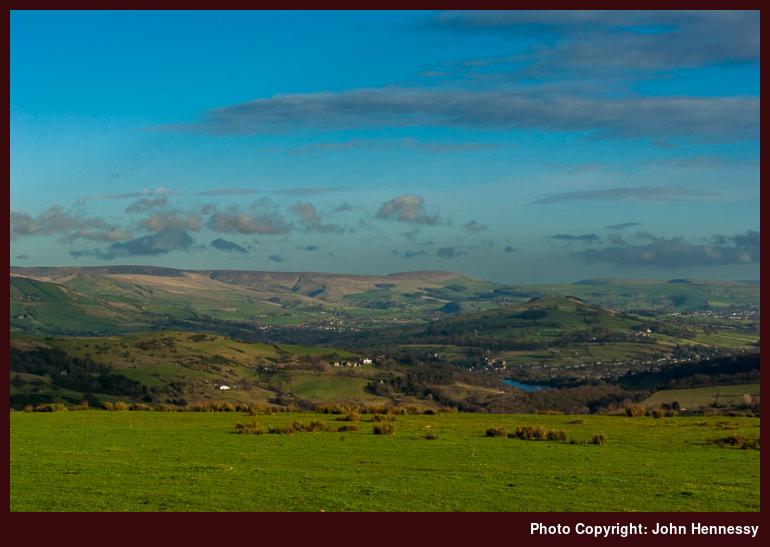
Turning right onto Bakestonedale Road brought me past the farmyard that I had been seeing. As if to prove that everything takes longer while you are waiting for it, the welcome signpost for the route of the Gritstone Trail over Sponds Hill felt as if it was taking its time to come into my view. When it did so, I was on the cusp of the best part of the hike and of the day. A little height was gained and below was a gash where a hairpin or switchback twist in the B5470 lay, another reminder of the return from Lyme Park in August 2009.
What I was after, though, was something that I had been denied by fog in 2003 and clouding skies in 2005: gazing towards the Derbyshire hills from one of their Cheshire neighbours. This time around, I wasn't to be disappointed as I looked beyond Whaley Bridge towards the sort of places that I rediscovered in April of this year. Here, I am thinking of Kinder Scout and what is found around it. Below me, the Toddbrook Reservoir was picking up the blue of the skies above it.
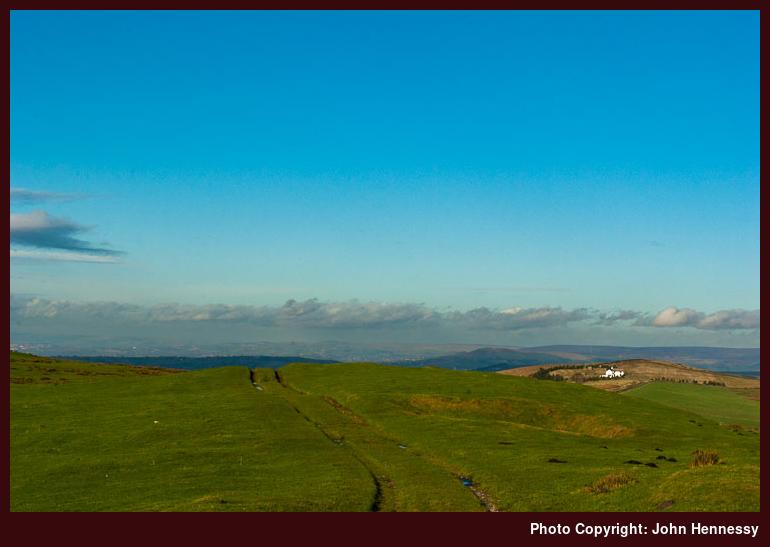
There was no shortage of vantage points from which to survey what lay to the east while clouds rolled in from the west. There even was some straying away from the right of way to visit the 410 metres trig point on Sponds Hill before I returned to the straight and narrow. Before that, I stopped at the CPRE viewpoint, which has a multitude of landmarks inscribed onto its metal surface. A bright cloudy day ironically might be best for identifying all that's mark on it, since sun-reflected glare could stymie such an attempt.
What gleamed in the near distance was the white house where the Gritstone Trail divides into one route for those going through Lyme Park and another for those going the way at times when access to the park is less certain. It was well clouded by the time that I got that far, yet I was not grumbling as I dropped into Lyme Park. A spot of sun could have been good for some sights, but they can form excuses for returning, and I spotted some alternative route options that make such errands less repetitive. There was one such scene that I had in mind for a photo from an earlier venture, only for this to be scotched on re-examination.
Once down through Knightslow Wood, I sought out a lunching spot, and a place that would be busy in the high season was blissfully unfrequented on a November afternoon. Even with their cafés, the National Trust still offer a covered area with tables and chairs in an old outbuilding for those wanting the DIY food stop. To repay their generosity, though, I patronised their vending machines to add to the sugar going down with my sandwiches. The sun may have appeared and disappeared during my refuelling stop, but I was more than relaxed about that.
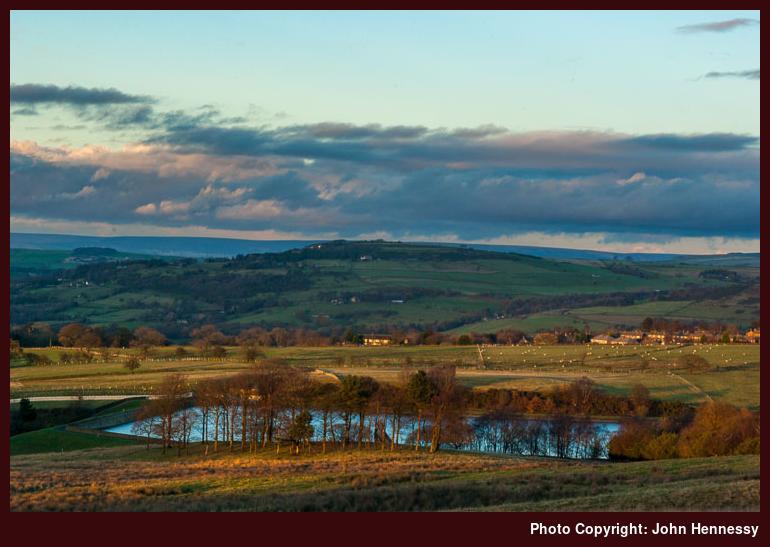
Having stopped a while, I got going again to head into Disley. There may have been no sun falling on Cage Hill as I passed it but having savoured it when it was some was a more than sufficient consolation. As the sun grew lower in the sky, it did its best to light what it could as it did so. There were some photographic experiments, even if getting through the East Gate was my priority. Once out through that, I could relax a little more but not so much that I could overlook the declining light, even if I liked the effect of the weak light on the landscape surrounding Bollinhurst Reservoir and the hills to the east of it.
Once past where both routes of the Gritstone Trail rejoined, it was time to pass Bollinhurst Bridge and turn into Green Lane. At the bridge came a surprise because it no longer is open to any traffic, even walkers, you have to use the wooden walkway instead of something that must have been in place for centuries. Taking a mountain bike this way is a less practical option now, if it ever was, given how uneven the track can be.
While the fading light was motivating to keep going as I rounded Bollinhurst Reservoir, there were others seeking to make the most of a day they couldn't use more fully. One lady was making sure of that as I passed her on my way along Green Lane and shared a few words with me, saying as much. A straight track like that can feel long in declining light, so I checked my progress on the map to ward off any pangs of impatience with my legs. As I neared Disley itself after shadowing Higher Disley, what appeared to be a maze of lanes faced me, and I picked my way through these to satisfy myself that I was sticking to an intended route and not getting myself waylaid at the last minute. There was no hiccup, and I had to decide between train and bus travel to start my way home. The latter got my vote this time around, so an uneventful journey home fitted what had been a great day out among Cheshire's eastern hills.
Travel Arrangements:
Bus service 392 to Bollington. Returned home via bus service 199 from Disley to Stockport and a train journey from there back to Macclesfield again.
Lyme Park: Beyond Late Arrivals and Fading Memories
2nd August 2013 A walk from Bollington to Disley last November that I have yet to share on here has been the cause of getting me pondering past visits to Lyme Park, and afternoons spent around Tatton Park late last year accentuated this. So, I have plundering fading recollections to collate what remains of them on here before they degrade any further. The amount of effort taken to recall happenings from more than ten years ago was brought home to me during my yet incomplete act of adding photograph dates to the photo gallery you find here. They have yet to make their appearance anywhere other than the test version that I have of this website; Ireland and Scotland are covered so Wales and England remain outstanding and there's a good collection of photos for those nations on here. It's just as well that I have this as a place of reference for those occasions when the troubles of life have erased memories that should be retained.
August 28th, 2000
Things were simpler in my early days because there weren't many trips away and even these could be associated with some other even to extract a date. Take the English & Welsh Summer Bank Holiday weekend of 2000. The Sunday saw me head on my first-ever trip to Wales, where I pottered towards the Swallow Falls from Betws-y-Coed on a day when the weather steadily improved after a damp start. There was a visit to Llanrwst and Gwydir Castle too, so it was a fairly full day. Also, my memories of it aren't too patchy and having a compact camera that added dates to the photos that it took helps reconstruction of recollections too.
The next day saw me head out on my bike for a journey that eventually took me as far as Lyme Park. That wasn't as planned as that first encounter with Wales, and my memories of the day are more hazy, too. It was sunny until I passed Rainow, before becoming less and less satisfied with the ups and downs of the landscape and the B5470; a road bike with no first gear and untrusted brakes is not an appropriate companion around those parts. There were good moments took and Rainow's a pretty place that I keep revisiting. There also was a stationery Massey Ferguson tractor that looked like it dated from the 1960's, and it was operating a backhoe loader without any throttle applied behind the engine's idling speed, a strange state of circumstances.
My cross-country route after that is lost to me, but a wetting from a passing shower beyond Pott Shrigley has stayed with me. One turning for Higher Poynton was passed before I used another, and that's where I needed to don waterproofs. They weren't needed for long, and I next recall coming onto the A6 near High Lane. The entrance to Lyme Park wasn't far from there, even if it was getting later in the day at that point. Even with bank holiday traffic and the need for a right turn, it is the long avenue into Lyme Park that was the more memorable.
My Ricoh GR 20 was pressed into action, though the fading light of that time of day exposed its limitations, ensuring that an SLR purchase was made within the following twelve months. The sun still did its best, and I reconnoitred some promising viewpoints for future visits. Those early seeds have come in handy since then, and the ride home along the A6 and the A523 went without incident and was quicker than the way there.
2003
Reading one of Mark Richards' Fellranger guides reminded me how sunny and dry much of 2003 was (that was when he did the research for it) and I got out into hill country quite a few times as a result. Apart from the low points of running out of colour camera film beside Loch Etive and getting several soakings in Fort William during a foolhardy week in Scotland at the end of July, it is the high points that stand out for me. A Summer bank Holiday Weekend spent around Fort William that featured a stunning walk along the West Highland Way from Kinlochleven to Glen Nevis set that July misadventure to rights, and there were multiple visits to Keswick to sample its surroundings. So many were made in March that the exertions could have run me down to the point of illness that Easter. August then saw a few that poured balm on a psyche wounded by poor look with my choice of week in Scotland. It felt as if my luck had run out with that country and I had been around Oban at the start of November 2002 when there were wet and stormy conditions, so I was wondering if that had blighted me. Any trace of that fatalism has been more than well banished.
With those more notable hill wanderings, it appears that they displaced recollections of visits to Lyme Park, and I now reckon that there were at three of these during 2003. The first was near the end of a walk along the Gritstone Trail between Bollington and Disley early in the year, maybe at the start of February. That trot had me venturing through misty hill country that retained some evidence of wintry weather in places. It was under cloudy skies when I entered Lyme Park, so the conditions were not conducive to photography, and my mind was more focussed on reaching Disley before it got too dark anyway. Quite why I had to discover the point of crampons on sheet ice now only can be explained by feckless fatigue. Even if my legs ended up above my hips momentarily as a result, no damage was done apart from a feeling of bewildered foolishness and self chiding. The right equipment would be put to use in the same circumstances now.
With fading light, there had been no opportunity but to scud through Lyme Park, even if I recall skies clearing as the sun declined. So, while I had passed closer by The Cage than previously was the case, a sighting in better had to wait. While I considered that this was addressed during an autumnal visit, looking through photos suggests that I did it during the spring before leaves appeared on trees. That's not to say that there has been no autumnal visit like that around ten years ago, but I am having to leave things at that because one's memory only can take so much scrutiny.
What is more memorable is a visit from July 2003 when I finally had the brighter light that I didn't have on that first visit and the access that I was denied on those which took place away from the peak season. A cycle along the Middlewood Way took me to Marple, and getting from there to Lyme Park revealed how fatigued it had made me. While at my destination, I paid to access the gardens where some of the BBC's then recent adaptation of Jane Austen's Pride and Prejudice had been filmed. An SLR with a selection of lenses had accompanied me, but my use of print film and ever milky skies thwarted the ambitions that lay in my head. The results of my endeavours only were discovered later, so they did not spoil the day. That, and the need to try again, ensured that more encounters followed.
January 2005
For some reason, I got it into my head that I acquired my first ever DSLR in January 2006. In fact, my Canon EOS 10D arrived a year earlier and the fact that a hard drive mishap was the cause of losing photos taken with it in 2005 and 2006 didn't help for a correct recollection either. Then, film photography was my mainstay, so it didn't bother my that much, though I now realise that certain files that I could have done with keeping got lost. Now that I mainly use digital photography, it's small wonder that I have more than one copy of any image that I create.
Other memories of 2005 weren't much clearer, even though it was a good year for exploring hill country. That around Llangollen and Dolgellau got to see me a fair bit, and there were successful trips to Scotland too. One weekend saw me trotting across Mull at its narrowest point and embark on a mad circuit that took in Glen Strae, Lairig Dhoireann, Glen Kinglass and Loch Etive. The latter should have been started earlier in the day for I arrived at Taynuilt Hotel looking to book a taxi far later than I'd have liked (a dour Scotsman got me sorted though, and a friendly barman offered to keep me company while awaiting the taxi's arrival, so all was well in the end). Even with showers frequenting the start of the walk, memorable views were savoured and a combination of film photography and printing off the best digital images ensured that nothing important was lost. A July visit to Skye may have been foreshadowed by an attempted terrorist attack in London (22/7, if you need to ask) when my brother (never the luckiest of folk, it needs saying) was visiting the place, but a memorable trot from Elgol to Sligachan is an experience that I'll always treasure. The ensuing yomp about the Trotternish may not have been of the same calibre, but it was no disappointment either.
With those highlights, it might be forgivable that I cannot work out exactly whether it was January or February when a walk took me to Lyme Park. A loss of digital records doesn't help either, but I was testing out the EOS 10D when I did so. The hike itself followed part of the Macclesfield Canal before I veered cross-country to Pott Shrigley. From there, I decided to make for the Gritstone Trail for a sunny entrance on foot into Lyme Park. However, cloud invaded the sky before I stepped onto the long-distance trail to thwart what dreams I had of sun-blessed Derbyshire hills. The visibility certainly was an improvement on what I got in 2003 though, so it was by no means a complete disappointment. Lyme Park may have been under dull skies when I reached it, but a walk had been enjoyed, and that was the main thing.
August 22nd, 2009
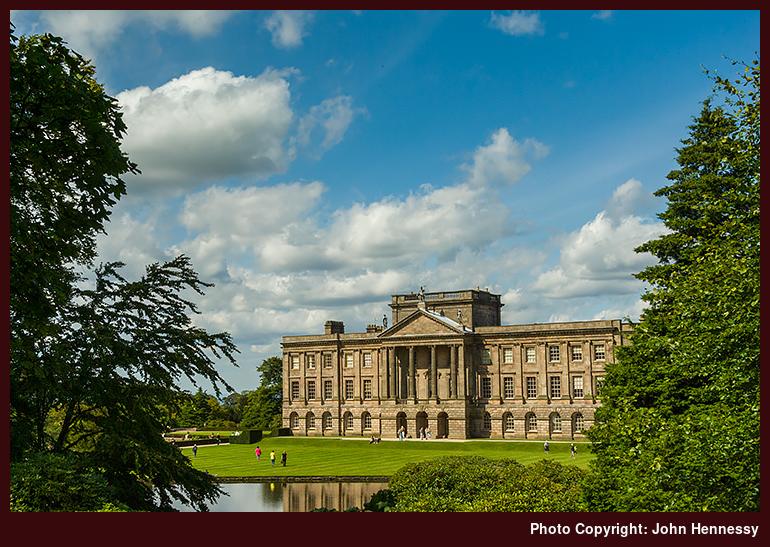
Being of a more recent vintage, my August 2009 visit to Lyme Park is better remembered so far, and having a full set of dated photos helps too. To make sure that those recollections are somewhere for reference, I'll stick them down here, too. In some ways, this was a repeat of that July 2003 visit in that I cycled all the way there from Macclesfield. A combination of the Middlewood Way, the Macclesfield Canal and the A6 saw to that. It may surprise some to learn that I reckoned the Macclesfield Canal towpath to be the least suited of all these for cycling, and that seems to apply to its full length, even if there are those like me who give using it like this a go.
Having come by bike early in the day, I had some time to expend. In many ways, this proved to be the most satisfying of all my visits. Good photos could be made for once using the mix of sunshine and blue skies. While not being tired like on that July 2003 trip, I still relished the opportunity of lounging a while and wondering if long-distance walking actually deprived me of such chances at times. The way home was nowhere near as direct as on the very first visit in August 2000 since I went for a cross-country route under clouding skies. Exiting the Park using a back avenue that wasn't very suitable for bikes, even mountain ones, and is even less so following a bridge closure, I made my way onto Mudhurst Lane and followed it as it turned into Higher Lane until I reached the B5470. That road in turn was left for Bakestonedale Road into Pott Shrigley, from where I journeyed through Bollington and onto home on very familiar roads after going along a few that were new to me. Because there were steep inclines that I just didn't fancy because of my lack of trust in bicycle braking or my ability to steer at speed on downhill sections, I often dismounted and walked the bike instead. Given that this was a day out and not a commute, there was little point in rushing anyway, and that was emphasised by my arrival home at a very respectable hour early in the evening too.
November 23rd, 2012
Last November saw me make my most recent visit, and that was the cause of inspiring me to collect these thoughts in the first place. It was a reprise of the walk from Bollington to Disley from early. This time around, I had clear blue skies for much of the walk and some sunshine. Once I had savoured views towards Derbyshire hills under better conditions than I ever had before, I could drop into Lyme Park and linger a little while. Clouds did take over the sky by this time, but I wasn't bothered. The walk was needed and there was plenty to enjoy while the sun stayed with me. In fact, there is much more to say about this trot, so I'll leave things at this teaser. The full account is next on my list of trip reports (one that is not afflicted by a patchy memory would be good, at least for later reference) and I'll not be abandoning Lyme Park either if I can help it. It may feel as if I have seen most of what it has to offer, but there is any harm in revisiting spots with which there is a certain familiarity anyway. If anything, that makes for more relaxation because there is little reason to dash about it, which is a very good thing.


