Littered with little walks
 30th September 2012
 One thing that I have noticed about the Derbyshire Dales is that many of the walks around there are short affairs. That would explain how I fitted in two on the same day last May. Also, a few weeks ago, I got to take in yet another: a trot from Thorpe to Hartington that followed the course of the River Dove that followed up on last May's venture.
Since part of the course that I followed was a busy stretch, I have been looking at what else the area has to offer. The sunny day had drawn out families, and they seemed to be everywhere, walking much further than I would normally expect. Usually, strollers like these are left after one quickly but the more level terrain and the beautiful day must have encouraged them.
Looking through Cicerone's White Peak Walks: The Southern Dales by Mark Richards revealed good supply of walks in the area, many of them short. With the hours of daylight now declining, that attribute could be a handy one for hibernation avoidance this winter. Options like Thorpe Cloud and others look promising and may offer less hemmed in savouring of the delights that are to be found around there.
The northern Derbyshire Dales but there seem to be longer walks there than in their southern counterparts if what's in Cicerone's White Peak Walks: The Northern Dales (again by Mark Richards). Still, they offer possibilities for shorter days that I feel inclined to investigate, especially those that are near at hand to those using public transport. One's that catch my notice are possibilities near Tideswell, Castleton and Bradwell since I haven't been around those parts for a while.
For when longer hours of daylight are restored to us again, there's Vertebrate Publishing's Day Walks in the Peak District by Norman Taylor and Barry Pope. These aren't limited to the White Peak with Dark Peak routes also included. However, they will fill a day nicely and without having to cut out a leisurely midday lunch either. One suggestion in that collection takes in Longnor and Crowdecote and that involves a deep-sided valley that hosts the upper reaches of the River Dove. There are plenty of others that I could use though, and an earlier start is a possibility since the Peak District is on my doorstep.
For walks that are even closer by me, there's Eastern Cheshire Walks: From Peak to Plain by Graham Beech from Sigma Leisure. Having had a trot home from Bollington that took in the Saddle of Kerridge and Tegg's Nose on a wonderfully sunny afternoon. It left me wondering why I don't make more of the local area and why it is that some nearby hummocks only get an annual visit when I should do better than that. Maybe I need to peruse this little green book a few times in an effort to address that state of affairs.
Speaking of a certain remiss, the western side of Cheshire always seems to be devoid of my attention. The idea of walking from Frodsham to Delamere train station along the Sandstone Trail has occurred to me, but things have got no further than that. That trail has its own guide too in the form of Walking Cheshire's Sandstone Trail by Tony Bowerman. This is an attractive, glossily presented affair from Northern Eye Books, and it looks as if it needs more than has been the case up to now. As that were not enough, there's also Walks in West Cheshire and Wirral by Jen Darling from the same publisher. Some of the walks in there are short too, which could be handy for a quick sortie. That's not all either, since Mara Books, an imprint of Northern Eye Books, have produced Circular Walks around the Sandstone Trail by Carl Rogers, so I should not be short of walking ideas for a part of Cheshire that I scarcely have frequented up to now.
All in all, there should be plenty from the above to fuel shorter and longer escapades in Derbyshire, Staffordshire and Cheshire. With those shorter hours of daylight around the corner, they could have a use. All that needs doing now is not to make the walks feel longer than they are and to summon the energy needed to get outside in the first place. Sometimes life events and weather forestall that but my design of at least one walk per month has been bearing up well since May, so here's hoping.
Coincidences or mind-reading?
20th August 2012 Last week, I picked up a copy of the latest edition of Country Walking and it features ideas with which I have been toying for a while. High Cup Nick and Teesdale on the Pennine Way are among these as is a circular walk from Ingleton that takes in Twisleton Scars and Ingleborough, yet another route that I'd like to reprise. Even, nearby Shutlingsloe and Tegg's Nose get a look in too so Cheshire's hill country does not get neglected either.
The week before, the current edition of TGO arrived on my doormat and it features two places that I have visited recently: the Howgill Fells and Gower. The latter of these only saw me again last week and I enjoyed a circular walk taking in Rhosili Down and a pleasant stretch of the Welsh Coastal Path between Rhosili and Port-Eynon. The TGO route differed from these coastal ambles but going inland and uphill for much of the way. Gower is not big but it attracts a lot of folk of a sunny day and the roads cannot take the traffic so that's worth bearing in mind. That also has the effect of severely delaying buses as I discovered. Sensibly, I decided to overnight in the area rather than trying a day trip so the delay caused no mishap and I was indoors before a weather drama featuring lightning, thunder and heavy rain unfolded. Looking along that coastline again is causing me to conjure up yet more walking ideas.
TGO's Howgill Fells route is an overnighting affair too and explores hills that I only glimpsed from atop The Calf. While a day walk would be more what I am after, it has made me think about approaching these hills using somewhere other than Sedbergh, again using the 564 bus service between Kendal and Kirkby Stephen. The Llyn in Wales is another walking possibility of which this month's TGO has reminded me and there's the prospect of a circular hike into hills from Achnashellach train station on the Inverness to Kyle of Lochalsh line too for pondering, especially as I have played with using an out and back train journey along that railway to occupy a day when the weather isn't as favourable for going out of doors.
While the overlap between my thinking and what's to be found in walking magazines may seem uncanny but it could also be that I am just ranging over so much of Britain when playing with possibilities that overlap with what others are thinking is inevitable. Then again, they may be reading my words on here too...
When two walks became one
7th August 2012 There are times when more gets fitted into a day than was expected and one of those came my way on a Saturday in May of this year. When a walk from Waterhouses to Hulme End didn't fill the day, an extension was in order. That took me to Hartington via Beresford Dale, Wolfscote Dale and Biggin Dale and fitted easily within the bounds of the rest of the afternoon. Being able to enjoy a longer walk was a bonus with the sunshine that was there to be enjoyed, whenever clouds didn't get in the way.
Waterhouses to Hulme End
Contrary to where my thinking had been, this essentially became a morning walk last May. It raises questions as to how I overestimated how long it would take me and I now think that tramping level tarmac tracks had something to do with my making good progress. As it happened, I am not so sure that I was expecting a metalled surface underfoot for all the way.
If the shortness of the trot had dawned on me last January, a tardy start after a busy tiring week at work would have had little impact on the day's plans, other than a later start. The non-appearance of a bus from Macclesfield to Buxton dues to icy road conditions would have had no real effect either. Nevertheless, it might have been better not to confront the prospect of icy surfaces so readily. Without actually getting out that day, I have no idea how things looked but it now sounds that rushing could have been unwise then.
One aspect of the walk in May was that no rushing was needed. A certain hunger ensured that I caught the 09:10 bus from Macclesfield. It was destined for Ashbourne and was well busy too, a heartening observation for a rural bus service in these austere times. Then, two folk boarded it when I alighted from it in Waterhouses.
My disembarking point gave me a longer walk through the village than a little extra knowledge would have left to happen. In the sunshine, that was of no concern and I proceeded steadily. That the River Hamps wasn't at all far away meant that I soon reached it and shadowed its course as I left the village. The next objective was the left turn that would get me away from the side of the A523 along which I was going.
The lack of signage when I did reach the turning near Brown End Farm reinforced the quiet vigilance that I had been exercising. This one of the few points in the day when inattention to map reading would have resulted in a spot of navigational floundering. Things would have been more obvious if I had sought out the site of the old railway station and started from there, but my approach worked and that's all that was needed.
The stillness of the countryside by the Hamps struck me and there only were a few passing cyclists and walkers to disturb any sense of isolation. Another reason for the quiet was a geologic quirk that meant the Hamps made no use of its riverbed on the day that I passed the way. Being limestone country, the river disappears underground for much of its course unless the weather turns wet enough for it to emerge above ground. With the news media being full of stories about drought at the time, it was tempting to think that this might be a manifestation of what was causing water companies to issue hosepipe bans and other measures aimed at conserving dwindling stocks. Little did I realise that we were in the midst of the wettest April to July period since weather recording began. Now, we don't hear such things and moans about having too much rain have replaced all the talk of water shortages, though it now seems that the weather has done a very good job of filling up reservoirs. With the U.K.'s dependence on surface water collection for our water supplies, maybe we need to better tolerate wet weather if we are to have any water at all.
The lack of water above ground prompts another question. Could our desire for being beside gently flowing rivers also explain the lack of folk around that part of the Hamps? Thinking about it now, it seems that other factors at play and I was following the route of a former narrow gauge railway that was set to link nowhere to nowhere. One of these backwaters was Waterhouses and it still is a quiet place today and the other was Hulme End and that's not exactly bustling either. Folk might seek more scenic drama when they visit the countryside and I was thinking my pastoral surroundings a little tame as I passed through them. In fact, thoughts of making good a design on walking the Howgill Fells from Sedbergh momentarily were restored and I was wondering if I had been a little timid in my route choice. Since then, I have made good use of the Howgills idea and need to say more about that excursion.
It isn't all farmland beside the Hamps, because the National Trust owns a number of woods along the way. It only took me an hour to get from Waterhouses to reach these and the sides of the valley had steepened by this point, partially putting paid to any yearnings for more visual drama. What also was unmissable was the lack of leaves on many trees that surrounded me. The evening before saw me spend some time around Tatton Park near Knutsford in Cheshire where there are plenty of leaves on trees, so this was a marked contrast. There must be slightly different climates between the two places.
Those National Trust woods had another use too on a track that needed little in the way of navigational intervention. They told me where I was and how I was going; names like Old Soles Wood and Soles Coppice proved to be good locators. Checking the map beside these told me that more might be made of the day than I had dared to expect. Beeston Tor Farm's caravan park came as a surprise to me after all the quietness that I had encountered and the limestone outcrop of Beeston Tor was there to be seen on the approach to where the Hamps meets the Manifold too. This was more like the sort of sight that I had in mind and there were more like it to be seen throughout the rest of my walk.
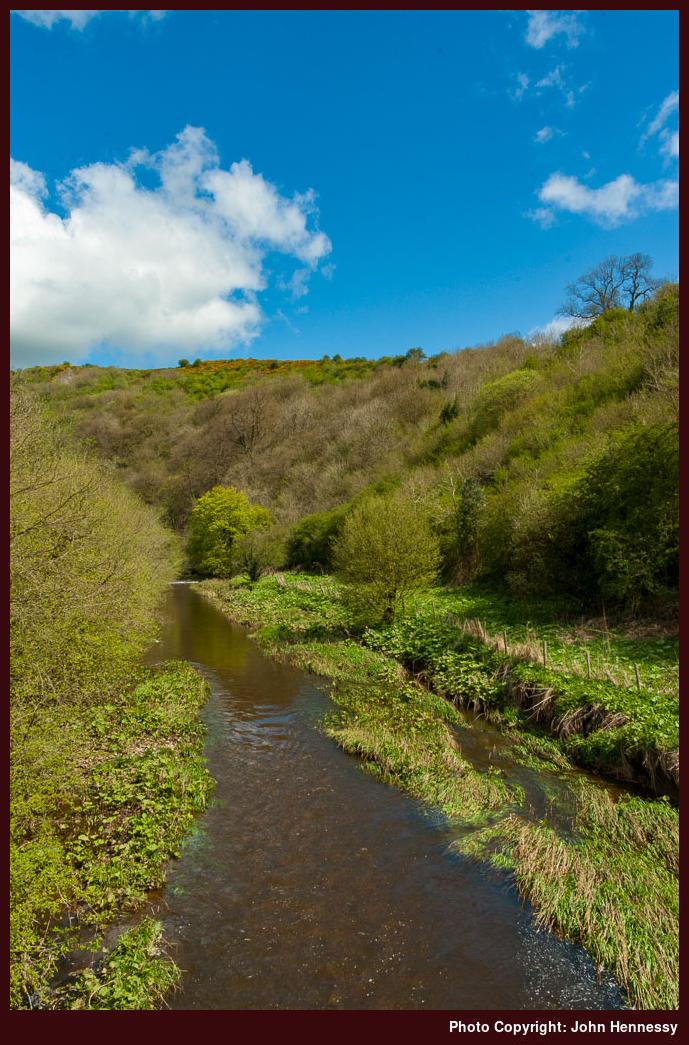
Unlike the Hamps, the Manifold was in good flow and there were more folk around it too, hence my earlier thoughts about humanity and flowing rivers. A mobile ice cream stall had set up for the day so there needed to be some custom. The caravan park, with a curious collection of older specimens, will have helped their cause along with any day visitors that came the way, though I staved away any sense of temptation. Accessibility helps too, since this was the next public road crossed by the former railway on its journey north since the A523 near Waterhouses. The abundance of hills made for narrow single track roads but we make our ways wherever we will.
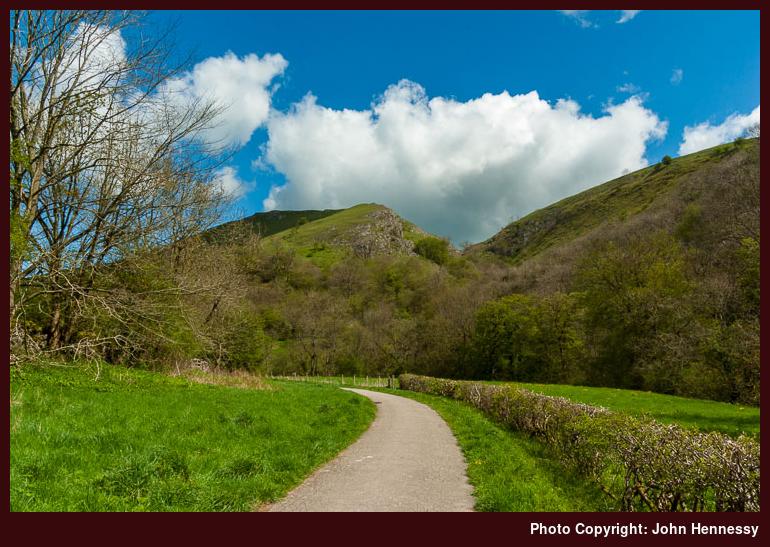
Soon enough, I was back on an off-road track again after admiring a road bridge over the River Manifold. Having to share the delights of the surroundings with more folk now was no downer and I continued to make good headway. The level nature of the track played its part and it could be a good option for anyone wanting to get back to walking again after a lay-off. Maybe that's what attracts those who don't get out so often. Those seemed to more numerous after I returned again to a public road after Ladyside Wood. On the approach to that road, someone bid me good morning and asked if it still was that time of day. There were ten minutes to go to noon, so a laugh was shared and enjoyed before we parted.
The next off-road section of the Manifold Way was beyond Ecton Bridge and the old railway tunnel required passage too if I wanted to stick with the route of the Manifold Way. Many signs for the Hamps Way and the Manifold Trail were to be seen along the course of my walk without any depiction on my OS map. Further investigation since then revealed that I needed a new one and it is sitting in front me as I write these words. The trails could have uses for future walks.
In fact, the Manifold Trail could have a use since it avoids the tunnel. As I went through it, others came that way with loud motorcycles and there was such a din that I stopped next to a wall until they had gone. The motorcyclists may have enjoyed the racket, and there are those who do, but it is not a taste that I plan to acquire. Being able to hear the peaceful sounds of the countryside is more my thing and there was plenty of restorative quietness between that tunnel experience and the end of the Manifold Way in Hulme End.
Hulme End to Hartington
After a break at Hulme End, a stretch of road walking conveyed me to Beresford Dale. The day was growing hotter as I plied more tarmac, all the while noting that caravan and camping sites are not scarce in this part of the world. It after passing the last of these for the day that I began my descent into Beresford Dale. As I did so, signs highlighting a public footpath diversion were to be seen and the cause was that the bridge that I was planning to cross had lost its railings at one side. In the event, I chanced going over it in spite of all the safety tape and did so without mishap or tumble. Sometimes, you have to use your own judgement.
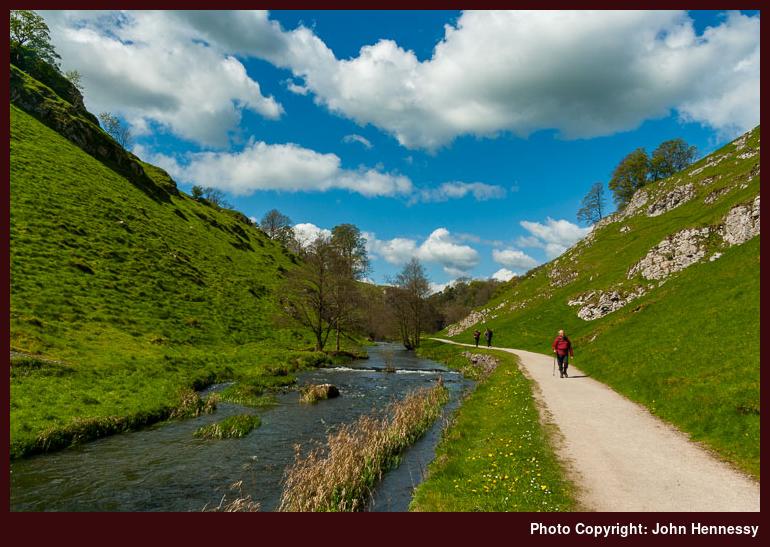
Once across the River Dove, crossing a field got me onto National Trust land and into Wolfscote Dale. The sun was in hiding when I entered the dale but it soon emerged to light up the wonder that lines this stretch of the River Dove. For one thing, the whiteness of limestone outcrops contrasted wonderfully with the green vegetation that surrounded them. Adding in a gently flowing river like the Dove was enough to make it all feel like a little piece of heaven that happened to fall to Earth. There was a need to share, but isn’t there always?
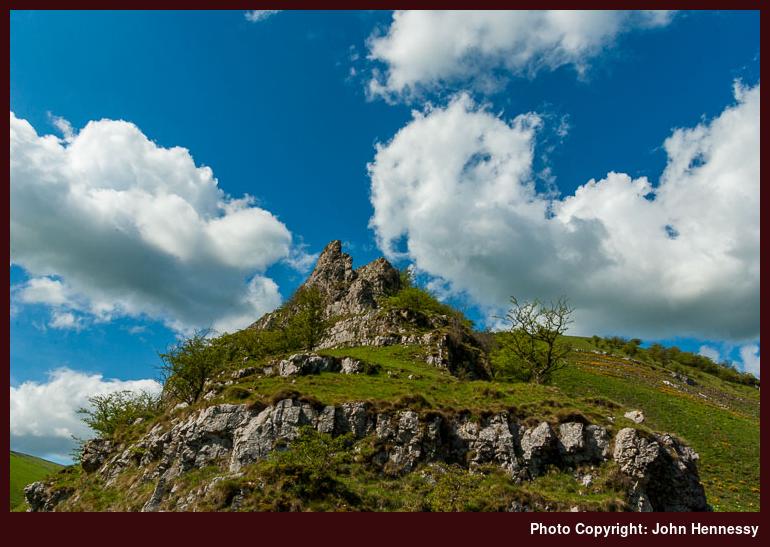
At the junction where Wolfscote Dale meets Biggin Dale, I popped uphill a little to find another resting place and ate more of my sandwiches there, a sort of outdoors afternoon tea after a fashion. During that time, the nearby surroundings emptied of folk to leave the place practically to myself. The prospect of continuing south towards Thorpe and Ashbourne really tempted, so alluring did the dale look. However, the use of two route ideas on the same day was enough so that brainwave was left for another time. It's best not to be greedy.
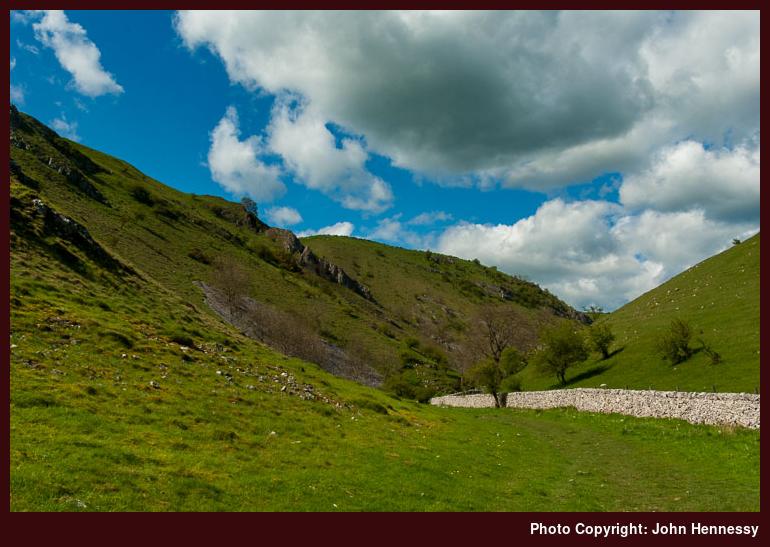
Once down off the slopes again, I turned to enter Biggin Dale and followed the walls while I was admiring the luscious green valley sides in bright sunshine. At the northern end of the dale, navigational choices were needed and I chose to go for Dale End instead of either Biggin or Reynards Lane. Once I had allowed cars and tractors to get by each other on the small road, I left it for the much quieter Highfield Lane to get to Hartington. Being above the dales at this point reminded me how much I felt I was missing while following the Tissington Trail from Pomeroy to Ashbourne in 2010. Appearances are that it's so much easier to make interesting photos when you're in a dale than when you're above it in this part of the world.
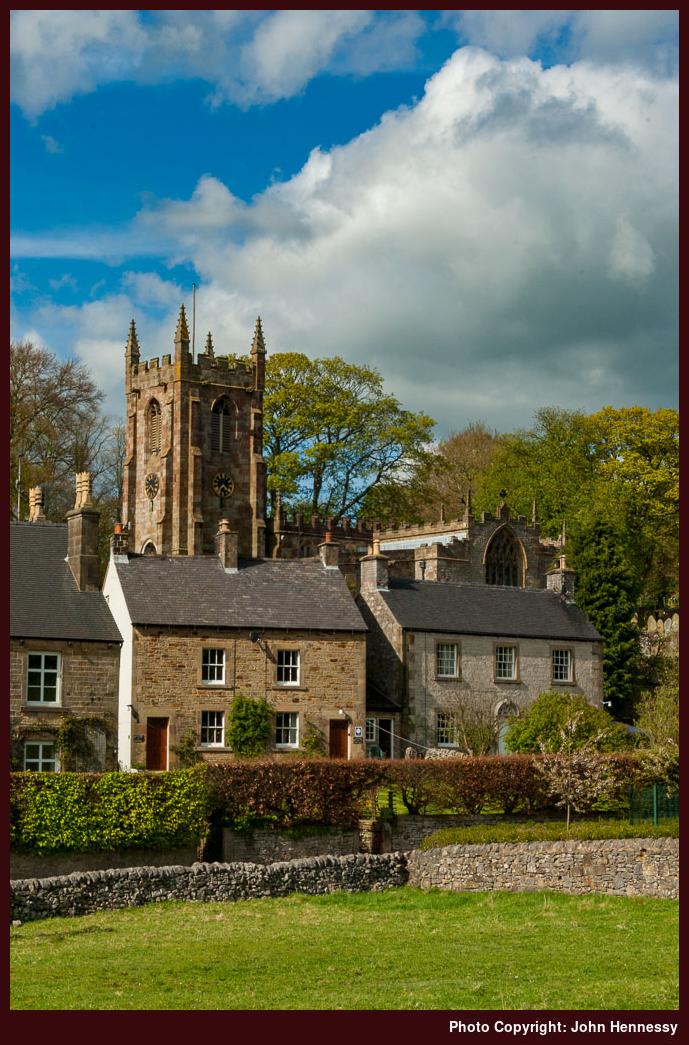
The lane was left for a public footpath that took me to the road into Hartington a little further along than the lane would. While dropping into my destination, I spotted a function going on at the YHA hostel, something that surprised me given it was May. Small wonder then that booking a YHA is an acquired art when things like that are done with their properties. A pleasing view towards Hartington's church replaced those thoughts and I turned into the heart of the place to find a bus stop in plenty of time before the next bus to Buxton would appear.
More Ideas
The outing may have used two walking ideas but it yielded many more. Even the homeward bus journey had its part to play in that it showed me what is to be found around Longnor and Crowdicote. There's much more to savour in White Peak country yet so I should not be bereft of excuses for escapades when I fancy straying not far from home.
Travel Arrangements:
Bus services as follows: 108 from Macclesfield to Waterhouses, 442 from Hartington to Buxton, 58 from Buxton to Macclesfield.
Collecting ideas…
2nd August 2012 The weekend before last saw me head to the Howgill Fells for an out and back trot from Sedbergh to The Calf. While the sky clouded over during my walk and there was an unintended deviation towards the end of the return leg, it remained an enjoyable affair, with my having traversed no fewer than five hilltops along the way. The first was Arant Haw with Calders, The Calf, Bram Rigg Top and Winders all following one after another and Calders being crossed twice. Much of it was on access land too, so it didn't matter much if I veered away from rights of way and, in fact, much of my course deliberately took advantage of this.
After getting in at least an outing a month since May, I would like to continue the pattern. Over the last few weeks, I have been dredging a few from previous outings that I made in the last few years. In its own, that visit to the Howgills was born of this strand of thinking, but there are others. A return to Ingleton for a circular hike featuring Twisleton Scars and Ingleborough with some sunshine and blue skies is but one of these others. Revisiting Teesdale is another, and it took the world of Twitter to remind me of that part of England. My sole visit to the dale so far also happened on an overcast day, so getting a day with better lighting and more interesting skies would be good too; that would make photographic endeavour all the more appealing. After all, someone has a very appealing image on their Pinterest site and I wouldn't mind having my own photos of Low Force (and High Force too) in similar conditions as well. The passage of the Pennine Way along there brings to mind the idea of exploring High Cup Nick near Dufton on the western side of the North Pennines. Again, there only has been a single outing in the Eden Valley so far, and I'd like to complement it with another. The weather was good that day, though travel issues curtailed the time that I had available, hence why I'd like to go back again.
There should be enough to be pondering from the above by catching up with a few issues of TGO while on a trip to Ireland added to them. They brought to my attention possible crossings of Lingmoor Fell in the Lake District and Beinn a' Chrùlaiste near Glencoe, both of which made use of roaming rights that we now have. The latter traverse reminds me that having a few Scottish trip ideas would be handy, and I was reminded of my pondering ascents either of Bynack More in the Cairngorms or a tempting Munro near Blair Atholl. Re-walking the West Highland Way between Bridge of Orchy and Kinlochleven was yet another. One new inspiration had caused me to recall older ones.
Maybe, I need to collate the various brainwaves in a permanent if ever-changing list somewhere so that I can inspect them in moments when nothing particularly can be extricated from my imagination, like during the latter half of 2010. Long-standing Welsh ideas like walking Ysgyryd Fawr near Abergavenny or returning to Pembrokeshire (featured in the current issue of Discover Britain, as it happens) would belong on there too. Maybe I need to re-read these prospective pieces more often than I do.
As it has turned out for me, the ideas that I have been using so far this year have treated me well, and all the inconvenient weather that has come our way doesn't seem to have stalled my hill wandering greatly at all. Now, I need to sit down and write about a few of them in place of thinking about possible new excursions, good though that is. The coming weekend looks not too promising for an outdoors excursion, so that may be a chance. That's not to say that other matters may not intrude, though...
Usable?
11th June 2012 Not so long ago, the Met Office introduced a major change to its website and I'm not so sure that it's all that successful. In fact, I still have a link to one of the old pages and they remain live if hidden away from view. One example is the rain radar page.
The new website dispatched niceties like bookmarking local weather forecasts on there that you often visited and even the backward and forward arrows for navigation through weather forecasts and several hours' worth of weather conditions. The latter is handy when you want to see how fast a rain belt is moving; it's not where it is that always matters but where it is going and how long it sticks around.
In its favour, the new website has five day forecasts for more locations and each is broken down over the course of a day for all five days too. Previously, we only got that for two days out of five. The old bookmarks are gone but the website remembers the last five locations for which you looked for weather forecasts so that's a partial concession.
The weather maps are where I feel there to be some degradation even if we now get period by period forecasts for five days at a time. The old site had its moments of unresponsiveness and the new one feels more so. These manifest themselves with five day location forecasts and also with maps too. For example, seeing the progress of a rain belt is less easy now because the loss in smoothness with the new maps. The absence of previous/next buttons is noticeable too. Being able to zoom into the maps is all well and good but it seems to have come at a cost. If it was possible to click on a location's weather icon to get a five tabular forecast, then that would be something more in return but that opportunity was not taken.
All in all, I am unconvinced by the Met Office website's redesign. Only time will tell if they have another go and I for one hope that they do. Perhaps, then they could bring back the good features from before in a way that fits in with where they want to go. As things stand, it reminds me of the uninspiring feel of Windows Vista and I'd like to see them make a Windows 7 of it.


