Explorations of the Manx Coastline
 14th May 2010
 Last July, I popped over to a rainy Douglas on a day trip from Dublin, but my only being in one place and time limitations meant that the Isle of Man remained one of those places that to me are terra incognito. However, I did come away with guidebooks and travel timetables that would come in useful for a longer visit like that I made over the Mayday bank holiday weekend. One thing that they revealed was that there was no way that I could make the best of all the island's attractions in a few days; I'd have to make my choices.
It's as if there's a little something for everyone, from gentle promenade strolling to railway heritage to hillwalking. Spending time around the likes of Castletown, Laxey or Ramsey would easily fill up a few days, it appears. If my memory serves me correctly, there was a music festival ongoing in Ramsey over the course of the weekend for those seeking a bit of culture. The island's steam railway was running extra services on the Sunday too, so they were aiming to please.
Of course, I was after a simpler pleasure: going for a walk in some alluring countryside. It so turns out that there's plenty to offer there too, and the mix is of coastal and hill country exploration. A collection of long-distance trails give structure to any planning, and there are quite a few from which to choose. First up is the island's main coastal trail, Raad ny Foillan in Manx Gaelic (and on all signs) or Road of the Gull as it is in English. After that, there's the Millennium Way that passes through the hill country at the heart of the island as it goes from Ramsey to Castletown (or vice versa, if you prefer) either shadowing or following the route taken by the Manx Kings in olden times when Castletown was the island's administrative centre. Complementing its north-south direction is an east-west trail called the (Steam) Heritage Trail that follows the former railway alignment from Douglas to Peel. Then, there's the Bayr ny Skeddan (the Manx Gaelic again is what you'll find on any waymarks) or Herring Way that follows an old route taken by fishermen between the posts of Peel and Castletown. As if these weren't enough to keep anyone busy, there are other public rights of way too, so there's nothing to stop you creating your own long-distance trot if you so desired it.
Given that there are enough options to keep anyone busy for a few weeks, I needed to select something for my few days. That ended up being a part or two of Raad ny Foillan with the main piece being the section between Port Erin and Peel on the Sunday. Saturday was taken up with travelling, but there was some poking around of Douglas and Onchan later in the day. Given that the most recommended part of Raad ny Foillan in my reading was between Port Erin and Port St. Mary, I was tempted to walk this shorter stretch on Monday before I left for home. However, the attractions of Peel on a sunny day drew me back around there for a final fling and some photographic action.
Saturday
While flying would have made a tempting travel option, I stuck with the rail and ferry combination that served me so well in July. That made my starting time a more civilised affair, and it was 14:00 when I arrived in Douglas. The fact that I had left sunny weather after me on the British mainland could have been troubling, but the situation was put out of my mind because there was plenty of time for the sun to make its appearance. Given that the air was dry anyway, there could be no complaint as I set about locating facilities such as the bus and railway stations (there are two of the latter with a steam railway serving the south as far as Port Erin and electric trams serving the north as far as Ramsey; the island has more of a railway heritage than you'd expect). My trots took me along the promenade (part of Raad ny Foillan; the coastal path offers variety) and around the town of Douglas before heading out the coast around Onchan before returning through its main street. Save for the cliffs that I admired, there wasn't so much of a wild feel to this dandering, but the next day was to address that deficit. Given my unfamiliarity with the place, it probably was just as well that I made a stronger acquaintance with my whereabouts.
Sunday
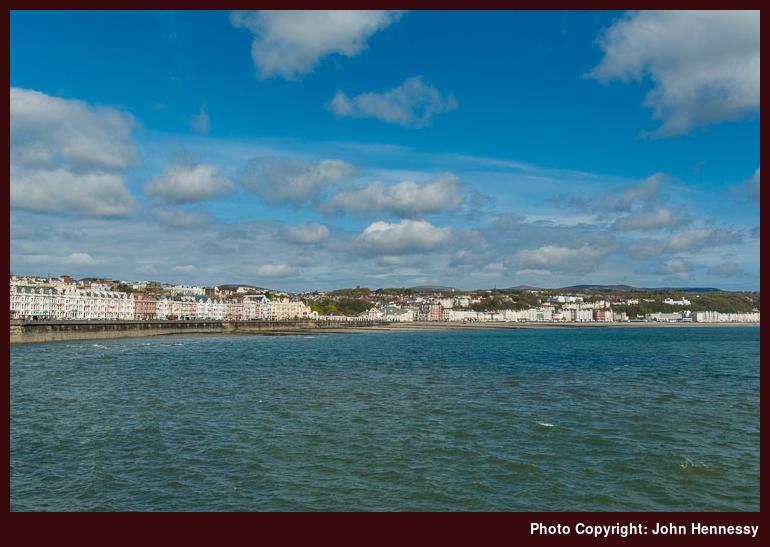
Overnight, cloudiness had given way to blue skies and sunshine. The pleasant start to the day wasn't wasted, even if it meant a late getaway to Port Erin. By that time, any white streaks in the sky may have come to be replaced by wads of clouds, but they did nothing to dispel the sense of satisfaction already granted by the day. Travel on the upper deck of a double-decker bus allowed wider views over the surrounding countryside and road works meant a stop to progress that allowed me to cast an eye and even aim a camera lens in the direction of Snaefell, the island's highest summit. The bus called at Ronaldsway Airport before negotiating the narrow and appealing streets of Castletown, once the island's capital and still in possession of its castle. The place certainly looked deserving of a longer visit, but my plans were set, even if they meant leaving some of the sun after me.
Port Erin was cloudy and overcast when I arrived, so there wasn't much camera activity on my part as I sought out the start of my walk. Signs for the Road of the Gull were conspicuous by their absence, so paying close attention to a map was unavoidable. While taking a break between sessions of map studying, a friendly local pointed me to Bradda Glen without my asking; it was to lead me in the right direction. Whatever thoughts I may have had regarding the navigational ease of coastal walking, doubts remained in my mind as to the correctness of my course. Nevertheless, Milner's Tower was a useful landmark as I made my way towards it, and that act granted views south towards the Calf of Man. On a sunnier day, I might have been struggling with lens flare, but the largely overcast conditions still condemned any photos to being record shots. It was a turning into a day for walking and not photography.
Leaving Milners Tower after me, I gained height on the way up Bradda Hill. As I did so, the path took me sufficiently close to the cliff edge as to concentrate my mind, and it was breezy at the time too. Eventually, the path pulled in from the edge to allow any vistas to be enjoyed in a more relaxed state of mind. Not only did they feature what lay behind me but also what lay ahead of me with Lhiattee ny Beinnee and Cronk ny Arrey Laa looming to the north with less taxing rolling countryside lying beyond them again. Looking east drew my eyes to less wild parts from my wilder outpost, with even Port St. Mary coming into view.
Bradda Hill felt loftier than its more than 200 metres of altitude might suggest, and I felt every metre of that on the steep descent to sea level. The worn surface of the path wasn't the most confidence-inspiring either, but I had been in that situation so many times that I just got on with the job with Fleshwick Wood to my right. After dipping my boots in the Irish Sea at Fleshwick Bay, I soon started to pay for all that loss of height on the first of the Carnanes. Apart from the toll from all the exertion, patience was tested too and time felt as if it was speeding by on me without much in the way of distance covered.
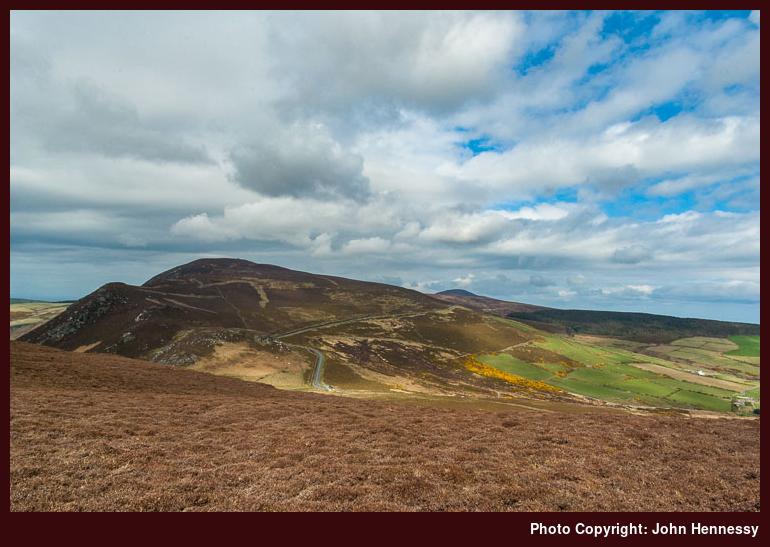
Eventually, the gradients eased, and it was gentler ambling to the top of Lhiattee ny Beinnee before I lost 100 metres again; the first half of my walk was having many ups and downs, but this probably is the hilliest part of the coastal trail and my choice of route was guaranteed to keep me busy for the day. Looking to my right, I could see how much flatter the land was, and I could make out the eastern coastline of the island. There were easier walks if I so desired them, but I'd be wondering if I was missing out then.
After coming down from Lhiattee ny Beinnee, I spotted a track that skirted its lower slopes. For those wanting a less taxing stroll, this may have been an option with an off-road start from Surby, not so far from Port Erin. In fact, I spotted a mountain biker heading exactly for that end as I was stopped for some food on the side of the A36. From there, it was on up the slopes of Cronk ny Arrey Laa, the highest point of my hike and where patience was needed again on the ascent. The skies darkened over me as I kept gaining height, and I wondered if I was in for a wetting. Luckily, it never developed beyond a few drops that were gone by the time that I reached the summit, so I could stop and take in the surroundings, among which was the hill of South Barrule and a triangulation pillar placed away from the summit of the hill. The latter seems to be the Manx order of things, if finding the same arrangement on two different tops is typical.
Getting down from Cronk ny Arrey Laa required due care and attention to go in my intended direction and not another. Once I avoided any navigational pitfalls, I found that my ascent had taken me up the hill's gentler side because it's no walk in the park if you are coming at it from the north, as I suspect many do. Going downhill as I was meant that I wasn't so concerned about gradients, but there were boggier stretches and sunken paths to negotiate later on. Even so, it didn't take me too long to come to a junction of paths near Eary Cushlin. Things looked less certain, so I invented my own route using the Isle of Man Survey 1:25000 map that was in my hands rather than poking around near cliff edges even if the land was owned by the Manx National Trust. Also, increasing time consciousness had its own contribution to the decision too.
My alternative took me onward via a good public footpath and a bridleway that really didn't merit the classification. It was so rutted that anyone taking a horse, bicycle or motorcycle over it without having to rethink their plans would amaze me. Even with the diversion, I was never far from the coast and I met up with Raad ny Foillan gain to look back about, saw how clear the way looked from that end. From there, I followed the trail onto tarmac where it passes through Dalby and didn't leave the A27 until near Glen Maye. If I was following the OS Landranger map for the Isle of Man, my route might have been slightly different, with a diversion around by Niarbyl. Apparently, its southern views are very pleasing, but I was getting plenty of those anyway.
Leaving the road, I picked up a well signed path that was to drop me to sea level and take me along a little of Glen Maye before I gained height again, though it was nothing tortuous or like the stiffer climbs that I encountered earlier in the day. From there, the trail really hugged the coast, yet I dealt with that and any undulations that came my way without any real drama. Corrins Tower still lay ahead of me, as it had done since commencing the descent of Cronk ny Arrey Laa, but steadily came nearer and nearer.
At this stage in the walk, I was keeping an eye on the time to see which bus would be taking me from Peel back to Douglas again. Even so, my mind was focussed by the proximity of cliff edges and views towards the hill country not far to the east of me. Knockaloe Plantation drew nearer in its own good time, as did Corrins Hill. Eventually, I was going along the seaward slopes of the latter and that proved to be the most unsettling part of the journey; seeing a path (even a wide one) following a shelf over nearby cliffs does tend to set your mind racing... Nevertheless, I did scuttle along that shelf to reach more friendly surroundings and a vehicle track for a nearby transmitter.
Views over Peel opened out before me, with a passing shower making a rainbow without even nearing where I stood. For the way down, I ended up eschewing the coastal trail for the vehicle track and was rewarded with ample views over Peel Castle and up along the coast in the fading evening light. It was a just way to end a walk that had taken its toll with all those ups and downs. The last act was to navigate through Peel's narrow winding streets to get to a bus stop in time; that nearly was the toughest navigational test of the day and with a tired head too. As I journeyed east again, I counted myself lucky to have avoided any rain while out on the trail because the rain showers through which the bus passed weren't the lightest. In fact, the only real wetting of the weekend was from light rain while I walked the last stretch to my lodgings, and that didn't bother me so much at the time. On a weekend with an uncertain weather forecast, you cannot decry things like this.
Monday
After the previous day's endeavours, I decided on an easier morning before I returned home again. Having not had much sun while wandering the western coast, I decided on a return to Peel when it looked like a day of blue skies and sunshine. Rushing around the coast, if that's even possible, between Port and Port St. Mary didn't sound far, and I was carrying all of my kit for the trip anyway. As it happened, I ended up taking in a short circuit around Peel.
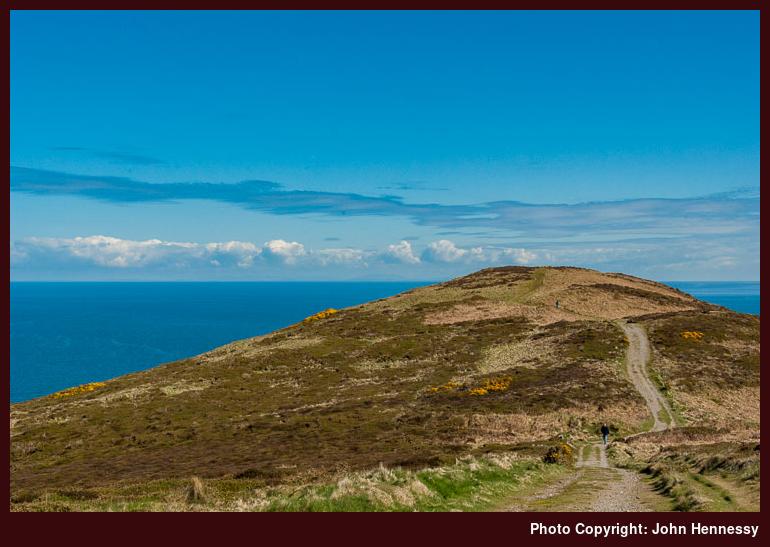
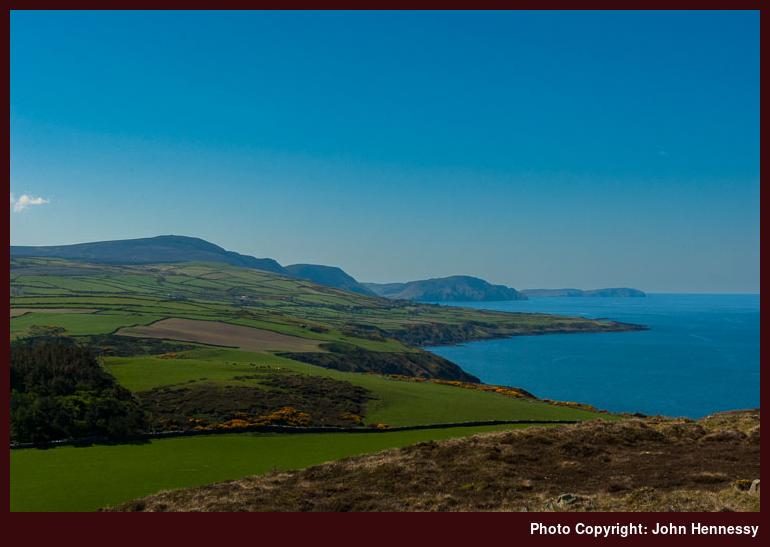
What I had in mind was to mount Corrins Hill and take in the surrounding vistas and make some photos of them if I was careful with lens flare. To accomplish that, I picked up the bit of Raad ny Foillan that I missed off the evening before and took a relaxed approach to soaking in the views. Sharing some words with a talkative chap taught me that the Mull of Galloway could be seen to the north. There was little sign of the Mourne Mountains of Northern Ireland, but I reckon that I got to see them the evening before anyway.
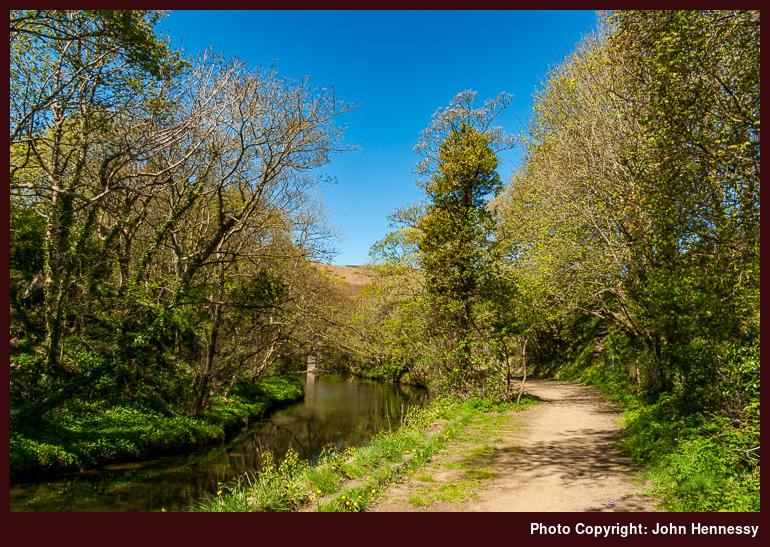
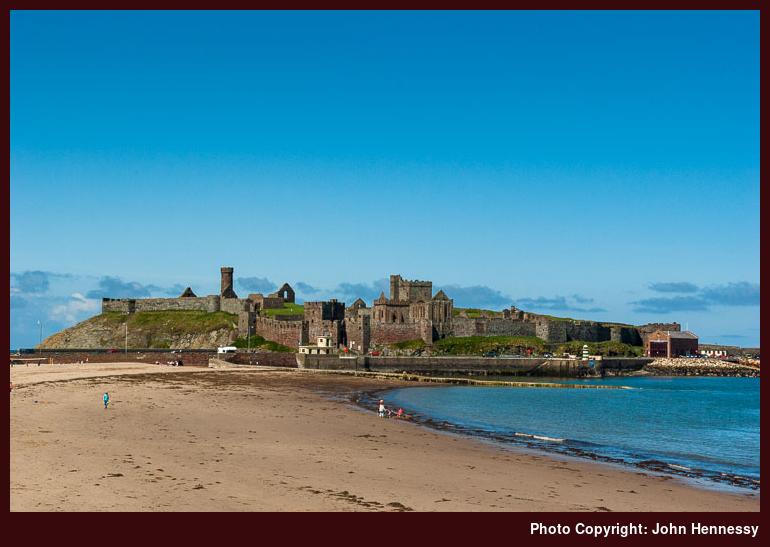
After staying a while on Corrins Hill, my little trot took me downhill to pick up a piece of Bayr ny Skeddan before meeting up with the Heritage Way, part of the former railway between Peel and Douglas. Back in Peel again, I headed towards the castle and followed the promenade while en route to the stance for a bus back east. Seeing a lad with a rucksack and other paraphernalia must have looked strange to anyone after a gentle seaside fair, but Peel is quite a mixture anyway. First, there's heritage with the ruins of a castle, narrow winding streets and a cathedral. Then, there's industry with an electricity generating station and fishing. Following all of that is pleasure, be it from sailing, gentle strolls by the waterfront or more taxing ones around nearby hills. Might it be a worthwhile base for a walking trip? That may remain to be seen, but it's an idea.
A Place to Return?
Funnily enough, someone who I met on my wanderings did ask if I'd be coming back to the Isle of Man. While I couldn't give a definite answer to that query because the future is not anyone's to see, there are plenty of reasons for a return. After all, I only sampled a small piece of the island's delights in the few days that I was there. When it came to weather, it was kind to me, even if I chose what probably is the toughest part of the coastal trail. The Isle of Man may not be the largest of locations, but it is packed full of quiet corners, as I found, even when you aren't far from built-up areas. You could say that my long hike on Sunday brought me into no conflict with anyone and most of its length was nearly as quiet as what you'd find on South Uist too. Douglas wasn't as busy as you might expect either, and there was plenty of space on the headlands of Port Erin and Peel for all of us. The Isle of Man feels like a good place for a quiet getaway; that certainly is how it came across to me. While I'd avoid the time around the TT, I'd have no qualms about returning to savour the coast between Port Erin and Port St. Mary or places like Castletown, Laxey or Ramsey.
Travel Arrangements:
Return train journey from Macclesfield to Liverpool, with changes in Stockport. Isle of Man Steam Packet Company ferry between Liverpool and Douglas. Bus travel from Douglas to Port Erin or between Douglas and Peel.
Revisiting the Scottish Borders
10th May 2010 After a bank holiday weekend spent expanding my explorations of the Isle of Man, last weekend allowed a getaway to a part of the world that I haven't really visited for nearly four years: the Scottish Borders. Since then, a new long-distance trail has appeared on OS maps, the Borders Abbeys Way, and caused me to look at the copyright date that was on the one that I used when I last got to sample the area around Peebles and Galashiels. With the legend "2002" peering back at me, I began whether a new edition was needed, but I persevered with the older one while up there.
It was sufficient for the task of hiking from Selkirk to Melrose via The Three Brethren and, from there, the Southern Upland Way on an ever improving afternoon and evening; I left the Borders Abbeys Way with its requirement for remembering where it went for another time. The Eildon Hills were catching the light sporadically as I grew to realise the distance between Galashiels and Melrose. Very deceptively, the proximity of Galashiels, Tweedbank, Darnick and Melrose would lure you into thinking that everything is close together, but the whole conurbation put together is at least five miles long!
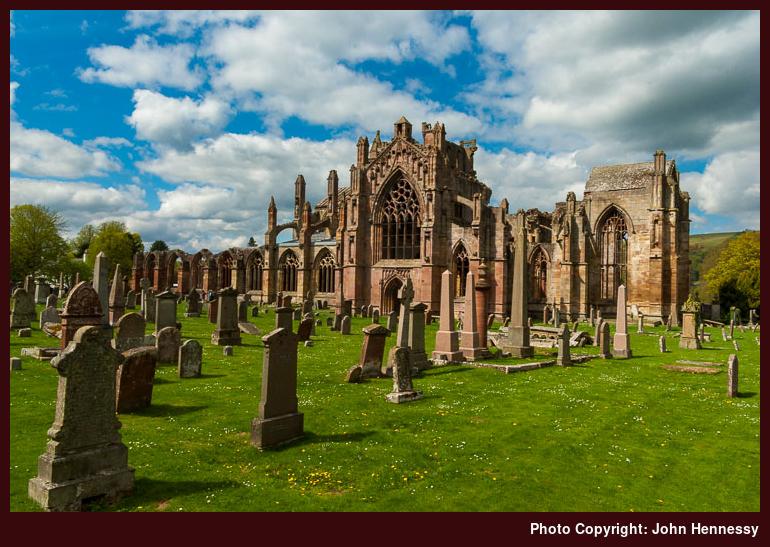
After the exertions of the previous day, Sunday was left as an easy day before I returned home again after a stay in Melrose. That energy expenditure made for tired legs, so I contented myself with enjoying the impressive sight of Melrose Abbey (yes, a camera was set into action too, but it's often what gets me out and about in the first place) on a day that kept improving after a damp start. There was an uphill potter along St. Cuthbert's Way to take a closer look at the Eildon Hills but time constraints put a stop to any potentially foolish designs that may have lain in my mind.
A look at a map since then has popped an idea into my mind: using St. Cuthbert's Way for a walk from St. Boswell's to Melrose that might grant me glimpses of Dryburgh Abbey and would pass over the Eildon Hills. Those hills are criss-crossed with paths, but there are other possibilities with sections of the Borders Abbeys Way allowing for sampling of the countryside around places such as Kelso, Hawick and Jedburgh. All in all, it looks as if there is plenty on offer to the passing wanderer in search of pleasant countryside with a smattering of low-sized hills.
After all, this is countryside that I should have been exploring when I lived in Edinburgh but for a combination of succumbing to the attractions of a very nice city and being blinded by attractions further north. Then, I would have considered cycling and the practicalities of getting a bike out into the Borders with no car would have raised their heads too. Until the restoration of the rail link to Galashiels and Tweedbank, that one will persist because I saw no evidence of bicycle carriage on any buses that I used over the weekend. In a way, that's a pity because there is the Four Abbeys Cycle that echoes the intent of the Borders Abbeys Way and there are quieter roads around the area too. That new railway could make things interesting but the prospect of it packing the area with visitors is hard to envisage with all the space that there is for everyone.
One thing that struck me over the weekend was how quiet everywhere was, and it is an area where you unleash your reverie without too much fear of intrusion. Of course, you still have to watch where you are going, but that effectively is the limit of things. Those ideas that have come into my mind already should keep me returning, and I do hope that it's more regular than it has been.
Away on Manannan’s Isle
4th May 2010 With a bank holiday weekend in prospect, I somehow managed to fix up a trip to the Isle of Man with some walking in mind. Though weather forecasts were mixed, I took the chance anyway and that even was after my drenching while on a day trip there. Manannan may be a mythical being who uses mist as a protector but this Irishman wasn't deterred by that first encounter last July.
This past weekend, the weather over there was far kinder with the only rain that gave me any sort of wetting being the lighter variety that frequented Douglas on Sunday night or the few drops that I thought I felt while crossing over Cronk ny Arrey Laa earlier in the day; heavier stuff may have fallen while I journeyed back from Peel after a day of walking but I was under cover then. A rainbow was spied around Peel on the approach to the end of my walk but any rain was away from me. Otherwise, it was dry with a mix of cloudy skies or blue ones letting the sun out to bring the best from the countryside, coastline and seascapes. The walking was a mix of poking around Douglas and Onchan on Saturday followed by a testing hike from Port Erin to Peel on Sunday and a far gentler potter around the latter under sunny skies before leaving the island on Monday.
All in all, it was a good sampling of the delights of the island's countryside and I left with more to explore. Examples include the area around Snaefell, the island's highest hill, the kinder northern shoreline and the populous areas around Laxey and Ramsey. Having to choose between so so much left me feeling torn as to what to do. The only cure for times when you have a few days and really need a week is to savour what you can and leave the rest for another time should it ever come. From what I have enjoyed already, I clearly see that there are plenty of good reasons to go again.
There are plans afoot to say more but there was a time when such a brief account would have constituted a trip report on here. That was back in the early days of this blog and the brevity of the report for a weekend in Pembrokeshire surprises. Thoughts of expanding it come to mind but I don't know how vivid four year old memories are. Returning to the area to explore more of its delights might be a good way of conveying this blog along through a little more of its fifth year. Time hasn't exactly stood still since those tentative steps taken after a Mayday bank holiday weekend divided between Fort William, Inverness and Pitlochry with a longer walk from Corrour to Spean Bridge fitted in among all the journeying. Rereading that account now reminds me how I have changed what goes on here: more on the actual walking and less on travel and accommodation. It is in that vein that I plan to continue and reading the writings of others must have had something to do with it.
Pondering coastal walking possibilities
28th April 2010 With a bank holiday weekend ahead of us, thoughts turn to making use of the extra time. In truth, the pondering started last week and my thinking ended up in Northumberland even if I didn't. It's been a while since my sole hike by the county's coastline near the start of 2006 and, given that I had a largely cloudy day for my exertions, it would be worth going back to savour the sights. Then, I journeyed from Alnmouth to Craster and back again, so there are sights such as Dunstanburgh and Bamburgh castles awaiting my attention along with Lindisfarne. Public transport connections make a day trip tricky, but it might be high time that I spent a bit longer over there.
While on the subject of a few days around Northumberland, my brain wandered inland to Wooler where I began to consider using St. Cuthbert's Way for heading west to Kirk Yetholm. Transport (on Sundays and bank holidays, that is; it's reasonable on other days) and other practicalities set me to considering the following of the Borders Abbeys Way for getting to Kelso for onward travel. Another walking option in the area would be going east along St. Cuthbert's Way towards the coast where travel connections are better of a Sunday.
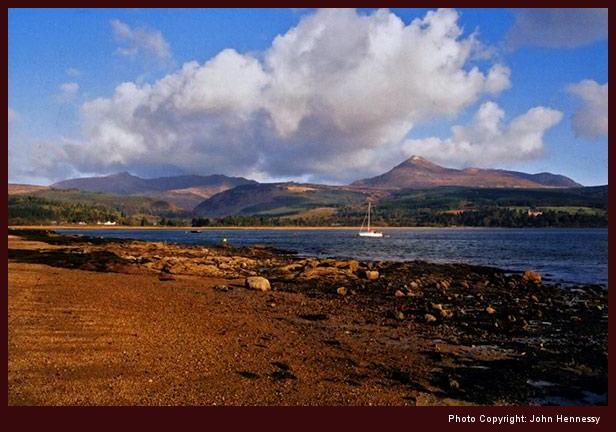
After that mental meander inland, it is time to return to the intended subject for this posting. That takes me to Arran, another part of the world where I haven't been for a few years since I walked to the top of Goatfell on Easter Sunday in 2006. Then, I got mixed weather with hail near the summit, a patch of snow on the path on the way down and a deluge that beset me while making my way back to my lodgings for the night. The next day, I took a bus ride around the island with occasional showers never far away. There is a coastal path to complement the bumpy stuff in the north of the island and that is what brings the island into this discussion. A return is long-overdue and following part of the island's coastline would make a good excuse to spend more time there again.
Turning south brings me to the Isle of Man and its coastal path. To date, the island has received just a single solitary flying visit, and I am tempted by the prospect of spending a bit more time seeing more of the place. It has its hills too, but you sometimes can get to know what lies inland while peering in from the coast. So far, it is largely uncharted terrain for me and that might be adding a certain frisson of novelty to the idea too.
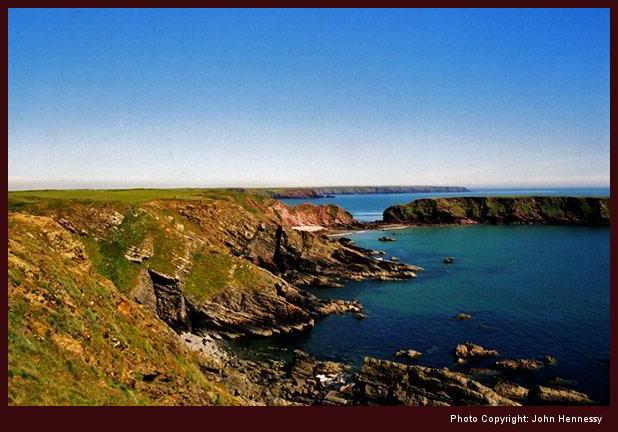
Staying on a southward trajectory takes me to another part of the world where I haven't been for next to four years: Pembrokeshire. A lengthened weekend down there had me walking from Newgale to St. David's on Saturday, around Marloes on Sunday and around Newport while on the way home on Monday. While there, I got lucky with the weather and the sunshine did plenty of justice to the indented coastline as it wowed me while I took in my ever-changing surroundings. Be warned that there are plenty of ups and downs with gentleness not being a strong point of the gradients. By the end of my walk on Saturday, it was time for a well-earned rest after the way that my leg muscles had been exercised along the Pembrokeshire Coastal Path. It may feel that I have taken in a lot, I only have nibbled at the national trail, so there's much more to savour yet.
There is a reason why I am sticking with a few examples of coastal trails for now: there are loads and enacted legislation is to provide more access, so there must be a certain something to exploring coastline for more than me. Navigation generally is easy, and the scenery can be an intoxicating mix too. Some walk may walk right around Britain or another island, but I'll content myself with pleasing sections like those mentioned above. Others such as the Fife Coastal Path, the Gower and the South West Coast Path are there should I ever decide on exploring very new horizons but pacing myself feels more sensible. Plenty of tempting options exist that are nearer to me and keeping closer to home mightn't be such a bad plan.
In its own way, the forthcoming bank holiday weekend set all of this off. It looks like bringing a mixture of weather to us but don't they all? Even so, I have concocted some sort of scheme to break me away from the day-to-day routine. As is my habit, I'll leave it to work out how it will before saying more on here.
Very alike but not the same: an ascent of Y Llethr from Dyffryn Ardudwy
26th April 2010 This past weekend has been a lazier one than the one before it, when I took myself down to Dyffryn Ardudwy with the idea of walking to the top of Y Llethr. Fatigue had a lot to do with the stasis, as did floundering with options as to what I could be doing; it is difficult to get more enthused for one idea over another when your brain is tired. That option perusal hasn't gone to waste because it has added ideas to the proverbial shelf for future outings, especially with a bank holiday weekend ahead of us. Thoughts of taking in sections of long-distance trails in places like Northumberland, Pembrokeshire or even the Isle of Man have come to mind, so who knows what might come of them.
In the midst of all this mulling over prospective escapades, it struck me as to how easy it is to make reaching a hill top the fulcrum of a walk. A long-distance trail needs room to breathe and so takes up more room on the landscape, whereas hummocks can be stuffed next to anywhere. The observation also illustrates how you can gravitate towards summits when there are few other objectives about, something that can lead you down a slippery slope that takes you up more gradients. However, if I have anything to do with it, I'll be following up the ascent of Y Llethr with trail walking for the sake of variety if nothing else.
Returning to the Welsh outing in question, the idea came from a previous hike to the top of Diffwys from Dyffryn Ardudwy. Spying Y Llethr across the valley from me was what set the brain to thinking. There is a horseshoe walk that takes in Crib-y-Rhiw as well, but it isn't something that I'd try on a day trip from home. In fact, sorting accommodation in the area for a night or two would be well rewarded with some poking around Rhinog Fawr and Rhinog Fach made possible along with the aforementioned horseshoe. Terry Marsh's Great Mountain Days in Snowdonia has put a few possibilities into my head, and they aren't all walks to summits either; he starts the Diffwys-Y Llethr horseshoe from Talybont, an interesting choice. After all, this is a wilder side of Wales that guarantees plenty of space and calm for those times when you need to escape the frenetic pace of the modern world. It's as near the emptiness of the Scottish Highlands as you'll find in the principality.
My Y Llethr hill outing was to have me reprising much of my walk to Diffwys with a twist. For the sake of variety, I used a different way from Dyffryn that avoided the megalithic tombs that I usually pass. That landed me further up Ffordd Gors and Cors y Gedol was passed without much further ado to pick up the non-metalled track for Llyn Bodlyn. The turn-off for Pont Scethin that I followed at the start of February was passed and not taken. What I was after was a clear path to my left that would take me up the slopes towards Y Llethr. I was already seeing signs of where I was headed when a labouring mountain biker passed me and later left the road to gain some height, using part of the path that I needed.
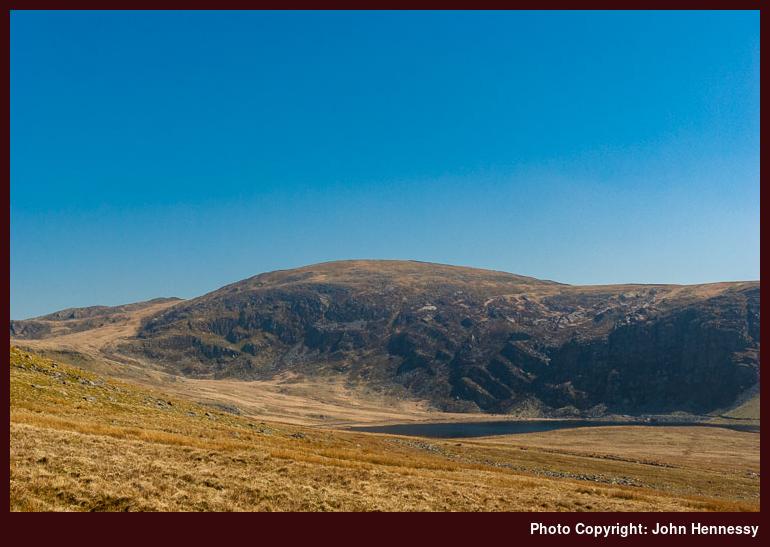
That cue from one of the few people that I encountered on my walk was more than useful. He may have gone left at a fork unmarked on my OL18 map, but once off the gravel track yet still on sound ground, I easily made out the direction that I needed. Going uphill granted views over Llyn Bodlyn without the gradients being overly harsh. Still, they were sufficient to make my pins remind me of what I did to them on the side of Moel Siabod the week before. Next up was the wall on Moelyblithcwm that I was to shadow loosely for much of the way. The track that I was following stayed with gentler gradients, even if that meant wandering away from the wall for much of the time. Eventually, it sent me through boggy ground, from which I emerged to find a stile that brought me over the wall to the final steep approach to the top of Y Llethr.
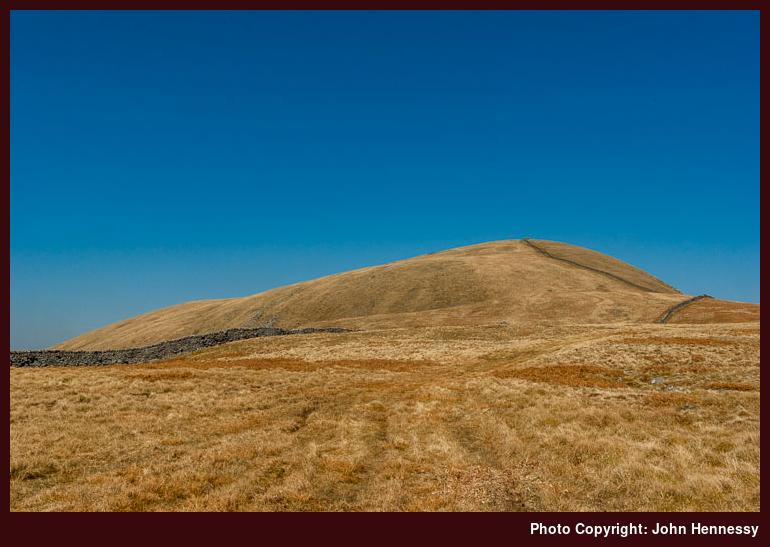
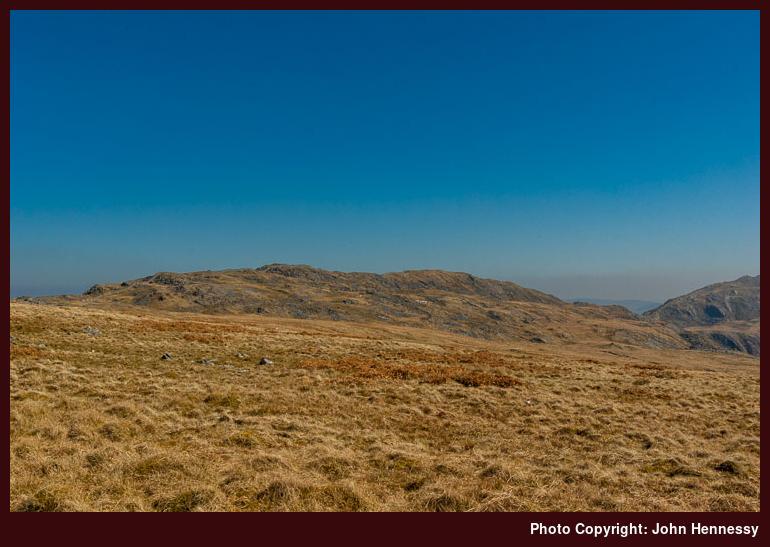
Steady, unhurried progress was what the final steep pull up to the flat top of Y Llethr. The summit was left to come towards me in its own good time, with vistas opening up more and more as I gained height. Moelfre was an unmissable feature through my out and back yomp, and it was to the west of me now. To the south, Crib-y-Rhiw lay temptingly at hand, with Diffwys beyond the ridge. Maybe it was that proximity that put walking up Y Llethr into my head last February. Cadair Idris and others like it were nearby too, though they were hazy on the day.
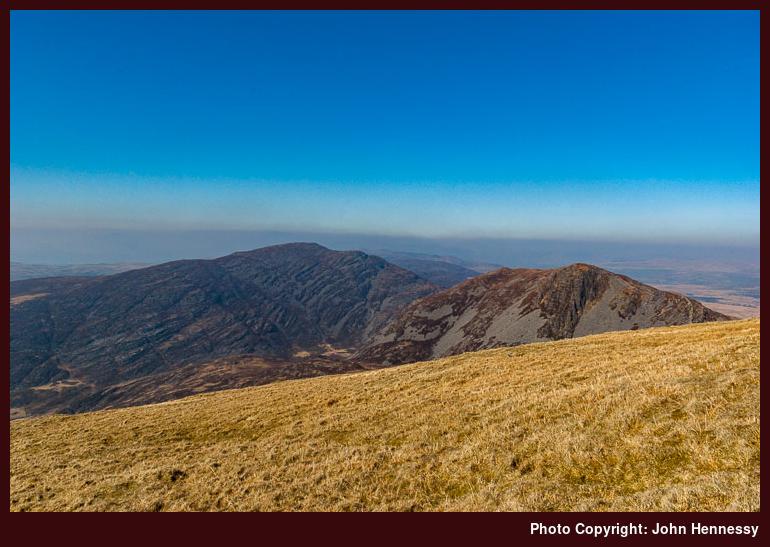
Once on the summit, I could gaze upon Rhinog Fach and Rhinog Fawr to the north; the views were finally verging on being 360º. It was at this point that I was joined by two walkers coming up from the other side. After exchanging a few words, I wandered over a little to gain better views of Rhinog Fawr and Rhinog Fach before descending on a route of my own making before I reached the stile that I had crossed earlier. Beyond the stile, I stayed with the wall and encountered some very soft mossy stuff underfoot before things dried up ahead of a stony canter downhill before I again picked up the track that had brought me uphill and stuck with it for the rest of the descent to the reservoir track. By now, the sun had changed position such that good photographic fodder was on offer behind me and I didn't waste it, even if it were to cost me time.
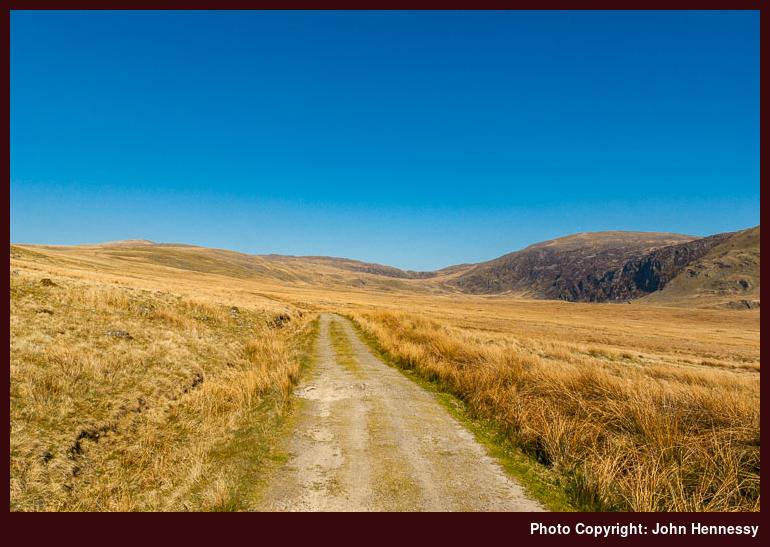
Knowing the distance that I had yet to travel after reaching the Llyn Bodlyn track, I paced myself so as not to miss my train home. Photographic pit stops were unavoidable given how the evening was going, even if I was mindful of the time. From Cors y Gedol Hall downhill, I stayed on Ffordd Gors like I did last February. Though there were a few hours left in the day, the sun was beginning to lower as I shortened the distance I had left to travel. It had all the hallmarks of an idyllic end to a good day's walking and acted as a reminder of summer too. All the while, I stocked up on refreshments in Dyffryn and caught that train home as planned. The sun may have been declining as it travelled down the Cambrian coast, but the enjoyment wasn't over so quickly.
Travel arrangements:
Return train journey from Macclesfield and Dyffryn Ardudwy. Changes on the outbound journey were at Stoke-on-Trent and Wolverhampton. On the way back, they were at Shrewsbury (due to the small matter of only two out of the four carriages continuing for Birmingham) and Wolverhampton.


