An involved way to cross a county boundary
 8th April 2009
 Whenever I get to plot an outdoors outing, I almost invariably turn to maps for ideas. That's not to say that guidebooks don't get perused as well, but there's something very immediate about casting one's eye over a map. Scotland's enlightened access legislation means that any track can be fair game, but more care is needed south of the border. In fact, I have had enough experience of the English and Welsh rights of way network that a growing distrust needs to be confronted, but I use any path. I need to be careful not to overdo things, but anything that looks unpromising could be left for another route. The sorts of things that leave a poor impression are rickety styles, poor waymarking and overgrown paths. A somewhat unpleasant experience last year has got me very wary about complex route finding too near habitations on other people's land.
Anything that's part of a long-distance trail should be fine, but there is a part of the Pennine Way proceeding through fields in North Yorkshire that looks like yet another unloved part of the rights of way network. Saying that, seeing the attention lavished on the Gritstone Trail reassures me more than just a little. The mention of the GT brings me to Staffordshire's moorlands. Yes, there are some neglected parts and I came across them while I was out hiking on Sunday, but a good deal of care is apparent too. I passed along part of the Staffordshire Way, but the moniker "Staffordshire Moorland Walks" is one that is seen a lot on maps for where I was wandering.
These are Staffordshire's answer to Ireland's Looped Walks and have been conceived, very nobly, as a network of self-guided walks by Staffordshire Moorlands District Council. You will not find them highlighted on OS Landranger maps, but they are given the same level of prominence on Explorer maps as point-to-point long-distance trails. That might have the potential to confuse just a little and some may decry the idea of cluttering up mapping, but these remain very useful. Good waymarking makes them more user-friendly, too. As it happened, Sunday saw me traversing portions near Biddulph, Rudyard and Leek but a previous escapade saw me rounding Tittesworth Reservoir with a side visit to Hen Cloud too.
What took me onto those looped walks on Sunday was a yomp from Congleton to Leek. It was meant to be the other way around but for my own muddling and a missing bus delayed my start as well. It also meant a change from my initial plan of going from Leek to Rushton Spencer by way of Rudyard Reservoir and then following the Gritstone Trail for most of the way to Congleton, possibly with an ascent of The Cloud included for good measure. However, the onset of summer time has granted us longer evenings, so sufficient daylight time was available for me to complete the walk. The walk out of Congleton to reach another part of the Gritstone Trail, a section shared with the Biddulph Valley Way, certainly took long enough to bring home to me the size of the town and how far its train station is from the town centre.
My patience on the exit from Congleton was rewarded by a peaceful amble among woodland along a now disused railway line that once ran between Congleton and Biddulph. That embankment was left to pick up part of the Staffordshire Moorlands Walks loop that goes around Biddulph. That stretch took me across the A527 and over the fields to The Talbot in Poolfold. Another road crossing followed and another exit into green fields was found in the said pub's car park. That proved temporary, and I found Country Landowners Association signs bearing waymarks and welcoming caring walkers around The Moor House, perhaps a reassuring touch.
The hotchpotch of public footpath and road walking was set to continue after I left the Staffordshire Moorlands Walks waymarks after me to cross High Bent. My journey took me around by Boons' Meadow Farm on tarmac before I again crossed fields to reach a byway called The Hollands. After another road crossing, I was following field boundaries again. There were copious views at this point, with the familiar sights of Croker Hill and Shutlingsloe visible in the northern panorama. Looking east, I could just about make out The Roaches beyond Gun. There were enough clouds in the sky to ensure that unbroken sunshine was a pipe dream, and my photographic exploits were attenuated as a direct result.
With all the twists and turns taken by my route, I would have been forgiven for tiring by the time that I reached Halfway House. As it happened, I must have missed the footpath for Birch Trees Farm. However, I had mixed feelings about following a right of way through a farmyard, so I wasn't sorry to have passed it and I knew where I was in any case. It may have meant that I needed to contend with motor vehicle traffic for longer than I might have liked, but no major perturbation was felt on my part.
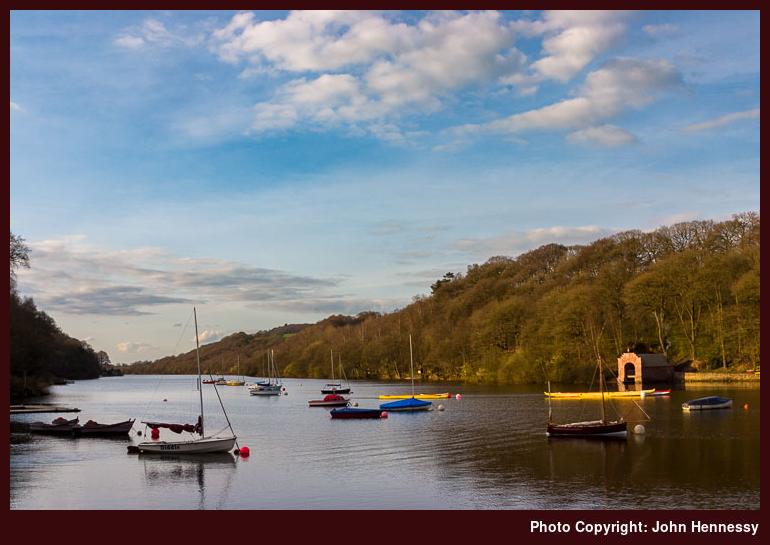
Reacliffe Road was found soon enough at a switchback bend and, a short downhill stroll later, I reached the second loop of the Staffordshire Moorlands Walks for the day. I was bound for Leek, but this is where you would be going for a circuit of Rudyard Reservoir. The quiet wooded lanes and paths were an agreeable way to reach the dam of the said reservoir before I descended to follow its outlet stream for much of the remainder of the walk. There was another uneventful road crossing too, but I was on the lookout for the junction that would see me go along a path that take me under the old Macclesfield-Derby railway line and on to the A523 on the outskirts of Leek. Perversely, the centre of Leek sits atop a hill and, by this time, my legs were telling me that they had done enough for one day as I made for the bus station.
Though the day had its moments of sunshine, they were limited throughout the walk, but that also meant that I wasn't to be scorched by the strengthening sun, never a bad thing. Because of circumstances, the route followed was a tricky one, but it was dispatched with only one unscheduled diversion and that was far from being a hardship. All in all, I enjoyed a good few hours and revisited somewhere where I hadn't been for a while. Many stretches were quiet, too, which helped for a spot of relaxation along the way. Hopefully, the short outing can act as a springboard for other excursions.
Travel details:
Service 38 from Macclesfield to Congleton. Service 18 from Leek to Hanley, followed by service 25 from there to Stoke train station for a Virgin train to Macclesfield. There is a service 108 connecting Leek and Macclesfield, but that is irregular, and the last one had long gone by the time that I reached Leek.
British Summer Time
2nd April 2009 Since Sunday, there have been a raft of announcements and happenstances that make it look as someone somewhere has held them over until the arrival of BST. First, there's spell of dry weather. The sun might be in short supply but I'm far from complaining as I have turned to the bike for the daily commute. I also have every plan not to have a computing failure stop me from embarking on an outdoors escapade like last weekend. While on the subject of weather, we have had the Met Office adding more detail to their mountain weather information and the Peak District has been added as a new area too, not at all inappropriate given the number of visitors that it receives.
The mention of a National Park brings to mind the announcement of one for the South Downs. Hopefully, the rancour that has accompanied the New Forest one can be avoided but I am reminded of something else: the fact that the southern English countryside is no lure for me. That is never to say that we should value everything in our custodianship so that we can hand it on to future generations in as good a condition as we can. I am sure that these places are an invaluable escape for those living near them but I may have been so spoilt by experiences in open hill country that it is difficult for me muster the wherewithal to visit them. Speaking of being spoilt, living in Cheshire does mean that I am within reach of an embarrassment of riches and the list would become long very quickly. It's the sort of thing that makes me reluctant to move south from here, particularly when I get to realising how little of I have actually savoured.
The mention of Cheshire reminds me of the local authority reorganisation that has happened. Hopefully, the new Cheshire East and Cheshire West & Chester unitary authorities will continue the good work that has been done with regard to public rights of way and not allow serious degradation in public transport provision either. Northumberland is getting a new county council so the same aspirations apply there.
Along with the release of the new Quo by Mapyx, this has been a busy week and that's even without looking in on the events in London but I won't comment on them here. It would be nice to cap it all with an outing. There are no definite plans yet but I am not going to rip up a computer over the weekend if it can be avoided. To get into the great outdoors needs some space and time to be set aside, for planning as much as execution; working through the variety of destinations that creep into my thinking so as to pick one can eat time like it's going out of fashion. An outdoors excursion can clear the head but I have found that other clutter might need clearing first or you'll never even get out the door. That has happened me rather too often...
A spot of computing trouble
30th March 2009 Yesterday was gorgeous but I only got a few hours out on my bike so I stayed local. What happened was that mucking around caused by to a rogue DVD writer cost me most of the weekend, a pity really but that's how it goes. However, it seems that I wasn't alone because Mapyx have put out a new version of Quo only for their servers not to take the load when it came to downloading the thing. Like Microsoft with the beta of the forthcoming Windows 7, they had underestimated the amount of interest that would be aroused (which is probably good for them given the times in which we are living). There is no longer a premium version of the Quo software so it looks like all of the goodies might be available now for free. Saying that, I need to admit that I have yet to download a copy and doubts are bubbling up in my mind as to the wisdom of the upgrade. This past weekend's misadventure is but one of the causes but seeing compatibility problems with using recent versions of Anquet's software looms larger in my thinking (technical note: they might need to put out something more self contained rather than having it dependent on what you have on your system). Whatever I choose to do, I'll make sure that I try to clear some space for an excursion should fine weather decide to visit us like it did yesterday. That "quick" piece of computer tinkering might need to wait for afterwards...
Walking among trees: pleasure or penance?
24th March 2009 My ongoing updates to the photo gallery (my attention is drifting towards the Argyll & Mull section at the time of writing) has caused my eye to fall upon coniferous forestry more often than not. It seems that my journeys in search of wilder countryside have taken through me by more plantations than I care to remember. Scotland is particular prone to them, it seems, but my native Éire has them too, a consequence of government policy in the 1960's and after. I seem to remember from secondary school geography lessons that statements like adding to the visual appeal of the landscape and making good use of marginal land were stated as its advantages. The first of these is a matter of personal taste but the second is being challenged by the realisation that marginal land only yields wood of a quality perhaps only useful for paper manufacture has since dawned upon our collective consciousness. It seems that some such plantations could be left without felling because their economic value cannot justify the expenditure involved. All in all, the advance of coniferous woodland wasn't all that it was cracked up to be.
Whatever the reservations may be, even I have to admit these commercial plantations have allowed the opportunity to create recreational spaces from which to escape our cluttered lives. In Ireland, trips to the likes of the Ballyhoura Mountains or Gougane Barra cannot be managed without the sight of conifers and they accompanied my early introductions to the pleasure of exploring hill country. In latter times, many a trek in Scotland has had me encountering similar sights.
It almost goes without saying that some plantations are more walker friendly than others. Ireland's forestry agency, Coillte, is one of the better owners and I ask myself how many Looped Walks or off road sections of the Waymarked Ways there would be without them. Also coming up for an honourable mention is the Forestry Commission with their work on paths and tracks around Loch Long and Glen Croe. They also made a contribution to the development of the Rob Roy Way in the shape of the way marking that I found useful while following the trail from Drymen to Callander.
Even with these helping hands, passage through plantations should never be taken for granted and I have caused myself torment of this kind more often than I should have. All it takes for an OS map to be unhelpful is for a new track to appear or an old one to become overgrown or obstructed. The ensuing navigational confusion can lead you to do things like my reaching the A85 in cross country fashion while walking from Inverarnan to Dalmally. It's not the only lesson teaching me never to rush woodland walking unless I know really well where I am going.
Aside from navigation, the other downside of passing through forestry is that you often cannot see the wider vistas that surround you. That point can be driven home rather too firmly by an outbreak of sod's law where the sun is released from its cloudy lair when the trees block your view only for it to be hidden again when you finally reach open country. In days when the prospects of capturing those panoramic views was a stronger draw for me, misgivings about woodland walking arose from this very kind of thing. There are times when the trees are felled to release the vistas but the challenge of making pleasing photos while avoiding having the remaining wreckage in the foreground rears its head on you.
While on the subject of photography, it has to be said that broadleaved woodland probably does you more favours than the conifers with their homogeneous and near unchanging hues; they do need the surrounding countryside to help them for wider views. For one thing, there's more diversity on the floor of one of the former and I have memories of the extensive bluebell glades etched in my mind from a yomp along the bonny banks of Loch Lomond to bag the WHW between Inverarnan and Drymen. The colours of new growth in May is another pleasure and any unease at the year reaching its autumnal phase is at least partly dispelled by the sights of the russets, oranges and yellows in the trees. It's the sort of thing that has brightened up many a lunchtime walk for me and there's birdsong too to make it a truly audiovisual experience. It's these sorts of experiences that soothed any misgivings about woodland walking that I may have had but coniferous forests have their pleasures too and you can always get above the tree line.
Work in progress
15th March 2009 After walking it in a piecemeal fashion over the course of a few years, I finally completed the West Highland Way in August 2007. Following that and a number of entries on this blog, I set up a West Highland Way section on my photo gallery with a view to completing it with more new photos in the fullness of time. In fact, it has taken until now for me to add photos for the piece between Inverarnan and Bridge of Orchy and there could be more when I get to look at some of the photos that I captured on film about the same time (I was capturing more vistas on film than digitally in those days, a trend that was reversed in the intervening period).
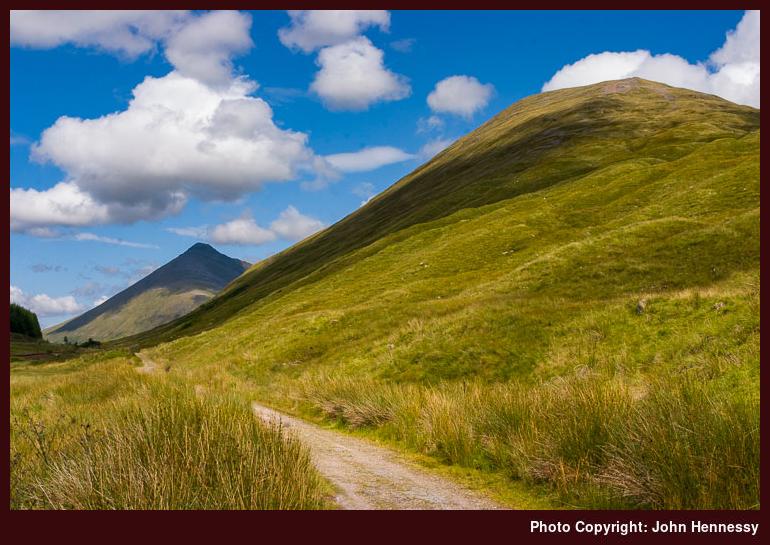
Looking back over photos can set the mind to wandering, and various ideas began to bubble up in mine. For one thing, I am considering re-walking the WHW between Glen Coe and Kinlochleven on a sunnier day than the one on which I actually walked that part of the trail. That would let me acquire more pleasing photos than what I have for it already. It wouldn't be the first time that I walked a section of the way, since I trekked the section between Kinlochleven and Fort William twice. A cloudy day attenuated photographic exploits the first time around, and the weather that I enjoyed on the second occasion couldn't have been better. Another part that saw me revisiting was a short stretch east of Tyndrum, and that wasn't done for any other reason than to make good use of a wait for the next train or bus to come and allow me to continue my southbound journey after a weekend spent in Argyll.
Other thoughts followed, with explorations of the hill country at either side of the way lining up for consideration. One such option was a trek from Inverarnan to Dalmally that I undertook last May, but there remain many others. The hills at either side of Strath Fillan attract attention for one thing and those near Tyndrum, such as Ben Lui and Ben Dubhcraig enticing the mind, if only to confirm what hills are in photos that I already made. Looking towards Bridge of Orchy yields a number of options, with making an ascent of the rounded humps of Beinn Udlaidh and Beinn Bhreac-liath as just one of these. My head for heights is far from being of climbing calibre, so I prefer my hills not to have frightening gradients when it comes to reaching their summits and, more importantly, getting back down again. The location of the twosome in question must mean that appealing views towards the Black Mount and Rannoch Moor are on offer. Then, there's the prospect of longer walks either through Glen Lyon to Killin or through Glen Kinglass to the shores of Loch Etive, with options from the foot of that glen to continue to Glen Coe or Taynuilt. These options might make for two-day backpacking hikes for when I finally get to add wild camping to my repertoire of outdoors skills, but one also could be seen as a long day walk.
All in all, casting my mind over older outings has yielded ideas for the future and in an area that hasn't seen my footfall for a while. They might come in handy for an occasion that surprises me with good weather, and it's never any harm to see a new side of an area that you already visited.


