Category: Outdoor Activities
A return to Gower
 30th December 2012
 The last weekend of July 2011 (a month of five weekends, incidentally, and each of them were spent away from home too) saw me make my first-ever visit to the Gower in south Wales. Though the sun gamely attempted to break through on occasions, grey skies were the dominant feature of the trip that saw me use the Heart of Wales railway line for part of my return train journey between Macclesfield and Swansea. Even without the sun, the day was a warm one with plenty of folk around too.
However, it was not a full walking trip like others that I undertake. Even so, I trotted out towards Worm's Head and returned to Rhossili, making a short loop featuring the coast as I did so. Then, I was lured up Rhossili Down towards its trig point before I scotched the brainwave of making another circuit from there in favour of a quicker return to catch a bus back to Swansea again, pondering a return as I did so.
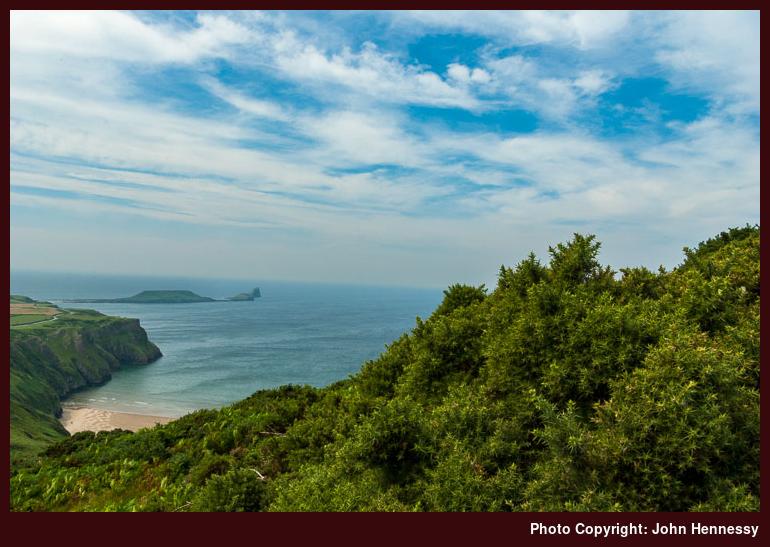
Unlike Pembrokeshire where it took me just over six years to make a return, the Gower was to see me sooner with a visit in early August of this year. Unlike the previous trip, this was a walking outing and there was more sun about too. The hiking started off where I last left off too, with a trot over a windy Rhossili Down that completed the circuit that tempted me before. As I did so, the sun went into hiding on me behind clouds. Even so, there still were better views towards Worm's Head than in 2011.
Other folk were making the effort to gain height as I was doing so and I played with the idea of avoiding the trig point but revisited it upon reconsideration. From there, it was a matter of picking my way over Sweyne's Howes and Bessies Meadow before dropping down to Hillend Burrows. Rhossili Down is access land and seems to see a lot of footfall, so there were more paths on the ground than on the OS map, so keeping to the right of way would involve some effort if so desired; there was a strong wind so staying upright was more of a concern.
Once down a steep incline (the Down may be low, but that's never to say that it isn't steep-sided as so many are), I picked up a bridleway at Hillend Burrows for returning to Rhossili again. Initially, this went by a caravan park, but that was soon left behind me and boggy sections were set to be found too. In fact, there were none of these on the hilltop so it must have been the shelter that sustained them. The sun began to emerge from the clouds again and the heat of a scorching summer day could be felt; it left me wishing for the cooling buffeting that was my lot up high.
The path was a narrow with deviations from the main track when things got really muddy. Once past the caravan park, I began to build up some pace even with others using the right of way at the same time; the deviations came in handy for this. Once by the Old Rectory, I could see my destination was coming nearer and it was reached in less time than I had grown to expect.
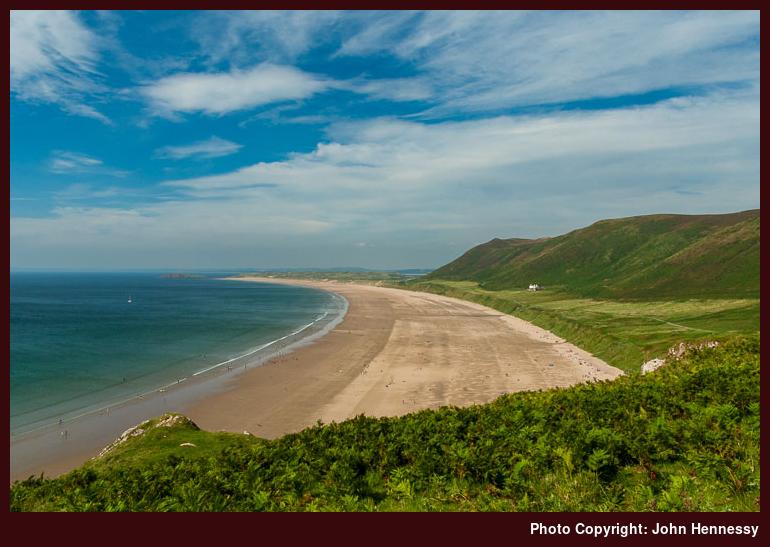
The heat of the afternoon was the cause of my visiting the National Trust shop for some ice cream and a drink. While I was there, some souvenir items for others were purchased too before I sat outside to enjoy the ice cream with views back along Rhossili Bay with Rhossili Down on the right-hand side. Though I stayed a little while, it was later in the day than I had anticipated it would be. A delayed arrival due to traffic congestion and the Rhossili Down circuit perhaps taking longer than expected were contributors to this so I needed to get going again.
Port-Eynon was my next destination and I started by making my way out the busy promontory towards Worm's Head. The time of day precluded any more serious efforts to make photos of Worm's Head beyond the hazy ones that I got on the way up Rhossili Down. In fact, it was those views north along Rhossili Bay that yielded the best results for me.
My itinerary was to take me south-east and away from the terminus of the Gower Way. Another development since my last visit to Gower was the instatement of the Welsh Coast Path, though it has been in place long enough for some of the signage to have fallen prey to the elements, so careful use of a map is needed in places too. Some of its course already had been sampled on my Rhossili Down circuit and there was to be more to come. Being along the coast gained me a cooling sea breeze that was strong enough for kite flying and some enthusiasts were making the most of the conditions on offer.
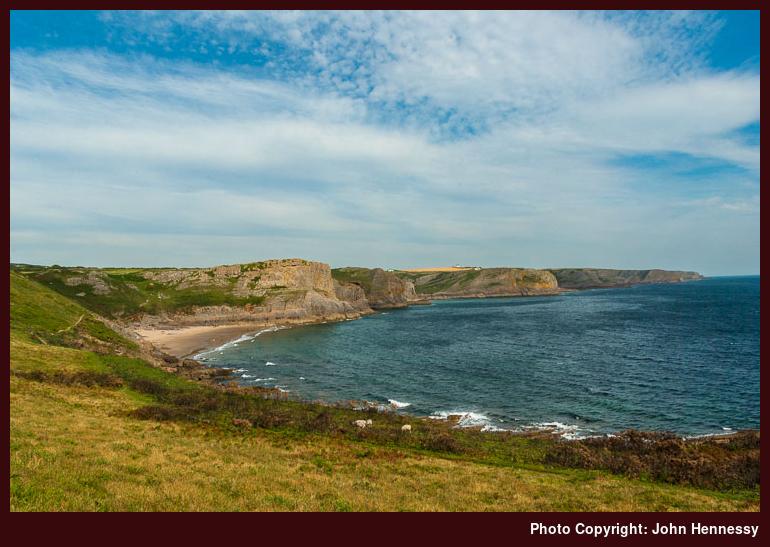
Passing them, I began to see some of the coastal scenery that I was to pass after leaving Worm's Head behind me. From reading guidebooks, I knew that this was worth walking and it reminded me of that previous visit to Pembrokeshire some years before. Such is the indentation of the coastline that the sights of Rhossili and nearby Middleton weren't to leave me so quickly. There was a path diversion due to erosion too and recent coastal landslips due to all the rain that we have been seeing make me wonder if more have been needed since then.
In the initial stages, there were a good few folk around, but there was to be more in the way of solitude later on in the walk. Many of these may have been on circular strolls and those can be left behind to go their own way. So, it appeared after passing Fall Bay and doing the same for Mewslade Bay meant an inland deviation and attendant loss and regain of height that reminded me of a hike from Newgale to St. David's that I did on that Pembrokeshire trip; this yomp was to have less of that, though.
With the last of the undulations behind me, it was onto steady field crossing on the way towards Overton. Cloud had arrived from the west to put an end to the sunshine and gave a sense of close-down to the proceedings as well as a warning of what rain was to come. As I continued in the dullness, there seemed to be more footpath signs than my OS map gave me to expect and I have not been able to see where the paths were leading since then.
In time, field crossing was to be replaced with rocky shoreline walking as the Welsh Coast Path lost height to go under Overton Cliff and along Overton Mere. This section felt wilder and more dramatic than any other part that I had passed all day and would make a worthy excuse for a return sometime; Port-Eynon seemed very away at this point. There was a bell to be heard too and I thought it to be a church bell in that village but I was being deceived. It was but one atop a buoy bobbing out in the sea that could be heard all around. An outsider with easily disturbed slumbering would have some acclimatisation to be doing. That apparent reassurance that I was really near my intended destination had been but a mirage.
In fact, I wasn't that far away either; one last ascent was to prove that to me. Though I needed to keep going, curiosity had me surveying a monument erected by the Gower Society to commemorate efforts to preserve the surrounding coastline. From there, I then dropped down towards the YHA hostel and trotted across the beach to the roundabout at the Port-Eynon end of the A4118. Following the road from there, I found my bus stop with a few folk waiting there, one of them being a Welshman wearing a kilt!
Having others waiting at the bus stop was comforting because it meant that I hadn't missed a bus, but the wait was to be a long one that extended into dusk. The earlier traffic congestion that I met on the way to Rhossili was the cause of delaying bus services even more by the time that I was going away again. There even was a call to First Cymru to make sure that buses still were running and it was just as well that I had a mobile that worked in Port-Eynon; O2 and Vodafone didn't while T-Mobile and Orange did. That bus did arrive before any rain though and that was just as well since thunder and lightning arrived around midnight and stayed for most of an hour in the sultry early hours.
Even with any traffic congestion, the Gower remains alluring for me. Seeing what is around Port-Eynon again with some sunshine would be a good thing and there's Oxwich Bay and Three Cliffs Bay (the latter's near Penmaen) to be savoured too. As well as this, catching Worm's Head at a better time for photography would be another draw and there's the Gower Way and other parts of the AONB to be experienced too. All in all, there are ample excuses for making a return sometime. Let's hope one actually happens.
Travel Arrangements:
Return train journey from Macclesfield to Swansea, with a change at Bristol Parkway on the outbound journey and at both Cardiff Central and Birmingham New Street on the return one. Bus service 118 from Swansea to Rhossili and travel on the same service from Port-Eynon to Swansea.
A catch-up on Irish walking magazines and books
25th December 2012 Recently, I got the opportunity to survey the current editions of both Walking World Ireland and Irish Mountain Log. The first of these is a magazine that I have featured on here a few times before, while the latter may be new to regular readers of these musings. It is published by Mountaineering Ireland, the Irish answer to the British Mountaineering Council, on a quarterly basis and does feature some articles that catch my eye. Those pertaining to clubs and climbing usually are those over which I skip but others such as an example entry from the perhaps overly grandiosely titled Irish Peaks Guidebook, a West of Ireland hill country photo essay from Adrian Hendroff, an article about a Pyrenean nature walk and others about the spirit of the sorts of special places in which all of us outdoors lovers love to immerse ourselves.
Walking World Ireland puts out its Annual around this time of year and the 2013 one is out now. There is no year planner inserted into the current one as there used to be in years gone by. Lists of walking festivals and organisations still have a place though and there is an index like there often is for these. Interestingly, the usual route articles are excerpts from a series of guides from Collins Press about which I say more later. Usually, we see similar contributions from Dennis, Gill, Tom Hutton, Gareth McCormack and Helen Fairbarn but that's not the case this time around. Loop Walks also seem not to have a place like they have had in recent issues. Otherwise, it's all the customary sort of content that you'd expect along with articles looking further afield than Ireland. Still, the differences seen in the Annual make me wonder what is set to come in the first actual issue of 2013.
Collins Press seem to be on their way to become the Cicerone or Frances Lincoln (the latter is particularly appropriate for this comparison since their outdoors publishing only seems to have commenced with their taking on Wainwright's guides) of Irish walking guide publishing. Like the latter publishing house, they do produce much more than just walking books. Most of these are available as what they call "Limpback" editions, like a hardback but with something of the paperback feel. The range of subjects includes: Carrauntoohil & MacGillycuddy's Reeks; Connemara & Mayo; Donegal, Sligo & Leitrim; Ireland's County High Points; Northern Ireland; Scenic Walks in Killarney; Scenic Walks in West Cork; The Burren & the Aran Islands; The Dingle, Iveragh & Beara Peninsulas; Tipperary & Waterford. There is a good range available with the Dublin & Wicklow Mountains being the only stand-out omission, but time may see that addressed yet. The guides seem to be temptingly presented so it might make a good excuse for a visit somewhere for me to try out one of the books for size to see what it opens up for a walker in Ireland's pleasing hill country; this is but one of the excuses that I should make a reality. Let's hope that they see success with these and that more get to experience the delights of Irish hill country too.
All of the above are set to be illuminating once I get around to setting aside some time to go further than cursory glances. The Kindle version of the Irish county high points (why not just call them tops?) guide has made it into my possession already and needs more consultation like the aforementioned magazines. After all, it amazes me to see how many Irish counties shared their highest hills with others; Limerick and Tipperary are far from being the only ones (the Munro-class Galtymore is the one that they share). There may be more Irish entries on the trip ideas page here yet.
A time that’s safe for dreaming?
21st November 2012 The allure of working in the outdoors also has attracted its share of dreamers, some of whom have managed to turn their dreams into reality. A few months back, I was reminded of this when reading a copy of Outdoor Photography. In there, I found something written that I hadn't seen for a while: an amateur photographer whose work was featured possessed the aspiration of turning professional. So much has happened in recent years that I wonder such dreams are realisable or if they are mere delusions.
One thing that hasn't changed is the appeal of the countryside to those living in urban settings. Escaping the topsy turvy of modern life is what keeps me getting in walks in quieter places and thoughts of seeing them in pleasing light is an attraction, especially when it comes to photographic capture of those scenes. In that, I am not alone even if life gets in the way from time to time.
Of course, the countryside is under pressure and that always seems to be the case. There is that fungus that kills ash trees just like another has been doing the same for elms, though some still survive and some progress seems to have been made with making the trees more resistant to the fungus that is carried by beetles. Then, there's the thorny subject of wind-powered electricity generation that rouses strong feelings. Added to that lot is a government so desperate for economic growth that it's willing to change planning laws in the hope that that might help.
We already have seen cuts in public spending taking hold. A few years ago, I remember reading of someone taking redundancy to start further education in order to become a countryside ranger. Those opportunities hardly can be very plentiful so I wonder how she got on with her planned career change. After all, not only have local authority budgets been reduced but national park authorities saw the same happen to theirs shortly after the current government took power.
Saturation of markets comes to mind when anyone shares ambitions of becoming a professional photographer and it isn't limited to that profession either. After all, how many guides and guidebook authors do we need? Maybe there were less walking guidebooks available than there are now, which gave some long-established writers a chance, but those bookshop shelves are well loaded now and there's the rise of digital publishing too. Cicerone may be keeping there eBooks at the same prices as their paper equivalents but I for one have been used to their being cheaper so how long can that last?
The advent of digital photography has had quite an effect on the lot of a professional photographer. A decade ago, a well supplied stock library was a good source of income but that seems not to be the case any longer. Sales of books, calendars and postcards help but there also is quite a growth in the provision of photography courses and writing always is an option. Such is the volume of images that is available that it is impossible to limit yourself to travel, landscape or wildlife photography to maintain that all important income.
It seems that even the obvious outdoors careers are not immune to the upheavals of the present day. Hobbies can lead to careers and my means for earning a living is an example of that as well as something from which many yearn to exit. Having grown up on a farm, I realise that an outdoors life isn't all easy and there are many things today that make it that bit harder too. Contenting myself with earning my crust using the skills and experience that I possess is how I plan to proceed while enjoying those all-important outdoor escapades for affording some quiet time away from it all. However, it also looks as if bit more effort is needed to keep the countryside more intact than otherwise might be the case. On that, I reckon that I need to have a think.
Another pair of TNF Hedgehog shoes
14th November 2012 For the last four years, I have been well served by a pair of The North Face Hedgehog trail shoes. They may look more tatty these days but they have plenty of life left in them yet and I am not planning on retiring them prematurely either. Good service and durability has been what they have given so I have no complaints. In fact, they feel more like slippers than some footwear that I have and the shoes that I use for work come into this category.
The past two weekends have seen me head to Knutsford and Tatton Park on consecutive Saturdays. The first of these wasn't so successful in that blundering in the name of finding another entrance to that park resulted in a misadventure involving barbed wire that ripped a coat and had me inadvertently find the source of Tatton Mere. In so doing, I submerged my TNF Hedgehogs in utterly sodden earth and left them both wetter and browner than they should be. Only for a wrong turn taken in innocence and some bloody-mindedness, I would have avoided annoyance at my foolishness.
By the time that I was along the track through Dog Wood with warning signs to keep to its course because of the bog of water that makes it a Site of Special Scientific Interest; there apparently aren't that many sodden woodlands in Britain and I had to blunder about in one of them... As it happens, it isn't so unsound away from that track but it's best to stay near it in my experience.
The sunlit scenes for which I was hoping were stymied by advancing shower clouds but I rounded Tatton Mere regardless and pottered into a few of Knutsford's shops too. There were those into which I didn't venture and one was Rohan. Looking at the window display, I noted that they have DWR-coated down jackets on offer this winter and I was wondering if such items were available last winter. The fill is 800+ too so they should be toasty and I cannot say that I am not tempted. However, online investigations revealed that the price tag is a little hefty at around £245 for the Nightfall jacket so I'll sit on the idea for a little longer.
As if to wash my shoes, a rain shower did make its appearance before I left again for home. On arriving there, the Hedgehogs got a good scrubbing to make them more presentable. Then, because of the deliberate and not so deliberate wettings, they took a few days to completely dry afterwards. Even with any mud that I failed to remove, they look more like their true colours again so they're not getting hidden away just yet. In fact, there were a pair of Columbia trail shoes that came apart on me after crossing a wet Irish hillside so the way that the Hedgehogs survived the aberrant episode says a lot for their quality.
Nevertheless, I got to reckon that a more respectable pair might be a worthwhile acquisition and so around £100 got me newer ones by mail order from Ellis Brigham that look like the one you see above. The colours have changed since I last looked and the demure blue and grey scheme of the older specimens that I have is not available any more, hardly a surprise if truth be told. Still, the available colours left me indecisive as to which ones to pick. The black ones weren't to my taste and I wasn't too sure about the grey and khaki ones either, though subsequent inspection in the Macclesfield branch of Millets would have reassured me enough to get ones in that scheme if I had looked there earlier. Still, the blue ones look just fine and I'll stick with them.
More importantly, the fit is good too and shoes from The North Face tend to suit my feet anyway. They feel stiffer than the older pair, but that could be down to years of using the latter. The same might apply to any little restrictions that my big toes feel in the new shoes. There will be a little more internal wearing in yet before they go out of doors, which, of course, is the whole point of having them.
The thread pattern is more chunky in the new Hedgehogs and that's a good thing given how the smaller lugs were prone to breaking off on my older ones; both generations may have Vibram soles but they are very different items. Laces are flat now and not round as they once were so lacing should be more secure. The newer lacing may pick up more mud, but I have been known to wash laces and they enclosed in socks; it may sound strange, but that's how I cleaned those (third-party replacements for the originals, as it happens) of the older shoes after that muddy dunking and they came out looking fine too.
In the main, I keep trail shoes for less taxing walks and it was my Meindl Burma boots that I took on my second more successful outing to Tatton Park. The previous day's rain had softened the ground and not just in watersheds either. There was a muddy encounter when leaving the park, so my choice of footwear seemed better than my choice of trousers; it was nothing that a washing machine couldn't sort. There was plenty of sun around before then and I made of the most of what it did to liven up the autumn colours. Dog Wood and Tatton were passed again and I moved on towards Tatton Old Hall before being lured across parkland alongside herds of deer. Antlers may have been on display, but there was more grazing than autumnal rutting and quiet than guttural roars, whenever there wasn't a passing plane from Manchester Airport of course (the newer runaway is not that far away from Tatton). Though the second trip undid the nagging unfinished business after the first, it produced its own reasons for a reprise of some sort: a new vantage point for making a photo of Tatton Hall was found but only after light started declining for the day. After recent experiences, it may not act as a testing ground for those new shoes until we have had a longer dry spell of weather first. Lessons are there to be learned though being a less messy learner would better.
Revisiting the Howgill Fells
11th November 2012 Compared to the Lake District, this part of Cumbria has seen me nowhere near as often. In fact, my visits to Sedbergh can be counted using the fingers on one hand with two left unused by the calculation. The first time was at the end of a walk from Ribblehead train station that skirted the side of Whernside before dropping down to pick up the Dales Way that took me past Dent on a hot day in July. That afternoon was a quiet one with a football match involving the English national team drawing folk into whatever pubs are to be found there. The passing of the last bus of the day before my arrival meant a taxi to Kirkby Stephen that showed me more of a flavour of the peaceful countryside that is typical of the area.
My second visit was a snowy affair and took me up the slopes to venture onto the foothills of the Howgills themselves rather than skirting them as before. That white covering may have limited my movements as much as the limited extent of the December daylight. It made up for that in the bright sunshine with the vistas that lay about me and the Lakeland fells glistened too in the distance. It was a fabulous from atop the modest top of Winder before I descended from there to follow an indirect course that had me confounded at one point (I could have done without shouted insolent directions from a quad bike rider on a nearby road, though).
My incursion last July was set to disturb no one and it started with sunshine and blue skies, albeit ones littered with clouds too. It wasn't set to stay that way though and cloud had completed its takeover of the sky by the time that I really was up among the tops and later photographic efforts got stymied by that obstruction of the sun. However, that's not to say that there weren't advantages to what happened. July's sunshine can be warm so that change in fortunes made for cooler walking, never a bad thing.
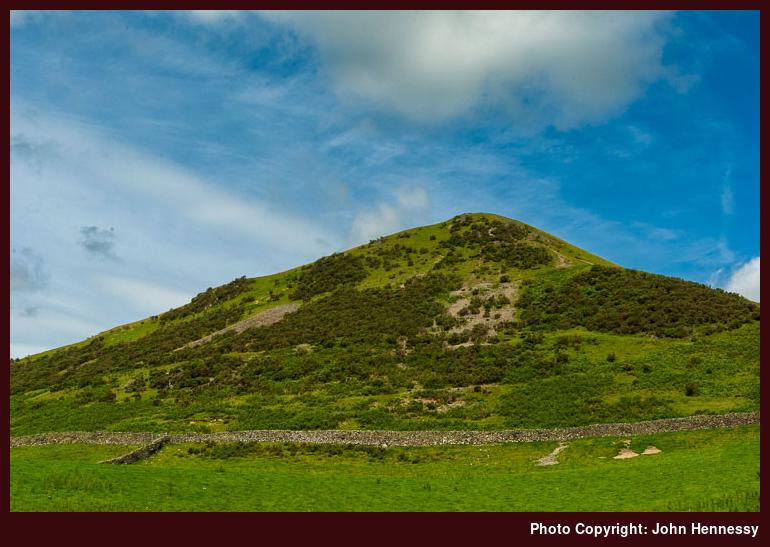
That was in the future as I made my way out of Sedbergh even if clouds got in the sun's way at one point as I did so. Picking my way along the dead-end road, I noticed the signs at various junctions highlighting the way to the fells. These seemed handmade affairs, so the locals must have had lost folk going around their patch instead of where they should have been heading. At the end of the road, it was time to take a footpath towards Settlebeck Gill with Winder to my left. A little height had been gained but more was to come, and the views opened out as I did so.
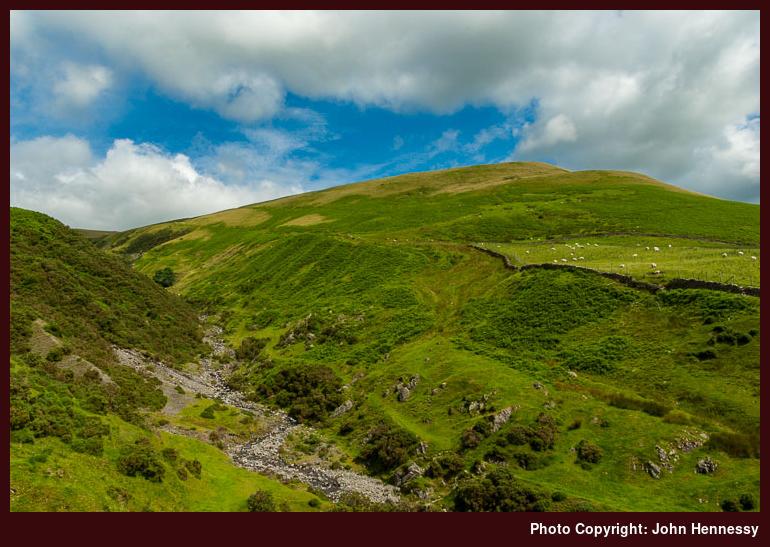
The right of way ended at the wall separating Sedbergh's commonage from other parts. This now is Open Access land so it didn’t matter that the way to the saddle between Winder and Arant Haw wasn't a right of way. That didn't mean that I wasn't using a well trodden path though and it even was distinct when I last used it. The, it was covered well with snow, so the surroundings looked so different this time around as I gained height: green instead of white. The going was steep though and plenty of stops were afforded to take advantage of the sunshine for some photography. After all, there was the steep cutting made by Settlebeck Gill between Crook Hill and the aforementioned Winder.
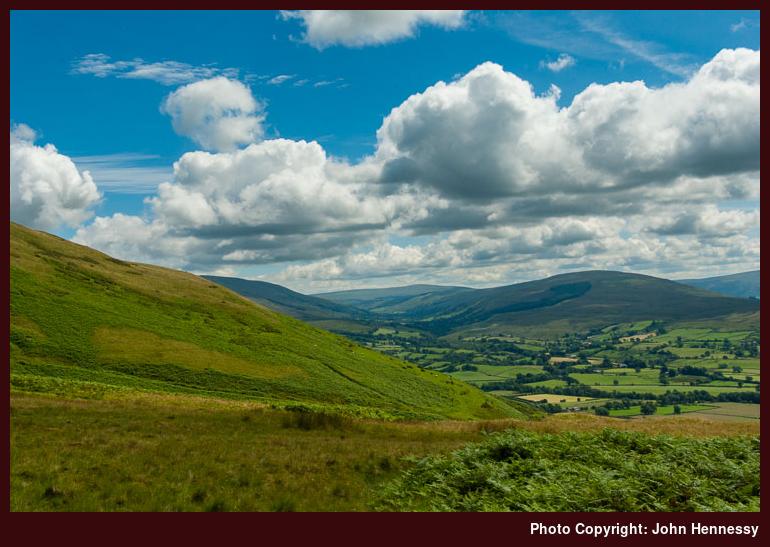
Hills other than the Howgill Fells were on show too. Whernside, one of Yorkshire's Three Peaks, cannot be overlooked, although its southern position makes it tricky for midday photographic exploits. Therefore, I contented myself with views towards the Garsdale hills and not too shabby did they look either. It's been a while since I have been that way so it might be an idea to make a return at some stage again.
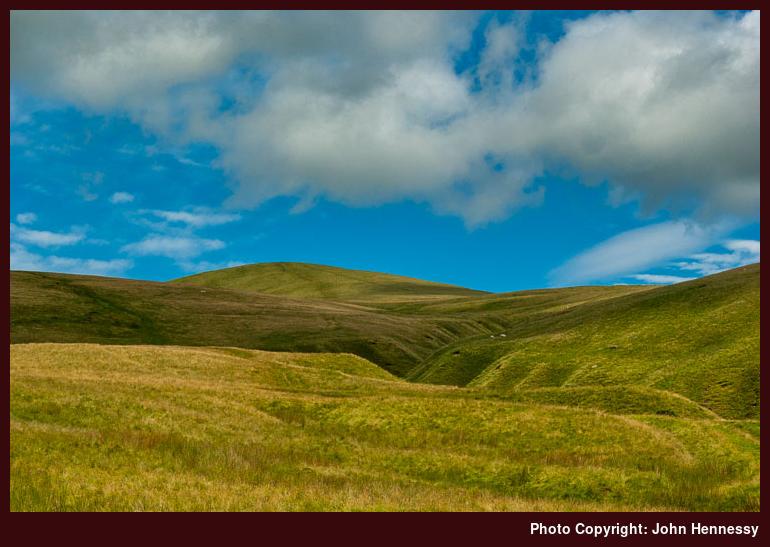
The Howgill Fells may not be as high as some, but that's not to say that they aren't steep sided. Anyone starting out from Sedbergh will discover that for themselves. However, that gradient does level off once you get up so far and, on my path, the going got a bit boggy when it did so too. Given how much rain had fallen since April, that came as no surprise to me. As I left the banks of the gill, Arant Haw came into view and I noticed something else too: a sheet of cloud approaching from the west that just kept going. Before that made its impact known, I spotted another sight that had a certain wonder about it: a spring burst forth to fill a pool and start a steam on its downward trajectory. This must be how some rivers rise.
By the time that I reached the saddle between Winder and Arant Haw, the day had become a cloudy one and that was how it was set to stay. While I might have liked some sun for more pleasing photos of more central Howgill Fells, capturing the sorts of scenes that I have glimpsed from trains before then, that was not to be. Undeterred, my walk continued and I deviated from the right of way to go over the top of Arant Haw, a sloping flat-topped affair. It was only then that I started to encounter any other fell wanderers after a silent solitary ascent from Sedbergh. Still, there weren't so many about and that was how it was set to be.
Leaving Arant Haw returned me to the bridleway again and saw me losing of that height I had gained. The ascent had been noticeable but far from overwhelming, but leaving Rowantree Grains, the saddle before Calders, involved a rather steeper ascent to the top of my next hill. Taking things steady was all that was needed and I found folk lunching atop Calders so I didn't delay, just to leave them in peace. My target anyway was The Calf and I was happy not be so far away from there.
Usefully, it was a matter of tackling relative undulations to get to the Calf. The gradients encountered while skirting Bram Rigg Top didn't prove to be at all taxing and there was another saddle to be crossed before the trig point marking the top of The Calf was reached. That may have meant loss of height and subsequent regain, but this was minor compared with some that you'd find; for instance, the central Brecon Beacons come to my mind here.
Folk must reach The Calf from starting points other than Sedbergh because I found more here than anywhere else on my trot. Subsequent perusals of issues of TGO have revealed one or two of these and they might have future uses. It still felt odd to find more folk away from habitation than near it, though.
As tempting as it might have been to continue walking deeper into the Howgill Fells from there, I decided to turn around at the Calf in the interests of making sure that it wasn't a rush back to Sedbergh to be in time for a bus back to Oxenholme train station. The fact that I found myself with ample time meant I could fit in some deviations from the outbound route. The first of these took me around some tarns on the top of the Calf before crossing some tussocky boggy ground to reach the saddle separating it from Bram Rigg Top.
On reaching the saddle, I stopped for some lunch before deciding to find the top of Bram Rigg Top. That wasn't so easy how flat-topped the hill is but I returned to the bridleway again after believing that I found it. The sun gamely battle with the cloud cover to brighten my surroundings and I stopped to see what I could do with what was on offer. My efforts now look more like record shots, so this could be an excuse to return.
Once the sun had given up on its efforts, I continued to a now quieter Calders before descending it again. My next passing point was Arant Haw, though I chose to stay on the bridleway skirting its side rather than going over its top again. More height loss followed, and shaggy horses came into sight. Though the lack of other folk might lead one to think otherwise, these creatures were far from being spooked by any passing stranger, even a journeying Irishman. Better lighting could have had me making more of them with a photo but I left my efforts to rest with a record shot.
Another deviation followed in the return to the top of Winder where its hill identification plaque awaited me. Another soul was about too but passed on before I was reaching the top to get in five hills in a single day. After looking around me for a little while, I retraced my steps to pick up a bridleway that lead to Lockbank Farm though I was descending the slopes of Winder itself. Steep ground wasn't to be escaped though and overcaution with time caused a premature descent that made it steeper than it should have been. While folk were in the farmyard below me, I negotiated the last steep section that took me back on the right of way again without any complaint from there; my knees were similarly understanding too for a change and they aren't always thus. It was an unplanned use of my right to roam in these parts.
With folk tending sheep in the farmyard through which the right of way passes, I decided not to disturb them and followed a path east along a wall instead. This returned me to that public footpath that I had used earlier to get to the Open Access land. On reaching the road end, I noticed that hens were out and about with a cockerel with them too. Speeding cars clearly don't go this way.
My return to Sedbergh was well before when my bus was to run so I could linger awhile. That extra time was used for ablutions and a little shopping for essentials. There were quite a few folk about the place too, more than I had encountered on previous visits if my memory isn't fooling me. Cafés were open too and it seemed set to be more of a lively evening in the town; hotel rooms were available and I would have been tempted but for my course being set. There was a chippy too and it was doing good business. The smell of its wares was enough to get me finding out why, as unhealthy as this kind of eating is. While I am no foodie, the batter that encased the fish was the best tasting that I'd ever found and the chips weren't bad either. More time on the hill would have been healthier than this indulgence, but the good might have been undone by any rushing. Sometimes, it's best to keep things relaxing.
For those photos that are to my tastes, a return to the Howgill Fells probably is in order. Since my day up there, that later bus which came in so handy no longer runs, so a hotel stay would not only make the trip more feasible but also allow me to spend a little more time in the area. The summer of 2012 also saw a good bus service linking Sedbergh with Dent train station on the Settle to Carlisle railway line. That might offer possibilities if it were to make a return next year. Before plotting any return to this corner of the Yorkshire Dales National Park though, I'll have a look at what the available travel options might be; they surprised me in 2012 and may do so again.
Travel Arrangements
Return train journey from Macclesfield to Oxenholme; outbound journey took me by Kidsgrove and Crewe while changes were at Preston and Manchester on the way home. Bus service 564 between Oxenholme and Sedbergh.


