Category: Cumbria
Hiking over Lingmoor Fell and along Loughrigg Terrace: A journey from Great Langdale to Rydal
 28th August 2025
 In the summer of 2014, I left some unfinished business after another seed had been planted in my mind back in February 2009, when I hiked from Old Dungeon Ghyll Hotel back to Ambleside, and the experience sparked an idea that stayed with me. There was nothing to dispel what lay in my mind, not even a December 2016 trek from Great Langdale to Grasmere in stunningly crisp and sunlit if frigid circumstances.
It took until May 2022, as I began to shake off the constraints of the pandemic, for these inspirations to be merged into a fulfilling day hike. Thus, I finally realised a vision that had lingered for years: reaching the top of Lingmoor Fell and making new photos of Grasmere. This was a day trip in a time before I again began to stay away from home in the U.K., though a trip to Ireland had involved exactly that. My sequential arrivals in Windermere, Ambleside and Great Langdale offer occasion to potter about Ambleside while awaiting the bus to the last of these. Once I got there, my traipsing on foot could commence.
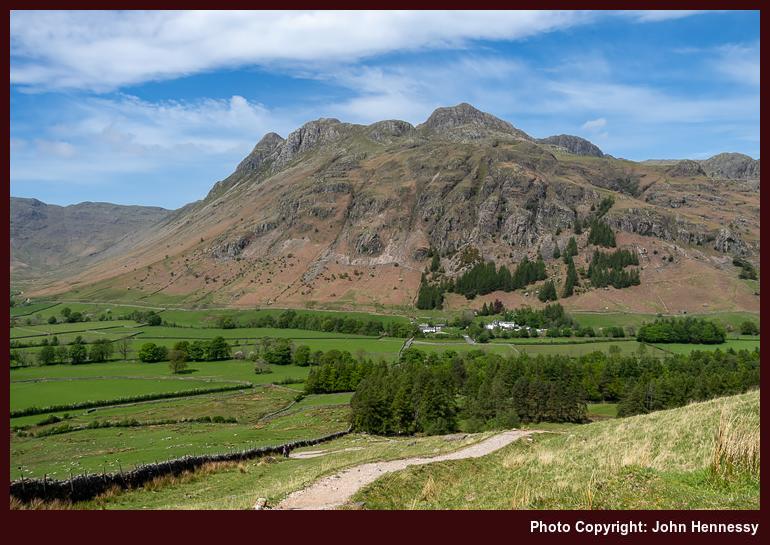
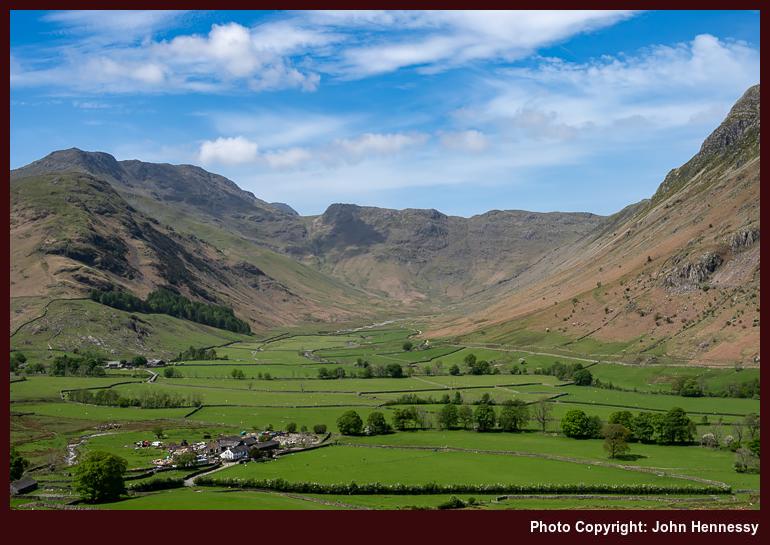
Once in Great Langdale, I began to make my way towards Blea Tarn, first along the lane leading to Little Langdale before peeling off onto public rights of way for the rest of the way. As I gained height in the heat of the day on the flank of Side Pike, views opened out below and around me. It was one thing to witness again the craggy eminences of the Langdale Pikes and quite another to peer along the line of the Mickleden Beck, one that I followed south under clouding skies at the end of May 2008. Seeing that under brighter skies was a definite bonus.
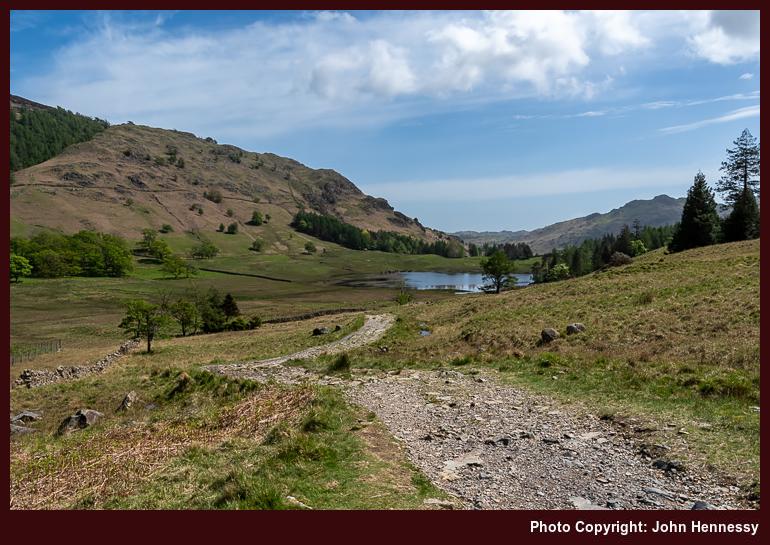
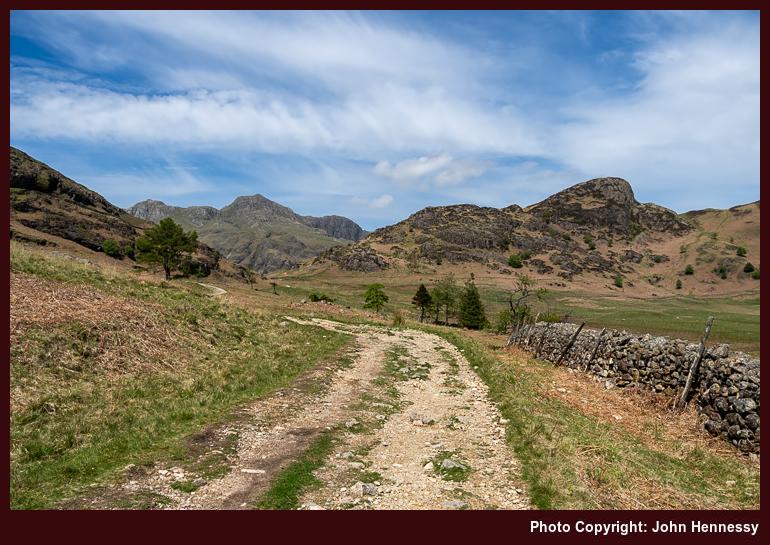
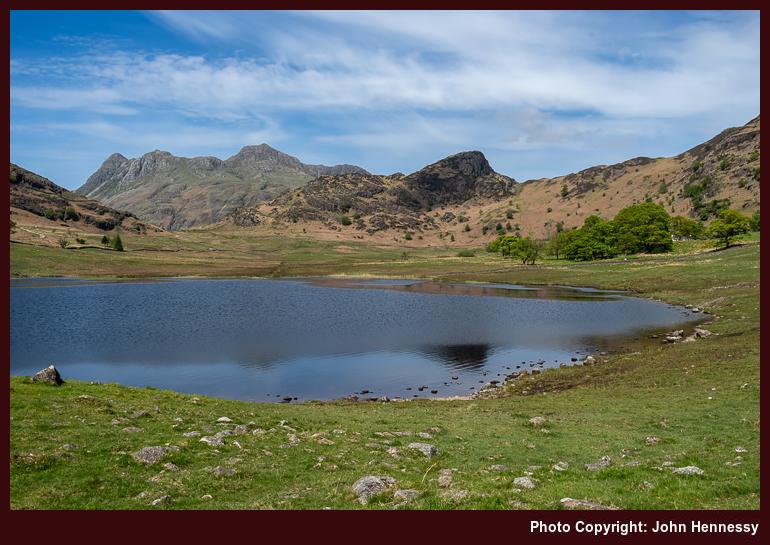
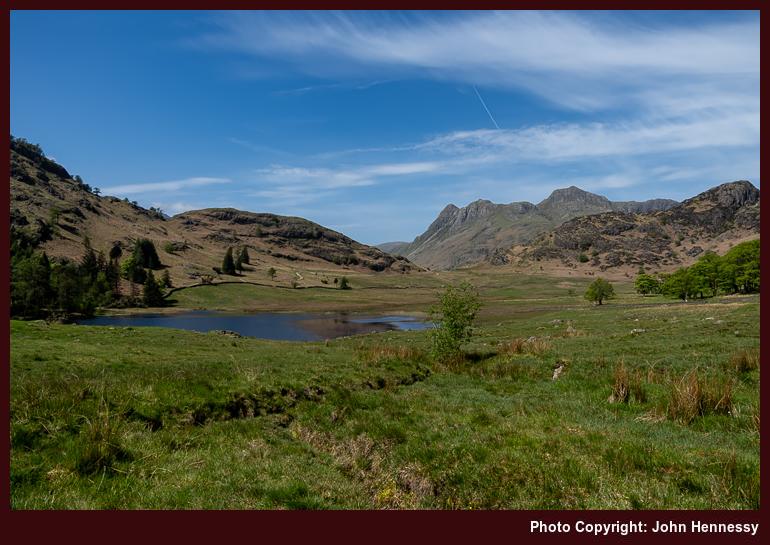
The way up from Great Langdale was unrelenting until I crossed the road to commence a trail below the slopes of Rakerigg. The easing of gradients beyond this point was welcome, though that meant losing those downward views that I had been enjoying before then. Nevertheless, there remained plenty to savour on the way to and around Blea Tarn. Some young people had music playing, something that was less easy to comprehend with the soundtrack that nature was offering. Maybe you have to live a little to grow to appreciate those natural sounds.
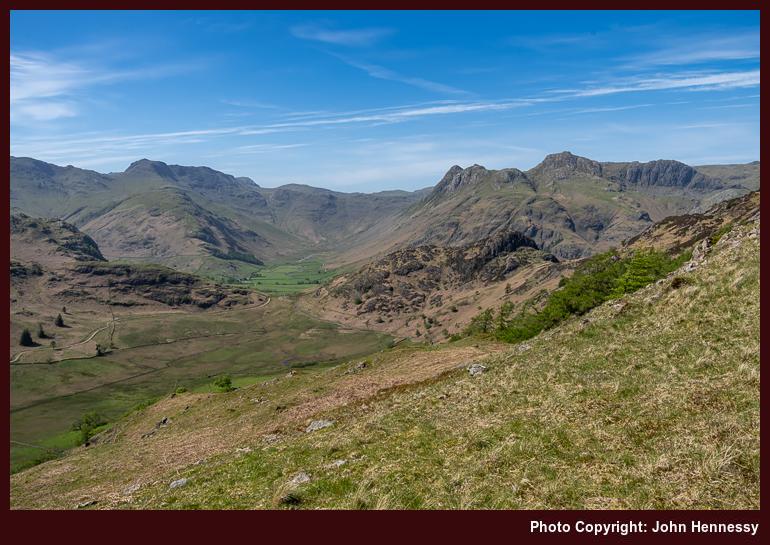
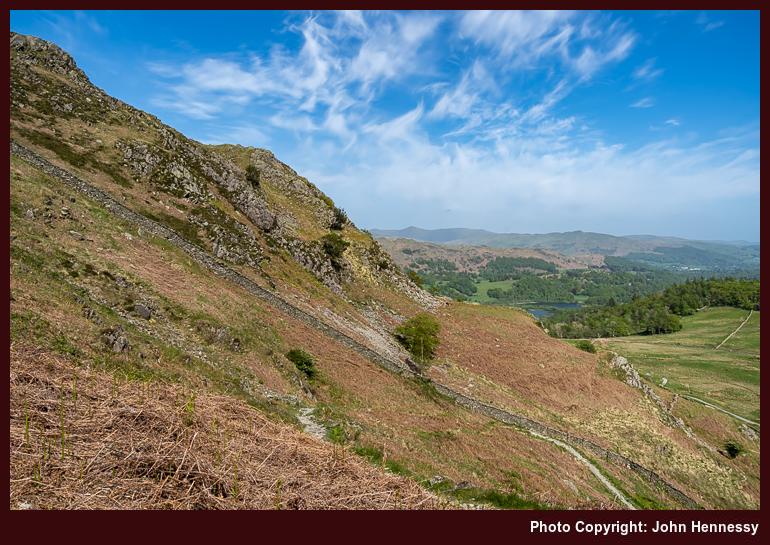
After crossing more level ground, a sterner test awaited: the ascent of Lingmoor Fell via a steep pathless flank. While going around by Bleatarn House to pick up an informal path following the line of a beck may have been wiser, I saved on distance by taking a more direct approach. Pausing to take in what lay around me was demanded by the gradient, as much as patience with my then under pressure legs. At least, the terrain had yet to be choked by bracken, making it easier to see where to place my feet. Fronds were slowly unfurling, though, a hint of what was to come.
In time, the slopes relented near Brown How, the summit of Lingmoor Fell. Naturally, I had to visit that top to witness the splendour that lay around me. All the while, I had been on access land, ensuring that no charge of trespassing could be made against me for the way that I went. A useful wall acted as a handrail for continuing on my way until I finally began the descent to Dale End, with glimpses of Elter Water and Little Langdale Tarn.
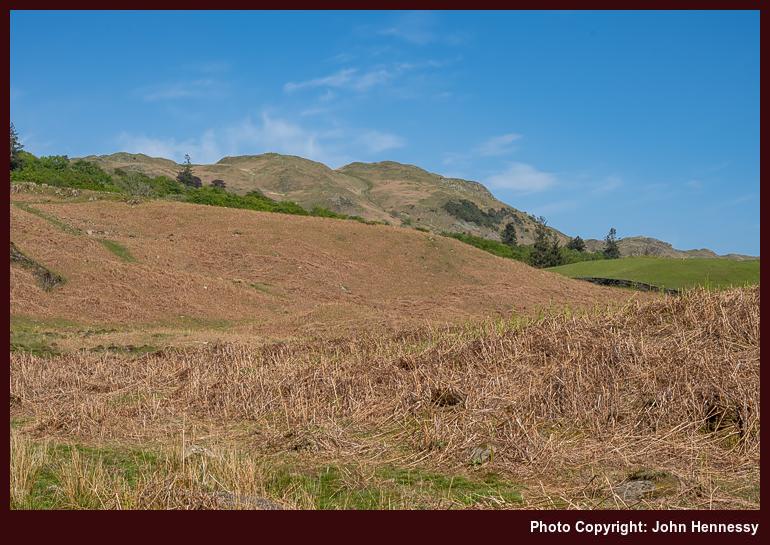
From Dale End, I pressed on towards Elterwater village in the afternoon heat. Kinder gradients meant that reasonable progress could be made, and I felt the need to push on in any case. A diversion around by Elter Water (the lake) was not on the cards this time around. That may be an excuse for a return to sate a photographic need. Instead, I crossed the B5343 to commence a taxing ascent to High Close, entering into countryside last frequented in August 2014.
Then, I stayed in the YHA hostel around there on a day through grew increasingly dull until rain arrived while I was exploring the surroundings after arriving at my lodgings for the night. Even under overcast skies, everything looked appealing, and I hiked to Grasmere village the following morning. The whole escapade had an end of summer feel to it and pervaded the journey home afterwards.
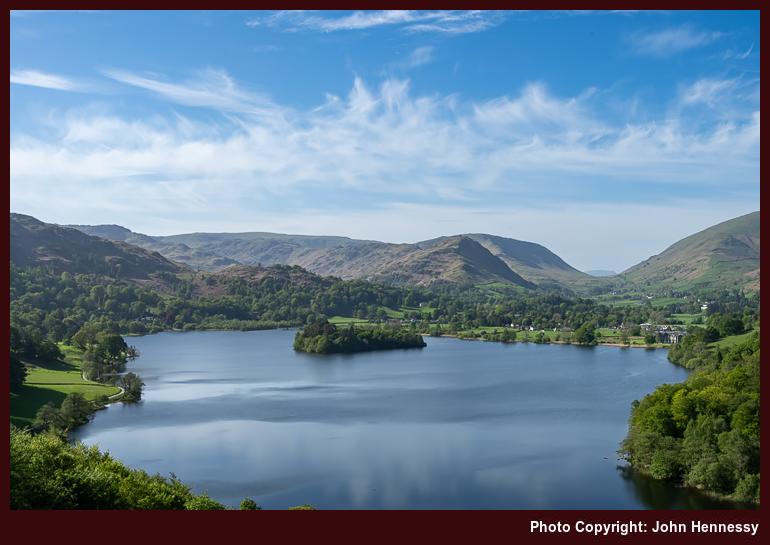
This time around, it was a lake that drew me and not a village. The afternoon was reminding me of an even earlier incursion, on a Sunday when transport foibles frustrated a trip to Wales. Then (which could have been in 2004), I ventured forth on foot from Ambleside before crossing Loughrigg and making photos as I went. However, the film stock that I used made exposures appear too red for my liking, inspiring the August 2014 reprise. Nevertheless, there was much to savour that earlier afternoon, etching it into my memory even now.
On leaving the lane during the 2022 ramble, I reached Loughrigg Terrace, the vantage point for the above photo. One thing that struck was that my timing might have been better because shadows were being thrown by the sun in places where having them lit might have given a better result. That brought challenges with composition that I may have overcome. After all, the outcome beats anything that I got before then.
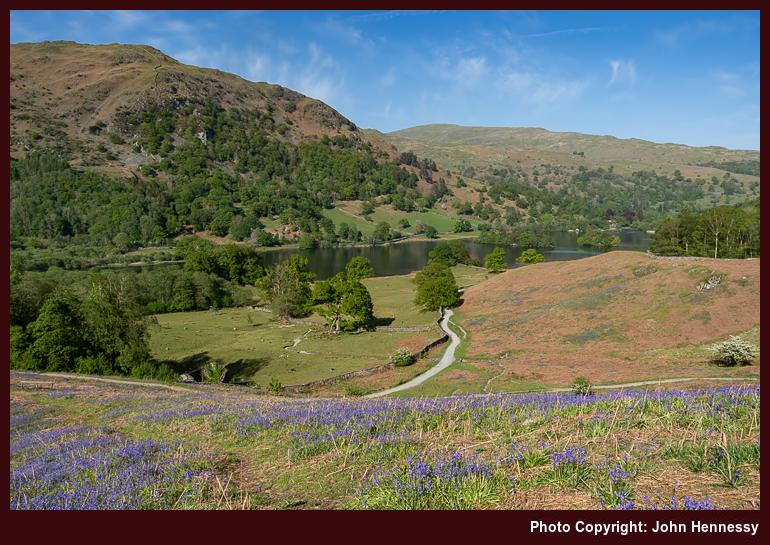
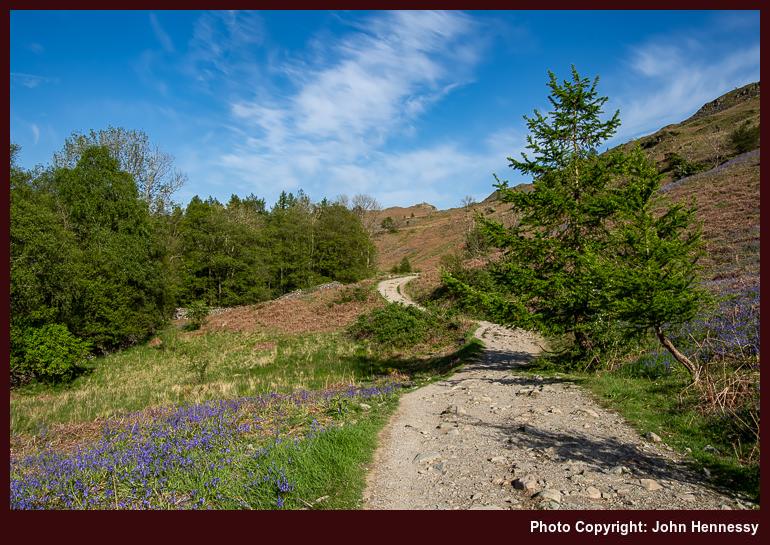
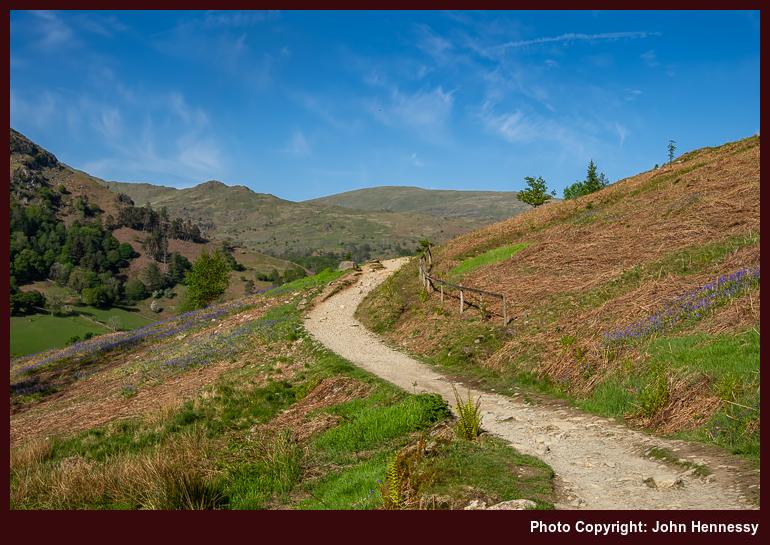
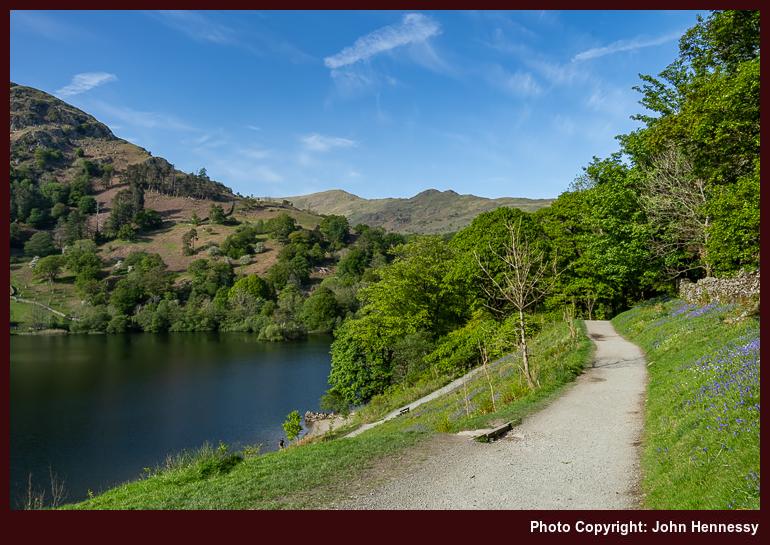
Unlike earlier sections of my walk, this one was busier. Others doubtless were drawn by the countryside and the weather, and their presence influenced my routing. Even with weary limbs, added uphill travel on a permissive path brought added quietude and more expansive views. As I continued on my way, I was reminded of that earlier Sunday afternoon. Then, whitethorn bushes and trees were in flower, while it became a moment for bluebells to hold my attention during the most recent encounter. All that lay around Rydal Water was catching the sunlight perhaps better than Grasmere, a happy accident of positioning.
My time around there ended with a wait at a bus stop for the next service to Windermere after getting to Pelter Bridge on a byway and subsequently walking back towards Rydal after that. Unlike a preceding occasion when a similar walk had continued to Ambleside, no such inclination arose this time. After all, rest was needed after all the exertions on what had been a satisfying day of rambling; it is days like these that draw you back time and again. In summary, the whole enterprise had drawn on previous encounters whilst also adding something distinctive to boot.
Travel Arrangements
For this outing, I took a round-trip train journey from Macclesfield to Windermere. From Windermere, I hopped on bus service 555 to reach Ambleside before bus service 516 took me the rest of the way to Great Langdale. Service 599 was used to get back from Rydal to Windermere at the end of my hike, allowing a chance to get some refreshments before I continued on my way home again.
Revisiting the Fairfield Horseshoe: A stirring trek through some of the Lake District’s craggy beauty
17th January 2025 The overriding memory of July 2022 is that of the record-breaking temperatures endured during the middle of the month. In hindsight, it would have been more productive not to have tried working through this at all, telling my client as much at the time. Scarcely anything could be accomplished in these conditions.
Not having air conditioning in a terraced cottage in the north of England was no preparation for temperatures exceeding 30° C around the clock, which meant that nights largely were sleepless as a result. Having a place near the coast in Ireland might have made for a good holdout while this was happening, something that only came into my possession last year, two years too late for that episode.
Before all that meteorological fury, I scurried north to the Lake District for a day hike. The destination was inspired by reappraisal of photos in my online gallery, a pervasive trend throughout 2022. It had been the most of twenty years since I first completed the Fairfield; a reprise came not before time. Since film photography was my mainstay back then, this was an opportunity to engage in some digital capture of what is found around there while following a similar route.


The preceding night may not have been as restful as I might have liked, yet I got to Rydal at around 10:00. On that round all those years ago, there were fewer people around until I got as far as Fairfield. The reprise was busier, especially on the ascent of Nab Scar, where the steep slopes caused others to clump together on rest breaks. Even at that stage of the day, there was summer heat to be felt, so the ascent was sweaty work.


When the gradients relented, I found somewhere to stop for a while to take on board some refreshments and savouring views of Rydal Water, Loughrigg Fell, Grasmere and whatever else lay about me. Because it was likely that there was a bolus all staring at once that morning, I left others pass on their way. One joked that they were on their second way around when they passed me again after my overtaking them during the initial ascent. It might have been prompted by the pandemic strictures easing substantially, but there was a feeling of added camaraderie on this round.

Once I got going again, Heron Pike was my next landmark. With everyone now more scattered, each could have more space, and that also applied to me. The going was now gentler than before and greater views were opening around me. It never ceases to amaze me how stiff the first few hundred metres of an ascent can be, only for things to ease off once you are higher up; then everything can feel a little more plateau like. This can catch you at the end of a descent too, as I found on this hike, and glacial action often is the cause of such arduous going.


The summit of Grey Rigg was my next staging post as I navigated the undulations atop a narrowing ridgeline; gradients again stiffened on the final approach to the summit to open up more views for me. To my left lay the narrow valley leading up to Grisedale Hause and then Grisedale Tarn. It was a scene showing the latter that I had in my mind's eye for its capture using newer technology than I had all those years ago. The further up and the further in that I went, the more that I got to savour.


Even with reaching the top of Great Rigg, I was not done with uphill gradients just yet. The last heave on the way to the flat top of Fairfield needed to be surmounted first. Patience was in order at this point before things became much kinder. On the way, I could glimpse my return route as it threaded between Dove Crag, Hart Crag and other eminences. Once on the top, the high point of my day's walking, I could glimpse St. Sunday Crag and Helvellyn to the north. The former was the subject of a yomp around eight years before, and the end of August would see me surmount the latter. There was topological majesty in every direction anyone could face, all brightly lit on the day.


Once you reach the greatest height of your day, the only way is down, not that such a reality means that it gets easier from there. Initially, the inclines were kind enough, and I could peer into Patterdale and make out the outline of Place Fell, a summit I surmounted in January 2010 at the start of a year of career turbulence for me. The list of fell tops that I would cross became Hart Crag, Dove Crag, High Pike and Low Pike.
It was after the penultimate of these that gradients again stiffened, that being my lot until I reached the floor of Scandale at High Sweden Bridge. Walking poles were essential for saving some knee strain, and patient foot placement was my lot while allowing the fleeter of foot to pass me; everyone has to hike their own hike. For a time, it seemed easier to follow the informal path by the stone wall instead of seeking out the line of the public footpath.
That came to an end when a challenging down scramble lay before me. Then, I sought out the public right of way to High Sweden Bridge, leaving the topological drama of High Brock Crags and Low Brock Crags behind me. This also left a walking group to go their way, possibly towards Low Sweden Bridge, mine turning out to be a quieter affair; the rest of the descent to Ambleside was now at hand. This broad track better suited wearied limbs, allowing patient progress to convey me safely onto busier streets, where I sought out the main bus stop after a satisfying day.
In summary, I had experienced what I came to encounter, making many images and enjoying the round. Though I normally seek quietude, the moments of shared camaraderie added its own special moments too. Any challenge posed by the warmth of the day has faded from recollection now; it was a scenic grandeur that stood out for me. This was a reprise more than worth doing as it took me around places that I have frequented before. It was great to see them all again.
Travel Arrangements
A return train trip from Macclesfield got me to Windermere. From there, I had a choice of bus routes for getting to Rydal for the start of the hike. The same applied for getting from Ambleside to Windermere. You can use either service 555 or 599 for this; the latter goes between Bowness-on-Windermere and Grasmere, while the former goes between Lancaster and Keswick.
Hiking lofty Helvellyn: A commendable scenic detour on the way to Scotland
15th January 2025 2022 was the year when I really began to emerge following the constraints of the pandemic. Trips to Ireland allowed me to become reaccustomed to staying away from home, as well as seeing more of the place than I had before then. While there had been day trips to the South Pennines, Wales and the Lake District, none had featured a stay away from home in the U.K. before the end of August.
My not having been in Scotland since 2019 was what drew me north. Other than having a client meeting, I cannot explain why I did not take Friday as a non-working day for travel to Stirling. That might have got me some better days for hiking up there, negating the return visits that I have described in other trip reports on here. We live our lives with so much unknowing.
Another complication was the performance of Avanti West Coast and Transpennine Express. Both operators were unable to operate their full timetables because of staffing challenges, resulting in many cancellations. That, and the Friday evening travel time, meant that I spent two nights in Carlisle, facilitating the third (and final) Lake District day hike of the year. Having pondered an ascent of Helvellyn during July, that became my choice. Terry Abraham's Life of a Mountain: Helvellyn was one inspiration behind that endeavour, and I reaped the rewards of my day around the Cumbrian landmark.

On Saturday, I headed to Glenridding from Carlisle, first by train as far as Penrith and then by bus from there. Car parks were full and visitors were struggling to find a space as I made my way towards Greenside Road, a gravel track despite the name. At one point, I found myself being asked if I was leaving, meaning that I was freeing up a space for someone. My mode of travel meant that I was no help in that regard, and I carried on from there to quieter surroundings. The sunny weather, the long weekend and the still reduced nature of international air travel all contributed to the busyness as much as the proximity of Ullswater and the surrounding fells.


Thankfully, I picked a quiet way to Helvellyn. It meant that I had much of the place to myself, though others very occasionally passed me. Naturally, there was an ascent too, and I noticed a certain lack of strength in my legs. Because the outing was part of a weekend away, I brought a heavier rucksack with me, the one that I used to use all the time before the pandemic came our way. Since the difference between that and the Lowe Alpine that I acquired in 2020 was easily perceptible, the effect on my legs was attributed to that. Taking things steady was the only option available.
Others could be seen on a track on the other side of the valley, highlighting that numerous route options are available. Because Striding Edge and Swirral Edge, well known though they are, seemed too airy to me, I opted for a gentler route. They may have been busy too, not the best when there is not so much space for everyone. Instead, I was bound for Whiteside Bank, from which the way to Helvellyn would take me over Lower Man. A longer option might have been to go via Stick's Pass and include Raise on the way; eschewing Helvellyn altogether, that might have opened up a myriad of routes leading north. One thing is certain: there is no shortage of hiking possibilities in these parts.


The skies might have been full of dispersed clouds, yet they still obstructed the sun from time to time. A few of episodes cam my way while I was ascending the flank of Glenridding Common and around Whiteside Bank, and there was less luck with sunshine for anyone around Catstye Cam. Looking back towards Patterdale drew my eyes to what lay behind me and how far I had come. The lack of rapidity was no concern of mine, given the delights through which I passed. After all, shortcuts can take longer, especially when there is significant height gain involved.


While I was up high, a pervading thought struck me: the views from a lofty vantage point can save much traipsing along the ground. When you have distant Skiddaw and Blencathra in your sights, as well as nearby Ullswater and Thirlmere, that point is rather rammed home for you. Throw in a sighting of Bassenthwaite Lake and the suggestion becomes incontestable. It is little wonder that Helvellyn draws so many, some of them from the Grasmere side of the fell.

Though this might be rugged countryside, Helvellyn's summit was a busy place when I was there that day. So many were making selfies around the trig point that I never got to touch it, a very human inclination that can possess me when I am near them. With all the scenic drama that lay around me, that was no omission and there could be no sense of loss. Though there may have been a compulsion to linger, there was a descent ahead of me. That meant that I needed to get going.

The way down to Thirlmere was unrelenting, possibly even brutal; this is not one to recommend for winter conditions when a fall could have consequences. In my case, it certainly took its toll on my knees, even with many breaks to savour the surrounding scenery. The hint of all this when a passing walker said that one of their number turned back on the ascent from Thirlmere. Others that following the same line uphill clearly were labouring and some were suffering, showing such signs of not being regular hill walkers that you could see them quitting. Even on the descent, pacing oneself became essential; this is not one to rush.

As often happens, the last part of the descent began to drag on for me. The routing felt indirect around Highpark Wood; it was a case of having come far yet having further to go. Once down on the A591 beneath Highpark Wood, the next move was to locate a bus stop to await the next service to Keswick. Thirlspot was in my mind, though it was not necessary to even go that far, which was just as well after the descent. While the terrain may have been more level, any rest was appreciated, and I marvelled at what I managed to get down while looking back on the route.
The bus to Keswick came soon enough, which felt just as well given that I was near a car park that was located away from so much. Even so, there are numerous trails around there would be more suitable for some of those trying to go up my descent route. My time in Keswick was brief, since I fancied getting going back to Carlisle as soon as I could. Cancellations of train services lay on my mind a bit, and they affected my eventual departure from Penrith so much that I wondered at my haste to get there. It felt like a ghost town after the busier spots in the Lake District, especially when so much natural glory had been my lot that day.
Travel Arrangements
Bus service 508 got me from Penrith to Glenridding after a train journey from Carlisle. The train journey to the latter featured changes at Manchester and Wigan. Bus service 555 got me to Keswick from the end of my hike, while bus service X4 or X5 got me from there to Penrith for a train back to Carlisle. The next day, train travel conveyed me from Carlisle to Stirling, with a change in Edinburgh. The rest of that story is elsewhere on here.
Last hurrahs
29th August 2024 These days, this time of year makes me wistful at the passing of summer. However, it was not always so. This also is the season when academic years start, so there are beginnings as well as endings. Even then, the decline in hours of daylight and dropping temperatures brought any attempts to hang onto a sense of summer to an unyielding halt.
Towards the end of my secondary schooling, the purchase of a new bicycle meant cycling it home. That was not only a sixteen-kilometre distance but a frustrating struggle against autumnal winds. That which was plausible in the summer months had become less easy away from them. There were a few more years of summertime cycling, building up distance with the passage of time, that not only met shortening evenings but also the commencing of studies again. That was broken when I moved to Edinburgh, meaning that my time in Ireland was much more limited.
With the end of my university years, the association of autumn with beginnings was broken. It all ended with a job search that preceded by a tour of the Scottish highlands and islands with my brother before a quick trip to Ireland. In truth, the continuity of a research degree throughout the year had faded the sense of autumnal beginnings anyway.
My career saw me move to England, where I had much more time for exploring than I ever did. Without the ebb and flow of academic life, it was all too tempting to try overlooking the seasons, especially when moving south took up so much of spring and summer. August was when the hills of Cheshire and Derbyshire still any prospects of exploring hill country by bike. Walking became the way forward. As the month ended, I made my first trip to Wales in mixed weather that was hinting that overlooking seasons was not an option.
In ensuing years, the range of experiences broadened. A few saw me returning to Edinburgh in August to note how autumnal the place could feel at that time of year. Academic pressures and lack of experience meant that I had been overlooking this. That even included a week of conference attendance in Aberdeen during my research degree. The sense was there yet not prioritised.
Sometimes, autumn can make amends for a less satisfying summer. Being soaked around Lorn and Lochaber during a week at the end of July was enough to send me north again. Numerous visits to the Lake District in August had not healed wounds that only a weekend visit to Lochaber at the end of August could do. The year after was wet for much of the time, and I moved house too. Thus, a muddy November hike from the Cat and Fiddle Inn to Rushton Spencer marked something of a beginning.
September is a month with its illusions too. There can be a lot of sun, so it is easy to think of endless summer. That certainly fitted a sunny weekend around Moffat, crowned by a stunning walk along the Southern Upland Way. The changing colours and closure of businesses at the end of the busy tourist season countermand this. The latter hit me while on a September visit to Gougane Barra with my parents. Still, autumn can offer its chances for partial continuity with local hikes through October, November and into December. There have been a few years of that too.
Seasons are not the only transitions that we meet in life. A change of employer once became a major career event for me, Before the turmoil that led to this, there were contrasting trips to Yorkshire, one in September and another in October. The first was to a sunny Wharfedale, while an often grey Ingleton became my lot for the second. After the changeover, my energy for walking trips was curtailed, yet there was an October stroll along the High Peak Trail and a November excursion to Church Stretton. Though work pressures grew after that, the wandering was much needed and happened more often than not. When even that was halted, local cycles and walks often provided release.
Family ageing, infirmity and bereavement took hold of a few years after that. Grieving continued through spring, beyond summer and into autumn. Nothing could stop an October hike from the Cat and Fiddle inn to Whaley Bridge, such were my needs at the time. The real end of August feel pervaded a weekend divided between Durham and York. This may have been the Summer Bank Holiday one in England, but it often just feels too late for it. As it happens, the same complaint can be levelled at the timing of the British Spring Bank Holiday weekend.
Feelings eased by the next autumn, though a weekend spent in mixed weather around Oban reflected a sense of political tumult that only got more intense in ensuing years. Eventually, a sense of release emerged to allow a memorable September Swiss escapade. Bern and Kleine Scheidegg were grey under autumn clouds, yet Geneva, Zermatt and Grindelwald continued the sunny theme. Inheritance matters lay ahead, but not before a November interlude around Warwick, Stratford-upon-Avon and Bath.
International travel was getting going for me, and dotted the year for a few weeks. An end-of-August trip to sunny Oslo and rainy Bergen bookended the summer the year after the Swiss trip. Inheritance matters were coming to a head to show that office work need not note the passing of seasons, unlike outdoor activities. They were to cause exhaustion, so a later autumn would see decompression at the start of a much-needed career break. That year, there was continuity of a sort from a week in Sweden in August to October day hikes in the Peak District and South Pennines.
Before the pandemic years, my freelancing faced an autumnal challenge that got addressed before the onset of restrictions. In September, there were visits to Oxford and Bath following a summer in British Columbia. The autumnal atmosphere of those, even if people were dressed in period costume around Bath for an event, reflected my mood at the time, for more things were ending than starting in that year.
The pandemic did nothing to halt hiking and, in 2020, even caused a resurgence of cycling. Getting outdoors then was much needed, resulting in a surprisingly rich year of day trips. That more or less ended at the end of September on a day that turned from sunny to grey as I walked from Hayfield to Chapel en le Frith. In the subsequent twelve months, things became less restricted, perhaps too quickly for my sensibilities. That made the discovery of Combs Moss near Buxton an uncrowded godsend during August and September that year. More were to be found when a new variant brought more restrictions around the end of the year.
Since then, the last few years have been about changing what I own. Some is being sold, and I now have a base in Cork that I can use. Manageability is what I am trying to improve now. More time has been spent in the outdoors as well, especially in Ireland. When it comes to the ending of summer, that does not feature so much, though. In the year before last, August was ended with a sunny ascent of Helvellyn followed by less satisfying trips to the Ochil Hills and Trossachs, extending activities into September.
Last year, a longstanding personal matter got attention and progress has felt rather miraculous. That started in August of last year and was got helped by numerous hill walks in Wales in August and September, a trip to Guernsey at the end of August, and a satisfying October encounter with the Ochil Hills from Stirling. While there was a sense of curtailment as the year wore on and other matters intruded, it still is remarkable to note what was happening then in any case.
This year has seen numerous walking trips in various places. Wales, Scotland, France and Ireland all provide the locations. Irish responsibilities continue to be reduced alongside these, and I am looking to progress other work activities as well. Autumn this year is about looking forward more than looking back during a period of letting go of things.
Autumn can feel quiet, yet it is often busy. Places can feel less thronged, giving a sense of new beginning that gets thwarted by the increasing sense of approaching winter. Even so, the working lives of many become more busy, as do places of learning. The latter can be filled with hubris that then is vanquished by academic pressures. This is an odd time of year, looking forward with anticipation, but also looking back with poignancy. Maybe, that is what transition brings. Nevertheless, spring is more to my liking and likely will remain thus.
Consolidation
27th February 2024 The magazines Cumbria and Lakeland Walker have been combined, a move that makes me wonder about the wisdom of remaining a subscriber. The strictures at the height of the pandemic saw me subscribe to a number of magazines, mainly to cut down on shop visits and also to contribute to keeping them going through a tough time. Lakeland Walker was one of these and had its uses for getting ideas for Cumbrian outings, especially among the Lakeland fells.
Since then, there have been a number of changes. Firstly, the world has turned against plastic, so many magazines are mailed in paper envelopes, not the best for keeping them dry during some of the deluges that have beset us during the last twelve months. My preference is for waterproof wrapping materials derived from plant matter, which some have been using.
What once was a title printed on A4 paper now is part of a combined title printed on what appears to be A5 paper, an increase in the size of the once smaller format Cumbria magazine, though. So, we have the perhaps clumsily titled Cumbria and Lakeland Walker magazine. In some ways, the combination is reminiscent of The Scots Magazine, which also has an outdoors section, albeit without maps. Thus, the merged entity can work and there may be a finite number of walking ideas among the Lakeland fells anyway.
Lakeland Walker had lost its long term editor John Manning too, so there may have been editorial instability. Only time will tell how things will out for the new title and if I remain a subscriber, for there can be too many magazines and not enough time to read them all. Current market conditions are challenging anyway, which ultimately may explain the merger.


