Category: Cumbria
From Windermere to Kentmere and back
 12th July 2007
 A sunny Saturday escapade was out of the question because my driving lessons continue so I took my chances on Sunday. Despite the threat of thundery showers, a trek to the Lake District appealed and it didn't disappoint either. In fact, the weather in the area can do its own thing and I have been clag-bound on days when the forecast was for fabulous sunshine. This time, it was the other way around: the clouds were in plentiful supply at times but they never threatened with rain and the day turned out to be one that I will remember and treasure.
The travel arrangements involved bus journeys to and from Crewe with trains taking me from there to Windermere and back, with a change in Oxenholme. It was all fairly straightforward and I was in Windermere before 12:40. I have no idea how I managed to get this into my head but I have never thought of Windermere as a place from which to start hill walks; I had always voyaged further by bus. It took Jim Reid's Tour of the Lake District (Cicerone) to put me straight. Sunday's trek proved that there's nothing at all shabby about the hill country north of Windermere.
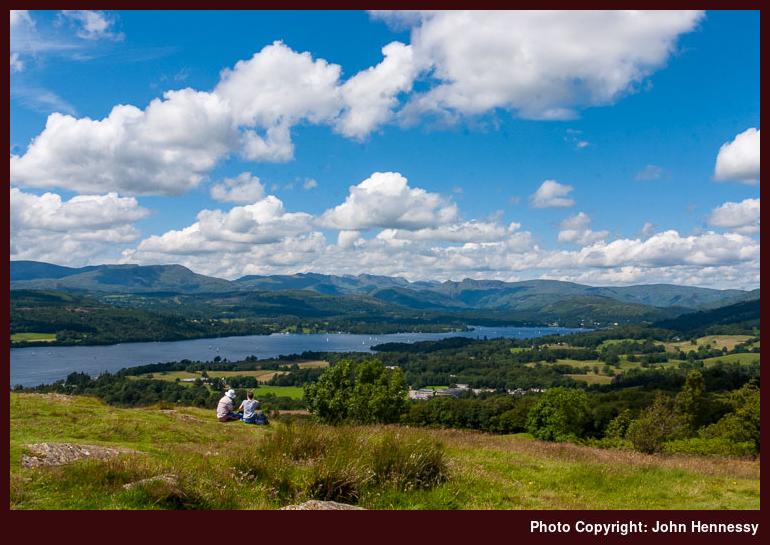
My walk took me up and over Orrest Head and the views from this modest little hill were sublime; I can see why Wainwright rated it. Its location more than makes up for any lack of height and proves that height is no prerequisite for enchanting vistas. Views up and down Windermere and the hills surrounding it are in ample supply with northern vistas also being packed fully of craggy and not so craggy delights. With sunshine in abundance, getting myself off it to continue on my way was a lengthy process.
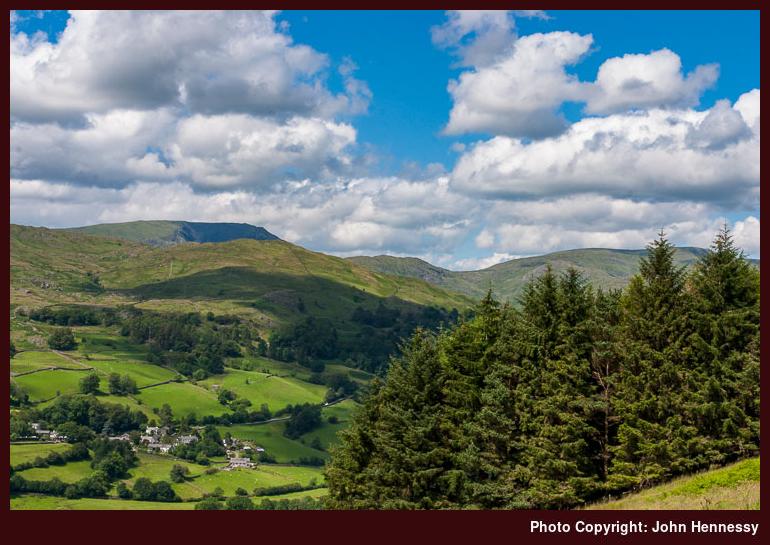
From there, I made my way to Moor Howe by a mixture of roads and public footpaths and made my way onto a track called the Dubbs Road. Deep pools almost occupying the whole width of the track in places were abundant as I walked onward to join another track, called Garburn Road. By then, I was on the slopes of Applethwaite Common above Troutbeck and road noise was percolating up from the valley below. Views of Ill Bell and other fells abounded to the north and I was soon to leave behind the bustle of road traffic to cross over Garburn Pass. A tempting track to Yoke and Ill Bell headed off to my left but I was content to leave such an excursion for another day.
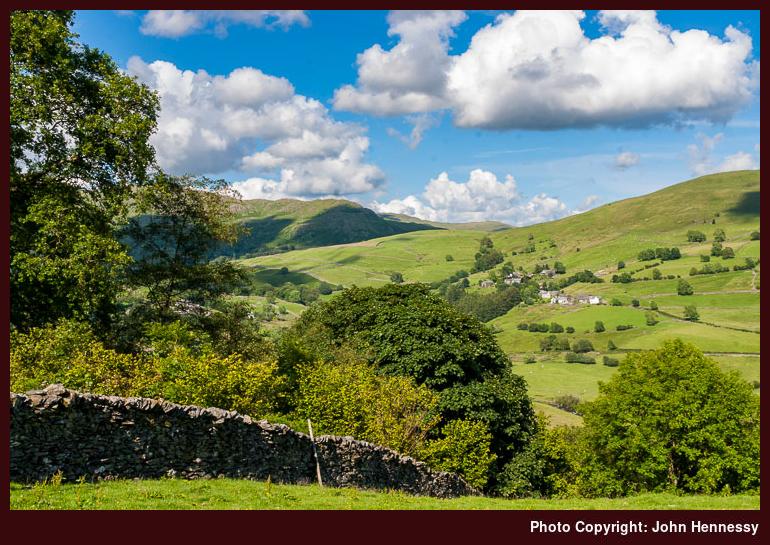
I lost height as I dropped into Kentmere valley but by then the scene was being set for a wonderful evening. I didn't go into Kentmere village itself but cut off towards Kentmere Hall and started gaining height again as I began my return to Windermere. The surrounding views were enchanting and stopping and staring slowed progress as did photographic exploits. Distractions and climbing soon became less of an issue and steady progress was made along mainly good tracks (some waterlogged patches were encountered, but that was to be expected given the weather that we have been having) until I reached High Borrans farm. From there, it was road walking all the way to Near Orrest farm and my feet weren't thanking me for it. A tramp along public footpaths offered some respite as I skirted Orrest Head took me back to Windermere where, having missed a train by ten minutes, I had a spot of time to stroll into Windermere to buy a few bits and bobs before I headed home satisfied after a good day out.
Public transport in Cumbria
6th May 2007 Public transport provision in Cumbria is a classic curate's egg, good in parts. As it happens, the western part of the county fares much better than the eastern side. For a walker in the Lake District, options are plentiful but they decline a lot when you start to consider following the likes of the Pennine Way. In any case, Cumbria County Council provides useful timetable information for any bus services that are likely to be running.
Being the honeypot that it is, it should not surprise you that bus services within the Lake District National Park are in good supply and they connect with train services, after a fashion. Anywhere with literary connections is bound to attract the crowds and will be well served by buses. Coniston, Rydal and Grasmere fall into that category and it is good news for walkers. However, any walking destinations away from these may not get the same level of service. Wasdale is the most extreme example here but Kentmere and Patterdale also fall into the same category, albeit to a lesser extent. Another thing to watch is that bus services can be seasonal too but this is all documented in the biannual guides that are produced.
There are a number of reasons why travel in eastern Cumbria takes my interest: the Dales Way, the Howgill Fells and the aforementioned Pennine Way. Am I becoming something of a connoisseur in my voyages off the beaten track? I am not sure that I am but getting to the likes of Sedbergh, Dufton and Alston would be very useful for exploring the above. The Settle-Carlisle railway line is a help for getting to Dufton, even if a walk from Appleby-in-Westmorland is involved but that isn't necessarily a bad thing. Nevertheless, it cannot do everything. Also, Sunday bus services are akin to the proverbial hens' teeth and weekday services aren't that plentiful either, particularly on Saturdays. It all needs some planning and maybe a few days of point-to-point walking to explore these parts. Nevertheless, Wright Brothers' summer only extension of their 888 service will be a boon when it comes to exploring around Alston and doing the sections of the Pennine Way nearest to the town. Weekday and Saturday connections from Carlisle and Haltwhistle help too. Eccentricities not withstanding, services between Kendal and Kirkby Stephen make access to the Howgill Fells a possibility.
Drawn to Skiddaw
5th May 2007 While pondering this post following my ascent of Skiddaw yesterday, it occurred that if I tried listing my excursions to Cumbria's Lake District, I could have ended up with a very long list and I have not even come close to exploring all the area. 2003 was when I spent the most time up there and, in marked contrast, the nearest I came to it was while I was on the way up and down from Scotland!
On my visits, I have been fanning out from the likes of Ambleside, Rydal, Grasmere and Keswick. From Keswick, I have got to Buttermere, up and down the shores of Derwent Water, to Catbells, along Coledale, in the woods on Dodd (the one next to Carl Side; there are a few of them), around the Back o' Skiddaw... I think that probably covers it; Keswick has made a good starting point for many of my Lakeland excursions. Anyone with any knowledge of the Lake District should not be too surprised if I bundle Ambleside, Rydal and Grasmere together and they have been the starting (and, in some cases, the ending) points of walks over Loughrigg Fell, around the Fairfield horseshoe, to Patterdale via Grisedale and Fairfield... They're the main ones.
However, given all my treks, it took me until yesterday to mount the summit of Skiddaw; too many other distractions, perhaps? The mountain has featured in numerous photos posted on my Lakeland photo gallery so it was about time that I ascended it. Given the fine weather that we have been enjoying recently and the predicted break in the weather, as is customary for a bank holiday weekend, I decided to take a day off for some walking. For the sake of some variety, I took a break from my Pennine Way objective and returned to Keswick since perhaps 2003.
An early morning train/bus combination got me to Keswick around 10:30. Once there, I organised myself and picked up the Cumbria Way. A useful footbridge got me over the busy A66 and I then rounded Lattrigg before leaving the way after passing through a car park. After passing rounding a 333-metre-high hillock and passing a Celtic cross commemorating two noted breeders of Herdwick sheep, I dropped down a little before commencing the real ascent in earnest. Then, it was a case of taking things slow and steady between 300 and 700 metres before the gradient became more kind. A tempting track was heading for Little Man but I stayed my course for Skiddaw to conserve my energy levels; the actual right of way goes along the northern slopes of Little Man. The actual final ascent of Skiddaw itself wasn't too hard on the legs, though "steady as she goes" remained the approach. As I went up, views of Derwent Water, Bassenthwaite Lake, Blencathra, Ullock Pike, Little Man and the Back o' Skiddaw were abundant, though an ominous looking bank was there to see in the north and to the east; it looked like I picked the right place for my day out.
The views remained there to savour as I started on my way down at 14:00. Even after 800+ metres of ascent, I still possessed the energy to allow me to vary my route a little on the descent. The first of these diversions was to pick up a path over Little Man; this one does not appear on the OS Explorer map but Harvey's Superwalker equivalent does show most of it. I'm glad that I tackled it on the descent as there is a false summit on the eastern approach. The second diversion was to go up and over Lattrigg; I kept seeing the path from on high and got tempted by the proposition. The ascent wasn't too taxing either, and the views made it worthwhile. Even with these variations, I was back in Keswick at around 17:30 and spent a bit of time strolling through the town and doing a spot of shopping before catching the bus that took me towards my train home.
Settle-Carlisle Celebration
6th July 2006 Within the rolling hills and rugged landscapes of England, there lies a railway line that has stood the test of time - the Settle-Carlisle extension, a former Midland Railway jewel, marks an auspicious anniversary this year. In 1986, several of its stations were reopened after a period of closure, and to celebrate this momentous occasion, a commemoration is planned for all those who cherish the line's rich heritage.
The fight to keep this vital artery operational during Britain's tumultuous economic journey and Beeching's infamous "axe" wielding was fierce, but I never truly appreciated its tenacity until now. The reopened stations gracefully dot the picturesque landscapes of Horton-in-Ribblesdale, Ribblehead, Dent, Garsdale, Kirby Stephen, Langwathby, Lazonby, and Armathwaite. Yet, it is challenging to envision their former selves, shrouded in the veil of time, as they lay dormant. For a more comprehensive understanding, I invite you to delve into the captivating world of the Settle-Carlisle Partnership's website.
The enchantment of these once-abandoned stations now serves as testament to the indomitable spirit of those who fought tirelessly to preserve them. Each station, in its rejuvenated glory, offers a glimpse into a bygone era and beckons the curious to explore the tales that lie hidden within their walls.
Horton-in-Ribblesdale, a quaint village nestled at the foot of the famous Three Peaks, boasts a station that is an architectural marvel, designed with intricate stonework that seamlessly blends into the surrounding landscape. Ribblehead, with its commanding position above Wensleydale, showcases the line's engineering prowess as it traverses the challenging terrain of the Ribblesdale Moors.
Dent Station, a Grade II listed building, stands proudly amidst the lush dales and valleys of Cumbria, while Garsdale is tucked away in a tranquil corner, offering breathtaking views of the Howgill Fells. Kirby Stephen's station, nestled in Eden Valley, offers a charming insight into rural England, as does Langwathby, which straddles the border between Cumbria and North Yorkshire.
The picturesque villages of Lazonby and Armathwaite complete the line's ensemble, offering a taste of the timeless charm that has drawn visitors for centuries. As we celebrate this milestone anniversary, these stations remind us of the rich tapestry of history woven into the fabric of our great nation.
As we gather to commemorate the reopening of these treasured sites, let us take a moment to reflect upon the perseverance and dedication that made their resurrection possible. The Settle-Carlisle Line serves as a poignant reminder that sometimes, it is not merely the destination that matters but the journey itself - the struggles, triumphs, and camaraderie forged along the way.
If you find yourself in the enchanting regions of North Yorkshire or Cumbria this year, be sure to take a step back in time aboard the Settle-Carlisle Line. Embark on a journey that transcends mere travel, immersing yourself in the rich history and the resilient spirit of those who dared to preserve a piece of our nation's past for future generations to cherish.
Yorkshire to Cumbria: A Ramble
5th July 2006 As I write this, the World Cup is coming towards its climactic end and a heat wave has nearly run its course. While I certainly know what has been happening with the football, I have tended to find other things to do instead of watching it. I have nothing against football but, as you might tell, I am light years from being obsessive about it. Even so, someone (a total stranger to me) was asking if I was watching Germany playing Italy and opined that I didn't like football when he heard that I wasn't. As it happened, when I completed my ramble last Saturday, England were playing Portugal and it was easy to sense the excitement. However, I had no inclination to watch, for reasons that may become apparent in a while.
Saturday was forecast to be cooler than Sunday so that's when I decided to walk from Ribblehead to Sedbergh, Yorkshire to Cumbria. This area was subject to country boundary changes in the 1970's when Cumbria was created from Cumberland, Westmoreland and parts of Yorkshire and Lancashire. The result is that part of Cumbria is within the Yorkshire Dales National Park, the boundary of which still follows the old county border. Further confusion is likely if, as has been put forward, the Lake District and Yorkshire Dales National Parks are extended to protect area lying outside of them such as the Howgill Fells (near Sedbergh) and Borrowdale (the one near Tebay). Planning permission for a wind farm in the former has recently been refused. The whole issue highlighted the natural beauty of the areas left out of the two nearby national parks.
The Howgill Fells cannot be missed if you are going on either the M6 or the West Coast Mainline. My ramble to Sedbergh allowed me a closer, if fleeting, look at them and the journey from Sedbergh to Kirkby Stephen really shows their extent. A word of warning though: don't drive and look at the hills simultaneously for there are sheep likely to be walking the road.
From Ribblehead, I skirted around Whernside on the Craven Way (a bridleway unpleasantly rutted in places) to join the Dales Way which I followed until near Sedbergh. Part of my journey took in the lower section of the bridleway headed for Whernside's summit (subject of an earlier day out) but these had so many out on it that it was the walker's equivalent of the M6 but I got off it and things soon became quieter and more pleasurable, an amazing sight when you see the hoards heading a different way from less than 100 metres away from you. I was glad that I tackled Whernside earlier in the year.
After not following my instincts, I lost 15 minutes finding the Dales Way from the Craven Way (someone put a church on the map but you couldn't see it!). From here I strode past Dent to Sedbergh (covering something like 6 miles in a bit of a hurry) but missed my bus. I was a little worse for wear after my exertions, my excuse for missing out on the football, so I waited a while before calling a taxi to get to Kirkby Stephen railway station and begin my train journey home.
This was not my first foray along the Yorkshire-Cumbria border since I was hopping over and back across the line in question while exploring Garsdale in 2004. I got some heavy showers that day, unlike last Saturday, before the evening cleared up and showed me what the area offered. If it is wild country that you are after, this part of the Yorkshire Dales has it in spades. It also means that public transport provision isn't what it might be, so you need to be careful.


