Category: Ireland
Irish journeys
 3rd July 2009
 Last weekend saw me across in Éire for a few days and some chances for spending time among its quieter parts were fitted into what was in essence a social visit. The first one was to Gougane Barra on a day that started out looking grey and damp before continual improvement began to become noticeable. That guaranteed some sunshine whenever the clouds got out of the way. Those clouds kept a lid on the temperatures but it would have been nice to have had more sun for photographic purposes. The second escapade took us across the Shannon estuary to Kilkee in West Clare on a day when the weather predictions were even more dubious. Because I was away from the world of Internet connections, television and radio forecast bulletins became important and the trick was to keep an eye on those flashes of time resolved displays and they are never there for very long. For the Gougane Barra outing, the trick was to have the band of grey dampness continue to the north and it didn't disappoint. The reason for heading to Clare was to salvage some satisfaction before a more concerted band of rain arrived from the south and south-west. Hoping for blue skies and sunshine was out of the question but some pleasant coastal strolling along the cliffs more than sufficed. There may have been drops airborne in the strong breeze but you can cope with that. In fact, steady rain did arrive around 15:00 so we left for home after a good few hours taking advantage of what was on offer; we had got something from the day.
Since the real travels, virtual roving has been going on in my mind. Much of this has been driven by curiosity but poring over maps has increased my awareness of the Irish countryside too. For instance, I have been casting my mind over the area round about Clifden in County Galway. Of particular interest are the Twelve Bens in Connemara (some call them Pins but be aware that others cannot abide that naming) and how walks can be made possible by use of public transport. What led me to this was my discovery of Citylink's Galway-Clifden-Cleggan/Letterfrack service. It seems far more user friendly of the alternative offered by Bus Eireann (services 419 and 421 if you're interested), who well may save time, money and effort if they standardised their timetables a bit more in place of the hotchpotch that is there at the moment (even going for a "stopping at anywhere safe" modus operandi would be better than the seemingly overly formal state of affairs that exists now). What really caught my eye was the way that the N59 rounds the Twelve Bens and the stopping points on any bus services that would provide access points for walking; Canal Bridge and Letterfrack both look promising. As you might have been able to tell, Connemara is not a part of the world where I have ever been before so all of this action is building up the picture for a possible future excursion. For now, it will remain on the ideas shelf until an opportunity for making something of the proposal comes to pass.
Freed of the constraints of temporal reality, the brain can course back and forth in time at will and so this posting ends up with my casting my mind into the more distant past. The cause was my collecting up a number of island ferry websites for the Miscellany. The more well known suspects like the Aran islands off the coast of Galway and Tory island off the Donegal coast coast come to mind though they also aren't places where I have been. In fact, I am of the opinion that I have only ever been on one Irish offshore island and that Sherkin island off the coast of Baltimore in West Cork. It was also a while back when I ended up there as part of my first ever school trip, something that was full of new experiences that didn't mean very much to me at that young age. Lengthy coach rides, ferry crossings and walking around an island won't phase me these days but it was a big jump for a small lad on that sunny June day. Descriptions such as enjoyment and suffering wouldn't have been appropriate but it all went rather over my head at the time. Thinking about it now, it's ironic that these are the kinds of thing that I seek out these days and last years escape to the Western Isles had all of those ingredients. To a point, things have come full circle but you have to be ready for opportunities too.
I have already made one leap from the past to the future in this piece and I am now set to repeat the feat. Looking at Sherkin, Cape Clear Island and other bastions of Irish language and culture has me pondering an Irish island hopping trip for sometime. Unlike some of their Scottish counterparts, the islands aren't big so there's no need to bring a car and any of the ferry services that I have found on the web have been for foot passengers only anyway; smaller vessels with a mixture of open and closed decks seem to be commonplace. Even with smaller sizes, the prospect of appealing mixtures of sunlit seascapes and landscapes can only cause one to find out more and I'll be popping onto the ideas shelf to be pulled off for more inspection from time to time.
One use for all of this mental meandering through the Irish countryside and around its shores would be for that longer summer trip that I have every year. However, I haven't counted Scotland out of the running at all and I have too many ideas if anything. All in all, I think that setting down a list is in order. The next task is to whittle my way through the options in readiness for setting off...
Some are lucky…
3rd June 2009 It may have cooled down now, but the recent burst of warm sunny weather brought familiar thoughts to mind. For one thing, the heat forestalled any plans for a day spent wandering in some hill country. Memories of how I felt after a day walking around Welshpool in oppressive heat were to blame for that. Hiking and hot weather can make such poor mixers that a heatwave might be classifiable as bad weather, an illogical thing to most people.
Nevertheless, I took to the bike for a spin around the highways and byways of Cheshire. Saturday evening saw me out on quiet country lanes and braving busy traffic about Congleton; the weather had lured many out. Only for thoughts of closing times, I might have ventured out later on Sunday than I did when I embarked on a round trip that took in Tatton Park, which was well busy thanks to a classic car weekend, and a quieter Dunham Massey. Along the way, I certainly caught the heat and worries about a faltering back tyre joined the fray too. Otherwise, reasonable use had been made of the weather on offer.
For many, it would have made the classic bank holiday weekend but for a none too shabby Spring Bank Holiday being a week earlier (I haven't forgotten my promises on trip reports at all...). Those in the Irish Republic, however, get no Spring Bank Holiday, with one at the start of June taking its place. That meant the economic gloom could be forgotten for a while, with many heading for the coast.
It may not be my scene, but the attractions of cool sea breezes cannot be underestimated. In fact, my thoughts were being drawn to cool shady spots near water and away from the madding crowds. However, every option that my brain could summon was likely to be well frequented if not thronged, so I went out cycling instead. Quiet, overlooked local lanes hardly ever fail.
Walking among trees: pleasure or penance?
24th March 2009 My ongoing updates to the photo gallery (my attention is drifting towards the Argyll & Mull section at the time of writing) has caused my eye to fall upon coniferous forestry more often than not. It seems that my journeys in search of wilder countryside have taken through me by more plantations than I care to remember. Scotland is particular prone to them, it seems, but my native Éire has them too, a consequence of government policy in the 1960's and after. I seem to remember from secondary school geography lessons that statements like adding to the visual appeal of the landscape and making good use of marginal land were stated as its advantages. The first of these is a matter of personal taste but the second is being challenged by the realisation that marginal land only yields wood of a quality perhaps only useful for paper manufacture has since dawned upon our collective consciousness. It seems that some such plantations could be left without felling because their economic value cannot justify the expenditure involved. All in all, the advance of coniferous woodland wasn't all that it was cracked up to be.
Whatever the reservations may be, even I have to admit these commercial plantations have allowed the opportunity to create recreational spaces from which to escape our cluttered lives. In Ireland, trips to the likes of the Ballyhoura Mountains or Gougane Barra cannot be managed without the sight of conifers and they accompanied my early introductions to the pleasure of exploring hill country. In latter times, many a trek in Scotland has had me encountering similar sights.
It almost goes without saying that some plantations are more walker friendly than others. Ireland's forestry agency, Coillte, is one of the better owners and I ask myself how many Looped Walks or off road sections of the Waymarked Ways there would be without them. Also coming up for an honourable mention is the Forestry Commission with their work on paths and tracks around Loch Long and Glen Croe. They also made a contribution to the development of the Rob Roy Way in the shape of the way marking that I found useful while following the trail from Drymen to Callander.
Even with these helping hands, passage through plantations should never be taken for granted and I have caused myself torment of this kind more often than I should have. All it takes for an OS map to be unhelpful is for a new track to appear or an old one to become overgrown or obstructed. The ensuing navigational confusion can lead you to do things like my reaching the A85 in cross country fashion while walking from Inverarnan to Dalmally. It's not the only lesson teaching me never to rush woodland walking unless I know really well where I am going.
Aside from navigation, the other downside of passing through forestry is that you often cannot see the wider vistas that surround you. That point can be driven home rather too firmly by an outbreak of sod's law where the sun is released from its cloudy lair when the trees block your view only for it to be hidden again when you finally reach open country. In days when the prospects of capturing those panoramic views was a stronger draw for me, misgivings about woodland walking arose from this very kind of thing. There are times when the trees are felled to release the vistas but the challenge of making pleasing photos while avoiding having the remaining wreckage in the foreground rears its head on you.
While on the subject of photography, it has to be said that broadleaved woodland probably does you more favours than the conifers with their homogeneous and near unchanging hues; they do need the surrounding countryside to help them for wider views. For one thing, there's more diversity on the floor of one of the former and I have memories of the extensive bluebell glades etched in my mind from a yomp along the bonny banks of Loch Lomond to bag the WHW between Inverarnan and Drymen. The colours of new growth in May is another pleasure and any unease at the year reaching its autumnal phase is at least partly dispelled by the sights of the russets, oranges and yellows in the trees. It's the sort of thing that has brightened up many a lunchtime walk for me and there's birdsong too to make it a truly audiovisual experience. It's these sorts of experiences that soothed any misgivings about woodland walking that I may have had but coniferous forests have their pleasures too and you can always get above the tree line.
Sampling Wicklow’s hill country
22nd February 2009 As promised, here is the fuller account of last weekend's walk on the fringes of the Wicklow Mountains. Casting my mind back to over a year ago, I remember getting around to thinking about investigations of the hill country that is within reach of Dublin. At the time, I was trying out Trail Master digital mapping from the OSi and began to construct possibilities in my mind as I went. Then, the possibilities that I was surveying centred around Marley Park, the northern end of the Wicklow Way, and the Dublin Mountains.
When I did get my chance for a few hours among those hills, it was further south that I ended up going. The area about Enniskerry and Powerscourt looked promising, but I plumped for Kilmacanoge and the Great Sugarloaf given the time that I had for an early morning outing. Since it was also my first outing to the area, it was best not to get too adventurous and limit my exertions to getting a feel for somewhere where I hadn't been before and going up a relatively accessible and low-sized hill on paper seemed to serve the purpose with its location garnering it panoramic views west into the main block of Wicklow hill country and east over Little Sugarloaf (342 metres above sea level) and Killiney Bay.
I was to discover that those vistas were very much there to be enjoyed, but my opportunity allotted me a grey day for my dander. In fact, my early start ensured that I was made very much aware of the dark greyness, with my camera meter indicating that long exposures were the order of the day. Not having visited the place before meant that my escape onto the slopes wasn't going to be a tidy affair, and no signposting was in place to correct any aberrant wandering off course; it's best not to expect too much of the walking infrastructure in Ireland. Even with more road walking than was really needed, there was plenty of time left for off-road wandering. In fact, the road bashing gave something of a feel for my surroundings before I met the track that I was to use to start my way uphill in earnest.
Once past a van that next to blocked access, I continued up a clear vehicle track. On the way, I met the van's owner coming downhill against me; my guess is that he was checking on sheep that I later saw in a field. I left the track for some more freestyle uphill ambling that took me past and around patches of snow that still remained even though the day was mild with a feeling of spring in the air. Westward views over such snow-covered "humps" as Djouce, War Hill, Maulin and the Tonduffs were pleasing and a spot of sun would have made them magical. Powerscourt and Enniskerry were out of view, possibly hiding in a groove beneath Long Hill, into which I was unable to see. Looking north took my gaze towards the Dublin Mountains with the transmitters of Three Rock or Kippure, the highest point in the county of Dublin, poking upward into the sky.
On the way up, I crossed pasture to reach ground hosting much rougher vegetation. It was at this point that better defined paths were reached, and I continued upwards in a south-easterly direction. Doubts were creeping into my mind whether I would go to the top of the hill or not. While it can look very appealing when its pointier aspect is seen from afar, I saw a rougher and less attractive side at the top of the hill. However, rather than contenting myself with going around it, I ended up making my way towards the top in a step-by-step manner. That was to take me onto to rockier slopes, and I chose what appeared to all the world to be a path manicured by some human intervention. Ultimately, that took me up a steep slope with loose material underfoot that persuaded me that this wasn't going to be a good way down. Even though I could leave the loose material underfoot for solid rock, the idea of downhill skidding on something approaching the consistency of scree didn't appeal to me one bit. Nevertheless, I did reach the summit and shared both it and a few words with some other walkers that were there.
To get down after taking in the copious views and the very definite spirit of spring that was in the air, I chose the route that they were using for ascent and descent. Well-stepped rock, a characteristic of the Great Sugarloaf, allowed me to descend with confidence to reach a well-defined path on much flatter ground so long as I watched my footfall; though not so high at 501 m, it's not a hill for lapses for concentration. For my return to Kilmacanoge, I chose to head north along this to go down to a track, part of which was the one that got me from the road to the hillside. Rather than checking this out for the sake of complete certainty, I headed east to cut out most of the road walking that I had done earlier. The track was clear for a while but became less distinct as I rounded Glencap Commons North. Nevertheless, I stayed with it and my faith was repaid after my conquering doubts that were bubbling up in my mind with the ups and downs along with the twists and turns that it was putting my way. I eventually ended up on tarmac again and, knowing where I was, turned left at two junctions to reach the R755 near Kilmacanoge's church. The bus stop was only a short hop away, and I popped into a shop for a few things before returning to Bray to take the train to Dublin's Connolly Station.
This stretch of exploration may only have lasted a few short hours, but it gave me a nice feel for Irish hillwalking. It's best not to expect niceties like waymarking or pitched paths (the place is perfect for those who despise such innovations) and I found none of these on my walk. Interestingly, though, you may find conveniently located car parks in places. Access is another thorny issue so it's best to be careful and do your homework before you; guidebooks (try Joss Lynam's Best Irish Walks for a few ideas), magazines (I can recommend the perhaps oddly titled Walking World Ireland) and the like usually ushers you away from the possibility of confrontation because the enlightened tolerance that was so typical of Scotland, even before their wonderful access legislation, does not hold universal sway in Ireland. Saying that, there are sufficient pockets to ensure that there remains plenty to sample. The day that I had might not have shown things at their best, but the countryside remained inviting, and the atmosphere was invigorating with its dash of mildness and there being birdsong in the air. The experience has left me wondering about a return for a longer visit to those hills.
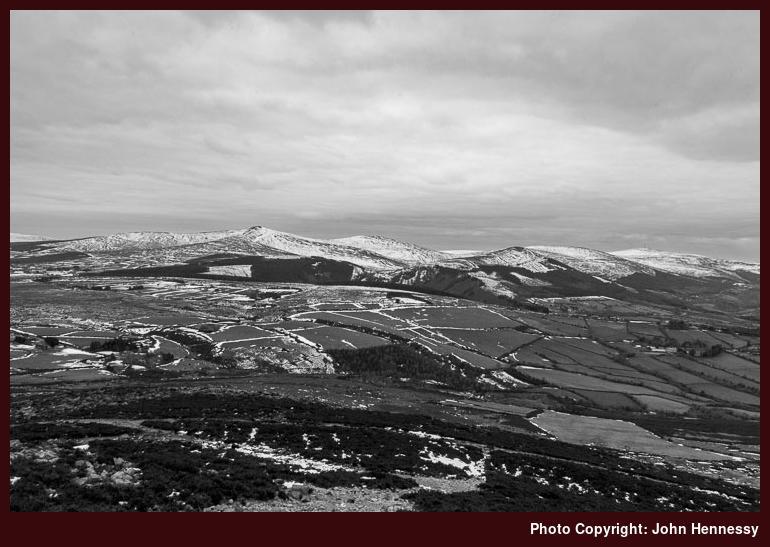
Travel Arrangements:
Ireland was reached by a return train journey to Holyhead, followed by a return ferry crossing to Dublin. Dublin Bus service 53B then got me between the port and Dublin city centre. Getting to the start of the walk involved a return trip to Bray on the DART rail system and a return bus journey on Dublin Bus service 145 to Kilmacanoge.
Greyness
20th February 2009 It has been a very grey week in weather terms around where I live and I could do with seeing a spot of sun and blue skies sooner rather than later. Given the times in which we live, the grey onslaught might be seen as a case of pathetic fallacy but we could all do with something to go and cheer us up. I find that I can only take so much grey weather before needing to head off where there is some sun and, though the sun has been trying to break through today, I feel the need for something more substantive. Saying that, the recent mildness, the return of birdsong and the general feeling of spring in the air has been welcome. That's not to say that the recent cold spell didn't have its bright spots, but the saying that a change is as good as a rest is what comes to mind.
As it has happened, my two most recent forays into hill country were under largely grey skies. The Cumbrian outing may have had its sunny interludes in the cold, but the mildness of the Irish escapade came with no sun at all and it took a while for the day to brighten up with my Pentax's metering showing how dark it thought everything was. Speaking of photography, the lack of sun does make it tricky to capture something in the way in which I would like to share with you. The result is that the occasional posting has appeared on here without any photos.
Part of the reasoning for that dates from over a decade ago when I was building the first incarnation of my online photo gallery. Then, all that any search for photos on the web yielded for me were grey day pictures that I didn't find appealing. The result was that I vowed that sunlit scenes were to be what went on there and I have to say that, apart from the occasional departure, the same thinking rules the roost here too and that's the way that I'd like to keep things.
That is not to say that concentrating on details found underfoot or ensconced in places where flat grey skies can be excluded will not yield anything. For instance, Torc Waterfall near Killarney in Ireland produced the goods on an otherwise damp and dreich day. The waterfall trick has worked elsewhere for me too, with one cataract allowing me to illustrate a trip report for a walk from Ardlui to Butterbridge utterly devoid of sun last November. No doubt, other details that work well in such diffused light would suffice too.
Thoughts of monochrome photography have sneaked into my mind too. A day that mightn't be one for capturing colour vistas might yield good black and white vistas. To me, the trick is to ensure that there is enough tonality to carry off the exploit and not every dull day offers that, so the monochrome route is not a panacea for rescuing otherwise gloomy efforts. In fact, I recommend a look at Craig McMaster's Elements if you want to how much better landscapes look in black and white when there is good light available. Taking colour digital images and converting them to mono like the examples that I have added below (no perfection or greatness is being claimed here) is more involved than merely clicking on the right buttons. Ideally, the photo should have been pre-visualised or planned as a black and white one rather than converting a few and seeing what happens. Of course, there's no harm having a go at that in a spare moment to see what works and what doesn't. That can only help develop your monochrome eye anyway and my impression is that there will be more misses than hits before any refinement starts to come on stream.
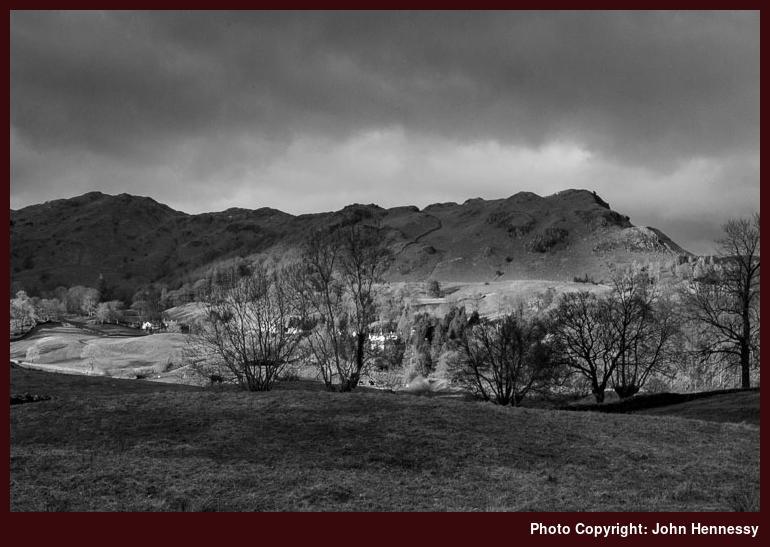
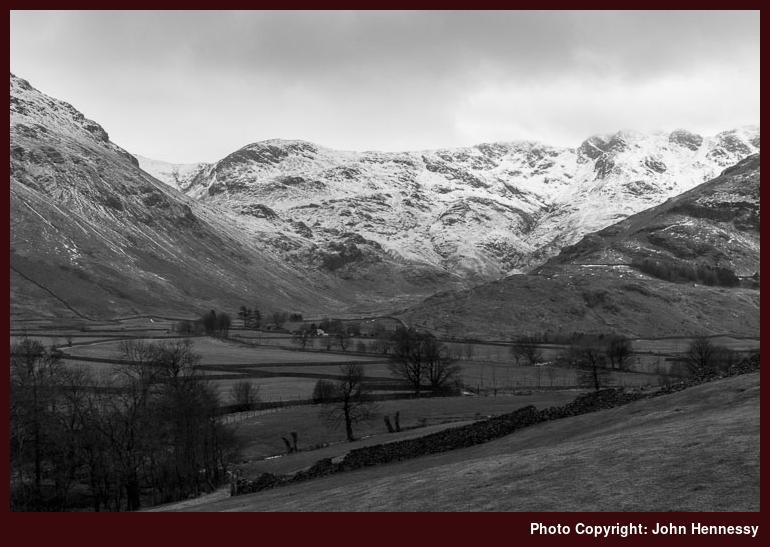
2009 seems to have got a start with long grey spells and plenty of ice and snow thrown in for good measure. That's not to say that it hasn't had its sunny interludes but the precedent of 2004 lingers in my memory. That year is one that I'll always remember as being one where sunny spells were a rarity and its summer and autumn didn't help its case, even if the deluges of 2007 and 2008 are perhaps more memorable for some, though that's not how I'll remember those (2007 was decent up until the middle of June if I recall correctly). Let's hope that 2009 brightens up and there's plenty of time for it to do the deed yet. With all the doom and gloom that surrounds us, it looks like we could do with it.


