Category: Europe
Sampling some snow among the Howgill Fells
 19th December 2008
 As promised earlier, here's that trip report for a brief visit to the Howgills at the start of the month. The idea of visiting these parts crossed my mind while happening to perusal a bus timetable during some dead time awaiting a train to take me to Windermere in Windermere. At any other time of year, Saturday bus connections to Sedbergh (pronounced "Sedberr", I believe) wouldn't seem quite so appealing, but the idea of a 15:50 departure on a winter's day didn't seem like leaving too early at all, even if that meant that my time was limited to little more than a few hours. Services on other weekdays allow a longer stay, but there's no service on Sundays, which constrains the idea of a weekend trip using public transport to get there and away.
For the perhaps overambitious, the time that I was allotted might have been enough time for an out and back romp to The Calf from Sedbergh but rushing things like this really is not my style. I go out to sample, to savour and to enjoy; good hill country deserves no less. Snow and ice abounded once a certain not so intimidating height was reached anyway, so rushing about would have been the epitome of foolishness. It may not have lain everywhere, but there was far more about than remained around Macclesfield by the time that I left it that morning. On arrival in Oxenholme, there was no hope of missing the white stuff, and the presence of ice meant that extra care was needed when getting on the bus to Sedbergh.
That bus journey was to mean that more whiteness was to be savoured, particularly between Oxenholme and the M6. A collection of wind turbines that were passed took on an unusually ghostly aspect but continuing past the M6 meant entering countryside where a thaw was in evidence. Higher places still had the snow, even if much green could be seen too. Whatever thaw that there had been didn't extend to many of the footways about the town of Sedbergh, so gingerly progress along roads was in order as I made my way to open country. That didn't take long, and braved a path going by noisy tied up dogs in a farmyard and icy stretches that acted as a reminder of the need for crampons to get to higher slopes where deeper snow underfoot gave my boots something with which they could engage.
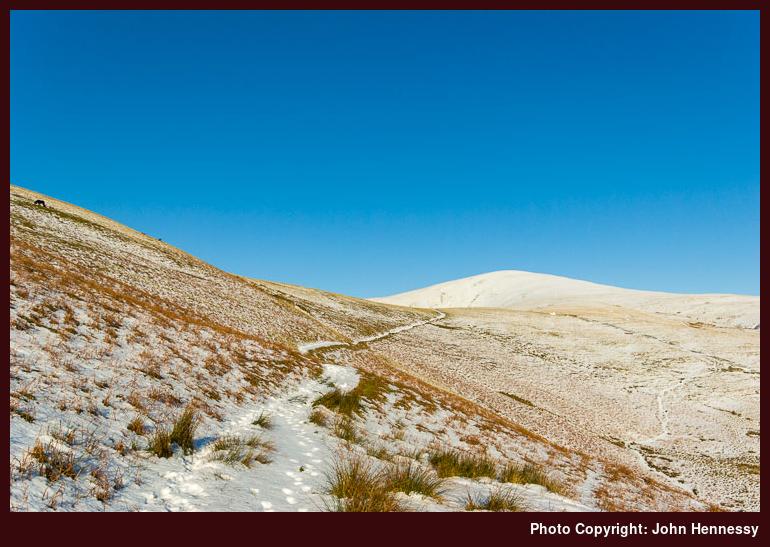
As I continued up the side of Winder, I began to meet deeper snow than any that I had ever encountered before. Across the gash cut by Settleback Gill and on the slopes of Crook, there were children playing in the winter sunshine. Beyond any green lands to the south, Whernside and its surrounding humps and bumps packed up the view. Gazing to the east led the eye towards Baugh Fell, Wild Boar Fell and Swarth Fell and all around them. In the west lay the snow-covered Lakeland fells, though I couldn't see them until I emerged from the trough along which I was hiking, and the same could be said for the sights that lay to the north of me.
The saddle between Winder and Arant Haw held a good thick covering of snow over its grassy tussocks, enough to slow progress and make me conscious of the time. If I had ever pondered getting to The Calf, that was put out of my mind as I ventured in the direction of Arant Haw. Though that hill lay within range, I decided in the end to leave it for another time to allow plenty of time for my descent. Instead, I continued to the top of Winder itself and lingered to take in the panoramic views. What it lacks in height, it possesses thanks in no small part to its location, so a spot of photographic activity ensued beside one of those viewpoint installations that are there to tell you what's surrounding you (hills in this case). The sights couldn't be more irresistible with that dusting of the white stuff.
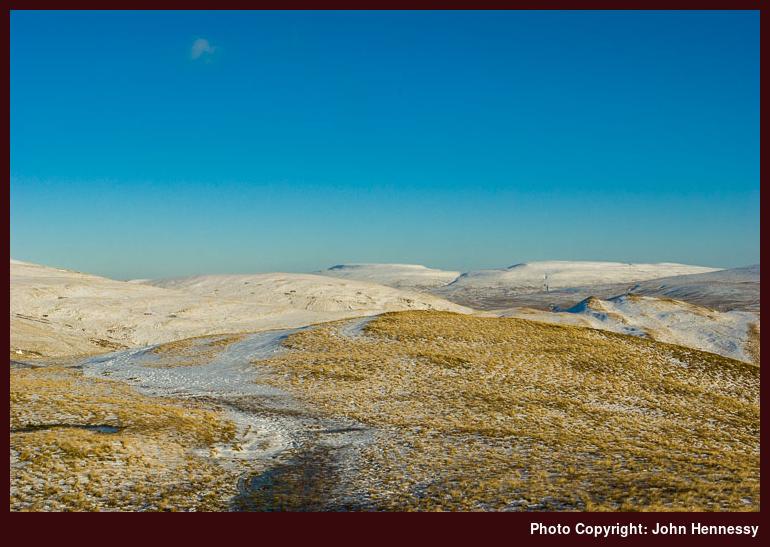
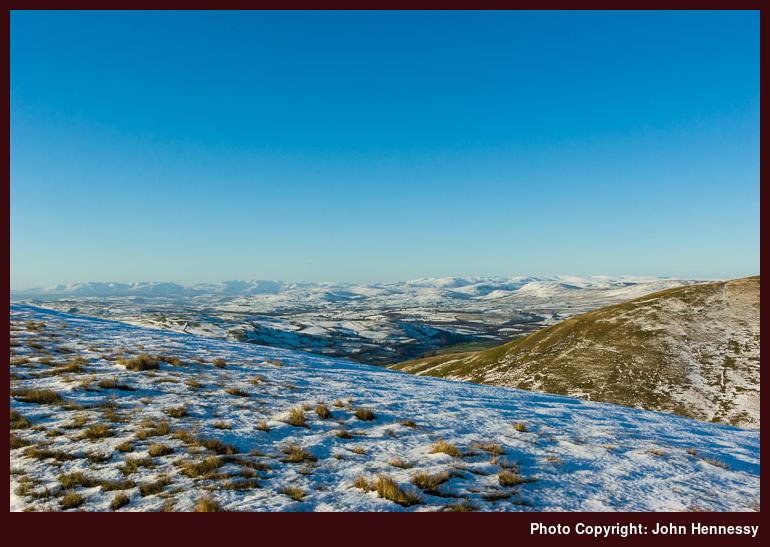
The descent from Winder meant a return to greener ground, especially since I used its western slopes. Like a winter walk that I undertook from Ribblehead to Ingleton via Ingleborough, I saw more of a thaw on western slopes than I did on eastern ones; it must have something to do with catching the warmth of the sun. It must have been the time of day, but I was seeing more folk emerging from the hills, but there was no intrusion on any reverie as I enjoyed views towards the Lune gorge and its viaduct and along the western slopes of other Howgill hills.
I returned to the tarmac in safety, and misgivings about making the most of the day erupted. That caused me to divert onto a public footpath that took me to Marthwaite. From there, it was road tramping to Birks before I plied along a short section of the Dales Way by the River Rawthey. Some more public footpath traversal took me into the heart of Sedbergh, passing by its famous school as I went to await my bus. Daylight was turning to dusk as the bus plied its way through snowy surroundings, and there seemed to be a certain reminder of alpenglow to be witnessed. After an uneventful train journey, I was home again and with some extra time remaining in the day too because of the early finish.
In hindsight, I didn't waste the opportunity that I was offered, and the taste of what the Howgills have to offer has whetted my appetite. It was about time that I set foot among these hills after passing them on train and coach so many times. Apart from that, the only other time that I sampled this countryside was when I reached Sedbergh after spending a hot July day walking from Ribblehead train station a few years back. More return trips beckon, so long as there are windows of opportunity for my continuing to explore the area.
Travel Arrangements:
Return train trip to Oxenholme and a return bus journey using Stagecoach's service 564 between Kendal and Kirkby Stephen.
An imperfect rights of way network?
16th December 2008 Access to the countryside has always been a contentious area and a recent piece of blundering of mine along a public footpath returned that very much to mind (I ended up straying away from where I should have been to earn some yelling from a passing gent atop a quad bike on a nearby road). Within the last decade, Scotland has got its very enlightened access legislation and a less extensive variant has made its appearance south of the border in England and Wales, with legal wrangles forcing up the cost of implementation of the latter.
Until these innovations, public rights of way did next to all the access backwork in England and Wales and the question as whether the network that has come into place over time is all that useful for the purposes of exploring the countryside. In a similar vein, Graham Wilson, in his book Macc and the Art of Long Distance Walking, comes up with some thoughts on the subject:
Many of these exist for reasons long since forgotten and to insist that the world and his wife can march through someone else's back garden because a postman from Time Immemorial has had to take this route to deliver a letter to a neighbouring farm is as equally unreasonable as it is for us to be denied the right to walk in a straight line across rough country direct from the summit of Shutlingsloe to the hospitality of The Hanging Gate.
I must admit that I find it hard to improve on that well put sentiment from the time prior to the Countryside Rights of Way Act that has given us tracts of Open Access Land with all their limitations in size. It just seems to capture so much and very much fits in with my wonderment as whether we are using a network designed in another era and for another purpose for very different ends. To my mind, it seems that we are using paths and tracks that came into use to link up houses and their ilk to explore the countryside. Add to that the very modern need of privacy and security and path diversions come to life, adding to the complexity that was there in the first place and things become more tricky as you approach civilisation. All that's needed is a momentary slip of concentration and the ungainly activity of map inspection and not always in the most opportune of places either.
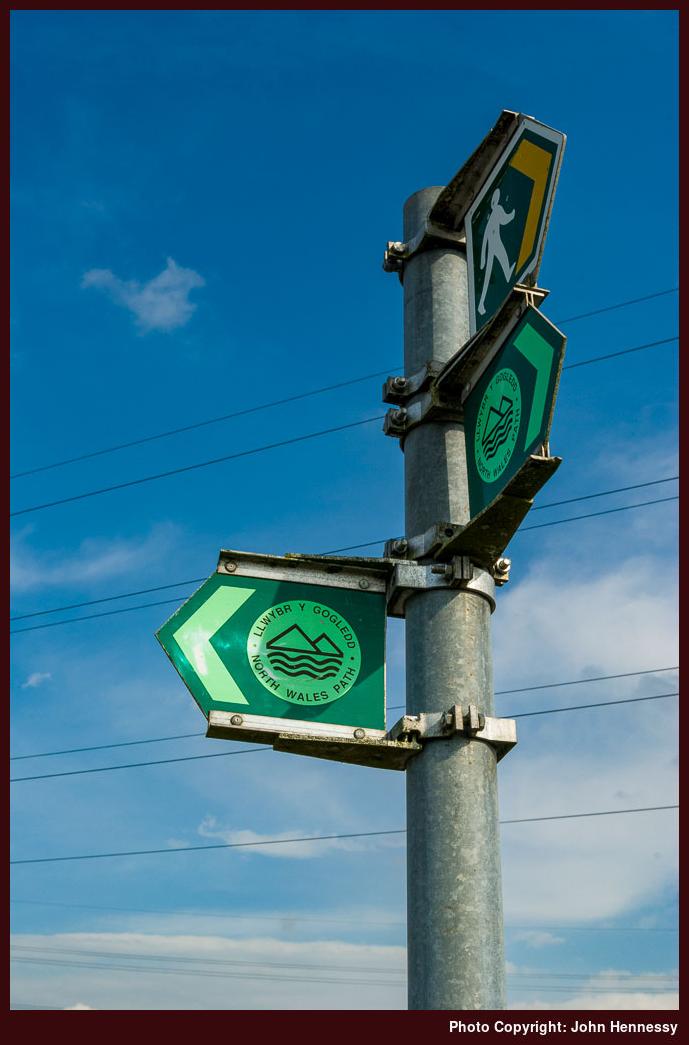
That intricacy and complexity makes waymarking even more important and it's not always up to scratch; even the best OS mapping cannot be expected to show every twist and turn of a path within a field with complete accuracy. With circular waymarks, the rotation of the arrow can confound if one is without the understanding that an arrow in the 2 o'clock position means that you are meant to take a sharp right! Apart from poor waymarking, other ways to make walkers a little unsure of themselves include the condition of stiles and the state of a path. Some areas do well on this and Cheshire would seem to be among them. Surprisingly, North Yorkshire is poor for waymarking away from its national parks while overgrown paths in North Wales are things that I have encountered a few times now. All of this doesn't aid one's sense of self-confidence if an unwelcoming soul were to be encountered (yes, the countryside is like anywhere and they surely exist there too). It seems that those spontaneous on the fly decisions to see where a right of way takes might be best replaced by a modicum of planning unless it's an area that I already know.
The impression that starts to build from this is that we might need a simpler network of rights of way in place of the rag bag that we use now. What I wouldn't want to see is a reduction in ease of access to any area, but diversions away from houses and farmyards would suit me better; I like my explorations to be uncontentious rather than appearing to be prying. However, I cannot see that scale of improvement happening because there are always other things that command the attentions of governments and local authorities and that is never more true than in these times of economic upheaval. Inertia probably rules anyway with a major push being needed to get anything like a path and bridleway reorganisation through; it took a huge effort to get the "Right to Roam" legislation implemented and I cannot see a government again confronting vested interests in the countryside quite like that for a while.
My conclusion from these ramblings? It sounds like making the best of what's there is the sensible approach, sharpening those navigational skills along the way. My days of spontaneously following a tempting signpost might be best put behind me in place of some more advance planning and noting of field exits or wanderings in open country where few are likely to feel threatened or annoyed. As with everything, you always can learn more and I am open to the idea, with thoughts of perusing the Open Spaces Society's book on rights of way coming to mind.
Cowal: yet another area that escaped my attention?
5th December 2008 A little while ago, the prospect of a sunny forecast for Argyll got me wondering about another journey up north and pouring over maps revealed north Cowal as a possible destination. The trip never got off the ground, so that idea is one that still remains on the shelf awaiting further examination. Even so, I thought that I'd share with you some of the possibilities that came into my mind.
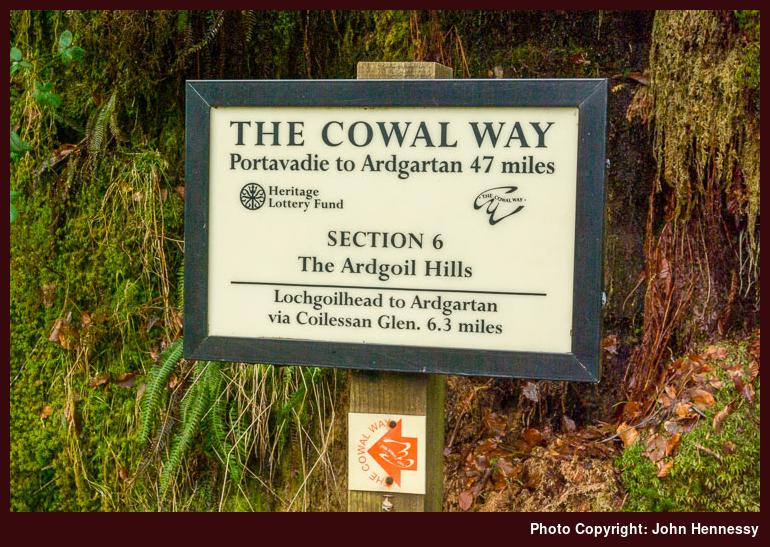
Casual inspection of OS Explorer mapping for the area will reveal the existence of the Cowal Way and it wouldn't be the first long distance to reveal itself to me in such a manner. Starting at Ardgartan near Arrochar, it then continues to Lochgoilhead and Strachur before dropping south on its way to Portavadie. Taking on the whole trail would be a longer excursion than a weekend away, but looking along its length does reveal possibilities for future exploration. The only fly in the ointment for some might be the number of forest plantations passed along its length but it is promising otherwise.
For that abortive weekend outing, I confined my attentions to north Cowal and the area around Arrochar. One idea that appealed was an early morning arrival by coach at Tarbet followed by going around the head of Loch Long and then starting up Glen Croe. Much of this can be done on forest tracks, so road walking, never the best sort, could be kept to a minimum. From Glen Croe, crossing between The Brack and Ben Donich would take you towards Lochgoilhead from which bus connections return to more built-up parts again. What I find attractive about that plan is the variety of scenery encountered so it goes on file awaiting a suitable opportunity for setting it into action.
Other ideas then began to queue up in my thinking too. Some are centred on Strachur, which can be reached by bus from either Dunoon or Inveraray, with a linear hike to Lochgoilhead and various circular options becoming apparent. Linear treks taking two days joined the line and soon I was sat with a good number of ideas to explore. This is not the sort of thing that is needed in the days leading up to a departure because that's a time for making up one's mind about things but, away from any imminent escapades, it's never a bad thing to be doing. After all, when an opportunity does make its appearance for a long weekend away, you might need to have more than one idea in mind. My trip to Cumbria at the start of November showed one advantage of this: some plans do fall by the wayside. As if to show another side to the proverbial coin, my Spring Bank Holiday weekend excursion to north Argyll left me feeling a little short on ideas after the longer walk from Inverarnan to Dalmally and I felt that to be a travesty with the perfect weather that I met while up there.
Cowal may not be that far away from Glasgow but, for whatever reason, it never dawned on me to go exploring the area; the lure of other destinations may have been to blame. I seem to have got a sense from guidebooks and so on that not many go past Dunoon to probe deeper into the area, so the omens are good for a spot of quiet walking; Arrochar and Ardlui are not so far from Glasgow either and quiet walking can be found in those places too, so my hopes are up. When it comes to a weekend visit, the fact that many bus services do not run on Sundays is a concern and, on other days, it is useful, but you do need to watch your times. Still, having a spot of hill country hiking and avoiding having to brave the possible A82 gridlock on a sunny bank holiday weekend seems good to me so I'll keep the area in mind for when the occasion arises.
When a certain ring of familiarity attracts your attention
29th November 2008 The name "Allt Coire Chaorach" probably doesn't mean that much to most people. When I saw mention of it in a BBC news item concerning the recent approval of a hydroelectric scheme, I just had to investigate. That search for further information led me to the Scottish Government's website where the fuller details are for all to see.
It was the inclusion of the word "Chaorach" that got up my curiosity because there was a faint possibility that I may have passed it on my travels through Scottish hills. In fact, it was my passing through Gleann nan Caorann whilst on a trek from Inverarnan to Dalmally at the end of May that proved to be the trigger. However, in Gaelic, caorann is the word for a rowan tree while caora is the word for sheep. So my wandering took me by glens and burns named after the rowan rather than sheep or ewes like how it appears for Allt Coire Chaorach. It's amazing how appearances can deceive when it comes to languages of which you don't have a detailed knowledge.
However, Allt Coire Chaorach isn't that far from Inverarnan since it starts out on the eastern slopes of Ben More and Stob Binnein before plunging to the floor of Glen Dochart to join the river that gives that glen its name; that river itself goes on to feed Loch Tay, from which emanates the river of the same name that reaches the sea near Dundee. Apparently, this is also a site of special scientific interest and the Scottish Government seems to be continuing on its course of not entirely respecting SSSI's if the approval of the hydroelectric scheme is any useful indicator. It's also located within the bounds of the Loch Lomond and the Trossachs National Park so the trend seems a little too consistent. Let's hope that the construction works are as sympathetic as they can be.
Incursion of modernity into our beloved hill country often attracts furious disapproval; just look what surrounds the subjects of wind farms and electricity supply lines. Anything that is already done doesn't trouble me so much since removing it might cause even more disruption than leaving things as they are. However, any proposed changes do rouse my misgivings and I hope that the powers that be do leave us with sufficient wild country to explore and so escape the pressures and demands of modern life. Getting corralled into busy honeypots would be no fun; while National Parks have their own multitude of quieter corners, making one's way through the hordes to get to them isn't as nice as the unimpeded access to them in lesser frequented parts.
Saying all of the above, the new hydroelectric scheme may not be that intrusive in the visual sense. From the side of the A85, it should be hidden behind forestry but it will take some time to blend in with its surroundings so that it doesn't look so obvious from the heady heights of the likes of Ben More and Stob Binnein. For those who might like a wilder feel, now might be a good time to explore these and other summits before any changes take place. The rest of us might be comforted by the thoughts as to how quickly nature can reclaim the land from our worst attentions. Just visit the North Pennines, once a bastion of lead mining, and other parts where such activities were once prevalent and now long gone. Visiting the quarry-scarred hillsides of Gwynedd might not be the best idea when seeking solace from our disregard for the landscape with which we have been gifted is what's in order.
Another day, another fell
26th November 2008 Last Saturday saw me venture out into hill country again with a trip to explore the fells near Ambleside. The last time that I was up around those parts, it struck me that I hadn't been around Ambleside for a few years, so the seeds were sown for a future outing. Being that time of year when shorter days are visited upon us, I was after a hike that I could complete in the available hours of daylight and ended up ascending Red Screes before descending to Scandale Pass and then down Scandale itself while returning to Ambleside.
My visits to Ambleside seem to alternative between grey days and those with an altogether more sunny aspect. Last Saturday was to prove to be one of those grey days, as was the one when I first went to Ambleside. Then, I plied a short circular route around by High Sweden Bridge and then Low Sweden Bridge. Next time, the sunshine of a crisp clear cold February really showed the landscape at its best as I made my way up Scandale, over Scandale Pass and then back to Ambleside by way of the Kirkstone Pass and down The Struggle; I was enjoying good moonlight on the final stretch of the stroll. A mixture of greyness and sunny breaks were what greeted me while on a round of the Fairfield horseshoe with a start at Rydal to ascend Heron Pike and Great Rigg to continue to Fairfield (the summit was deserted when I reached it so it isn't always crowded) before dropping down to Ambleside again. When a trip to North Wales proved unworkable after a train cancellation, I found my way back to Ambleside and was consoled by the delights of a sunny day and a fabulous evening as I went over and around Loughrigg Fell on a circular hike.
The sun did peep out near the end of the day last Saturday but it was frigid, breezy and bracing greyness for most of the time. There were signs of blue skies in the distance as I left Ambleside to go up the narrow Kirkstone Road. Sufficient cars were passing the way to make me appreciate the off-road travel when at last I started up a public footpath traversing the often soft ground.
Eventually, that softness began to the hardness of well frozen terrain, but there was a fair amount of ascent among stone walls before that transition was encountered. Apart from a momentary spot of confusion due to an overestimation of progress near Snarker Pike, navigation was a straightforward affair. On the lower reaches, I was sheltered from the cold biting breeze from which there was no escape once headier heights were reached and especially as the gradients eased between Snarker Pike and the summit of Red Screes. It was no day to linger on that summit and, very appropriately, it was bedecked with frozen tarns. This was hardly the time and place for conversation but I was asked by a lady where the path that I had following started out; it went too near to Ambleside for her and those with her (there is another possible way down, but even Wainwright suggested that to be too steep for a descent; that might have been how they made their way up).
With the inhospitable conditions on the top of Red Screes, it should come as little surprise that I started my descent with no delay. The greyness was one limitation of photographic exploits but it was the cold that capped it all. Production of anything worthwhile was to await another day and I picked out my path down the slopes to Scandale Pass. A wall provided a useful navigational handrail and Scandale Tarn was in view too. Eventually, I was to lose that biting breeze on the return to more familiar surroundings.
The way down from Scandale Pass was easy walking and softer ground was met as I plied the banks of Scandale Beck until I reached High Sweden Bridge. It was then that the sun escaped from its cloudy hideout and I got to acquire more pleasing results, to my eyes at least. That appearance of sunshine caused me to diverted around by Low Sweden Bridge but it was soon to disappear again. A goodly number were descending this way to Ambleside, including a sizeable group of students; I wonder if they were attached to the University of Cumbria, whose campus I passed as well.
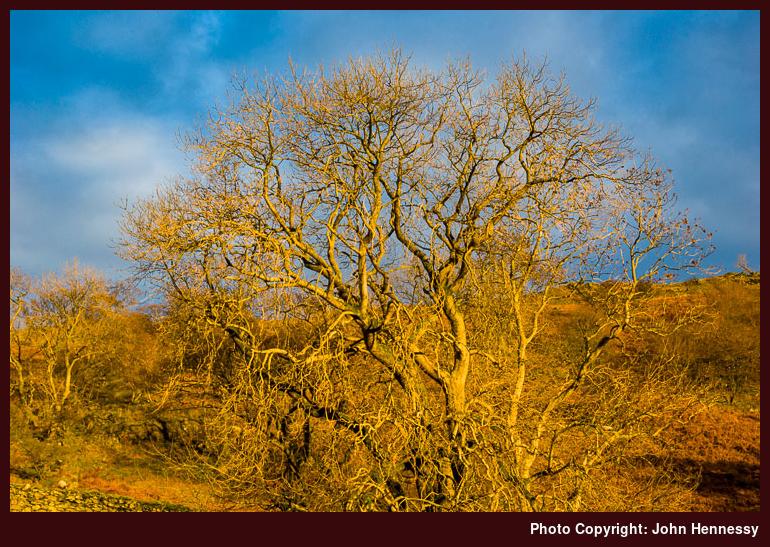
I was easily back in Ambleside before daylight faded for the day. The town was chock-a-block with people, making any aspiration of having a look in outdoor gear shops utterly impractical. The mercury was really dropping by now as I made for the bus stop for my bus back to Windermere, retracing the journey made that morning by train to Windermere and bus to Ambleside. However, I was left waiting in the cold for up to an hour due to the turning on of Ambleside's Christmas lights and its concomitant disruption of any passing bus services (I wish that I knew about this beforehand so that I could have planned accordingly). I still managed to catch my intended train from Windermere to Oxenholme only to have an hour's delay in Oxenholme due to an incident on the line; being able to wait in the warmth of the indoors helped here. Even so, I was back home before 21:30 after a good day out that might yet be the progenitor of more like it.


