Category: Europe
Crossing a watershed between Ardlui and Butterbridge
 17th November 2008
 Over the weekend, I was lured north to Scotland by thoughts of seeing its magnificent countryside lying resplendent in bright sunshine, however fleeting that might have been. However, that halcyon dream was merely just that because the predicted continual improvement in the weather on Saturday proved to be more gradual than had been predicted by the forecasters, so much so that it could have been called an illusion. That mountains can make their own weather may not have helped my cause either.
The weather that I did encounter was more reminiscent of that which I got while out walking around Arrochar and Tarbet in February or March. Then, I got heavy showers that got more progressively slow moving and frequent as the day wore on until they grew into the sort of irritant that made me glad that I was leaving when I did. On that day though, there was some good sunshine at times to make up for all the wetness, but my last excursion was bereft of any such succour, even if holes in cloud did allow glimpses of blue sky and the sun did make feeble attempts to get through. It wasn't to be a day for photography, particularly since making pictures of wide vistas was utterly out of the question.
When I got off a coach at Ardlui, there were grey skies but it was dry after a passing shower. I then made my way down a wet A82 to Garristuck cottage, a little south of Ardlui train station. After a short spell along a track that passed two houses, I was into a field and making my way up the hillside. The path that I was following may have been faint, but that was sufficient to steady any navigational waywardness. The plan was to reach a coll between Stob an Fhithich and Stob nan Connich Bhacain and then drop down to reach a path that was to take me over paths and dams to a 4x4 track that would land me on the A83 near Butterbridge, between Cairndow and Rest and Be Thankful. However, the sight of the crags of Stob an Fhithich resulted in a change of direction and I went around to the other side of that hill to traverse gentler slopes. The gradient may have been manageable, but gentleness wouldn't be a quality that I would ascribe to the terrain that I was crossing. It was waterlogged and grassy with occasional crags, bracken and scrub encountered before I dropped into Srath Dubh-uisge, looking very much part of the catchment area for Loch Sloy. For a while, this was to be the type of walking that could be a more effective workout of the leg muscles than any gym and in much more interesting surroundings.
Picking up that informal path (a wonderful description that I found in Walking World Ireland and it was used to describe something similar) needed a bit of searching to locate it, even with the sights of dam railings and such like; it was merely a line of trampled grass that soon enough brought me onto a good track. Up to this point, I only had one passing shower during the hike, but things were to intensify on the weather front while the walking actually got easier. It was just as well that I was by now well on the way to Butterbridge. Even with the greyness, the murk, the heavy rain and strong winds, the colours of the countryside showed themselves. All the while, my waterproofs and my boots very usefully kept out the dampness while I proved that I too could cope with the conditions as well as my gear did.
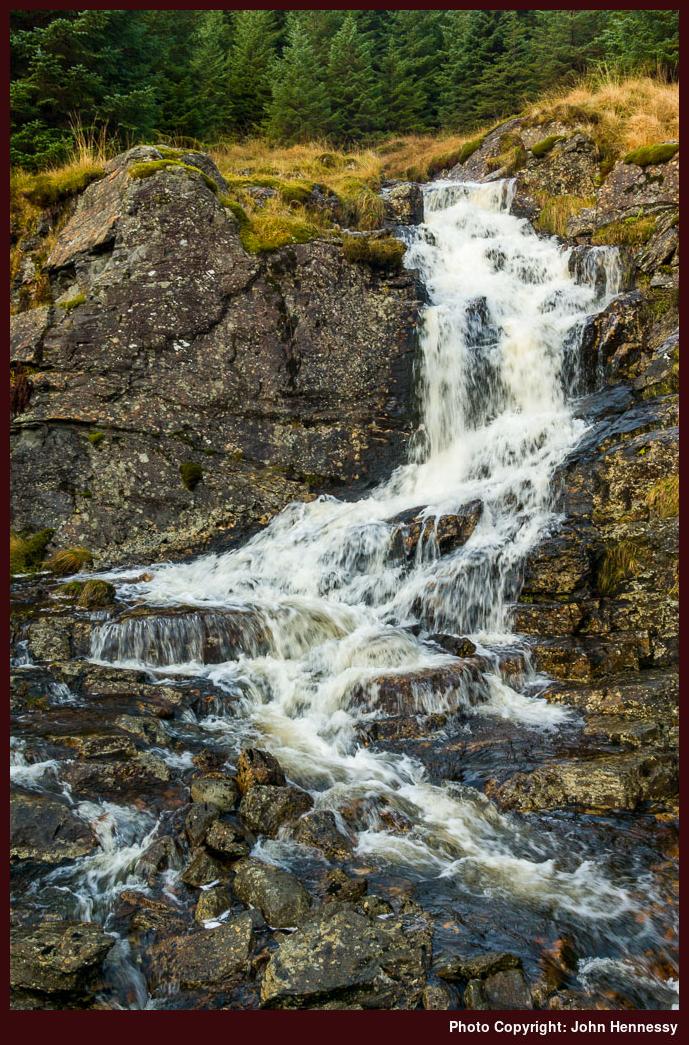
I continued my way down Glen Kinglass regardless and started to encounter the only fellow walkers that I'd met all day. Any wonderment as to where they might be headed was partially answered by a sign for a track to Ben Vane that I was to see later on. Because of the conditions, I could only imagine how my surroundings might look at their best as weak sunshine attempted to brighten things up while I made out the road up to Rest and Be Thankful. The A83 came soon enough and I awaited my coach back to civilisation while among high hills that need to be surveyed on a more suitable day. I reckon that I was out among them a day too early and, annoying as that might be, it'll take another visit to see them at their very best and I might even cross that coll between Stob an Fhithich and Stob nan Connich Bhacain too. I may not have left with wonderful photos but I have something equally valuable: more ideas for future outings. Those hills won't go away anytime soon so I hope to be able to stage a return at some suitable juncture.
On Western Isles walking guides
12th November 2008 In order to build a picture of anywhere that I am going for the first time, I end up hitting the web as well as perusing books and maps to get a sense of the place and where to go together with what there is to be seen. Of course, any plan that results is going to be incomplete so I always feel the need for flexibility so as to explore the unexpected, the unknown unknowns if you will. Things like the stillness of the Uists and Harris' potent mixture of stony hillsides, sandy beaches and blue seas will forever stick in my memory but it's discoveries like the Harris Walkway that could prove invaluable on any future trip.
When I started out on my hill wandering journey, many places were new to me but there are now less locations where I haven't been. Anywhere south of a line drawn below the Brecon Beacons fall into this category as does much of my own native Ireland and Scotland north of the Great Glen. Over time my walking trips have tend to gravitate on certain areas and it's very easy for some places to keep you profitably occupied, so much so that there are years that I could title by the places where most of my walking took me. 2003 could be the Lake District year for instance. I remain partial to going somewhere that I haven't visited before and that Western Isles trip falls into that bracket as do a number of trips I made in 2006 when Northumberland and Pembrokeshire saw my footfall.
Speaking of heading onto pastures new, I got the idea that my Western Isles trip needed a spot of research before I went. It could be said that the idea of heading onto offshore islands focussed the mind more than it otherwise might have done. Apart from a certain tourist overview, these were to be terra incognito to me and it might be said that I was venturing further away from the usual locations than is my wont. All of that was enough to get books lifted off shelves and mapping organised.
In fact, I didn't even have a collection of paper OS maps for the islands even if I did possess digital mapping from the likes of Anquet and Mapyx. A lurk in the outdoors blogosphere will reveal that printing out digital maps is being done by a fair few but I retain a preference for the old style paper mapping from the likes of the OS or Harveys, if only to allow myself more options when I'm actually out there among the hills; it's amazing what can take your fancy while you're actually there. Having digital mapping did allow me to refine my shopping list so that I wasn't expending any more cash than was absolutely necessary. I have to admit that I have developed a taste for OS Explorer mapping and a full collection of these for Na hEileannan an Iar would not have cheap, hence the cutting of the proverbial cloth to my measure. I might enjoy the flexibility offered by paper mapping but both the cost and the need to watch the weight that I was carrying for my week away meant that any overindulgence simply was out of the question.
While I have planned many an outdoors excursion by mere perusal of a map, books remain essential for that broader view. I am very partial to Cicerone's guidebooks but I found that Walking in the Hebrides didn't meet my expectations, even with the mention of "Western Isles" in its subtitle. If I had wanted to get an overview of the walking on offer across all of the islands on Scotland's western seaboard, then it might have been fine but I was after something that was a little tighter in its focus. The fact that it did not contain route maps, even sketches, for any of the walks didn't help either and it really needs a map open in front of you for the directions to feel that little bit more real.
More more successful in my opinion is Nick Williams' The Islands from the Pocket Mountains stable. The scope might have been as broad as the Cicerone title but the punchy pithiness of the descriptions really did give a feel for what was there to be explored and worked far better than the often dense prose of Walking in the Hebrides. The featured walks might have scaled the heights and ventured into the wilds but a spot of map perusal picked out lower level hikes through the wonderful stuff.
Speaking of lower level walking, I spotted another even more slender title while actually on my week long outing that might have its uses yet: Luke Williams' Walks: Western Isles from Hallewell Publications. Again, brevity might be a very prominent feature but there are a plethora of ideas here too. Speaking of mid-outing acquisitions (I can be the proverbial magpie at times, picking up things and adding extraneous weight to what I am carrying, and it's a habit that needs careful control), I also ended up procuring Charles Tait's The Western Isles Guide Book with its enticing photos and useful overview of things to see while on the islands.
My mid-trip book buying brings to mind a comment I overheard a few years back, in Portree's tourist information centre if my vague recollection serves me correctly. The comment itself was the more memorable and I'll turn it slightly on its head here: to get books devoted to a certain location, you almost need to go there. Even in these days of internet shopping, that still retains a ring of truth about it and it's an opinion that can be taken even further. You don't get the full feel for a place like the Western Isles simply by surfing a website extolling its virtues. It's by going to explore that you find what else awaits discovery and that it turn provides reasons for any return; exploration and discovery begets more of the same and the role of books and maps is to get the process started.
A return to the familiar when other plans come to nought
10th November 2008 The first day of November saw me make an overdue return to hill country, with Cumbria's Lake District acting as my main destination. I had a few walking locations in mind by the time that I reached Windermere train station; the railways served as my way there and away again. However, my train was late (thanks to a little Saturday morning trespassing on the line near Deansgate) so any plans for a return to Great Langdale needed to be placed on a hold and a broken down bus meant that the Coniston fells still await my footfall. That left the option of an out and back hike from the train station to the top of Yoke, and my revisiting familiar terrain as I went.
Even so, I was far from disgruntled, and the sights from Orrest Head should have put paid to any sense of humbug anyway. It was its usual splendid self while I admired the views, even with a very noisy dog and her apologetic owners. The pooch had the misfortune of an aggressive appearance and an equally aggressive bark, but I soon learnt to ignore her enough to make a few photos. The fells by now have their autumn/winter clothes on them, and there's an occasional dusting of snow to be seen in places too. Panoramic views were just the balm to soothe the soul after the noisy interruptions.
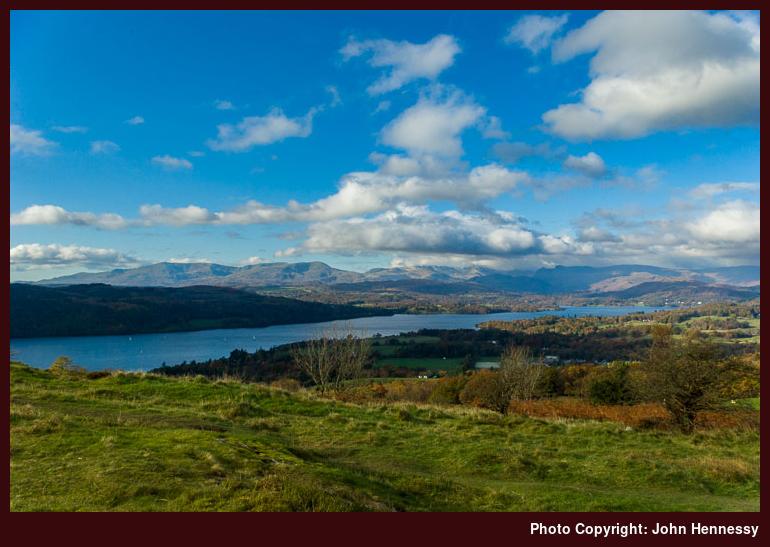
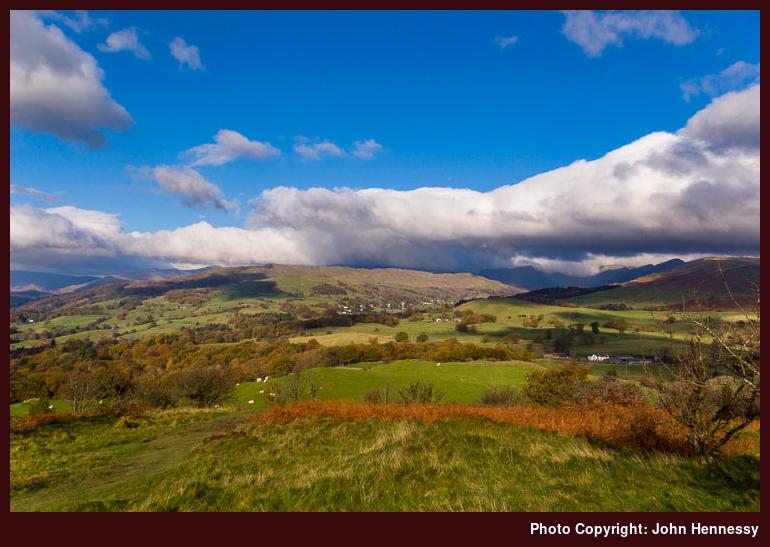
Having bobbed up to Orrest Head from Windermere's train station, I bobbed back down the other side as I made for the road near The Causeway Farm. A very short eastbound piece of tarmac bashing later, I began to cross fields again to reach Moorhowe Road where I repeated the shuffle but reaching a gravel track called Dubbs Road. Shortly after passing Dubbs Reservoir, the views over Troutbeck opened out before me and northern vistas were packed full of gloriously humpy whalebacks of hills. All of this was familiar to me from a previous circular walk from Windermere to Kentmere and a linear wander from Windermere to Staveley by way of Kentmere.
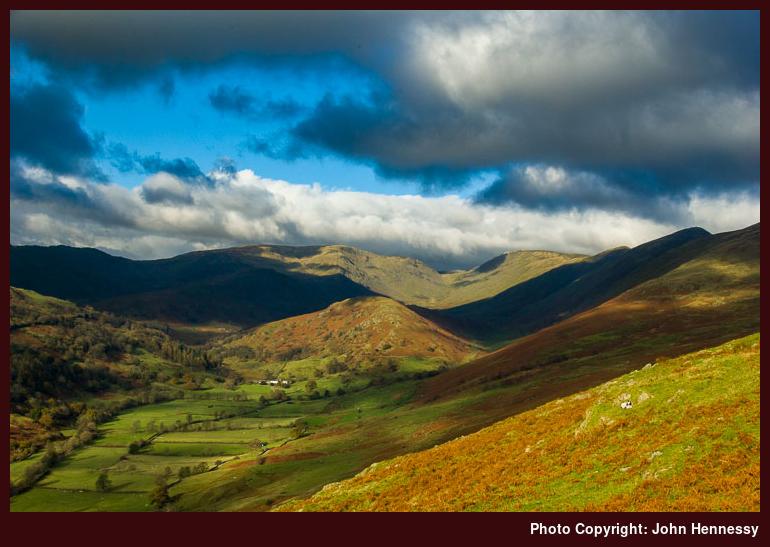
Passing a wood to my left, I emerged onto the rougher track that is Garburn Road. In so doing, I left the dodging of puddles that took up near enough the width of the track behind me; these were there on my previous hikes too, so I was unsurprised by their size. In place of those puddles, I got steeper slopes and looser surface that tested the nimbleness of my ankles. Garburn Pass was reached soon enough and, rather than descending to Kentmere as I have done on those previous visits, I left the wide track for an initially boggier one taking me higher up the slopes.
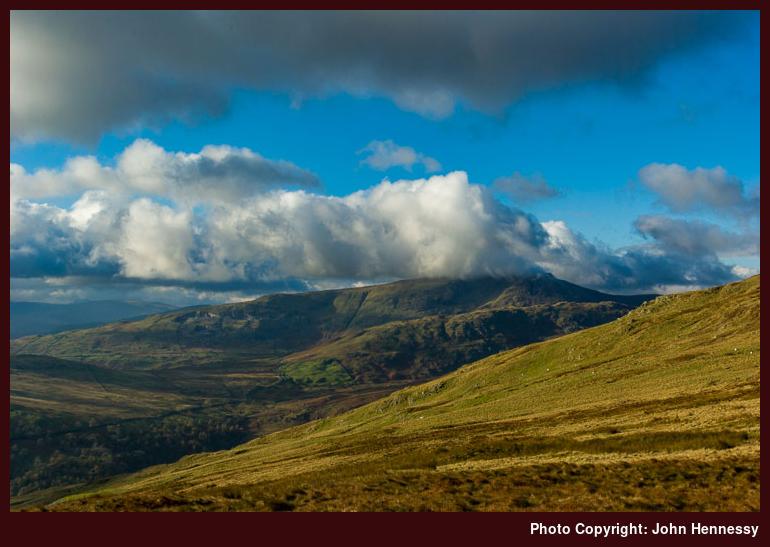
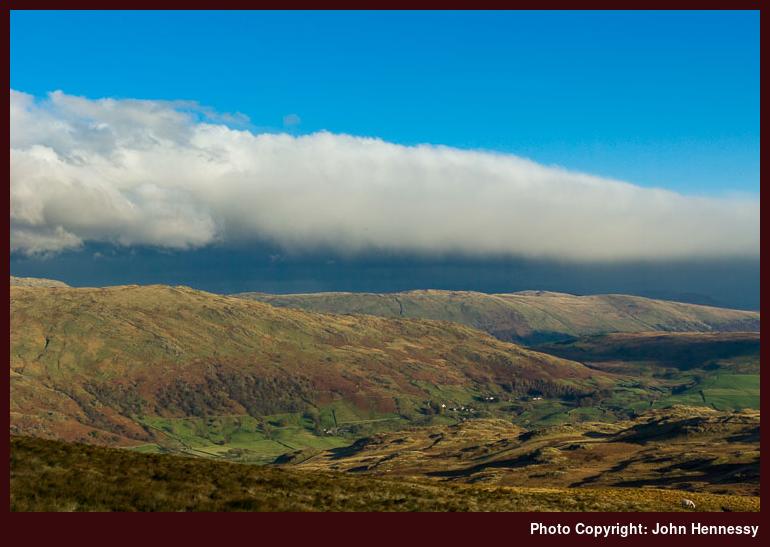
That boggy bit was to turn into a very good gravel path, and it surprises me that there wasn't a good track all the way, but I suppose that it keeps some in their place. As I went ever upward, views to my right opened out before me and the houses of Kentmere could be seen. Ever mindful of time, I continued to inch my way up Yoke with an appropriate number of photography stops. The summit wasn't long coming, even if there was an extra cairn lurking to confuse the unwary. I was tempted by the prospect of Ill Bell, but consciousness of the remaining hours of daylight and the prospect of losing a lot of height before regaining it again made me see sense; the sight of an oncoming shower helped to wean me away too. That other hill can wait for another day.
I came down Yoke in the dampness, and I need to admit that having to pull on waterproofs did cost me some time. Given that the rain didn't stay long, I am left wondering if it would have been better braving it, but you never know with these things, and it's often better to be safe than sorry. The sun was lowering in the sky all the while as I retraced my steps, and I was happy to be making progress all the while. When I made Garburn Road, I decided to stick with that track rather than continuing along Dubbs Road because of the hour that it was. That meant descending on a lot of loose surface, and it did begin to take its toll on my patience, so it was not before time that I left it for the much smoother Longmire Road, another track in spite of the name.
My plan was to return to tarmac before the light dropped too much since I wasn't wanting to have navigational nightmares in the dusk, let alone the dark; it was an objective that was easily achieved. As it happened, I did see someone else who was going to run that gauntlet of crossing fields at dusk, but I left him to it as I descended by minor roads to the A592 that would carry me onto the A591 for the final stretch back to Windermere train station. Even with failing light, the greatest challenge in all of this was one that I encountered earlier in the day: getting across the A591. Thankfully, a kind lady did me a favour for the second crossing.
It had been a great day to revisiting an old haunt but with an added twist. Ill Bell might not have been summited, but hills always last more than a day and Yoke did well what was asked of it. Other plans that fell by the wayside can be kept on file for future visits. What really matters is that I enjoyed the day out, and I remain hopeful of more like it.
Straight into the gallery
30th October 2008 A visit to family in Ireland last month allowed me a day trip to the beauty spot that is Gougane Barra; somewhere to which I have devoted a previous post on here. That also followed a day trip there when the skies remained resolutely grey with any photos not being the type of thing that I'd share on here. In fact, it seems that many of my trips to Gougane over the years have been on cloudy days. My most recent outing looked as if it might have been the same, with the forecast predicting a rain band moving south over Ireland. In the event, we managed to see Gougane under blue skies with the sun making it out from behind any clouds to make photography a more than worthwhile pursuit. The result is that I have some pleasing photos from my excursion and these have now made their way into the West Cork section of the photo gallery and I have taken the chance to freshen up some existing ones too.
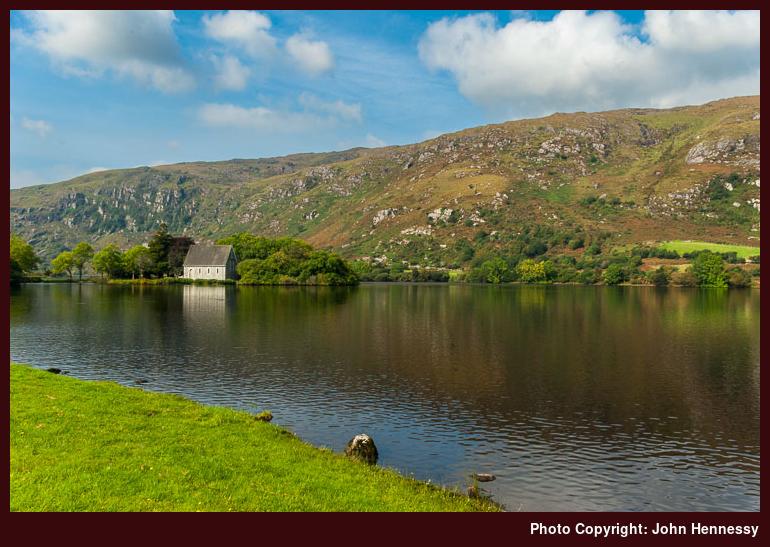
The addition of new photos has not been the sole change to that online photo gallery. Some work has gone into simplifying navigation and enhancing the search facility. Behind the scenes, the wonders of ImageMagick (it's a neat command line tool, but that probably makes it best for technophiles) have been such that the process of adding new photos is now more streamlined than it ever was. Even so, the need for devoting some attention to each individual photo doesn't go away and that is regardless of whether it was made on film or digitally. Nevertheless, any time saved might make me add new photos to the gallery on a more regular basis than has been the case in recent times. After all, there's a potential new section for the Western Isles on the horizon and more photos from other outings to be shared.
A spot of island hopping Part 7: leaving South Uist for home
16th October 2008 At the end of every good trip, there's the bittersweet experience of the journey home, especially if you like the wilder places as much as I do. Nevertheless, this was a journey that had its good points with the surroundings becoming ever more familiar as it continued. The first part of the journey involved a lengthy ferry crossing from Lochboisdale to Oban and I readily admit that I was looking forward to it because places that I had never visited before were to be passed along the way. After breaking my journey in Oban for the night, it was time to travel on land again, a journey that I had undertaken many times before.
Saturday, August 16th:
Of course, good weather can make any enticing sea journey even more memorable but I wasn't to be blessed with perfect weather. When I arose on the Saturday of my onward passage, the day was taking a more autumnal aspect with damp greyness being the recurring theme. There was a certain end of season feel too, not at all that inappropriate given that another of Scotland's school years was to begin on the following Monday.
Drier interludes allowed me out and about for one final stroll in the stillness before the afternoon sailing. However, the dampness was to win over the dryness and cars assembled for the ferry with rain falling. I had by now ensconced myself in the ferry terminal's waiting room and remained there until the Lord of the Isles made its appearance at the appointed time. Thankfully, it didn't take long for foot passengers like me to get on board and I went to the cafeteria for a midday meal. A sailing taking around five hours meant that it was never to get overly busy but getting some food was a good use of the time taken for all cars to be loaded onto the boat and the rain meant that being outside on the ship's deck at this stage in the day wouldn't have been the pleasure that it otherwise might have been.
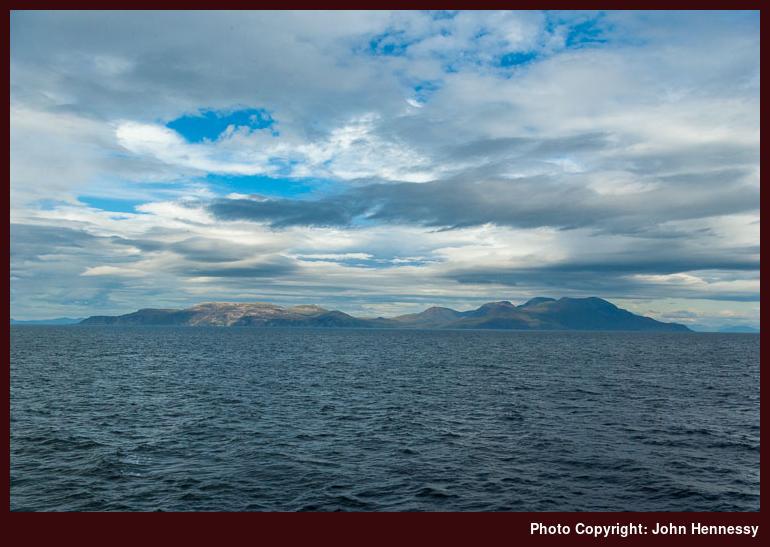
Thankfully, heading due east meant that the rain was going to be left after us at some point. However, we were in the vicinity of Rum before you could reside on the top deck without your sanity being questioned; it was good timing. In fact, there were flashes of blue sky and Rum was allowed to catch some sun and tease any onlookers. Eigg and Much were gathered about the tantaliser while Skye's Cuillin loomed in the distance beyond it. I did spy some indentations on the eastern horizon from South Uist and wondered if they belonged to Skye or to Rum; I am now inclined to think that it was the former that I had been seeing. Speaking of sightings on a horizon, Colonsay and Tiree may have lain to the south, but there was little sign of them.
It was nearly the halfway point of the crossing before the mainland made its appearance after my being away from it for the most of a week. Ardnamurchan's lighthouse was approached and passed as we changed to a more southerly direction to enter the Sound of Mull. The appearance of Mull allowed for some spotting of familiar locations like Tobermory and Craignure while we left Ardnamurchan behind on reaching Morvern. This continuous sight of land did make time go by a lot faster than the earlier expanse of open sea. The sun remained hidden away, so my camera was never going to be that useful and so I contented myself with savouring what was on offer. In any event, there's more to life than being concerned with photographic opportunities every single second when merely taking in the sights is often sufficient.
South of Craignure, I was well into territory frequented on my crossings from Oban to Mull. Landmarks like Torosay Castle, Duart Castle, the island of Lismore, Loch Linnhe, Ben Cruachan and so on all served to remind me that landfall was not far away. Nevertheless, I think that it might have when we passed Kerrera that I went downstairs to collect my belongings. I was well-organised by the time that we were to dock, even if remembering where I put the copy of my boarding card took some thinking (you start to wonder what will happen if you can't find it...). For sailings into (more) open water, Calmac needs you to fill out a boarding card in addition to purchasing your ticket. For the crossing from Skye to Harris, one copy sufficed, but two were needed for the South Uist-Argyll sailing; I suppose that it's an extra check that no one has fallen overboard, not at all a great thought.
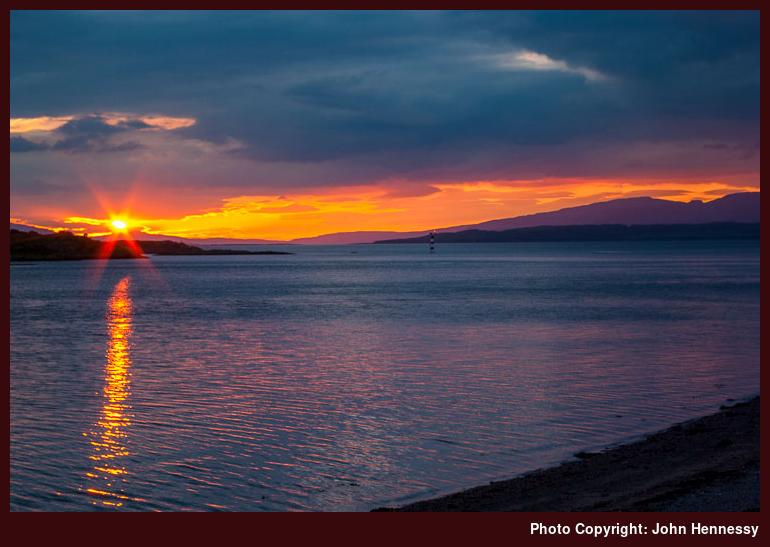
After my island hopping and all the new places that I had explored, you could say that reaching Oban was like a partial homecoming, to what is familiar to me at least. The town caught the sun and a memorable sunset was gifted to those who were out and about. Before all this, I needed to get to the SYHA hostel where I would spend the night. Duly booked in and organised, I then popped out to take in the last of the evening, a perfect end to a good day.
Sunday, August 17th:
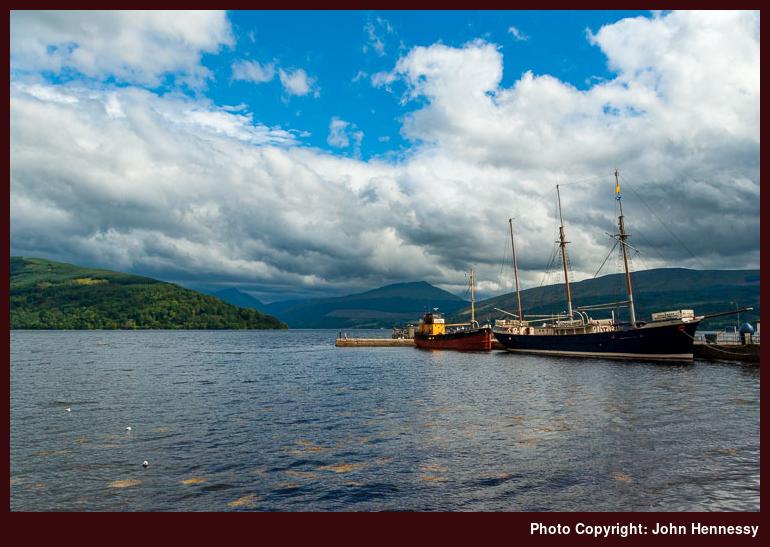
The next morning was glorious too and I had some time to enjoy it before catching the midday Citylink coach to Glasgow; familiarity was to reign supreme for the remainder of my travels. The sun did duck and dive behind the clouds, but the countryside retained its inviting feel as the bus passed Kilchurn Castle and Loch Awe. A short sunny stop in Inveraray allowed for a quick piece of camera action; I don't believe that I have seen the town and its surroundings catching the sun before. The sun stayed out as we passed Arrochar and Loch Lomond on the way to Glasgow. A flying visit to George Square preceded my onward journey by train, an uneventful journey that is more typical of my experiences of railway travel, that landed me at home at not too unreasonable hour. It was a good end to a wonderful trip to places where I had not gone before, and the best bit is that I am left with reasons to return, should the opportunity ever arise.


