Category: Europe
Reconnaissance walking in South Shropshire
 21st December 2007
 Engineering works induced some timetable changes that presented the prospect of a Sunday visit to Knighton to explore some of the scenery around there. After all, the Offa's Dyke Path passes nearby, so it can't be bad. A bus journey from Macclesfield to Crewe set me up for an onward train journey. Everything was going well until tardiness by Arriva Trains Wales meant that I missed the train to Knighton. It's on the Heart of Wales railway, and so the level of service isn't at all frequent. Couple that with the absence of a Sunday bus service, and plans soon change.
As ever, I had a back-up plan in mind: this time, it was to be the Long Mynd near Church Stretton. Having passed by this striking hill country a number of times while destined for such places as Abergavenny, Crickhowell and Brecon, it was about time that I paid the area a visit, even as short as my first one turned out to be. The oversight had been caused by my not realising what was there. The sighting of the shapely prominences even had me wondering if I was nearing Abergavenny, the first time that I went down there. More wisdom has emerged since then.
Thus, I pottered up the Carding Mill Valley to the heights where Pole Bank tempted me until I saw the faintness of the path through the heather from Shooting Box. That still left me with a good bimble before I came back down again, by way of Haddon Hill and Bodbury Hill. These hills may not be high in those parts, yet the gradients are nothing to be mocked; they certainly gave my legs and lungs a decent workout. The day remained resolutely overcast, but that doesn't bother me, since the idea of a return is a tempting prospect. In any case, I still hope to get to Knighton, and the prospect of seeing the environs of Church Stretton under blue skies is another motivator. There may be much cause for repeat visits yet.
A trot atop tors
19th December 2007 The prospect of some winter sunshine last Thursday had me taking a day off work for a spot of walking after my near hibernation for November. I rifled my way through the possibilities in my head before arriving at the idea of heading to Keswick and then Borrowdale. That plan never came to fruition, though, and I ended up embarking on a local stroll instead. The more adventurous plan remains a good prospect for the future...
That local stroll was to take me along the hills lining the Cheshire-Derbyshire border in the cold, chilly clearness and with a certain amount of concentration so as not to slip on any ice or mud. While up high, ice was the main concern, with flags attracting hoar frost and any water collected on tracks and paths was frozen. In contrast, slippery mud was cause for attention on downhill sections towards the end of the walk. All the while, I was well wrapped up and enjoying the sights.
My starting point was the Cat and Fiddle Inn, the second-highest pub in England and a short bus ride from the centre of Macclesfield, and the idea in my head was to redo part of a walk that once returned me to Macclesfield by way of Shining Tor, Pym Chair and Rainow in cloudier conditions. The idea of seeing the landscape around Cat's Tor and Pym Chair in better light was enough to encourage me. This time, instead of returning to Rainow from Pym Chair, I continued to Kettleshulme by way of Windgather Rocks and Taxal Edge. I could have finished in Kettleshulme but, given that there was an hour or so of daylight left, I opted to continue to Whaley Bridge via Toddbrook Reservoir and avoiding the B5470 as much as I could.
This is hill country that I have frequented on a number of different occasions, and with my following a slightly different route each time. For instance, the start of last Thursday's walk was also the start of a walk to Buxton via Errwood Reservoir in the Goyt Valley. I left that track for a path up Shining Tor. That path is in good condition, though it is showing signs of wear with webbing meant to support the path appearing above the gravel in some places as it crosses very boggy terrain, a fact reinforced by the sight of a very bogged down DK55-registered Massey Ferguson tractor. I assume that its owners will be back for it, but it is telling that even a four-wheel drive tractor cannot manage these conditions.
The boggy theme was continued with the appearance of flagstones underfoot, a situation very much reminiscent of parts of the Pennine Way. A gentle descent and ascent saw me to Cat's Tor, though the appearance of hoar frost on the flags concentrated the mind. That didn't stop me making the most of the photographic opportunities offering by a sun using the clouds to play hide and seek. I made up for earlier when the likelihood of lens flare reduced the possibilities when it came to capturing views of Shutlingsloe.
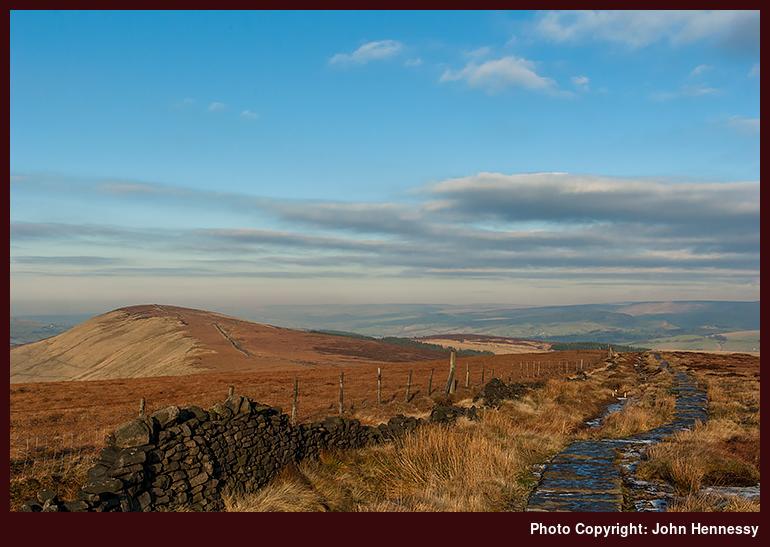
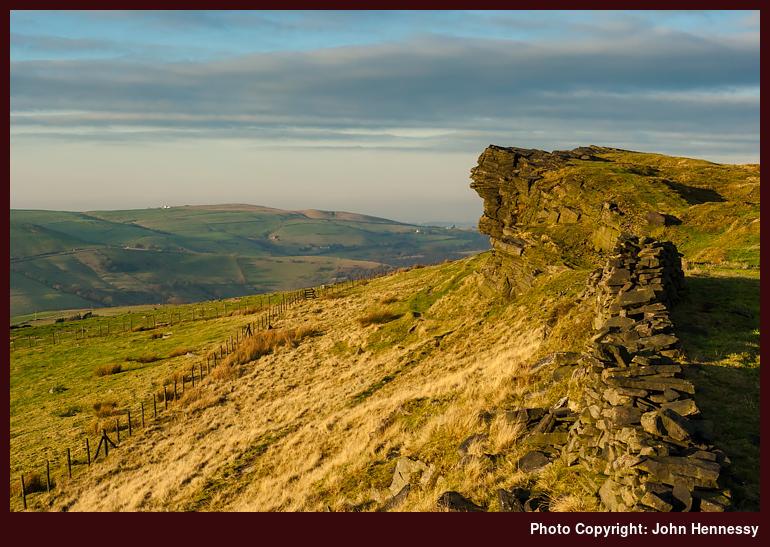
Suggesting sounder ground, the flags were lost after Cat's Tor and road was encountered at Pym Chair. At this point, I headed to Kettleshulme rather than Rainow as was the case of my previous trip. The ground was more or less thawed out from here onwards. A mixture of public and permissive paths got me to Windgather Rocks where more photographic action took place before continuing the public/permissive path and tarmac mixture, I reached Kettleshulme. Having more daylight with which to play, I chose to continue to Whaley Bridge. Although I largely avoided the remarkably unpleasant B5470, the tarmac/footpath mixture continued and care with a muddy descent to reach Todd Brook meant that I didn't more mud than I did. My journey was eventually to take me by Toddbrook Reservoir while making for Whaley Bridge and its train station. A railway journey round by Stockport was enough to get a very satisfied Irishman home.
A step forward for the opening up of the countryside in Éire?
3rd November 2007 Access to the countryside in my native Éire has always remained a grey area, often tolerated even if it is not strictly legal. It is also a matter that has been complicated by history. For one thing, it hasn't bequeathed us a network of public footpaths and bridleways like that which criss-crosses England and Wales. In that respect, the Irish situation is somewhat akin to Scotland's, though that country does have known rights of way even if they are not marked on any OS map and so take some finding. Of course, Scotland has imported some Scandinavian enlightenment with its access legislation as well, while it places an emphasis on those out enjoying their rights also knowing their responsibilities.
Continuing the Scotland versus Ireland theme, there is also the matter of how land is owned to be considered. A feudal land ownership system still pervades in parts of Scotland, but was all but banished from Ireland in the early years of the twentieth century. Scotland suffered the Clearances, while the Irish largely resisted any such attempts at a free for approach that might have ended up there. The result of the former is that we see vast tracts of Scottish land sparsely populated and owned by far fewer people, with the people who actually farm the land renting it. Land agitation in the Ireland resulted in several land acts that resulted in loans being given to Irish farmers to buy their own land. This has meant that holdings in Ireland hardly ever top a few hundred acres and a 40 acre farm far from an uncommon situation; the questionable economic viability of the latter is perhaps why EU subsidies are so important to Irish farming families. That has meant that the Irish countryside is more peopled than its Scottish equivalent, and the fight for the right to own land has made for an emotional attachment to it that only now may be slackening.
Putting the lack of traditional rights of way and a strong emotional attachment both to the idea of owning land and handing on to the next generation should they be interested in farming, a waning pattern given the rise of the Celtic Tiger and the opportunities that it has presented, it is remarkable that there is any off-road walking on offer at all. Indeed, the Waymarked Ways, Ireland's long-distance walking trail network, sadly goes over a lot of tarmac and that's a pity, even if the roads are quiet affairs.
Thankfully, the opportunities remain and Walking World Ireland does have some good ideas for routes that I must explore some time; this was also borne out by Andy Howell's outings along the coast and among the mountains of West Cork (excursions that put me to shame...). However, the said magazine also reports tussles arising from the whole land access issue, and that's why a recent item on the RTÉ News website was an encouraging sign. The idea of an expanded network of paths for off-road walking can only be a good, and it is also promising that there is now a willingness at government level to fund can only be a good thing. Let's hope that it comes to pass and worries about spurious insurance claims and bad walker behaviour will come to nothing. We all owe it to the proposal to make it a success and then ensure that it is the start of something greater.
A return to Brontë country
24th October 2007 In public transport terms, the day didn't start too well, yet I did get to do some hillwalking last Sunday. The first bus service from Macclesfield to Manchester didn't happen for me, either through it not running or my missing the thing by a mere minute. It doesn't matter what actually happened because the result was the same anyway. The alternative plot of catching the 10:29 train to Manchester Piccadilly was set into action. Once in Piccadilly, the next step was to make my way to Manchester Victoria to catch the 11:08 departure to Hebden Bridge, as I had originally planned. Things were looking hopeful until Stockport, but it went downhill after that. The result was that I ended up on the 12:09 to Hebden Bridge. The final leg of the journey was a ride on Transdev Keighley and District service 500 to Oxenhope.
Those obstacles overcome, I began my walk a good hour later than I had intended, but the day continued to be as sunny as it had started. If it had done otherwise, I would have had grounds for irritation. After finding my bearings, I started to make my way out of Oxenhope and took advantage of roadside footways all the way until I made it onto a minor road that I was soon to leave for the moorland public footpath network. I climbed steadily but not too steeply with views of Leeshaw reservoir to my left. Looking down gained me views of pleasant farmland with the moors overhead. I made my way around Haworth Moor and Harbour Hill to pick up the Brontë Way before it joined the Pennine Way and headed for Top Withins. I was to join the Pennine Way myself, but I had another footpath in mind. However, there was no sign of it in the heather, so I made my own crossing with a navigationally useful wall to my left.
The idea that I had in my mind was to knock off another section of the Pennine Way, but the reality was that I took a mere nibble of the portion between Haworth and Gargrave that I have yet to do. I did get as far as Ponden Reservoir and pondered going further, but the time that I had was limited. Launching further into remote country means that you have to return afterwards, and all of that was likely cost a lot of a commodity of which I didn't have a lot: time. Getting back to Macclesfield was actually a bigger consideration than when the sun was due to go down. So, I decided to head onto Stanbury via Ponden Mill and then onto Haworth for the last bus to Hebden Bridge so that I could retrace my way home. Otherwise, I would have had to get a bus to Keighley and then take a longer journey from there. As it turned out, I was home by a very timely 19:30; getting to the Worth Valley via Hebden Bridge is easily an hour shorter than going around by Keighley.
Something that had started out as an opportunity to bag another part of the Pennine Way turned into an enjoyable reconnaissance ramble in rustic moorland on a sunny October day. Naturally, my thoughts turned to how I might advance the PW cause in this area, so here goes. Getting into the Worth Valley via Hebden Bridge is a practical public transport option, and a quicker one than the obvious alternative. Trying on a Saturday would get me there earlier in the day and would also have the added advantage of there being a bus service to the pleasant village of Stanbury, assuming that the times worked out. A good supply of off-road walking would get me to Ponden Reservoir and the PW again. It's a plan, but who knows if or when I'll put it into action?
Postscript: Visiting land belonging to Yorkshire Water
Yorkshire Water seem to very keen on encouraging people to enjoy the land around their reservoirs. After all, they do have a website containing useful ideas for walkers, cyclists, horse riders and so on. Unsurprisingly, I took a look from the walker's perspective and there are walking route ideas with full descriptions and the same seems to be on offer to cyclists.
It's all a far cry from the way that things were once upon a time. Before the advent of water treatment plants and their like, reservoirs and the land round about them were out of bounds for the general public lest the supplies got contaminated. That mindset certain applied in Longdendale and also was behind the building of the Mourne Wall among the mountains of the same name in Northern Ireland. Aren't we lucky that we live in more enlightened times? And yes, I know that they are far from perfect...
Following brooks in Cheshire hill country
20th October 2007 On a bus journey from Macclesfield to New Mills some time back, I made a mental note of the pleasant hill country through which the B5470 threads its way from Rainow to Kettleshulme. Even though the memory remained with me, for some reason unbeknownst to me, I never managed to take a walk among the glorious surroundings until last Thursday afternoon. And that amazes me all the more when I look at the map and consider my ventures: there are many places in the vicinity where I have wandered, but this gap in my explorations still remained.
The morning was taken up with the main reason for my day off from work, an unsuccessful venture that left me feeling annoyed with myself, so a walk on a fine October day seemed as good a distraction as any. It may have not been the complete cure for my annoyance that I was hoping it would have been, but my head was clearer than before I popped out.
The sun was unsure of itself while I was readying myself for the outing, so I was wondering whether I would be seeing the landscape in the best light. I carried onto to Bollington anyway, and I'm glad that I did because the sun returned and, apart from some stutters, stayed away from clouds for the whole afternoon. I pottered up a minor road and picked up the Gritstone Trail for a while before I left it for a vehicle track taking me along the slopes above Harrop Brook. Looking back now at the route that I took, it could be said that I followed the same brook to its source on the slopes of Cook Hill and Broad Moss. A closer look at the map revealed a number of names accompanying Harrop Brook: Black Brook and Moss Brook are but two. My journey following these took me past the end of the vehicle track and onto muddier underfoot conditions as I passed through woodland and over fields, crossing the B5470 along the way.
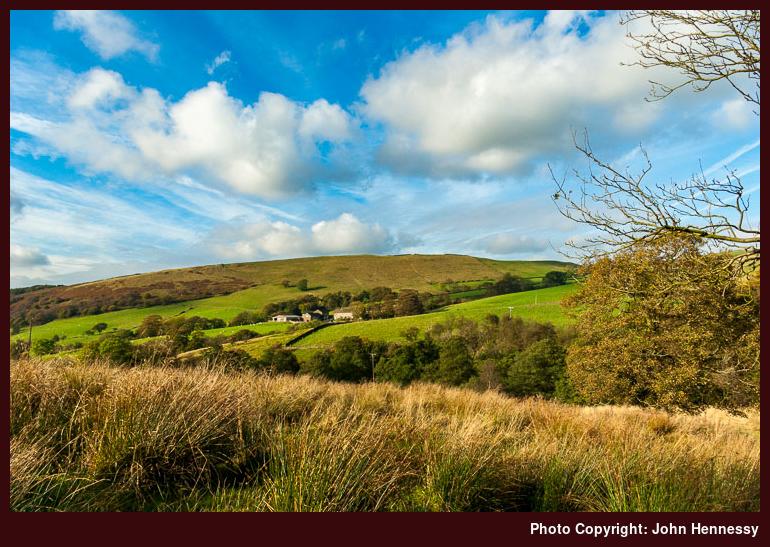
Once across the aforementioned road, the views really opened up. I ascended the minor heights of Broad Moss, and views north towards the moors of the High Peak were mine to enjoy. That wasn't all since Taxal Edge, Pym Chair and Cats Tor all blocked any view of the Goyt Valley and its reservoirs. Those hills and the valley in question have been frequented by my boots on other walks, so I made my way towards Charles Head and Kettleshulme. Getting to the latter proved tricky because the B5470 is a busy if narrow road devoid of footways, so careful progress is a must if you are not to get knocked down. This is not an escape route to civilisation for the hill wanderer until you reach Rainow, and it certainly is no road to be walking in the dark.
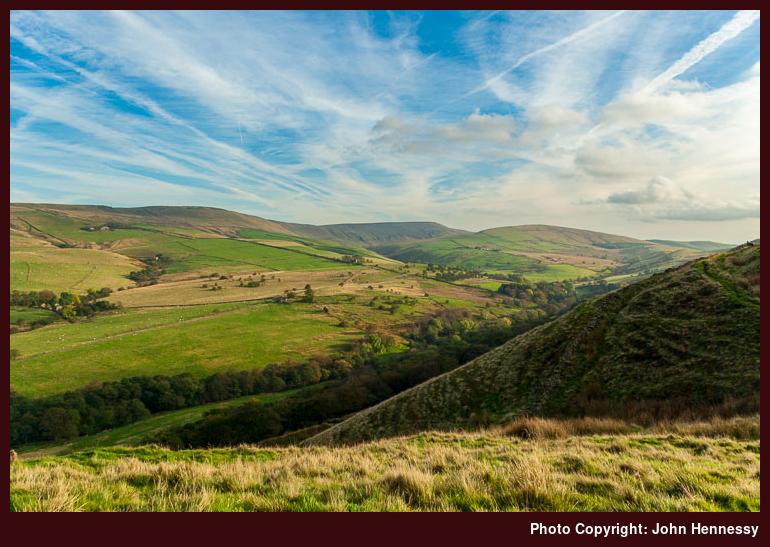
Kettleshulme was to be the end of my walk on a wonderful day in equally wonderful surroundings. The public footpaths followed shared a property that pervades much of the public footpath network in England and Wales: haphazard waymarking. This makes it essential to be on the ball with your map and your compass; GPS would help too. Where things got tricky, I kept it simple and, since my plan was fluid, any diversions taken were no disappointment. In fact, they added to the experience.


