Category: Europe
A Sunday morning stroll
 7th October 2007
 The weather in Britain and Ireland is an ever-changing affair that doesn't take long to change when it sets its mind to it; thirty minutes often is all that's needed. The weather this weekend is what's put that thought into my head. Yesterday morning started as a cloudy affair before the clouds shifted to leave a cloudless blue sky and very quickly too. That wasn't to last long, however, and my enthusiasm for an afternoon stroll among the hills beyond Bollington waned. Yes, I have to admit that cloudy skies do bring out the lazy git in me as does my indecision regarding where to go for a walk when my time is limited; it's all too easy to stay where you are. Many of my walks are also photographic expeditions of a sort and cloudy skies more often than not do not make for pleasing landscape photos; saying that, they are good for subjects where diffuse light is what you need and woodland comes to mind as an example.
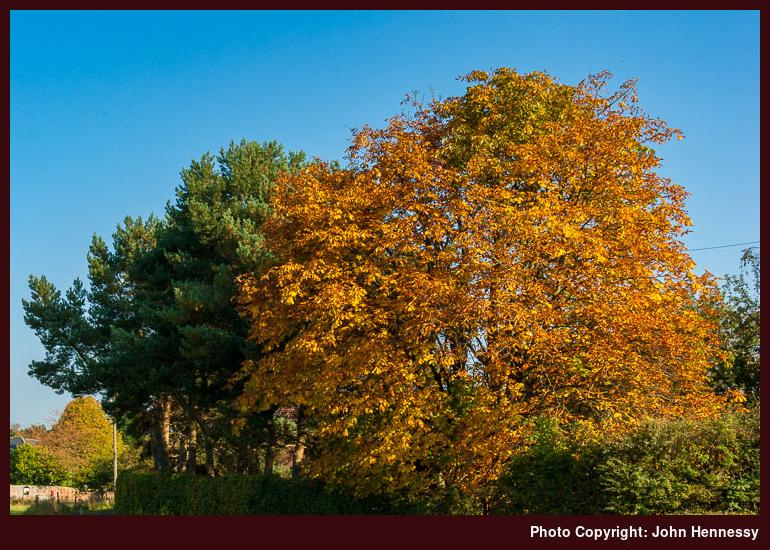
This morning was a similar affair and it is now well cloudy as I write this, though the sun is still trying to find a way through. However, I made no mistake when the sky cleared this time and pottered out for what was a gentle stroll starting on my own doorstep. The thoughts of seeing wondrous autumn colour in equally wonderful October sunshine was enough to set me on my way to Prestbury along the Bollin Valley Way. And I wasn't to be disappointed on my excursion. My return journey was an unplanned affair made up of a mishmash of public footpath and road walking; at one point I ended up on an overgrown path and encountered plenty of nettles in a wilder patch of a normally manicured Cheshire. The sun had delighted, but clouds were appearing from the south and, within minutes of returning home, the sky had filled with clouds.
End of a trail, start of a gallery
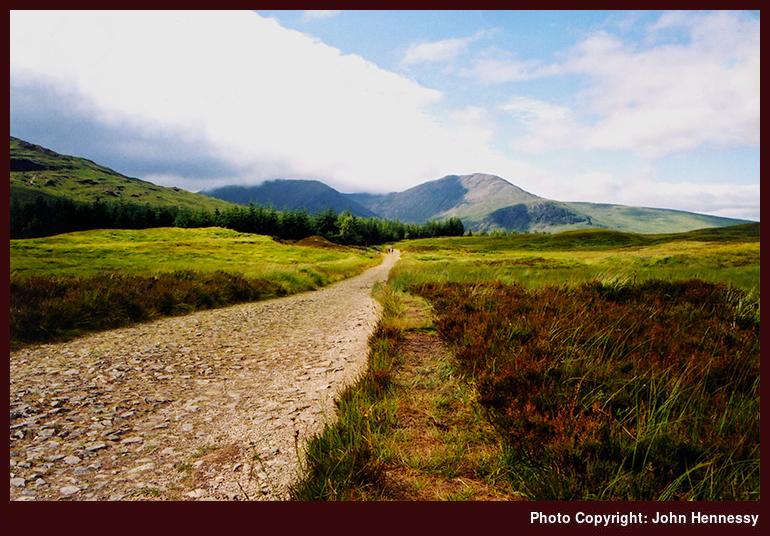
24th September 2007 Because I had until this year only walked the West Highland Way north of Bridge of Orchy, I had the photos from the corresponding treks bundled with those from Lochaber. Following my establishment of a Pennine Way gallery and my walking the rest of the WHW, it was time to split the previous Lochaber gallery in two and recognise that some photos that were included there really belonged under the Argyll umbrella. So, I now have two sections in the gallery, one for a circuit of Lochaber and another for the WHW. The WHW one is still awaiting more photos and some that are already included may need a spot of sympathetic retouching so the WHW show really is only starting. And knowing me, I may even encounter the WHW again and again so you never know what'll turn up yet.
Why not Kinlochleven?
23rd September 2007 The following thought entered my head not so long ago while looking at the idea of creating a West Highland Way photo gallery: why is Kinlochleven a sleepy place in the heart of fine mountain country rather than a bustling centre of all things outdoors? My visit last month might have one answer to this. I suffered the attentions of a swarm of midges while awaiting a bus and it is not an experience that I wish to repeat. Fort William was mercifully free of the blighters.
In a sense, it is too easy to ignore Kinlochleven for it is bypassed by the A82 and the railways. Fort William has the "Ben" and much more with the accommodation provision to match. Yet, it isn't for nothing that the West Highland Way passes through Kinlochleven as it is in the midst of its climax. Proximity to Glen Coe and the Mamores ensures that eventuality but not a steady stream of other visitors, it seems.
The village's history may not help its cause either. After all, it did nearly get called "Alumimiumville" and possessed the requisite smelter that used hydroelectric power provided from the Blackwater Reservoir. These days, the old smelter is now an outdoors centre with the The Ice Factor being its major attraction but there is an outdoor equipment shop and a cafe to complement the said indoor ice climbing wall.
As the mention of Glen Coe and the Mamores suggests, this is quality hillwalking country that is not limited to the attentions of winter climbing wannabees. A quick inspection of an OS and Harvey map will reveal a plethora of hill tracks probing countryside that affords plenty of peace and solitude. I didn't see it at its best last month but I did like what I saw and the views over Loch Leven were excellent, even with rain laden skies and low level cloud.
With its prospects for good walking and reasonable bus service to and from Glencoe, Ballachulish and Fort William, Kinlochleven is well worth using as an access point for hill country. I suppose that its being overlooked by the hordes that frequent Fort William does have one very attractive compensation: you get to feel that you admire the scenery at your ease without the feeling that you are constantly leap frogging others. I hope to go back.
Trekking around the Trossachs
22nd September 2007 Having dispatched my musings on the West Highland Way, I can now recount my wanderings on the last weekend in August, a bank holiday in England but not Scotland; they, like Éire, get theirs at the start of August. A Saturday free of driving lessons meant that an excursion was very likely, so I returned to Scotland when I saw a promising forecast.
Since the weather on that Saturday was not to be the best, I chose that day for travelling. Everything was going hunky-dory until I took a tumble at Dumbarton East train station and felt the worst for wear afterwards. It then was a case of getting to my hotel for the night and taking things easier from then on. Otherwise, it had been a good train journey all of the way from Macclesfield, with changes in Manchester, Lancaster and Glasgow. The change in Glasgow allowed me to get a new Explorer 365 after its predecessor had somehow managed to disappear. While my maps don't usually do things like that, it was fortuitous in the sense that the Rob Roy Way is shown in the current edition.
Though the sun made fleeting appearances while I was in Dumbarton, I wasn't to make much use of my camera there. The nearby castle looked promising, as did the Kilpatrick hills. These offer possibilities for the future, and I will be watching my steps in train stations around there after my mishap. Sunday saw me leave for Balloch, where I caught a bus to Drymen for the start of my walk.
It was just as well, given my tumble, that I had chosen part of the less challenging Rob Roy Way as the route for my weekend stroll. Initially, I had designs on heading to Balmaha and starting from there and rounding Conic Hill, only to drop this idea because my start was later than originally intended. From Drymen, the RRW follows the old Gartmore Road for three and a half miles (5.6 km) before it heads west to Aberfoyle through Loch Ard Forest, where the trail is usefully waymarked. Views of the Campsie Fells were plentiful and there were glimpses of Ben Lomond to be had too. While I am usually not a fan of road walking, the road was quiet and I appreciating the easier going. Having to remain alert for cars is my main reason for disliking road walks. Once off the road, northward views opened up, with the Menteith Hills being among what was to be seen. The tarmac was lost too, along with any sights of pylons, and it was all pleasant stuff. I made decent progress even with carrying a heavy rucksack and polished off the ten-mile walk in five hours to reach a sun-drenched Aberfoyle; because cloud abounded, the sun wasn't out all of the time.
For the evening, I settled myself in an Aberfoyle guest house before going on a stroll to and from Loch Ard itself. Surprisingly, I wasn't feeling the effects of my endeavours and so enjoyed my walk along the quiet road, which lead all of the way to Inversnaid on the shores of Loch Lomond. Even though the sun was playing hard to get, some photographic opportunities did present themselves and I did my best with them. When I got back to the guest house, road workers from the council were proceeding with road repairs that were to continue all night, much to the annoyance of other guests at my lodgings. Nevertheless, I suffered no such inconvenience and was extra careful when passing lorries, dumpers and other such carriageway maintenance machinery.
The next morning began promisingly. The sun was out, and it wasn't overly hot either, a feature of the whole weekend; walking and hot weather are not made for each other. I encountered some Americans at breakfast who were wondering what bank holidays and speed cameras were. I satisfied their curiosity before they continued their way on a holiday that was to lead them to Ireland's mid and southwest. As I finished my breakfast, children were making their way to school. It was a normal Scottish weekday.
I took my leave of the guest house to follow the RRW to Callander. It was 10:00 by the time that I began to make progress away from Aberfoyle; this always seems to happen to me on these trips: I leave somewhere later than I would have liked. From Aberfoyle, it was on to Dounan's Centre and into more forestry; more RRW waymarks were there to resolve any confusion. Views of the Campsie Fells and towards Ben Lomond still pervaded as I headed along the Menteith Hills. The forestry track turned into a path that was to take me through open country with splendid views before me lit up by the sun. It was after an unnamed lochan that I again found myself with forestry track underfoot. That track was to drop me down to the shores of Loch Vennacher, with views of Ben Ledi percolating through the trees.
Sadly, cloud cover predominated while I was walking by Loch Vennacher and the sun was nowhere to be seen. Still, the scenery looked glorious, causing me to add a mental note about n=making another visit when the skies are less clouded. The Trossachs proper were further west and a busy A821 could be heard, though it wasn't to be that intrusive. It remained cloudy as I bashed more tarmac to arrive in Callander at 15:00; I had made good time and put three miles behind me in an hour without too much effort.
Since Callander was where I ended my walking for the weekend, I caught a bus from there to Stirling. It started to rain as I left: some sort of pathetic fallacy, perhaps? At Stirling train station, I was in something of a dilemma regarding the next stage of my journey: was I going via Edinburgh or Glasgow? It should have been a no-brainer; I had a return ticket from Macclesfield to Glasgow. Being overcautious me, I had to double-check things before plumping for Glasgow.
As it happened, I made it to Queen Street station shortly after 17:20 and hot footed it to Central station in a pleasing 10 minutes; I will keep that in mind for the future. Then, I hopped on the 17:40 departure for London Euston and was home by 22:30, having changed in Preston and Manchester on the way south. It was a good trip into some countryside where I hadn't been before, and I hope to come back again.
Thoughts on the West Highland Way Part 3: Tweaks and Other Ideas
21st September 2007 This should be the last post in this series with Part 1 dealing a detailed appraisal of the route and Part 2 describing the way that I walked the West Highland Way. You might have gathered from my witterings that I think that some parts are too close to the A82 and that others are a bit tamer than I might have expected. Also, as you can gauge from its appearance at number 23 in Country Walking's listing of Top 50 treks in its current issue, this is a popular trail and it's not easy to relax when you're leap frogging other hikers a lot of the time.
The above sets the scene for my starting point with these musings. From here, the directions fork somewhat. In the initial version of my appraisal, I was suggesting all sorts of improvements that the powers that be could make to the route. I have mellowed since then and now suggest deviations from the official WHW that may add to the enjoyment of the trail. Following on from this, I have also got the idea that the way could form the backbone for a series of walks that extend into wilder country than that frequented by the main trail. Then, I'll finish with some thoughts that fall under the heading "Where next?" or "What are the alternatives?".
Adding a Spot More Wildness...
From the first part of the series, you may have gathered that I might not consider the WHW to be a true wild country trail in the mould of the Pennine Way, the Southern Upland Way or the Cape Wrath Trail. It seems, rather, to be a journey towards wild country, which is why the climax starts north of Bridge of Orchy. So here are a few deviations from the official route that might just enhance the wild country aspect of the trail.
Personally, I have my doubts about the wisdom of starting at Milngavie and I have had some thoughts about how make the start of the WHW feel better. Here a few ideas:
- Start at Drymen: it may not be as accessible as Milngavie from the public transport point of view, but you get to see less pylons and reduce the amount of tarmac to be encountered. You also avoid the disused railway and you still get some views of the Campsie Fells.
- Another idea is to replace the stretch along Strath Blane with a hike through the Campsie Fells. You may need to change your starting point to do this or make your way from Milngavie towards the town of Strathblane; there seems to be a useful track through the woods that nicely keeps down the amount of road walking. A spot of cross-country travel may be needed but, by all accounts, the Campsie Fells look to be worth the effort. Starting from Kilsyth is another idea even if some road travel is needed to pick up the WHW near Drymen. Using minor roads as much as possible may make this more bearable.
The piece between Inverarnan and Bridge of Orchy is another place where the feeling of wildness is sadly absent at times. While some parts of the route are worthwhile, the episodes of loud road noise remain in my memory: funnelling road, railway and hill track through a narrow steep sided glen does rather amplify the racket and you might as well be in an underground tunnel with the lot. Following a hill track towards Dalmally does sound an appealing alternative even if you have an electricity line with its attendant pylons for company most of the way; that said, they have a use in this case when it comes to navigation. There is an element of trackless country crossing in this but you are away from noisy roads and photo opportunities may be grasped with careful composition. From Dalmally, my plan would be to follow hill tracks shadowing the hopefully less busy B8074 along Glen Orchy to Bridge of Orchy. Your legs will be exercised by ascent and descent here but the peace offered should be a definite boon. A more adventurous option would be to head from Dalmally to Glen Strae and head over Lairig Dhoireann into Glen Kinglass before heading along that glen towards Inveroran to meet the WHW there.
There is one last deviation from the route that I am suggesting because I find it hard to understand why the WHW drops onto the road in Glen Nevis when there are perfectly usable paths and tracks that will carry you around Cow Hill and into Fort William; it does to be said that the Glen Nevis road is never too busy. Admittedly, my route means that you do get dropped onto tarmac at the back of a leisure centre but the trot to the centre of the town is then a short one. Maybe that's what the powers that be want to do when they describe plans for extending the trail into the town. I can't see the emporium near the current end on the A82 being very happy about my suggested change, though.
Side Excursions
The WHW follows old rights of way for a lot of its route and that fact neatly brings to my next set of ideas: using the WHW as an access point for walks into wilder country. Here, I am limiting myself to old rights of way described in ScotWays' excellent volume, Scottish Hill Tracks. You can roll your own routes simply by studying maps, thanks to Scotland's enlightened access legislation, but I'll stick with the old tracks for now. Here some possibilities and they get more challenging as you go further north:
- Drymen to Rowardennan via Aberfoyle: there could be a lot of tarmac to be covered on this one (that certainly applies up to Aberfoyle. The more daring could avoid Aberfoyle altogether for a bigger day out. I measured the distance on Anquet and it's around 20 miles with a climb to above 400 metres as it goes over the shoulder of Ben Lomond. My experience has been that the countryside is quiet and forestry tracks are the mainstay; it seems an interesting proposition.
- Ascent of Ben Lomond: this is Scotland's second most popular hill and the ascent from Rowardennan is bigger on height than on distance.
- Inverarnan to Crianlarich via Inverlochlarig: a testing 16 mile diversion that gets you away from the noisy Glen Falloch and travels on sometimes pathless terrain to Rob Roy's house before heading over a bealach to reach the A85 and Crianlarich.
- Crianlarich to Bridge of Orchy via Loch Lyon: this seems a challenging two day affair and so will follow my having got in some camping practice. Boggy pathless terrain abounds at times and that will no doubt slow progress too, especially where steeper ascents are involved.
- Bridge of Orchy to Glen Coe by Loch Etive and/or Glen Etive: there are a variety of routes and your choice depends on your fitness, your experience and the weather. A simpler excursion would be to head along Glen Kinglass and follow the shores of Loch Etive to its head whereupon a long road walk would take you to the head of Glen Coe.
- Kinlochleven to Glen Nevis: there are a goodly number of diversions here and the usual caveats apply.
For those who want greater altitude, there is the Highland High Way. There seems to be no website dedicated to the trail but I have seen a book on it published by Mainstream Publishing, which may or may not still be available. As it happens, my preference is for hill tracks frequenting wilder spots than increasing my Munro count. Despite all my visits to Scotland, that steadfastly remains at zero.
A Beginning?
When you are done with one long distance trail, your mind does tend to return to others. Even so, any long distance trail only allows you a passing glimpse of the country surrounding it. For that reason, the WHW may not be an end but rather the start of other excursions among the hills that it passes. Speaking of beginnings, the route of the WHW does make a good option for those who are frequent walkers and want to get into the trail bagging game. That leads me onto my thoughts for future options. The Pennine Way is and will continue to be a project for me but the Southern Upland Way also appeals. Both may be more serious propositions than the WHW and that is down to their remaining in wild country that is mercifully bereft of busy roads. And I ever walk all of those, there will more and more to be walked. This game is one that never finishes until you are...


