Category: Places Explored
Centrism
 20th February 2022
 My perusal of a recent copy of TGO magazine brought me across a few possibilities in an issue having the strapline "Walk the World" on its cover. When it comes to overseas journeying, I tend to take what alpinists might call a centrist approach. What I mean is that I have a habit of basing myself in one location and exploring that and places situated around and about it. The other approach would be to go from place to place on an itinerary.
Certainly, my usual approach makes it much easier to organise a trip and it matters more when I am going further away from home: just book somewhere to stay and sort out how to travel there and back again. After that, it is possible to concentrate on finding one's feet and experiencing any local delights to a deeper level than you would if moving from place to place. It also works well for independent travelling and that is what I did before the pandemic came our way.
There are many trips to Scotland and the Isle of Man where I have taken the centrist approach and it has come in handy for overseas escapades featuring Iceland, Switzerland, Austria, Spain and Canada. One notable exception has been Norway but, even there, I have limited my stopping points and there was a time that I traipsed from place to place around Scotland too.
Thus, the list of possible base "camps" for European excursions in that recent issue of TGO caught my eye. Two places on the lists have seen my footfall already: Innsbruck in Austria and Sóller in Mallorca. The first of these has an embarrassment of riches surrounding it that easily caused quandaries during my extended weekend stay during May 2016. The others need to remain on file for the future. They include Senja in Norway, Gavarnie in the Pyrenees, Sotres in Picos de Europa, Cortina d'Ampezzo in the Dolomites and Bled in Slovenia. All are near to the type of countryside that I relish so they could be worth seeking should opportunities arise.
In a similar vein, Outside also listed the best mountain towns in the U.S.A. and this too struck a chord with me since I have had designs on exploring American mountain country for a while. For example, the prospect of spending time around Denver and Boulder in Colorado during the summer of 2020 foundered because of the pandemic. So, getting a wider list could be helpful and there are twenty-four entries. The source article is behind a paywall but it is worth becoming a paid subscriber to get a list like this.
The possibilities include Cordova in Alaska, Sedona in Arizona, Bentonville in Arkansas, Truckee in California, Durango & Telluride in Colorado, Stanley in Idaho, Copper Harbor in Michigan, Bozeman & Whitefish in Montana, Asheville in North Carolina, North Conway in New Hampshire, Taos in New Mexico, Lake Placid in New York, Bend in Oregan, Spearfish in South Dakota, Chattanooga in Tennessee, Terlingua in Texas, Park City in Utah, Stowe in Vermont, Roanoke in Virginia, Leavenworth in Washington State, Davis in West Virginia and Jackson in Wyoming. Here, I have ordered things by state so you will need to go to the article to get their ordering and the details that they supply for there is a lot to uncover about these. Many already are places that I have checked out but others are not.
It is all very fine to have lists of locations but there are other considerations like accessibility using public transport and the availability and cost of accommodation. Some locations are sure to be well known and hence will be busy places so knowing quieter times like shoulder seasons will prove useful as could using the services of a travel company. Of course, you cannot go anywhere without having the ideas in the first place.
Into nighttime
14th February 2022 Over the last few months, I have gone walking in hours of darkness by design rather than accidentally as often has been the case. Much of this has been in urban areas in the name of remaining active after a day of working from home, but some have taken me away from hard surfaces as well. It all helps with getting through these more uncertain times.
The first time that I ever tried this was during a much-needed career break at the end of 2017. Then, I chose a nearby route that I knew well, and I relished the quietude once I had over some initial nervousness. The same route was plied by night several times during the winter of 2020/21 and the reduction in the chances of encountering others was as much an attraction as being out on moonlit ones and ones that were not so bright. Naturally, a head torch was put to good use in the process.
The same sense of peace and solitude drew me out again, and other routes were chosen. Most were near at hand and with better starting points as well. Each time, I was reminded of the reduction in the amount of information from what we have by day, and I was always on familiar ground. It was not just one's whereabouts that demonstrated this, but the placement of one's feet and one's sense of balance, especially when crossing a steep slope with a significant drop should one fall.
This traipsing reached its zenith on New Year's Eve at the end of a long day out that added an extreme elbow to two places that are not that far apart. Mostly, I try to keep away from where people live because having unexpected lights around a home in the countryside could feel unsettling and intrusive. Nevertheless, the countryside feels very different at night and being out there feels more adventurous than it might during the hours of daylight.
Curtailed adventuring
19th August 2021 Despite the pandemic, 2020 turned out to be something of a vintage outdoor activity year, though most of that was local, and I never got to Scotland, let alone overseas. If anything, 2021 has turned out to be more restricted even if I have been fully vaccinated for a while now.
During late May and early June, I was starting to get out and about, though numbers of others doing likewise meant that it did feel uncomfortable at times. The Spring Bank Holiday weekend showed me both quiet countryside and busy places. A reprise of a walk between Disley and Macclesfield proved to be a quieter affair, though the same could not be said for one from Monyash to Bakewell. With few places to go and the onset of warm sunny weather, places like Bakewell or even Youlgreave meant that these were not places to linger. The same could have been said of the Hope Valley the following weekend, but I still walked from Hayfield to Hope while keeping to quieter parts of the Great Ridge. Again, warm sunshine had drawn many outside, and there were busy trains to bear as well. Nevertheless, there were no longer-term effects even if I was not fully vaccinated at that stage.
From then on though, it looked as if things were reopening too quickly given the case numbers. Even delaying the full withdrawal of restrictions was insufficient for my sense of safety. In many ways, a more gradual reduction would have been better since so-called "Freedom Day" was in fact "Anxiety Day" for anyone was nervous in their disposition. To be fair, many have been sensible and much continues as it was with the use of face coverings and social distancing.
Last month, I took a break of several weeks from work, but the timing was not in many ways the best for outdoor excursions. "Freedom Day" came in the midst of it so that was one reason not to be so carefree and a scorching heatwave persisted for the entire week as well, so outdoor activities were stymied by lack of acclimatisation. After those, there was yet another reason for my persisting with a "homecation".
In some ways, this takes me back to my student days in Edinburgh when research work, lack of money, living in a wonderful city and a strong interest in computers conspired to delay the development of any interest in explorations of hill and coastal countryside. The interest in computing still remains, and I embarked on a major PC upgrade that did not run so smoothly; that took several weeks to settle everything done again. That not only kept me indoors a lot, but was the cause of my working up quite a sweat as I carried things between my work area and my home office. Also, worries about wreckage of expensive equipment entered my mind, and the heat was not helping the machinery either.
Those worries were to prove groundless and everything has settled in again though ongoing assessments regarding cooling and noise reduction continue. Usefully, the weather has cooled and become more autumnal in feel though warmer temperatures are predicted without their reaching abnormal highs. Damper weather now abounds though there are interludes for getting out and about on sunny evenings as well.
Video viewing earlier in the year became the cause of my acquiring a GoPro camera and an extension pole. Later, a magnetic mount for attaching the device to clothing and other similar materials was acquired, and all has been put to some use. However, videography is a very different activity to photography, so things are very experimental for now since there is much to learn.
After all that, it feels like a time to realise that there is a need to live with the ongoing pandemic, and I am of a cautious persuasion. Yet, I am spotting some possibilities that may help with confidence building, since case numbers have not gone as high as was predicted. They did rise dramatically in July, but it looks as if the Euro 2020(1) football tournament caused a lot of that, since they also reduced substantially afterwards. If there is a chance for some stability and the weather offers some motivation, this may become a good time to get going on longer trips again. The pace of advance will be slow and there are other things to occupy me too, since there has been a lot of self-learning of new computing tools over the last year. Life can become very full, so gaps do not always happen, and they often need to be made.
A bitter blustery day on Moel Famau
18th April 2021 Though there were plenty of things on my mind, like executing my next career moves at the end of a long break, times certainly were simpler in February 2018 than they are now. Personal income was reduced heavily but I also controlled expenditure far better. Also, time largely was my own so I could pop out on day trips whenever the weather allowed, so a sunny day was enough to lure me to Moel Famau, a place on which I had designs for more than a decade. A weekday excursion allowed for better public transport options so the previous stymied trip idea became a real outing.
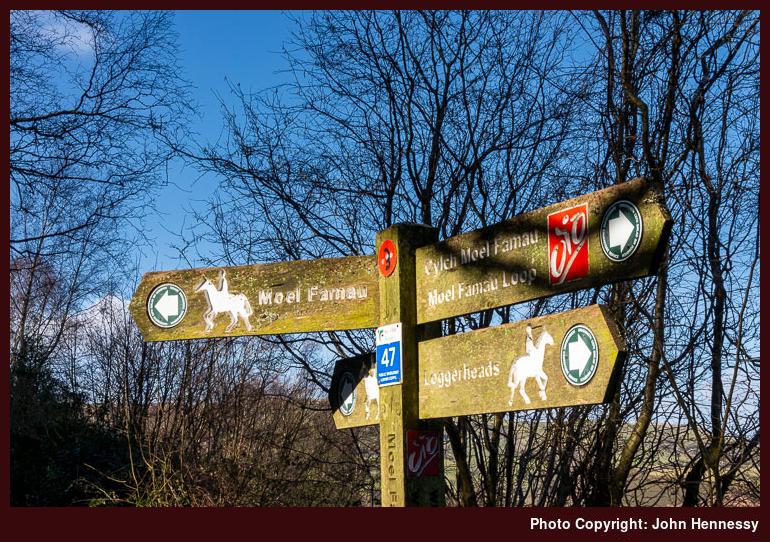
Ironically, the trip that never happened was inspired by a bus timetable leaflet then produced by the now defunct Cheshire County Council. Instead, I was to encounter other parts of the Clwydian Range on a hike from Denbigh to Ruthin and on another that carried me from Llangollen to Wrexham when Ruthin seemed too far to reach that Sunday evening. Belatedly after those, I was not only to encounter the Clwydian Range but actually potter along part of its length.
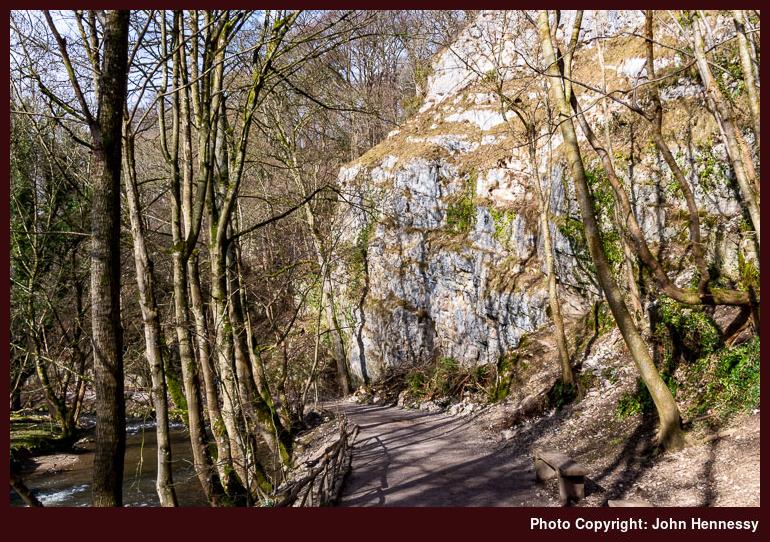
My timing also coincided with a school midterm break and Loggerheads Country Park had attracted families, but simply continuing on my way was enough to leave them after me. Given that there were many other spots that granted me more in the way of the solitude that I so relished, that was just as well. To get closer to those, I just followed the River Alyn as it flowed past limestone outcrops and was completely unaware that, behind them, most of the hill of Cefn Mawr was eaten up by a quarry. It just goes to show, that even in Wales, limestone country can hide such a thing.
The full revelation of the extent of scarring left on the landscape by Cefn Mawr Quarry needed some height gain and that was ahead of me if I wanted to reach the top of Moel Famau. Before that though, I remained by the banks of the River Alyn until I left the track to cross the river and some muddy fields to reach Bryn Alyn. There was a road-based route that would have taken me around by Bryn y Castell but I fancied keeping that to a minimum at this stage, possibly a good idea since so much tarmac travel was to occupy the end of the day's walking.
Nevertheless, continuing uphill from Bryn Ayn on a minor road was needed to get me onto a bridleway that would round Ffrith Mountain and get me most of the way to Moel Famau. As I continued along the track, height was gained all the way and views of the surrounding landscape opened out before me. Much was pastoral and the size of Cefn Mawr Quarry became more and more apparent; most of the hill seemed to be gone!
Leaving sights of environmental sacrilege after me, I rounded the boundary of Clwyd Forest to reach the summit that I was seeking. While the bridleway got me most of the way there, I left it to make the final approach to the Jubilee Tower. As if to remind me of the season, a brief flurry of snow came upon me, but the lasting impression is of the stiff and bitterly cold wind that blew along the ridge.
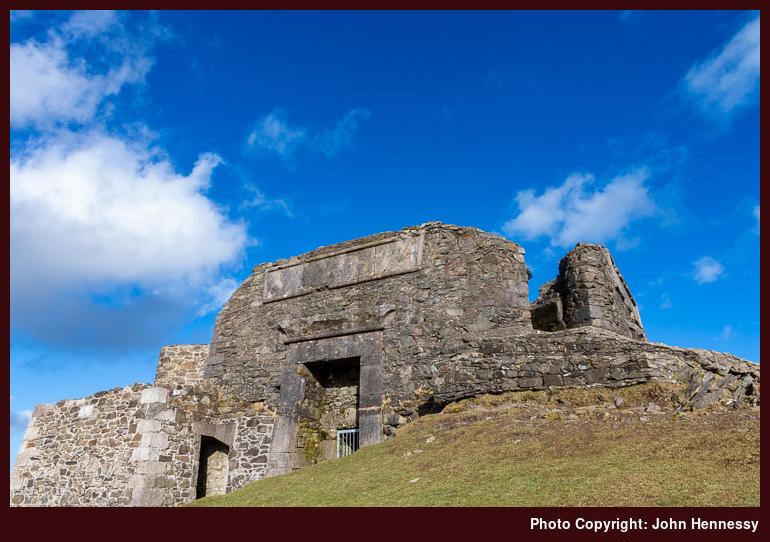
That did not deter me or the others who were there, but this was not a day for lingering, especially with a wind that could knock you. Still, the tower dating from the reign of Queen Victoria was explored before I started to descend along Offa's Dyke Path. Conditions underfoot were greasy enough for walking poles to prove unable to halt a muddy tumble. After that, more careful travel was in order, yet my sure-footedness was not guaranteed even then.
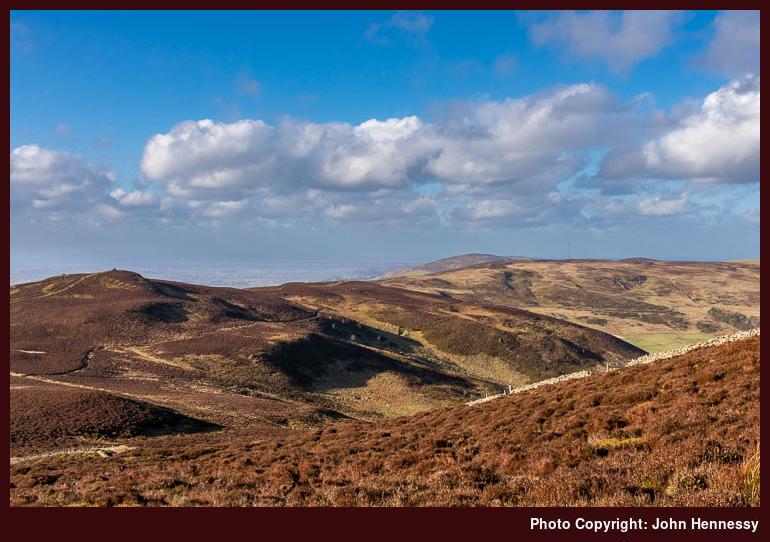
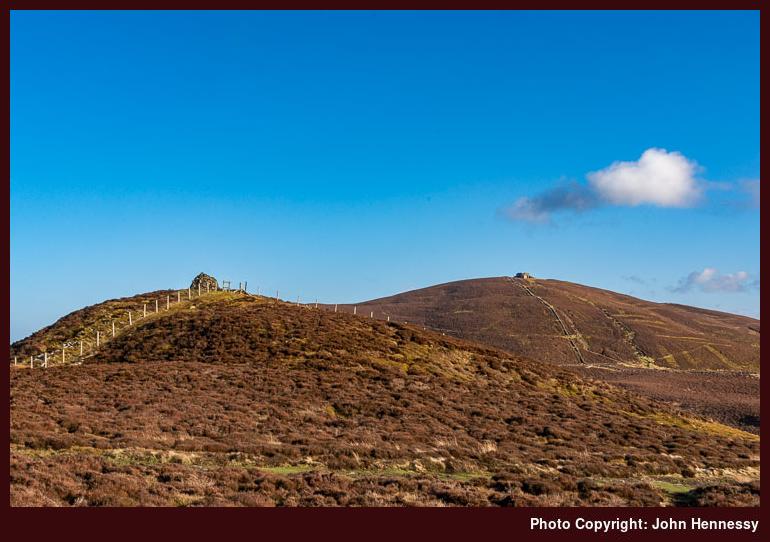
Even with plains abutting the eastern and western edges of the chain of hills, it still was possible to make images that could make one believe that it was more extensive than it was. There was so much scope for that choosing photos for this trip report was an exercise in itself. All the while, the afternoon was edging towards its end so I needed to think about getting to Mold before it got too dark. Before that, I had plenty of moments full of uninterrupted quiet and had ensured that by continuing from Moel Famau to Moel Dywyll after seeing a sizeable group of walkers taking a route that I might have taken. Peaceful wandering was what I sought and there was plenty of that so it often does no harm to let others decide some things for you.
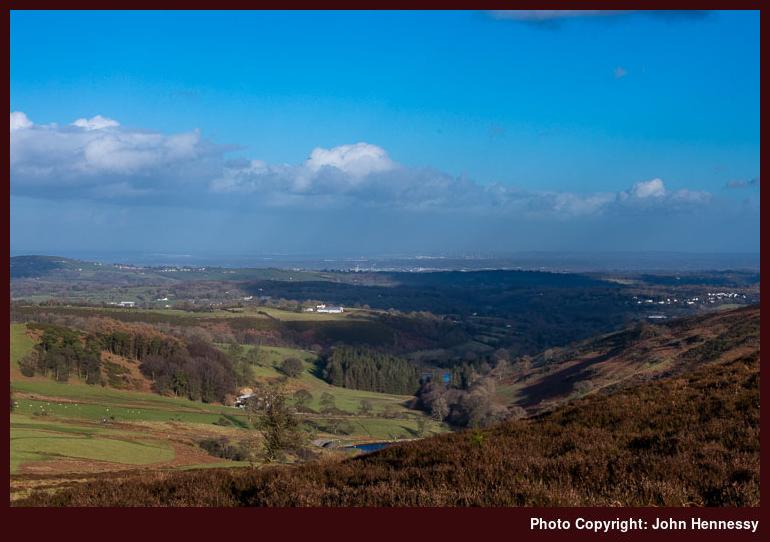
After Moel Dywyll, I found the bridleway that started me on my descent. However, greasy ground turned out to be my undoing as I endured my second muddy stumble of the day. That caused some muttering about my falling into a somewhat carefree mood, but this was the last of these and I continued on my way without anyone seeing my blundering and with added care in spite of the alluring late evening sunshine. The shelter afforded by the valley was all the more appreciated as I passed Garth and two reservoirs on my way to Pentre.
While a side-trip to Cilcain tempted me, weary limbs and declining light informed my decision to follow a stream-side public footpath by Nain Gain instead. After that, it was road walking all the way to Mold's bus station. Along the way, there was another crossing of the River Ayn and I passed such smaller places as Pontnewydd, Pantymwyn, Gwernaffield and Pant-glas. Light really was fading by then but I got within the street-lighting area in good time and reached the bus station as I hoped, so my journey home started after a satisfying day in the hills laden with soothing quieter moments.
Travel Arrangements
Return train journey between Macclesfield and Chester. Bus service X1 from Chester to Loggerheads where my walk started and, when It ended in Mold, bus service 4 was used to get from there back to Chester train station.
Visual treats
3rd January 2021 Over this weekend, I have been watching Life of a Mountain: Helvellyn on Vimeo. That meant renting the title for 24 hours at a cost of £7 and I have a copy of the DVD on order from Striding Edge too. The latter action was a result of watching the online version though I somewhat mourn the loss of SteepEdge where I used to buy digital versions of such wares.
The film was made by Terry Abraham and is the last of a trilogy concentrating on best loved Cumbrian fells. Scafell Pike and Blencathra have featured before now and I have copies of those too. The latest installation is long with a running time of nearly two and a half hours but it is packed with such visual delights that the length is deserved. This still feels a much tighter and less padded out piece of work. The others had me going back to The Cairngorms in Winter with Chris Townsend, Abraham's first accomplished effort and he also has shorter films introducing parts of the Lakeland Fells.
The Helvellyn film re-uses contributors from earlier films like Alison O' Neill, David Powell-Thompson, Stuart Maconie and Mark Richards but there is a host of other new ones like Peter Gibbs, Mary-Ann Ochota and Julia Bradbury among others. Even the Royal Air Force and Ordnance Survey get included. They all complement the backdrop of dramatic scenery accompanied by a stirring soundtrack, especially the action sequences involving the RAF, skiing down to Red Tarn from the summit of Helvellyn or paragliding off the same starting point. That the footage came from a time before the present pandemic was a reminder of how things should be.
The whole combination has re-ignited a desire to walk around Helvellyn that has lain dormant for too long. What that needs is determination and opportunity to accompany ongoing patience needed by the course of the ongoing pandemic. After all, I have visited Patterdale and Ullswater a few times now and they were so heavily featured in the film that I at the time wondered if it was about them and not very much about the mountain (that probably is what happens when you need include something on the lives of people living in the area). Nevertheless, 2020 did not involve a Lakeland visit for me so a return is not before time and having a lure to draw you through darker times has to be a good thing.


