Category: Pennine Way
Proceeding beyond Calderdale
 28th March 2007
 Sunday was forecast to be dry and sunny, so it was a matter of seizing the opportunity and deciding where to walk. In the end, I plumped for the continuation of my Pennine Way adventure. I left the section between Littleborough and Marsden for another day and tackled the section between Burnley and Haworth. However, I actually did my walk in the reverse direction due to public transport logistics. In fact, when I was first drafting this post, it was fast becoming a public transport rant so that was put elsewhere so as not to ruin an account of what in fact was a pleasant walk, and it is the walking that I will always remember rather than any transport frustrations. I once had a planned trip to Wales scuppered by a train cancellation, so I headed up to the Lake District, and it is the memorable evening in the company of the likes of Loughrigg Fell, Grasmere and Rydal Water of which I will always have the strongest recollections. That was far from being a disappointing day.
Getting away involved catching the first bus from Macclesfield to Manchester. From there, the railway got me to Keighley with changes at Leeds and Shipley and another bus got me to Haworth. I suppose that I could have travelled on the Keighley and Worth Valley railway, but I stuck with my original plan, even if I caught a Transdev Keighley & District bus for the last leg with only moments left to its departure.
Haworth is certainly a charming spot, but it is not its rustic appeal that attracts the visitors; that is its Brontë connections. Unfortunately, I didn't have the time to linger there, yet there was enough Brontë-this, Brontë-that and Brontë-the-other to give me the general idea. In fact, the Brontë theme was to pervade for a lot of my walk.
It took longer to find than it ought to have done, but I picked up the Brontë Way and followed it until I left it to join the Pennine Way just east of Upper Heights farm. On my journey to that point, I had ambled over Penistone Hill and crossed the Brontë bridge at the foot of the Brontë Falls. Yes, there is a danger of Brontë overload here, and I wasn't finished yet. My trot up the Pennine Way was to take me to Top Withins, the site of the ruins of which is supposed to have inspired the fictional Wuthering Heights in the eponymous novel. There is a plaque erected here by the Brontë Society declaring to the same effect.
I left the literary connections after Top Withins to continue into wild country with broad moorland and big skies. There were wind turbines on the horizon, but I didn't care, though I normally carry strong reservations about the siting of the things. It was not long until I was in reservoir country again; on the way out of Haworth I passed Lower Laithe Reservoir and caught a glimpse of Ponden Reservoir, by which a future northbound Pennine Way excursion would take me. Now I was encountering the Walshaw Dean reservoirs, whose company I would have almost until I met the next public road. By now, the evening light was glorious, and I had to stop myself becoming engrossed in photographic exploits at the expense of my getting home that night; I think that I may have a photo that tries to portray Walshaw Dean Middle Reservoir as if it were a natural lake rather than the man-made construction that it is.
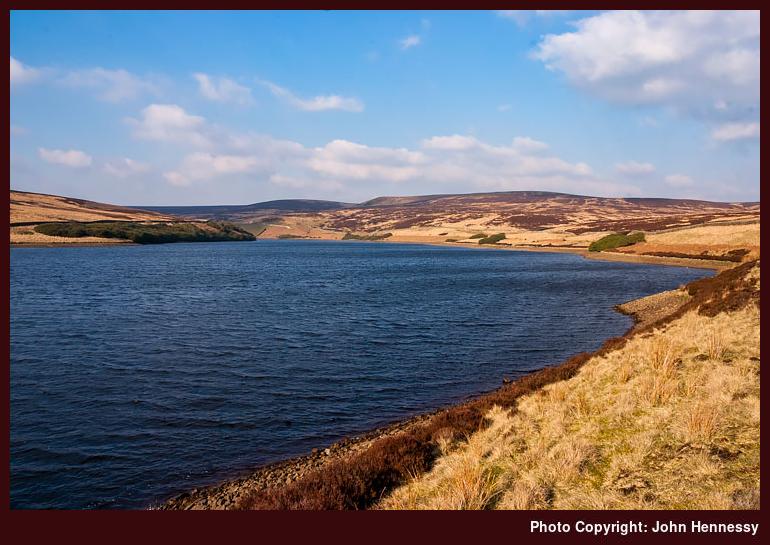
The nearest public road saw me leave the Pennine Way at the spot where I left it on my previous visit to the area, and I was to retread my footsteps on part of the Mary Townley Loop of the Pennine Bridleway until I reached Worsthorne. More reservoirs (Widdop, Gorple Lower, Gorple Upper, Hurstwood; yes, there are a lot around here all right) were passed on what was a surprisingly fleet-footed trek to Worsthorne, a village with a pleasant atmosphere on the edge of Burnley.
Worsthorne proved to be the end of the walking adventure for the day, but my travelling continued. A useful Transdev Burnley & Pendle service carried me to Burnley bus station. My journey continued from Burnley by train to Crewe, with a change in Preston. From Crewe, another bus got me home. It might be better if I had less waiting to do, then I would have got home an hour earlier, but it was a still a satisfactory end to a satisfying day.
Postscript: This was also the first hill day for my new Osprey Atmos pack, and it seems to have performed well. Apart from a little soreness at the end of the day, my back is none the worse and my shoulders were spared the usual torment applied to them by its Eurohike predecessor. So, a little more breaking in, and it looks as if this one will go on and on. I'll just have to try to stop it getting too muddy...
Calderdale revisited
6th March 2007 For some reason, the West Yorkshire Metro calls the railway that passes through Calderdale the Caldervale Line; it's enough to confuse the likes of me. However, the local authority is Calderdale MBC and so it is Calderdale to me then.
Anyway, let's get away from the nomenclature and back to some walking. Last week, I was feeling a little burnt out, so I took Friday off to recharge my batteries in the hills around Calderdale. Taking in another section of the Pennine Way was also on the agenda.
An early morning departure from Macclesfield got me as far as Manchester Piccadilly station, from where I used the Metrolink to get to Manchester Victoria station. From Victoria, I caught a train to Todmorden. The timings were a little finer than I would have liked, but the departure from Victoria was delayed by 10 minutes due to its needing some attention; for once, a train was late when I wanted it to be that way.
Once in Todmorden, the walking started in earnest, and in glorious sunshine too. The Calderdale Way and the Pennine Bridleway took me from the heart of Todmorden onto Lumbutts and Mankinholes before rounding Stoodley Pike to pick up the Pennine Way. At this point, my previous hike in the area took me south on my way to Littleborough. This time around, I headed north and descended to the A646 at Charlestown. The only problem with mid-walk descents is that ascents usually follow, and the one from the A646 did take its toll on my legs as I continued on my northward trajectory. My amble continued with a spot of road crossing as I skirted Heptonstall on my way to and through Colden. There was a bit of down and up as I neared Colden, but I did take the chance for a spot of lunch by the stream that caused it. A pub wasn't far away either, if I felt so inclined.
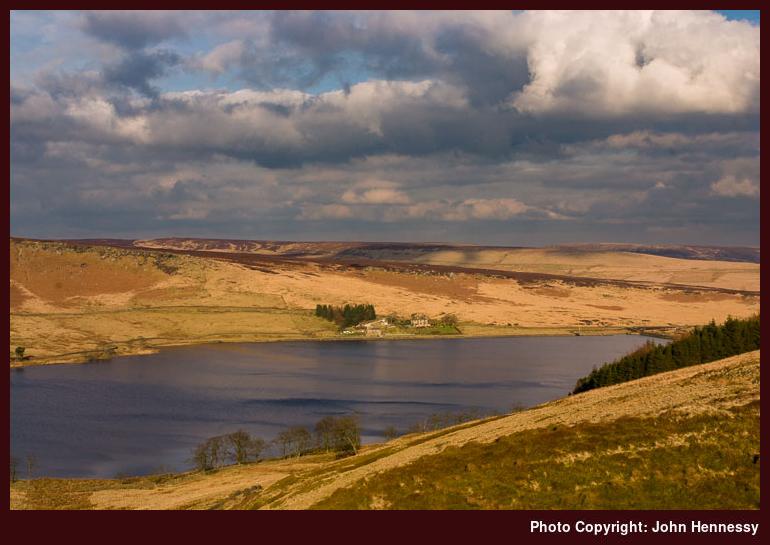
Beyond Colden, the Pennine Way regained its wild feel after its passage through what is a very much inhabited and post-industrial area. The section around Heptonstall Moor was one of the most enjoyable of the whole walk, the only fly in the ointment being the cloud that was bubbling up in the sky. Eventually, I neared the Gorple Lower Reservoir and followed the Pennine Way as it dropped into the gorge carved out by Graining Water until it clambered out onto the nearest minor road. From here, the Pennine Way continues east, and it was at this point that I left it for the Pennine Bridleway, the trail that was to take me onto Worsthorne and Burnley.
I continued up the road and took the track around the shores of Widdop Reservoir, stopping for another food break along the way. After being dull for an hour, the day began to cheer up as I left Widdop, and it largely continued that way for the rest of my walk. On my journey, I continued past views of gritstone outcrops and Gorple Upper Reservoir. The final stretch to Worsthorne took me past Hurstwood Reservoir, with views over Burnley on the descent. Once on tarmac, things began to feel like a slog and I broke my walk into Burnley town centre when I encountered the bus that returned me to Todmorden, a welcome sight. Once in Todmorden, I commenced my railway journey upon the arrival of the next service to Manchester, delayed due to technical problems in Leeds. After that, it was the reverse of my journey that morning.
Though tired after the long day, the walk was good, and it has far from dimmed my appetite for future Pennine Way strolls. Immediate options are the section that starts near Littleborough and gets you near to Marsden, with other footpath options doing the connection honours. Continuing northward, perhaps onto Keighley or beyond on the next stretch, remains a very tempting possibility.
Another Pennine day
5th February 2007 The sunny weekend tempted me into the outdoors after something of a hiatus; January did not offer much in terms of dry sunny hillwalking weather at the weekends though I did get out around Chirk and Llangollen on what was a fine mild Sunday in the middle of the month. In fact, only for the fact that I had a driving lesson on last Saturday (it has finally happened after talking about it for what seems an eternity), I might have gone off for the whole weekend but I really have to get that skill under my belt.
Therefore, with Saturday sadly out of the picture (it was a smashing day for learning to drive, even if the sun caused some glare), I needed to decide what to do on Sunday. Thankfully, the crisp fine weather stayed with us and I headed off into the South Pennines for a day in the hills. After a bus ride into Manchester, I took the Metrolink to Victoria station, from where I caught a train to Hebden Bridge. From there, I picked up the Pennine Bridleway and that took me on to Stoodley Pike and the Pennine Way. Once on the Pennine Way, I continued south until I met another section of the Pennine Bridleway that took towards Littleborough and Smithy Bridge. By some strange navigation (it was dusk at the time, after all), I managed to get to Smithy Bridge train station rather than the one in Littleborough. That gave me a few more minutes than I would otherwise have had, a very welcome commodity when making a train after a long walk. Nevertheless, brushing up on my low light navigation skills is required.
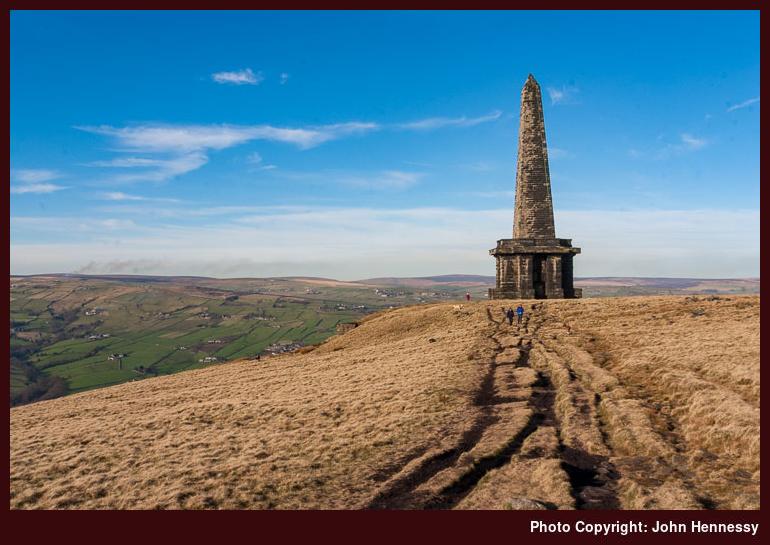
And what of the walking itself? The day was one spent in a wild, somewhat industrialised, moorland criss-crossed by a plethora of bridleways and footpaths in pleasant sunshine. Good paths ensured that heavy going was not encountered for as long as it otherwise have been. That allowed steady progress without recourse to the opportunities for route shortening allowed by the populous Calderdale (or is Caldervale?) valley, a consequence of the area's industrial past. The Stoodley Pike Monument, a memorial to the Napoleonic wars, dominated the skyline for a lot of the walk and provided a useful focal point for my photographic efforts. After that, it was onto walking around reservoirs on the approach to the White House pub. Once across the road, I picked up an old Roman road forming part of the Rochdale Way. Cobbles are visible today, though I am unsure of their antiquity. That path led me to another part of the Pennine Bridleway before I continued towards a golf clubhouse, where confusing navigation got me worried for a while, before the reassuring sight of another reservoir told me that I was on the right track.
In summary, I got to walk another part of the Pennine Way. Heading from Littleborough to Marsden along another section of it is a very tempting proposition for a Sunday stroll. And so is heading north from Hebden Bridge but I will need to see where that might take me so that I can make it another day walk. It looks as if my Pennine Way explorations are continuing.
Return to Northumberland: around Bellingham
15th December 2006 Last Saturday, I took my chance after all the naff weather that we have been having and headed off to the hills when the opportunity presented itself. Northumberland offered the chance of a dry day when showers were afflicting other parts. The railway got me to Hexham and back again, with changes at Manchester and Carlisle along the way. Hexham, with its centrally located abbey, was a tempting proposition, but my plans meant that it had to be left for another day. From Hexham, I took the useful Tyne Valley Coaches 880 to and from Bellingham. Plus Bus ticketing would have covered both rail and road transport but for the fact that I did not realise it: something for the future then.
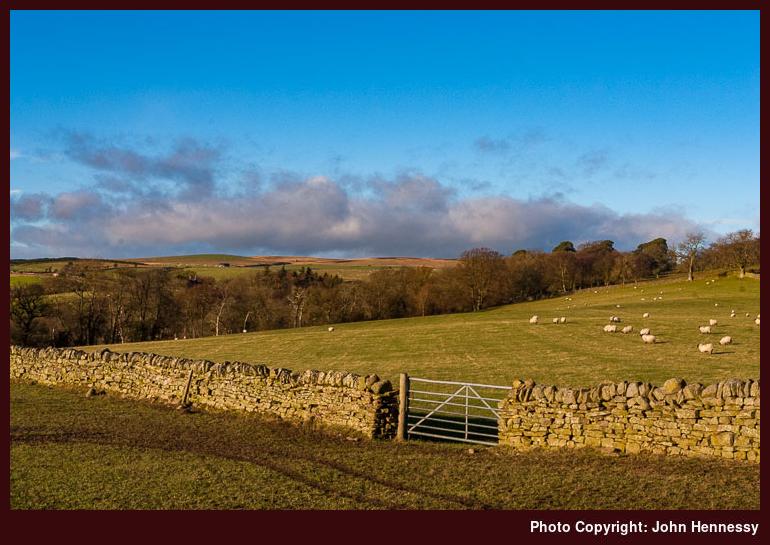
While there, I took a stroll along a short section of the Pennine Way out as far as Hareshaw House before returning on another public footpath. The ramble took me into and out of the Northumberland National Park, which excludes Bellingham for some reason. Unsurprisingly given the weather that we have been having recently, muddy stretches abounded, and extra care was needed when going through any gates: I still retain the memory of having mud up to my left shin after a careless step while following the Dane Valley Way as part of a walk from the Cat and Fiddle Inn in Cheshire to Rushton Spencer in Staffordshire around this time of year in 2004. On my way back to Bellingham, I followed what clearly was an alignment of some sort, almost like the bed of a railway track and raised in places. However, its bridges over streams have not survived, so some diversions proved necessary; I still returned to Bellingham with an hour to spare, time that allowed me to savour some walks along the North Tyne (which joins with the South Tyne to give, you've guessed it, the same River Tyne that flows through Newcastle-upon-Tyne: they don't seem to expend much energy naming rivers up here) before the light faded completely.
I only got to savour but a small sample of the countryside that surrounds Bellingham, so there is further potential for walking trips. And I think that I need to find out more about the area as well...
Exploring the Pennine Way
3rd November 2006 Last Sunday was not the first occasion that I walked along part of the Pennine Way; I already been along different sections at different times and in no particular order. Given that its southern terminus is at Edale in Derbyshire, not that far from where I live in Cheshire, my acquaintance with the long distance trail should come as little surprise. Last Sunday took me from Torside reservoir towards the Snake Pass but a sunny Saturday in September 2005 saw me journey along the Way as part of a walk from Edale to Glossop. Before that, I journeyed from Marsden in Yorkshire to Hadfield in Derbyshire, taking in another part of the way on a day that started out glum and ended up glorious.
While all that means that I trotted along most of the way between Marsden and Edale, there are other short sections on which I have been as well. For instance, in July 2002, I walked from Hebden (near Grassington in the Yorkshire Dales) to Malham via the Dales Way, Mastiles Lane, other paths and, of course, the Pennine Way. That meant that section between Malham Tarn and Malham has been visited by my boots. Another short Yorkshire section that has received attention from my boots is that around Pen-y-Ghent in Ribblesdale: the Way goes right over this member of Yorkshire's three peaks (not ideal for tired legs at the end of the day, then).
Reviewing this uncoordinated series of visits has got me thinking: what about a concerted effort? I am not talking about doing it all (or the parts that I have yet to encounter) in one hit but planning to complete it in sections rather than the hotchpotch approach that I have taken to date. For instance, I have been looking a hill day staring in Marsden and heading to Littleborough, Todmorden or Hebden Bridge, depending on how fit I feel and the length of the day. Another thought is to have a look at the northernmost sections around Bellingham and Kirk Yetholm, its northern terminus. Both are reasonably accessible with regular bus services. Then there is everything in between; Terry Marsh's Pennine Way (published by Dalesman) and a good deal of travel planning will help to make inroads on that front. This venture would take me into areas where I have to encounter and some that where my encounters have been so fleeting that they may as well not have happened at all. Alfred Wainwright (of Pictorial Guides to the Lakeland Fells fame) may not have liked this long distance trail but the idea of completing it all or just seeing more of it seems an appealing prospect to me.


