Category: Trip Reports
Following Derbyshire’s River Derwent
 10th May 2009
 Every so often, the idea of Sunday passage through the Chatsworth Estate would rear its head, only for it not to happen on the day. It had occurred to me that I hadn't been over that way for a while, so a return was in order. The longer evenings now mean that a later departure still leaves a chance for a few hours of walking so long as you are not venturing too far away. Thus, an early afternoon getaway did the needful, so there was no need for a manic morning, never a bad thing.
Speaking of the morning, that could not have been more delightful but clouds and the unfulfilled threat of an afternoon shower began to pervade by the time that I left Macclesfield. Going east recaptured blue skies before the clouds caught up with me again. Saying that, the day retained its mild and springy feel throughout with the sun not getting locked away all the time.
There was an ulterior motive for going with a gentler option. I managed to acquire a pair of Meindl Burmas in the January sales at a well reduced price and I want to start making regular use of them in place of my rather voluminous Scarpas. They fit me better and don't seem to be having any untoward effects on my feet or ankles. There was a little soreness in the soles of my feet on reaching Matlock, but a spot of rest allowed that to dissipate very quickly. This was their first big outing and it was over solid surfaces too so I will not be hypercritical at this stage. In truth, I probably didn't need boots for this walk at all, but level and easier terrain makes more sense to me when it comes to breaking in new footwear.
Roads were busy around the Derbyshire Dales when I reached Baslow for the start of my hike and they were no quieter around Rowsley. Chatsworth was busy too, so this was not going to be one of those quieter hikes. You could attribute some of this bustle to the proximity to places like Sheffield and Derby on a pleasant day, but another attraction presented itself too. Once I got away from the road, things were quieter with some folk about. Things started looking busier again as I came closer and closer to the big house. Cricket was being played, and many cars were parked on the lawns by the Derwent and in front of the house. There was a hint of something else afoot too: the burbling of a TVR V8 engine. Chatsworth was playing host to its annual TVR Car Club meet and I never saw so may of those cars together in all my life. Occasional sunshine was the weather's offering as I passed the way, not getting too caught up in the throngs. The main estate road was as busy as a major road during rush hour traffic so it took me a while to get across it. If I had wanted quietness, I picked the wrong day and it wasn't until I passed Calton Lees and its car park that I emerged into quieter environs. Saying that, I did veer off the right of way proper to avoid the constant passage of people going to and from that car park.
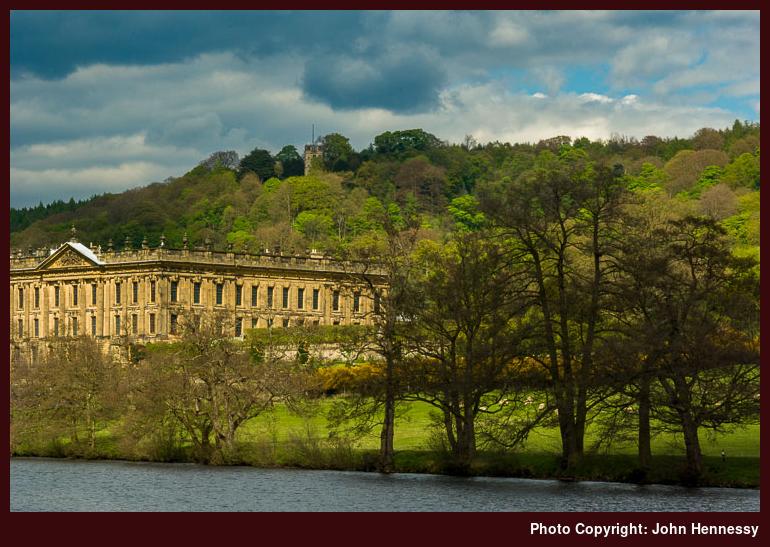
The Derwent Valley Heritage Way on which I had been travelling since Baslow was still well travelled, but numbers were by now in single figures. The well trodden turf simplified navigation as I progressed from field to field before briefly entering woodland to emerge onto a defined track. Before too long, I was in Rowsley. It's a pretty sort of spot but finding the continuation of the DVHW might confound the unaware. The trick is to head for the old railway station and enter the woodland at the end of the car park. After allowing some cyclists pass (they probably shouldn't have been on the narrow path but I don't believe in starting needless arguments while out and about), I was on less frequented terrain. Road noise from the A6 may have shattered the peace a bit, but I was to get away from that too, after the short hop to Northwood, the terminus of the preserved Peak Railway, formerly part of the old Midland Railway to Manchester.
Emerging into Darley Dale took me away from the A6 and through fields to Churchtown and Darley Bridge. Field wandering with some tarmac bashing was the mainstay for the rest of the journey to Matlock. The sun was back in control by this time, but my mind was filling with thoughts of making my way back home so I pressed on rather than dawdling in the evening sunshine. As I neared Matlock, more folk were encountered but they were no encumbrance to me. I could have stayed on the DVWH all the way to Matlock's train station but I decided to leave it to be sure of my bearings and my bus home. Ironically, that left from the train station anyway, but it's always better to be sure than sorry. A good few hours had been spent, even if quietness and wildness was far from being the order of things on the day.
Travel details:
A GMPTE Wayfarer ticket very conveniently covered all my travel costs for the day; just scrape the appropriate panels for the date and you're away. Buses conveyed me to Baslow (Bowers' 58 & TM Travel's 218 with a change at Buxton) and from Matlock to Stockport (Trent Barton's TransPeak & 199, again changing at Buxton) for a train home.
Weaving a way beneath many a height
6th May 2009 The idea of going over the hill from Dolwyddelan to Capel Curig has lain in my mind for a while, with one attempt at doing it being scuppered by railway tardiness. It only takes a few hours, so that makes it a viable option for a short winter's day. With the extra daylight of a spring day, I decided to extend it as far as Llyn Ogwen. That made it a lower level walk around and by a number of hills. First up was Moel Siabod with the Glyderau and Carneddau coming later.
The name Dolwyddelan means the meadow of Saint Gwyddelan; I suppose that Ireland's proximity made for many a Gaelic incursion into Wales, and this Irish saint was yet another of them. It's certainly well located in pretty and tranquil countryside with its castle too. That appears not unlike the one near Llanberis, but I never glimpsed it on this walk but rather on a train journey to Blaenau Ffestiniog instead. After spending a little time organising myself, I made my way from Dolwyddelan's train station to the track that was to carry me to Capel Curig.
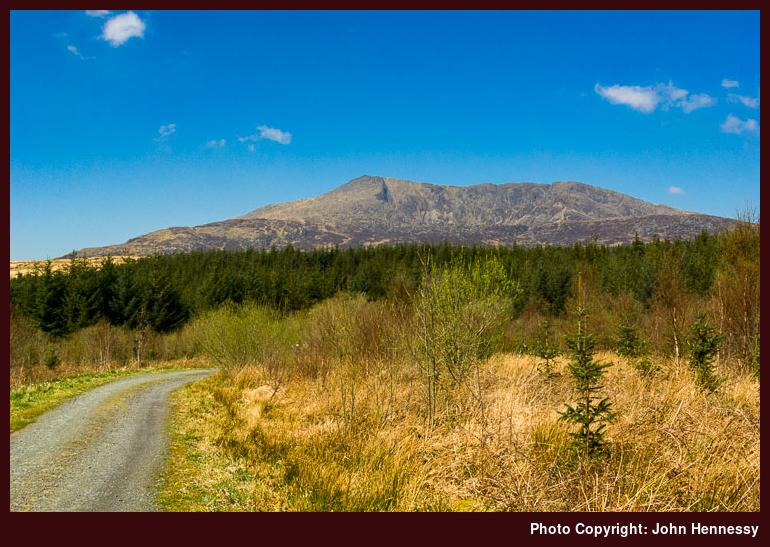
The climb from the A470 is a keen one that can easily take your breath away. Initially, I was a little unsure of my navigation, but it soon enough started to fall into place: I was where I thought I was. My progress was set to be through forestry for a while and with enticing views to Moel Siabod in the morning sun too. Others were about, yet it was no throng, just a mixture of gentle strollers from my home country and other more active walkers like myself. Even with a good deal of camera action on my part, I wasn't to be deprived of my personal space for a spot of reverie. A tempter turned up in the form of a sign saying Moel Siabod, but this was left behind me in favour of my planned itinerary.
The forest may not have been overrun, but things were even quieter after I left it for some open hillside. Cloud had bubbled up and was obscuring the sun at times, yet my descent to Capel Curig was far from unpleasant. After some tarmac bashing, I was back on softer turf again with a plan to follow a public footpath all the way to Plas y Brenin before crossing the A4086 to join a bridleway heading towards Llyn Ogwen. In the event, I ended up on the A5, perhaps because of a lack of clarity on the ground. In hindsight, that may have been just as well because it alerted me to the heat of the day, the strength of the sun and my lack of a hat.
On my way to the A4086 junction, I passed one outdoor emporium, a former service station by the looks of things, and was kicking myself for not realising my want. Since there were two at the aforementioned junction, that was no travesty, and a hat was duly acquired. In a departure from my usual habit of using peaked caps, I went for something more substantial with a good wide brim all the way around. Having the extra protection that this sort of thing provides has been in the back of my mind, and it isn't before time that I finally took the plunge. The new acquisition was a Trekmates item and features Gore-Tex for keeping off the rain too, while a chin strap stops the wind from carrying it off on me. Somehow, I have a certain feeling that it will see a good bit of use.
With an ice cream in my hand and the new hat on my head, I set off along the bridleway to Llyn Ogwen. As I rounded Cefn y Capel, I gazed across the A5 towards those places through which I have wandered on previous walks starting from Capel Curing. One of these took me around by Llyn Cowlyd on a day when the hills conspired to collect clag while all about them was sunny. By the time that I had passed Moel Eilio to reach Coedty reservoir, the weather had improved to produce a fabulous evening that would have been an incredible predication earlier. Even the humps and bumps of the Carneddau that I could see had cleared. If my memory serves me correctly, I believe that I may have ended up in Tyn-y-groes before a combination of buses and trains returned me home. That wasn't the only stroll staring from Capel Curig that landed me in the Conwy Valley with another hike that I think finished in Trefiw after passing Crimpiau, Llyn Crafnant and Llyn Geirionydd. Now that I cast my mind over these past excursions, the haziness of my recollections is in stark contrast with anything that I have shared through this blog. Things that you find on here may be for sharing, but setting something down in writing does mean that you still have it for jogging your memory afterwards.
Looking over a map searching for those past excursions does make me wonder at how contorted some of the routes were. These days, I tend to appreciate the idea of less intensive footpath navigation, with episodes like a recent amble from Congleton to Leek perhaps being the exception. The track that I used to get from Capel Curig to the shores of Llyn Ogwen was very much of the clear and relaxing variety. Traffic from the A5 was surprisingly not so intrusive at all, and I only started to encounter humanity again at and after the campsite at Gwern Gof Isaf. The sky was hazy at times, and clouds often intervened to provide respite from the heat of the sun. Picking out one hill from another, especially on the opposite side of the A5, was a tricky endeavour and I think that I need to get in among them to be really sure. Looking at maps now reveals an intriguing route to the top of Carnedd Llewelyn via Y Braich and Pen Yr Helgi Du, so there's some scope for a spot more exploration around here and much of the countryside is Open Access land too.
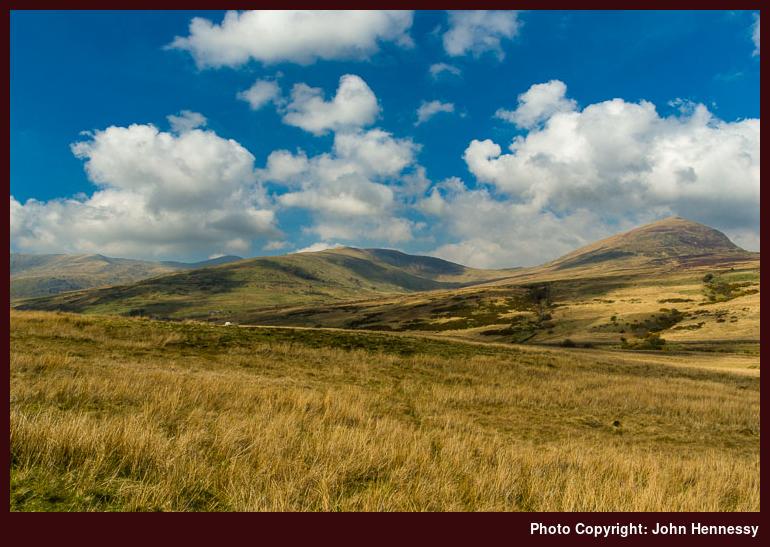
There was another campsite to pass before crossing the A5 not far from the craggy buttress of Tryfan; I was very much approaching countryside that I have visited before. The path along the lower slopes of Pen Yr Ole Wen and above Llyn Ogwen had less of the clarity of the track that brought me to Nant y Bedlog. Once past the farmstead of Tal y Llyn Ogwen, conditions underfoot were often boggy and another way of losing any line of any path was over rocky portions. Broadly heading in the right direction was the approach that I adopted, so my remaining on the right of way probably was a hit-and-miss affair. The clambering that was involved on my return to tarmac convinces me that I couldn't have got it right, and that walking it in the opposite direction mightn't be such a bad idea. Even so, any time spent looking across the lake at Tryfan easily compensated for any effort, especially when the sun escaped from behind the copious quantities of clouds that were by now filling the sky.
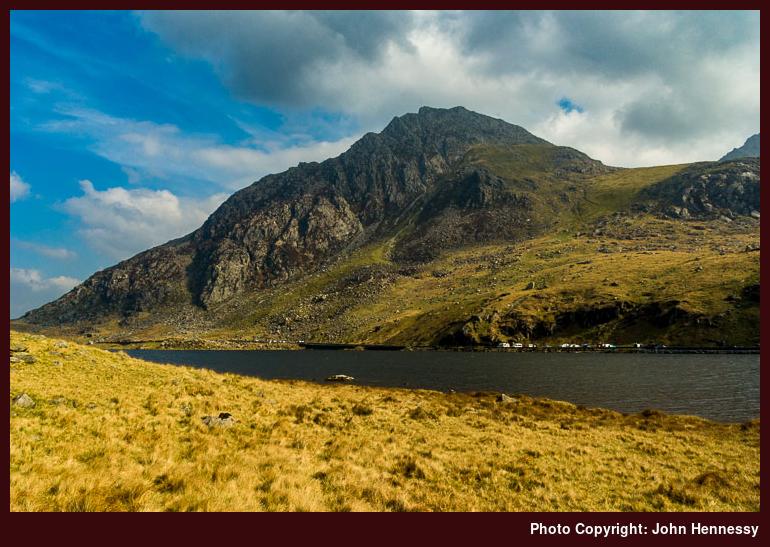
My walk was completed with time to spare before the next bus to Bangor was due, never a bad thing and much better than being in a major rush. After acquiring some refreshments, I certainly had the time, even with a coach load of young people nearly overwhelming the small shop, to go confirming my suspicions about some of my route finding, but the thought never even entered my head. Instead, I ventured along the path towards Llyn Idwal, another spot familiar to me from previous visits; I have walked from here to Llanberis by way of the Devil's Kitchen path and Yr Aran and in the reverse direction using a different route that omitted the said hill. Time wasn't sufficient for me to get to the cwm but a some more photographic action was allowed before I made sure of catching my bus, the last one of the day going to Bangor in fact. Not reaching a small target that may have come to mind late in the time was no bad end to what had been a good day out and casting an eye over maps since then has added more ideas, including a higher level route around the Glyderau, that can be held over for other opportunities that may come my way.
Travel Arrangements
It might have been an idea to get a rover ticket for this one, but it wasn't such an extortionate journey anyway. A train journey got me to Dolwyddelan, with changes in Manchester and Llandudno Junction. The latter allowed for some photographic activity and the purchase of a hot bacon butty. The S6 Snowdon Sherpa service operated by Silver Star conveyed me to Bangor, from which another train journey got me home, with changes in Crewe and Stockport.
A first outing among the Cairngorms
30th April 2009 The trouble with going somewhere for the first time is that you need to decide what to see. That reality is heightened when there are so many options that there is an embarrassment of riches. My Easter visit to Aviemore was a good example of this last point, in every way. The weather could not have been better so it would have been a pity to waste that too. Having only a day available to me for on foot explorations meant that making best use of it was very much in mind.
In the end, I opted for a walk around the Rothiemurchus Estate to savour as many sights as possible. Leafing through Ronald Turnbull's Cicerone guide, Walking in the Cairngorms, revealed a tempting option in the shape of Creag Dhubh and the Argyll Stone but I ruled out the idea of a quick ascent of a single hill in favour of a deeper incursion that took in more of the surrounding scenery. The prospect of a trot up Gleann Eanaich was also sorely tempting but I, perhaps erroneously now that I look at it again, thought it to be too confining an idea. It might have its difficulties at the time but leaving something for later has its rewards when one idea unleashes many more.
Getting from Aviemore to Inverdruie meant facing progress over tarmac. However, a short off-road crossing over the Spey and the presence of useful roadside footways provided some relief, as did the ambiance of a sunny morning. Inverdruie was where I left tarmac after me for a while to pick up a pleasant footpath through heather-carpeted heath with a good scattering of pines. That took me by Lochan Mor where I lingered a little while I enjoyed the pure idyll that was on offer. It's the sort of spot where you could stop all day in the right conditions but I was minded to go further.
At Milton Cottage, I met up with tarmac again and watched with some amazement as a truck negotiated a narrow bridge with some difficulty before I continued to Loch an Eilean after it had passed. At the loch, where tarmac was left after me until evening and I could have got to Creag Dhubh from here if that was my plan. The tracks are good and were playing host to cyclists as well as walkers, so a certain state of alertness was very much in order.
Another meeting of tracks was where I might have turned for Loch Eanaich (or Einich if you prefer; the OS uses both spellings) and the crags above it. They certainly look dramatic on OS maps so I suppose that they are yet another addition to the ideas shelf. I stayed my course to pass Lochan Deo and crossed Am Beanaidh using the Cairngorm Club Footbridge. My onward progress was to have me shadow Allt Druidh, as I continued on in the direction of the Lairig Ghru.
After another meeting of paths called Piccadilly, I took the one signposted as being for the said famed mountain pass. It was at this point that I left any gentle strollers and cyclists for quieter terrain. That allowed me a spot of lunch-taking before commencing my ascent. That ascent was steady rather than tiring, but the results of any labours were there to be seen, particularly whenever I looked behind.
However, I wasn't bound for Lairig Ghru; I was happy with a glimpse of that pass and what surrounds it. Instead, the idea of mounting Creag a' Chalamain and Castle Hill became a prospect. Sticking with the Chalamain Gap wouldn't have left me disappointed either. Being mindful of time, I decided against the roundabout route followed by the tracks shown on my map for a more direct and cross-country route. Whatever doubts may have lain in the back of my mind regarding the strength of my legs were dispelled as I made my way up the slopes. It didn't take so long to reach the track that I would have been following if I had been using the route marked on my map.
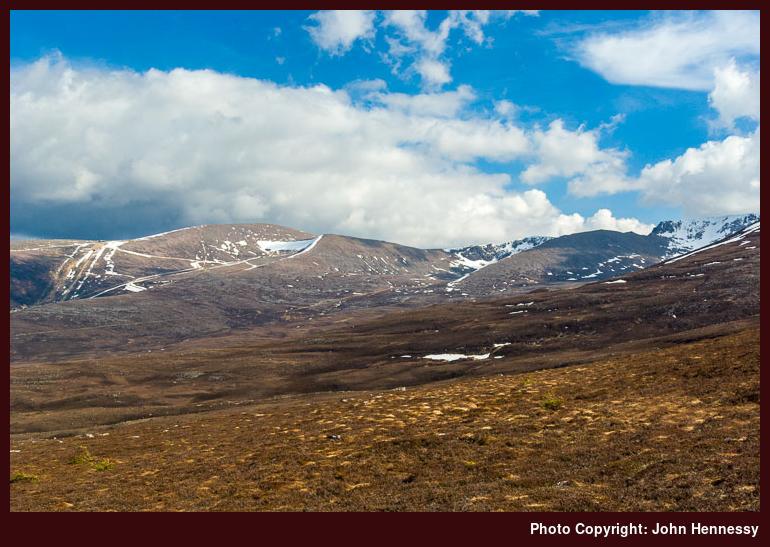
My eventual course to the top of a hill was made all too tempting by the sight of a good clear track up the side of Creag a' Chalamain from the gap. The reward for my energy expenditure was ample views of all that lay about me. The experience laid the seed of an idea for resolving hill identification questions, an occasional bugbear of mine: to work out what hills feature in one of your photos, get on top of one of them to simplify your view of the landscape. Cairngorm and Braeriach lay among the cornucopia that lay about me. Both were holding on to snow with the latter really succeeding in its hoarding of the white stuff. By staying lower down, I was avoiding any such difficulties.
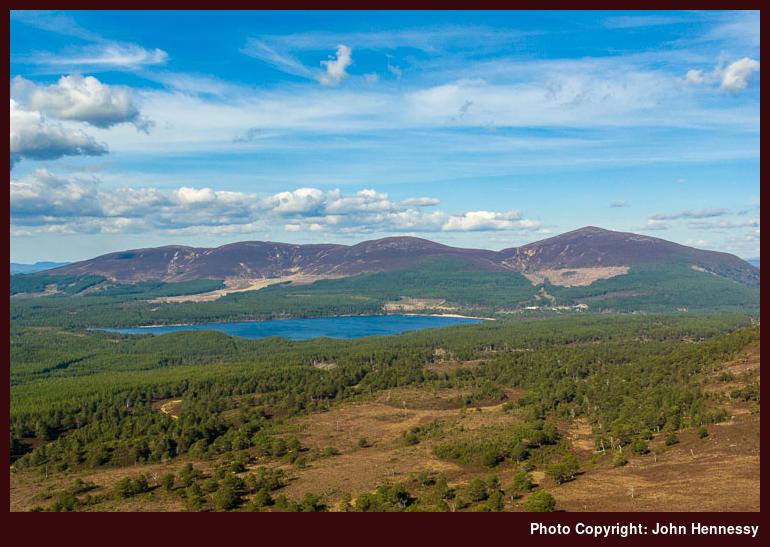
Hopping over to Castle Hill didn't cost me much in labour or in views either. Loch Morlich and Lochan Dubh a' Chadha lay beneath me with lower hummocks like Airgiod Meall, Craiggowrie, Creagan Gorm and Meall a' Bhuachaille being easy to pick out from the map in my possession. I probably should have dropped into Eag a' Chait to pick up a path to Rothiemurchus Lodge, but my meandering course took me further east around the hillside before I gingerly picked my way down a steep slope to join an alternative track to the same place. This was to be no exact route march and I didn't mind so long as I knew where I was and remained safe; there are bigger worries in life than whether a route was followed exactly or not.
Given that I was now on more level terrain, I snatched some time for a breather after Rothiemurchus Lodge before scotching any ambitions to visiting the shores of Loch Morlich in favour of a return to base. Ironically, my route back to Aviemore was to take me not far from the said loch before I headed along another track to join the one that I had been using that morning. Somewhere along the way, my brain had jumped a time zone to CET, or double summer time if you like, to reduce the perceived amount of time that I had until the light failed. This silly development would have been worse if it lured me into a false sense of security so I'll be more careful in future. It might be after so many years with digital watch faces that using one with an analogue style has not become second nature to me just yet and I've had it a few years. Still, the last time my brain jumped time zone was on a walk among the Brecon Beacons a few years and the movement was in the same direction and with the same watch too. Maybe, a return to digital displays is in order...
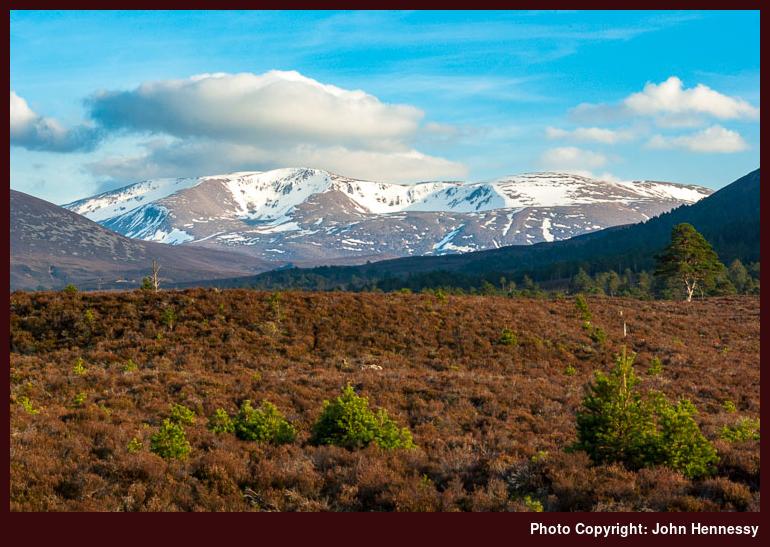
That mental time shift did not deprive me of the ability to enjoy the walk back in the late evening sunlight. If anything, its direction and its warmth of colour suited my surroundings better. Naturally, photographic activity continued as I plied the paths and tracks on my way back to base. That there were less folk about added to the sense of relaxation too as I reached Piccadilly to begin reversing my outward route. From there, it was back over the Cairngorm Club Footbridge, past Lochan Deo to reach Loch an Eilean again. From the latter, I stayed on tarmac for the journey to Inverdruie rather than reprising my earlier off-road route. Traffic was light so I only had to contend with the effects of tarmac bashing on my feet. From Inverdruie, I reversed the way that I had earlier trodden with a stop to give directions to two young ladies in a car wanting the SYHA hostel. It was after they had left that I wondered about having joined them for the sake of giving better directions because that's where I was staying too. There was another cause for that perhaps aberrant brainwave: the tarmac tramping was taking its toll. There was woodland prior to my crossing of the Spey so I pottered along a softer track there for some respite. In the meantime, my brain had returned to BST and I felt a bit of an idiot but was glad to have had the extra hour anyway. It had been the only real howler on an otherwise stellar and long day of walking in Highland countryside with a different feel from that to which I have been accustomed.
It might be the presence of well-maintained paths and tracks along with the mixture of heather and pine trees that covered the ground but I got the impression that this was a drier part of the Highlands than other areas that I have explored before now. Even the higher slopes seemed to possess none of the boggy stuff. That's not to say that I met no messy conditions underfoot because the track that I joined after coming off Castle Hill was very rough, but that was the exception to the norm as far as my hike was concerned. Geology and weather might also have their part to play. After all, the Cairngorms do lie in the east, so the rain-bearing westerlies might have to jettison much of their cargo by the time that they get this far. Then, there's the hand of humankind too. Whatever the causes, my surroundings felt a world apart from the sogginess that I have encountered in the west and that was without the airborne moistness that I have met in parts of Argyll and Lochaber. Yomps from Corrour train station to Spean Bridge and from Loch Awe train station to Taynuilt by way of Glen Kinglass certainly took over sodden terrain but my taste of Badenoch felt very different to this.
From an Easter weekend for which the forecast was none too promising, I managed to extract a decent walk. Having a well-stocked ideas shelf and some spare time meant that a getaway proved possible when things started to look better for the U.K. The rain stayed in Ireland to saturate the countryside and annoy people like my father. I suppose that it sounds perverse to have some gaining from the discomfort of others and it's not the first time that I remember that happening but I suppose that's life.
Having possibilities is all very fine but I have found that they can cause indecision and delay too. That's when I find that having an informal pecking order helps and having not walked in Scotland for a little while pushed the Cairngorms plan higher up the wish list. Saying that, it helped that it was possible to book a place to stay at the Aviemore SYHA too. Having that option open to me meant that unexpected good weather wasn't left to go to waste and more ideas not populate that walking wish list either. Those may form part of a longer visit yet, but that's only a pipe dream right now.
Travel Details:
Whichever way that you do it, this is a long schlep from Macclesfield. It's the sort of journey that makes the Caledonian Sleeper an appealing idea were it not for the cost. Still, if you allow the time and avoid engineering works, a return train works out well enough if a little on the expensive side. Travelling at Easter, as I did, meant that engineering works on the West Coast mainline sent me around by York to Edinburgh before continuing to Inverness. Logistically, I needn't have done it on the way back, but return ticketing was probably best from the cost point of view. Flying is another idea, but times aren't always in your favour and I'm not certain how they'd cope with walking poles unless a duffel bag came too. Of course, there's the environmental consequences to be considered too. Sitting back on a train with a music player and something to read isn't so bad, is it?
An involved way to cross a county boundary
8th April 2009 Whenever I get to plot an outdoors outing, I almost invariably turn to maps for ideas. That's not to say that guidebooks don't get perused as well, but there's something very immediate about casting one's eye over a map. Scotland's enlightened access legislation means that any track can be fair game, but more care is needed south of the border. In fact, I have had enough experience of the English and Welsh rights of way network that a growing distrust needs to be confronted, but I use any path. I need to be careful not to overdo things, but anything that looks unpromising could be left for another route. The sorts of things that leave a poor impression are rickety styles, poor waymarking and overgrown paths. A somewhat unpleasant experience last year has got me very wary about complex route finding too near habitations on other people's land.
Anything that's part of a long-distance trail should be fine, but there is a part of the Pennine Way proceeding through fields in North Yorkshire that looks like yet another unloved part of the rights of way network. Saying that, seeing the attention lavished on the Gritstone Trail reassures me more than just a little. The mention of the GT brings me to Staffordshire's moorlands. Yes, there are some neglected parts and I came across them while I was out hiking on Sunday, but a good deal of care is apparent too. I passed along part of the Staffordshire Way, but the moniker "Staffordshire Moorland Walks" is one that is seen a lot on maps for where I was wandering.
These are Staffordshire's answer to Ireland's Looped Walks and have been conceived, very nobly, as a network of self-guided walks by Staffordshire Moorlands District Council. You will not find them highlighted on OS Landranger maps, but they are given the same level of prominence on Explorer maps as point-to-point long-distance trails. That might have the potential to confuse just a little and some may decry the idea of cluttering up mapping, but these remain very useful. Good waymarking makes them more user-friendly, too. As it happened, Sunday saw me traversing portions near Biddulph, Rudyard and Leek but a previous escapade saw me rounding Tittesworth Reservoir with a side visit to Hen Cloud too.
What took me onto those looped walks on Sunday was a yomp from Congleton to Leek. It was meant to be the other way around but for my own muddling and a missing bus delayed my start as well. It also meant a change from my initial plan of going from Leek to Rushton Spencer by way of Rudyard Reservoir and then following the Gritstone Trail for most of the way to Congleton, possibly with an ascent of The Cloud included for good measure. However, the onset of summer time has granted us longer evenings, so sufficient daylight time was available for me to complete the walk. The walk out of Congleton to reach another part of the Gritstone Trail, a section shared with the Biddulph Valley Way, certainly took long enough to bring home to me the size of the town and how far its train station is from the town centre.
My patience on the exit from Congleton was rewarded by a peaceful amble among woodland along a now disused railway line that once ran between Congleton and Biddulph. That embankment was left to pick up part of the Staffordshire Moorlands Walks loop that goes around Biddulph. That stretch took me across the A527 and over the fields to The Talbot in Poolfold. Another road crossing followed and another exit into green fields was found in the said pub's car park. That proved temporary, and I found Country Landowners Association signs bearing waymarks and welcoming caring walkers around The Moor House, perhaps a reassuring touch.
The hotchpotch of public footpath and road walking was set to continue after I left the Staffordshire Moorlands Walks waymarks after me to cross High Bent. My journey took me around by Boons' Meadow Farm on tarmac before I again crossed fields to reach a byway called The Hollands. After another road crossing, I was following field boundaries again. There were copious views at this point, with the familiar sights of Croker Hill and Shutlingsloe visible in the northern panorama. Looking east, I could just about make out The Roaches beyond Gun. There were enough clouds in the sky to ensure that unbroken sunshine was a pipe dream, and my photographic exploits were attenuated as a direct result.
With all the twists and turns taken by my route, I would have been forgiven for tiring by the time that I reached Halfway House. As it happened, I must have missed the footpath for Birch Trees Farm. However, I had mixed feelings about following a right of way through a farmyard, so I wasn't sorry to have passed it and I knew where I was in any case. It may have meant that I needed to contend with motor vehicle traffic for longer than I might have liked, but no major perturbation was felt on my part.
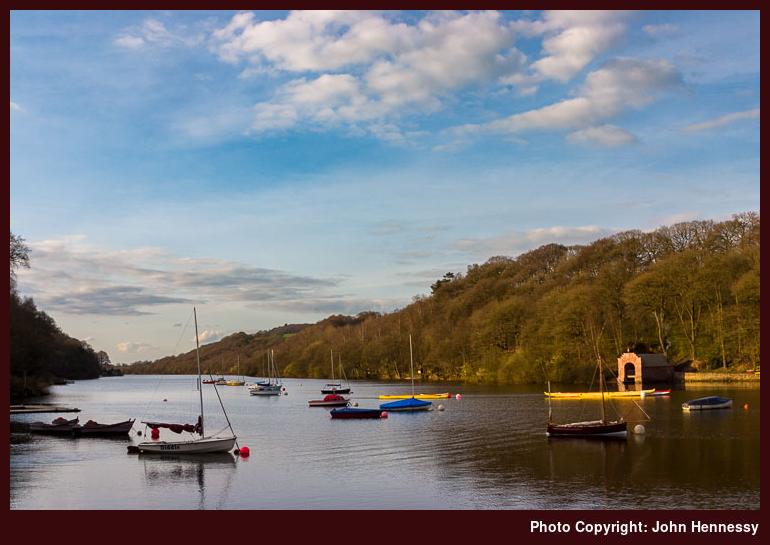
Reacliffe Road was found soon enough at a switchback bend and, a short downhill stroll later, I reached the second loop of the Staffordshire Moorlands Walks for the day. I was bound for Leek, but this is where you would be going for a circuit of Rudyard Reservoir. The quiet wooded lanes and paths were an agreeable way to reach the dam of the said reservoir before I descended to follow its outlet stream for much of the remainder of the walk. There was another uneventful road crossing too, but I was on the lookout for the junction that would see me go along a path that take me under the old Macclesfield-Derby railway line and on to the A523 on the outskirts of Leek. Perversely, the centre of Leek sits atop a hill and, by this time, my legs were telling me that they had done enough for one day as I made for the bus station.
Though the day had its moments of sunshine, they were limited throughout the walk, but that also meant that I wasn't to be scorched by the strengthening sun, never a bad thing. Because of circumstances, the route followed was a tricky one, but it was dispatched with only one unscheduled diversion and that was far from being a hardship. All in all, I enjoyed a good few hours and revisited somewhere where I hadn't been for a while. Many stretches were quiet, too, which helped for a spot of relaxation along the way. Hopefully, the short outing can act as a springboard for other excursions.
Travel details:
Service 38 from Macclesfield to Congleton. Service 18 from Leek to Hanley, followed by service 25 from there to Stoke train station for a Virgin train to Macclesfield. There is a service 108 connecting Leek and Macclesfield, but that is irregular, and the last one had long gone by the time that I reached Leek.
A trot from Tarbet up to the head of Glen Croe
8th March 2009 Thinking back over the various trips where I spent just a day exploring Argyll during a weekend in Scotland, success with the weather has been patchy to say the least. A trek that started from Tarbet and saw me venturing into Glen Loin and a little beyond was on a day that had its share of dampness with showers coming in one on top of another to annoy me by the time I got to Arrochar. Another hike, this time from Ardlui to Butterbridge, was beset also by a dreich dampness. The weather on my most recent escapade presented a good deal of wetness, but there was a sunny interlude in the morning that more than made up for the coming dampness. Later, the rain became near constant, so much so that the constant soakings would make you consider whether you had paid enough heed to the forecast and better controlled your ambitions. Even with the right gear, those wettings still become something of a chore even if you have confidence in remaining warm and dry.
My walk started in Tarbert and a dump of rain was already in progress when I arrived. Having donned my waterproofs in a handy bus shelter, I set off along the road towards the nearby train station. Going under tracks there brought me onto a good Forestry Commission path that was to bring me to the shores of Loch Long and Arrochar. Water may have lain everywhere underfoot, but the weather dried up as I made my way onward. Bright sunshine was very much the order of the day while I rounded the head of Loch Long on useful paths that got me away from the A83. This was a chance for photographic activity and I didn't want to waste it. Summits such as Beinn Narnain and A'Chrois were momentarily clear and brightly lit while other summits like Ben Arthur (The Cobbler) were attracting low cloud from time to time. As if these sights weren't enticing enough, the air was full of birdsong and the calls of seabirds to yield an uplifting atmosphere.
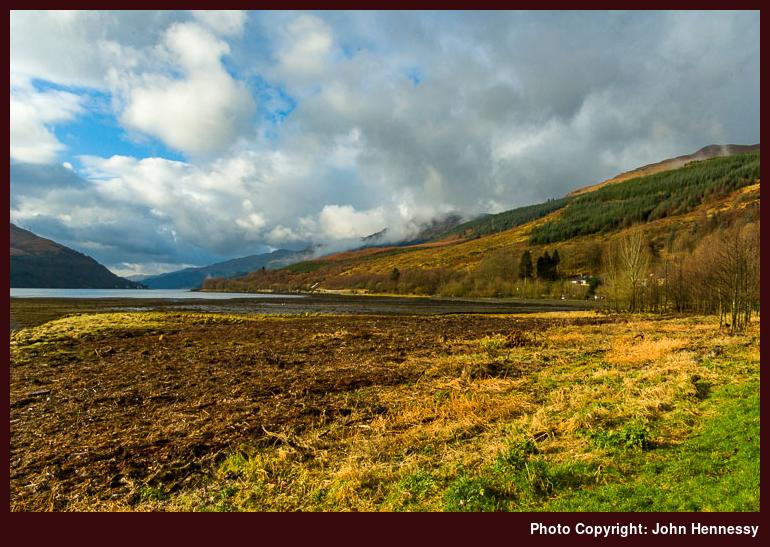
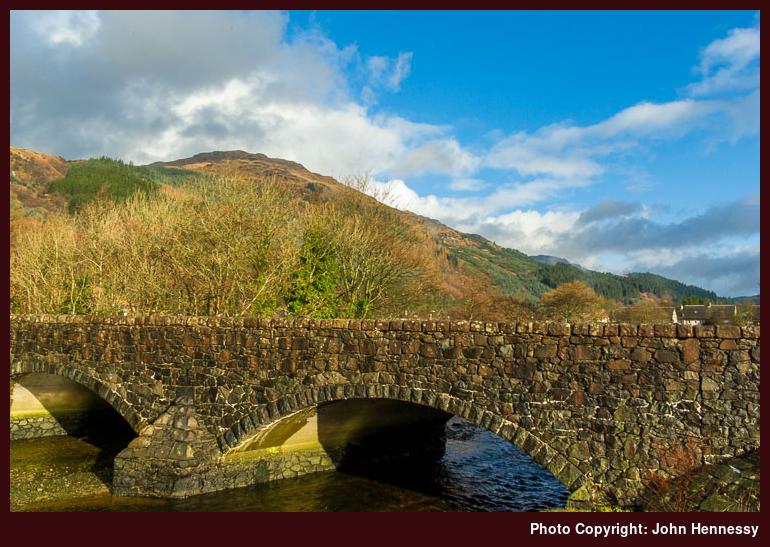
On the other side of the loch, another crossing of the A83 took me onto a well-engineered path that must be the start of many an exploration of the area's hills. Quite why some cut off the corners on this section is somewhat beyond but they may not realise the effects of erosion, particularly with the amount of rain that the area gets and I have very good reason to know that. Soon enough, I reached the track that was to convey me to Ardgartan and leave those walkers who were headed for greater heights behind me. The upper slopes above me looked temptingly manageable but I had no designs on reaching summits and managed to scotch the idea even with my passing a path leading to those heights. Even if I did have ambitions to reach hilltops, the prospect of clag and rain might have gone some way to attenuate them.
That track turned into a path that had its share of ups and downs as I turned the corner to leave the coast to journey along Glen Croe. Clouds were becoming predominant in the sky by this time and dampness soon followed my reaching Ardgartan. The visitor centre and its public conveniences were closed, making me wonder if opportunities were being missed. Though this is one end of the Cowal Way, there were no leaflets was that long-distance trail available but, oddly, those for the Kintyre Way were. I wasn't bound for Lochgoilhead so I eschewed the Cowal Way to stick with the idea of hiking up Glen Croe to Rest and Be Thankful as I had planned.
Because of my needing to catch a bus back to civilisation again, I was concerned about the time needed to complete this part of my trek. However, my fears were groundless because I had plenty of time to wait before that bus came. The fact that rain continued to fall as I plied my way along a good forestry track was probably a help because it ensured that I kept going without any long stops; photography stops are not so plausible under grey skies anyway and you don't mix rain and cameras if it can be avoided. There was a steady ascent with Croe Water below and just to the north of me, so some short stops were made. Saying that, the gradients weren't too taxing either. Other paths leading off to higher slopes were passed with one leading to The Brack and another passing through the hills to Lochgoilhead that I had spotted on a map a little while back. There were track junctions too but they posed no navigational challenges and I could tell where I was from the hills that lay across the glen from me. Seeing the cleft between Ben Cobbler and Ben Luibheann was reassuring and the B828 was reached after negotiating a track made muddy by forest operations. The snow-covered summit of Beinn an Lochan was ahead of me and gazing to the south-west led my eyes to look upon Ben Donich. From there, it was a short hop, even for tired legs, to Rest and Be Thankful.
Many of my Scottish excursions have taken me past Rest and Be Thankful and coming upon the trough that is Glen Croe from the Inveraray side without warning results in the sort of attention that may explain why the place was a resting point for the cattle drovers who gave it its name. That surprise may have something to do with the more gradual nature of the ascent from Cairndow and the flatness around Bealach an Easain Dubh. Being the lofty vantage point that it is, Rest and Be Thankful earns itself the obligatory car park but little else in terms of facilities apart from visits by a mobile snack van, a fact that was brought home to me when I received a wetting while adding my coach. In view of the droving history, I find it unusual that no one ever tried starting up an inn near the vantage point. Though I did enjoy some dryness and saw some spouts of sun while I was there, I am inclined to think that there may be a return at some point in the future when conditions are drier; the wetness was a distinct contrast from what I encountered while rounding the head of Loch Long. I believe that seeing Glen Croe on a good day when sunshine makes the most of the landscape would be more than worth the effort, as would a deeper exploration of the hill country of Ardgoil.


