Category: Trip Reports
A last blast of winter?
 3rd March 2009
 Whatever my views on the meteorological months of winter might be (if I had my way, I would bring everything forward by two weeks but I digress), it has to be said that we have been having one of the colder ones with milder spells like those that we got last month and the one before becoming more like exceptions in the memory. Dumps of snow are forecast for Scotland but getting snow in early March isn't so strange and it has happened a few times in recent years. In fact, last year saw us getting a white Easter at the end of the month.
Speaking of Scotland, I actually managed to spend a bit of time up there over the weekend. In fact, Sunday saw me out among the hills around Tarbet, Arrochar and Glen Croe; my walk took me from Tarbet to Rest and Be Thankful. While I was lucky to get some spring sunshine early in the day and got to hear birdsong filling the air, there were prolonged rain showers wandering the hills too. In the afternoon, they started to come in one after another, so much so that leaving for greater shelter seemed the most sensible option when I did so.
I'll tell more about that escapade later, but the transition from snow to mildness to soaking rain to snow again is a striking one, especially when you start getting to think about what unstable snow packs can do. Snow seems to have left the Cheshire hills that I can see from my house and the forecast shows no sign of it returning to them this time around. In many ways, it has been an amazing winter and one that I'll continue to remember, at least if those late springs and early summer days deliver the weather goods appropriate to showing off their wares.
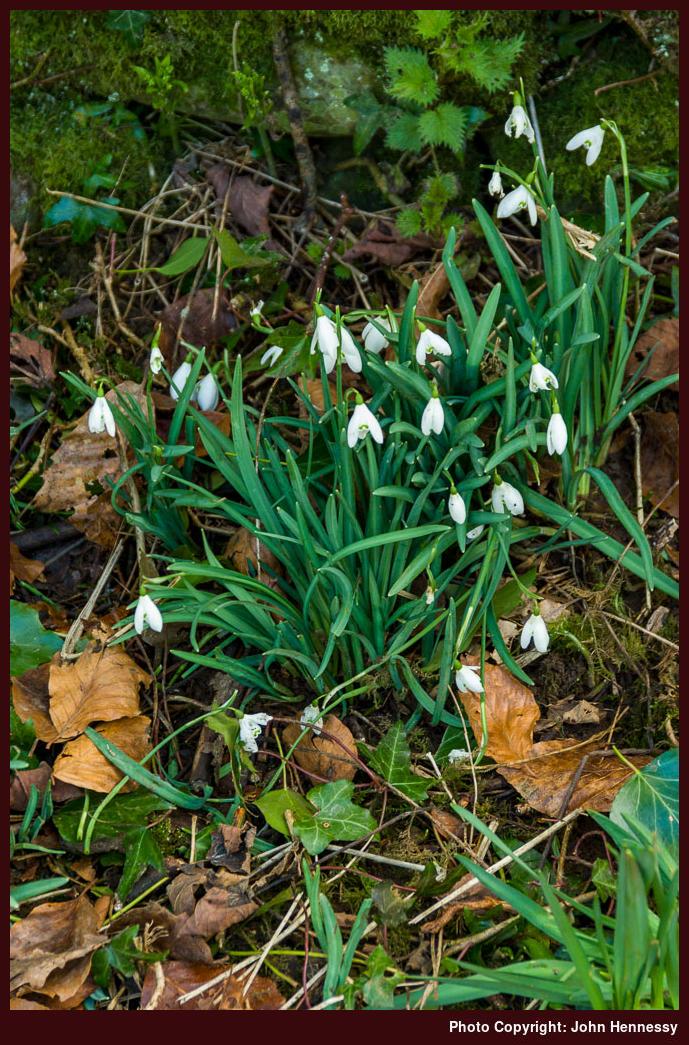
Update 2009-03-05: A dusting of snow has been granted to us but it's inconsequential in the lowlands. Peering into the hills though reveals a greater covering.
Encircling a cloud shrouded Moelfre
28th February 2009 By the end of last week, I was gagging for blue skies and sun so, being the outdoors type that I am, it was maybe inevitable that I would find myself among hills at the weekend if there was a chance of any sun on offer. Suitably enough, Saturday was offering, and my mind turned to another excursion into Welsh hill country where I hadn't been for over a year and a half. I was to spend a few good hours in the vicinity of the Rhinogs with low cloud stopping any ambitions to ascend a hill in their tracks.
That's not to say that there wasn't sun too, but the clag attenuated things somewhat. On the train journey from Macclesfield, I saw plenty of sunlit hill country while we crossed Shropshire and I might have been tempted to stop off at Caersws at the same time as another bunch of walkers if the Rhinog plan hadn't crystallised strongly in my mind. From there to the west, great wads of cloud were about and often obscured the sun too. The skies were clearer after passing Machynlleth and I assumed that Cadair Idris was in part responsible for the lumps that pervaded overhead. Still more were ahead of me after reaching Dyffryn Ardudwy, following a journey that took in busy trains. An alternative culture event (manga or anime, anyone?) in Telford certainly drew folk in droves, but the school midterm break might have it hand in this too. Things were set to be far, far quieter on the return leg.
The first thing that I needed to do in Dyffryn was acquire a map, a need that is so unlike me. Having maps is a task that is always on the to-do list, so this mishap was unusual. Nevertheless, I soon fulfilled my needs in the Village Store and I was very grateful for the chance. Needing to get a new map was not even close to the end of the world, since I do have some ideas worked out in my mind anyway and the one that I already had did predate the advent of the Open Access areas that allow such peace of mind in exploring more remote parts. Saying all of that, I would have felt very "naked" without one and it's certainly not something that I'd leave to chance again.
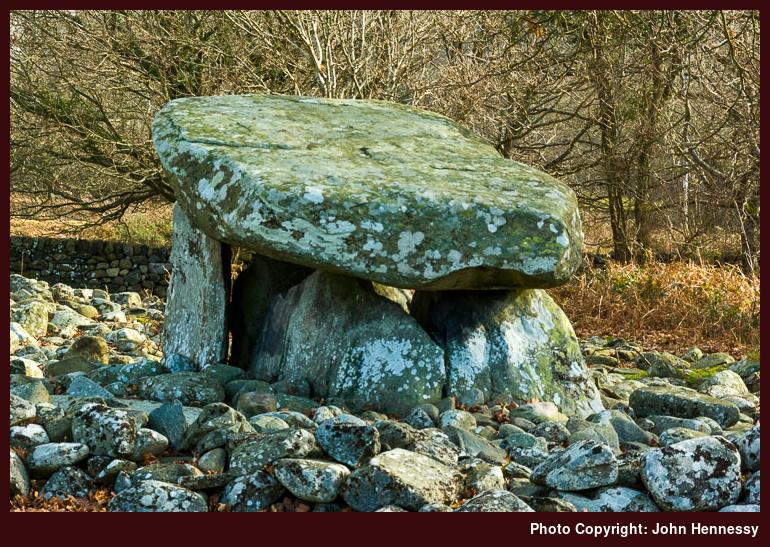
My cartographic needs duly fulfilled, I set off on my wander. My first stop turned out to be burial chambers of a type that is familiar to me from Ireland. We call them dolmens and it was intriguing to see similar constructions along the west coast of Wales, even if they were not of the same size; our ones are capped by boulders that cause one to wonder how they were placed where we find them at all. After that piece of prehistory, it was back to the modern task of hiking along public footpaths and quiet roads.
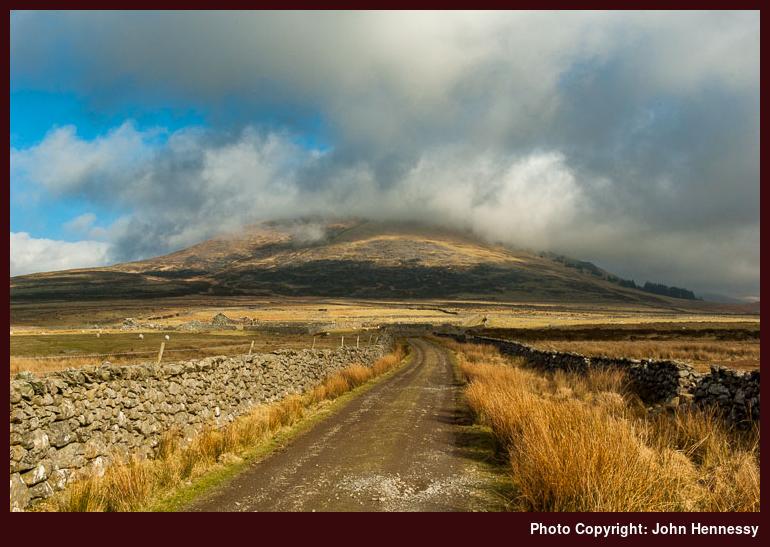
The tarmac mercifully ran out after Cors y Gedol Hall to be replaced by a hard core track. Behind me, I left the coast while the countryside in front of me contained significant and not so significant attractors of clag. Moelfre was one of these while Diffwys was shrouded too. On a fairer day, the temptation to mount the latter might have been there, but the shrouds kept ambitions on a short leash.
I stuck with the track bound for Llyn Bodlyn until it passed the summit of Moelfre and I then began to ascend its shoulder after that few kilometres of gravel bashing. A sound grassy hillside more than capably replaced it and I continued until I found the wall through which I was to pass before taking a left turn to motion towards the top of Moelfre. As it happened, I decided not go all the way to the top. Standing in the midst of murk didn't seem worth the effort and there were rather more stone walls about than was suggested by my OS map. I probably had the best views anyway and could see Llyn Erddyn across the valley from me.
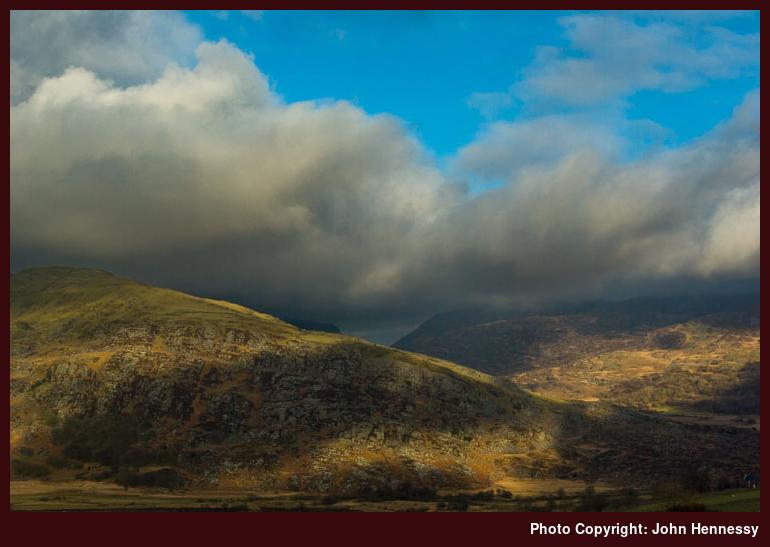
Having satisfied myself, I began my descent to reach a bridleway that I had intended to use. My northbound course took me from one valley to another and with new hills to see. Foel Ddu lay across from me while Rhinog Fawr, Rhinog Fach and perhaps Y Llethr nestled behind lesser bumps. These heights weren't so clag-bound as those that I had been seeing earlier, but cloud remained abundant, limiting sunshine to spouts from any openings.
Once the bridleway had returned me to tarmac, I had decided to start returning to Dyffryn Ardudwy using a mix of quiet single track roads and rights of way. The tarmac element was well gated to keep sheep where they were put, so the possibility for any traffic was much reduced, so the countryside still could be enjoyed and admired without there being any interruption. Looking at the map now, I suppose that going to Llanbedr might have made more sense, but that wasn't what my train ticket said so I stuck to the original plan. Not long after passing Moelfre, the sun escaped from the clouds to yield a magical display and allowed time for a spot of photographic activity. It didn't last so long though, which was probably just as well since I needed to continue on to bring a good day's walking to an end before night fell. Sun and blue skies may have been in short supply at times, but there was easily enough of both to keep me happy.
Travel arrangements:
Return train journey to Dyffryn Ardudwy, changing at Stoke-on-Trent, Wolverhampton and Machynlleth on the outbound portion while the return trip only involved a change at Wolverhampton.
Sampling Wicklow’s hill country
22nd February 2009 As promised, here is the fuller account of last weekend's walk on the fringes of the Wicklow Mountains. Casting my mind back to over a year ago, I remember getting around to thinking about investigations of the hill country that is within reach of Dublin. At the time, I was trying out Trail Master digital mapping from the OSi and began to construct possibilities in my mind as I went. Then, the possibilities that I was surveying centred around Marley Park, the northern end of the Wicklow Way, and the Dublin Mountains.
When I did get my chance for a few hours among those hills, it was further south that I ended up going. The area about Enniskerry and Powerscourt looked promising, but I plumped for Kilmacanoge and the Great Sugarloaf given the time that I had for an early morning outing. Since it was also my first outing to the area, it was best not to get too adventurous and limit my exertions to getting a feel for somewhere where I hadn't been before and going up a relatively accessible and low-sized hill on paper seemed to serve the purpose with its location garnering it panoramic views west into the main block of Wicklow hill country and east over Little Sugarloaf (342 metres above sea level) and Killiney Bay.
I was to discover that those vistas were very much there to be enjoyed, but my opportunity allotted me a grey day for my dander. In fact, my early start ensured that I was made very much aware of the dark greyness, with my camera meter indicating that long exposures were the order of the day. Not having visited the place before meant that my escape onto the slopes wasn't going to be a tidy affair, and no signposting was in place to correct any aberrant wandering off course; it's best not to expect too much of the walking infrastructure in Ireland. Even with more road walking than was really needed, there was plenty of time left for off-road wandering. In fact, the road bashing gave something of a feel for my surroundings before I met the track that I was to use to start my way uphill in earnest.
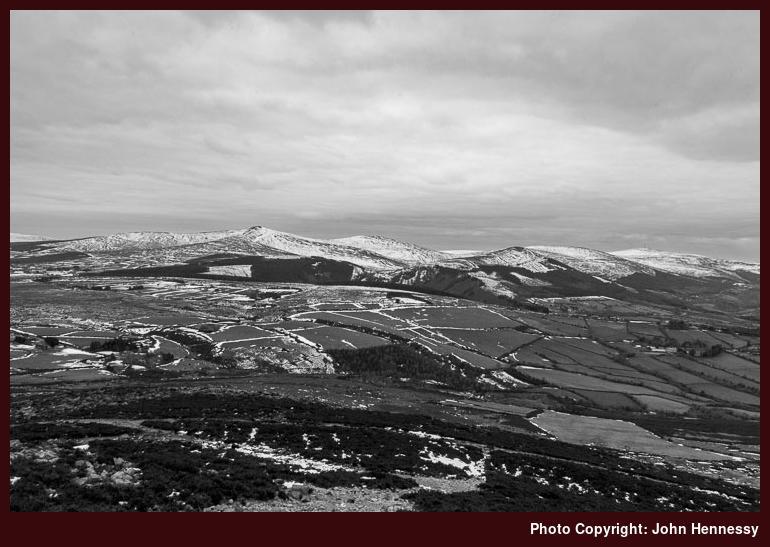
Once past a van that next to blocked access, I continued up a clear vehicle track. On the way, I met the van's owner coming downhill against me; my guess is that he was checking on sheep that I later saw in a field. I left the track for some more freestyle uphill ambling that took me past and around patches of snow that still remained even though the day was mild with a feeling of spring in the air. Westward views over such snow-covered "humps" as Djouce, War Hill, Maulin and the Tonduffs were pleasing and a spot of sun would have made them magical. Powerscourt and Enniskerry were out of view, possibly hiding in a groove beneath Long Hill, into which I was unable to see. Looking north took my gaze towards the Dublin Mountains with the transmitters of Three Rock or Kippure, the highest point in the county of Dublin, poking upward into the sky.
On the way up, I crossed pasture to reach ground hosting much rougher vegetation. It was at this point that better defined paths were reached, and I continued upwards in a south-easterly direction. Doubts were creeping into my mind whether I would go to the top of the hill or not. While it can look very appealing when its pointier aspect is seen from afar, I saw a rougher and less attractive side at the top of the hill. However, rather than contenting myself with going around it, I ended up making my way towards the top in a step-by-step manner. That was to take me onto to rockier slopes, and I chose what appeared to all the world to be a path manicured by some human intervention. Ultimately, that took me up a steep slope with loose material underfoot that persuaded me that this wasn't going to be a good way down. Even though I could leave the loose material underfoot for solid rock, the idea of downhill skidding on something approaching the consistency of scree didn't appeal to me one bit. Nevertheless, I did reach the summit and shared both it and a few words with some other walkers that were there.
To get down after taking in the copious views and the very definite spirit of spring that was in the air, I chose the route that they were using for ascent and descent. Well-stepped rock, a characteristic of the Great Sugarloaf, allowed me to descend with confidence to reach a well-defined path on much flatter ground so long as I watched my footfall; though not so high at 501 m, it's not a hill for lapses for concentration. For my return to Kilmacanoge, I chose to head north along this to go down to a track, part of which was the one that got me from the road to the hillside. Rather than checking this out for the sake of complete certainty, I headed east to cut out most of the road walking that I had done earlier. The track was clear for a while but became less distinct as I rounded Glencap Commons North. Nevertheless, I stayed with it and my faith was repaid after my conquering doubts that were bubbling up in my mind with the ups and downs along with the twists and turns that it was putting my way. I eventually ended up on tarmac again and, knowing where I was, turned left at two junctions to reach the R755 near Kilmacanoge's church. The bus stop was only a short hop away, and I popped into a shop for a few things before returning to Bray to take the train to Dublin's Connolly Station.
This stretch of exploration may only have lasted a few short hours, but it gave me a nice feel for Irish hillwalking. It's best not to expect niceties like waymarking or pitched paths (the place is perfect for those who despise such innovations) and I found none of these on my walk. Interestingly, though, you may find conveniently located car parks in places. Access is another thorny issue so it's best to be careful and do your homework before you; guidebooks (try Joss Lynam's Best Irish Walks for a few ideas), magazines (I can recommend the perhaps oddly titled Walking World Ireland) and the like usually ushers you away from the possibility of confrontation because the enlightened tolerance that was so typical of Scotland, even before their wonderful access legislation, does not hold universal sway in Ireland. Saying that, there are sufficient pockets to ensure that there remains plenty to sample. The day that I had might not have shown things at their best, but the countryside remained inviting, and the atmosphere was invigorating with its dash of mildness and there being birdsong in the air. The experience has left me wondering about a return for a longer visit to those hills.
Travel Arrangements:
Ireland was reached by a return train journey to Holyhead, followed by a return ferry crossing to Dublin. Dublin Bus service 53B then got me between the port and Dublin city centre. Getting to the start of the walk involved a return trip to Bray on the DART rail system and a return bus journey on Dublin Bus service 145 to Kilmacanoge.
Ambitions realised, possibilities await
18th February 2009 Regular visitors may have seen me comment that I have never done a longer hill wandering outing in my native Éire. Last weekend, I got the chance to set that one to rights with a few hours spent walking right to the very top of the Great Sugarloaf near Kilmacanogue in Co. Wicklow, itself not far from Bray. It may not have been as long as other hill wandering excursions that I have undertaken but it was enough to be able to say that I have set my boots on an Irish hillside. That was not all but it was my first introduction to the delights of the hill country of Co. Wicklow too. The fact that the hills of mainland Britain saw a lot of me while those across the Irish Sea in the "old country" remained unexplored has irked me for a while now so I am more than happy to have consigned that disparity to the history books. Like its near neighbour, Ireland has plenty to savour too.
Even so, what I have done last weekend is to make a start. After all, I have only sampled a little of what Wicklow has to offer and then it is but one walking area out of many. Other areas where I have not been to date that come to mind are the likes of Connemara, Mayo and Donegal. Ranges of mountains and hills like the Galtees, the Ballyhouras, the Comeraghs and the Knockmealdowns all await my footfall. Looking north of the border, there is Co. down with its Mourne Mountains too. It's all good stuff and one thing that cannot be said is that Ireland doesn't have plenty to offer walkers, even if access remains a contentious issue in places over there. In fact, I could list so many areas that a lengthy list could result and I don't believe in writing too many of them on here.
With my recent visit to Wicklow and my various shorter outings among the hills of Cork and Kerry, all that I can say is that I have scratched the surface so far. Those mountains and hills won't disappear overnight so I am not going to rush about to sample everything on a single sitting, gorging myself in the process and not leaving enough time to linger and appreciate wherever I might be. Time might wait for no one but cutting down those ambitions should allow me to savour a little more of Ireland's delights each visit without impacting on those things that are truly important in life. The full account of my Wicklow hike will appear later but this entry has lead my mind to wander all over what, in the grand scheme of things, is a small island packed full of enticing possibilities.
An amble down Great Langdale
16th February 2009 It's amazing how pondering ground conditions during periods of cold weather can be a harbinger for foreboding. You get to think of iced-up roads and pavements that's even before you consider how it might be at greater heights. As it turned out, there seemed to be even less snow (saying that there was no snow at all wouldn't be such an inaccurate description) lying about at lower levels on my visit to Cumbria the Saturday before last than I encountered on a previous one in December when I went exploring the Howgill Fells. However, I didn't have to look very far to find the white stuff with many a fell coated in it. Following various warnings and some fatalities, I stayed low to follow the Cumbria Way on a hike from the Old Dungeon Ghyll Hotel to Ambleside. Even though I was hopeful for some sun, grey clouds blocked out the sun for most of the time that I was on my hike; ironically, the sun had stayed out while I was awaiting a bus at Windermere.
To get to Langdale, I needed to run the gauntlet of some roadworks, but any delays proved not to be disruptive to my scheme. In fact, when I got to Old Dungeon Ghyll, I pottered a little north-east to look up along Mickleden to gaze upon those snow-covered summits. I soon turned around to the task of passing one hotel to make progress on the way towards another. Because parts of the track along which I was going to take the form of a watercourse, there were stretches of ice that commanded care and attention as I passed. Still, I was on a quiet stretch with a good few folk heading down Mickleden and others heading for the Pikes.
After getting to the New Dungeon Ghyll Hotel, a crossing of the B5453 and Great Langdale Beck took me on a journey along the other side of the valley. There were enough people around for me to wonder if I was going to get stuck in a hiking convoy, but that was to melt away to leave me some space within which I could enjoy my surroundings as I journeyed along the lower slopes of Lingmoor Fell. That took me a little higher for a while, but the terrain levelled out when I returned to the banks of the beck again. In a field near Baysbrown farm, a tractor was out muck-spreading and the loading of the spreader forced me to divert from the track that it had obstructed. It was so easily avoided that there was no point in fuming over "wilful" obstruction of a public right of way. After passing an empty campsite, I skirted Chapel Style and my surroundings took on a less rural feel until the village of Elterwater was left after me.
Once past that village, it was a case of reaching the shores of Elter Water and following them around. My first sight of the lake in question was through trees, but the woodland was soon exited to reveal a very idyllic setting. It's being accessible meant that many were out and about on often muddy paths, but their presence was no perturbation to me and I didn't begrudge their presence at all. Even in the greyness, the beauty of the spot was without question, with the Langdale Pikes and other fells forming a pleasing backdrop to the lake. Even with the gloom, the setting was sufficiently wondrous as to cause me to make a mental note of the idea of returning when the skies are clearer, should that kind of opportunity arise.
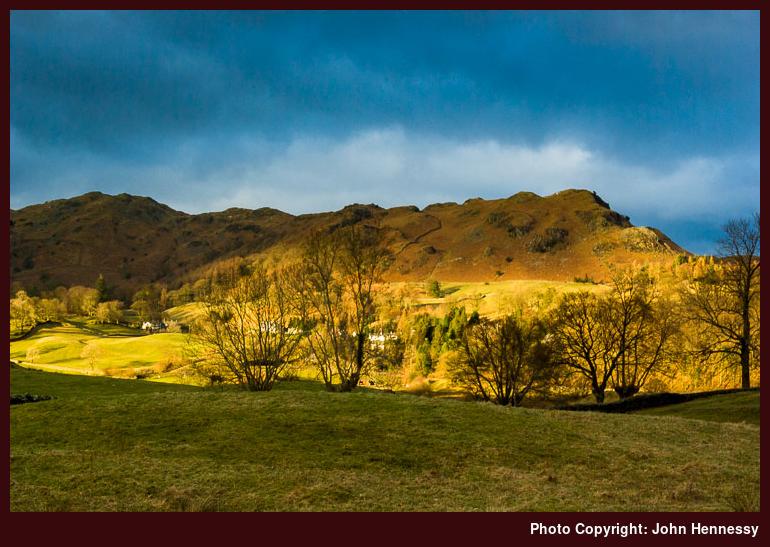
Skelwith Bridge was the next point passed though trees obscured any view of it. As it happened, I inadvertently continued a little further along the Cumbria Way than I had intended before leaving it for the day. After shadowing the Coniston road for a little while, I ventured onto it and made my way towards Skelwith Fold and Clappersgate on a mixture of minor roads and public footpaths while a spout of sunlight momentarily lit up Loughrigg Fell. From there, I made good progress along roadside footways into Ambleside to catch a bus to Windermere, from where a railway journey home. It goes without saying that the outing had been a good one, though it looks like a return is needed if I am to come away with the sort of pleasing photos that I would enjoy sharing with others. Hopefully, I can make the journey there on a quieter day too.
Travel Arrangements:
Return train journey to Windermere, 555 to Ambleside, 516 to Old Dungeon Ghyll Hotel and 599 from Ambleside to Windermere.


