Category: Website News
They don’t have to be that high
 28th January 2010
 Last weekend's greyness did nothing to coax me out of doors and other things took up whatever spare time was available. With a promising forecast for the coming one, I am minded to make use of what goodness comes the way, though it will mean preparation for colder temperatures and mindfulness of the threat of snow showers too. The shadow of winter hasn't left us just yet but the thought of crossing frozen moorland does sound tempting. It's too soon to say where the first full hillwalking trip of 2010 will take me but I hope to make a getaway soon, even if only for a day.
One of the things that I got around to doing last weekend was to see what more sympathetic processing would do for older photos brought away after outings among the hills of Kerry over in Ireland. Apart from the now customary thoughts about returning to see more or to do better photographic justice to the place, I got to being amazed by how proud of their surroundings and shapely even low sized hills can appear.
That observation propels my brain to another point: that steeper flanked humps can deceive. Well, they certainly can tire, as I discovered along a stretch of the West Highland Way between Balmaha and Rowardennan. None of the humps rose much above 100 metres in height but the constant up and down action wasn't kind either. Hillocks don't just possess the party trick of feeling higher than they are but they can look it too. That observation takes me to Loch Seaforth (Loch Shìphoirt) on Harris where Seaforth Island (Eilean Shìphoirt) has a high point not exceeding 200 metres in height but it doesn't rise out of the water by half when seen from Ardvourlie (Aird a' Mhulaidh). I suppose that everything looks higher when seen from next to sea level and you have to wonder how Ben More on Mull presents itself to someone walking in from the coast to reach its summit too.
Those smaller isolated hills might have their uses though, especially when they offer vistas featuring summits. It is for that reason that Diamond Hill near Letterfrack in Connemara has taken my fancy after seeing it featured in a Walking World Ireland route. If I ever manage to make to that part of County Galway, I'd have in mind for that first-ever visit. Ben Tianavaig on the Isle of Skye fulfilled a similar role with views of the Red Hills, the Cuillin, Raasay and the Trotternish all on offer in a 360º panorama on an evening that mixed bright sunshine with spells of rain. Orrest Head in Cumbria is another such delectable picking and illustrates that being deceived into expending energy to reach a lesser top is not foolishness at all. There are enough of the same kind that I risk making a big long list when only a few examples will do. The steep sides to any of these is a hint that any panoramas need work, but who can complain with the rewards on offer?
Alterations
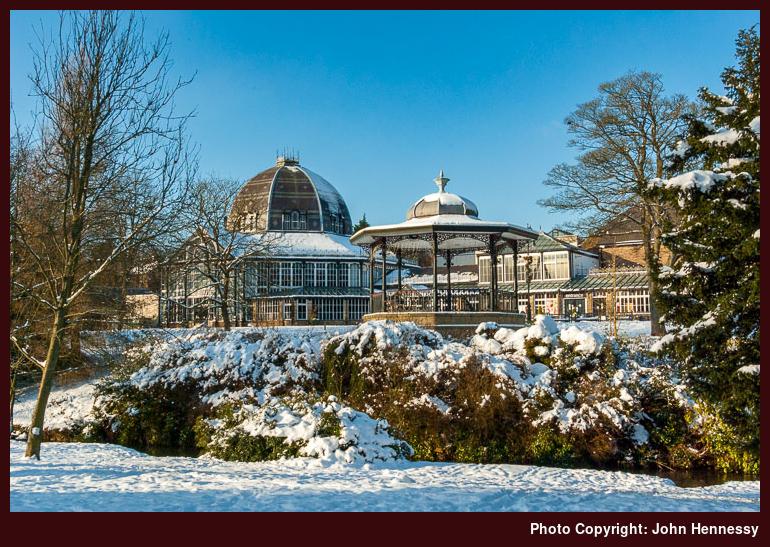
18th January 2010 Those of you who are regulars may note a certain change in the colours around here. Another bit of electronic fiddling was the cause of bringing the background colour to my notice. The new year has yet to see a proper piece of outdoors action. That's not to say that I didn't inspect the recent snow, especially given how much of it was plastered on the hills between Macclesfield and Buxton. That viewing took place on the second Saturday of the year from the confines of a warm bus rather than in an attempt to flounder through fields hosting feet of snow. Hearing and seeing how much was up there, thoughts were attuned to the need for snow shoes in such circumstances. It's little wonder that folk took to skis and going downhill on unexpected slopes like those of Kerridge Hill near Bollington. Drifting snow was starting to impede traffic while I was on my little excursion and it later closed the A537 Cat and Fiddle road almost completely. Buxton looked very pretty in its white coat on a bright day, but things were duller by the time that I reached Bakewell. It all made for an enjoyable spot of reconnaissance but a fuller bout of hill wandering is in order now that things are calming down, though there is more snow on the horizon for the middle of the week. It would appear that 2010 is getting an interesting start.
A longer winter break
6th January 2010 We have had the cold winter mixture of snow and ice for so long now that it almost is no longer newsworthy. It was there before I set off on a winter airborne crossing of the Irish Sea and remained to welcome me back on my return. That's not to say that it isn't causing disruption, with travel being a casualty from time to time. It also explains why I was out on Christmas Day and the day after (Boxing Day to some, St. Stephen's Day to others) breaking ice to clear tracks so that those with older bones than mine didn't go breaking them. There was a useful thaw thereafter that allowed things to dry up before the next round of frosts and I took my chance on an afternoon stroll around by Springfield Castle in the winter sun. Traffic, thankfully, was light on the roads that conveyed me much of the way and most of the ice had gone. In fact, I found more of that on the back avenue of Springfield Castle than anywhere else, including the front avenue. The latter allowed me to escape from a sizeable bunch who were engaged in pucking sliotars (hitting hurling balls with hurling sticks to the uninitiated) along the road from Broadford to Dromcollogher. Apart from that collective, places were otherwise quiet with only the occasional soul encountered along the way. It was a useful escape from worrying about the effects of slips on those who really could do without a knock.
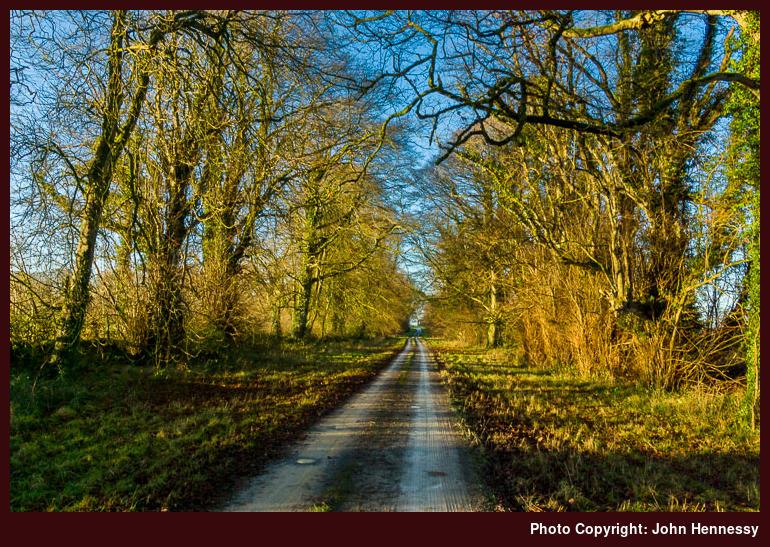
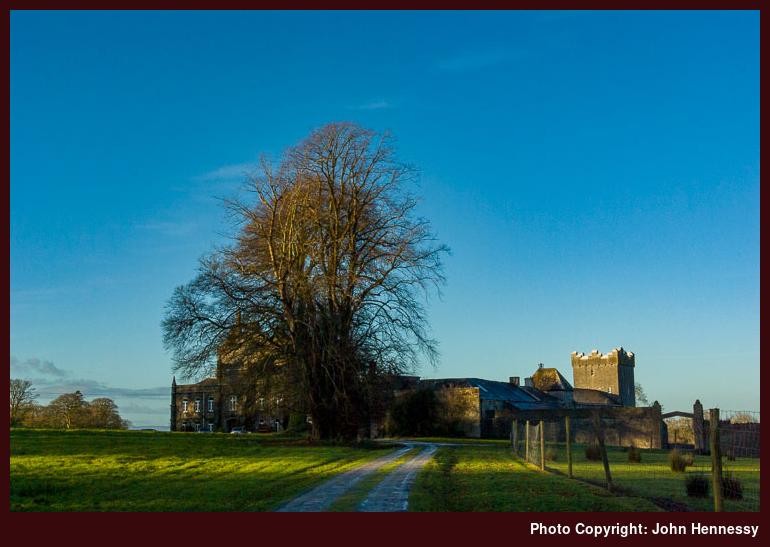
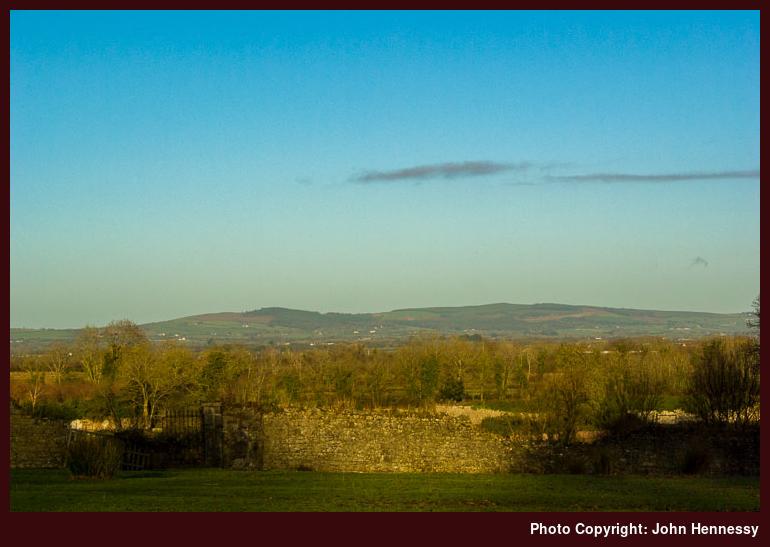
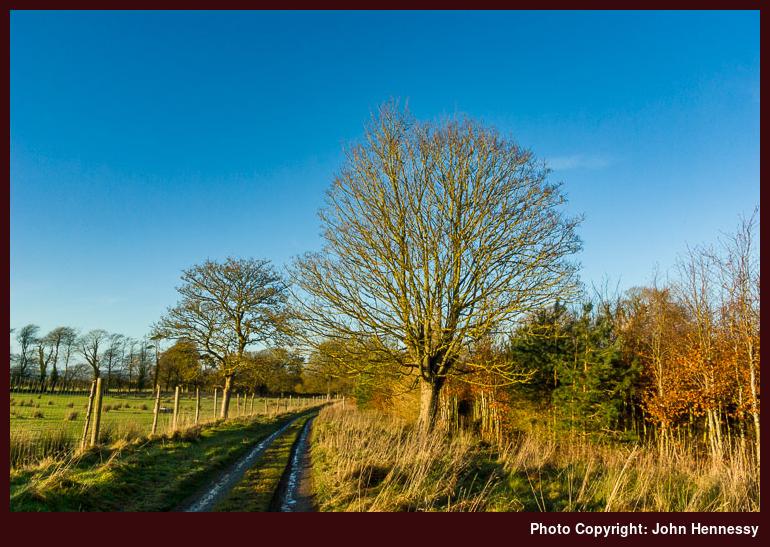
The only other trot of note was an afternoon jaunt around by Kilmeedy on an increasingly foggy New Year's Day. Though I gained some height, the lack of visibility meant that wide-ranging views were out of the question so I contented myself with decent progress along largely ice-free and dry roads with little or no traffic on them. It was, but an unremarkable few hours out in the cold air apart from the sight of a pair of swans in the River Deel near Belville. Even so, it was a good way to let the mind loose to lose any stresses and strains that had been collecting.
Apart from those bursts of road walking, the countryside journeying was largely virtual with some books capturing my attention. The first of these was found around my parents' house and caught my eye. Tales of canal boating do not normally attract my interest, but Gerald Potterton's In the Wake of Giants kept me occupied for a few hours with its mix of modern-day anecdotes and historical interjections. Ostensibly, it is a tale of someone fulfilling an interest in journeying along the Grand Canal and the River Barrow with its numerous canal cuttings for the avoidance of weirs. Naturally, this took me around by locales that wouldn't have crept too high up my list of places to visit and told me a little about them too, adding to my knowledge of the "Old Country". The tale may have stuttered to life like a marinised old Ford diesel engine that is used as a power unit for a canal boat, but the narrative soon got going in its own inimitable manner and went to show that there can be more to tillage farmers than meets the eye.
The second occupier of any free moments was a volume that I picked up a while back and lay on my reading list before I got around to it. Joseph Murphy's At the Edge does fit in rather better on a blog full of walking trip reports than a tome on canal boating and it has its own soul too. The backbone of the thing is a walk along the coasts of Ireland and Scotland from Kerry to Lewis made by someone who feels that he has lost a little something of his Irish heritage. Along the way, he gets to pondering Gaelic culture and the differences between Ireland become apparent with the emptiness of Scotland contrasting with an Ireland peopled with obliging folk; interlopers who fail to engage with their Scottish surroundings stick out like sore thumbs later on in the narrative. While I may have developed a beady eye with all my online scribblings, there were times when perceived typographical errors intruded on any sense of reverie (I know that I'm only human, so please let me know privately about any failings of my own making). Clearly, a spot of improvement on the proofreading side is needed on the part of the publishers and the author. Even with intrusions, the explorations of exile and connectedness drew me in as the journey continued; I suppose that my being an Irishman living and working in England had something to do with this, though my affinity for the places visited along the way may have helped too.
Just as there are Irishmen in England, there are Englishmen in Ireland and Tim Robinson has been one of the latter since 1972. On the return trip to Cheshire, I felt the need for a book and his Stones of Aran: Pilgrimage became my accompaniment as I left the branch of Easons on Dublin's O' Connell Street. It's an intense piece of writing that needs to be savoured away from the vacant prattling of drunken folk on trains. Quite how he can make so much of coastal explorations with only the occasional diversion inland is surprising. Until a few years ago, it was out of print but Faber & Faber brought out a new edition with a forward by Robert Macfarlane. There is a companion volume called Stones of Aran: Labyrinth that also was out of print until the New York Review of Books addressed that situation last year. More recently, he wrote a counterpart pair on Connemara with titles such as Connemara: Listening to the Wind and Connemara: The Last Pool of Darkness, both published by Penguin Ireland. The latter of these is in my possession and remains unfinished but it very typically was on the wrong side of the Irish Sea when it would have been continued. Of course, that's a human failing with my not thinking that I'd not be reading that much while ensconced in West Limerick. It's also an unusual one for me, but carriage of paper items is sure to add weight that can prove expensive if indiscipline is allowed to reign. In that light, the extra purchase can be seen as a comparative bargain.
With all this reading about a country to which I haven't done justice in walking terms, you might think that 2010 is set to be a year when Ireland might see more of me. That, however, is not mine to see. The start of any year usually is like beginning with a blank slate, but 2010 seems more wide open than other years. While grand designs are not my style, I am more inclined to avoid them this year than I otherwise might do. It will be a case of meeting the future one day at a time and seeing where things take me from here.
In times of plummeting mercury
12th November 2009 It had to come as it often does at the start of November. Temperatures fell on a Sunday night after a fairly pleasant day that saw me fail to get out into the open air as I would have liked. What followed it was a day that mixed fine crisp winter sun and typical November misty murkiness. Some may say that it's still autumn, but the weather feels like winter even if trees retain the last leaves after some stormy interludes. A lunchtime walk had me surveying what's left of the golden shreds after the Indian summer that came to us in September and October.
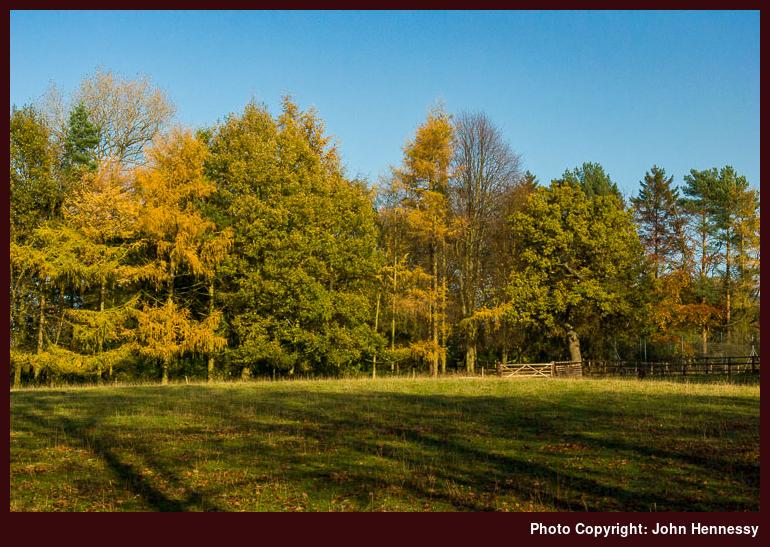
Apart from the chill in the air, November brought us some unsettled weather too and that seems set to continue; we may be in the midst of a lull at the moment but something more dramatic lies ahead of us if forecasters are right, and they are far from infallible. Thus, it is somewhat timely that The New York Times has brought us an article concerned with the avoidance of hibernation. The activity at the heart of it may be running, but the same malady afflicts those who explore the outdoors world so it's interesting to read another take on the subject, especially given November's habit of bringing grey murky weather with it.
It is tempting to retreat to virtual explorations on one's PC when it looks not so alluring out of doors. Nevertheless, that can have its place too and might even result in putting you out over your activation energy barrier to enjoy what abounds at this time of year. In recent weeks, I have been sprucing up old members of my online photo gallery. The ones of Skye are as good as done until I get to add to that collection from a day's walking over Ben Tianavaig last year. Lochaber has come next for a spot of improvement and Argyll hasn't escaped either with an old print taken by the shores of Loch Etive seeing an attempt to better it with a new scan and subsequent Photoshop work; there's a knack in keeping things realistic, a line on the wrong side of which I don't want to find myself.
The trouble with all this tinkering with old photos and is that it consumes spare time like it's going out of fashion, so a short session can gobble time that was set aside for other things. That's what happened to me on Sunday but it has its benefits too. Looking at those old photos reminds you of places where you haven't been for a while. For instance, I now think of that photo of Loch Etive as a less than sharp specimen and wonder about a return visit. In the past, I have played with the idea of a two-day walk from Taynuilt to Glen Coe or vice versa with an overnight stopover at a bothy. Nothing has come of it so far, but the idea of revisiting Loch Etive and passing along Glen Etive for the first time makes the notion attractive. If the weather was to play ball, then it would be even better.
While on the subject of a wandering mindset, there are places in Lochaber to revisit. Loch Treig and the Grey Corries fit in here and there's what's around Corrour too; the idea of disembarking from a Sleeper to walk to Fort William has come to mind from time to time. More civilised spots like Loch Lochy and Loch Arkaig also beckon. Mind you, a spot of bicycle hire might be an idea for the latter pair because progress along the Caledonian Canal as it rounds Meall Bhanabhie can seem so slow as to be infuriating. Still, this is a nice part of the world that should be traffic free and the distances involved make bicycle travel look the more useful. For long-distance travel on foot, there's the Great Glen Way of which I have sampled only a little and it would take me by Loch Lochy on its way to parts that have yet to host my footfall.
Continuing the theme of exploring pastures new, there's around Mallaig too with some introductory possibilities from Morar to gain a sense of what lies about there; it is remote country too, replete with possibilities around Loch Morar and Loch Arkaig for the more adventurous. It's been a few years since I ventured around by these parts while en route from Skye to Oban and the only stops were Mallaig and Glenfinnan. With the options already described and others like Knoydart and the Small Isles within reach, it is perhaps small wonder that the summer excursion that eventually took me to Aviemore could have taken to towards Mallaig instead. In the end, I decided that it was better to try for a time when the weather would have been more suitable for showing off the landscape at its best. Nevertheless, it is good to have such a scheme in mind, for the sake of avoiding indecision if noting else.
Having skirted around it, I suppose that Skye well deserves a longer mention. That walk from Elgol to Sligachan may not get repeated after seeing my surroundings bathed in the sort of light that would have been in order for a week based in Mallaig. However, there are other paths to follow and other parts to savour. Glen Brittle is but one of these and a spot of cycling might be in order given that's how I got about on my first visit to the island. It's never any harm to see new sides to an old favourite.
With all of these, what really hits me is how well peering at old photos can act as a muse as well as being an uplifting distraction from any greyness that is about. It is tempting to say that shortening days curtail the possibilities but I am minded to convert the delights of afar into experiencing what lies on my doorstep. Making use of the latter may set me up for heading further afield yet. In a way, it's amazing what indoor inspiration can achieve so long as you don't spend all of your time lost in the reverie and fail to get out at all. After all, November isn't always murky and December's bright moments should not be missed either.
Unto Yorkshire again
19th October 2009 Outings beget photos and photos can beget ideas for more outings. In recent weeks, I have been sprucing up the Yorkshire Dales photo collection that I have on display for all to see on the web. Many of these were taken on negative film, so new scans of old prints were attempted in order to make more of the results. Back then, I did things with my SLR that I would try to avoid now. Included among these would be a determined attempt at picture making in the middle of a hazy summer day. That's not to say that such conditions would stall play but I'd be more judicious about what I'd record. Whether it is down to the advent of digital capture or not, it does feel like I have developed more of feeling of how a scene before me will come out in a photo. The reason for my suspecting the effect of technological progress is that I may spend longer looking at my photos now than was the case when I exclusively used film. The fact that I am in total control over the entire process in the digital world may have a bearing because making prints from negatives or transparencies involves a certain amount of interpretation on the part of the printer, even if we are not talking about fine art monochrome images. In time, I may get around to adding more new images, but my attention has gone forth to a spot of under the bonnet work on my slide show machinery followed by giving my Isle of Skye photo collection (still under way) the same sort of attention lavished on that for the Yorkshire Dales.
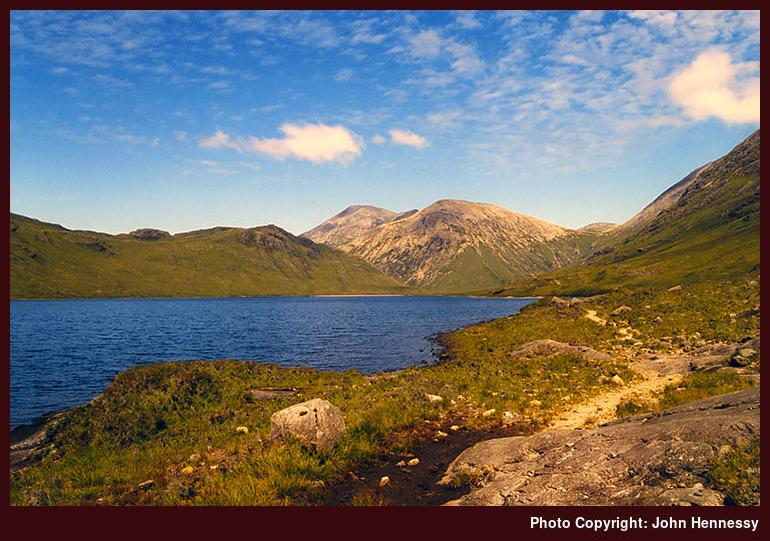
For a few years, I have not been devoting so much attention to the Yorkshire Dales, but that may be finding itself seeing some recompense. Last month saw me out in the midst of the gentle surroundings of lower Wharfedale while last weekend saw me out in some wilder countryside. A circuit from Ingleton saw me both thrilled by limestone pavements, even under duller skies, and immersed in spacious open country. That's never to say that there was no one else about, yet we each could have our own corner for a little while and chilling out was well possible on the moors around Twisleton; there was none of the feelings of being in a cavalcade that entered my mind between Burnsall and Howgill in September. It was a little busier on the way up Ingleborough from Chapel-le-Dale but dropping off in the Ingleton direction wasn't long losing any semblance of crowding though there was little sign of anywhere being overrun. Bunching together became a reality on the steep approach to Ingleborough, but that's always the way so it's never any real trouble so long as you don't rush things and keep an awareness of whoever is about you; we all can share a bit of countryside anyway. The day provided the sort of experience that draws me back time and again and it helps that there is more to explore too. Getting a sunny day to make photos reminiscent of those by a certain Granville Harris would be a bonus.
Photographically, it was a day of digital and film capture. Perhaps perversely, the sun found breaks in the clouds at precisely the moment when my DSLR ran out of electrical juice; being ever ready with a charged battery might have been a help but I only can own up to my own fecklessness. Then, it was over to the world of film to capture the wondrous lighting as I tramped the final miles towards the end of my hike. The instantaneous nature of digital capture may have been missed, but a spot of patience is all that's needed to see how well the results of my endeavours worked out for me and to use a lab that I know to do the business for me. If I had no back up camera, I would have been kicking myself, so this is no problem. In fact, the incident probably justifies my continuing to bring both a DSLR and an FSLR on walking trips, even if there is a weight penalty.
Like the film photos, the full account of Saturday's walk should follow and I need to look at those digital images and charge up that camera. A spare battery might be a sensible purchase, but any excuse for a spot of film photography never can be bad. My recent exploits with old photos in Photoshop Elements using exposure correcting tools like levels, curves, hue/saturation tweaking and shadow/highlight adjustments have shown me that new life can be added to an old photo (hopefully) without overdoing things. Of course, there has to be some potential for decent results to be obtained and you always want to avoid some abomination in keeping with the punch drunk efforts using filters in the 1980's. Having a good sense of what is natural and what isn't has to help, but there's a very fine line between having the right amount of colour saturation and contrast and ending up with a day-glow semi-fluorescent effort; I aim to stay on the right side of that line.


