A spot of recce in Gougane Barra
 3rd May 2007
 Last weekend saw pop over to Éire to see the folks for the first time since the Christmas break. It also saw me revisiting Gougane (pronounced guugawn) Barra, where the River Lee rises, on the Sunday. This place is one of my father's favourite places and even with cloudy skies and a cloud base approaching the 500 metre level, you could still see why. Seeing it on a sunny day and being able to explore it in a bit more depth would have been ideal but my 90 minutes off the leash (my parents are not really into walking but they have bequeath me a love of the countryside) allowed for a good few record shorts capturing ideas for any return. Still, the weather remained dry for our stay, a bonus since we had passed through mist, murk and light rain while we made our way there.
Gougane is place with two sides to it: Valley Desmond and an eponymous lake with an island hosting the ruins of an old monastery and a small church. The lake sits outside Valley Desmond and collects the waters of the juvenile Lee before it continues its onward journey towards Cork city where it meets the sea in Cork harbour. The monastic ruins once hosted a religious community found by Cork city's patron saint, Finbarr. Given how old it is, it is amazing how much remains in good condition and it is hard to fault its setting but it is well frequented.
Nowadays, Valley Desmond is owned by Coillte, the Irish forestry agency (it's the Irish word for forests or woods and is pronounced queellte), and ubiquitous conifers line the hills from whose craggy slopes the waters of the juvenile Lee gather. There was a time before the invasion of commercial forestry but there was no access for the public back then like there is today. Coillte, like any state-owned custodian of commercial forest, does do its bit to encourage visitors and they charge for entry too, though you could be lucky in the off season. For the money, you get parking and a reasonable network of paths; in fact, this network is being treated to a spot of maintenance right now with bridge replacements and surface improvements taking place. It was on these paths that I went for a stroll and some of them do get you above the tree line for views of the lake, among other things. The hills around here may not be that high - the Irish have a penchant for calling anything above 400 metres high a mountain but that's a discussion for another day - but the thoughts of delving deeper do appeal to me.
Twelve months a blogging
1st May 2007 It's been a year since I first stepped out into the blogosphere, and a lot of water has gone under the proverbial bridge since then. At the start, I used Blogware enough to appreciate both its abilities and its limitations. The main one was not having the option to customise it so that it looked like a part of my website rather than being a mere add-on. That it was a service from my hosting provider could have been part of the straitjacketing; it would have worked better in a standalone capacity.
To get the level of customisation that I needed, I downloaded WordPress and began to host the blog from my own webspace after a spot of fiddling, migration of pre-existing posts and adding a MySQL database to my hosting account. The result was that I now had a blog that at least looked as if it was part of the same website as the other sections, such as the photo gallery.
The content of the blog has evolved too, though the backbone is essence the same: descriptions of any walks, public transport commentary, consideration of new walking ideas, musings on outdoor gear, photo gallery updates and thoughts of hill walking books and magazines.
However, my walking now has evolved from where it was this time last year. Then, it was a case of picking a part of Britain where the weather is due to be clement and heading off there. That approach does lend itself to a variety of content, but without having somewhere new to explore, motivation can run flat.
That said, 2006 proved itself to be the year of going to places new; my boots trod Pembrokeshire, Northumberland and Southern Scotland, to name a few. In contrast, 2007 appears to be dominated by a single large objective: continuing north along the Pennine Way, perhaps its northern terminus Kirk Yetholm. Who knows where it all could go next.
It’s all coming on wonderfully…
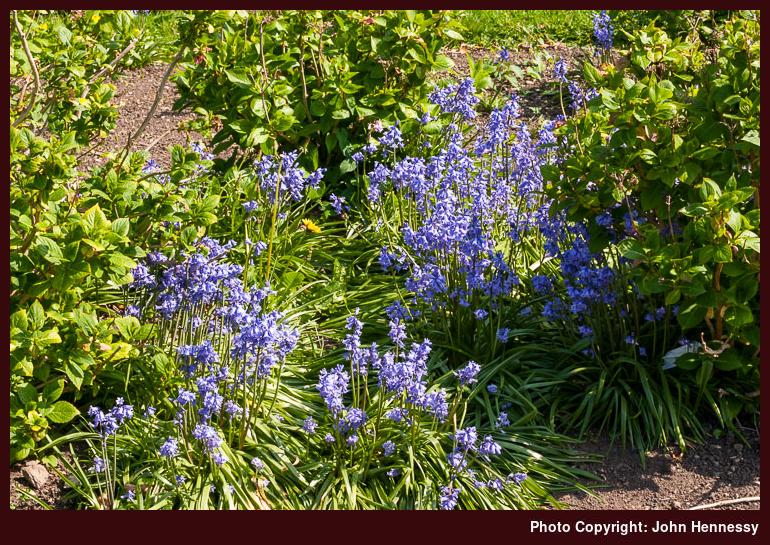
26th April 2007 While May is my favourite month, I always enjoy the first half of the year more than the second. That is not to say that autumn does not have its appeal, but seeing the leaves coming out on the trees at the end of April is always an uplifting experience. Though the weather is a spot mixed for now, bluebells are spreading their blue hue across woodland floors and flowering cherry trees are spicing up the landscape. And the shade of green that abounds in new growth everywhere is a near magical sight. Now, I hope that we get the weather for enjoying all this.
From walker to backpacker?
25th April 2007 Even though I am an avid hillwalker, my trips to date have either been day excursions or a case of basing myself somewhere and exploring the local area from there, a series of day trips if you will. At times, I have even done some base-hopping but I would never consider it backpacking per se. The idea of walking the last section of the Pennine Way, between Byrness and Kirk Yetholm, has been challenging this status quo. And the long sections of the Southern Upland Way, recently completed by Aktoman and related in his usual quizzical fashion, have done nothing to detract from this challenge.
First, I need a spot more education, yes, even with my reading of TGO. Last Friday after work, I was in the Manchester's Deansgate branch of Waterstone's looking for an Oracle book and had a look at other things too, trying not to get too carried away with impulsive buying. The result was that I came away with a copy of Chris Townsend's The Backpacker's Handbook; next steps are to read the thing and make good use of the contained sagely advice.
In the meantime though, I am keeping an eye up for lightweight sleeping bags. PHD's Piqolo has in the past caught my eye with its 395g payload and the 465g Minimus is another option from the same stable. By default, they come without side zips but you add them for an extra £24. Roman from Lighthiker's World favours Western Mountaineering's 541g Summerlite bag. Only Snow+Rock seem to sell Western Mountaineering bags in the U.K. and do not feature the aforementioned article on their online store. Nevertheless, they do offer the 454g Highlite which is another lightweight option. Aktoman uses a bag from another British manufacturer, Criterion, and its packed down size seems very impressive indeed. These all appear to be worthy contenders but I'll learn a bit more before coming to a decision.
New Lonely Planet book on Scottish Hillwalking
18th April 2007 When passing through Leeds on my Easter Yorkshire Dales excursions, I popped into Waterstones and spotted that Lonely Planet has finally updated its guide to walking in Scotland. The previous edition dated from 2001, so it might have been time for an update. Six years can be a long time, sometimes.
Being easily persuaded, I acquired a copy to see what's in the new one. There are changes to the routes featured, but I'll hang on to my copy of the first edition as there seem to be a number of changes to the featured walking routes and I might find some use for it yet.
On the surface, not much has changed with the included walking information, apart from updates to the text and changes to the presentation. These include putting the walking information chapters at the back and adding glossy sections at the front containing a good supply of colour photos. Nevertheless, dig deeper and more of the changes appear.
The recently enacted Scottish access legislation must surely have had an impact, as walks in the Campsie Fells and Ochil Hills are now headline inclusions. New routes such as the John Buchan Way between Peebles and Broughton now get a mention. Some previously featured routes now find themselves in the Other Walks sections at the end of the chapters, along with new additions such as the Rob Roy Way that goes from Drymen to Pitlochry.
Another fate for previous headline routes is that they find themselves in boxes sitting outside the main text. Classic routes such as the Aonach Eagach ridge or the ascent of Ben Nevis via the Carn Mor Dearg arête find themselves in this position. Given the level of challenge associated with these, that may be wise, for these are not beginner's routes.


