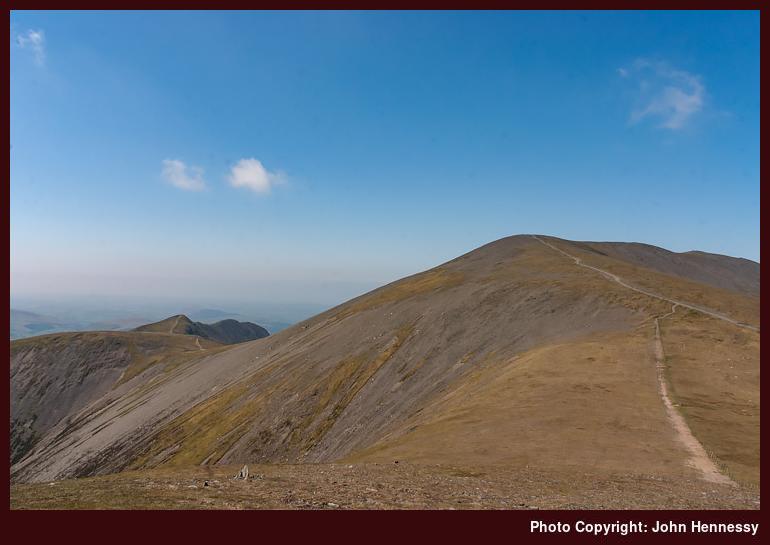
A bimble in border country
 22nd May 2007
 Even with showers forecast, I fancied taking myself off somewhere for a walk on Sunday. Because I wanted to continue my hiatus from the Pennine Way for the sake of variety, wandering along a bit of the Offa's Dyke National Trail appealed. I planned my hike using Anquet Maps to get an idea of what I was taking on and, while I departed from it at times, my planned route was essentially the one that I followed on the ground. The software also gave a projected time for the walk and, though it was largely correct, I might be tempted to add a bit extra to the predicted time for future excursions; I still kept an eye on the time and had alternate plans if it was taking too long.
With that in mind, I travelled to Chirk after braving the hoards of the Macclesfield Bikeathon and picked up the Llwybyr Ceiriog Trail and followed it along the Ceiriog valley until I met both the Offa's Dyke trail and part of the aforementioned earthwork itself, after crossing from Wales into England (Chirk is almost on the border between Wales and England). In fact, I was to have the famous military barrier for company for a good part of my journey to Craig Nant. It was while I was following this section that the sun came out for a brief spell on what was a mainly cloudy if dry day; the threatened showers thankfully failed to materialise. In fact, it caused me to dawdle for longer than maybe I should have done.
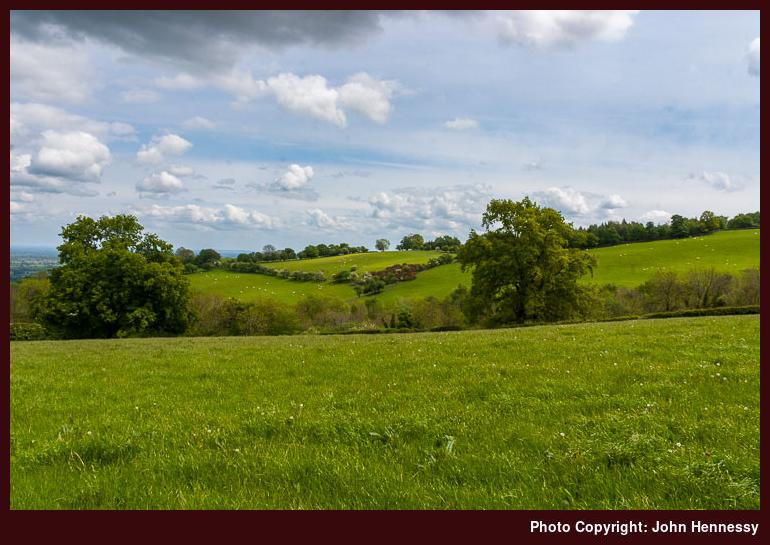
Progress from Craig Nant was steady as I rounded Selattyn Hill on my way to Racecourse Common, part of which unfortunately involved some tarmac bashing. Once past Racecourse Common, it was on into Racecourse Wood for views east over Shropshire with the humps of Long Mynd making an appearance; as luck would have it, the sun was very much in evidence further east, and I wonder what delights I would have savoured if skies were clearer for more of my journey.
These days, Racecourse Common and Wood are an amenity for those wanting a stroll but, as the name implies, there was indeed a racecourse here, and it was for horse racing. Its heyday was the early nineteenth century before the coming of the railways, and a less than salubrious crowd put paid to its continued existence.
It was about this point that I started to think about getting to Oswestry so that I could start on my journey home. The plan was to leave the national trail for a public footpath taking me most of the way to Oswestry, but the need to catch a bus from Oswestry meant that I instead pounded more tarmac than I would have liked. The sun had by then escaped from behind the clouds, and I was treated to pleasant scenes as I continued on my way; I still found some time to stop and admire my surroundings.
Oswestry is certainly a pleasant spot and one where I wouldn't have minded lingering but for time constraints; I needed to catch the 18:15 Arriva service to Shrewsbury. The wondrous St. Oswald's Church and the pleasant town centre may well inspire another excursion, and one with ample time for my training my camera on the sights. I will hold it in mind for the future. Until this walk, Shropshire hadn't really been subject to my attentions even though it does have its hill country; the Long Mynd and the country round about it certainly do look very attractive through train windows as I ply my way to Abergavenny for the hill country of the Brecon Beacons National Park; it's almost a shame to do so. Speaking of Wales, one thing that you don't need to do is go there for places whose names reveal Welsh origins; there are plenty in the west of Shropshire, as OS maps will show you. It's a part of the world to which I can return.
Dipping a toe into the world of digital mapping
10th May 2007 Having seen in an old TGO that Anquet now allows you to buy digital mapping like you would buy digital music, I decided to take a look at what was on offer. For now, I am sticking with 1:50000 mapping; I cannot justify the cost of the 1:25000 equivalent. For instance, 1:25000 mapping for the Western Isles would set you back over £300 while you could have 1:50000 for around £12. This makes the latter look much cheaper than paper mapping and the former appear very much more expensive. The differential is enough to make me ask if one is subsidising the other. At least, you don't have to pay extra for the software required; it's a free download from the Anquet website and the installation seems straightforward, at least for a computer literate type like me.
Speaking of the required software, not only does it act as the viewer of any digital maps but it is also the interface through which these maps are purchased and downloaded. Because the files are not small, a broadband internet connection is a must. For instance, 1:50000 mapping the size of the Western Isles area is just over 65 MB and this is at the smaller end of the scale. I can only imagine what size the 1:25000 map files must be.
While you can print off maps, I don't see this as the main use of digital mapping. In fact, I plan to continue with paper maps for a good while yet; I like the idea of having a wider when I am out walking too much and cost of digital 1:25000 mapping is a factor too. That leaves route planning capabilities and it is here where digital mapping scores. For one thing, the ability to measure the distance of a walk without having to get down on your knees on an outstretched paper map on your bathroom floor is a definite plus. You can also save the routes for later and the software will generate route cards for you as well. A compatible GPS receiver would be able to download a route for use in the outdoors but this is one feature that I am unable to test since I don't have a GPS receiver and I have to admit that acquiring one is not that high on my list of priorities.
It all seems very useful though there are some features about which I am not so convinced. One example is the Virtual Landscape mode, though I suppose that it can be used to confirm your interpretation of contours. Another is the ability to download Country Walking and Trail routes through the Anquet website; I tend to plan my own, often using ideas generated by the perusal of walking magazines rather than slavishly following their route descriptions. Aside from these, the planning capabilities have me impressed and I hope to continue using these and learn more.
Consideration for other hillwalkers
7th May 2007 It's amazing what thoughts pop into your head while following a well engineered track on the way up to the top of a hill. Such was the case when I was ascending Skiddaw last Friday. The track in question was a bridleway, something that was made apparent when I saw a cyclist preparing to descend it; it's not something that I would have done and it amazed another walker going uphill like me. All that I could add to that amazement was to say best of luck to the gentleman on the bike. I wonder how he got on...
It was on the descent that the thoughts really began to roll into my head, particularly regarding one gentleman encountered by Alan Sloman on his LEJOG journey through Teesdale. My suspicion is that the walker in question may not have the muscle strength in his legs to control his speed, even with walking poles. Hence, the apparent lack of courtesy... Not only is that sort of thing not good to fellow walkers but it's not good for tracks either and steep heavily eroded paths are no fun for those of us whose vertigo has a habit of kicking in at inopportune moments.
Speaking of vertigo, a steep track devoid of steps like that which I used for my Skiddaw excursion causes me to look for footholds to use and do not like to see them dislodged by those who are going too fast and treading too heavily. The thoughts of out of control "skiing" on gravel definitely do not entertain me. And I am sure that the same would apply to any fell runners frequenting Skiddaw; I am not trying to ban them. Nevertheless, we all have a part of play in stopping footpath erosion and I come from the school of thought where nothing is taken but but memories or photos and nothing is left except (light) footsteps. Consideration for others is not only avoiding bumping into them or saying hello but also leaving what you have enjoyed in a state for them to enjoy too. I certainly hope that I did...
Public transport in Cumbria
6th May 2007 Public transport provision in Cumbria is a classic curate's egg, good in parts. As it happens, the western part of the county fares much better than the eastern side. For a walker in the Lake District, options are plentiful but they decline a lot when you start to consider following the likes of the Pennine Way. In any case, Cumbria County Council provides useful timetable information for any bus services that are likely to be running.
Being the honeypot that it is, it should not surprise you that bus services within the Lake District National Park are in good supply and they connect with train services, after a fashion. Anywhere with literary connections is bound to attract the crowds and will be well served by buses. Coniston, Rydal and Grasmere fall into that category and it is good news for walkers. However, any walking destinations away from these may not get the same level of service. Wasdale is the most extreme example here but Kentmere and Patterdale also fall into the same category, albeit to a lesser extent. Another thing to watch is that bus services can be seasonal too but this is all documented in the biannual guides that are produced.
There are a number of reasons why travel in eastern Cumbria takes my interest: the Dales Way, the Howgill Fells and the aforementioned Pennine Way. Am I becoming something of a connoisseur in my voyages off the beaten track? I am not sure that I am but getting to the likes of Sedbergh, Dufton and Alston would be very useful for exploring the above. The Settle-Carlisle railway line is a help for getting to Dufton, even if a walk from Appleby-in-Westmorland is involved but that isn't necessarily a bad thing. Nevertheless, it cannot do everything. Also, Sunday bus services are akin to the proverbial hens' teeth and weekday services aren't that plentiful either, particularly on Saturdays. It all needs some planning and maybe a few days of point-to-point walking to explore these parts. Nevertheless, Wright Brothers' summer only extension of their 888 service will be a boon when it comes to exploring around Alston and doing the sections of the Pennine Way nearest to the town. Weekday and Saturday connections from Carlisle and Haltwhistle help too. Eccentricities not withstanding, services between Kendal and Kirkby Stephen make access to the Howgill Fells a possibility.
Drawn to Skiddaw
5th May 2007 While pondering this post following my ascent of Skiddaw yesterday, it occurred that if I tried listing my excursions to Cumbria's Lake District, I could have ended up with a very long list and I have not even come close to exploring all the area. 2003 was when I spent the most time up there and, in marked contrast, the nearest I came to it was while I was on the way up and down from Scotland!
On my visits, I have been fanning out from the likes of Ambleside, Rydal, Grasmere and Keswick. From Keswick, I have got to Buttermere, up and down the shores of Derwent Water, to Catbells, along Coledale, in the woods on Dodd (the one next to Carl Side; there are a few of them), around the Back o' Skiddaw... I think that probably covers it; Keswick has made a good starting point for many of my Lakeland excursions. Anyone with any knowledge of the Lake District should not be too surprised if I bundle Ambleside, Rydal and Grasmere together and they have been the starting (and, in some cases, the ending) points of walks over Loughrigg Fell, around the Fairfield horseshoe, to Patterdale via Grisedale and Fairfield... They're the main ones.
However, given all my treks, it took me until yesterday to mount the summit of Skiddaw; too many other distractions, perhaps? The mountain has featured in numerous photos posted on my Lakeland photo gallery so it was about time that I ascended it. Given the fine weather that we have been enjoying recently and the predicted break in the weather, as is customary for a bank holiday weekend, I decided to take a day off for some walking. For the sake of some variety, I took a break from my Pennine Way objective and returned to Keswick since perhaps 2003.
An early morning train/bus combination got me to Keswick around 10:30. Once there, I organised myself and picked up the Cumbria Way. A useful footbridge got me over the busy A66 and I then rounded Lattrigg before leaving the way after passing through a car park. After passing rounding a 333-metre-high hillock and passing a Celtic cross commemorating two noted breeders of Herdwick sheep, I dropped down a little before commencing the real ascent in earnest. Then, it was a case of taking things slow and steady between 300 and 700 metres before the gradient became more kind. A tempting track was heading for Little Man but I stayed my course for Skiddaw to conserve my energy levels; the actual right of way goes along the northern slopes of Little Man. The actual final ascent of Skiddaw itself wasn't too hard on the legs, though "steady as she goes" remained the approach. As I went up, views of Derwent Water, Bassenthwaite Lake, Blencathra, Ullock Pike, Little Man and the Back o' Skiddaw were abundant, though an ominous looking bank was there to see in the north and to the east; it looked like I picked the right place for my day out.
The views remained there to savour as I started on my way down at 14:00. Even after 800+ metres of ascent, I still possessed the energy to allow me to vary my route a little on the descent. The first of these diversions was to pick up a path over Little Man; this one does not appear on the OS Explorer map but Harvey's Superwalker equivalent does show most of it. I'm glad that I tackled it on the descent as there is a false summit on the eastern approach. The second diversion was to go up and over Lattrigg; I kept seeing the path from on high and got tempted by the proposition. The ascent wasn't too taxing either, and the views made it worthwhile. Even with these variations, I was back in Keswick at around 17:30 and spent a bit of time strolling through the town and doing a spot of shopping before catching the bus that took me towards my train home.