A winter wander from home to hills and back again
 21st December 2008
 After my sampling of the Howgills the day before, the continuing run of fine if very frosty weather had me out again. This time around, I stayed local and ventured into Macclesfield's hilly hinterland. In fact, my walk started and ended on my own doorstep, and that happens from time to time. Even though my memory of them was far from photographic, the trails followed were ones that I have often trodden, but that was never to dull the satisfaction from being in the outdoors, even if non-completion of pre-Christmas chores did nag a little at the back of my mind.
My first task was to make my way into the country, and I left the streets behind to follow the towpath beside part of a frozen Macclesfield Canal for a little while. As it happened, I met up with a collection of characters trying to do some fishing. One spotted my walking poles and commented, jokingly I think (well, one of those with him was laughing anyway), that he could do with a loan of them for ice breaking duties. I carried on, noticing the difficulty that ducks were having on the ice, until the point where the canal towpath is shut following the collapse of a wall; there was a man out walking his dog when it happened, and he attributes his not being under the rubble to his mutt's slowing him down!
Following a now familiar itinerary, I then returned to tarmac again as I continued up towards the Macclesfield Golf Club's clubhouse to pick up a footpath that rounded both the golf course and the hill that played host to it before dropping down to Langley; that secured my escape from the urban confines of Macc. Shutlingsloe could be seen in the distance, with Sutton Common and Croker Hill bringing up the rear behind the village of Sutton. The ground was its customary winter softness at this point, and an eagle eye was kept out for any wayward greasy spot that would sweep the legs from under me. The descent took me through more sheltered parts where the overnight frost remained.
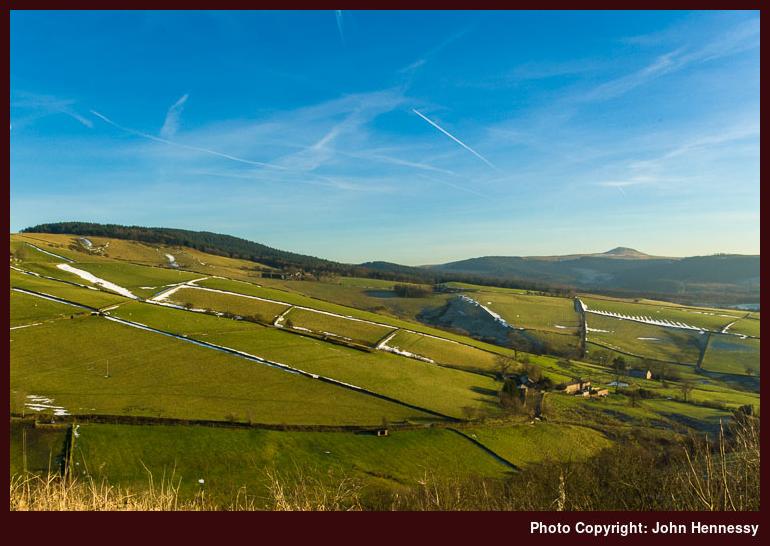
A hike right through the village of Langley was needed before I found another escape from civilisation. This led me towards the Gritstone Trail but, rather than following it up to the summit of Tegg's Nose, I opted for a different way. Picking up a bridleway that led me between Teggsnose Reservoir and Bottoms Reservoir, I continued to round yet another hill before starting on the ascent again after crossing a stream that feeds Teggsnose Reservoir, one of those that I had passed earlier. Another road crossing later, and I was on to a concessionary path named Saddler's Way for some reason. The gradient steepened and the views continued to open out until I made my way to a viewpoint at Tegg's Nose Country Park. A host of humpy stuff with Shutlingsloe among them lay there as a feast for the eyes.
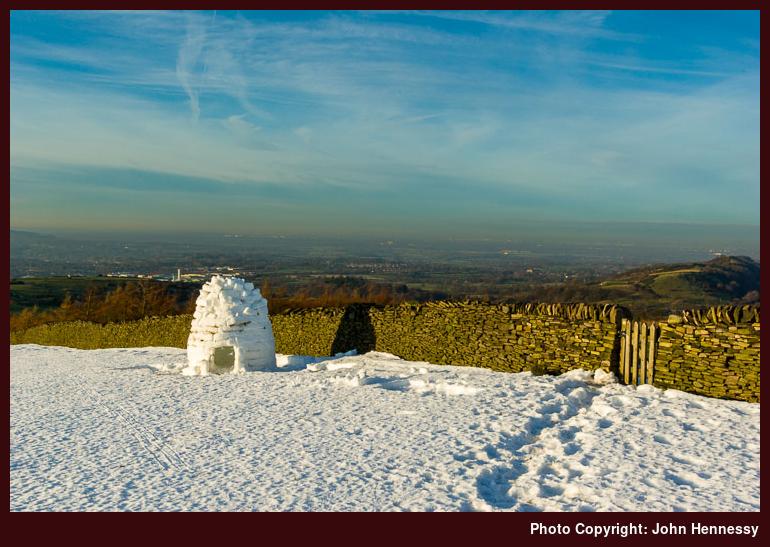
It was at this point that I started on the Gritstone Trail proper for my journey to Kerridge. As I started crossing fields again, winter started to make its presence a little more obvious, with snow remaining along by stone walls. Someone had even fashioned an igloo of sorts, and the structure was still very much there to see. A crossing of the A537 saw me go down a rough slope that might have offered plenty of greasy mud had it not been for the fact that it was frozen solid. After the steep descent came an equally testing ascent; appropriately, a brook lay in the gash that I needed to negotiate.
That set me on my way towards Rainow and, soon enough, the said village started to come into view. Imperfect memories of the route were refreshed as I went, and the B5470 was reached without any navigational madness. The path on the other side of the road took a little finding with the signpost being a little away from the road and nestled between two houses, a combination that makes it easy to miss and goes to prove that you cannot remember everything.
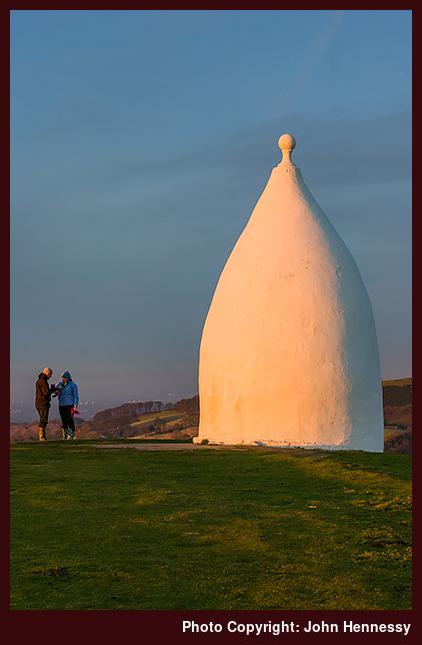
Following that modicum of route finding, the last stretch of steep ascent for the day awaited, and it was on frozen east-facing slopes too. If the sun had ever got over Kerridge Hill, it wasn't managing it while I was scaling it. The reward for these exertions was a level stroll along a ridge replete with generous panoramic views. As if that is insufficient, the folly that is the White Nancy stands atop the Bollington end of the ridge. The landmark is a simple affair that has attracted its share of vandalism over the years; it is a hollow construction, but can no longer be entered thanks to the attentions of some. In recent years, there was a prank that involved painting the thing pink, an act not without its amusement value, even if it did wind up the locals.
More frozen slopes were crossed on the way down to Kerridge, and at a time when it could be seen that the day was coming closer to its end. One more road crossing took me onto public footpaths that led me back on to the banks beside a different part of a partially frozen Macclesfield Canal. Light was really fading by now, and I changed over to the Middlewood Way for the short distance to the well-lit streets along which I would complete my walk, with a call to a shop for provisions along the way.
Revisiting those familiar trails turned out to be a very good use of one of the cold, crisp, dry sunny days that can visit us at this time of year. Other folk were out and about too, but they weren't so numerous as to make the countryside feel anything like overcrowded; many good stretches of solitude were there too to soothe the spirit. It just goes to show that you should never overlook what can be reached from your doorstep.
Sampling some snow among the Howgill Fells
19th December 2008 As promised earlier, here's that trip report for a brief visit to the Howgills at the start of the month. The idea of visiting these parts crossed my mind while happening to perusal a bus timetable during some dead time awaiting a train to take me to Windermere in Windermere. At any other time of year, Saturday bus connections to Sedbergh (pronounced "Sedberr", I believe) wouldn't seem quite so appealing, but the idea of a 15:50 departure on a winter's day didn't seem like leaving too early at all, even if that meant that my time was limited to little more than a few hours. Services on other weekdays allow a longer stay, but there's no service on Sundays, which constrains the idea of a weekend trip using public transport to get there and away.
For the perhaps overambitious, the time that I was allotted might have been enough time for an out and back romp to The Calf from Sedbergh but rushing things like this really is not my style. I go out to sample, to savour and to enjoy; good hill country deserves no less. Snow and ice abounded once a certain not so intimidating height was reached anyway, so rushing about would have been the epitome of foolishness. It may not have lain everywhere, but there was far more about than remained around Macclesfield by the time that I left it that morning. On arrival in Oxenholme, there was no hope of missing the white stuff, and the presence of ice meant that extra care was needed when getting on the bus to Sedbergh.
That bus journey was to mean that more whiteness was to be savoured, particularly between Oxenholme and the M6. A collection of wind turbines that were passed took on an unusually ghostly aspect but continuing past the M6 meant entering countryside where a thaw was in evidence. Higher places still had the snow, even if much green could be seen too. Whatever thaw that there had been didn't extend to many of the footways about the town of Sedbergh, so gingerly progress along roads was in order as I made my way to open country. That didn't take long, and braved a path going by noisy tied up dogs in a farmyard and icy stretches that acted as a reminder of the need for crampons to get to higher slopes where deeper snow underfoot gave my boots something with which they could engage.
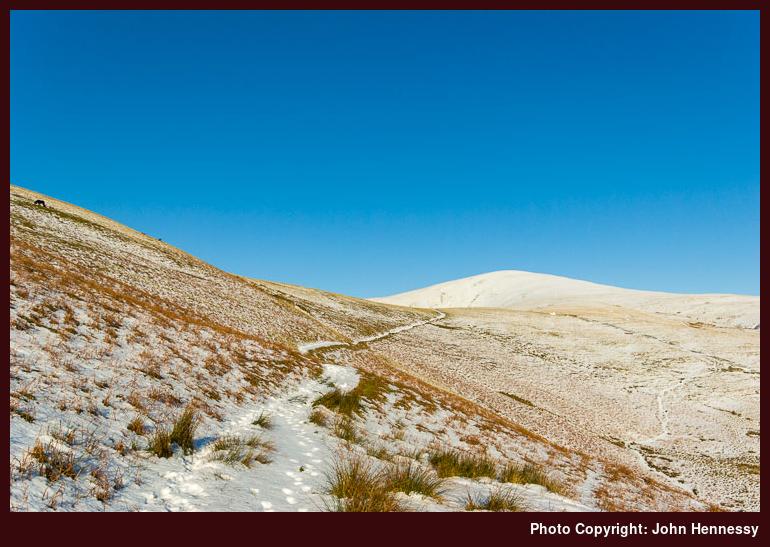
As I continued up the side of Winder, I began to meet deeper snow than any that I had ever encountered before. Across the gash cut by Settleback Gill and on the slopes of Crook, there were children playing in the winter sunshine. Beyond any green lands to the south, Whernside and its surrounding humps and bumps packed up the view. Gazing to the east led the eye towards Baugh Fell, Wild Boar Fell and Swarth Fell and all around them. In the west lay the snow-covered Lakeland fells, though I couldn't see them until I emerged from the trough along which I was hiking, and the same could be said for the sights that lay to the north of me.
The saddle between Winder and Arant Haw held a good thick covering of snow over its grassy tussocks, enough to slow progress and make me conscious of the time. If I had ever pondered getting to The Calf, that was put out of my mind as I ventured in the direction of Arant Haw. Though that hill lay within range, I decided in the end to leave it for another time to allow plenty of time for my descent. Instead, I continued to the top of Winder itself and lingered to take in the panoramic views. What it lacks in height, it possesses thanks in no small part to its location, so a spot of photographic activity ensued beside one of those viewpoint installations that are there to tell you what's surrounding you (hills in this case). The sights couldn't be more irresistible with that dusting of the white stuff.
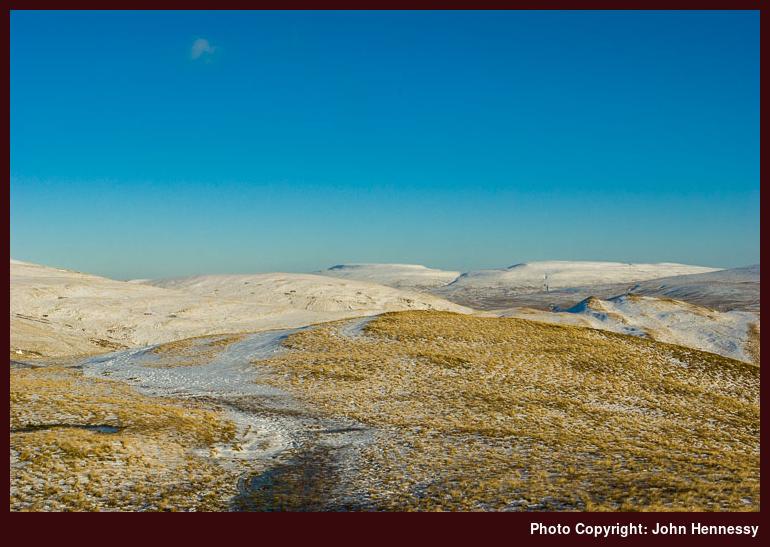
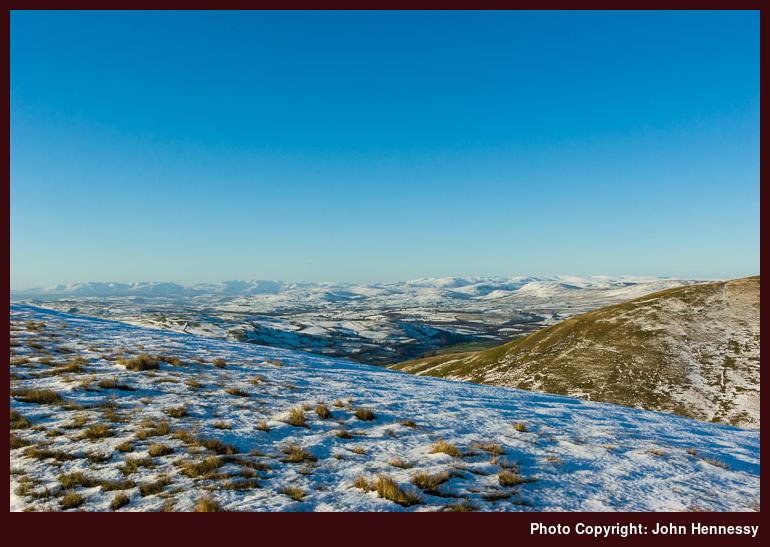
The descent from Winder meant a return to greener ground, especially since I used its western slopes. Like a winter walk that I undertook from Ribblehead to Ingleton via Ingleborough, I saw more of a thaw on western slopes than I did on eastern ones; it must have something to do with catching the warmth of the sun. It must have been the time of day, but I was seeing more folk emerging from the hills, but there was no intrusion on any reverie as I enjoyed views towards the Lune gorge and its viaduct and along the western slopes of other Howgill hills.
I returned to the tarmac in safety, and misgivings about making the most of the day erupted. That caused me to divert onto a public footpath that took me to Marthwaite. From there, it was road tramping to Birks before I plied along a short section of the Dales Way by the River Rawthey. Some more public footpath traversal took me into the heart of Sedbergh, passing by its famous school as I went to await my bus. Daylight was turning to dusk as the bus plied its way through snowy surroundings, and there seemed to be a certain reminder of alpenglow to be witnessed. After an uneventful train journey, I was home again and with some extra time remaining in the day too because of the early finish.
In hindsight, I didn't waste the opportunity that I was offered, and the taste of what the Howgills have to offer has whetted my appetite. It was about time that I set foot among these hills after passing them on train and coach so many times. Apart from that, the only other time that I sampled this countryside was when I reached Sedbergh after spending a hot July day walking from Ribblehead train station a few years back. More return trips beckon, so long as there are windows of opportunity for my continuing to explore the area.
Travel Arrangements:
Return train trip to Oxenholme and a return bus journey using Stagecoach's service 564 between Kendal and Kirkby Stephen.
An imperfect rights of way network?
16th December 2008 Access to the countryside has always been a contentious area and a recent piece of blundering of mine along a public footpath returned that very much to mind (I ended up straying away from where I should have been to earn some yelling from a passing gent atop a quad bike on a nearby road). Within the last decade, Scotland has got its very enlightened access legislation and a less extensive variant has made its appearance south of the border in England and Wales, with legal wrangles forcing up the cost of implementation of the latter.
Until these innovations, public rights of way did next to all the access backwork in England and Wales and the question as whether the network that has come into place over time is all that useful for the purposes of exploring the countryside. In a similar vein, Graham Wilson, in his book Macc and the Art of Long Distance Walking, comes up with some thoughts on the subject:
Many of these exist for reasons long since forgotten and to insist that the world and his wife can march through someone else's back garden because a postman from Time Immemorial has had to take this route to deliver a letter to a neighbouring farm is as equally unreasonable as it is for us to be denied the right to walk in a straight line across rough country direct from the summit of Shutlingsloe to the hospitality of The Hanging Gate.
I must admit that I find it hard to improve on that well put sentiment from the time prior to the Countryside Rights of Way Act that has given us tracts of Open Access Land with all their limitations in size. It just seems to capture so much and very much fits in with my wonderment as whether we are using a network designed in another era and for another purpose for very different ends. To my mind, it seems that we are using paths and tracks that came into use to link up houses and their ilk to explore the countryside. Add to that the very modern need of privacy and security and path diversions come to life, adding to the complexity that was there in the first place and things become more tricky as you approach civilisation. All that's needed is a momentary slip of concentration and the ungainly activity of map inspection and not always in the most opportune of places either.
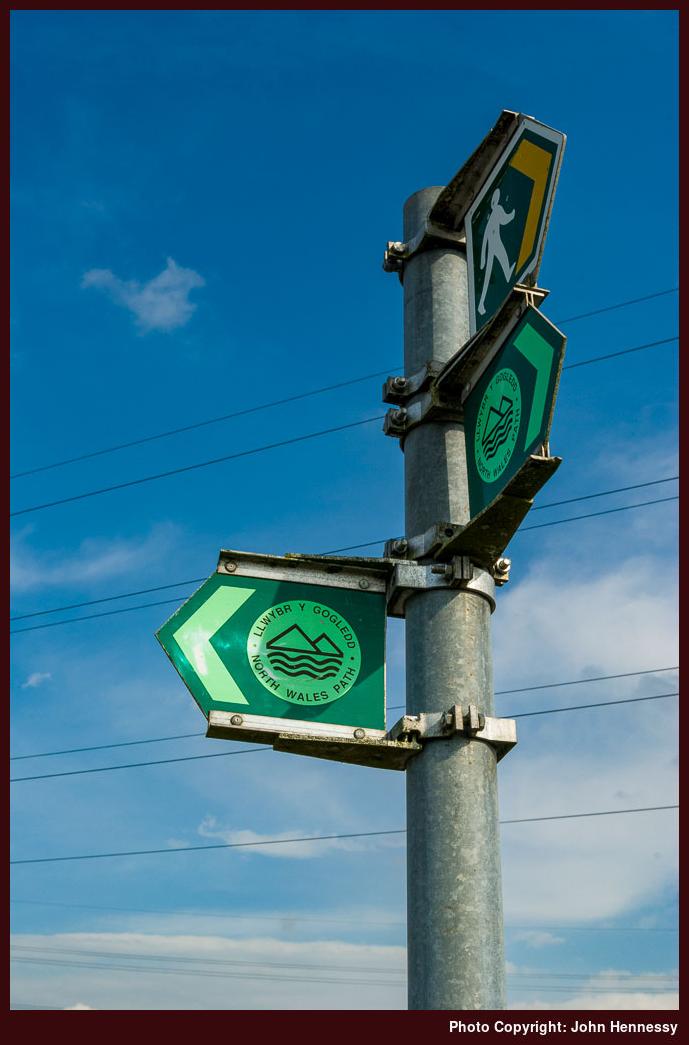
That intricacy and complexity makes waymarking even more important and it's not always up to scratch; even the best OS mapping cannot be expected to show every twist and turn of a path within a field with complete accuracy. With circular waymarks, the rotation of the arrow can confound if one is without the understanding that an arrow in the 2 o'clock position means that you are meant to take a sharp right! Apart from poor waymarking, other ways to make walkers a little unsure of themselves include the condition of stiles and the state of a path. Some areas do well on this and Cheshire would seem to be among them. Surprisingly, North Yorkshire is poor for waymarking away from its national parks while overgrown paths in North Wales are things that I have encountered a few times now. All of this doesn't aid one's sense of self-confidence if an unwelcoming soul were to be encountered (yes, the countryside is like anywhere and they surely exist there too). It seems that those spontaneous on the fly decisions to see where a right of way takes might be best replaced by a modicum of planning unless it's an area that I already know.
The impression that starts to build from this is that we might need a simpler network of rights of way in place of the rag bag that we use now. What I wouldn't want to see is a reduction in ease of access to any area, but diversions away from houses and farmyards would suit me better; I like my explorations to be uncontentious rather than appearing to be prying. However, I cannot see that scale of improvement happening because there are always other things that command the attentions of governments and local authorities and that is never more true than in these times of economic upheaval. Inertia probably rules anyway with a major push being needed to get anything like a path and bridleway reorganisation through; it took a huge effort to get the "Right to Roam" legislation implemented and I cannot see a government again confronting vested interests in the countryside quite like that for a while.
My conclusion from these ramblings? It sounds like making the best of what's there is the sensible approach, sharpening those navigational skills along the way. My days of spontaneously following a tempting signpost might be best put behind me in place of some more advance planning and noting of field exits or wanderings in open country where few are likely to feel threatened or annoyed. As with everything, you always can learn more and I am open to the idea, with thoughts of perusing the Open Spaces Society's book on rights of way coming to mind.
On readiness for winter walking
11th December 2008 It's winter again and I for one have come around to the notion that this time of year has much to offer those who enjoy the countryside. Shorter days and colder air are part and parcel of things in winter but cut your cloth according to your measure and you may begin to think that summer is overrated. From the photographic point of view, the golden light that abounds does yield results with a pleasing glow and the golden hours of dawn and dusk become more accessible too. A lot of my usual outdoors gear still remains useful but with extra warm clothing to keep out the cold and a working head torch for when walks broach the hours of darkness. Waiting for a bus or train home can be a cold business, especially since temperatures can and do plummet after dark, so my down jacket gets to see a lot of use.
The very mention of winter sends images of frost and snow into the mind but it isn't always thus. In recent years, some winters have been so mild that one would be forgiven for thinking that we had been sold a forgery. As if to prove that colder winters still exist, last year and this one have seen good falls of snow in places. It's almost as if there is a general oscillation between milder and colder winters going on and research carried out by the Met Office suggests a link with the El Nino cycle in the Pacific.
Without snow and ice, winter hiking involves negotiating wetter ground and getting back to civilisation before it gets too dark. Add in frozen ground and areas of normally soft ground become easier to cross, even if the feeling of boots not gaining purchase with the ground unnerves just a little. Otherwise, the landscape remains a familiar place but snow is another matter entirely with its ability to obscure details that are usually quiet obvious. While undoubtedly beautiful, it also presents new hazards like cornices, avalanches, drifts and blizzards for the explorer of hill country. In some ways, the door is shut on normal hillwalking with classic walks getting turned into winter mountaineering with all of its lingo. That's a whole new arena with the various different types of snow and the various pieces of equipment like ice axes along with crampons and compatible boots.
That alien feel of the collected wisdom of exploring a frozen landscape is something that I find eerily alien with my being more accustomed to green places. The wilder places become more like what you find described in Robert Macfarlane's Mountains of the Mind or Ranulph Fiennes' Captain Scott. My usual outdoors haven has more in common with that of Damien Enright's A Place Near Heaven: A Year in West Cork. That slim volume provided episodes of pleasant relief while I was following Fiennes' tale of Antarctic adversity and I can recommend it.
My experience of what might be termed full winter conditions can be compared to standing on the threshold of that world where everything is covered in the white stuff. Until last weekend, treading on powder dry snow and avoiding slips on ice were more akin to what I previously encountered. I took matters a little further among the Howgill Fells while avoiding ice on the steep lower slopes and ploughing through deeper than I had met before when up higher. I got reminded of the need for crampons while ensure that I did not go beyond the capabilities of my boots.
When it comes to entering that world of the white stuff, I am facing something of a dilemma. Do I plan to expand my experience of handling snow and ice in the hills with winter skills courses and various pieces of equipment or do I inch forward and continue to develop an appreciation of the limitations of my skills and equipment, turning back when conditions look as if they are beyond me? Being more walker than mountaineer, the latter notion is where my inclinations lie but I have no desire to become another statistic or a news item that pads out a television or radio news bulletin.
Media sensationalism can go too far and this year's OMM in Cumbria fell victim to this; it was never going to be helped by a few overreacting individuals and the torrents of rain that fell. Even so, those yarns can still be instructive. No one who has earned their outdoors spurs should be tackling Snowdon with failing light without the right equipment like two lads who were found on Crib Goch last winter so that's more of a lesson for the masses but there remain ones for outdoors types. One that comes to mind is a student group with only one map between them getting separated in poor visibility while out in Highland Perthshire earlier this year. Then, there are reports of fatalities like those on Helvellyn and they can be very off-putting.
There's something to be said for staying among the foothills on the threshold of that white world, reading and learning more all of the while. Articles like that put out on grough in recent days have their place and I wish that it was published before my weekend exertions. My preference to stay on the walking side of the walker/mountaineer divide and quote a certain Alfred Wainwright comes to mind:"You are not dicing with death. You are not making a technical excursion into space. You are going for a walk". I can be corrected on the original context but what appears to be severe riposte has its own resonance for me. In a way, I suppose that it is telling me not to get technical mountaineering mixed up with my hiking but where elements of it are needed in order to stay safe, I feel that it would be foolish not to learn about them and use them in their own good time. This can be seen as another outdoors journey: getting out into that white world without going in beyond my depth and back again safely with no harm done. It's not about conquering nature but rather to let nature help me to conquer the stresses and strains of modern life.
Cowal: yet another area that escaped my attention?
5th December 2008 A little while ago, the prospect of a sunny forecast for Argyll got me wondering about another journey up north and pouring over maps revealed north Cowal as a possible destination. The trip never got off the ground, so that idea is one that still remains on the shelf awaiting further examination. Even so, I thought that I'd share with you some of the possibilities that came into my mind.
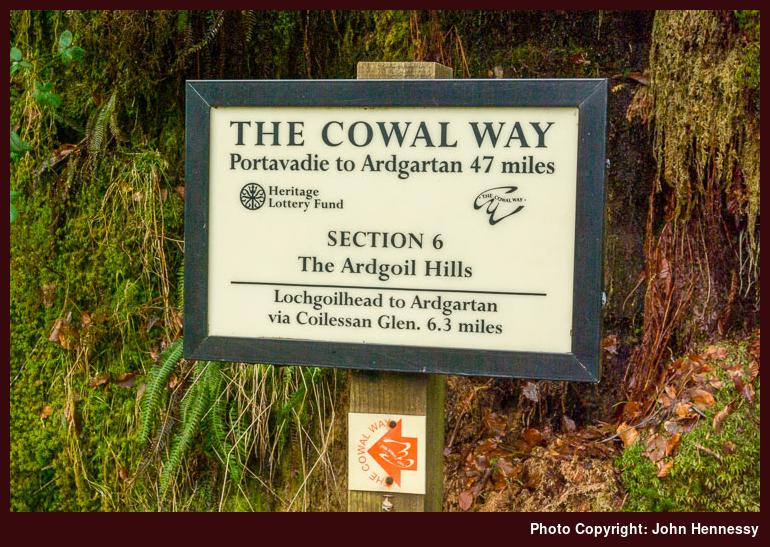
Casual inspection of OS Explorer mapping for the area will reveal the existence of the Cowal Way and it wouldn't be the first long distance to reveal itself to me in such a manner. Starting at Ardgartan near Arrochar, it then continues to Lochgoilhead and Strachur before dropping south on its way to Portavadie. Taking on the whole trail would be a longer excursion than a weekend away, but looking along its length does reveal possibilities for future exploration. The only fly in the ointment for some might be the number of forest plantations passed along its length but it is promising otherwise.
For that abortive weekend outing, I confined my attentions to north Cowal and the area around Arrochar. One idea that appealed was an early morning arrival by coach at Tarbet followed by going around the head of Loch Long and then starting up Glen Croe. Much of this can be done on forest tracks, so road walking, never the best sort, could be kept to a minimum. From Glen Croe, crossing between The Brack and Ben Donich would take you towards Lochgoilhead from which bus connections return to more built-up parts again. What I find attractive about that plan is the variety of scenery encountered so it goes on file awaiting a suitable opportunity for setting it into action.
Other ideas then began to queue up in my thinking too. Some are centred on Strachur, which can be reached by bus from either Dunoon or Inveraray, with a linear hike to Lochgoilhead and various circular options becoming apparent. Linear treks taking two days joined the line and soon I was sat with a good number of ideas to explore. This is not the sort of thing that is needed in the days leading up to a departure because that's a time for making up one's mind about things but, away from any imminent escapades, it's never a bad thing to be doing. After all, when an opportunity does make its appearance for a long weekend away, you might need to have more than one idea in mind. My trip to Cumbria at the start of November showed one advantage of this: some plans do fall by the wayside. As if to show another side to the proverbial coin, my Spring Bank Holiday weekend excursion to north Argyll left me feeling a little short on ideas after the longer walk from Inverarnan to Dalmally and I felt that to be a travesty with the perfect weather that I met while up there.
Cowal may not be that far away from Glasgow but, for whatever reason, it never dawned on me to go exploring the area; the lure of other destinations may have been to blame. I seem to have got a sense from guidebooks and so on that not many go past Dunoon to probe deeper into the area, so the omens are good for a spot of quiet walking; Arrochar and Ardlui are not so far from Glasgow either and quiet walking can be found in those places too, so my hopes are up. When it comes to a weekend visit, the fact that many bus services do not run on Sundays is a concern and, on other days, it is useful, but you do need to watch your times. Still, having a spot of hill country hiking and avoiding having to brave the possible A82 gridlock on a sunny bank holiday weekend seems good to me so I'll keep the area in mind for when the occasion arises.


