Insights from a comparison
 3rd December 2008
 Buying outdoor gear is an expensive habit to to acquire, which is why I gamely try to keep the collecting to a minimum. Nevertheless, that does nothing to stop wish-lists from growing and seeing shiny kit featured in magazine reviews is no help either. Of course, expert gear reviewers are in an enviable position with their ability to compare different manufacturers' attempts to cater for a particular need. That gives them a level of insight unavailable to the rest of us with those ever tightening constraints on purchasing power and all those other calls on our time limiting our explorations. Even with the insights of experts, we still need to discover what is right for ourselves and that can mean the occasional mistake from time to time. Speaking for myself, I am lucky to say that most of what I own is of the silent stalwart variety rather than attracting my reservations. Maybe, reading those gear reviews is useful after all...
When it comes to the minority that I mentioned above, my Scarpa boots come to mind but another piece of kit that fell into the same category is a Karrimor Cougar rucksack that I bought a few years back. To be fair, it served me reasonably well on numerous Scottish outings including sessions along the West Highland Way and the Rob Roy Way along with weekend visits to Lochaber. Being a heavy duty article, there is a weight penalty of next to 3 kg before anything goes into it and that is where my concerns start. Add to that its harness feeling a little like a cage while you have it on you back and a hip belt that gives a neutral performance and the penalty points rack up, especially when compared to something like an Osprey Atmos 50. It also took some time to fine tune the back system so that it worked more to my liking and that's somewhere the Atmos scores too.
Those reservations about the comfort, fit and weight of the Karrimor got me thinking about alternatives for August island hopping trip. While my Atmos 50 has an Tardis-like ability to carry more than you'd expect of it, I thought that using it for a whole week might be a little limiting; according to BPL.com, the Exos has eerily reminiscent talents and would be on my list if I was looking at a rucksack for a week-long trip again. However, the Exos was in the future so I ended up settling on another Osprey, an Aether 60, for load hauling duties in its place and that of the Karrimor. The Aether, definitely a lighter article than the Karrimor, did whatever I asked of it, even if it was that little bit bulky (compression straps on the 'sack do make things much more manageable though) for day walks and some of those really did take me across some rough country. When fully loaded, the hip belt worked well so long as it was done up tight, a behaviour typical of these packs if comments made by BPL.com are to be believed. The back system again gave me no cause for real complaint either and the weights being carried really tried it out, especially on the Tuesday of my sojourn on Harris.
I have to say that the Aether still seems to suit me better than the Cougar but there's one insight that I have gained from using both: you need to be acclimatised to whatever weight you plan to carry or your progress will slow. It could also make you gradient-shy like I was on a weekend away with the Cougar and left a walk up Ben Vrackie for another time; the damp aspect of the day provided additional impetus for my decision. For sake of clarity, I am talking about weights of up to 20 kg here rather than anything more than that. So, for that future longer trip away to sample hill country, I plan to more acclimatised to the weights that I will be carrying and that perhaps preposterous thought of carrying the Karrimor on shorter training walks and it well loaded may come into play yet. Another idea is to plan for posting things home as I go. From my experience of spending a week of island hopping in August, maps come to mind because I was moving around from place to place but there can be other things being carried needlessly too. Organising parcelling and making time to visit a post office without it impacting on time in the countryside are probably the tricks to master with this one.
It may have meant spending a more money than I might have liked but I think that I learned something useful from using two different rucksacks for multi-day hiking. No doubt, there is more to be learnt and that comment applies to more than rucksacks. For instance, who knows what my footwear explorations could yield yet? I may even start to view my Scarpas in a new light.
A feast of fog and frost
1st December 2008 One of the problems with a flatter area like the Cheshire plain is that fog can accumulate and, even though Macclesfield is set higher on the cusp of hill country and it's not near any major rivers or other bodies of water, we were graced with very thick fog for the whole of Saturday. The thickness was sufficient to make one wonder about the sense in navigating through the countryside without the full picture, even if walking in foggy conditions does possess its own charm.
That fog cleared progressively on Sunday and all that remains is a faint haze today. However, frosted vegetation is everywhere for all to see, acting as a reminder to wrap up warm and my North Face Nuptse is brilliant for this so long as conditions remain dry. Seeing everywhere as if it was immersed in a freezer cabinet has its own delights so long as you keep your wits about you and do not take a tumble from slipping on ice; it's the black variant that really catches you out and it's amazing how clumsy people can be with throwing water about the place.
In fact, all that's needed to complete the picture is snow and that seems to be arriving too, even if my cynical self believes that we should never expect that much of the white stuff and that's even with my venturing out on snow-covered lands from time to time; those parts with greater altitude and higher latitude seem better endowed. Photographically speaking, it all looks a bit monochrome under grey skies but something can be made of that also. And, with sufficient preparation, it all can make for wondrous winter wandering.
Snow and frost is something that we don't get to notice for so long these days, especially with the usual pre-Christmas hurly-burly, so it's probably no bad bad idea to make what we can of it if and when we can (I am trying to shake off a cold at the moment). Every season has its own delights and I am beginning to wonder if summer is overrated and so reckon that it's best to get out there to savour whatever is on offer whenever it comes. I'll see if I can fit in an outing among all the other things that need doing.
Update 2008-12-05: We have had our snow and it's gone for now though it always can return.
When a certain ring of familiarity attracts your attention
29th November 2008 The name "Allt Coire Chaorach" probably doesn't mean that much to most people. When I saw mention of it in a BBC news item concerning the recent approval of a hydroelectric scheme, I just had to investigate. That search for further information led me to the Scottish Government's website where the fuller details are for all to see.
It was the inclusion of the word "Chaorach" that got up my curiosity because there was a faint possibility that I may have passed it on my travels through Scottish hills. In fact, it was my passing through Gleann nan Caorann whilst on a trek from Inverarnan to Dalmally at the end of May that proved to be the trigger. However, in Gaelic, caorann is the word for a rowan tree while caora is the word for sheep. So my wandering took me by glens and burns named after the rowan rather than sheep or ewes like how it appears for Allt Coire Chaorach. It's amazing how appearances can deceive when it comes to languages of which you don't have a detailed knowledge.
However, Allt Coire Chaorach isn't that far from Inverarnan since it starts out on the eastern slopes of Ben More and Stob Binnein before plunging to the floor of Glen Dochart to join the river that gives that glen its name; that river itself goes on to feed Loch Tay, from which emanates the river of the same name that reaches the sea near Dundee. Apparently, this is also a site of special scientific interest and the Scottish Government seems to be continuing on its course of not entirely respecting SSSI's if the approval of the hydroelectric scheme is any useful indicator. It's also located within the bounds of the Loch Lomond and the Trossachs National Park so the trend seems a little too consistent. Let's hope that the construction works are as sympathetic as they can be.
Incursion of modernity into our beloved hill country often attracts furious disapproval; just look what surrounds the subjects of wind farms and electricity supply lines. Anything that is already done doesn't trouble me so much since removing it might cause even more disruption than leaving things as they are. However, any proposed changes do rouse my misgivings and I hope that the powers that be do leave us with sufficient wild country to explore and so escape the pressures and demands of modern life. Getting corralled into busy honeypots would be no fun; while National Parks have their own multitude of quieter corners, making one's way through the hordes to get to them isn't as nice as the unimpeded access to them in lesser frequented parts.
Saying all of the above, the new hydroelectric scheme may not be that intrusive in the visual sense. From the side of the A85, it should be hidden behind forestry but it will take some time to blend in with its surroundings so that it doesn't look so obvious from the heady heights of the likes of Ben More and Stob Binnein. For those who might like a wilder feel, now might be a good time to explore these and other summits before any changes take place. The rest of us might be comforted by the thoughts as to how quickly nature can reclaim the land from our worst attentions. Just visit the North Pennines, once a bastion of lead mining, and other parts where such activities were once prevalent and now long gone. Visiting the quarry-scarred hillsides of Gwynedd might not be the best idea when seeking solace from our disregard for the landscape with which we have been gifted is what's in order.
A need to try again?
28th November 2008 It's been a while since I mentioned my Scarpa ZG10's on here. Over the summer, I took a risk in taking them with me on my bout of island hopping because I feared that I needed their waterproofing with the weather that was being forecast. As it turned out, I went to one of the few parts of Britain where there was sunny weather but I still put them to good use and needn't have had the worry that most occupied my mind: ankle discomfort. Any breaking that I had been doing paid dividends there.
Since then, I have found that if I did get unpleasant weather, they would cope well with it. Their robust construction meant that crossing of rough country around Skye and South Uist was easily within their operating range. More recently, I confirmed this when I took them on that crossing of waterlogged terrain from Ardlui to Butterbridge. Having a solid rubber rand all around the the bottom of the uppers makes cleaning easy too, a useful attribute in this season where mud is often encountered.
So, there's a lot to like about them. There is, however, one constant nagging doubt remaining at the back of my mind and that relates to how well they fit me. Scarpa is one of those manufacturers that resolutely sticks with European sizing, even on the U.K. market. Because of this, I wonder if I ended up with a pair of boots that is a U.K. half-size bigger than what I really need. In the shop, they appeared to fit fine and I didn't detect too much looseness while breaking them in but it was my taking them north on that island hopping excursion that found them out. On my most recent hiking trip to Cumbria, I found that wearing thicker socks and using volume adjusters really did help and I don't remember much heal lift, so long as any laces didn't fulfill an urge to loosen.
My having qualms about sizing and fit is something of a shame, considering how well the Scarpas otherwise perform, but it is often said that fit is the most attribute of a pair of boots and I would have to agree. It would be worse if the boots were too small for me but their being a little too big can be troublesome too so the thought of trying out alternatives does linger in my mind. Since there's only so much that you can learn from trying boots out in a shop, the idea of renting a pair to see what they're like sounds an intriguing way to avoid spending money on what isn't suitable (I have a vague recollection of such a service being advertised). Of course, having firmer idea of what you want helps too and could get you away from picking a particular brand or model to seeing what a shop might have on offer, taking advantage of their expertise in the process.
I have yet to decide on a boot hunting mission so I'll continue to see how I can get on better with my ZG10's while continuing to ponder the footwear issue. They have already taught me a lot so there my be more to learn and they may loosen more with use with fit improving as a result; it happens with Raichles, apparently, but I will not be depending entirely on this happening with all boots. Even if the Scarpas were to get replaced by others for much of my hill wandering, I would still hang on to them because one never knows what might happen that would have me seeking out a spare pair for some weekend away; I am sure that they would serve a bigger purpose that what they have taught me so far.
Another day, another fell
26th November 2008 Last Saturday saw me venture out into hill country again with a trip to explore the fells near Ambleside. The last time that I was up around those parts, it struck me that I hadn't been around Ambleside for a few years, so the seeds were sown for a future outing. Being that time of year when shorter days are visited upon us, I was after a hike that I could complete in the available hours of daylight and ended up ascending Red Screes before descending to Scandale Pass and then down Scandale itself while returning to Ambleside.
My visits to Ambleside seem to alternative between grey days and those with an altogether more sunny aspect. Last Saturday was to prove to be one of those grey days, as was the one when I first went to Ambleside. Then, I plied a short circular route around by High Sweden Bridge and then Low Sweden Bridge. Next time, the sunshine of a crisp clear cold February really showed the landscape at its best as I made my way up Scandale, over Scandale Pass and then back to Ambleside by way of the Kirkstone Pass and down The Struggle; I was enjoying good moonlight on the final stretch of the stroll. A mixture of greyness and sunny breaks were what greeted me while on a round of the Fairfield horseshoe with a start at Rydal to ascend Heron Pike and Great Rigg to continue to Fairfield (the summit was deserted when I reached it so it isn't always crowded) before dropping down to Ambleside again. When a trip to North Wales proved unworkable after a train cancellation, I found my way back to Ambleside and was consoled by the delights of a sunny day and a fabulous evening as I went over and around Loughrigg Fell on a circular hike.
The sun did peep out near the end of the day last Saturday but it was frigid, breezy and bracing greyness for most of the time. There were signs of blue skies in the distance as I left Ambleside to go up the narrow Kirkstone Road. Sufficient cars were passing the way to make me appreciate the off-road travel when at last I started up a public footpath traversing the often soft ground.
Eventually, that softness began to the hardness of well frozen terrain, but there was a fair amount of ascent among stone walls before that transition was encountered. Apart from a momentary spot of confusion due to an overestimation of progress near Snarker Pike, navigation was a straightforward affair. On the lower reaches, I was sheltered from the cold biting breeze from which there was no escape once headier heights were reached and especially as the gradients eased between Snarker Pike and the summit of Red Screes. It was no day to linger on that summit and, very appropriately, it was bedecked with frozen tarns. This was hardly the time and place for conversation but I was asked by a lady where the path that I had following started out; it went too near to Ambleside for her and those with her (there is another possible way down, but even Wainwright suggested that to be too steep for a descent; that might have been how they made their way up).
With the inhospitable conditions on the top of Red Screes, it should come as little surprise that I started my descent with no delay. The greyness was one limitation of photographic exploits but it was the cold that capped it all. Production of anything worthwhile was to await another day and I picked out my path down the slopes to Scandale Pass. A wall provided a useful navigational handrail and Scandale Tarn was in view too. Eventually, I was to lose that biting breeze on the return to more familiar surroundings.
The way down from Scandale Pass was easy walking and softer ground was met as I plied the banks of Scandale Beck until I reached High Sweden Bridge. It was then that the sun escaped from its cloudy hideout and I got to acquire more pleasing results, to my eyes at least. That appearance of sunshine caused me to diverted around by Low Sweden Bridge but it was soon to disappear again. A goodly number were descending this way to Ambleside, including a sizeable group of students; I wonder if they were attached to the University of Cumbria, whose campus I passed as well.
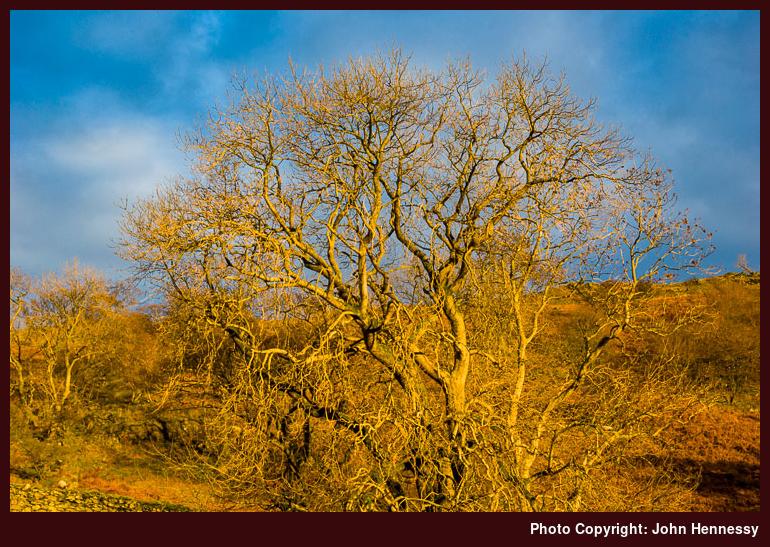
I was easily back in Ambleside before daylight faded for the day. The town was chock-a-block with people, making any aspiration of having a look in outdoor gear shops utterly impractical. The mercury was really dropping by now as I made for the bus stop for my bus back to Windermere, retracing the journey made that morning by train to Windermere and bus to Ambleside. However, I was left waiting in the cold for up to an hour due to the turning on of Ambleside's Christmas lights and its concomitant disruption of any passing bus services (I wish that I knew about this beforehand so that I could have planned accordingly). I still managed to catch my intended train from Windermere to Oxenholme only to have an hour's delay in Oxenholme due to an incident on the line; being able to wait in the warmth of the indoors helped here. Even so, I was back home before 21:30 after a good day out that might yet be the progenitor of more like it.


