Category: Ireland
Revisiting the subject of Irish digital mapping
 9th January 2009
 If you were to ask me about digital mapping for the Irish Republic this time last year, you would have been told about OSi's Trail Master DVD's. They may not have covered the whole country but what they did was nothing to be derided. Perhaps unsurprisingly, things have changed a lot since then. For one thing, it is now possible to find all of OSi's 1:50000 Discovery mapping available for free on the web. I must admit that I came across it by accident and after I had used the "City" zoom level (yes, that's what they call it). The quality of the rendition may feel imperfect but it is hard to argue with there being no cost involved.
What brought this re-visitation about was the announcement before Christmas that Trail Master mapping was coming to GeoLives. Then, I didn't have the time to explore what this meant because of the pre-Christmas necessities but I have been able to set that to rights now that we are in 2009. For many, the mention of GeoLives might demand some explanation. Put at its simplest, it provides digital mapping much in the same way that Anquet and Mapyx do it: while you used to have to buy Trail Master DVD's from OSi previously, you can now download the same data and more from GeoLives.
There is more to GeoLives than Irish digital mapping and it features Belgian, Dutch, French and Swiss data too. In fact, the organisation is based in Luxembourg and was established last year as a collaboration between a provider of geographic data (STAR-APIC) and a specialist in internet applications (Géomatic Ingénierie). Of the countries whose data are included, it is for France, Switzerland and Éire that there is mapping most relevant to walkers.
Like Anquet and Mapyx, Windows-only software can be downloaded for working with any downloaded maps. For users of alternative operating systems like OS X and Linux (that's the one I mainly use at home), there is a web-based application for performing the same functions as the Windows application and there's nothing to stop your using it on Windows either. GeoLives calls the former the PC Editor and the latter its Web Editor. The reason for the use of the word "Editor" here is the inclusion of route planning capability in both and I can vouch for inclusion of place searching functionality too. I cannot say that I have been testing out the route planning pieces so far but they look similar to what you find with offerings from the main purveyors of British digital mapping. With the Web Editor, there is the possibility of sharing your routes with other GeoLives users.
A €15 tariff needs to be paid before you can get going with the service. Since I already owned Trail Master mapping, I could use my OSi login credentials and even had pre-acquired Trail Master data made available to me online without need for payment above and beyond the subscription.
Buying mapping works on the principle of using up credit that you have purchased beforehand; it's available in €10, €20 and €50 denominations. Then, you can buy maps by the tile or bundled in Supermaps. Even if you don't make any purchase, certain large scale maps come as part of the subscription but these are little use to the walker. Once tiles are bought, they become available through the web application and can also be downloaded too within 48 hours of an email containing the requisite link being sent to you. Downloading the data for offline use is something that I have found troublesome with time outages blighting the experience; the fact that we are talking large files here doesn't help matters, even if they are wonderfully crisp in their appearance. GeoLives would appear to have some way to go before the process becomes as painless and that with either Anquet or Mapyx. For now, it's just as well that there is the web application.
In summary, this is an interesting service that I hopefully will continue to explore. As I intimated earlier, I have yet to try out the route planning side of things and I would like to see data downloads become far more reliable than they currently are. Despite this, it could be that GeoLives becomes a purveyor of digital mapping for all of Europe and it seems to have made a good start. Let's hope that it continues to grow and to improve.
Straight into the gallery
30th October 2008 A visit to family in Ireland last month allowed me a day trip to the beauty spot that is Gougane Barra; somewhere to which I have devoted a previous post on here. That also followed a day trip there when the skies remained resolutely grey with any photos not being the type of thing that I'd share on here. In fact, it seems that many of my trips to Gougane over the years have been on cloudy days. My most recent outing looked as if it might have been the same, with the forecast predicting a rain band moving south over Ireland. In the event, we managed to see Gougane under blue skies with the sun making it out from behind any clouds to make photography a more than worthwhile pursuit. The result is that I have some pleasing photos from my excursion and these have now made their way into the West Cork section of the photo gallery and I have taken the chance to freshen up some existing ones too.
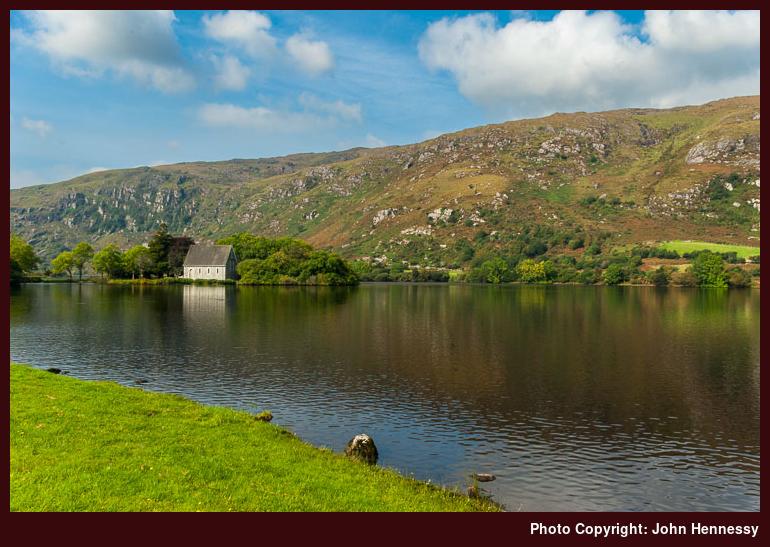
The addition of new photos has not been the sole change to that online photo gallery. Some work has gone into simplifying navigation and enhancing the search facility. Behind the scenes, the wonders of ImageMagick (it's a neat command line tool, but that probably makes it best for technophiles) have been such that the process of adding new photos is now more streamlined than it ever was. Even so, the need for devoting some attention to each individual photo doesn't go away and that is regardless of whether it was made on film or digitally. Nevertheless, any time saved might make me add new photos to the gallery on a more regular basis than has been the case in recent times. After all, there's a potential new section for the Western Isles on the horizon and more photos from other outings to be shared.
Not a bad weekend…
15th June 2008 It's the sort of time when I might have been off somewhere, braving the threat of showers. However, a bout of flu picked up last weekend in Ireland has meant that staying at home has been the most sensible option. Still, getting grounded with sunny skies outside does wonders for the outdoors enthusiasm, never a bad thing. For one thing, it allows ideas for excursions to foment, and the same could be said for that weekend in Ireland.
Regular visitors will know that my native Ireland has never played host to a proper hillwalking outing of mine to date and that I am always wanting to change that, even if plans have never come to fruition to date. Last weekend's outing to Killarney was as strong a reminder of that as any. It was anything but my typical outing with it involving a lot of driving and I doing it. My people are not big into walking, but I still managed to get a stroll lasting up to two hours out of the day.
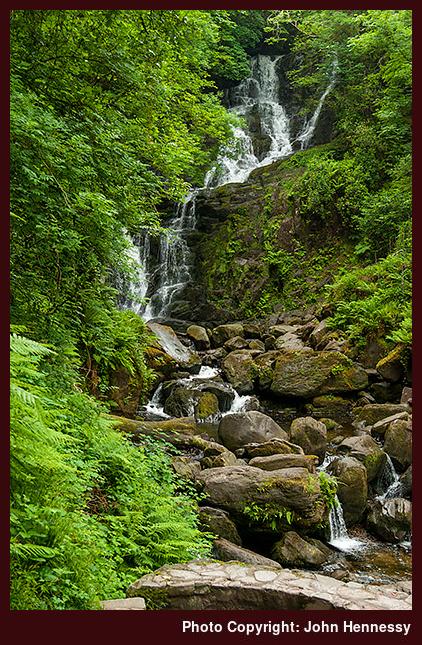
This part of Kerry plays host to a goodly amount of quality hill country, and there's a very tempting long-distance trail that threads its way though a lot of it: the Kerry Way. As it happened, my short walk wandered along part of the said trail as I plied my way from Muckross House to Torc Waterfall and back again. The day was a grey one, damp at times, but the scenery was nonetheless wonderful; if we had the weather of the preceding and subsequent days, then the appearance of the surrounding landscape would have been next to peerless. I had to leave the tempting track of the old Kenmare road after me, or those with me might have been wondering what happened to me on my brief escape. The amble was a good taster, and I must sort out that proper Irish hillwalking trip...
Relating adventures…
12th January 2008 Like many outdoorsy bloggers, I share my meagre adventures with the world. Of course, they are nothing like Irishman Pat Falvey's recently successful Beyond Endurance expedition to the South Pole. The Antarctic attracted its fair share of Irish with names like Bransfield, Shackleton, Crean, Keohane, Forde and McCarthy gracing the history of the continent's exploration in an era where the exploits were a world away from our interconnected present where websites can convey regular news of progress in a timely manner. In contrast to the blogs of members of Falvey's team like Shaun Menzies and Jonathan Bradshaw, the diaries of those explorers from the past were much slower in becoming publicly available. Having read Sir Ranulph Fiennes' Captain Scott, I detect resonances of similar hardships down through the ages even in the latest stories.
The heroics of Scott, Shackleton et al. were all the more profound given that they were venturing into the unknown; it wasn't as if they could fly back from the South Pole after reaching it, like present day explorers can do; they not only had to reach the pole but they had to return too and that sadly was Scott's undoing. Fiennes' descriptions of the hardships and disasters suffered on Scott's expeditions were so vivid that I needed some gentler reading to give me a break from the grim happenings being described. Damien Enright's A Place Near Heaven returned my imagination to a more temperate climate with is vividly pleasant observations of the activities of nature throughout the seasons in West Cork. Bemused recollections of crows breaking open shellfish by dropping them onto boreens, and puncturing car tyres with the resultant mess, certainly provided light relief. Maybe, I am not cut out for polar exploration.
Another world far away from mine is that of high altitude mountaineering, the type of thing for which the likes of the late Sir Edmund Hilary gained their fame. Names like Alan Hinkes and Chris Bonnington also come to mind. Climbing the world's highest mountains is another activity that more than takes the human body well outside of its zone of comfort. Reading of Irish mountaineer Gavin Bate's pulmonary oedema on Everest in a recent of Walking World Ireland certainly made me shudder (he managed to make his way back down from the death zone and is still very much with us). Stories like that do make one wonder why some people do this and that sort of wonderment brings my thoughts to Robert MacFarlane's Mountains of the Mind. Like Fiennes' book, that too ends with a hero encountering his goal and never returning alive; in Mallory's case, we may never know if he achieved his.
You might be wondering what has brought this lot on. Ironically, it isn't necessarily my wonderment at the exploits of those venturing into extreme places, though that of course plays its part. In the main, the real triggers come from a world more like that described by Damien Enright rather than that frequented by Pat Falvey and his kind. It seems that we Irish, rather than wallowing in the habitual and banal like poet Patrick Kavanagh, would rather relate the exceptional. There is a place for that but I reckon that the world is the poorer for Irish hillwalkers not relating their more accessible adventures in the Irish countryside. I, for one, would have a strong interest in them and, if I were to encounter a good blog musing over walking in Ireland as its mainstay, I'd be more than happy to give it a mention. In the meantime, I really should try to get in a proper hillwalking day over there this year. It shouldn't demand the heroics of Scott and others...
2007: the excursions reviewed
7th January 2008 It's very human to look back at the turn of a year/decade/century/millennium/etc. and, this time last year, I took the opportunity to look over my travels in 2006. In the same vein, I now cast my mind back over the same sort of thing but for 2007 instead. If 2006 was to be the year of seeking out pastures new, then 2007 has been a year largely taken up with following long-distance trails into country familiar to me from a different angle and, more often than not, into country that I am visiting for the first time.
2007 was to start quietly with only one walking excursion in January. The weather didn't tempt but for a day when I went to Chirk for a trek to Llangollen that saw me hop over and back along the Wales-England border before picking up a small piece of the Offa's Dyke Path and leaving that to get to Llangollen before nightfall. It was a case of something old, something new, and put an idea into my head that laid the foundations for a walk later in the year. The long-distance trail ethic that was to pervade my walking in 2007 had made an early appearance.
February built up the long-distance trail trend with my exploring two trails. First up was the Pennine Way, with a hike from Hebden Bridge to Littleborough giving me a feel for the moors above Calderdale. Walks along the Pennine Way, still unfinished business in 2008, were to pervade my outings until the end of April. My second excursion took me up to Scotland for the southernmost part of the West Highland Way: Milngavie to Drymen. This was also a case of going into countryside new to me and, like the Calderdale trot, it was to give rise to more excursions later on.
The Pennine Way hiking continued in March, and it started again early in the month with a trek that saw me return to Calderdale for a walk from Todmorden to Burnley by way of both the Pennine Way and the Pennine Bridleway. This was followed up at the end of the month when I yomped from Haworth to Burnley.
My Pennine wanderings were set to continue in April and the first one plugged a gap in the itinerary from Edale to Haworth: Marsden to Littleborough via Wessenden Reservoir. It was to prove a claggy day until lunchtime, something that very much focussed the mind when it came to navigation. My next day along the Pennine Way was in clearer if blustery conditions. It also was to take me through some of the best countryside on the Pennine Way as I voyaged from Horton-in-Ribblesdale to Hawes. Rain was to beset me on my next excursion as I left Malham Tarn to head for Gargrave, but I left the rain after me in Malham and things cheered up immeasurably as I was nearing my destination for the day. Those two excursions left a gap that was filled on a tramp from Malham Tarn over Fountains Fell and Pen-y-Ghent to Horton on a day that when it felt like summer.
I started May with another trip blessed by fair weather. After years of admiring it, I finally made my way up to the top of Skiddaw. Some may view the manicured lines of the "tourist track" that I followed as dull, I'd rather not scare myself with descents that are too steep, so I well appreciated its gentler approach and I still found time to take in Little Man and Lattrigg as well. Next up in May was a trip that my memory reckons happened in July; it's just as well that I have this blog! I made my return to Chirk for another stroll along the Offa's Dyke Path, this time to Oswestry. Cloud predominated on the day, so photographic opportunities were rare. Even so, it didn't stop my having a good walk in countryside that was new to me. If I had more time, I would have dawdled more, so it might time for a return. In walking terms, the month of May went out with a bang: a two-day trek on the West Highland Way along the banks of Loch Lomond with an overnight stay in Rowardennan. I very much took a chance with the weather on this one, but Scotland didn't let me down on what is, for me, one of the finest stretches of the WHW.
June was to be a quieter month regarding walking and the long evenings were allowing me to get out in the part of Cheshire's hill country that is near me. These outings were to become a feature of the "summer". June soon became a sodden affair, yet I still returned to Rhinog country for a creditable stroll through a landscape that was anything but dry. The weather that we were getting was a foretaste of what was to come, making 2007 a year of two halves: one fabulous and one that returned us to reality. Alan Sloman was lucky to complete his LEJOG when he did.
July was for many a washout, yet I managed to get two decent Lakeland excursions out of the month. Both involved my heading to Windermere, with the first being an over and back hike to Kentmere and the second being a trek to Staveley via Kentmere. On both outings, I enjoyed the fine scenery in excellent weather, something that must sound ironic to those sodden by the floods of 2007. Yes, water had accumulated underfoot, but the worst difficulties, if any, were avoidable.
August saw me finishing two long-distance trails and starting on another one. The first to be completed was the West Highland Way, and that happened on my now habitual summertime stay in Scotland. That saw me complete of perhaps the noisiest stretch of the trail: that between Bridge of Orchy and Inverarnan and with some sun to enliven the views too. The other walking that I did during that trip was a soggy reconnaissance trip among the hills near Kinlochleven. The other trail completed was one passing not far from where I live: the Gritstone Trail. Hikes from Macclesfield to Congleton and from Eaton to Kidsgrove in pleasant conditions allowed me to bring my walking of the trail towards a good end. A final evening stroll was sufficient for me to walk the final short stretch around Bollington before I then walked home to my house. The bank holiday weekend at the end of the month allowed me the opportunity to start off the Rob Roy Way by walking from Drymen to Callander, with an overnight stay in Aberfoyle. This got me into nice countryside that I hadn't visited before, and it seems more than worthy of a return.
After what must sound like a bountiful August, hillwalking activities were less prevalent for the rest of the year, even if I had planned not to have things slow down. September and November stand out as months when you could have said that I had gone into hibernation. October saw me head out for a local constitutional to take in the Autumn colour, follow streams in local hill country and visit the South Pennines for a hike that was lacking in any real progress on completing the missing link in my Pennine Way journey. In December, I decided to vanquish any sense of hibernation by another wander among the hills lining the Cheshire-Derbyshire border, followed up by a fleeting unintended visit to the hill country of the Long Mynd near Church Stretton.
All in all, 2007 was another good walking year for me. Unless you lost out in the flooding (and I don't envy anyone who did: hope it all works out all right for them), it would be a travesty to remember 2007 for its sodden summer when we had so much clement weather earlier in the year. As it happens, the continual greyness that pervaded nearly all of 2004 remains with me, with 2007's bright spots easily causing me to forget any grey bits. The proverbial question of what 2008 will bring does raise its head, as it is wont to do; so also is the realisation that the future is not ours to see (we're probably better off!). I never go in for big plans anyway, but that doesn't stop me having ideas in my mind for when the opportunities to explore them arise. We'll see what happens...


