Category: Reflections
Revisiting ruggedness on the way from Hayfield to Edale
 26th September 2024
 A previous posting on here mentioned the elongated break that I took from work during the summer of 2020. It also collated three longer hikes that took me through hills that line the boundary between Cheshire and Derbyshire. Perhaps wisely, for the sake of not overdoing the length of the piece, I omitted a hike that me over Kinder Scout that came the day after walking from Disley to Macclesfield. Yet, there is a slight link in that the bus conveying me from Macclesfield to Hayfield also passed through Whaley Bridge, possibly sowing the seeds for later hikes from there back to Macclesfield.
However, the Kinder Scout escapade had a few distinctions of its own. Firstly, this was the first hike since the onset of the pandemic that did not end with my walking or cycling back home. Another point was that it no longer felt feasible to use a 50 litre rucksack for day hikes. My attempts to make things less blatant than this attracted some amused comments from a passer-by, so I went and got a smaller Lowe Alpine item from The Climber Shop. Apart from a weekend ascent of Helvellyn and subsequent wandering near Callander and Stirling, and the trip to Paris in May of this year, the smaller Low Alpine pack has become my mainstay on countryside incursions.
By the time that I got on the receiving end of those remarks regarding how I was equipping myself, I already had got as far as the trail going along White Brow to the north of Kinder Reservoir. Recollections of the way there have needed to be rekindled from my memory banks, but the image of my leaving Hayfield village under grey skies and following a largely quiet section of the Pennine Bridleway has returned to me. The lack of activity around the campsite that I passed after leaving that trail is another fragment that helps top rebuild my route in my mind. Because of the lack of sun, photos were made infrequently, possibly because of how familiar the area is to me.
After Bowden Bridge, recall is again vague. However, just going along Kinder Road seems unlikely. Thus, the course more likely passed Hill Houses, The Cote, Booth and Farlands. There is another image from under grey skies that takes me around by Tunstead House and not far from Tunstead Clough Farm before reaching the others. That feels stronger than mere confabulation as I write these words, so I am going with that.
It would mean a crossing of the River Kinder beneath the reservoir dam that resonates with me because of the onward route to the flank of White Brow. From there, things become more memorable again, and there are photos to help too. This may have been familiar ground to me, but the novelty was not lost, either. After crossing Nab Brow, there was the matter of powering my way up through William Clough. My light load may have helped with this, making someone else comment on how well I was going.
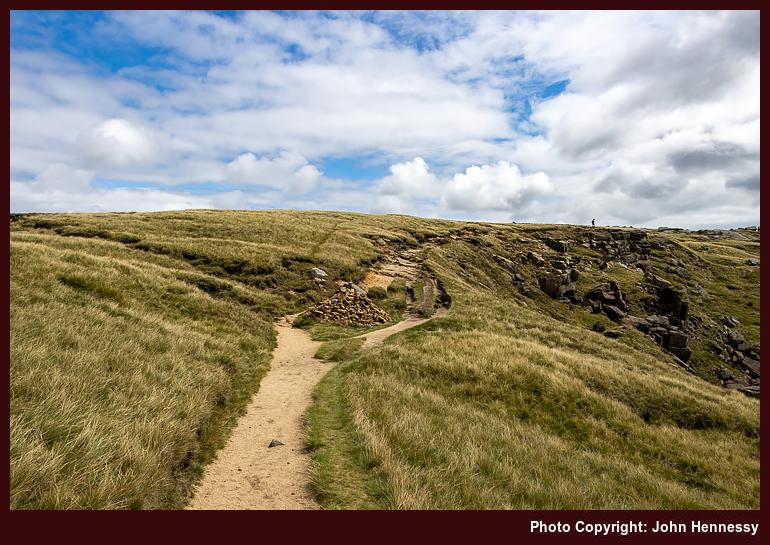
Beyond William Clough, I met up with the Pennine Way. That was going to convey me to the top of Kinder Scout and around by its western edge. After the initial short pull up steeper inclines, it struck me that most of the ascent was on gentler gradients. That initial steepness was over quickly, much to my surprise; William Clough felt much more rugged in comparison. There were others about at this stage, yet the place felt none too crowded, and skies broke overhead to allow the sun to do its uplifting work on a tapestry of hardy grasses and wind-sculpted rocks.
Near Kinder Downfall, there was the option of following the old course of the Pennine Way towards Grindsbrook Clough, perhaps avoiding many of the people that I was to pass later in the day. The horror stories from bygone crossings and my lightweight state meant that I stayed within view of Kinder Reservoir instead.
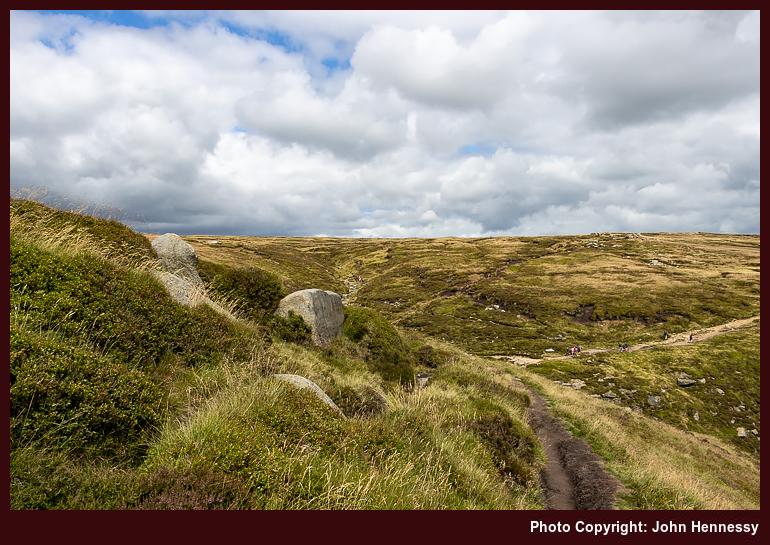
As I grew closer to Edale Cross, it struck me that this was not going to feel like a quiet Monday around there. If I had designs, on following the Pennine Way down to Edale, they were scotched in favour of what I hoped to be quieter informal paths. As with many things with 2020, old experiences became poor predictors of then contemporary behaviour. Thus, I had to share the place with more people than I felt was ideal. It was a matter of making the best of it, and relishing any quieter stretches as I passed Edale Head, Pym Chair and Crowden Tower, some of these being part of nature's gallery of rocky outcrops. Each formation seemed to tell a tale of millennia, weathered yet unyielding.
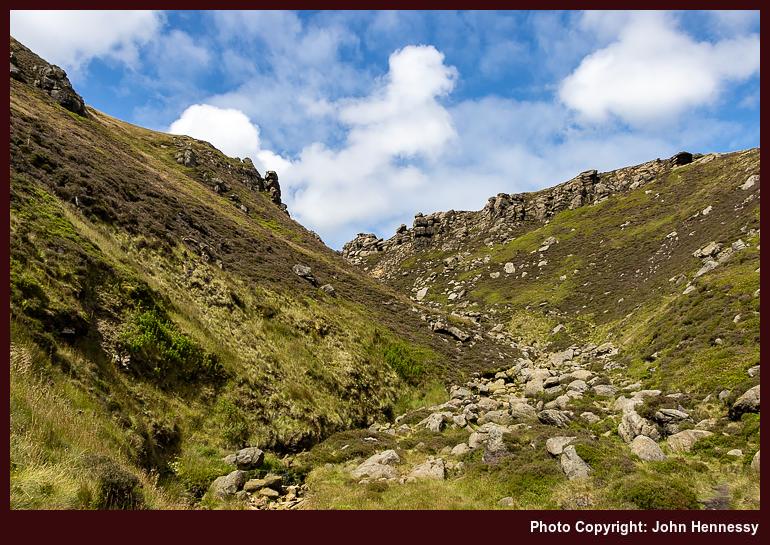
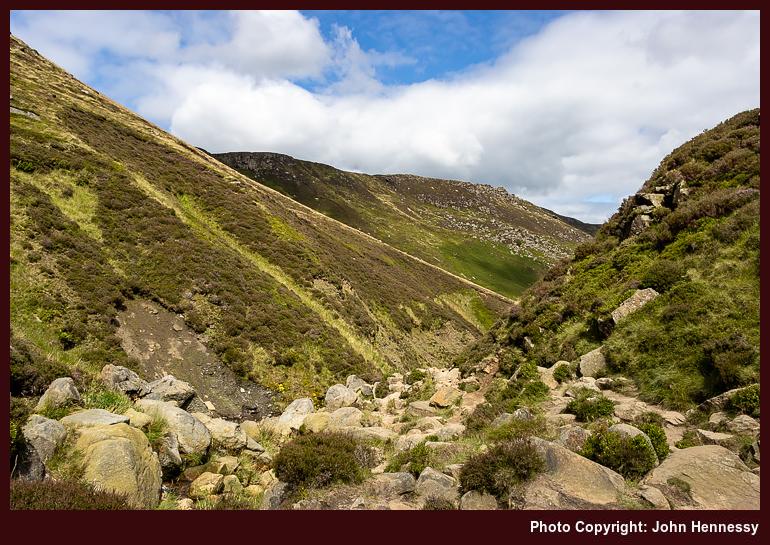
In some ways, the descent into Grindsbrook Clough was a wise choice; it thinned out the encounters with others to near nothing. The steepness of the initial stretches only would have helped to ensure that. This was light scrambling, with plenty of occasions for getting hands on intimacy with the gritstone slabs. Even with an abundance of cool, unyielding stone, keeping three points of contact hereabouts is a frequent necessity. It staggers me to think that the Pennine Way once went this way; there is plenty to remind one of nature's raw beauty and the respect it commands.
Patient resolve was rewarded when the gradients eased. The skies were again packing with cloud cover, which would have foiled any ambition to improve on photos made in August 2001, if there even was one at that moment. Having a pleasant path to follow on the way to more bucolic surroundings was enough for me that afternoon.
Edale felt tranquil with less around it than I found on the edges of Kinder Scout; it prompts the question as to where they came from, but a rural car park or two might explain that. A quirk in the train timetable meant that I spent longer around the place than I was expecting. This proved to be a refuelling opportunity using some refreshments purchased from a kiosk near the train station.
While the day may have been cloudy much of the time, there was uplifting sunshine in the middle of the hike. This also was when I met more people, a discomfort in times of pandemic. Nevertheless, there were moments of treasured, sublime solitude too. These were steps, not just through a majestic and treasured landscape, but part of a journey through an ongoing global upheaval. Despite all the surrounding drama, there remains that ineffable something that calls us all to wander. Few things, it seems, can stop that.
Travel Arrangements
Bus service 60 from Macclesfield to Hayfield. Rail journey from Edale to Macclesfield with a change at Manchester Piccadilly
Hikes that took me back home through some Cheshire and Derbyshire hill country
24th September 2024 The trouble with recounting tales of local hikes is that the locations often are too familiar; they lose their novelty with frequent encounters. That applies even with the backdrop of a pandemic, so I am bundling these three hikes from the summer of 2020. Each is different in its own way, yet there is a connecting thread linking them all. After all, my traipsing through the countryside hardly ever is just exercise, since any tranquillity is sought, relished and savoured as I go. Quietude was prized whenever it came.
Initiating a Longer Break
Given the effect that all the upheaval and disruption was having on my mental health, I decided on a three-week staycation that flowed from July into August, much longer than I normally do. Even with never straying far from home, it was to help a lot. Even so, there were more than a few day trips.
Some were less consequential, at least from the point of view of an outdoors blog like this one. Visits to Rostherne, Knutsford, Tatton Park, Buxton and Sheffield (even if I did wander its parks, encountering its Cholera Monument, a stark resonance that summer) are not the kind of things that are related here. There is too little to say about short encounters that often involve revisiting the familiar, even if they had their uses at the time.
The same might be said for a visit to Lyme Park, but for one thing: it was en route during a hike from Disley back home to Macclesfield. This also was my second journey since the start of the pandemic and involved a change at Stockport; courage was increasing with added experience.
While the arrival in Disley was delayed, that is something that matters less when you are walking all the way home when there are long hours of daylight. Picking up the Gritstone Trail near the train station, I started on my way. Going through Lyme Park was another act of increasing courage. However, I avoided its front gate to go in and out of the back ones. That was the way that the trail went anyway, though there is a route alternative if I had wanted to avoid the busier stretch passing Lyme Hall.

Beyond that, things became quieter again. The terrain was familiar to me as I went up and over Sponds Hill. That perhaps was just as well, when so much else was peculiar at the time. The illusion of an unchanging countryside added a badly needed fulcrum and was as important as the feeling of freedom and solitude that was being gained. The church tower at Pott Shrigley could be glimpsed from a distance, while the same happened with Bollington. That was not a halting point, especially with there being no Sunday bus service and how it drew many out from Macclesfield that spring and summer.

To skirt Rainow, I left the Gritstone Trail to follow Oakenbank Lane, another discovery from earlier in the year, the Friday immediately preceding the Spring Bank Holiday weekend in fact. This hike may not have been as unpeopled as the photos show, yet there was every chance that decreasing restrictions allowed people to spread out to leave more space for each other. Nothing everything had opened, but there were more possibilities than there were a few weeks or months before.

Passing Ginclough brought me to a way leading to Lamaload Reservoir that was another discovery from prior sorties into nearby countryside, especially a circuit starting from and ending at home that took in Shining Tor. Everything might have been close to home, yet there were new places traipsed as well. The way from Lamaload Reservoir to Walker Barn may have been another of these paths that I came to travel during the pandemic times that I have not frequented since then. The same might be said of the way that I took by Tegg's Nose Country Park as I closed in my place of residence again. In some ways, the ways taken were so familiar that maps hardly were needed and decisions could be taken on the hoof as well.
On reflection, the whole route was a collation of different possibilities that led this way and that. There was Disley to Bollington, Bollington to Ginclough, Ginclough to Lamaload Reservoir, Lamaload Reservoir to Walker Barn and Walker Barn to Macclesfield. While some of those staging points did not get entered, each portion was a hiking possibility in itself. The longer evenings allowed a pick and mix approach to be taken. It really helped that there were quieter stretches where solitude could work its magic after what was becoming a wearying year.
Taking a Chance with the Weather
The previous week was laden with melancholy. The idea of facing into a trying autumn while fatigued by ongoing events was enough to send me away from home, doing anything to go get out of the house. Macclesfield Library, Buxton and Knutsford (even on a scorcher of a day, such was the need; getting better photos of Rostherne was a draw too) all had been visited along with other local spots while out on evening walks and cycles.
Remembering photos made during autumn rambles in 2007 was what put going around by Windgather Rocks into my head. The rain radar may have been showing showers approaching from the west, but I was determined to get to Whaley Bridge for a hike, such was my state of mind.
Things began well enough, and it looked as if showers might be escaped. There was a sunny start as I commenced from the railway station in Whaley Bridge to pass beneath the dam of Toddbrook Reservoir, still drained and under repair following the previous year's structural issues, and alongside the River Goyt. It was no threat by this time, so I continued to Macclesfield Road and went up that thoroughfare to join the Midshires Way to get to Taxal, where I lingered by its church in some sunshine.
That long-distance trail was left soon enough to cross fields on the way to Taxal Moor Road. The quietness of the morning air struck me, though a walking group was to be heard behind me at times. They were left behind me as I continued to the top of Taxal Moor before descending to a lane on the Cheshire side.
That was when the illusion of escaping a wetting was being punctured. The surrounding hillsides were cloaked with signs of rain. Undeterred, I continued, not without some hope of meeting only light showers. While making my way to Taxal Edge, the rain caught me, and it was of the “soft Irish day” variety: light and steady but not too wetting.
If things remained at that, my gear would have coped. When things escalated, the lack of rain trousers meant I got a proper soaking while waiting for the rain to move away. This kind of thing always seems to leave more slowly than it arrives; my more lightweight way of working met its match, and this was not something to repeat. A newly acquired smaller rucksack had endured the wetness with aplomb, though.

The pleasing photos that I hoped to get around Windgather Rocks failed to materialise, and I got moving when the rain eased. All I got were some atmospheric record shots that I do not feel are worth sharing. As the air dried, I did too. Pym Chair was the next landmark, somewhere I had not been very much since my earlier hill wanderings.
From there, I continued to Cats Tor and Shining Tor on a quiet morning on the tops and relished the freedom to travel along the slabbed track at my own pace without the need for much thought about social distancing. After reaching the trig point on Shining Tor, I retraced my steps and started my descent to Lamaload Reservoir after accommodating mothers with children by giving them some space. The ground was looking drier as I dried out, too. Things were starting to look brighter again: the band of showers had passed, and I was not to be bothered by such things for the rest of the day.


The way back to my house from Shining Tor was the reverse of the outbound route from June. As the skies continued to break over me, temperatures increased until the heat was readily perceptible around Rainow. Getting there took me around by Lamaload Reservoir (a service road got me from the reservoir to the village), a place that I was finally exploring after years of glimpses while travelling between Macclesfield and Buxton by bus. There may have been an educational wetting, but none of this was in evidence on my person by the time that I got home.
A Last Sunny Reprise
Mainly motivated by the previous Monday's soaking and the prospect of better weather, I returned to Whaley Bridge the following Saturday. The desire for better photos had something to do with it too, especially around Windgather Rocks. Another factor was the imminent end to my elongated summer break and the uncertainties of the coming autumn. It felt better to settle accounts while one could, on this second Saturday in August.


The way to Taxal Moor essentially was a retracing of previous steps, albeit with much more sunshine. Beyond there, deviations set in, firstly by following an informal path on the Open Access Land on the moor itself. That set me going onward to Taxal Edge and Windgather Rocks by a different route, one that passed closer to Goyt Forest.


The weekend timing and enticing sunshine drew out others, but it was easy to keep apart if you wanted, as was needed in those extraordinary times. In other places, climbers may have been closer together than was ideal, but that was their concern. On the paths and trails that I was travelling, some even let me pass first, as if their time were their own, and I was happy to oblige in kind. There was space for photography too and the results still appeal to me, bringing a sense of closure to one part of the outing.


With photos made, I continued to Pym Chair and Cats Tor as before, while stepping away from the path to let others pass. When you have had something to yourself once (as I had the previous Monday), it becomes easier to share with others. Then, Shining Tor was crossed before I went down to the A537 by way of Stake Farm. The way along these tops is one that I never tire of tramping with its undulations and its paved stone surfacing.


Crossing the road, I followed a permissive path to the access land around Cuckoo Rocks. They were not a destination for me though, so I followed another permissive path to join a public footpath to get to Bottom-of-the-Oven, a small place with a curious name, before heading up to Forest Chapel along a byway. These were much quieter parts than the places that I had passed on the other side of the A537. Legs were wearying with all the ascent and descent. The slopes leading to Forest Chapel felt a little more foreboding because of that. Just taking everything one step at a step overcame that, especially beyond Bottom-of-the-Oven.
Making use of another byway beyond Forest Chapel, I reached Charity Lane. Along the way, I overheard a comment from a passing family group about not realising what is on one’s doorstep. That probably is a story of 2020, given its lockdown and my finding people in places where I never encountered them before. On reaching Walker Barn, I then went towards Tegg’s Nose Country Park along Old Buxton Road, but left it for a byway leading to Back Eddisbury Lane. The latter took me onto Buxton Road under clouded skies, and I was on the home run straight to my house. The reprise had been worth the effort, with plenty of quieter moments as recompense for making more space for others where this was needed.
Reflections
In hindsight, it may have been better to make an entry for each of these. Once memories were rekindled, the accounts became longer than intended. Each hike had its own personality, a combination of location, weather and state of mind. Even the restrictions of a global pandemic did little to eliminate variety. Everything might have been local, yet there was much that offered respite, solace, consolation and healing too.
Travel Arrangements
All of these only needed outbound transportation. The first was a train journey with a change in Stockport while going from Macclesfield to Disley (there is something in my mind about trying to catch a bus that never appeared, but memories may be combining, so I am leaving things as they are). The others used bus service 60, which was then working to a reduced timetable because of reduced demand and staff availability.
There was an easier way home…
18th September 2024 During a weekend of two hikes, and with one occupying me for the whole day, anyone would think that an easier day after all that exertion would have made sense. That, in fact, was the plan. Walking back to Macclesfield from Congleton via The Cloud should have traipsed through Cheshire farmland and through North Rode and Gawsworth, shadowing previous walks and cycles in the area. The sunshine was not there to be wasted anyway. However, temptation got the better of me and a more hilly diversion ensued.
Before all that, there was the matter of getting to Congleton first. Pandemic bus service reductions (this was July 2020) meant that bus travel was not an option. Handily, there were occasional local train services that Sunday, and I caught the first of those. This was the first time that I had travelled by train since the onset of the pandemic and, if there was any apprehension about this, it would have been dispelled by my having an entire carriage to myself. Passengers were fewer in those days.
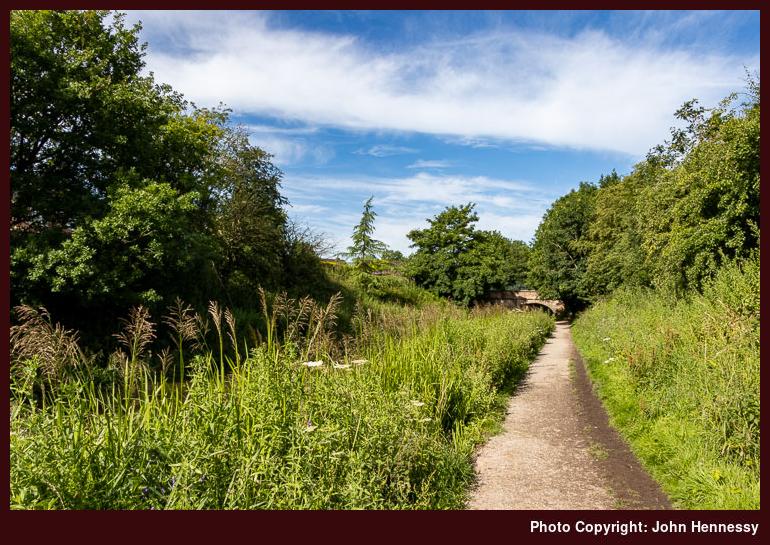
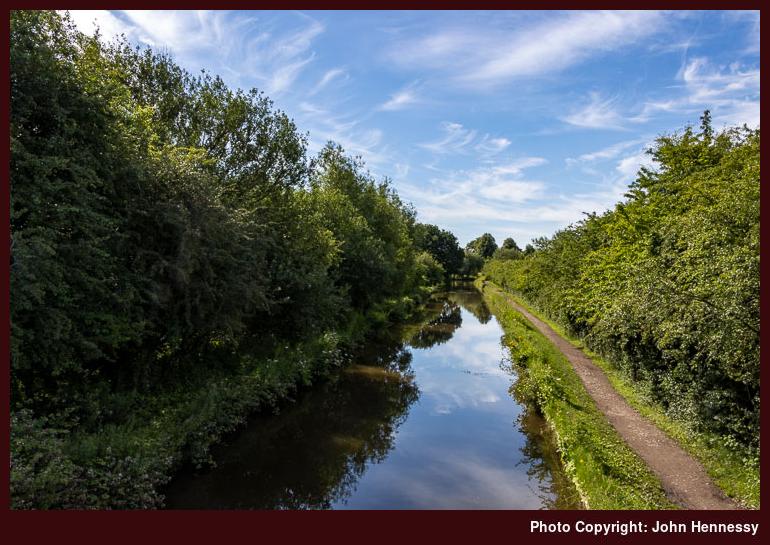
Much like Kidsgrove further south, Congleton also has a train station beside the Macclesfield Canal. By going by train there, I also had saved myself an uphill schlep from its town centre. The photos above show an unpeopled canal towpath, but that is not how I remember it. Disquiet about the pandemic had me recording that it was a little busier than I might have liked. The weather was such that others were lured out for walking, jogging and cycling; the temptation was not mine alone.
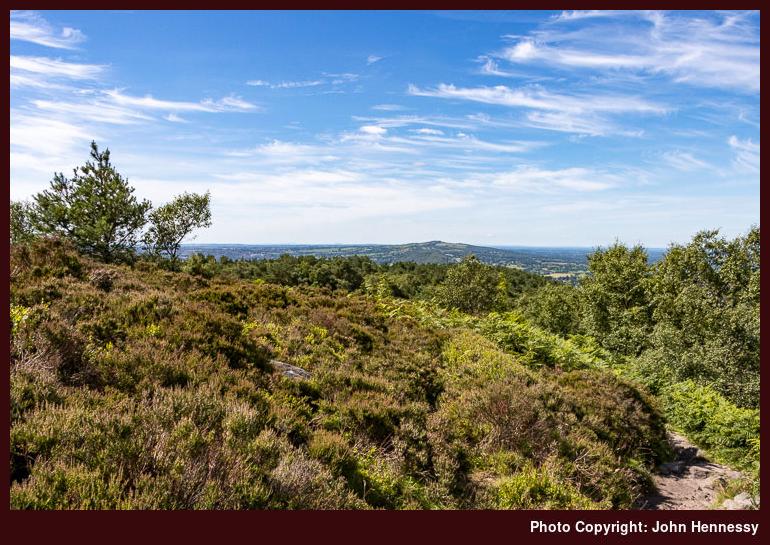
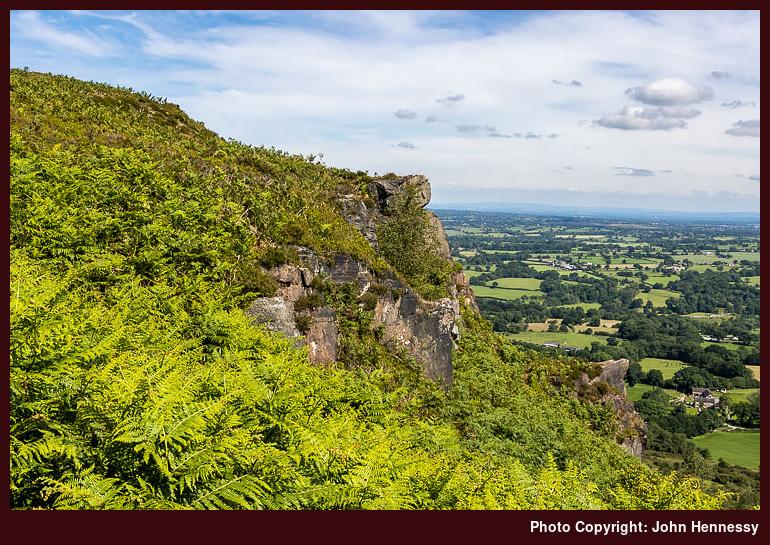
Leaving the canal might have brought me onto quieter paths, but I was never without sharing the space with others at times. Nevertheless, there were an ample number of occasions when solitude could work its magic. All the while, I was bound for The Cloud. A stretch of level field crossing was replaced by an ascent that tested wearied limbs. That the summit was occupied should have been no surprise to me. The sunshine and preceding restrictions would have led to that outcome. Everyone needed a break after the weeks of lockdown, and this was one location where that could happen.
Quite what turned me from my original plan is somewhat lost to me. The quality of the day's weather surely must have had something to do with it, as would my sensing any extra strength in my legs. There also was my having more company than I felt comfortable having in those times. Taking to the Gritstone Trail quickly alleviated the latter.
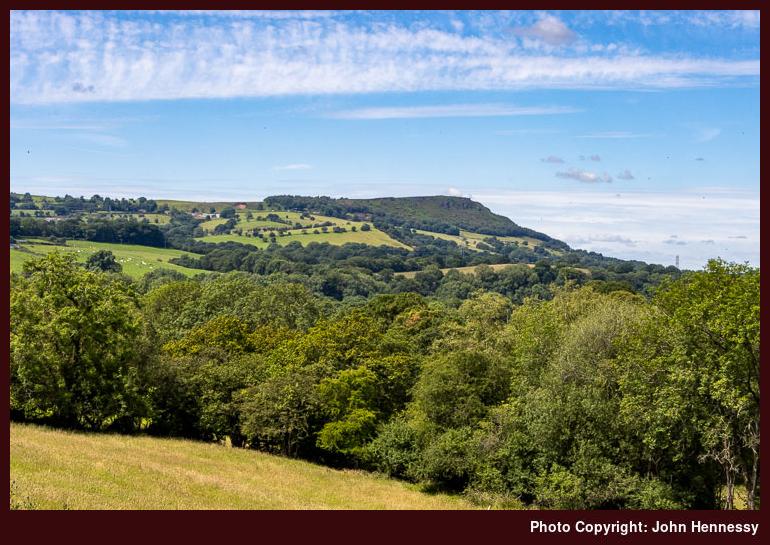
Any quietness that there was along the Gritstone Trail between The Cloud and the A523 really mattered near Cloudwood End Farm and Raven's Clough, where the trail narrowed to a shaded single track path. Beyond that, everything broadened as fields were crossed beside the River Dane. By this stage, my course was shared by the Dane Valley Way and the Staffordshire Way. Sometimes, long-distance trails overlap each other.
Once across the A523, crossing a field led me to the muddiest part of the hike: a towpath shadowing a conduit that was greening over in places. The water looked as if it were anything but moving. Others passing the way stayed in the nearby fields to avoid the conditions underfoot. Having boots meant that I stuck with the right of way instead, thus staying legal.
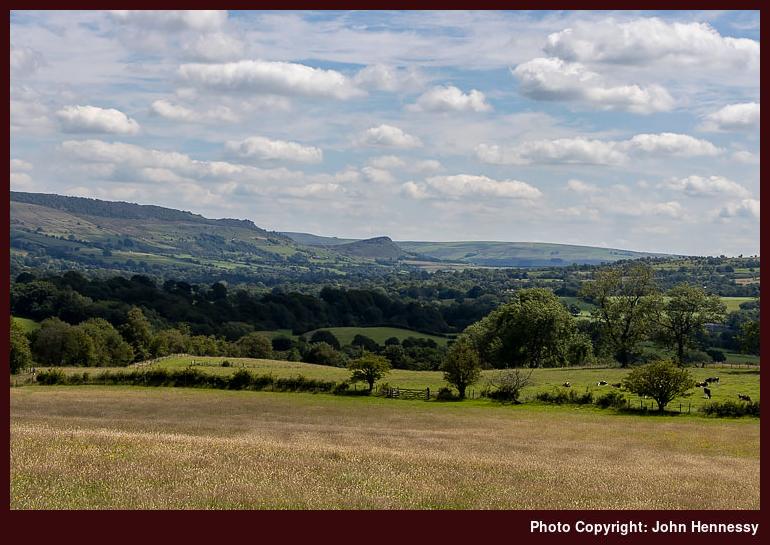
Leaving the conduit, I crossed the River Dane by means of Barleigh Ford Bridge. Beyond this, I encountered more walkers than I had done for a while. This was not so intrusive though and was behind me soon enough. Beyond this, the mind was focussed by the ascent on the way from Dumkins to Hawkslee. It was during that section that views south towards the Roaches began to open out before me.
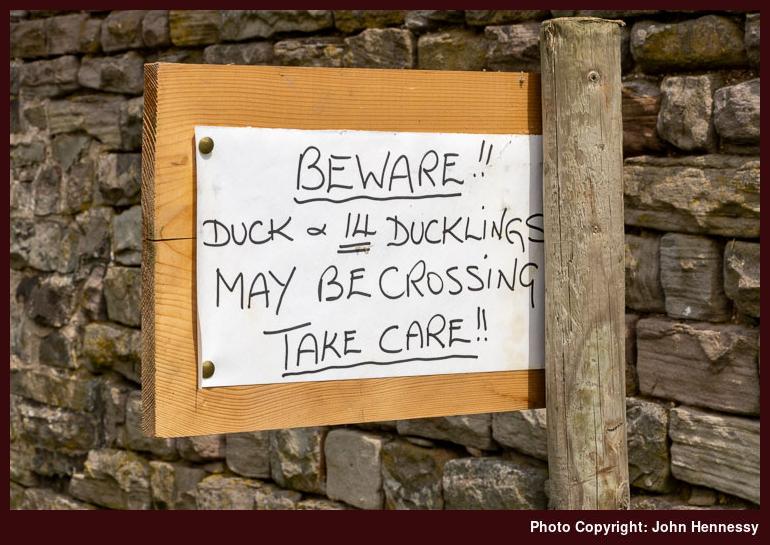
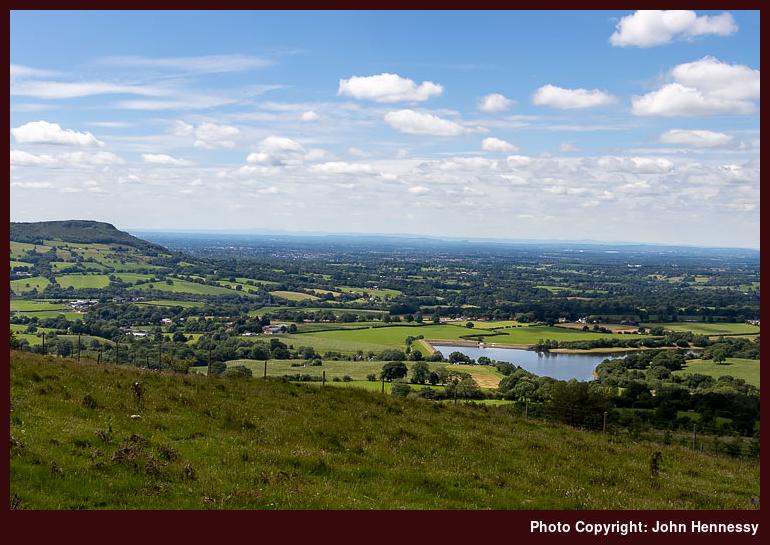
Beyond Hawkslee, I found myself on Minn-End Lane all the way to the A54. A quizzical sign warning about the passage of ducks and ducklings entertained early in the time. Later, as opening views of Croker Hill drew me onward, I also gazed down on Bosley Reservoir and beyond whenever I could. The Cloud was in view too during these westward sightings.
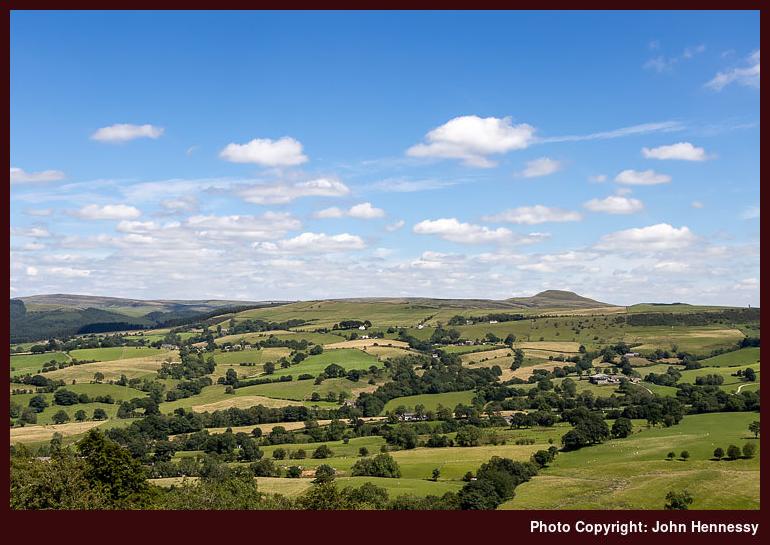
After crossing the A54, the ascent of Croker Hill began, Views eastward towards Shutlingsloe abounded and looking north drew my eyes towards Tegg's Nose. While I do not recall the effects of climbing Croker Hill, fatigue certainly kicked in after that. Even going downhill can have that effect on you, and the descent of Fox Bank to reach Lowerhouse, not far from Rossen Dale, would have been enough for that to happen.
Coaxing was the order of business from there onward, especially as far as Meg Lane, where I was going uphill more than I might have liked. Someone out for a run went past me at one point as I marvelled at his energy. There might have been a certain amount of temptation to stay on Meg lane to reach Sutton after going past Higher Sutton, yet I did not do even that. Thankfully, the way towards Ridgegate Reservoir was easier on my legs than that around by Smallhurst.
Proximity to home helped to provide encouragement too. The way to Clarke Lane is well known to me, as is the way from there through Langley. That may explain the uphill deviation around by Birch Knoll, too. Familiarity can make it easier to mark off progress to reinforce the internal messaging that there is not much further to go. That pull may be even stronger than coaxing, even on the second of two long days of hiking.
Wearied yet sated, I arrived home. Spontaneity had intruded yet again, and for the better. The pandemic onslaught had zeroed things on me, so this was part of a journey of reinstatement that is still ongoing in some ways. Returning to public transport usage and finding those quieter spaces where solitude could be healing became important steps for getting through a disruptive and scary period. Such escapes retained their importance throughout. Simpler pleasures can be so sustaining.
Afterword: A Winter Reprise
Looking through my mini trip reports posted in advance accounts, I notice that there is nothing for 2021. The cause was not that I was distracted with other things, as I had supposed, but a certain lack of variety. In short, I went over old ground rather a lot. It is difficult to find anything to write about a repeated hike. There were some unique strolls like one from Miller's Dale to Castleton and various saunters around Combs Moss near Buxton. Mostly, though, it was a year when much felt as if it was frozen in anticipation rather than moving into novelty.
2022 started in a likewise manner before the South Pennines, the Lake District, Ireland and Scotland returned to the fray for me. Novelty was returning. Before all that, I ended up doing a reprise of the route described here on a crisp day near the start of the year. Restrictions had returned in part, which allowed me to get going outdoors again. The day was less peopled than the one in 2020, partly because of its being a working day and the time of year. Either way, it was a healthy way to get 2022 on the way. The year turned out to be less about repeats than its predecessor.
Travel Arrangements
Train journey from Macclesfield to Congleton with Northern Trains
Older Irish summers
6th September 2024 During the last few years, I have been exploring the country of my birth more than I ever have. This has helped me to bridge a chasm created by moving to Scotland for postgraduate education, and was sustained by my working in England thereafter. In too many ways, this website has its genesis in those early years spent finding my feet in the U.K. and with no roots in the place where I lived before then.
Places to Go
After a summer that took me around many places on the Emerald Isle, it is not before time that I extended the timeline back further. Thus, we reach a time with long summer holidays from school and university. They allowed for many family day trips around the Irish province of Munster.
Coastal destinations featured so much that I began to tire of them. Those in Clare, like Kilkee or Spanish Point, retained their appeal, possibly because we did not go to these so often. Anyway, cliff scenery offers more to the eye than beaches. Maybe, that is why Beale, Ballyheigue or Banna in Kerry were not a major draw for me. Ballybunion got visited too often for me, though I went back there once in 2023.
Historical interest pervaded too. A trip to Blarney Castle involved a steep descent made in the belief that we were going the wrong way. The one-way system has changed, so you ascend this way and go down what once was the way up. Lough Gur was another calling point, along with other places that lay outside the consciousness of most, like Springfield Castle, for instance.
Touring
Where there is ruggedness and a chance to stretch my legs, the appeal never wanes. That started off in those years, and got repurposed in Scotland and England before I headed into Wales and other places. Killarney was favoured then, as it is now. Gougane Barra was another, even if current public transport provision is insufficient for getting back there now. Other destinations included the Ballyhoura Mountains, the Glen of Aherlow and Mount Melleray Abbey.
Touring by car was favoured by my father more than self-powered travel. Lack of patience for walking was part of this, as much as the need to return home for evening farm work. Even so, there were some epics, like a 180-mile circuit from home that got us around the Ring of Beara on a day trip. Others include a round that took us through the Black Valley and the Gap of Dunloe. The Healy Pass was another favoured route on the Beara peninsula. The trouble with all this driving was that you scarcely got time for a lunch stop, let alone a break for stretching your legs. It often felt as if you were skimming the landscape; getting out on foot ensures a much deeper experience.
Local Explorations
At the time, it was cycling that did that for me. Over the course of the summer, this started with short circuits to build up fitness before lengthening them. The later times for sunset in Ireland allowed more time for those evening bike rides, especially in August. The earlier sunsets in September curtailed such escapades during my university years. The outcome was that I cycled through many of the local towns and villages at some stage. Roads in various states of repair were endured, and I paid numerous visits to an aunt, too. Dry weather was seen as best for all of these, though rainwear allowed for travel in the rain as well.
The first bike that took me out on these circuits was an elderly item without much braking power. That was resolved by my putting my feet on the ground, a habit that resulted in a somersault when a saddle broke under me. That mishap put paid to a visit to my aunt for that evening. The lack of braking efficiency possibly left a mark on my psyche that continues to this day, a lack of trust in bicycle brakes that causes me not to let go of the brakes when going downhill, hardly the best at times when there are other road users going their way.
Aside from borrowing a racing bicycle at times, the other bike used on these travels was a one acquired new at the end of the first summer. This had three speed gearing and much better brakes. Others probably preferred my having something safer to use. However, there was one other hazard that it did nothing to avoid: dogs at the hour of dusk. One nipped me while returning from my aunt's, ensuring a visit to the family doctor for a tetanus booster. Wariness around dogs still remains with me.
Rupture and Restoration
Most of this was left after me when I moved to Scotland. It took until the last Christmas when we were all together for me to realise that. Other things occupied my life after that, yet there were occasions of reconnection. Ambiences stay with me, and one from six years ago is one of them. That was a week when I was staying at the old family home and savouring the long summer evenings at the time. The sense of calm of an evening while at the back of the house remains with me. In some ways, it may have taken my mind back to years before.
Two years ago, the inspiration for various explorations of the Irish countryside came from those years while living full-time in Ireland. Killarney and West Cork were among these. The Clare Glens between Newport and Murroe also covered ground from that time. The retracing of steps did nothing to stop me from going to Galway and Connemara (a 2018 outing), the Sheep's Head peninsula, Cahir, Clonmel, Clogheen or Killaloe, new places for me. Still, the list of repeat visits lengthens: the Dingle peninsula, Mount Melleray Abbey, Cashel, Blarney, Cobh, Fota, Bunratty, Doneraile and the Ballyhoura Mountains.
Even with a list that suggests a constant going over of old ground, there are new experiences that change how things feel to me. That all adds up. The accumulation means that you start to take ownership of things in a way that you could not do before. These are not just places where your parents took you; they become yours, too.
One thing that has struck me repeatedly in recent months: there is also something about hearing music from another time that sends you back there. Even so, you now look at things with different eyes and understand them in different ways. The occasions can be prompted by something like the playlist during a hotel stay in Tralee or what is played on a radio station. Even looking up a tune on a streaming service has a similar effect, restoring old connections in the process. It helps if you encounter these in an environment that is not so far removed from the time to which you are being transported. The result can be a melding of time that closes gaps, and mends ruptures in this way.
The closing of gaps has been a recurring theme during the last few years, and it is something that continues. Nevertheless, there is much more to Ireland than all this. The acquisition of a new base to use may mean more visits and the spending of more time there. With that, explorations can go even deeper than they already have. The experience of exploring other parts of the world can be brought home.
Some experiences of Irish hiking maps
5th September 2024 Much of my hiking has been in England, Scotland and Wales, where I have been rather spoiled by the quality of Ordnance Survey mapping. Things are quite different in Ireland, though the mapping offered here is nowhere as difficult to use as in other places where I have been.
The Standard Option
My go-to scale in OS mapping is 1:25000, while 1:50000 is the most common one offered by Tailte Éireann (formerly Ordnance Survey Ireland or OSi). That makes a difference when estimating distances on a ready reckoning basis. The smaller scale makes it easier to underestimate the length of a trail, and hence the amount of time that it will take to complete. With a need to make a bus back from a day hike, that can be a challenge, but one that is eased by doing things more rigorously in advance. Adding extra slack on the day will help too.
Another habit into which I have fallen is to look at a map to see what trails are available. This again is something that Tailte Éireann could improve. One absence is the lack of Greenway depiction; often, you get the disused railway line, which is a hint, but marking the recreational trail would be even better. While someone has put together a web app to show where Greenways are, having something more official would be better and may have more staying power than a volunteer effort.
It may have something to do with publishing schedules, but not all looped walks may get marked. That is what I founded with the Fastnet Trails around Schull and Ballydehob. At least, there is a website for those. Even so, having more of them marked on a map would help even more. Nevertheless, some are marked already, so some credit is due.
The same could not be said so emphatically for the trails around Mount Melleray Abbey near Cappoquin and Lismore in County Waterford. That might have helped me avoid some rough cross-country travel on a day hike around there that ruined a hiking trousers on me. Saint Declan's Way is completely absent too, so I ended up loading a GPX track onto Outdooractive for future reference. Since this goes from Ardmore to Cashel and through the Knockmealdown Mountains, it could offer hiking possibilities for another time.
Alternative Options
Following the aforementioned escapade, curiosity had me explore what is offered by EastWest mapping these days. They still cover the Wicklow and Dublin Mountains like they always have, and Wild Nephin is another area that they have covered for many years, but other ones are included now.
Parts of Munster now benefit, and the range includes the Knockmealdown Mountains, the Galtee Mountains and the Comeragh Mountains, not always ones that you hear much about when it comes to Irish hillwalking. The county of Cork is absent thus far, while the mountains of Kerry around Killarney and Dingle gain deserved coverage. In Connemara, there is a guide to the Western Way between Oughterard and Westport, along with maps of Connemara, Mweelrea and Croagh Patrick, and Achill and Corraun with Clare Island.
While I do have a Wicklow Mountains map in my collection, I have added one for Knockmealdown Mountains. Like many others in the range, it has a scale of 1:25000, which is more like what I find in Great Britain (Northern Irish mapping is much like what you find in the Republic). Those missing trails from the Tailte Éireann maps are noted too. Should a return to those parts come to pass, the new map will have its uses.
All in all, EastWest is on its way to becoming Ireland's answer to Harvey Maps in Scotland. That operation does not abandon Ireland, either. In fact, it offers two more than it once did: Dingle Peninsula and the Mourne Mountains. They complement longstanding coverage of the Wicklow Mountains, MacGillycuddy's Reeks and Connemara. Most are 1:30000, with the Mourne Mountains getting 1:25000 coverage.
What About Digital?
Much of the discussion here would apply to paper maps, yet I often use the Outdooractive app these days. That is equipped with maps from both Tailte Éireann and Harvey Maps. If I were to do the same for EastWest Mapping, I would need the Hiiker app. Since I plan to stick with what I have for now, I will leave the addition of another app until later. Even so, mixing information from different sources only helps when plying the trails, boreens, and ancient paths that criss-cross the Emerald Isle. Having a paper map and compass to complement digital tooling remains essential too. My Irish explorations may be facing a hiatus for numerous reasons, yet there is so much more to explore.


